 2017, Vol. 36


2. 中国科学院广州地球化学研究所, 同位素地球化学国家重点实验室, 广州 510640
2. State Key Laboratory of Isotope Geochemistry, Guangzhou Institute of Geochemistry, Chinese Academy of Sciences, Guangzhou 510640, China
中亚造山带(Central Asian Orogenic Belt)又称阿尔泰型造山带(Altaids),位于西伯利亚和华北-塔里木克拉通之间,是全球最大的显生宙增生型造山带之一,由不同时代的岩浆弧、岛弧增生楔、海山、蛇绿混杂岩及微陆块等地体相继拼贴形成(Yakubchuk,2002; Xiao et al., 2003, 2004; Helo et al., 2006; Kröner et al., 2013)。中亚造山带的演化自新元古代早期开始(~ 1.0 Ga)到二叠纪结束(~ 250 Ma),经历了长达七亿多年的复杂演化过程(Xiao et al., 2003),其形成与古亚洲洋的长期俯冲增生作用密不可分(Khain et al., 2003; Windley et al., 2007)。对于中亚造山带的形成机制,存在3种不同的观点:单一岛弧俯冲模式(Şengör et al., 1993; Sengör and Natal'in,1996)、多岛弧俯冲模式(Yakubchuk, 2002, 2004)和类似西太平洋的多岛洋模式(Buslov et al., 2001; Badarch et al., 2002; Khain et al., 2003; Windley et al., 2007; Xiao et al., 2015)。尽管目前越来越多的学者倾向接受类似西太平洋的多岛洋模式,但对于造山带内部不同块体的属性及其演化过程还存在不同认识(Xiao et al., 2004, 2015; Windley et al., 2007; Wilhem et al., 2012; Kröner et al., 2013)。
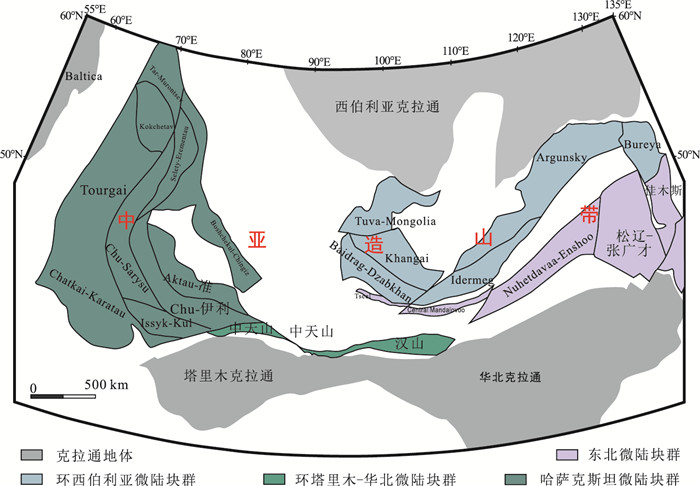
在中亚造山带内,众多微陆块是中亚造山带的一大地质特征,如中国新疆境内的伊犁地块、中天山地块和蒙古境内的图瓦-蒙古地块(Windley et al., 2007; Wilhem et al., 2012; Kröner et al., 2013; Xiao et al., 2015)(图 1)。对于中亚造山带内前寒武纪微陆块的来源,目前存在两种截然不同的认识:一种观点认为这些微陆块裂解自北半球的西伯利亚(Siberia)和波罗的海(Baltica)古陆,之后向北拼贴(Sengör and Natal'in,1996; Yakubchuk,2004; Turkina et al., 2007);另一种观点则认为这些微陆块是裂解自南半球的冈瓦纳(Gondwana)古陆,随古亚洲洋的演化拼贴增生至西伯利亚和波罗的海古陆的边缘(Mossakovsky et al., 1994; Dobretsov et al., 2003; Kheraskova et al., 2003; Windley et al., 2007; Biske and Seltmann, 2010)。最近,一些学者相继提出塔里木克拉通也可能是中亚造山带内微陆块的一个重要来源(Levashova et al., 2011; Ma et al., 2013; Liu et al., 2014; Wang et al., 2014c)。由于缺乏系统的中亚造山带内部不同微陆块的物质来源和地质演化对比研究,相关微陆块的构造亲缘性争论已经阻碍了古亚洲洋演化历史和中亚造山带构造演化模式的恢复。
|
图件修改自:Wilhem等(2012) 图 1 中亚造山带微陆块分布图 Figure 1 Distribution map of microcontinents in the Central Asian Orogenic Belt |
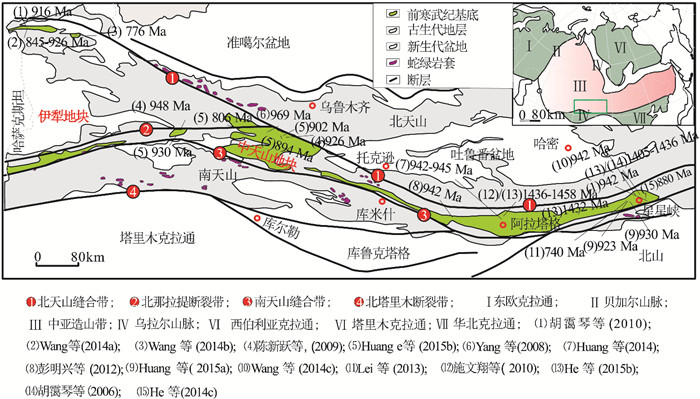
中国天山造山带位于中亚造山带的南部,其南北两侧分别为塔里木克拉通和准噶尔盆地,东西展布上千米,是揭示中亚造山带构造演化的关键地区(图 2)(Gao et al., 1998, 2009; Qian et al., 2009)。伊犁地块和中天山地块作为中国天山造山带内的两个具有前寒武纪基底的微陆块,为探讨中亚造山带南部早期地质演化和造山带内微陆块的构造起源提供了研究载体。
|
图件据Gao等(2009); Huang等(2015a, 2015b)修改;嵌入图为中亚造山带简略图 图 2 天山地质简略图 Figure 2 Sketch map of the Chinese Tianshan Block with an inserting figure of a simplified map of the Central Asian Orogenic Belt |
伊犁地块位于西天山(肖序常等,1992; 胡霭琴等,1997; 朱志新等,2011),东南紧邻中天山地块和塔里木克拉通,北与西准噶尔地体接壤,向西延伸进入哈萨克斯坦(Allen et al., 1993; Hu et al., 2000; Wang et al., 2006, 2011)。早期区域地质资料显示,伊犁地块前寒武纪地质体主要由古元古代温泉群变质岩、中元古代长城-蓟县纪浅变质碎屑岩和碳酸盐岩,以及一些元古宙片麻状花岗岩类组成(新疆维吾尔自治区地质矿产局,1993)。其中,温泉群主要由片麻岩、片岩、大理岩、角闪岩和石英岩等组成,其原岩以碎屑岩和碳酸盐岩为主(《中国地层典》编委会,1996)。该套岩系出露于伊犁地块北缘的温泉地区,向西延伸到哈萨克斯坦境内,并被作为天山古老基底的重要组成部分(Allen et al., 1993; Gao et al., 1998; Hu et al., 2000; Wang et al., 2007, 2014a, 2014b)。
2.1 伊犁地块基底的形成时间有关伊犁地块最古老地质体(温泉群)的岩石组合特征早已厘定,但对于该地块的基底形成时代却长期存在争议。20世纪90年代初期,众多学者认为伊犁地块温泉群中的片麻岩主要形成于太古代和古元古代(新疆维吾尔自治区地质矿产局,1993)。近年来的一些研究发现,原温泉群中混杂有大量的强烈变形的中酸性及少量基性侵入体(胡霭琴等, 2008, 2006b; Wang et al., 2011; Huang et al., 2013)。胡霭琴等(1997)首次对原温泉群进行了系统研究,指出其中的角闪岩、斜长角闪岩、石英云母片岩和眼球状片麻岩为正变质岩,其原岩主要为基性或酸性火山岩和花岗岩,系遭受了绿片岩相-角闪岩相的变质作用,有强烈的韧性变形。其后胡霭琴等(2006, 2008)所做的锆石SHRIMP U-Pb定年结果显示,原温泉群中的眼球状片麻岩形成于新元古代早期(919 Ma),其中的变辉长岩形成于早古生代(~ 455 Ma)。Wang等(2014a)对原温泉群中眼球状片麻岩和混合岩中的浅色体的锆石年代学研究也获得了近似年龄(909 Ma和908~926 Ma)。此外,Wang等(2012)对原温泉群中的弱变形闪长岩和其中的辉长岩包体的锆石SHRIMP U-Pb定年结果也得到了早古生代的成岩年龄(447~466 Ma)。笔者最近获得的年代学数据显示温泉地区1 ︰ 20万地质图中的元古宙中-酸性侵入体多形成于晚奥陶世(445~465 Ma)(Huang et al., 2013)。综上说明,原温泉群中的中酸性侵入体主要形成于新元古代早期(926~798 Ma)和晚奥陶世,变辉长岩主要形成于晚奥陶世(450~462 Ma),揭示伊犁地块的结晶基底形成时代并非前人所认为的太古代和古元古代。
最近,Huang等(2016)和Liu等(2014)的碎屑锆石研究也表明,伊犁地块温泉群浅变质碎屑沉积岩主要沉积于新元古代。值得一提的是,在新元古代的碎屑沉积岩中存在少量的2.5~1.8 Ga碎屑锆石记录(Liu et al., 2014; He et al., 2015a; Huang et al., 2016)。虽然2.5~1.8 Ga的碎屑锆石在邻区塔里木克拉通、西伯利亚克拉通和华北克拉通均有大量发现(Zhai,2004; Powerman et al., 2015; He et al., 2015a),但在伊犁地块的温泉群碎屑岩中仅发现少量大于2.5 Ga的古老碎屑锆石,且具有他形特征。古元古代到中元古代的碎屑锆石具有自形到半自形特征,揭示这些碎屑锆石具有近源沉积的特点(Liu et al., 2014; He et al., 2015a; Huang et al., 2016)。这些锆石形态说明,2.5~1.6 Ga的碎屑锆石可能来自伊犁地块自身或者相对较近的物质源区,伊犁地块可能存在古元古代的基底(Liu et al., 2014; He et al., 2015a; Huang et al., 2016)。伊犁地块新元古代片麻岩Nd模式年龄主要集中在2.0~1.6 Ga(Wang et al., 2014a),也支持伊犁地块存在古元古代基底。近期笔者在伊犁地块温泉地区发现的中元古代花岗质片麻岩(1.3~0.99 Ga,未发表数据),显示伊犁地块的古陆核可能在中元古代已经开始形成。
2.2 伊犁地块前寒武纪地壳演化虽然火成岩的同位素特征能够揭示前寒武纪大陆地壳的演化过程,但是有限的露头使得伊犁地块前寒武纪地质演化研究程度相对比较低。相比之下,沉积岩中的碎屑锆石及其Hf同位素是研究伊犁地块前寒武纪地质演化的重要手段。
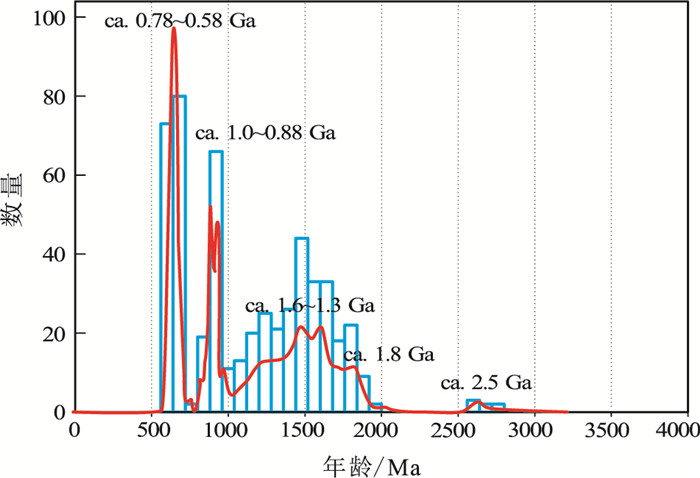
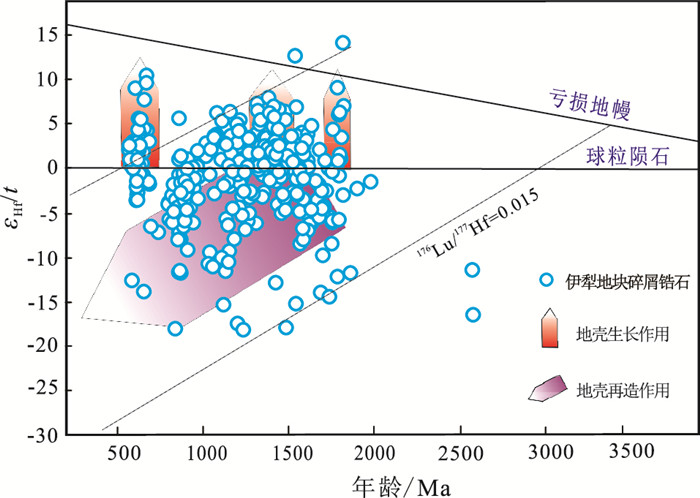
最近笔者及其他一些学者的研究表明(图 3),伊犁地块前寒武纪碎屑沉积岩中的碎屑锆石年龄主要集中于1.6~1.3 Ga,1.0~0.88 Ga,0.78~0.58 Ga和少量在2.5~1.7 Ga(Liu et al., 2014; He et al., 2015a; Huang et al., 2016)。除了少量的2.5~1.7 Ga的年龄,该时期碎屑锆石年龄主要集中在1.8~1.7 Ga,且具有相对自形到半自形的特征,部分显示相对亏损锆石Hf同位素特点(图 4),说明作为物质源区的古元古代的岩浆作用中有一定量新生地壳物质的加入,揭示了一期重要的大陆地壳生长事件。与此同时,部分1.8~1.7 Ga碎屑锆石的Hf同位素呈现富集的特点(图 4),揭示伊犁地块在该时期可能同样也发生大陆地壳的改造作用。与此类似,中元古代的碎屑锆石(1.6~1.3 Ga)也具有大量亏损的锆石Hf特征,表明伊犁地块在中元古代发生了另一期地壳生长事件。这些古元古代和中元古代的碎屑锆石Hf同位素构成了伊犁地块早期的大陆地壳演化曲线(图 4)。因为中元古代晚期和新元古代的碎屑锆石Hf同位素沿该地壳演化趋势线变化,所以认为伊犁地块在中元古代晚期到新元古代的漫长时期(1.3~0.78 Ga),大陆地壳主要以改造作用为主,缺少明显的地壳生长。而到了新元古代晚期(ca. 0.58 Ga),碎屑锆石呈现强烈亏损的Hf同位素特征(图 4),表明伊犁地块的大陆地壳在这一时期有非常显著的新生地壳物质的加入,指示伊犁地块在新元古代晚期发生了一次比较强烈的地壳生长作用。
|
图中数据来源: He等(2015a); Huang等(2016) 图 3 伊犁地块新元古代沉积岩碎屑锆石年龄频谱分布图 Figure 3 Histogram of U-Pb ages of detrital zircons from the Neoproterozoic sediments in Yili Block |
|
图中数据来源: He等(2015a),Huang等(2016) 图 4 伊犁地块碎屑锆石Hf同位素特征 Figure 4 Diagram of εHf(t)values vs. ages of detrital zircon grains in the Yili Block |
笔者对伊犁地块已有的岩浆岩年代学研究数据统计结果表明,伊犁地块前寒武纪的岩浆作用主要发生在3个阶段:~ 1.3 Ga,0.93~0.85 Ga和~ 0.76 Ga。伊犁地块现今发现的最早期岩浆作用发生于~ 1.3 Ga,对应的岩浆记录主要为一套长英质正片麻岩(未发表数据),遭受了角闪岩相变质。这些现今发现的最古老花岗质岩石,可能意味着伊犁地块古老陆核的真正形成。新元古代早期的岩浆记录(0.93~0.85 Ga)主要为花岗质片麻岩和眼球状片麻岩,混合岩和S-型花岗岩以及浅色脉体。伊犁地块的0.93~0.91 Ga花岗质片麻岩和眼球状片麻岩普遍发生了糜棱岩化作用。Wang等(2014a)认为这些新元古代早期的正片麻岩属于S-型花岗岩并显示壳源岩浆岩出特征,同时被新元古代早期的S型花岗岩(0.92~0.86 Ga)和浅色脉体(0.91~0.85 Ga)侵入。伊犁地块这些新元古代早期正片麻岩、S型花岗岩主要为温泉群的变质沉积岩部分熔融形成,伴随混合岩化作用(Wang et al., 2014a)。新元古代早期强烈的部分熔融作用,表明伊犁地块在该时期发生了广泛的地壳再造作用,最终形成统一固结的结晶基底。0.76 Ga的双峰式岩浆作用(以辉长质-闪长岩脉和花岗岩脉为代表)的发育,说明伊犁地块在新元古代中期开始转变为伸展环境,这一伸展环境可能与罗迪尼亚超大陆的裂解有关(Wang et al., 2014b)。
3 中天山地块中天山地块呈狭长的带状东西向展布于天山造山带中部,西边以北那拉提断裂与伊犁地块相邻,南北两侧分别以北天山缝合带和南天山缝合带与北天山构造带和南天山构造带为界(图 2)(Gao et al., 2009)。在中天山地块东部和中部地区,最古老的地质体为星星峡群,主要分布在星星峡到小布鲁斯台之间(新疆维吾尔自治区地质矿产局,1993)。星星峡群整体为一套区域变质岩系,岩性主要为大理岩、片岩、石英岩、变粒岩、片麻岩、混合岩和斜长角闪岩,不同区域岩性组合稍有差异。星星峡上覆为喀瓦布拉克群,分布在喀瓦布拉克山至星星峡一带,主要为一套变质碎屑岩和变质碳酸盐岩。喀瓦布拉克群之上为天湖群,断层接触。天湖群出露在尾亚天湖地区,其下部为片麻岩组成;上部为黑云斜长片麻岩、眼球状混合岩、斜长角闪岩、各类片岩、浅变质砂岩(新疆维吾尔自治区地质矿产局,1993;胡霭琴等,2006a)。
在中天山西部,较为古老的地层为那拉提群、木札尔特群和特克斯群,主要分布在哈尔克山南北坡和那拉提山。那拉提群主要分布在哈尔克山北坡和那拉提山脊一带,主要由混合岩、片麻岩、绿片岩、石英岩和白云质大理岩组成。木札尔特河群分布在哈尔克山南坡木札尔特河一带,其下部为条痕状及眼球状混合岩、黑云斜长片麻岩;上部为绿泥斜长变粒岩、二云母片岩、二云斜长片麻岩,以及未变质的砂质灰岩、细砂岩和粉砂岩。特克斯群则主要分布在特克斯河以南,科克苏河以东的琼喀拉俊山一带,主要岩性为片岩、灰岩、砂岩、石英岩。特克斯群往上则沉积有科克苏群,其与特克斯群连续沉积,主要发育在科克苏河东岸。科克苏群为一套浅变质硅镁质碳酸盐岩夹泥质、钙质、凝灰质粉砂岩及石英岩、灰岩和白云岩并具有叠层石。科克苏群上覆沉积有库什太群,其主要出露在特克斯河以南,科克苏河以东的琼喀俊山一带。该群主要为一套硅镁质的碳酸盐岩夹碎屑岩建筑,含丰富的叠层石和微古化石(新疆维吾尔自治区地质矿产局,1993;胡霭琴等, 1997, 2006b; 陈新跃等,2009)。
3.1 中天山地块基底形成中天山基底的形成时代长期存在争议。胡霭琴等(1997)认为中天山花岗质片麻岩、混合岩和其他高级变质岩主要形成于1.85~1.83 Ga(Sm-Nd等时线年龄),并具有亏损Nd同位素的特征(4.5),因而提出中天山地块基底是大约在1.8 Ga前由壳幔分异作用产生的新生地壳。然而,部分学者的研究发现中天山地块碎屑沉积岩中存在太古代的碎屑物质记录,据此认为中天山地块存在太古代的结晶基底(Ma et al., 2012a, 2012b, 2013)。最近,Wang等(2014d)根据他们在中天山地块发现的具有亏损锆石Hf同位素特征(3.4~9.2)的古元古代早期片麻岩上交点年龄(2.47 Ga)提出,中天山地块存在太古代到古元古代结晶基底。上述争论说明,目前对于中天山地块是否存在太古代和古元古代的结晶基底仍旧没有形成一致的认识。
最近的一些锆石年代学研究工作揭示,中天山地块发育大量的1.4 Ga片麻岩(胡霭琴等,2006a; 施文翔等,2010;He et al., 2015b)。进一步的锆石Hf同位素研究显示,这些中元古代片麻岩具有古元古代的Hf二阶段模式年龄(2.2~1.6 Ga)(He et al., 2015b)。此外,中天山地块同样出露有大量新元古代片麻岩(0.98~0.74 Ga)(Yang et al., 2008; 陈新跃等,2009;胡霭琴等,2010;Lei et al., 2013; He et al., 2014c; Huang et al., 2014, 2015a, 2015b; Wang et al., 2014c, 2014d; Gao et al., 2015; Liu et al., 2015),这些片麻岩也具有古元古代锆石Hf二价段模式年龄(2.2~1.6 Ga)(Lei et al., 2013; He et al., 2014c; Huang et al., 2014, 2015a, 2015b; Wang et al., 2014c; Gao et al., 2015; Liu et al., 2015)。这些一致的二阶段模式年龄表明,中天山地块初始的地壳物质主要形成于古元古代,间接说明中天山地块不可能存在太古代结晶基底。中天山地块广泛出露的中元古代花岗质片麻岩(ca. 1.4 Ga)指示,中天山地块的古老陆核主要形成于中元古代。
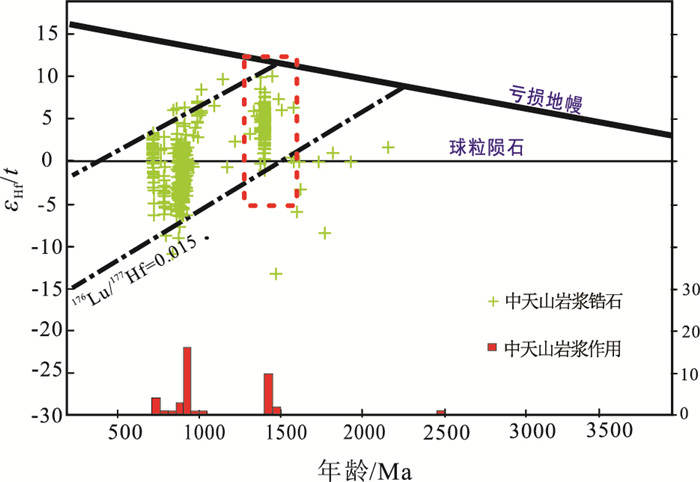
3.2 中天山地块前寒武纪地壳演化近年来随着研究的不断深入,中天山地块前寒武纪地壳演化研究取得一些重要进展。中天山地块主要发育3期岩浆作用,分别集中在1.46~1.40 Ga,0.97~0.88 Ga和0.74~0.71 Ga期间(Yang et al., 2008; 陈新跃等,2009;胡霭琴等,2010;彭明兴等,2012;Lei et al., 2013; Huang et al., 2014, 2015a, 2015b; He et al., 2014c; Wang et al., 2014c, 2014d; Gao et al., 2015; Liu et al., 2015)。第一期的岩浆作用(1.46~1.40 Ga)主要形成了一套片麻状花岗岩,该套花岗岩具有亏损锆石Hf同位素特征(~ 0~8.6)(图 5)(He et al., 2015b),表明中天山地块在中元古代时期经历一期显著的大陆地壳生长事件。由于第二期和第三期岩浆作用所形成的花岗质片麻岩的锆石Hf同位素均落入中元古代锆石所定义的Hf同位素地壳演化区间(图 5),因而说明中天山地块在新元古代早期(0.97~0.88 Ga和0.74~0.71 Ga)大陆地壳以改造作用为主(Huang et al., 2015a),而大陆地壳生长作用并不明显。
|
图上数据引自:Lei等(2013); He等(2014c); Huang等(2014, 2015a, 2015b); Wang等(2014c, 2014d); Liu等(2015); Gao等(2015) 图 5 中天山岩浆岩锆石Hf同位素特征及其岩浆作用 Figure 5 Diagram of εHf(t)values versus ages of magmatic zircon grains in the Chinese Central Tianshan Block and those of magmatic events |
值得一提的是,最近有报道指出在中天山地块西部存在古元古代岩石记录(2.46 Ga)(Wang et al., 2014d)。然而,该年龄为上交点且其寄主岩石经历了强烈的变质作用,所以这一年龄的地质意义值得商榷。笔者最近统计的年代学研究结果显示,中天山地块东部广泛分布的中元古代片麻状花岗岩(1.46~1.40 Ga)可能代表了中天山地块最古老的岩石记录,直接说明中天山地块的古老陆核形成于中元古代(Huang et al., 2015a)。此后,古老的变质沉积岩发生深熔作用形成大量新元古代的过铝质花岗岩(0.97~0.88 Ga),并发生强烈变质、变形作用,表明中天山地块的结晶基底主要在新元古代发生固结(Huang et al., 2015a)。在新元古代晚期,近来发现的双峰式火山岩(0.74~0.71 Ga)揭示,中天山地块在新元古代中期开始处于大陆伸展环境(Lei et al., 2013; Wang et al., 2014d; Gao et al., 2015)。
4 伊犁地块与中天山地块的亲缘性伊犁地块和中天山地块是否具有亲缘性一直是中亚造山带南部研究的一个重要问题。一些学者认为,伊犁地块和中天山地块具有亲缘性,来源于同一个古老大陆(Allen et al., 1993; Qian et al., 2009; Liu et al., 2014)。然而,另一部分学者则提出中天山地块是一个独立的微陆块,与伊犁地块不具有亲缘性(Hu et al., 2000; 刘树文等,2004; 李秋根等,2009)。
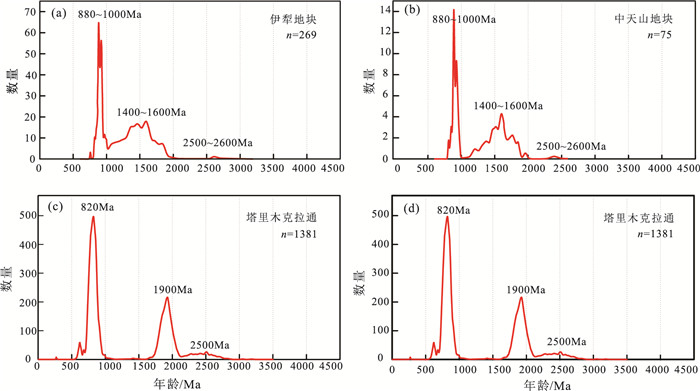
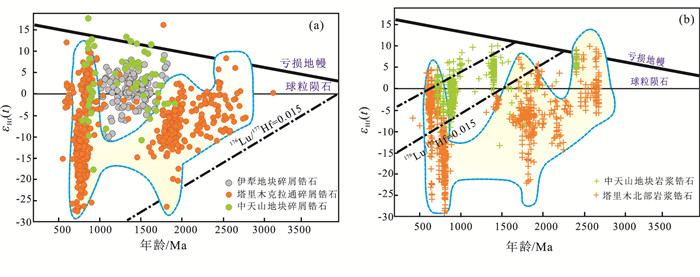
最近,笔者(Huang et al., 2015a, 2016)和Liu等(2014)的研究表明,伊犁地块和中天山地块具有亲缘性,可能经历了相同的前寒武纪地质演化过程,主要证据如下:(1)伊犁地块和中天山地块同时期或接近同时期沉积的碎屑沉积岩具有一致的碎屑锆石年龄频谱分布图,峰值主要为1.6~1.4 Ga和1.0~0.88 Ga(图 6a、6b),表明二者在新元古代具有一致的物质源区特征。(2)伊犁地块和中天山地块同时期碎屑锆石具有一致的锆石Hf同位素特征(图 7a),这些特征进一步表明伊犁地块和中天山地块的新元古代碎屑物质可能来源于相同的大陆块体。(3)伊犁地块和中天山地块同时还具有相似的前寒武纪岩石组合,如花岗质片麻岩、混合岩、斜长角闪岩、石英岩、砂岩、大理岩、灰岩和片岩(新疆维吾尔自治区地质矿产局,1993; Gao et al., 1998, 2009; Shu et al., 2004; 胡霭琴等,2008; 陈新跃等,2009; Xiao et al., 2010)。(4)伊犁地块和中天山地块前寒武纪岩浆作用峰期完全可以对比,这些前寒武纪岩浆作用主要集中在ca. 1.4~1.3 Ga、0.97~0.85 Ga和ca. 0.76~0.71 Ga期间(Yang et al., 2008; 陈新跃等,2009;胡霭琴等,2010;彭明兴等,2012;Lei et al., 2013; He et al., 2014c; Huang et al., 2014, 2015a, 2015b; Wang et al., 2014a, 2014b, 2014c, 2014d; Gao et al., 2015; Liu et al., 2015)。此外,伊犁地块和中天山地块的新元古代早期的岩浆岩(1.0~0.88 Ga)都由变质沉积岩部分熔融形成,并显示出相同的源区组成特征,表明中天山和伊犁地块在新元古代早期可能处于相同的构造环境(Huang et al., 2014, 2015a, 2015b; Wang et al., 2014a)。(5)伊犁地块和中天山地块在新元古代早期(0.9 Ga)经历了相同的深熔作用和中新元古代的裂解事件(ca. 0.76~0.71 Ga)(Wang et al., 2014a, 2014b; Gao et al., 2015; Huang et al., 2015)。(6)伊犁地块和中天山地块均经历了中元古代陆核的形成和大陆地壳的生长,此后以大陆地壳的改造作用为主。
|
图中数据来源:Zhu等(2011); He等(2014a, 2014b, 2014c); Powerman等(2015); Huang等(2016) 图 6 伊犁地块、中天山地块、西伯利亚克拉通、华北克拉通和塔里木克拉通前寒武纪碎屑锆石频谱分布图 Figure 6 Distribution diagrams of ages of Precambrian detrital zircons from the Yili Block, Chinese Central Tianshan Block, Siberian Craton, North China Craton, and the Tarim Craton |
|
数据来源:(a) He等(2014a, 2014b, 2014c); Huang等(2016);(b) Long等(2010, 2011a, 2011b, 2012); Ge等(2012, 2013, 2014a, 2014b); Lei等(2012); Zhang等(2012b); He等(2013, 2015b); Lin等(2013); Ye等(2013); Huang等(2014, 2015a, 2015b); Wu等(2014); Wang等(2014d); Liu等(2015); Gao等(2015) 图 7 (a) 伊犁地块、中天山地块和塔里木克拉通碎屑锆石Hf同位素特征;(b) 中天山地块和塔里木克拉通岩浆锆石Hf同位素特征 Figure 7 (a) Diagram of εHf(t) values vs. ages of detrital zircons from the Yili Block, Chinese Central Tianshan Block, and Tarim Craton; (b) Diagram of εHf(t) values vs. ages of magmatic zircons from the Chinese Central Tianshan Block and the Tarim Craton |
一些资料显示,伊犁地块和中天山地块具有亲缘性,同属一个古老大陆块体,但对于这个古老大陆的起源认识存争议,其焦点是伊犁地块和中天山地块是否来源于塔里木克拉通。Liu等(2014)和Ma等(2012a, 2012b)通过碎屑锆石研究认为二者都是塔里木克拉通的一部分。然而,一些学者基于碎屑锆石研究,并结合岩浆岩研究,认为塔里木克拉通不是这两个地块的来源(Wang et al., 2014a, 2014b; He et al., 2015b)。对于这些碎屑锆石,之所以得出不同认识,主要是因为没有选取同时期或近同时期沉积的碎屑沉积岩进行对比。
笔者对比研究了伊犁地块与塔里木克拉通同时期碎屑沉积岩,发现二者具有不同的碎屑锆石年龄频谱分布(图 6a、6c)(Huang et al., 2016)。塔里木克拉通具有明显的2.5 Ga和2.0 Ga年龄峰值,而该峰值未见于伊犁地块(图 6a、6b);伊犁地块具有明显的1.6~1.4 Ga碎屑锆石峰值,塔里木克拉通却缺少该时期碎屑锆石记录(图 6c)。此外,伊犁地块与塔里木克拉通同时期的碎屑锆石显示不同的锆石Hf特征(图 7a),表明伊犁地块与塔里木克拉通具有不一致的物质源区记录。如图 7所示,塔里木克拉通的碎屑锆石和岩浆岩中的锆石Hf同位素组成特征非常相似,构成了类似的地壳演化趋势(橙色阴影部分)。如果伊犁地块是新元古代之后从塔里木克拉通裂解出来,那么伊犁地块新元古代碎屑锆石应该记录有塔里木克拉通特征的Hf同位素组成。然而,伊犁地块1.8~1.0 Ga碎屑锆石并没有落入该趋势范围(图 7a),表明伊犁地块不可能是从塔里木克拉通裂解出来的微陆块。伊犁地块记录有显著的1.6~1.3 Ga的地壳生长作用(图 4),而在塔里木克拉通在该时期则以大陆地壳改造作用为主(He et al., 2014a, 2014b)。同时,伊犁地块碎屑锆石Hf模式年龄(3.2~1.5 Ga)较塔里木克拉通的(3.9~2.4 Ga)年轻。这些差异说明伊犁地块碎屑物质的物质源区不是塔里木克拉通(Huang et al., 2016),即伊犁地块不可能来源于塔里木克拉通。
中天山地块和塔里木克拉通也具有不同的碎屑锆石年龄频谱特征(图 6b、6c)。在中天山地块,新元古代地层中的碎屑锆石年龄主要集中在1.6~1.4 Ga,而在塔里木克拉通则集中于2.5 Ga和1.9 Ga。同样,中天山地块和塔里木克拉通的碎屑锆石也呈现出不一致的Hf同位素特征(图 7a),表明中天山地块的物质源区并非塔里木克拉通。此外,中天山地块的前寒武纪岩浆岩活动峰期及其锆石Hf同位素特征明显区别于塔里木克拉通,可能成因为:①中天山陆块来自塔里木克拉通,但其岩浆岩形成过程中受到新生物质的影响而使得锆石Hf同位素偏离塔里木克拉通地壳演化趋势;②中天山陆块的起源并非塔里木克拉通。最近,Huang等(2014, 2015a, 2015b)对中天山新元古代花岗质片麻岩研究表明,该套片麻岩主要通过早期变质沉积岩部分熔融形成,但源区缺少太古代碎屑物质。与此相反,塔里木克拉通却发育大量古元古代-太古代的基底物质(Long et al., 2010, 2011a, 2011b; Zhang et al., 2012b; Lei et al., 2012; He et al., 2013; Ge et al., 2013, 2014b; Wu et al., 2014)(图 7)。此外,相比塔里木克拉通古老的岩浆岩锆石Hf模式年龄(3.6~1.3 Ga),中天山地块的前寒武纪岩浆岩具有相对年轻的锆石Hf模式年龄(2.5~1.6 Ga),也说明中天山地块早期地壳物质的形成比塔里木克拉通明显年轻(Huang et al., 2015a)(图 7)。因此,中天山地块和塔里木克拉通也具有不同的前寒武纪大陆地壳演化特征,说明中天山地块也不是起源于塔里木克拉通的。
综上可知,伊犁地块和中天山地块的早期演化不同于塔里木克拉通,说明这两个地块在新元古代时期可能不是塔里木克拉通的组成部分。
6 伊犁地块和中天山地块的构造起源作为中亚造山带南部两个典型的微陆块,伊犁和中天山地块为探讨中亚造山带内众多的微陆块的构造起源提供可靠的证据,同时对恢复中亚造山带的演化历史和构建古地理格局也具有重要意义。尽管前人多认为伊犁和中天山地块在新元古代之前是塔里木克拉通的一部分(Shu et al., 2011; Ma et al., 2012a, 2012b, 2013; Lei et al., 2013; Liu et al., 2014; Wang et al., 2014d),但笔者系统的研究揭示出这两个地块在新元古代时期与塔里木克拉通不具有构造亲缘性。伊犁和中天山地块到底是哪里来的?近年来周边主要古老块体的碎屑锆石研究取得重要进展(Cawood et al., 2003; Safonova et al., 2004; Yu et al., 2010; Shu et al., 2011; Liu et al., 2012b, 2013; Marschall et al., 2013),为与伊犁和中天山地块的对比提供了数据支持,也为探讨这两个微陆块的构造起源创造了条件。
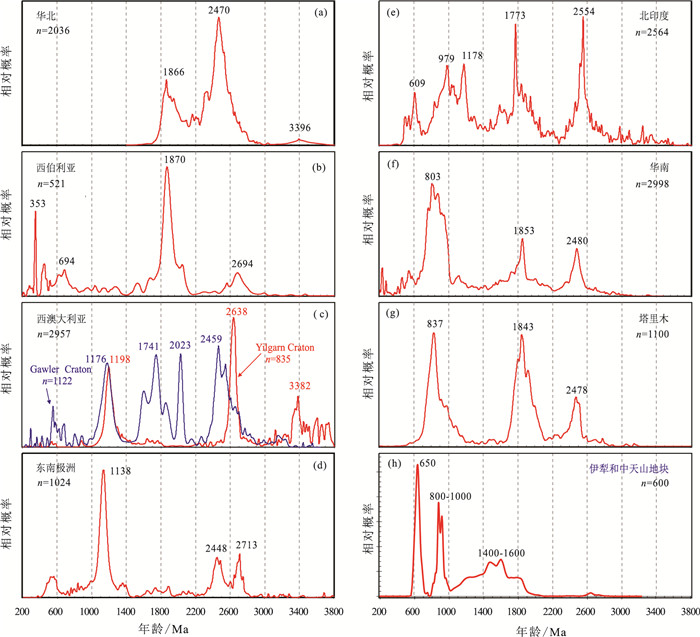
在华北克拉通(图 8a),现有的碎屑锆石结果揭示主要的岩浆事件介于1.6~2.7 Ga(Darby and Gehrels, 2006; Zhou et al., 2008; Wan et al., 2011; Liu et al., 2013, 2012b),其中两个主要峰值年龄为2.5 Ga和1.9 Ga,记录了华北克拉通太古宙基底的形成及其东、西陆块的碰撞汇聚(Zhao et al., 2004, 2005; Zhai and Santosh et al., 2011)。此后,华北克拉通在1.2~1.6 Ga期间整体处于比较稳定的构造环境,岩浆活动较弱。
|
图 8 伊犁和中天山地块与其周边主要块体碎屑锆石年龄分布对比图 Figure 8 Comparison diagrams of ages of detrital zircons from the Yili Block, Chinese Central Tianshan Block, and other blocks |
在西伯利亚克拉通(图 8b),碎屑锆石年龄结果显示岩浆活动主要集中于2.9~2.4 Ga、2.0~0.9 Ga和0.6~0.2 Ga,发育4个主要的年龄峰值(2.7 Ga、1.87 Ga、694 Ma和353 Ma),明显不同于华北克拉通(Rainbird et al., 1998; Khudoley et al., 2001; Wang et al., 2011)。西伯利亚克拉通太古宙的年龄峰值为2.7 Ga,可能记录了克拉通化的年龄,说明西伯利亚克拉通早期基底的形成早于华北克拉通。西伯利亚克拉通~1.87 Ga的年龄峰值可能对应了全球的哥伦比亚造山事件。
澳大利亚板块的岩浆活动非常复杂(图 8c),明显不同于其他克拉通块体,以强烈的新太古代岩浆活动为主要特征,年龄峰值为2.6 Ga和2.5 Ga(Cawood et al., 2003; Veevers et al., 2005; Swain et al., 2005; Pidgeon and Nemchin, 2006; Belousova et al., 2009)。澳大利亚西部主要由Yilgarn和Gawler克拉通组成,二者区别明显(Belousova et al., 2009)。前者以2.64 Ga和1.2 Ga两个主要峰值为标志,含有少量始太古-古太古代的碎屑锆石(Cawood et al., 2003; Veevers et al., 2005; Pidgeon and Nemchin, 2006)。后者以多阶段的古元古代岩浆活动(2.46、2.02、1.74和1.18 Ga)为其标志(Swain et al., 2005; Belousova et al., 2009)。尽管澳大利亚板块发育多期元古宙岩浆活动,但缺失~800 Ma罗迪尼亚超大陆裂解的年龄信息。
南极洲板块的碎屑锆石年龄分布相对比较简单(图 8d),最显著的前寒武纪峰值为~1.4 Ga,其他两个次峰形成于~2.71 Ga和~2.45 Ga(Bisnath et al., 2006; Grew et al., 2012; Clark et al., 2012; Marschall et al., 2013)。
印度板块与华南板块及塔里木克拉通的碎屑锆石年龄分布特征基本类似,均发育2.6~2.3 Ga和2.1~1.6 Ga两期岩浆活动(图 8e~8g)。印度板块以这两期岩浆活动为主,并发育多期元古代岩浆活动(图 8e),年龄峰值为1.18 Ga、979 Ma和609 Ma(Decelles et al., 2004; Gehrels et al., 2006; Kaur et al., 2011; Ravikant et al., 2011)。相比之下,华南和塔里木前寒武纪碎屑锆石年龄分布非常一致(图 8f、8g),除2.6~2.3 Ga和2.1~1.6 Ga两期岩浆记录外,还发育强烈的新元古代(1.0~0.8 Ga)岩浆活动,对应年龄峰值分别为2.48 Ga、1.85 Ga、~0.8 Ga,与全球太古宙末期的克拉通化、哥伦比亚超大陆汇聚和罗迪尼亚超大陆裂解事件非常一致(Xu et al., 2007; Wang et al., 2007; Wan et al., 2007; Sun et al., 2009; Yu et al., 2010; Long et al., 2010, 2011b; Shu et al., 2011; Zhu et al., 2011; Li et al., 2011; 张英利等,2011)。
根据笔者的资料和收集的数据结果(图 8 h),伊犁和中天山地块碎屑锆石年龄主要集中于~ 650 Ma、0.8~1.0 Ga及1.4~1.6 Ga,此外有少量古元古代年龄。伊犁和中天山地块缺少太古代和~ 1.9 Ga碎屑锆石,并以中元古代-新元古代碎屑锆石为主(0.8~1.0 Ga和1.4~1.6 Ga),完全不同于华北克拉通和西伯利亚克拉通,揭示这两个克拉通可能不是伊犁和中天山地块前寒武纪碎屑物质的源区。澳大利亚克拉通缺失~ 0.8 Ga的年龄信息,并强烈发育~ 1.2 Ga和新太古代-古元古代早期(2.64 Ga和2.46 Ga)的岩浆活动,南极洲板块缺乏中-新元古代年龄信息却也发育新太古代-古元古代早期(2.71 Ga和2.45 Ga)的岩浆活动,均明显不同于伊犁和中天山地块,说明澳大利亚克拉通和南极洲板块也不可能是伊犁和中天山地块前寒武纪碎屑物质的物质源区。虽然伊犁和中天山地块记录有0.8~1.0 Ga的年龄记录与塔里木、华南和印度新元古代碎屑锆石年龄类似,但由于这3个古老地块缺少1.4~1.6 Ga年龄信息,并大量发育~ 1.8 Ga和新太古代晚期(2.55 Ga)或古元古代早期(2.48 Ga)的岩浆活动,揭示明显不同的物质源区特征。因此,笔者认为伊犁和中天山地块并非直接来源于周缘的古老大陆块体,如华北、西伯利亚、澳大利亚、南极洲、华南或塔里木。
哈萨克斯坦地块是中亚造山带内一个重要的具有前寒武纪结晶基底的古老块体(图 1),前寒武纪地质体主要出露于Kokchetav,Chu-Yili,Issyk-Kul,Aktau等地,东与伊犁地块紧邻(Degtyarev et al., 2017)。尽管地块发育大量前寒武纪岩石,但其形成时代长期以来并未得到有效制约。近年来,基于哈萨克斯坦和吉尔吉斯坦的研究,大量高精度年代学结果陆续发表(Kröner et al., 2013;Kovach et al., 2016; Degtyarev et al., 2017)。这些结果一致揭示,哈萨克斯坦地块发育大量古元古代和新元古代岩浆岩,年龄主要介于0.65~0.95 Ga和1.0~1.4 Ga,此外还有少量更古老的岩浆活动,这些岩浆活动时代特点与伊犁和中天山地块主体碎屑锆石年龄分布一致(图 8 h)。基于这些相似性,笔者认为伊犁和中天山地块可能来自相邻的哈萨克斯坦地块,但目前的研究资料还比较有限,因而这一观点仍需进一步验证。
7 结论(1) 伊犁地块和中天山地块的古老陆核主要形成于中元古代(ca.1.4~1.3 Ga),并在早新元古代(0.97~0.85 Ga)发生固结;
(2) 伊犁地块和中天山地块在前寒武纪时期经历了相似的地质演化过程,具有构造亲缘性;
(3) 伊犁地块和中天山地块早期演化不同于塔里木克拉通,其构造起源可能同于相邻的哈萨克斯坦地块。
| [] | 《中国地层典》编委会. 1996. 中国地层典(古元古界). 北京: 地质出版社, 44- |
| [] | Allen M B, Windley B F, Zhang C. 1993. Palaeozoic collisional tectonics and magmatism of the Chinese Tien Shan, central Asia. Tectonophysics, 220(1-4): 89–115. DOI:10.1016/0040-1951(93)90225-9 |
| [] | Badarch G, Cunningham W D, Windley B F. 2002. A new terrane subdivision for Mongolia:Implications for the Phanerozoic crustal growth of Central Asia. Journal of Asian Earth Sciences, 21(1): 87–110. DOI:10.1016/S1367-9120(02)00017-2 |
| [] | Belousova E A, Reid A J, Griffin W L, O'Reilly S Y. 2009. Rejuvenation vs.recycling of Archean crust in the Gawler Craton, South Australia:Evidence from U-Pb and Hf isotopes in detrital zircon. Lithos, 113(3-4): 570–582. DOI:10.1016/j.lithos.2009.06.028 |
| [] | Biske Y S, Seltmann R. 2010. Paleozoic Tian-Shan as a transitional region between the Rheic and Urals-Turkestan oceans. Gondwana Research, 17(2-3): 602–613. DOI:10.1016/j.gr.2009.11.014 |
| [] | Bisnath A, Frimmel H E, Armstrong R A, Board W S. 2006. Tectono-thermal evolution of the Maud Belt:New SHRIMP U-Pb zircon data from Gjelsvikfjella, Dronning Maud Land, East Antarctica. Precambrian Research, 150(1-2): 95–121. DOI:10.1016/j.precamres.2006.06.009 |
| [] | Buslov M M, Saphonova I Y, Watanabe T, Obut O T, Fujiwara Y, Iwata K, Semakov N N, Sugai Y, Smirnova L V, Kazansky A Y. 2001. Evolution of the Paleo-Asian Ocean(Altai-Sayan Region, Central Asia)and collision of possible Gondwana-derived terranes with the southern marginal part of the Siberian continent. Geosciences Journal, 5(3): 203–224. DOI:10.1007/BF02910304 |
| [] | Cawood P A, Nemchin A A, Freeman M, Sircombe K. 2003. Linking source and sedimentary basin:Detrital zircon record of sediment flux along a modern river system and implications for provenance studies. Earth and Planetary Science Letters, 210(1/2): 259–268. |
| [] | Clark C, Kinny P D, Harley S L. 2012. Sedimentary provenance and age of metamorphism of the Vestfold Hills, East Antarctica:Evidence for a piece of Chinese Antarctica. Precambrian Research, 196-197: 23–45. DOI:10.1016/j.precamres.2011.11.001 |
| [] | Darby B J, Gehrels G. 2006. Detrital zircon reference for the North China block. Journal of Asian Earth Sciences, 26(6): 637–648. DOI:10.1016/j.jseaes.2004.12.005 |
| [] | DeCelles P G, Gehrels G E, Najman Y, Martin A J, Carter A, Garzanti E. 2004. Detrital geochronology and geochemistry of Cretaceous-Early Miocene strata of Nepal:Implications for timing and diachroneity of initial Himalayan orogenesis. Earth and Planetary Science Letters, 227(3-4): 313–330. DOI:10.1016/j.epsl.2004.08.019 |
| [] | Degtyarev K, Yakubchuk A, Tretyakov A, Kotov A, Kovach V. 2017. Precambrian geology of the Kazakh uplands and Tien Shan:An overview. Gondwana Research. DOI:10.1016/j.gr.2016.12.014 |
| [] | Dobretsov N L, Buslov M M, Vernikovsky V A. 2003. Neoproterozoic to Early Ordovician evolution of the Paleo-Asian Ocean:Implications to the break-up of Rodinia. Gondwana Research, 6(2): 143–159. DOI:10.1016/S1342-937X(05)70966-7 |
| [] | Gao J, Li M S, Xiao X C, Tang Y Q, He G Q. 1998. Paleozoic tectonic evolution of the Tianshan Orogen, northwestern China. Tectonophysics, 287(1-4): 213–231. DOI:10.1016/S0040-1951(98)80070-X |
| [] | Gao J, Long L L, Klemd R, Qian Q, Liu D Y, Xiong X M, Su W, Liu W, Wang Y T, Yang F Q. 2009. Tectonic evolution of the South Tianshan orogen and adjacent regions, NW China:Geochemical and age constraints of granitoid rocks. International Journal of Earth Sciences, 98(6): 1221–1238. DOI:10.1007/s00531-008-0370-8 |
| [] | Gao J, Wang X S, Klemd R N, Jiang T, Qian Q, Mu L X, Ma Y Z. 2015. Record of assembly and breakup of Rodinia in the Southwestern Altaids:Evidence from Neoproterozoic magmatism in the Chinese Western Tianshan Orogen. Journal of Asian Earth Sciences, 113: 173–193. DOI:10.1016/j.jseaes.2015.02.002 |
| [] | Ge R F, Zhu W B, Wilde S A, He J W, Cui X, Wang X, Zheng B H. 2014b. Neoproterozoic to Paleozoic long-lived accretionary orogeny in the northern Tarim Craton. Tectonics, 33(3): 302–329. DOI:10.1002/2013TC003501 |
| [] | Ge R F, Zhu W B, Wilde S A, Wu H L, He J W, Zheng B H. 2014a. Archean magmatism and crustal evolution in the northern Tarim Craton:Insights from zircon U-Pb-Hf-O isotopes and geochemistry of~2.7 Ga orthogneiss and amphibolite in the Korla Complex. Precambrian Research, 252: 145–165. DOI:10.1016/j.precamres.2014.07.019 |
| [] | Ge R F, Zhu W B, Wu H L, Zheng B H, He J W. 2013. Timing and mechanisms of multiple episodes of migmatization in the Korla Complex, northern Tarim Craton, NW China:Constraints from zircon U-Pb-Lu-Hf isotopes and implications for crustal growth. Precambrian Research, 231: 136–156. DOI:10.1016/j.precamres.2013.03.005 |
| [] | Ge R F, Zhu W B, Zheng B B, Wu H L, He J W, Zhu X Q. 2012. Early Pan-African magmatism in the Tarim Craton:Insights from zircon U-Pb-Lu-Hf isotope and geochemistry of granitoids in the Korla area, NW China. Precambrian Research, 212-213: 117–138. DOI:10.1016/j.precamres.2012.05.001 |
| [] | Gehrels G E, DeCelles P G, Ojha T P, Upreti B N. 2006. Geologic and U-Pb geochronologic evidence for early Paleozoic tectonism in the Dadeldhura thrust sheet, far-west Nepal Himalaya. Journal of Asian Earth Sciences, 28(4-6): 385–408. DOI:10.1016/j.jseaes.2005.09.012 |
| [] | Grew E S, Carson C J, Christy A G, Maas R, Yaxley G M, Boger S D, Fanning C M. 2012. New constraints from U-Pb, Lu-Hf and Sm-Nd isotopic data on the timing of sedimentation and felsic magmatism in the Larsemann Hills, Prydz Bay, East Antarctica. Precambrian Research, 206-207: 87–108. DOI:10.1016/j.precamres.2012.02.016 |
| [] | He J W, Zhu W B, Ge R F, Zheng B H, Wu H L. 2014b. Detrital zircon U-Pb ages and Hf isotopes of Neoproterozoic strata in the Aksu area, northwestern Tarim Craton:Implications for supercontinent reconstruction and crustal evolution. Precambrian Research, 254: 194–209. DOI:10.1016/j.precamres.2014.08.016 |
| [] | He J W, Zhu W B, Ge R F. 2014a. New age constraints on Neoproterozoic diamicites in Kuruktag, NW China and Precambrian crustal evolution of the Tarim Craton. Precambrian Research, 241: 44–60. DOI:10.1016/j.precamres.2013.11.005 |
| [] | He J W, Zhu W B, Zheng B H, Wu H L, Cui X, Lu Y Z. 2015a. Neoproterozoic diamictite-bearing sedimentary rocks in the northern Yili Block and their constraints on the Precambrian evolution of microcontinents in the Western Central Asian Orogenic Belt. Tectonophysics, 665: 23–36. DOI:10.1016/j.tecto.2015.09.021 |
| [] | He Z Y, Klemd R, Zhang Z M, Zong K Q, Sun L X, Tian Z L, Huang B T. 2015b. Mesoproterozoic continental arc magmatism and crustal growth in the eastern Central Tianshan Arc Terrane of the southern Central Asian Orogenic Belt:Geochronological and geochemical evidence. Lithos, 236-237: 74–89. DOI:10.1016/j.lithos.2015.08.009 |
| [] | He Z Y, Zhang Z M, Zong K Q, Dong X. 2013. Paleoproterozoic crustal evolution of the Tarim Craton:Constrained by zircon U-Pb and Hf isotopes of meta-igneous rocks from Korla and Dunhuang. Journal of Asian Earth Sciences, 78: 54–70. DOI:10.1016/j.jseaes.2013.07.022 |
| [] | He Z Y, Zhang Z M, Zong K Q, Xiang H, Chen X J, Xia M J. 2014c. Zircon U-Pb and Hf isotopic studies of the Xingxingxia Complex from Eastern Tianshan(NW China):Significance to the reconstruction and tectonics of the southern Central Asian Orogenic Belt. Lithos, 190(-191): 485–499. |
| [] | Helo C, Hegner E, Kröner A, Badarch G, Tomurtogoo O, Windley B F, Dulski P. 2006. Geochemical signature of Paleozoic accretionary complexes of the Central Asian Orogenic Belt in South Mongolia:Constraints on arc environments and crustal growth. Chemical Geology, 227(3-4): 236–257. DOI:10.1016/j.chemgeo.2005.10.003 |
| [] | Hu A Q, Jahn B M, Zhang G X, Chen Y B, Zhang Q F. 2000. Crustal evolution and Phanerozoic crustal growth in northern Xinjiang:Nd isotopic evidence.Part Ⅰ. Isotopic characterization of basement rocks. Tectonophysics, 328(1-2): 15–51. DOI:10.1016/S0040-1951(00)00176-1 |
| [] | Huang B T, He Z Y, Zhang Z M, Klemd R, Zong K Q, Zhao Z D. 2015b. Early Neoproterozoic granitic gneisses in the Chinese Eastern Tianshan:Petrogenesis and tectonic implications. Journal of Asian Earth Sciences, 113: 339–352. DOI:10.1016/j.jseaes.2014.08.021 |
| [] | Huang B T, He Z Y, Zong K Q, Zhang Z M. 2014. Zircon U-Pb and Hf isotopic study of Neoproterozoic granitic gneisses from the Alatage area, Xinjiang:Constraints on the Precambrian crustal evolution in the Central Tianshan Block. Chinese Science Bulletin, 59(1): 100–112. DOI:10.1007/s11434-013-0010-y |
| [] | Huang Z Y, Long X P, Kröner A, Yuan C, Wang Q, Sun M, Zhao G C, Wang Y J. 2013. Geochemistry, zircon U-Pb ages and Lu-Hf isotopes of early Paleozoic plutons in the northwestern Chinese Tianshan:Petrogenesis and geological implications. Lithos, 182-183: 48–66. DOI:10.1016/j.lithos.2013.09.009 |
| [] | Huang Z Y, Long X P, Kröner A, Yuan C, Wang Y J, Chen B, Zhang Y Y. 2015a. Neoproterozoic granitic gneisses in the Chinese Central Tianshan Block:Implications for tectonic affinity and Precambrian crustal evolution. Precambrian Research, 269: 73–89. DOI:10.1016/j.precamres.2015.08.005 |
| [] | Huang Z Y, Long X P, Yuan C, Sun M, Wang Y J, Zhang Y Y, Chen B. 2016. Detrital zircons from Neoproterozoic sedimentary rocks in the Yili Block:Constraints on the affinity of microcontinents in the southern Central Asian Orogenic Belt. Gondwana Research, 37: 39–52. DOI:10.1016/j.gr.2016.05.009 |
| [] | Kaur P, Zeh A, Chaudhri N, Gerdes A, Okrusch M. 2011. Archaean to Palaeoproterozoic crustal evolution of the Aravalli mountain range, NW India, and its hinterland:The U-Pb and Hf isotope record of detrital zircon. Precambrian Research, 187(1-2): 155–164. DOI:10.1016/j.precamres.2011.03.005 |
| [] | Khain E V, Bibikova E V, Salnikova E B, Kröner A, Gibsher A S, Didenko A N, Degtyarev K E, Fedotova A A. 2003. The Palaeo-Asian ocean in the Neoproterozoic and early Palaeozoic:New geochronologic data and palaeotectonic reconstructions. Precambrian Research, 122(1-4): 329–358. DOI:10.1016/S0301-9268(02)00218-8 |
| [] | Kheraskova T N, Volozh Y A, Didenko A N, Bush V A. 2003. The Vendian-early Paleozoic history of the continental margin of eastern Paleogondwana, Paleoasian ocean, and Central Asian Foldbelt. Russian Journal of Earth Sciences, 5(3): 165–184. DOI:10.2205/2003ES000123 |
| [] | Khudoley A K, Rainbird R H, Stern R A, Kropachev A P, Heaman L M, Zanin A M, Podkovyrov V N, Belova V N, Sukhorukov V I. 2001. Sedimentary evolution of the Riphean-Vendian basin of southeastern Siberia. Precambrian Research, 111(1-4): 129–163. DOI:10.1016/S0301-9268(01)00159-0 |
| [] | Kovach V, Degtyarev K, Tretyakov A, Kotov A, Tolmacheva E, Wang K L, Chung S L, Lee H Y, Jahn B M. 2016. Sources and provenance of the Neoproterozoic placer deposits of the northern Kazakhstan:Implication for continental growth of the western Central Asian Orogenic Belt. Gondwana Research. DOI:10.1016/j.gr.2016.09.012 |
| [] | Kröner A, Alexeiev D V, Rojas-Agramonte Y, Hegner E, Wong J, Xia X, Belousova E, Mikolaichuk A V, Seltmann R, Liu D, Kisilev V V. 2013. Mesoproterozoic(Grenville-age)terranes in the Kyrgyz North Tianshan:Zircon ages and Nd-Hf isotopic constraints on the origin and evolution of basement blocks in the southern Central Asian Orogen. Gondwana Research, 23(1): 272–295. DOI:10.1016/j.gr.2012.05.004 |
| [] | Lei R X, Wu C Z, Chi G X, Gu L X, Dong L H, Qu X, Jiang Y H, Jiang S Y. 2013. The Neoproterozoic Hongliujing A-type granite in Central Tianshan(NW China):LA-ICP-MS zircon U-Pb geochronology, geochemistry, Nd-Hf isotope and tectonic significance. Journal of Asian Earth Sciences, 74: 142–154. DOI:10.1016/j.jseaes.2013.03.025 |
| [] | Lei R X, Wu C Z, Chi G X, Chen G, Gu L X, Jiang Y H. 2012. Petrogenesis of the Palaeoproterozoic Xishankou pluton, northern Tarim block, northwest China:Implications for assembly of the supercontinent Columbia. International Geology Review, 54(15): 1829–1842. DOI:10.1080/00206814.2012.678045 |
| [] | Levashova N M, Meert J G, Gibsher A S, Grice W C, Bazhenov M L. 2011. The origin of microcontinents in the Central Asian Orogenic Belt:Constraints from paleomagnetism and geochronology. Precambrian Research, 185(1-2): 37–54. DOI:10.1016/j.precamres.2010.12.001 |
| [] | Li L M, Sun M, Wang Y J, Xing G F, Zhao G C, He Y H, He K J, Zhang A M. 2011. U-Pb and Hf isotopic study of detrital zircons from the meta-sedimentary rocks in central Jiangxi Province, South China:Implications for the Neoproterozoic tectonic evolution of South China Block. Journal of Asian Earth Sciences, 41(1): 44–55. DOI:10.1016/j.jseaes.2010.12.004 |
| [] | Lin W, Chu Y, Ji W B, Zhang Z P, Shi Y H, Wang Z Y, Li Z, Wang Q C. 2013. Geochronological and geochemical constraints for a middle Paleozoic continental arc on the northern margin of the Tarim block:Implications for the Paleozoic tectonic evolution of the South Chinese Tianshan. Lithosphere, 5(4): 355–381. DOI:10.1130/L231.1 |
| [] | Liu C H, Zhao G C, Sun M, Zhang J, Yin C Q. 2012b. U-Pb geochronology and Hf isotope geochemistry of detrital zircons from the Zhongtiao Complex:Constraints on the tectonic evolution of the Trans-North China Orogen. Precambrian Research, 222(-223): 159–172. |
| [] | Liu H S, Wang B, Shu L S, Jahn B M, Lizuka Y. 2014. Detrital zircon ages of Proterozoic meta-sedimentary rocks and Paleozoic sedimentary cover of the northern Yili Block:Implications for the tectonics of microcontinents in the Central Asian Orogenic Belt. Precambrian Research, 252: 209–222. DOI:10.1016/j.precamres.2014.07.018 |
| [] | Liu J H, Liu F L, Ding Z J, Yang H, Liu C H, Liu P H, Xiao L L, Zhao L, Geng J Z. 2013. U-Pb dating and Hf isotope study of detrital zircons from the Zhifu Group, Jiaobei Terrane, North China Craton:Provenance and implications for Precambrian crustal growth and recycling. Precambrian Research, 235: 230–250. DOI:10.1016/j.precamres.2013.06.014 |
| [] | Liu Q, Zhao G C, Sun M, Eizenhöfer P R, Han Y G, Hou W Z, Zhang X R, Wang B, Liu D X, Xu B. 2015. Ages and tectonic implications of Neoproterozoic ortho-and paragneisses in the Beishan Orogenic Belt, China. Precambrian Research, 266: 551–578. DOI:10.1016/j.precamres.2015.05.022 |
| [] | Long X P, Sun M, Yuan C, Kröner A, Hu A Q. 2012. Zircon REE patterns and geochemical characteristics of Paleoproterozoic anatectic granite in the northern Tarim Craton, NW China:Implications for the reconstruction of the Columbia supercontinent. Precambrian Research, 222-223: 474–487. DOI:10.1016/j.precamres.2011.09.009 |
| [] | Long X P, Yuan C, Sun M, Kröner A, Zhao G C, Wilde S, Hu A Q. 2011a. Reworking of the Tarim Craton by underplating of mantle plume-derived magmas:Evidence from Neoproterozoic granitoids in the Kuluketage area, NW China. Precambrian Research, 187(1-2): 1–14. DOI:10.1016/j.precamres.2011.02.001 |
| [] | Long X P, Yuan C, Sun M, Xiao W J, Zhao G C, Zhou K F, Wang Y J, Hu A Q. 2011b. The discovery of the oldest rocks in the Kuluketage area and its geological implications. Science China Earth Sciences, 54(3): 342–348. DOI:10.1007/s11430-010-4156-z |
| [] | Long X P, Yuan C, Sun M, Zhao G C, Xiao W J, Wang W J, Yang Y H, Hu A Q. 2010. Archean crustal evolution of the northern Tarim craton, NW China:Zircon U-Pb and Hf isotopic constraints. Precambrian Research, 180(3-4): 272–284. DOI:10.1016/j.precamres.2010.05.001 |
| [] | Ma X X, Shu L S, Jahn B M, Zhu W B, Faure M. 2012a. Precambrian tectonic evolution of Central Tianshan, NW China:Constraints from U-Pb dating and in situ Hf isotopic analysis of detrital zircons. Precambrian Research, 222-223: 450–473. DOI:10.1016/j.precamres.2011.06.004 |
| [] | Ma X X, Shu L S, Santosh M, Li J Y. 2012b. Detrital zircon U-Pb geochronology and Hf isotope data from Central Tianshan suggesting a link with the Tarim Block:Implications on Proterozoic supercontinent history. Precambrian Research, 206-207: 1–16. DOI:10.1016/j.precamres.2012.02.015 |
| [] | Ma X X, Shu L S, Santosh M, Li J Y. 2013. Paleoproterozoic collisional orogeny in Central Tianshan:Assembling the Tarim Block within the Columbia supercontinent. Precambrian Research, 228: 1–19. DOI:10.1016/j.precamres.2013.01.009 |
| [] | Marschall H R, Hawkesworth C J, Leat P T. 2013. Mesoproterozoic subduction under the eastern edge of the Kalahari-Grunehogna Craton preceding Rodinia assembly:The Ritscherflya detrital zircon record, Ahlmannryggen(Dronning Maud Land, Antarctica). Precambrian Research, 236: 31–45. DOI:10.1016/j.precamres.2013.07.006 |
| [] | Mossakovsky A A, Ruzhentsev S V, Samygin S G, Kheraskova T N. 1994. Central Asian fold belt:Geodynamic evolution and formation history. Geotectonics, 27(6): 445–474. |
| [] | Pidgeon R T, Nemchin A A. 2006. High abundance of early Archaean grains and the age distribution of detrital zircons in a sillimanite-bearing quartzite from Mt Narryer, Western Australia. Precambrian Research, 150(3-4): 201–220. DOI:10.1016/j.precamres.2006.07.008 |
| [] | Powerman V, Shatsillo A, Chumakov N, Kapitonov I, Hourigan J. 2015. Interaction between the Central Asian Orogenic Belt(CAOB)and the Siberian craton as recorded by detrital zircon suites from Transbaikalia. Precambrian Research, 267: 39–71. DOI:10.1016/j.precamres.2015.05.015 |
| [] | Qian Q, Gao J, Klemd R, He G Q, Song B, Liu D Y, Xu R H. 2009. Early Paleozoic tectonic evolution of the Chinese South Tianshan Orogen:Constraints from SHRIMP zircon U-Pb geochronology and geochemistry of basaltic and dioritic rocks from Xiate, NW China. International Journal of Earth Sciences, 98(3): 551–569. DOI:10.1007/s00531-007-0268-x |
| [] | Rainbird R H, Stern R A, Khudoley A K, Kropachev A P, Heaman L M, Sukhorukov V I. 1998. U-Pb geochronology of Riphean sandstone and gabbro from southeast Siberia and its bearing on the Laurentia-Siberia connection. Earth and Planetary Science Letters, 164(3-4): 409–420. DOI:10.1016/S0012-821X(98)00222-2 |
| [] | Ravikant V, Wu F Y, Ji W Q. 2011. U-Pb age and Hf isotopic constraints of detrital zircons from the Himalayan foreland Subathu sub-basin on the Tertiary palaeogeography of the Himalaya. Earth and Planetary Science Letters, 304(3-4): 356–368. DOI:10.1016/j.epsl.2011.02.009 |
| [] | Safonova I Y, Buslov M M, Iwata K, Kokh D A. 2004. Fragments of Vendian-early Carboniferous oceanic crust of the Paleo-Asian Ocean in foldbelts of the Altai-Sayan region of Central Asia:Geochemistry, biostratigraphy and structural setting. Gondwana Research, 7(3): 771–790. DOI:10.1016/S1342-937X(05)71063-7 |
| [] | Şengör A M C, Natal' in B A, Burtman V S. 1993. Nature evolution of the Altaid tectonic collage and Palaeozoic crustal growth in Eurasia. Nature, 364(6435): 299–307. DOI:10.1038/364299a0 |
| [] | Sengör A M C, Natal' in B A. 1996. Paleotectonics of Asia:Fragments of a synthesis. In:Yin A, Harrison M(eds). The Tectonic Evolution of Asia. Cambridge:Cambridge University Press, 486-640 |
| [] | Shu L S, Deng X L, Zhu W B, Ma D S, Xiao W J. 2011. Precambrian tectonic evolution of the Tarim Block, NW China:New geochronological insights from the Quruqtagh domain. Journal of Asian Earth Sciences, 42(5): 774–790. DOI:10.1016/j.jseaes.2010.08.018 |
| [] | Shu L S, Yu J H, Charvet J, Laurent-Charvet S, Sang H Q, Zhang R G. 2004. Geological, geochronological and geochemical features of granulites in the Eastern Tianshan, NW China. Journal of Asian Earth Sciences, 24(1): 25–41. DOI:10.1016/j.jseaes.2003.07.002 |
| [] | Sun W H, Zhou M F, Gao J F, Yang Y H, Zhao X F, Zhao J H. 2009. Detrital zircon U-Pb geochronological and Lu-Hf isotopic constraints on the Precambrian magmatic and crustal evolution of the western Yangtze Block, SW China. Precambrian Research, 172(1-2): 99–126. DOI:10.1016/j.precamres.2009.03.010 |
| [] | Swain G, Woodhouse A, Hand M, Barovich K, Schwarz M, Fanning C M. 2005. Provenance and tectonic development of the late Archaean Gawler Craton, Australia; U-Pb zircon, geochemical and Sm-Nd isotopic implications. Precambrian Research, 141(3-4): 106–136. DOI:10.1016/j.precamres.2005.08.004 |
| [] | Turkina O M, Nozhkin A D, Bayanova T B, Dmitrieva N V, Travin A V. 2007. Precambrian terranes in the southwestern framing of the Siberian craton:Isotopic provinces, stages of crustal evolution and accretion-collision events. Russian Geology and Geophysics, 48(1): 61–70. DOI:10.1016/j.rgg.2006.12.007 |
| [] | Veevers J J, Saeed A, Belousova E A, Griffin W L. 2005. U-Pb ages and source composition by Hf-isotope and trace-element analysis of detrital zircons in Permian sandstone and modern sand from southwestern Australia and a review of the paleogeographical and denudational history of the Yilgarn Craton. Earth-Science Reviews, 68(3-4): 245–279. |
| [] | Wan Y S, Liu D Y, Wang W, Song T R, Kröner A, Dong C Y, Zhou H Y, Yin X Y. 2011. Provenance of Meso-to Neoproterozoic cover sediments at the Ming Tombs, Beijing, North China Craton:An integrated study of U-Pb dating and Hf isotopic measurement of detrital zircons and whole-rock geochemistry. Gondwana Research, 20(1): 219–242. DOI:10.1016/j.gr.2011.02.009 |
| [] | Wan Y S, Liu D Y, Xu M H, Zhuang J M, Song B, Shi Y R, Du L L. 2007. SHRIMP U-Pb zircon geochronology and geochemistry of metavolcanic and metasedimentary rocks in Northwestern Fujian, Cathaysia block, China:Tectonic implic ations and the need to redefine lithostratigraphic units. Gondwana Research, 12(1-2): 166–183. DOI:10.1016/j.gr.2006.10.016 |
| [] | Wang B, Jahn B M, Shu L S, Li K S, Chung S L, Liu D Y. 2012. Middle-Late Ordovician arc-type plutonism in the NW Chinese Tianshan:Implication for the accretion of the Kazakhstan continent in Central Asia. Journal of Asian Earth Sciences, 49: 40–53. DOI:10.1016/j.jseaes.2011.11.005 |
| [] | Wang B, Liu H S, Shu L S, Jahn B M, Chung S L, Zhai Y Z, Liu D Y. 2014a. Early Neoproterozoic crustal evolution in northern Yili Block:Insights from migmatite, orthogneiss and leucogranite of the Wenquan metamorphic complex in the NW Chinese Tianshan. Precambrian Research, 242: 58–81. DOI:10.1016/j.precamres.2013.12.006 |
| [] | Wang B, Shu L S, Liu H S, Gong H J, Ma Y Z, Mu L X, Zhong L L. 2014b. First evidence for ca.780 Ma intra-plate magmatism and its implications for Neoproterozoic rifting of the North Yili Block and tectonic origin of the continental blocks in SW of Central Asia. Precambrian Research, 254: 258–272. DOI:10.1016/j.precamres.2014.09.005 |
| [] | Wang F, Chen F K, Siebel W G, Li S Q, Peng P, Zhai M G. 2011. Zircon U-Pb geochronology and Hf isotopic composition of the Hongqiyingzi Complex, northern Hebei Province:New evidence for Paleoproterozoic and late Paleozoic evolution of the northern margin of the North China Craton. Gondwana Research, 20(1): 122–136. DOI:10.1016/j.gr.2011.02.003 |
| [] | Wang T, Hong D W, Jahn B M, Tong Y, Wang Y B, Han B F, Wang X X. 2006. Timing, petrogenesis, and setting of Paleozoic synorogenic intrusions from the Altai mountains, northwest China:Implications for the tectonic evolution of an Accretionary Orogen. The Journal of Geology, 114(6): 735–751. DOI:10.1086/507617 |
| [] | Wang X L, Zhou J C, Griffin W L, Wang R C, Qiu J S, O'Reilly S Y, Xu X S, Liu X M, Zhang G L. 2007. Detrital zircon geochronology of Precambrian basement sequences in the Jiangnan orogen:Dating the assembly of the Yangtze and Cathaysia Blocks. Precambrian Research, 159(1-2): 117–131. DOI:10.1016/j.precamres.2007.06.005 |
| [] | Wang X S, Gao J, Klemd R, Jiang T, Li J L, Zhang X, Tan Z, Li L, Zhu Z X. 2014d. Geochemistry and geochronology of the Precambrian high-grade metamorphic complex in the Southern Central Tianshan ophiolitic mélange, NW China. Precambrian Research, 254: 129–148. DOI:10.1016/j.precamres.2014.08.017 |
| [] | Wang Z M, Han C M, Xiao W J, Su B X, Sakyi P A, Song D F, Lin L N. 2014c. The petrogenesis and tectonic implications of the granitoid gneisses from Xingxingxia in the eastern segment of Central Tianshan. Journal of Asian Earth Sciences, 88: 277–292. DOI:10.1016/j.jseaes.2014.03.015 |
| [] | Wilhem C, Windley B F, Stampfli G M. 2012. The Altaids of Central Asia:A tectonic and evolutionary innovative review. Earth-Science Reviews, 113(3-4): 303–341. DOI:10.1016/j.earscirev.2012.04.001 |
| [] | Windley B F, Alexeiev D, Xiao W J, Kröner A, Badarch G. 2007. Tectonic models for accretion of the Central Asian Orogenic Belt. Journal of the Geological Society, 164(1): 31–47. DOI:10.1144/0016-76492006-022 |
| [] | Wu C Z, Santosh M, Chen Y J, Samson I M, Lei R X, Dong L H, Qu X, Gu L X. 2014. Geochronology and geochemistry of Early Mesoproterozoic meta-diabase sills from Quruqtagh in the northeastern Tarim Craton:Implications for breakup of the Columbia supercontinent. Precambrian Research, 241: 29–43. DOI:10.1016/j.precamres.2013.11.007 |
| [] | Xiao W J, Huang B C, Han C M, Sun S, Li J L. 2010. A review of the western part of the Altaids:A key to understanding the architecture of accretionary orogens. Gondwana Research, 18(2-3): 253–273. DOI:10.1016/j.gr.2010.01.007 |
| [] | Xiao W J, Windley B F, Badarch G, Sun S, Li J, Qin K, Wang Z. 2004. Palaeozoic accretionary and convergent tectonics of the southern Altaids:Implications for the growth of Central Asia. Journal of the Geological Society, 161(3):339-342 |
| [] | Xiao W J, Windley B F, Hao J, Zhai M G. 2003. Accretion leading to collision and the Permian Solonker suture, Inner Mongolia, China:Termination of the central Asian orogenic belt. Tectonics, 22(6): 1069. |
| [] | Xiao W J, Windley B, Sun S, Li J L, Huang B C, Han C M, Yuan C, Sun M, Chen H L. 2015. A tale of amalgamation of three Permo-Triassic collage systems in central Asia:Oroclines, sutures, and terminal accretion. Annual Review of Earth and Planetary Sciences, 43(1): 477–507. DOI:10.1146/annurev-earth-060614-105254 |
| [] | Xu X S, O'Reilly S Y, Griffin W L, Wang X L, Pearson N J, He Z Y. 2007. The crust of Cathaysia:Age, assembly and reworking of two terranes. Precambrian Research, 158(1-2): 51–78. DOI:10.1016/j.precamres.2007.04.010 |
| [] | Yakubchuk A. 2002. The Baikalide-Altaid, Transbaikal-Mongolian and North Pacific Orogenic collages:Similarity and diversity of structural patterns and metallogenic zoning. In:Blundell D J, Neubauer F, Von Quadt A(eds). The Timing and Location of Major Ore Deposits in an Evolving Orogen. London:Geological Society, Special Publications, 204:273-297 |
| [] | Yakubchuk A. 2004. Architecture and mineral deposit settings of the Altaid orogenic collage:A revised model. Journal of Asian Earth Sciences, 23(5): 761–779. DOI:10.1016/j.jseaes.2004.01.006 |
| [] | Yang T N, Li J Y, Sun G H, Wang Y B. 2008. Mesoproterozoic continental arc type granite in the Central Tianshan Mountains:Zircon SHRIMP U-Pb dating and geochemical analyses. Acta Geologica Sinica, 82(1): 117–125. |
| [] | Ye H M, Li X H, Lan Z W. 2013. Geochemical and Sr-Nd-Hf-O-C isotopic constraints on the origin of the Neoproterozoic Qieganbulake ultramafic-carbonatite complex from the Tarim Block, Northwest China. Lithos, 182-183: 150–164. DOI:10.1016/j.lithos.2013.10.002 |
| [] | Yu J H, O'Reilly S Y, Wang L J, Griffin W L, Zhou M F, Zhang M, Shu L S. 2010. Components and episodic growth of Precambrian crust in the Cathaysia Block, South China:Evidence from U-Pb ages and Hf isotopes of zircons in Neoproterozoic sediments. Precambrian Research, 181(1-4): 97–114. DOI:10.1016/j.precamres.2010.05.016 |
| [] | Zhai M G, Santosh M. 2011. The early Precambrian odyssey of the North China Craton:A synoptic overview. Gondwana Research, 20(1): 6–25. DOI:10.1016/j.gr.2011.02.005 |
| [] | Zhai M G. 2004. Precambrian tectonic evolution of the North China Craton. In:Malpas J, Fletcher C J N, Ali J R, Aitchison J C(eds). Aspects of the Tectonic Evolution of China. London:Geological Society, Special Publications, 226:57-72 |
| [] | Zhang C L, Zou H B, Wang H Y, Li H K, Ye H M. 2012b. Multiple phases of the Neoproterozoic igneous activity in Quruqtagh of the northeastern Tarim Block, NW China:Interaction between plate subduction and mantle plume?. Precambrian Research, 222-223: 488–502. DOI:10.1016/j.precamres.2011.08.005 |
| [] | Zhao G C, Sun M, Wilde S A, Li S Z. 2004. A Paleo-Mesoproterozoic supercontinent:Assembly, growth and breakup. Earth-Science Reviews, 67(1-2): 91–123. DOI:10.1016/j.earscirev.2004.02.003 |
| [] | Zhao G C, Sun M, Wilde S A, Li S Z. 2005. Late Archean to Paleoproterozoic evolution of the North China Craton:Key issues revisited. Precambrian Research, 136(2): 177–202. DOI:10.1016/j.precamres.2004.10.002 |
| [] | Zhou J B, Wilde S A, Zhao G C, Zheng C Q, Jin W, Zhang X Z, Cheng H. 2008. SHRIMP U-Pb zircon dating of the Neoproterozoic Penglai Group and Archean gneisses from the Jiaobei Terrane, North China, and their tectonic implications. Precambrian Research, 160(3-4): 323–340. DOI:10.1016/j.precamres.2007.08.004 |
| [] | Zhu W B, Zheng B H, Shu L S, Ma D S, Wu H L, Li Y X, Huang W T, Yu J J. 2011. Neoproterozoic tectonic evolution of the Precambrian Aksu blueschist terrane, northwestern Tarim, China:Insights from LA-ICP-MS zircon U-Pb ages and geochemical data. Precambrian Research, 185(3-4): 215–230. DOI:10.1016/j.precamres.2011.01.012 |
| [] | 陈新跃, 王岳军, 孙林华, 范蔚茗. 2009. 天山冰达坂和拉尔敦达坂花岗片麻岩SHRIMP锆石年代学特征及其地质意义. 地球化学, 38(5): 424–431. |
| [] | 胡霭琴, 王中刚, 涂光炽. 1997. 新疆北部地质演化及成岩成矿规律. 北京: 科学出版社: 1-246. |
| [] | 胡霭琴, 韦刚健, 江博明, 张积斌, 邓文峰, 陈林丽. 2010. 天山0.9 Ga新元古代花岗岩SHRIMP锆石U-Pb年龄及其构造意义. 地球化学, 39(3): 197–212. |
| [] | 胡霭琴, 韦刚健, 张积斌, 邓文峰, 陈林丽. 2008. 西天山温泉地区早古生代斜长角闪岩的锆石SHRIMP U-Pb年龄及其地质意义. 岩石学报, 24(12): 2731–2740. |
| [] | 胡霭琴, 张国新, 陈义兵. 2006. 中国新疆地壳演化主要地质事件年代学和地球化学. 北京: 地质出版社: 1-427. |
| [] | 李秋根, 刘树文, 宋彪, 王彦斌, 陈友章. 2009. 中天山东段中元古代晚期-古生代构造-热事件:SHRIMP锆石年代学证据. 地学前缘, 16(2): 175–184. |
| [] | 刘树文, 郭召杰, 张志诚, 李秋根, 郑海飞. 2004. 中天山东段前寒武纪变质地块的性质:地质年代学和钕同位素地球化学的约束. 中科学(D辑), 34(5): 395–403. |
| [] | 彭明兴, 钟春根, 左琼华, 朱婉明, 杨世文, 黄迅. 2012. 东天山卡瓦布拉克地区片麻状花岗岩形成时代及地质意义. 新疆地质, 30(1): 12–18. |
| [] | 施文翔, 廖群安, 胡远清, 杨再峰. 2010. 东天山地区中天山地块内中元古代花岗岩的特征及地质意义. 地质科技情报, 29(1): 29–37. |
| [] | 肖序常, 汤耀庆, 冯益民, 朱宝清, 李锦轶, 赵民. 1992. 新疆北部及其邻区大地构造. 北京: 地质出版社: 1-169. |
| [] | 新疆维吾尔自治区地质矿产局. 1993. 中华人民共和国地质矿产部地质专报——区域地质第32号新疆维吾尔自治区区域地质志. 北京: 地质出版社: 13. |
| [] | 张英利, 王宗起, 闫臻, 王涛, 郭现轻. 2011. 库鲁克塔格地区新元古代沉积物源分析:来自碎屑锆石年代学的证据. 岩石学报, 27(1): 121–132. |
| [] | 朱志新, 李锦轶, 董连慧, 王克卓, 张晓帆, 徐仕琪. 2011. 新疆西天山古生代侵入岩的地质特征及构造意义. 地学前缘, 18(2): 170–179. |