 2017, Vol. 36


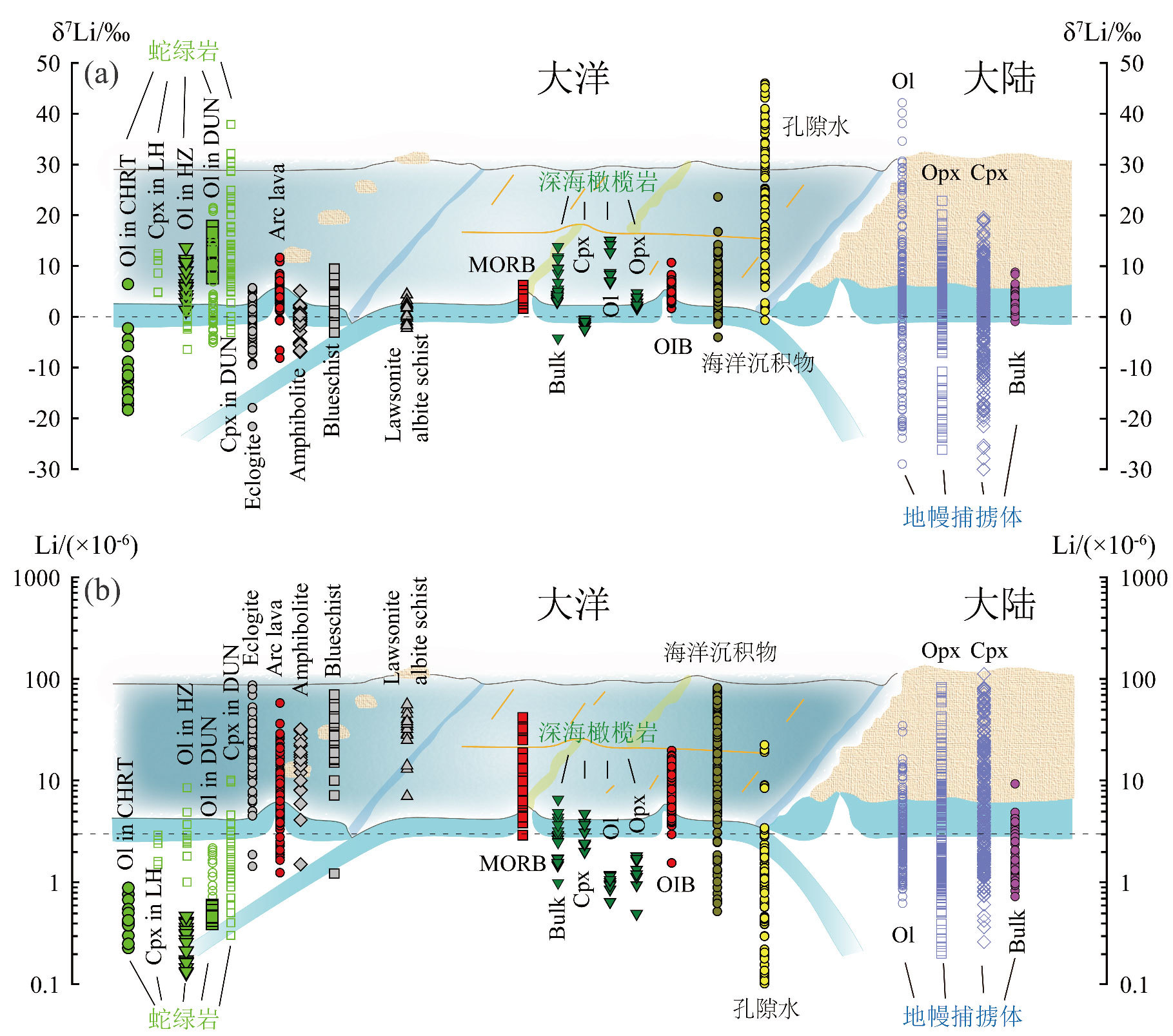
锂(Li)是自然界最轻的金属元素, 有2个天然稳定同位素6Li和7Li, 丰度分别为7.5%和92.5%。高达~15%的相对质量差使得Li在地质过程中容易产生较大的同位素分馏。在部分熔融过程中, Li的中等不相容的地球化学特征导致其在壳-幔体系中发生分异: 陆壳和新鲜MORB平均Li含量分别为~20 mg/g(Teng et al., 2004, 2008)和5~6 mg/g(Chan et al., 1992;Eggins et al., 1998;Elliott et al., 2006), 明显高于正常地幔的平均值1.5 mg/g(Eggins et al., 1998)。同时, Li也是强烈的流体活动性元素, 而且7Li优先在液体相中富集。已有研究表明地球上不同储库的δ7Li值差异可高达80‰(图 1;Tang et al., 2010;Su et al., 2016), Li的这些特性使得Li同位素体系被广泛应用于地壳物质再循环和地幔交代作用的示踪。
|
图 1 不同构造背景下一些地球样品的Li同位素(a)和Li含量(b)组成(据Su et al., 2016) Figure 1 Li isotopic(a)and elemental(b)compositions of the main hosts and mineral separates in oceanic and continental settings(after Su et al., 2016) |
新鲜的大洋中脊玄武岩经洋底低温蚀变作用转变为高δ7Li的蚀变洋壳, 在俯冲变质脱水过程中, 那些从海水中“捕获”的“重”Li从蚀变洋壳中释放并交代上覆地幔, 形成重Li的地幔楔和轻Li的板片残留(肖益林等, 2015)。大洋地壳的蚀变程度愈高, 经脱水残余相的δ7Li值就愈低。地幔中的这种低δ7Li组分熔融所释放的熔体与地幔橄榄岩的相互作用可以改变地幔的Li同位素组成(Tomascak et al., 2002;Elliott et al., 2004;Brooker et al., 2004;Zack et al., 2003;Wunder et al., 2006)。正常地幔(未经交代作用)的Li含量较低(1~2 mg/g), 其中橄榄石中的Li含量为~1.5 mg/g, 单斜辉石为~1 mg/g, 斜方辉石为~1 mg/g(Seitz and Woodland, 2000;Tang et al., 2011;Su et al., 2012a)。已有研究发现, 地幔中Li含量和Li同位素存在明显的不均一性(Seitz et al., 2004;Wagner and Deloule, 2007;Aulbach and Rudnick, 2009;Su et al., 2012a)。
鉴于Li的强活动性, 很多早期研究者认为较大的Li同位素变化是由扩散作用造成的, 并不代表地幔初始的Li同位素组成(见Tomascak et al., 2016)。近年来, 随着Li同位素原位分析技术(LA-MC-ICP-MS和SIMS)的发展以及更多矿物标样的成功研发(Li et al., 2011;Xu et al., 2013;李献华等, 2015;Su et al., 2015), 更多矿物内部及矿物之间的Li元素和同位素组成信息得以揭示。越来越多的矿物Li同位素分析结果已不能由单纯的扩散机制所解释, 更多的则是记录了不同的地质过程。本文就Li同位素在地幔交代作用、地幔不均一性、岩浆分异和蛇绿岩及其中铬铁矿成因等方面的应用进行了总结, 以期对拓展Li同位素的应用潜力提供启示。
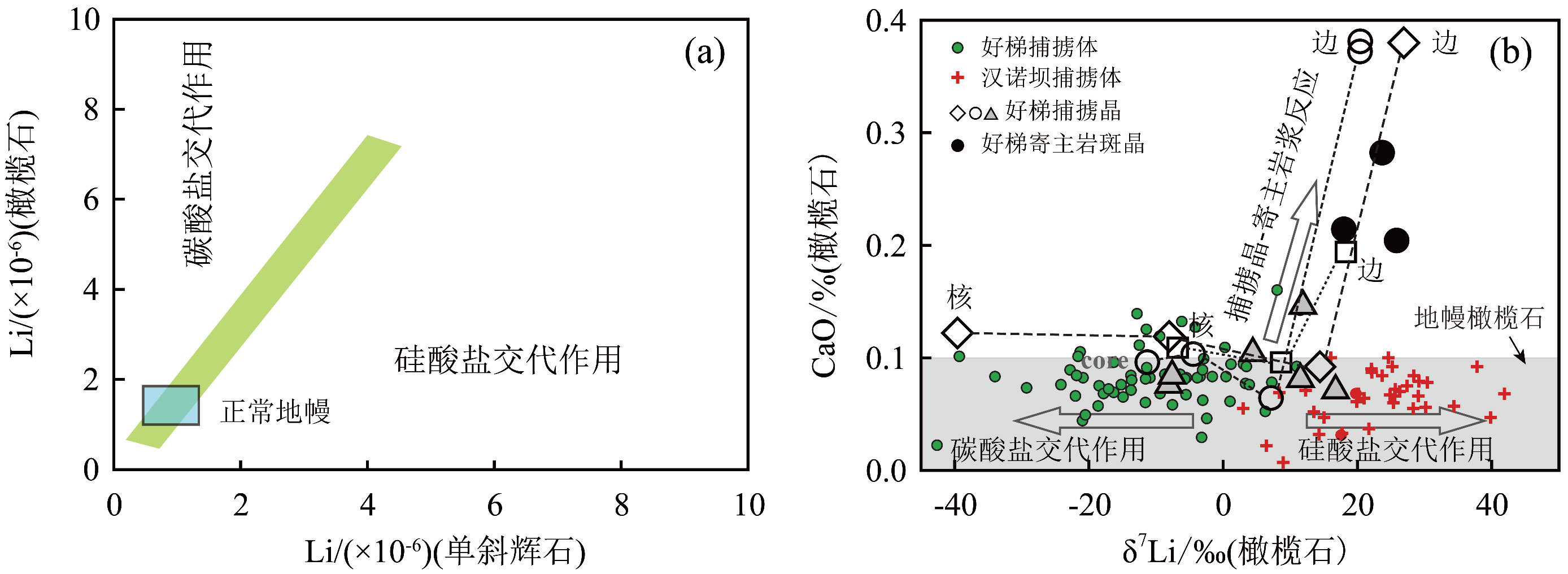
1 地幔交代类型的Li同位素识别地幔交代作用是改变地幔化学组成的重要方式。硅酸盐和碳酸盐交代是主要的2种类型, 二者在改变地幔物理化学状态方面存在明显的差异。在显性交代的情况下, 二者具有岩石学和矿物学上的差别;但是对于隐性交代的样品则需要地球化学上的识别。前人提出的一些地球化学指标在很多情况下并不能有效地识别交代类型, 因而不断受到质疑。 地幔交代作用可以明显增加地幔橄榄岩的Li含量, Li同位素的变化则主要取决于熔体的性质和来源(Seitz et al., 2004;Woodland et al., 2004;Zhang et al., 2010;Su et al., 2014a, 2014b)。硅酸盐熔体交代作用使单斜辉石较橄榄石更富集Li元素, 碳酸盐熔体交代可以明显提高橄榄石的Li含量(图 2a;Woodland et al., 2004)。这种矿物间的Li元素分布差异已被应用在多项有关地幔交代作用类型判别的研究中, 并与岩石学、矿物学和其他地球化学特征一致(Zhang et al., 2010;Tang et al., 2011;Xu et al., 2013;Gu et al., 2016)。
|
图 2 (a) 共生单斜辉石和橄榄石的Li含量对地幔交代作用的识别(据Woodland et al., 2004修改);(b) 橄榄石Li同位素和CaO含量对地幔交代作用及捕掳晶-寄主岩浆反应的识别(据Su et al., 2014a, 2014b) Figure 2 (a) Li distribution in coexisting clinopyroxene and olivine discriminating mantle metasomatism agents(modified after Woodland et al., 2004);(b) δ7Li and CaO correlation diagram for olivine discriminating mantle metasomatism agents and xenocryst-host magma interaction(modified after Su et al., 2014a, 2014b) |
Su等(2014a)选择分别受到典型硅酸盐(华北汉诺坝)和碳酸盐交代(西秦岭好梯)的地幔捕掳体为研究对象, 进行详细的Li同位素原位分析。结果显示, 橄榄石的Li同位素组成可以有效地反映硅酸盐和碳酸盐交代作用: 硅酸盐交代作用使橄榄石的Li同位素变重即增加δ7Li值, 而碳酸盐交代则降低橄榄石的δ7Li值(图 2b);硅酸盐交代的样品中δ7Li值顺序为橄榄石>斜方辉石>单斜辉石, 碳酸盐交代的样品中δ7Li值顺序则相反。橄榄石和单斜辉石捕掳晶以及熔体囊中矿物的Li同位素结果(Su et al., 2014b)进一步证实了上述观点。因此, 地幔橄榄岩的Li含量和Li同位素特征可以用来指示地幔交代作用性质以及熔体来源, 但造成不同地幔交代类型中Li同位素差异的机制尚需进一步研究。
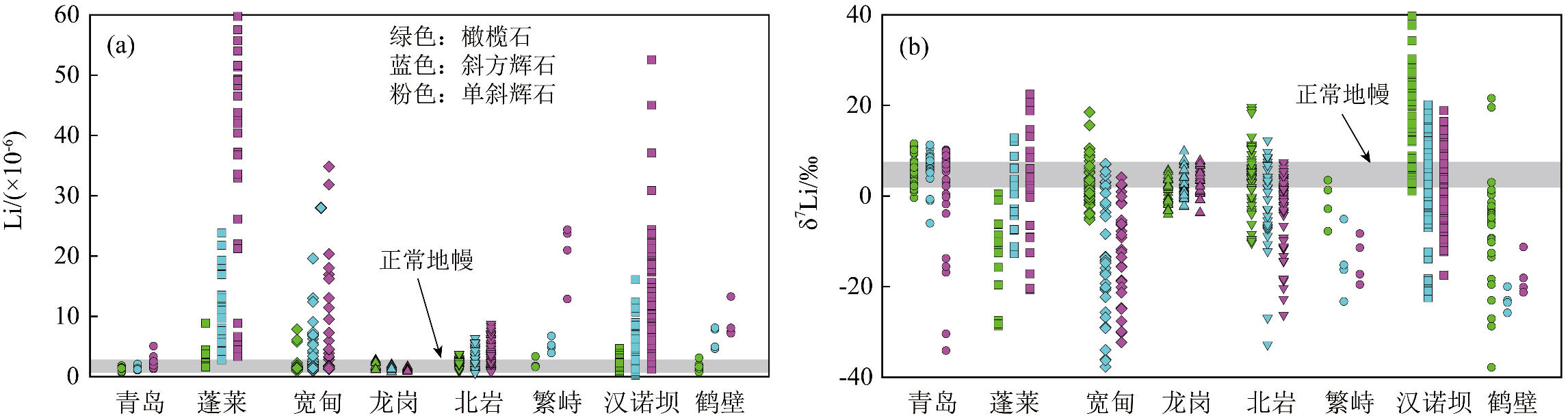
2 地幔不均一性: 以华北克拉通为例目前, 研究者已对华北克拉通多个地方的地幔捕掳体进行了矿物Li同位素分析, 分析结果总结于图 3。华北克拉通地幔捕掳体中矿物的Li含量和Li同位素总体显示非常大的变化范围, Li含量从略低于正常地幔值到60 mg/g, δ7Li值为-40‰~40‰, 不同地区之间也存在不同程度的变化。除青岛和龙岗样品的Li含量在正常地幔范围内外, 其他地区样品均显示高于正常地幔值的特征, 蓬莱、宽甸和汉诺坝的样品具有最大的变化范围;相比较而言, 橄榄石的Li含量变化较小(<10 mg/g), 2种辉石具有较大的Li含量变化范围且高于橄榄石的Li含量。在Li同位素组成上, 除龙岗样品在正常地幔范围变化外, 其他地区样品的δ7Li值变化范围较大且大多低于正常地幔值;2种辉石较橄榄石具有略大的δ7Li变化范围;其中汉诺坝多数橄榄石的δ7Li值高于正常地幔值, 鹤壁橄榄石的δ7Li值具有比辉石更大的变化范围(图 3)。另外, 原位分析揭示同一地区相同矿物不同颗粒之间具有明显的Li含量和Li同位素差异, 颗粒内部也存在不同程度的成分环带, 并且核-幔-边的成分变化并不具统一的变化规律(李佩等, 2012;Xu et al., 2013;Su et al., 2014a;Tang et al., 2014;Xiao et al., 2015)。
|
数据来源: 青岛(Zhang et al., 2010);蓬莱(李佩等, 2012);宽甸(Xu et al., 2013);龙岗(Tang et al., 2012);北岩(Xiao et al., 2015);繁峙(Tang et al., 2010);汉诺坝(Tang et al., 2007a;Su et al., 2014a);鹤壁(Tang et al., 2010, 2014) 图 3 华北克拉通各个地区地幔捕掳体中橄榄石、斜方辉石和单斜辉石的Li含量和Li同位素组成 Figure 3 Li abundance and Li isotopic compositions of olivine, orthopyroxene and clinopyroxene in mantle xenoliths from the North China Craton |
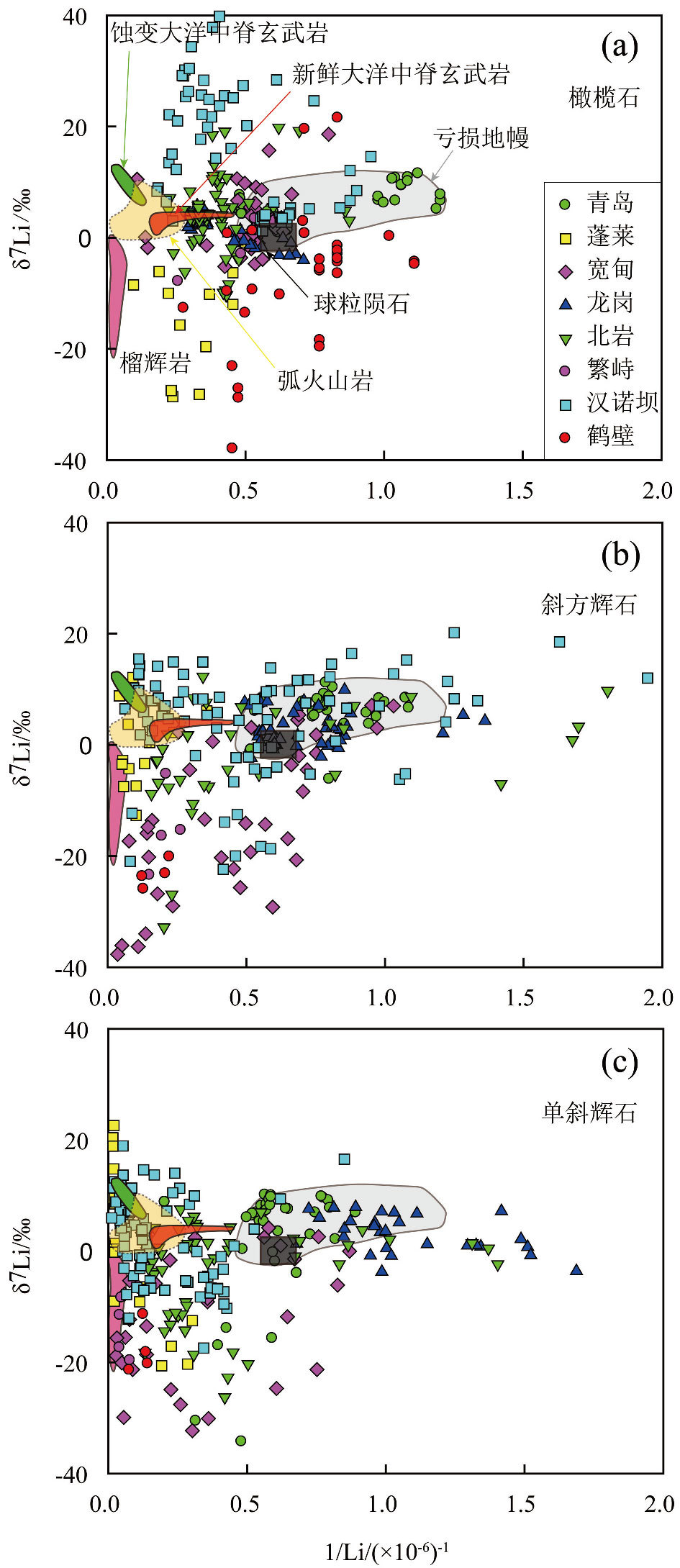
上述矿物成分的变化特征和地区差异表明, 华北克拉通下的岩石圈地幔具有高度不均一的Li含量和Li同位素分布。矿物之间、同一矿物的不同颗粒之间以及颗粒内部的Li含量和Li同位素差异均可指示岩石圈地幔中强烈不平衡的Li同位素体系。这种高度的不均一性和强烈的非平衡体系以及缺乏Li含量和Li同位素系统的相关性(图 4)已不能用同位素的扩散分馏机制所解释, 而应该是华北克拉通岩石圈地幔经历的强烈而复杂的地幔交代作用的结果(Zhang et al., 2010;Tang et al., 2011, 2014;汤艳杰等, 2011;李佩等, 2012;Xu et al., 2013;Xiao et al., 2015)。华北克拉通地幔捕掳体中的辉石普遍较共生橄榄石更富集Li元素, 与硅酸盐交代的特征相一致(Zhang et al., 2010;Tang et al., 2011);蓬莱和鹤壁橄榄石低δ7Li的特征与典型碳酸盐交代作用一致;汉诺坝橄榄石高δ7Li的特征指示典型硅酸盐交代作用(Su et al., 2014a);其他地区的地幔捕掳体可能记录了碳酸盐和硅酸盐2种熔体交代的混合信息(如北岩;Xiao et al., 2015)。
|
华北克拉通地幔捕掳体数据来源同图 3 图 4 华北克拉通各个地区地幔捕掳体中橄榄石、斜方辉石和单斜辉石的1/Li-δ7Li图解及与不同储库的对比(底图改编自Brooker et al., 2004;Tang et al., 2007b;Zhang et al., 2010) Figure 4 Correlation diagram of 1/Li versus δ7Li of olivine, orthopyroxene and clinopyroxene in mantle xenoliths from the North China Craton(modified after Brooker et al., 2004;Tang et al., 2007b;Zhang et al., 2010) |
与已有Li同位素储库对比, 所有青岛样品和大部分龙岗样品都落在亏损地幔范围内;其他地区的样品多显示从亏损地幔向弧火山岩或榴辉岩演化的趋势;汉诺坝样品还含有蚀变洋中脊玄武岩的信息(图 4)。这些特征表明, 华北克拉通岩石圈地幔的熔体交代作用与俯冲洋壳物质再循环密切相关。在地幔交代过程中, 辉石是较容易被改造的矿物, 因而被认为主要记录近期的地幔交代作用, 而不易被改造的橄榄石则可记录更早期的地幔过程(李佩等, 2012;Tang et al., 2014)。青岛中生代及代表古老岩石圈地幔的鹤壁高Mg#橄榄石较低的Li含量和Li同位素变化, 被认为其交代熔体来自相对古老的再循环物质(Zhang et al., 2010;Tang et al., 2014)。其他地区的交代熔体被认为主要与太平洋板块向西俯冲有关: 高Li含量和高δ7Li值的交代熔体可能来自俯冲早期脱水过程中改造的地幔楔, 或直接来自板片脱水的熔/流体;低Li含量和低δ7Li值的交代熔体可能来自脱水后的板片直接熔融, 或有软流圈组分的加入(Tang et al., 2007a, 2012;李佩等, 2012;Xu et al., 2013;Xiao et al., 2015)。
3 弧岩浆分异过程中的Li同位素分馏: 对阿拉斯加型岩体的研究结果理论研究表明, 同位素平衡分馏随温度升高而逐渐变小(Chacko et al., 2001), 因而高温过程如玄武质岩浆和花岗质岩浆分异, Li同位素几乎不发生分馏(Tomascak et al., 1999;Bryant et al., 2004;Teng et al., 2007;Magna et al., 2010)。但也有研究表明, 演化程度较高的岩浆岩具有相对较高的Li含量和较轻的Li同位素组成(Plyusnin et al., 1979;Hamelin et al., 2009), 同时, 玄武岩中橄榄石和基质的Li含量和Li同位素差异也暗示玄武质岩浆分异过程中可能发生Li同位素分馏(Weyer and Seitz, 2012)。尽管岩浆系统中的Li同位素分馏尚不明确, 但已有研究指出可能使Li同位素发生分馏的主要控制因素有高程度分异(Hamelin et al., 2009)、高程度流体出溶(Teng et al., 2006)、高氧化状态(Marks et al., 2007)和相对封闭体系(Ackerman et al., 2015)。
阿拉斯加型镁铁-超镁铁岩体具有高分异、富水、高氧逸度、无或少地壳混染等特点, 被认为是弧岩浆分异的产物(如Irvine, 1974;Farahat and Helmy, 2006;Su et al., 2012b, 2014c)。这些特点使得阿拉斯加型岩体成为研究岩浆分异过程中Li同位素分馏的理想对象。作者对新疆峡东阿拉斯加型岩体中纯橄岩的橄榄石进行了Li同位素分析, 结果表明橄榄石的Li含量和δ7Li值具有较大的变化范围, 分别为0.10~11.18 mg/g和-7.2‰~34.4‰(图 5), 二者具有非常好的负相关线性关系。样品之间、同一样品不同颗粒之间以及单颗粒内部的Li含量和Li同位素变化均表明不是后期蚀变、壳源混染、与铬铁矿的成分交换和扩散作用的影响, 而是记录了结晶时的化学组成。橄榄石的Li含量和δ7Li值均与岩浆分异的地球化学参数具有较好的相关性(图 5), 指示在橄榄石及共生铬铁矿结晶分异过程中Li含量增加和Li同位素组成变轻的趋势。与喷出岩和花岗岩相比, 阿拉斯加型岩体的高流体组分、高程度分异和高氧逸度特征更有助于Li同位素发生分馏。这项工作同时也暗示初始弧岩浆应该具有较重的Li同位素组成, 大量橄榄石在深部的分离结晶使其Li同位素组成显著变轻。

|
09XDTC1-35样品发生了高度蛇纹石化 图 5 新疆峡东阿拉斯加型岩体中纯橄岩的Li含量和Li同位素组成与岩浆分异地球化学参数的相关性图解(作者未发表数据) Figure 5 Correlation diagrams of Li and δ7Li with Fo in olivine, NiO and MnO in chromite of dunites from the Xiadong Alaskan-type intrusion in Xinjiang(unpublished) |
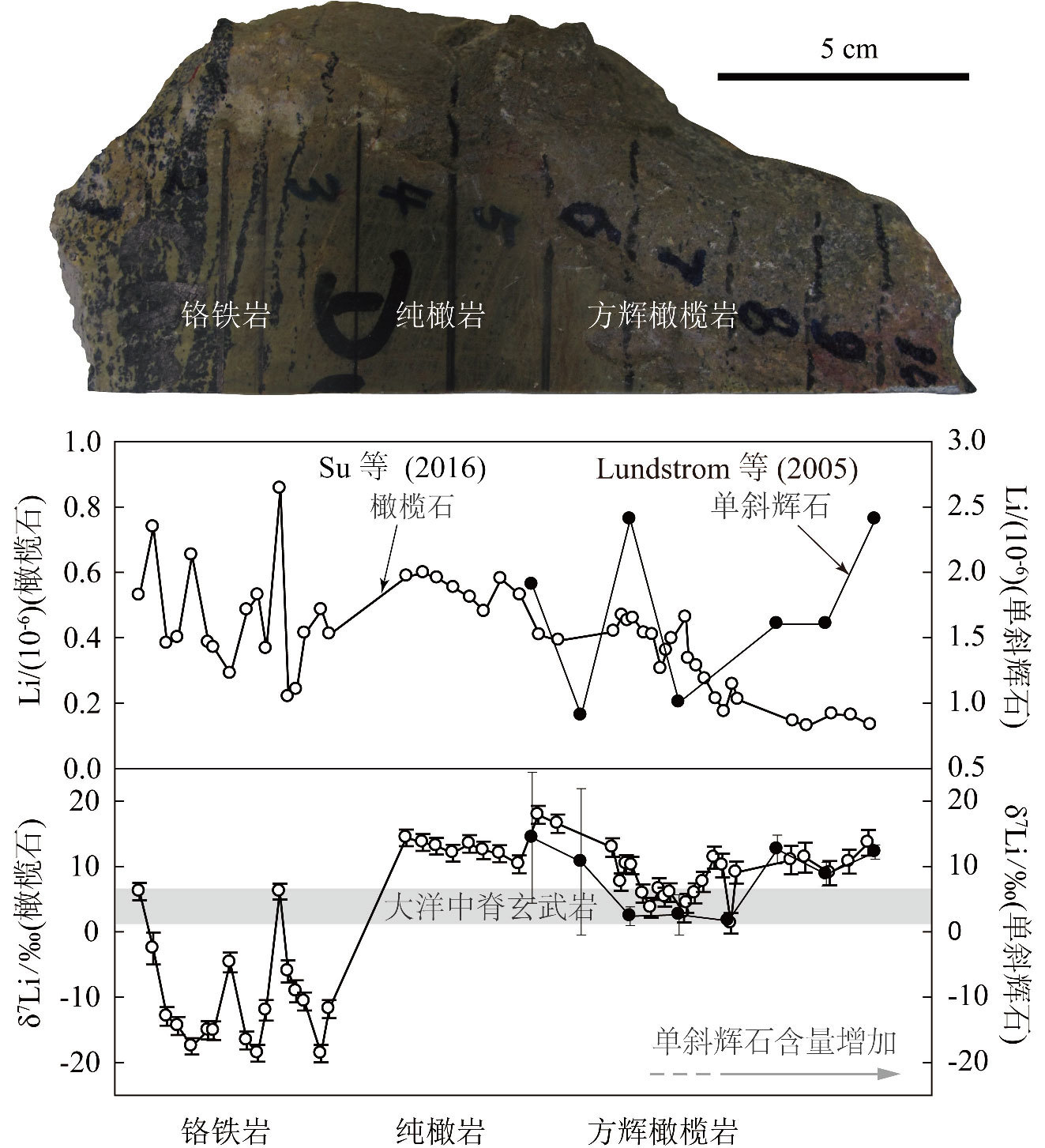
作者尝试对西藏罗布莎蛇绿岩中的方辉橄榄岩-纯橄岩-条带状铬铁矿复合型样品进行橄榄石原位Li同位素分析, 结果显示3种岩性中橄榄石的Li含量和Li同位素存在明显差异(图 6)。橄榄石Li含量总体较低(<1 mg/g), 从方辉橄榄岩到纯橄岩逐渐升高, 而在铬铁岩中变化较大, 与铬铁矿条带相关。纯橄岩中的橄榄石δ7Li总体高于方辉橄榄岩, 与弧岩浆相似, 其变化趋势和Lundstrom等(2005)对Trinity蛇绿岩中相应岩石的单斜辉石Li同位素分析结果一致;铬铁岩中的橄榄石具有低的δ7Li值, 铬铁矿条带中橄榄石的δ7Li值最低(低至-20‰), 与榴辉岩的Li同位素组成具有可比性;而橄榄石条带的δ7Li值略高, 可接近MORB值。这些Li同位素结果与岩石学和地球化学特征(Zhou et al., 1996, 2005, 2014)共同指示罗布莎蛇绿岩经历了俯冲物质的改造, 纯橄岩的形成与俯冲板片脱水作用相关的弧岩浆作用有关, 而结晶出铬铁矿的熔体可能与脱水后的板片的熔融有关(Su et al., 2016)。
|
图 6 西藏罗布莎蛇绿岩中方辉橄榄岩-纯橄岩-铬铁岩样品中橄榄石(据Su et al., 2016)及美国Trinity蛇绿岩中单斜辉石(据Lundstrom et al., 2005)的Li含量和Li同位素组成特征(据Su et al., 2016修改) Figure 6 Variations of Li abundance and δ7Li value of olivine in harzburgite-dunite-chromitite composite sample from the Luobusa ophiolite in Tibet(after Su et al., 2016)and of clinopyroxene in Trinity ophiolite in United States(after Lundstrom et al., 2005)(after Su et al., 2016) |
蛇绿岩中矿物的Li同位素组成可能会受扩散作用和后期蚀变的影响。根据其Li含量和Li同位素的变化趋势, 很容易排除这些干扰而获得其原始的地球化学信息(Su et al., 2016)。Li同位素对俯冲信息的敏感性可能有益于解释蛇绿岩形成背景和经历的地质过程, 进而可能为识别蛇绿岩类型(大洋中脊型和俯冲带型蛇绿岩)提供地球化学判别。尤其值得一提的是, 纯橄岩和铬铁岩的矿物组成简单(橄榄石和铬铁矿), 铬铁矿几乎不含Li元素, 因而橄榄石可以代表其全岩的Li同位素组成;同时, Li同位素体系也不会受到橄榄石和铬铁矿之间Fe-Mg交换的影响(Chen et al., 2015;Xiao et al., 2016)。对不同类型蛇绿岩和不同类型纯橄岩和铬铁岩的更多更详尽的Li同位素分析, 将进一步制约结晶出铬铁矿的熔体性质和来源, 进而揭示铬铁矿成因。
5 结论越来越多的Li同位素数据表明, 地幔岩石矿物的Li同位素组成和变化, 不能仅由其强活动引起的扩散作用所解释, 而是与地质过程密切相关。对典型样品的分析揭示Li同位素体系可以对地幔硅酸盐和碳酸盐交代类型进行有效识别;对区域上广泛样品的研究表明Li同位素能够揭示地幔不均一性、示踪复杂的地幔过程;幔源岩浆分异演化过程中的Li同位素分馏可能与岩浆的含水性、氧逸度和演化程度等因素有关;对蛇绿岩的Li同位素初步研究显示其在蛇绿岩形成演化和铬铁矿成因方面存在较大的应用潜力。尽管Li同位素已在地幔地球化学研究中体现出了较大的应用前景, 但其在高温下的地球化学行为和引起分馏的控制因素尚不明确, 有待深入研究。
| [] | Ackerman L, Ulrych J, Řanda Z, Erban V, Hegner E, Magna T, Balogh K, Frána J, Lang M, Novák J K. 2015. Geochemical characteristics and petrogenesis of phonolites and trachytic rocks from the Č eské Stř edohoří Volcanic Complex, the Ohře Rift, Bohemian Massif. Lithos , 224-225 : 256–271. DOI:10.1016/j.lithos.2015.03.014 |
| [] | Aulbach S, Rudnick R L. 2009. Origins of non-equilibrium lithium isotopeic fractionation in xenolithic peridotite minerals:Examples from Tanzania. Chemical Geology , 258 (1-2) : 17–27. DOI:10.1016/j.chemgeo.2008.07.015 |
| [] | Brooker R A, James R H, Blundy J D. 2004. Trace elements and Li isotope systematics in Zabargad peridotites:Evidence of ancient subduction processes in the Red Sea mantle. Chemical Geology , 212 (1-2) : 179–204. DOI:10.1016/j.chemgeo.2004.08.007 |
| [] | Bryant C J, Chappell B W, Bennett V C, McCulloch M T. 2004. Lithium isotopic compositions of the New England Batholith:Correlations with inferred source rock compositions. Earth and Environmental Science Transactions of the Royal Society of Edinburgh , 95 (1-2) : 199–214. DOI:10.1017/S0263593300001012 |
| [] | Chacko T, Cole D R, Horita J. 2001. Equilibrium oxygen, hydrogen and carbon isotope fractionation factors applicable to geologic systems In:Valley J W, Cole D R (eds). Stable Isotope Geochemistry. Washington D C:Mineralogical Society of America , 43 : 1–82. |
| [] | Chan L H, Edmond J M, Thompson G, Gillis K. 1992. Lithium isotopic composition of submarine basalts:Implications for the lithium cycle in the oceans. Earth and Planetary Science Letters , 108 (1-3) : 151–160. DOI:10.1016/0012-821X(92)90067-6 |
| [] | Chen C, Su B X, Uysal I, Avcı E, Zhang P F, Xiao Y, He Y S. 2015. Iron isotopic constraints on the origin of peridotite and chromitite in the Kızılda ophiolite, southern Turkey. Chemical Geology , 417 : 115–124. DOI:10.1016/j.chemgeo.2015.10.001 |
| [] | Eggins S M, Rudnick R L, McDonough W F. 1998. The composition of peridotites and their minerals:A laser-ablation ICP-MS study. Earth and Planetary Science Letters , 154 (1-4) : 53–71. DOI:10.1016/S0012-821X(97)00195-7 |
| [] | Elliott T, Jeffcoate A B, Bouman C. 2004. The terrestrial Li isotope cycle:Light-weight constraints on mantle convection. Earth and Planetary Science Letters , 220 (3-4) : 231–245. DOI:10.1016/S0012-821X(04)00096-2 |
| [] | Elliott T, Thomas A, Jeffcoate A B, Niu Y L. 2006. Lithium isotope evidence for subduction-enriched mantle in the source of mid-ocean-ridge basalts. Nature , 443 (7111) : 565–568. DOI:10.1038/nature05144 |
| [] | Farahat E S, Helmy H M. 2006. Abu Hamamid Neoproterozoic Alaskan-type complex, south Eastern Desert, Egypt. Journal of African Earth Sciences , 45 (2) : 187–197. DOI:10.1016/j.jafrearsci.2006.02.003 |
| [] | Gu X Y, Deloule E, France L, Ingrin J. 2016. Multi-stage metasomatism revealed by trace element and Li isotope distributions in minerals of peridotite xenoliths from Allègre volcano(French Massif Central). Lithos , 264 : 158–174. DOI:10.1016/j.lithos.2016.07.019 |
| [] | Hamelin C, Seitz H M, Barrat J A, Dosso L, Maury R, Chaussidon M. 2009. A low δ7Li lower crustal component:Evidence from an alkalic intraplate volcanic series(Chaîne des Puys, French Massif Central). Chemical Geology , 266 (3-4) : 205–217. DOI:10.1016/j.chemgeo.2009.06.005 |
| [] | Irvine T N. 1974. Petrology of the Duke Island ultramafic complex southeastern Alaska. Geological Society of American Memoirs , 138 : 1–244. DOI:10.1130/MEM138 |
| [] | Li X H, Li Q L, Liu Y, Tang G Q. 2011. Further characterization of M257 zircon standard:A working reference for SIMS analysis of Li isotopes. Journal of Analytical Atomic Spectrometry , 26 (2) : 352–358. DOI:10.1039/C0JA00073F |
| [] | Lundstrom C C, Chaussidon M, Hsui A T, Kelemen P, Zimmerman M. 2005. Observations of Li isotopic variations in the Trinity Ophiolite:Evidence for isotopic fractionation by diffusion during mantle melting. Geochimica et Cosmochimica Acta , 69 (3) : 735–751. DOI:10.1016/j.gca.2004.08.004 |
| [] | Magna T, Janoušek V, Kohút M, Oberli F, Wiechert U. 2010. Fingerprinting sources of orogenic plutonic rocks from Variscan belt with lithium isotopes and possible link to subduction-related origin of some A-type granites. Chemical Geology , 274 (1-2) : 94–107. DOI:10.1016/j.chemgeo.2010.03.020 |
| [] | Marks M A W, Rudnick R L, McCammon C, Vennemann T, Markl G. 2007. Arrested kinetic Li isotope fractionation at the margin of the Ilímaussaq complex, South Greenland:Evidence for open-system processes during final cooling of peralkaline igneous rocks. Chemical Geology , 246 (3-4) : 207–230. DOI:10.1016/j.chemgeo.2007.10.001 |
| [] | Plyusnin G S, Posokhov V F, Sandimirova G P. 1979. Magmatic differentiation and reliationship of 7Li/6Li ratio to fluorine content. Doklady Academy of Sciences USSR, Earth Sciences , 248 : 187–189. |
| [] | Seitz H M, Brey G P, Lahaye Y, Durali S, Weyer S. 2004. Lithium isotopic signatures of peridotite xenoliths and isotopic fractionation at high temperature between olivine and pyroxenes. Chemical Geology , 212 (1-2) : 163–177. DOI:10.1016/j.chemgeo.2004.08.009 |
| [] | Seitz H M, Woodland A B. 2000. The distribution of lithium in peridotitic and pyroxenitic mantle lithologies-an indicator of magmatic and metasomatic processes. Chemical Geology , 166 (1-2) : 47–64. DOI:10.1016/S0009-2541(99)00184-9 |
| [] | Su B X, Gu X Y, Deloule E, Zhang H F, Li Q L, Li X H, Vigier N, Tang Y J, Tang G Q, Liu Y, Pang K N, Brewer A, Mao Q, Ma Y G. 2015. Potential orthopyroxene, clinopyroxene and olivine reference materials for in situ lithium isotope determination. Geostandards and Geoanalytical Research , 39 (3) : 357–369. DOI:10.1111/ggr.2015.39.issue-3 |
| [] | Su B X, Qin K Z, Sakyi P A, Malaviarachchi S P K, Liu P P, Tang D M, Xiao Q H, Sun H, Ma Y G, Mao Q. 2012b. Occurrence of an Alaskan-type complex in the Middle Tianshan Massif, Central Asian Orogenic Belt:Inferences from petrological and mineralogical studies. International Geology Review , 54 (3) : 249–269. DOI:10.1080/00206814.2010.543009 |
| [] | Su B X, Qin K Z, Zhou M F, Sakyi P A, Thakurta J, Tang D M, Liu P P, Xiao Q H, Sun H. 2014c. Petrological, geochemical and geochronological constraints on the origin of the Xiadong Ural-Alaskan type complex in NW China and tectonic implication for the evolution of southern Central Asian Orogenic Belt. Lithos , 200-201 : 226–240. DOI:10.1016/j.lithos.2014.05.005 |
| [] | Su B X, Zhang H F, Deloule E, Sakyi P A, Xiao Y, Tang Y J, Hu Y, Ying J F, Liu P P. 2012a. Extremely high Li and low δ7Li signatures in the lithospheric mantle. Chemical Geology , 292-293 : 149–157. DOI:10.1016/j.chemgeo.2011.11.023 |
| [] | Su B X, Zhang H F, Deloule E, Vigier N, Hu Y, Tang Y J, Xiao Y, Sakyi P A. 2014a. Distinguishing silicate and carbonatite mantle metasomatism by using lithium and its isotopes. Chemical Geology , 381 : 67–77. DOI:10.1016/j.chemgeo.2014.05.016 |
| [] | Su B X, Zhang H F, Deloule E, Vigier N, Sakyi P A. 2014b. Lithium elemental and isotopic variations in rock-melt interaction. Chemie der Erde-Geochemistry , 74 (4) : 705–713. DOI:10.1016/j.chemer.2014.04.005 |
| [] | Su B X, Zhou M F, Robinson P T. 2016. Extremely large fractionation of Li isotopes in a chromitite-bearing mantle sequence. Scientific Reports , 6 : 22370. DOI:10.1038/srep22370 |
| [] | Tang Y J, Zhang H F, Deloule E, Su B X, Ying J F, Santosh M, Xiao Y. 2014. Abnormal lithium isotope composition from the ancient lithospheric mantle beneath the North China Craton. Scientific Reports , 4 : 4274. |
| [] | Tang Y J, Zhang H F, Deloule E, Su B X, Ying J F, Xiao Y, Hu Y. 2012. Slab-derived lithium isotopic signatures in mantle xenoliths from northeastern North China Craton. Lithos , 149 : 79–90. DOI:10.1016/j.lithos.2011.12.001 |
| [] | Tang Y J, Zhang H F, Nakamura E, Moriguti T, Kobayashi K, Ying J F. 2007a. Lithium isotopic systematics of peridotite xenoliths from Hannuoba, North China Craton:Implications for melt-rock interaction in the considerably thinned lithospheric mantle. Geochimica et Cosmochimica Acta , 71 (17) : 4327–4341. DOI:10.1016/j.gca.2007.07.006 |
| [] | Tang Y J, Zhang H F, Nakamura E, Ying J F. 2011. Multistage melt/fluid-peridotite interactions in the refertilized lithospheric mantle beneath the North China Craton:Constraints from the Li-Sr-Nd isotopic disequilibrium between minerals of peridotite xenoliths. Contributions to Mineralogy and Petrology , 161 (6) : 845–861. DOI:10.1007/s00410-010-0568-1 |
| [] | Tang Y J, Zhang H F, Ying J F. 2007b. Review of the lithium isotope system as a geochemical tracer. International Geology Review , 49 (4) : 374–388. DOI:10.2747/0020-6814.49.4.374 |
| [] | Tang Y J, Zhang H F, Ying J F. 2010. A brief review of isotopically light Li-a feature of the enriched mantle?. International Geology Review , 52 (9) : 964–976. DOI:10.1080/00206810903211385 |
| [] | Teng F Z, McDonough W F, Rudnick R L, Dalpé C, Tomascak P B, Chappell B W, Gao S. 2004. Lithium isotopic composition and concentration of the upper continental crust. Geochimica et Cosmochimica Acta , 68 (20) : 4167–4178. DOI:10.1016/j.gca.2004.03.031 |
| [] | Teng F Z, McDonough W F, Rudnick R L, Walker R J. 2006. Diffusion-driven extreme lithium isotopic fractionation in country rocks of the Tin Mountain pegmatite. Earth and Planetary Science Letters , 243 (3-4) : 701–710. DOI:10.1016/j.epsl.2006.01.036 |
| [] | Teng F Z, Rudnick R L, McDonough W F, Gao S, Tomascak P B, Liu Y S. 2008. Lithium isotopic composition and concentration of the deep continental crust. Chemical Geology , 255 (1-2) : 47–59. DOI:10.1016/j.chemgeo.2008.06.009 |
| [] | Teng F Z, Wadhwa M, Helz R T. 2007. Investigation of magnesium isotope fractionation during basalt differentiation:Implications for a chondritic composition of the terrestrial mantle. Earth and Planetary Science Letters , 261 (1-2) : 84–92. DOI:10.1016/j.epsl.2007.06.004 |
| [] | Tomascak P B, Magna T, Dohmen R. 2016. Advances in lithium isotope geochemistry. Switzerland: Springer International Publishing: 1 -195. |
| [] | Tomascak P B, Tera F, Helz R T, Walker R J. 1999. The absence of lithium isotope fractionation during basalt differentiation:New measurements by multicollector sector ICP-MS. Geochimica et Cosmochimica Acta , 63 (6) : 907–910. DOI:10.1016/S0016-7037(98)00318-4 |
| [] | Tomascak P B, Widom E, Benton L D, Goldstein S L, Ryan J G. 2002. The control of lithium budgets in island arcs. Earth and Planetary Science Letters , 196 (3-4) : 227–238. DOI:10.1016/S0012-821X(01)00614-8 |
| [] | Wagner C, Deloule E. 2007. Behaviour of Li and its isotopes during metasomatism of French Massif Central lherzolites. Geochimica et Cosmochimica Acta , 71 (17) : 4279–4296. DOI:10.1016/j.gca.2007.06.010 |
| [] | Weyer S, Seitz H M. 2012. Coupled lithium-and iron isotope fractionation during magmatic differentiation. Chemical Geology , 294-295 : 42–50. DOI:10.1016/j.chemgeo.2011.11.020 |
| [] | Woodland A B, Seitz H M, Yaxley G M. 2004. Varying behaviour of Li in metasomatised spinel peridotite xenoliths from western Victoria, Australia. Lithos , 75 (1-2) : 55–66. DOI:10.1016/j.lithos.2003.12.014 |
| [] | Wunder B, Meixner A, Romer R L, Heinrich W. 2006. Temperature-dependent isotopic fractionation of lithium between clinopyroxene and high-pressure hydrous fluids. Contributions to Mineralogy and Petrology , 151 (1) : 112–120. DOI:10.1007/s00410-005-0049-0 |
| [] | Xiao Y, Teng F Z, Su B X, Hu Y, Zhou M F, Zhu B, Shi R D, Huang Q S, Gong X H, He Y S. 2016. Iron and magnesium isotopic constraints on the origin of chemical heterogeneity in podiform chromitite from the Luobusa ophiolite, Tibet. Geochemistry, Geophysics, Geosystems , 17 (3) : 940–953. DOI:10.1002/2015GC006223 |
| [] | Xiao Y, Zhang H F, Deloule E, Su B X, Tang Y J, Sakyi P A, Hu Y, Ying J F. 2015. Large Lithium Isotopic Variations in Minerals from Peridotite Xenoliths from the Eastern North China Craton. Journal of Geology , 123 (1) : 79–94. DOI:10.1086/680222 |
| [] | Xu R, Liu Y S, Tong X R, Hu Z C, Zong K Q, Gao S. 2013. In-situ trace elements and Li and Sr isotopes in peridotite xenoliths from Kuandian, North China Craton:Insights into Pacific slab subduction-related mantle modification. Chemical Geology , 354 : 107–123. DOI:10.1016/j.chemgeo.2013.06.022 |
| [] | Zack T, Tomascak P B, Rudnick R L, Dalpé C, McDonough W F. 2003. Extremely light Li in orogenic eclogites:The role of isotope fractionation during dehydration in subducted oceanic crust. Earth and Planetary Science Letters , 208 (3-4) : 279–290. DOI:10.1016/S0012-821X(03)00035-9 |
| [] | Zhang H F, Deloule E, Tang Y J, Ying J F. 2010. Melt/rock interaction in remains of refertilized Archean lithospheric mantle in Jiaodong Peninsula, North China Craton:Li isotopic evidence. Contributions to Mineralogy and Petrology , 160 (2) : 261–277. DOI:10.1007/s00410-009-0476-4 |
| [] | Zhou M F, Robinson P T, Malpas J, Edwards S, Qi L. 2005. REE and PGE geochemical constraints on the formation of dunites in the Luobusa ophiolite, Southern Tibet. Journal of Petrology , 46 (3) : 615–639. |
| [] | Zhou M F, Robinson P T, Malpas J, Li Z J. 1996. Podiform chromitites in the Luobusa Ophiolite(southern Tibet):Implications for melt-rock interaction and chromite segregation in the upper mantle. Journal of Petrology , 37 (1) : 3–21. DOI:10.1093/petrology/37.1.3 |
| [] | Zhou M F, Robinson P T, Su B X, Gao J F, Li J W, Yang J S, Malpas J. 2014. Compositions of chromite, associated minerals, and parental magmas of podiform chromite deposits:The role of slab contamination of asthenospheric melts in suprasubduction zone environments. Gondwana Research , 26 (1) : 262–283. DOI:10.1016/j.gr.2013.12.011 |
| [] | 李佩, 夏群科, DelouleE. 2012. 山东蓬莱新生代岩石圈地幔的异常锂同位素组成:橄榄岩包体的离子探针分析. 高校地质学报 , 18 (1) : 62–73. |
| [] | 李献华, 刘宇, 汤艳杰, 高钰涯, 李秋立, 唐国强. 2015. 离子探针Li同位素微区原位分析技术与应用. 地学前缘 , 22 (5) : 160–170. |
| [] | 汤艳杰, 张宏福, 英基丰. 2011. 地幔中EM1端员成因的锂同位素制约. 矿物岩石地球化学通报 , 30 (1) : 11–17. |
| [] | 肖益林, 孙贺, 顾海欧, 黄建, 李王晔, 刘磊. 2015. 大陆深俯冲过程中的熔/流体成分与地球化学分异. 中国科学(D辑) , 45 (8) : 1063–1087. |