 2017, Vol. 36


火山喷出气体的组成表明, 水是地球岩浆中的一种主要挥发分(Symonds et al., 1994)。对于火山岩斑晶中熔体包裹体的研究也得到相同的结论(Moore, 2008)。水的存在导致硅酸盐岩石体系的熔融温度降低, 熔融程度增大(Hirschmann, 2009)。水可以促进岩石熔融的根本原因就在于它是一种不相容组分, 更易溶解于硅酸盐熔体而非固相矿物中, 从而使熔体中硅酸盐组分的化学势降低(Ni et al., 2016)。了解水在硅酸盐熔体中以何种形式存在、硅酸盐熔体具有多强的储水能力、水对硅酸盐熔体的密度等物理性质又产生哪些影响, 对于认识部分熔融、岩浆分异和火山喷发等一系列地质过程都具有十分关键的意义。关于硅酸盐熔体中的水的高温高压实验和计算研究近三十年来长盛不衰, 取得了多项重要进展。
1 水在硅酸盐熔体中的赋存形式在地球岩石圈对应的温度、压力和氧逸度条件下, 溶解在硅酸盐熔体中的水主要以H2O分子和带电荷的OH 2种形式存在(Stolper, 1982), 其中OH又可以与不同的阳离子成键(Xue and Kanzaki, 2004)。在地球深部更高压力下, 有可能形成Si-O-H-O-Si等更大型的结构(Mookherjee et al., 2008); 如果再考虑到深部的氧逸度较低, H也可能以H2的形式溶解在硅酸盐熔体中(Hirschmann et al., 2012)。
在岩石圈深度, H2O和OH这2种水种型的比例与温度、压力、熔体成分和总水含量均有一定的依赖关系。一般认为, 2种水种型之间存在以下反应平衡(Stolper, 1982):

|
(1) |
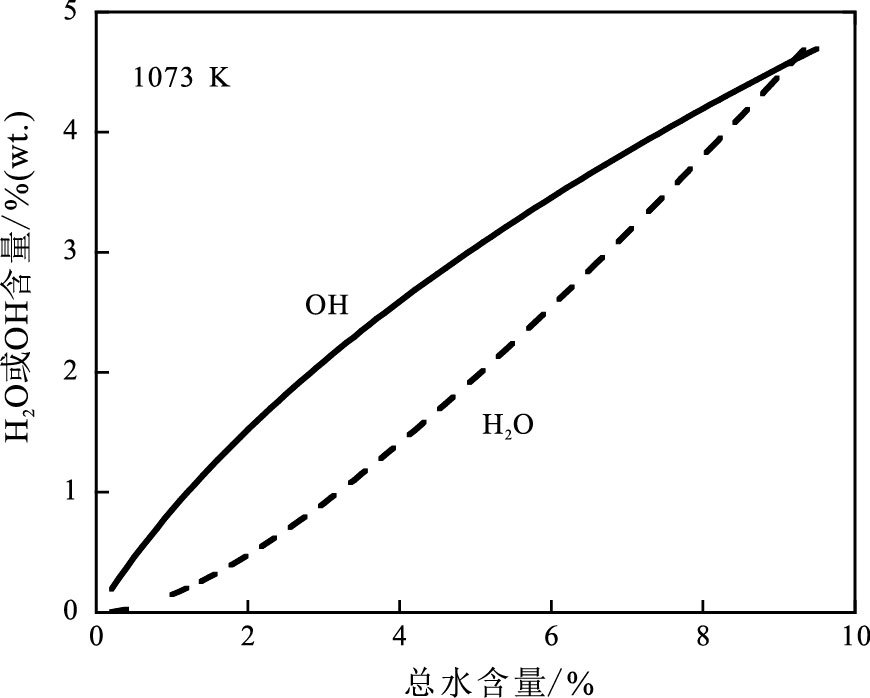
即水分子打开相邻硅氧(或铝氧)四面体之间的连接, 反应生成2个OH。此反应是吸热反应, 温度升高导致OH的比例上升。压力效应不如温度效应显著, 但升压也有利于OH的形成(Hui et al., 2008)。从流纹质到英安质到安山质熔体, 在其他条件相同时OH的比例递增(Zhang and Ni, 2010; 倪怀玮, 2013)。当总水含量增大时, H2O含量的增长更快, OH的相对占比下降(图 1)。但在绝大多数情况下, OH仍居优势地位。
|
图 1 温度为1073 K的流纹质熔体中不同总水含量对应的H2O和OH含量(根据Zhang et al., 1997计算) Figure 1 Variation of H2O and OH concentrations with total water contents in a rhyolitic melt at 1073 K(based on Zhang et al., 1997) |
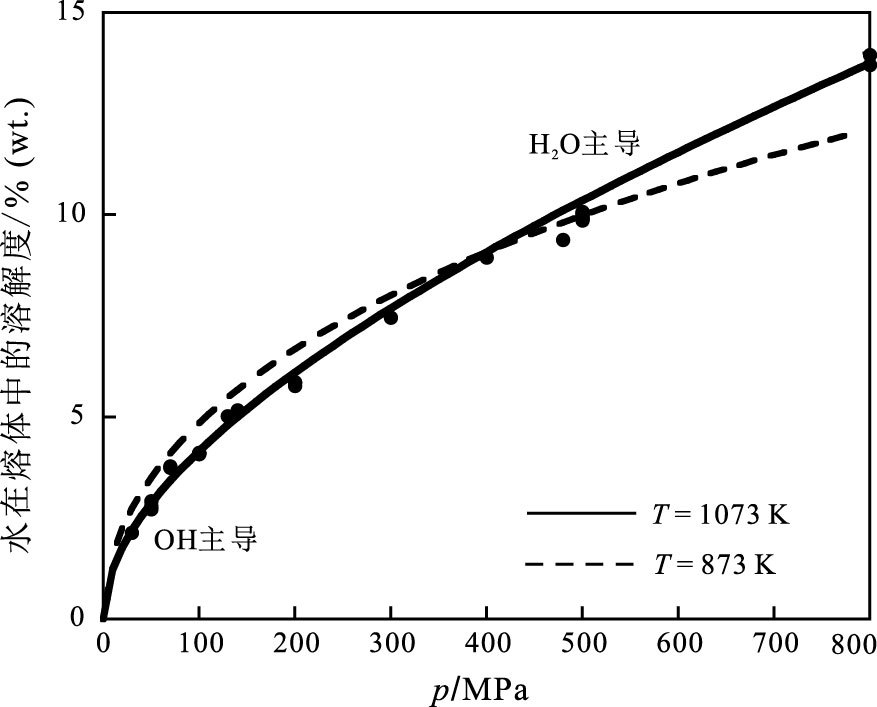
水在硅酸盐熔体中的溶解度随压力的升高而增大(图 2)。溶解度在低压下与压力的平方根成正比, 在高压下随压力升高近似呈线性增长, 这种变化特征与水的种型变化趋势(随着总水含量的增加从以OH为主过渡到以H2O为主)是一致的(Zhang, 1999)。在低压下, 溶解度随温度升高略微降低; 在高压下, 升温却又使溶解度略微升高。水在过碱性熔体中的溶解度相较于过铝质或准铝质熔体更高一些, 但一般来说溶解度对硅酸盐熔体成分的变化并不敏感(Zhang et al., 2007; Keppler, 2013)。
|
图 2 水在流纹质熔体中的溶解度(实心点为Holtz et al., 1995的1073 K实验数据, 曲线根据Zhang et al., 2007计算) Figure 2 Water solubility in a rhyolitic melt(solid systemols are experimental data at 1073 K in Holtz et al., 1995, and the solubility curves are based on Zhang et al., 2007) |
在流体饱和条件下, 当压力升高时, 不单水在熔体中的含量升高, 溶解在流体中的硅酸盐含量也升高。当温压条件位于硅酸盐-H2O体系的临界曲线之上时, 硅酸盐熔体和富水流体之间的混溶隙完全闭合, 水的溶解度(或熔体的储水能力)失去定义(Shen and Keppler, 1997)。此时水和硅酸盐可以在较大范围内以任意比例混溶, 形成中间成分的超临界流体。超临界流体可能是俯冲带从板片向地幔楔迁移物质的关键媒介(Kessel et al., 2005), 关于超临界流体形成条件和物理化学性质的研究已经成为地球深部研究的一个重要的前沿方向。
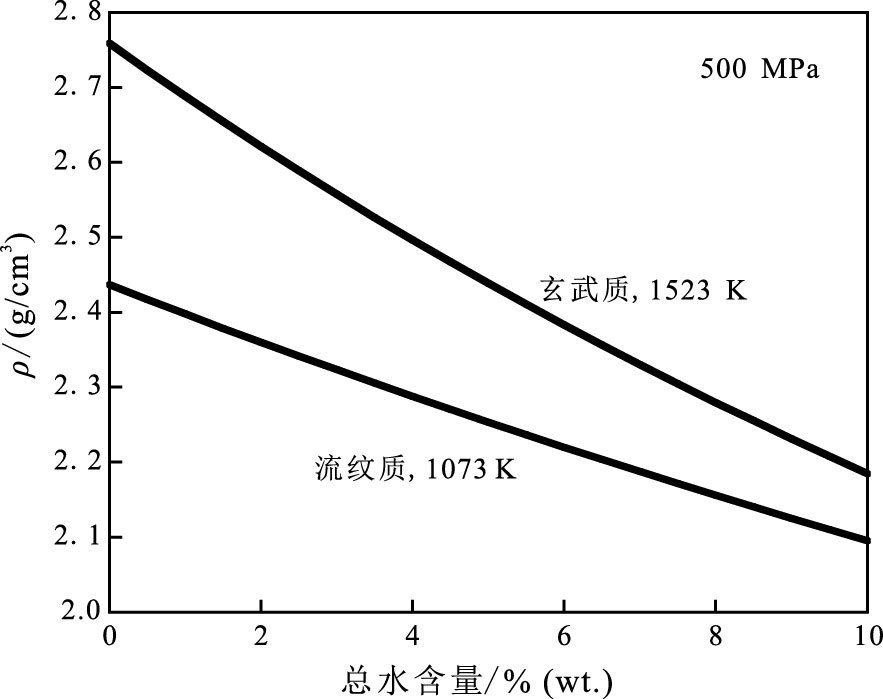
3 含水硅酸盐熔体的密度硅酸盐熔体的密度随着水含量的增加近似呈线性下降趋势(图 3)。Ochs和Lange(1999)测定水在1273 K和常压下熔体中的偏摩尔体积为22.9 cm3/mol, 对应的密度不足0.8g/cm3, 大大低于干的硅酸盐熔体的密度(一般介于2~3g/cm3之间)。此外, 含水硅酸盐熔体的热膨胀和压缩性质也比干的熔体更强。Sakamaki等(2006)发现在2473 K的玄武质熔体中, 水的偏摩尔体积从常压下的34 cm3/mol随压力升高近似呈指数下降, 当压力达到10 GPa时降到不足10 cm3/mol。
|
(据Lange, 1997和Ochs and Lange, 1999计算) 图 3 硅酸盐熔体的密度随水含量的增加而下降 (based on Lange, 1997; Ochs and Lange, 1999) Figure 3 Decrease in melt density with increasing water content |
可以用单一的偏摩尔体积值描述水对熔体密度的效应也暗示反应(1)造成的体积变化不大。理论上从水的溶解度和种型分异数据中也可以提取水在熔体中的偏摩尔体积, 但Zhang(1999)发现这种方法得到的结果与Ochs和Lange(1999)的测量值之间存在很大差异, 其具体原因尚不清楚。
密度降低导致含水硅酸盐熔体相对于固相岩石的浮力效应增强, 更容易从源区分凝。在研究地球深部熔体的重力稳定性时, 水的作用也是一个需要重点考察的关键因素(Matsukage et al., 2005; Sakamaki et al., 2006)。
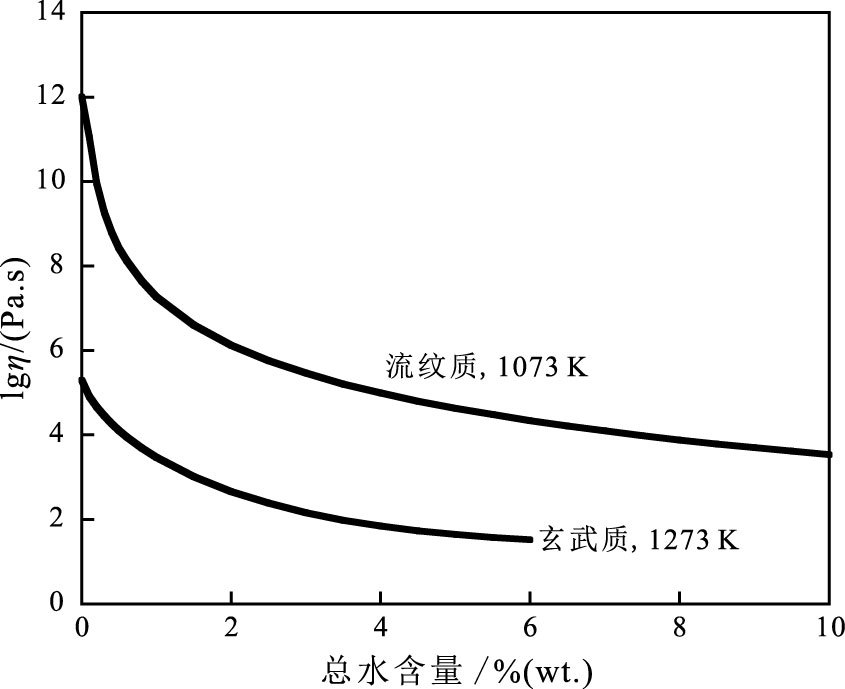
4 水对熔体黏度的影响当水溶解进入硅酸盐熔体, 熔体的黏度迅速降低(图 4)。这种现象的微观机制可以用反应(1)来解释, 即从H2O生成OH的过程导致熔体的聚合度下降。也正因为如此, 在同等条件下, 聚合度较高的长英质熔体的黏度下降得比聚合度较低的镁铁质熔体要更显著一些。对于特定成分的熔体如流纹质熔体, 已经建立起准确的定量模型描述水对熔体黏度的影响(Zhang et al., 2003)。Hui和Zhang(2007)和Giordano等(2008)的硅酸盐熔体黏度普适模型也充分考虑了水的作用。熔体黏度下降有利于熔体的分凝、元素的扩散迁移以及晶体和气泡的生长和搬运。相比之下, CO2对于熔体黏度的影响要弱得多(Brearley and Montana, 1989)。
|
(根据Zhang et al., 2003和Hui and Zhang, 2007计算) 图 4 硅酸盐熔体的黏度随水含量的增加而下降 (based on Zhang et al., 2003; Hui and Zhang, 2007) Figure 4 Decrease in melt viscosity with increasing water content |
由于熔体的黏度随着水的加入而降低, 熔体的微观活动性加强, 各种原子、分子和离子在熔体中的扩散迁移加快。水对Si和Al等与熔体结构弛豫紧密耦合、扩散较慢的元素的扩散系数的提升效应更为显著(Zhang et al., 2010; 倪怀玮, 2013)。
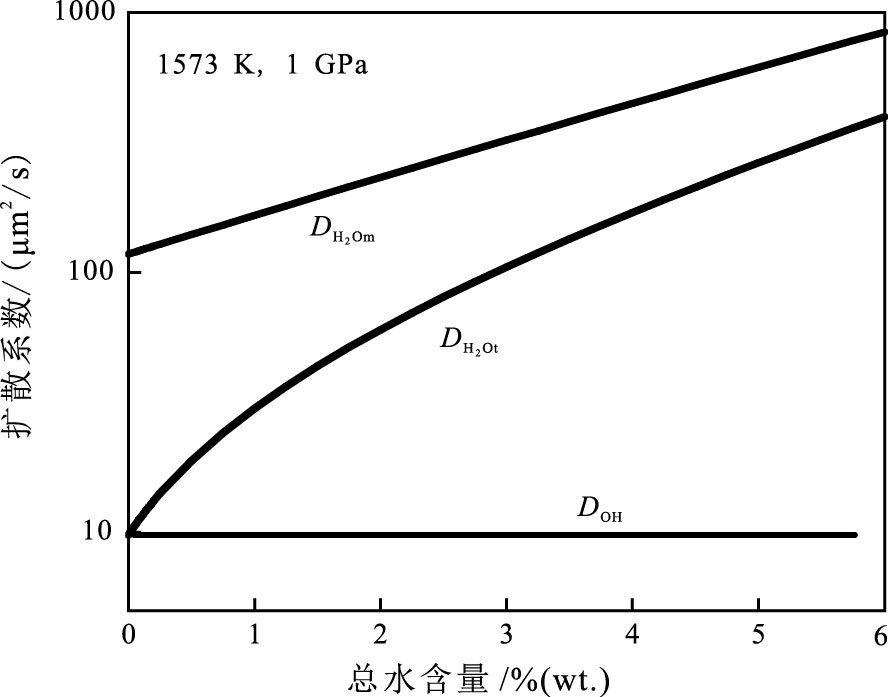
水自身在硅酸盐熔体中的扩散行为也具有重要的理论意义和应用价值。H2O和OH的电价不同, 在熔体中的扩散快慢不一, 总水扩散系数是H2O扩散系数和OH扩散系数的加权平均, 这属于典型的多种型扩散问题。Zhang等(1991)对流纹质熔体的研究发现, 水的扩散由H2O主导, OH的贡献可以忽略不计。Ni等(2013)利用双扩散偶技术研究了安山质熔体中的水扩散, 不单确定了H2O扩散系数和总水扩散系数随水含量的变化, 还成功分辨出了OH的扩散系数(图 5), 推翻了OH扩散受熔体黏度控制的传统认识。他们的一系列工作(Ni and Zhang, 2008; Ni et al., 2009a, 2009b; Ni et al., 2013)确定了大范围温压条件下(700~1900 K, 0~2 GPa)水在俯冲带钙碱性熔体中的扩散系数, 并建立了精确的水扩散系数模型。这些模型在定量模拟火山喷发过程中的气泡生长和岩浆的水含量演化方面得到了广泛应用(如Ruprecht and Bachmann, 2010; Giachetti et al., 2015)。
|
图 5 分子H2O(H2Om)扩散系数和总水(H2Ot)扩散系数随安山质熔体水含量的增加而增大(根据Ni et al., 2013计算) Figure 5 Increase in molecular H2O(H2Om)diffusivity and total water(H2Ot)diffusivity with increasing water content in an andesitic melt(based on Ni et al., 2013) |
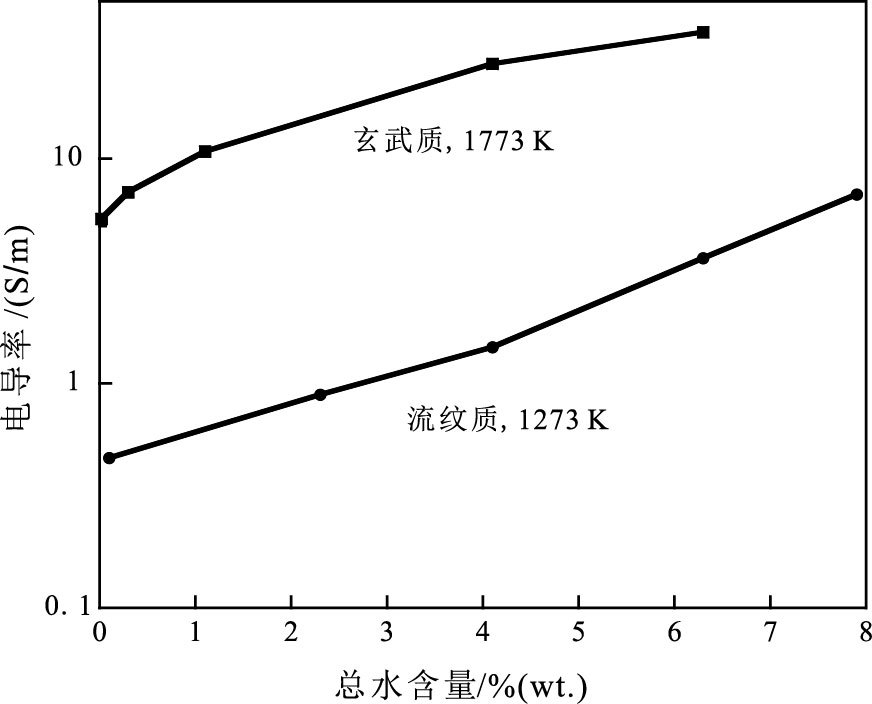
除黏度和扩散系数外, 硅酸盐熔体的电导率也是饱受水含量影响的又一参数(Ni et al., 2015)。一系列熔体电导率实验研究结果发现(Ni et al., 2011a; 2011b; Guo et al., 2016), 熔体电导率随水的加入迅速升高(图 6), 其主要原因在于熔体中的Na+等离子的迁移加快, 而非OH直接参与导电。含水熔体电导率测量结果为解析地球内部部分熔融区域的物理化学状态奠定了基础。Ni等(2011b)指出大洋软流圈低速带中的电导异常可能是由1%左右的含水玄武质熔体造成的, 此观点获得了多项高温高压实验和地球物理观测研究的支持(Naif et al., 2013; Sifré et al., 2014)。Guo等(2016)对长白山天池火山下方活动岩浆房的熔体比例和熔体水含量作出了制约, 为评估天池火山的喷发前景提供了依据。
|
(根据Ni et al., 2011b和Guo et al., 2016绘制) 图 6 硅酸盐熔体的电导率随水含量的增加而升高 with increasing water content(based on Ni et al., 2011b; Guo et al., 2016) Figure 6 Enhanced electrical conductivity of silicate melts |
目前对岩石圈深度硅酸盐熔体中水的赋存形式和溶解度以及含水硅酸盐熔体的物理性质已经取得了比较充分的认识。可以看出, 水的种型分异反应是理解水的溶解行为以及水对熔体迁移性质的影响的关键。由于水对岩石熔融和熔体性质的显著影响, 在研究与熔融有关的地质过程时需要充分考虑水的作用。未来需要着力探索的研究方向包括: ①地球深部低氧逸度条件下H在硅酸盐熔体中的赋存形式和溶解度, 以及此类熔体的物理化学性质; ②中间成分超临界流体(可以视为一种极度富水的熔体)的形成条件、物理化学性质和在俯冲带过程中的作用; ③水扩散系数和熔体电导率随熔体成分、温度、压力和水含量变化的普适定量模型。
致谢: 感谢中国矿物岩石地球化学学会约稿以及郭璇博士和李镇江的协助。
| [] | Brearley M, Montana A. 1989. The effect of CO2 on the viscosity of silicate liquids at high pressure. Geochimica et Cosmochimica Acta , 53 (10) : 2609–2616. DOI:10.1016/0016-7037(89)90132-4 |
| [] | Giachetti T, Gonnermann H M, Gardner J E, Shea T, Gouldstone A. 2015. Discriminating secondary from magmatic water in rhyolitic matrix-glass of volcanic pyroclasts using thermogravimetric analysis. Geochimica et Cosmochimica Acta , 148 : 457–476. DOI:10.1016/j.gca.2014.10.017 |
| [] | Giordano D, Russell J K, Dingwell D B. 2008. Viscosity of magmatic liquids:A model. Earth and Planetary Science Letters , 271 (1-4) : 123–134. DOI:10.1016/j.epsl.2008.03.038 |
| [] | Guo X, Zhang L, Behrens H, Ni H W. 2016. Probing the status of felsic magma reservoirs:Constraints from the P-T-H2O dependences of electrical conductivity of rhyolitic melt. Earth and Planetary Science Letters , 433 : 54–62. DOI:10.1016/j.epsl.2015.10.036 |
| [] | Hirschmann M M, Tenner T, Aubaud C, Withers A C. 2009. Dehydration melting of nominally anhydrous mantle:The primacy of partitioning. Physics of the Earth and Planetary Interiors , 176 (1-2) : 54–68. DOI:10.1016/j.pepi.2009.04.001 |
| [] | Hirschmann M M, Withers A C, Ardia P, Foley N T. 2012. Solubility of molecular hydrogen in silicate melts and consequences for volatile evolution of terrestrial planets. Earth and Planetary Science Letters , 345-348 : 38–48. DOI:10.1016/j.epsl.2012.06.031 |
| [] | Holtz F, Behrens H, Dingwell D B, Johannes W. 1995. H2O solubility in haplogranitic melts; compositional, pressure, and temperature dependence. American Mineralogist , 80 (1-2) : 94–108. DOI:10.2138/am-1995-1-210 |
| [] | Hui H J, Zhang Y X, Xu Z J, Behrens H. 2008. Pressure dependence of the speciation of dissolved water in rhyolitic melts. Geochimica et Cosmochimica Acta , 72 (13) : 3229–3240. DOI:10.1016/j.gca.2008.03.025 |
| [] | Hui H J, Zhang Y X. 2007. Toward a general viscosity equation for natural anhydrous and hydrous silicate melts. Geochimica et Cosmochimica Acta , 71 (2) : 403–416. DOI:10.1016/j.gca.2006.09.003 |
| [] | Keppler H. 2013. Volatiles under high pressure. In:Karato S I(ed). Physics and Chemistry of the Deep Earth. Blackwell:Wiley, 3-37 |
| [] | Kessel R, Ulmer P, Pettke T, Schmidt M W, Thompson A B. 2005. The water-basalt system at 4 to 6 GPa:Phase relations and second critical endpoint in a K-free eclogite at 700 to 1400℃. Earth and Planetary Science Letters , 237 (3-4) : 873–892. DOI:10.1016/j.epsl.2005.06.018 |
| [] | Lange R A. 1997. A revised model for the density and thermal expansivity of K2O-Na2O-CaO-MgO-Al2O3-SiO2 liquids from 700 to 1900 K:Extension to crustal magmatic temperatures. Contributions to Mineralogy and Petrology , 130 (1) : 1–11. DOI:10.1007/s004100050345 |
| [] | Matsukage K N, Jing Z C, Karato S I. 2005. Density of hydrous silicate melt at the conditions of Earth's deep upper mantle. Nature , 438 (7067) : 488–491. DOI:10.1038/nature04241 |
| [] | Mookherjee M, Stixrude L, Karki B B. 2008. Hydrous silicate melt at high pressure. Nature , 452 (7190) : 983–986. DOI:10.1038/nature06918 |
| [] | Moore G. 2008. Interpreting H2O and CO2 contents in melt inclusions:Constraints from solubility experiments and modeling. Reviews in Mineralogy and Geochemistry , 69 (1) : 333–362. DOI:10.2138/rmg.2008.69.9 |
| [] | Naif S, Key K, Constable S, Evans R L. 2013. Melt-rich channel observed at the lithosphere-asthenosphere boundary. Nature , 495 (7441) : 356–359. DOI:10.1038/nature11939 |
| [] | Ni H W, Behrens H, Zhang Y X. 2009b. Water diffusion in dacitic melt. Geochimica et Cosmochimica Acta , 73 (12) : 3642–3655. DOI:10.1016/j.gca.2009.03.029 |
| [] | Ni H W, Hui H J, Steinle-Neumann G. 2015. Transport properties of silicate melts. Reviews of Geophysics , 53 (3) : 715–744. DOI:10.1002/2015RG000485 |
| [] | Ni H W, Keppler H, Behrens H. 2011b. Electrical conductivity of hydrous basaltic melts:Implications for partial melting in the upper mantle. Contributions to Mineralogy and Petrology , 162 (3) : 637–650. DOI:10.1007/s00410-011-0617-4 |
| [] | Ni H W, Keppler H, Manthilake M A G M, Katsura T. 2011a. Electrical conductivity of dry and hydrous NaAlSi3O8 glasses and liquids at high pressures. Contributions to Mineralogy and Petrology , 162 (3) : 501–513. DOI:10.1007/s00410-011-0608-5 |
| [] | Ni H W, Liu Y, Wang L J, Zhang Y X. 2009a. Water speciation and diffusion in haploandesitic melts at 743-873 K and 100 MPa. Geochimica et Cosmochimica Acta , 73 (12) : 3630–3641. DOI:10.1016/j.gca.2009.03.024 |
| [] | Ni H W, Xu Z J, Zhang Y X. 2013. Hydroxyl and molecular H2O diffusivity in a haploandesitic melt. Geochimica et Cosmochimica Acta , 103 : 36–48. DOI:10.1016/j.gca.2012.10.052 |
| [] | Ni H W, Zhang L, Guo X. 2016. Water and partial melting of Earth's mantle. Science China Earth Sciences , 59 (4) : 720–730. DOI:10.1007/s11430-015-5254-8 |
| [] | Ni H W, Zhang Y W. 2008. H2O diffusion models in rhyolitic melt with new high pressure data. Chemical Geology , 250 (1-4) : 68–78. DOI:10.1016/j.chemgeo.2008.02.011 |
| [] | Ochs F A Ⅲ, Lange R A. 1999. The density of hydrous magmatic liquids. Science , 283 (5406) : 1314–1317. DOI:10.1126/science.283.5406.1314 |
| [] | Ruprecht P, Bachmann O. 2010. Pre-eruptive reheating during magma mixing at Quizapu volcano and the implications for the explosiveness of silicic arc volcanoes. Geology , 38 (10) : 919–922. DOI:10.1130/G31110.1 |
| [] | Sakamaki T, Suzuki A, Ohtani E. 2006. Stability of hydrous melt at the base of the Earth's upper mantle. Nature , 439 (7073) : 192–194. DOI:10.1038/nature04352 |
| [] | Shen A H, Keppler H. 1997. Direct observation of complete miscibility in the albite-H2O system. Nature , 385 (6618) : 710–712. DOI:10.1038/385710a0 |
| [] | Sifré D, Gardés E, Massuyeau M, Hashim L, Hier-Majumder S, Gaillard F. 2014. Electrical conductivity during incipient melting in the oceanic low-velocity zone. Nature , 509 (7498) : 81–85. DOI:10.1038/nature13245 |
| [] | Stolper E. 1982. The speciation of water in silicate melts. Geochimica et Cosmochimica Acta , 46 (12) : 2609–2620. DOI:10.1016/0016-7037(82)90381-7 |
| [] | Symonds R B, Rose W I, Bluth G J S, Gerlach T M. 1994. Volcanic-gas studies:Methods, results and applications. Reviews in Mineralogy , 30 : 1–66. |
| [] | Xue X Y, Kanzaki M. 2004. Dissolution mechanisms of water in depolymerized silicate melts:Constraints from 1H and 29Si NMR spectroscopy and ab initio calculations. Geochimica et Cosmochimica Acta , 68 (24) : 5027–5057. DOI:10.1016/j.gca.2004.08.016 |
| [] | Zhang Y W, Ni H W. 2010. Diffusion of H, C, and O components in silicate melts. Reviews in Mineralogy and Geochemistry , 72 (1) : 171–225. DOI:10.2138/rmg.2010.72.5 |
| [] | Zhang Y X, Belcher R, Ihinger P D, Wang L P, Xu Z J, Newman S. 1997. New calibration of infrared measurement of dissolved water in rhyolitic glasses. Geochimica et Cosmochimica Acta , 61 (15) : 3089–3100. DOI:10.1016/S0016-7037(97)00151-8 |
| [] | Zhang Y X, Ni H W, Chen Y. 2010. Diffusion data in silicate melts. Reviews in Mineralogy and Geochemistry , 72 (1) : 311–408. DOI:10.2138/rmg.2010.72.8 |
| [] | Zhang Y X, Stolper E M, Wasserburg G J. 1991. Diffusion of water in rhyolitic glasses. Geochimica et Cosmochimica Acta , 55 (2) : 441–456. DOI:10.1016/0016-7037(91)90003-N |
| [] | Zhang Y X, Xu Z J, Liu Y. 2003. Viscosity of hydrous rhyolitic melts inferred from kinetic experiments, and a new viscosity model. The American Mineralogist , 88 (11-12) : 1741–1752. DOI:10.2138/am-2003-11-1215 |
| [] | Zhang Y X, Xu Z J, Zhu M F, Wang H Y. 2007. Silicate melt properties and volcanic eruptions. Reviews of Geophysics , 45 (4) : RG4004. |
| [] | Zhang Y X. 1999. H2O in rhyolitic glasses and melts:Measurement, speciation, solubility, and diffusion. Reviews of Geophysics , 37 (4) : 493–516. DOI:10.1029/1999RG900012 |
| [] | 倪怀玮. 2013. 硅酸盐熔体的物理化学性质研究进展及其应用. 科学通报 , 58 (10) : 865–890. |