 2016, Vol. 35


2. 青海省西宁市武警黄金第六支队, 西宁 810021
 , LI Hua-qiao1, PENG Hao1, FENG Cai-xia1, CHENG Jun-jin2, LIU Shen1
 , GUO Xiao-lei1, FENG Qiang1
2. No.6 Gold Geological Party of China's Armed Police Gold Forces in Qinghai Province, Xining 810021, China
伴随超级大陆的裂解,全球岩石圈发生了区域性拉张和伸展,从而导致大范围不同期次基性岩墙(几十至几百米宽、数百至数千米长)的最终侵位和出露(Halls,1982; Halls and Fahrig,1987; Féraud et al.,1987; Tarney and Weaver,1987; Zhao and McCullcoch,1993; Gudmunsson,1995; Hou et al.,2006; Liu et al.,2004,2006,2008a,2008b,2008c,2009a,2009b,2012a,2012b,2013a,2013b,2013c,2013d,2013e; 刘燊等,2005;Peng et al.,2005,2007,2008,2010,2011a,2011b; Peng,2010)。基性岩墙主要有玄武岩、辉绿岩、辉长岩、辉绿玢岩、苦橄岩、苏长岩和煌斑岩,著名基性岩墙主要出露在格伦维尔和马拉松(Halls and Hatts,1990; Ernst and Baragar,1992; Ernst et al.,1995; Liu et al.,2013c)、津巴布韦(Oberthür et al.,2002)、澳大利亚威奇穆尔萨、格陵兰西南部和中国(刘燊等,2005;Hou et al.,2006; Liu et al.,2004,2006,2008a,2008b,2008c,2009a,2009b,2012a,2012b,2013a,2013b,2013c,2013d,2013e; Peng et al.,2005,2007,2008,2010,2011a,2011b; Peng,2010)。该方面研究对探讨岩石圈伸展拉张过程、地幔性质及其时空演化,以及古陆块聚合、伸展乃至裂解的重建具有至关重要的意义。
华南和华北克拉通基性岩墙分布十分广泛,目前,该方面的研究主要集中在元古代(陈孝德,1983;陈孝德等,1992;陈孝德和史兰斌,1994; Hou et al.,2006; Liu et al.,2012b,2013b,2013c; Peng et al.,2005,2007,2008,2010,2011a,2011b; Peng,2010; John et al.,2010; Li et al.,2010),而对华南和华北克拉通大规模(>700条)中生代基性岩墙(刘燊等,2005; Liu et al.,2004,2006,2008a,2008c,2009a,2012a,2012b,2013a,2013d,2013e)的研究则较薄弱(邵济安和张履桥,2002;Zhang and Sun,2002; 邵济安等,2003;Zhai and Santosh,2013; Yang et al.,2004; Zhai et al.,2004; 刘燊等,2005;Liu et al.,2004,2006,2008a,2008b,2008c,2009a,2009b,2013a,2013e),中生代基性岩墙的形成时代和成因(底侵作用?岩浆不混溶性?置换作用?拆沉作用?)仍存在非常明显的争议。
针对前期研究的不足和争议,在国家和陕西省本科生创新项目实施基础上,采集了郯庐断裂带中部山东省沂水县姚店子镇黄家庄(HJ-05-HJ-15)、莒县小店(XD-01-XD-05)和寨里河(SLH-01-SLH-06)、莒南县夏庄(XZ-01-XZ-05)的代表性中生代基性岩墙,通过岩石学、K-Ar年代学、地球化学和Sr-Nd同位素证据支持,限定基性岩墙的形成机制。
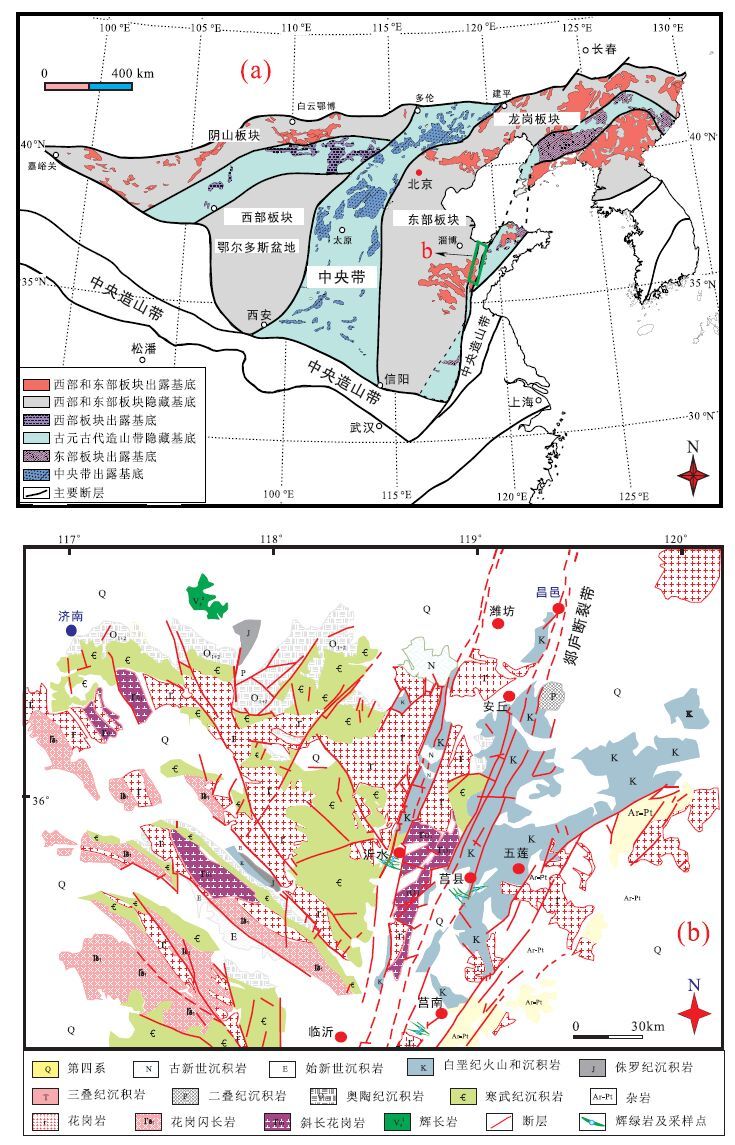
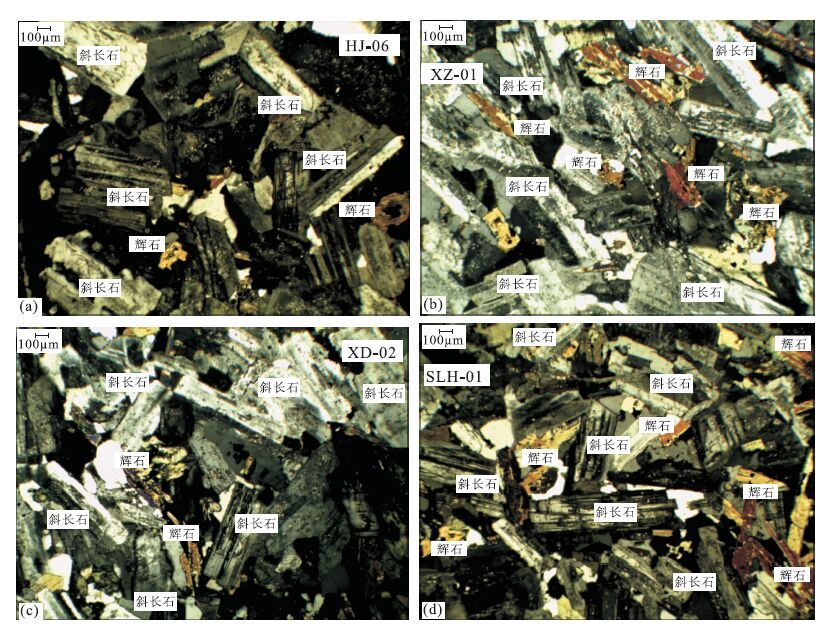
1 地质背景和岩相学华北克拉通位于中国北部,是非常古老的(超过3.8 Ga)大陆(Liu et al.,1992; Zheng et al.,2005; Lin et al.,2008),约170×104 km2(吴福元等,2008; Li et al.,2013;Zhai and Santosh,2013; Zheng et al.,2013),由太古代东西板块和中央带组成,南北边界分别为印支期秦岭大别和海西期阴山燕山造山带,南北板块被东西走向的古太古代孔兹岩带分隔(Xia et al.,2008; Yin et al.,2009,2011)。另外,华北克拉通可进一步被划分为几个微大陆板块和活动带(Zhai et al.,2000; 赵国春,2009)。华北克拉通具有一套典型的前寒武纪(太古代-震旦纪)变质基底,上覆较年轻的(寒武纪-第四纪)岩相覆盖层。山东地区(胶东、鲁西和郯庐断裂带)分布有200多条中生代基性岩墙。基性岩墙全部侵入侏罗纪沉积地层和元古代杂岩(图 1)(山东省地质矿产局,1991;Zhao et al.,2001)。单条岩墙皆为直立北西-南东向,岩墙宽10 m~1.2 km,长2.5~16 km(图 1)。岩墙岩性上都为典型的辉绿岩,主要由~35%的单斜辉石(2.0~6.0 mm)和斜长石(2.0~5.5 mm)斑晶及~65%的单斜辉石(0.05~0.06 mm)、斜长石(0.03~0.05 mm)和少量磁铁矿(0.02~0.03 mm)基质组成。副矿物以锆石和磷灰石为主(图 2)。
|
图 1 华北克拉通分布图(a)(Zhao et al.,2001)及采样点分布地质图(b)(山东省地质矿产局,1991) Fig. 1 The tectonic map of the North China Craton(a)(after Zhao et al.,2001),and the regional geological map showing sampling locations(b)(after data of Bureau of Geology and Mineral Resources of Shandong Province) |
|
图 2 代表性基性岩墙显微照片 Fig. 2 The micrographs of the representative mafic dykes |
在样品采集过程,挑选相对较大的(宽30 m以上,长4.0 km以上)的岩墙为对象,并沿岩墙分布均匀取样,共采集样品31件,剔除个别不新鲜的风化样品,本研究共用样品22件。黄家庄基性岩墙(15件)为北东向直立型,岩墙宽大于45 m,长大于10 km(图 1b)。 岩墙由30%~35%单斜辉石、斜长石和少量的黑云母(0.5~1.2 mm)斑晶和~60%~70%的基质(辉石、斜长石、磁铁矿、绿泥石)组成。夏庄基性岩墙(5件)为北东-西东向直立型,岩墙宽大于40 m,长大于10 km(图 1b)。 岩墙含30%~35%单斜辉石、斜长石和少量的黑云母(0.5~1.3 mm)斑晶和~60%~65%的基质(辉石、斜长石、磁铁矿)。小店和寨里河基性岩墙(11件)为北东-西东向直立型,岩墙宽大于35 m,长大于12 km(图 1b)。 岩墙含30%~36%单斜辉石、斜长石和少量的黑云母(0.5~1.3 mm)斑晶和~60%~70%的基质(辉石、斜长石、磁铁矿、绿泥石)。
K-Ar测年在中国地震局地质研究所完成。主量元素测试在中国科学院地球化学研究所矿床地球化学国家重点实验室X荧光光谱(Axios(PW4400)XRF)实验室完成。分析精度优于5%。微量元素在中国科学院地球化学研究所矿床地球化学国家重点实验室ICP-MS仪器上完成,操作程序参考Qi等(2000),标准样品为GBPG-1(Thompson et al.,2000)、OU-6(Sun and McDonough,1989)、GSR-1和GSR-3(Potts and Kane,2005),分析精度优于5%。Rb-Sr和Sm-Nd同位素分析在宜昌地质矿产研究所完成,测试仪器为TIMS(Finnigan MAT-262)。Sm和Nd程序空白低于200 pg,Rb和Sr程序空白低于500 pg。Sm/Nd质量分馏校正 86 Sr/88 Sr=0.1194,146 Nd/144 Nd=0.7219。NB987标准 87 Sr/86 Sr=0.71246±16(2σ),La Jolla标准 143 Nd/144 Nd=0.511863±8(2σ)(表 1)。

|
表 1 基性岩墙全岩K-Ar年龄 Table 1 Whole rock K-Ar ages of the mafic dykes |
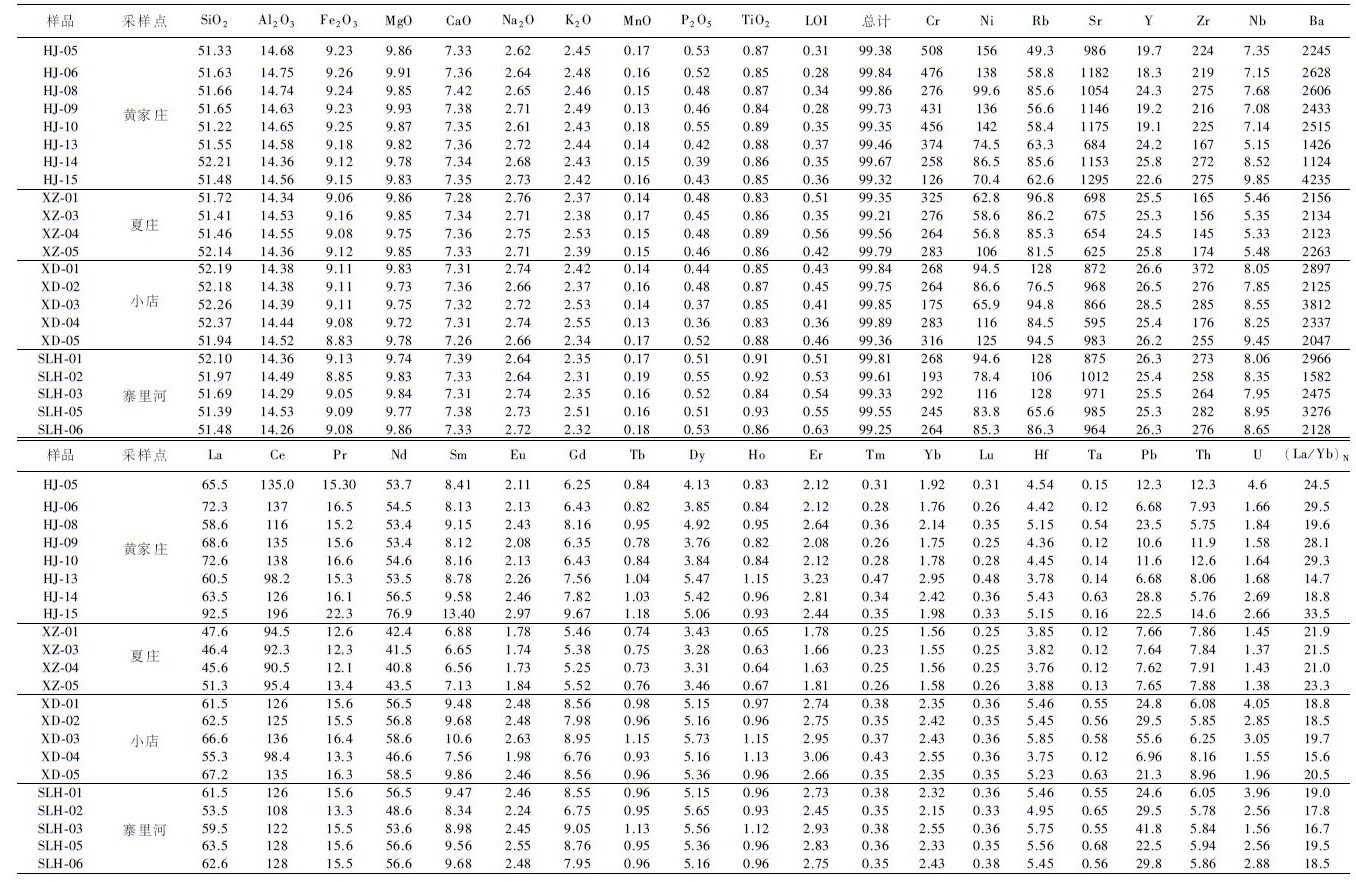
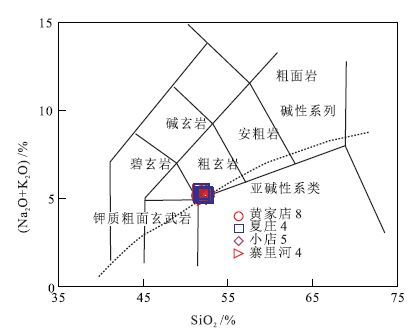
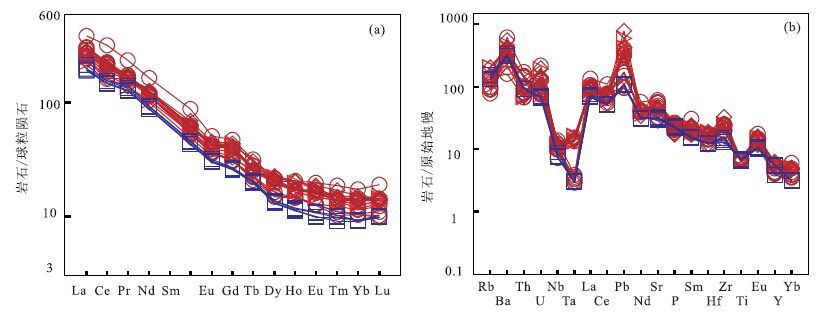
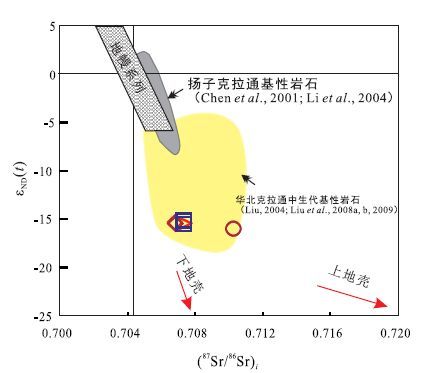
4个代表性新鲜样品(HJ-06、XZ-01、XD-02、SLH-01)全岩K-Ar年龄测试结果显示(表 1),研究区基性岩墙为白垩纪(122.2±2.8~128.3±2.4 Ma)岩浆活动的产物。研究区基性岩墙地球化学测试结果见 表 2,基性岩墙都具相对较小的主量元素和烧失量变化范围(SiO2=51.22%~52.37%,Al2O3=14.26%~14.75%,Fe2O3=8.83%~9.26%,MgO=9.73%~9.93%,CaO=7.26%~7.42%,Na2O=2.61%~2.74%,K2O=2.31%~2.55%,MnO=0.13%~0.19%,P2O5=0.36%~0.55%,TiO2=0.83%~0.93%,LOI=0.28%~0.63%),在SiO2与Na2O+K2O相关图解中,所有样品皆为粗玄岩类偏向碱性系列(图 3)。另外,在Na2O与K2O相关图解上(略),所有样品都投入钾玄质岩系列。且MgO与TiO2、Al2O3、K2O、Na2O和P2O5具有负的相关性,而与Fe2O3存在正的相关性(略)。球粒陨石和原始地幔标准化图解显示(图 4),所研究辉绿岩具有相对富集轻稀土元素 、Eu异常不明显、富集大离子亲石元素(Rb、Ba、U和Pb)和Eu以及亏损高场强元素(Nb、Ta和Ti)(图 4b)的特征(王毅民等,2003)。辉绿岩Sr-Nd同位素分析结果见 表 3,12个测试样品具有相对较大的(87 Sr/86 Sr)i比值(0.7068~0.7104)和负的εNd(t)值(-15.2~-16.2)变化范围。基性岩墙Sr-Nd同位素组成与华北克拉通中生代基性岩石类似(Liu et al.,2004,2008a,2009a),而与扬子克拉通基性岩石存在较大差别(Guo et al.,2001)。
|
|
表 2 基性岩墙主元素(%)和微量元素(×10-6)组成 Table 2 Major (%) and trace element (×10-6)compositions of them afic dykes |
|
图 3 基性岩墙SiO2-K2O+Na2O图解(底图据Rock,1991) Fig. 3 The diagram of SiO2 vs. K2O+Na2O of the mafic dykes(modified after Rock,1991) |
|
图 4 稀土元素球粒陨石标准化配分图解(a)和原始地幔标准化蛛网图(b)(王毅民等,2003)(图例同图 3) Fig. 4 Chondrite-normalized REE and primitive-mantle-normalized multi-element variation diagrams of the mafic dykes(after Wang Yiming et al.,2003) |
|
|
表 3 代表性基性岩墙Sr-Nd同位素测试结果 Table 3 Sr-Nd isotopic compositions of representative mafic dykes |


研究区白垩纪基性岩墙具有较低的SiO2(51.22%~52.37%,表 2)含量,暗示其来自一个超基性地幔源区(Liu et al.,2008a,2009a,2009b,2013a,2013b,2013c,2013d)。因为任何地壳岩石与下地壳中等麻粒岩在深部地壳的部分熔融通常只会产生高硅低镁含量的溶液(花岗类岩石)(Gao et al.,1998; Chen et al.,2001)。辉绿岩的La/Sm和Sm/Yb值较高(6.41~8.90、2.98~4.58),La-La/Sm和Sm-Sm/Yb图(略)表明其来自石榴石二辉橄榄岩地幔的低程度(<5.0%)部分熔融作用。另外,辉绿岩的Sr-Nd同位素组成 Sr/86 Sr)i=0.7068~0.7104,εNd(t)=-15.2~-16.2](表 3)表明,基性岩墙来自富集的岩石圈地幔源区,而非源自具有亏损Sr-Nd特性的软流圈地幔(如,大洋中脊玄武岩)。从La与La/Sm正相关性(略)可知,研究区辉绿岩来自富集岩石圈地幔源区的部分熔融作用。MgO与Fe2O3、CaO、CaO/Al2O3和Ni具有正的相关关系,而与SiO2、Al2O3和Sr存在负的相关性,暗示基性岩墙形成过程经历了橄榄石、单斜辉石和角闪石的分离结晶作用,但斜长石的分离结晶作用不明显。另外,Nb-Ta亏损特征同样支持了含钛相矿物(如,金红石、钛铁矿、榍石)的分异作用存在。通常地壳混染会导致基性岩石负Nb-Ta-Ti、Pb的正异常和富集的Sr-Nd同位素组成(Hirajima et al.,1990)。研究区基性岩墙具有类似的地球化学特征(表 2,图 4b、 5)表明基性岩浆形成过程可能混入了一定量的地壳物质。另外,MgO与SiO2和CaO的负相关性及与P2O5的正相关性(略)同样暗示了地壳混染作用的存在。同时,地壳混染作用在MgO与(87 Sr/86 Sr)i和εNd(t)正负相关性图解(略)中可看出,基性岩墙较高的La/Nb和Ba/Nb比值(6.41~10.2、132~446; 表 2)也暗示了太古-元古代花岗岩类、麻粒岩和沉积物等对地幔岩浆进行了一定程度的混染,但混染程度仍较难估算。
|
图 5 基性岩墙(87 Sr/86 Sr)i-εNd(t)图解(底图据Guo et al.,2004;Liu et al.,2008a,2008b,2009a) Fig. 5 Diagram showing variations of initial 87 Sr/86 Sr vs. εNd(t)values of the mafic dykes(modified after Guo et al.,2004; Liu et al.,2008a,2008b,2009a) |
目前,关于该区基性岩墙的形成机制,存在2种重要模式(Liu et al.,2008a,2009a,2013b):①扬子板块的俯冲作用;②古太平洋板块的俯冲作用(Zhang et al.,2005; Gai et al.,2013)。然而,华北克拉通和扬子板块碰撞期发生于三叠纪(Gao et al.,1998; Cai et al.,2013),同时,早白垩纪以前,根本不存在古太平洋板块与华北克拉通的西向俯冲作用存在(Tang et al.,2013),而且也没有证据支持古天平洋板块对华北克拉通以东中生代岩浆作用的可能影响(Hirajima et al.,1990)。因此,研究区基性岩墙与扬子板块和古太平洋板块的俯冲没有直接成因联系。在山东省中生代基性岩墙研究过程,大陆下地壳拆沉已成为一种合理的成因机制(Liu et al.,2008a,2008b,2009a,2009b)。因为榴辉岩相对岩石圈地幔密度较高(Meng and Zhang,1999),因此它可以拆沉进入岩石圈地幔(Xu et al.,1993; Anderson,2006; Jull and Kelemen,2001)。另外,榴辉岩具有比地幔橄榄岩低的熔融温度(Kay and Mahlburg-Kay,1991; Gao et al.,2004)。
当发生拆沉作用时,硅饱和的榴辉岩将熔融生成英云闪长岩-奥长花岗岩含硅熔体,而且该含硅熔体会与上覆地幔橄榄岩发生强烈的交代作用,将生成不含橄榄石的辉石岩,经熔融从而生成玄武质熔体(Jull and Kelemen,2001)。在华北克拉通东部,较多地质现象:①强烈的岩石圈减薄作用(Liu et al.,2008a,2008b);②大规模的同期(130~120 Ma)岩浆作用(Yang et al.,2004; 刘燊等,2005;Liu et al.,2004,2006,2008a,2008b,2008c,2009a,2009b,2012a,2012b,2013b,2013d,2013e; Li et al.,2013);③大范围的成矿作用(Wang et al.,1998; Yang et al.,2004);以及④埃达克质岩石的出现(Jull and Kelemen,2001; Liu et al.,2009b)都是对拆沉模式的有力支持证据。综上所述,本研究给出下述合理的拆沉作用成因模式:①早侏罗世至白垩纪(240~185 Ma)期间(Gao et al.,1998; Liu et al.,2008a,2013e),扬子板块与华北克拉通的持续碰撞,导致了地壳加厚和地壳底部榴辉岩化现象(Liu et al.,2008a,2008b);②165~185 Ma时段,华北克拉通东部下地壳因加厚发生相变生成的榴辉岩,因重力不稳定而发生强烈的拆沉作用(Li et al.,2002; Liu et al.,2008a,2008b),从而导致软流圈的上涌、地表的突然抬升及岩石圈的伸展拉张。拆沉的榴辉岩发生部分熔融并生成含硅熔体,含硅熔体与上覆地幔橄榄岩发生强烈的交代作用;③130~120 Ma期间,交代的岩石圈地幔发生减压熔融,产生基性岩墙群的母岩浆,随后残余的榴辉岩进一步熔融将会生成一系列埃达克岩石(Liu et al.,2008a,2008b)。在强烈岩石圈的伸展拉张背景中,母岩浆在侵位过程中发生一定的分离结晶作用,最终侵位并导致大规模的中生代基性岩墙群的形成。
5 结论(1)基性岩墙为晚中生代白垩纪(122.2±2.8~128.3±2.4 Ma)岩浆活动的产物;
(2)基性岩墙来源于富集的石榴石二辉橄榄岩地幔的低程度(<5.0%)部分熔融作用,成岩过程受到一定程度的地壳混染和分离结晶作用(橄榄石、单斜辉石和角闪石)的影响,但地壳混染程度目前较难加以确定;
(3)基性岩墙形成于扬子板块和华北克拉通持续碰撞后的伸展拉张背景,富集源区为拆沉榴辉岩化下地壳熔体与上覆岩石圈地幔交代作用的结果。
| [1] | Anderson D A. 2006. Speculations on the nature and cause of mantle heterogeneity. Tectonophysics, 416(1-3): 7-22 |
| [2] | Cai Y C, Fan H R, Santosh M, Liu X, Hu F F, Yang K F, Lan T G, Yang Y H, Liu Y S. 2013. Evolution of the lithospheric mantle beneath the southeastern North China Craton: Constraints from mafic dikes in the Jiaobei terrain. Gondwana Research, 24(2): 601-621 |
| [3] | Chen J F, Yan J, Xie Z, Xu X, Xing F M. 2001. Nd and Sr isotopic compositions of igneous rocks from the Lower Yangtze region in eastern China: Constraints on sources. Physics and Chemistry of the Earth, Part A: Solid Earth and Geodesy, 26(9-10): 719-731 |
| [4] | Ernst R E, Baragar W R A. 1992. Evidence from magnetic fabric for the flow pattern of magma in the Mackenzie giant radiating dyke swarm. Nature, 356(6369): 511-513 |
| [5] | Ernst R E, Buchan K L, Palmer H C. 1995. The global mafic dykes Gis-Database project. Trans-Hudson Orogen Transect Lithoprobe Report, 38: 42-46 |
| [6] | Féraud G, Giannerini G, Campredon R. 1987. Dyke swarms as paleostress indicators in areas adjacent to continental collision zones: Examples from the European and Northwest Arabian Plates. In: Halls H C, Fahrig W F eds. Mafic dyke swarms. Geological Association of Canada Special Paper, 34: 273-278 |
| [7] | Gao S, Rudnick R L, Yuan H L, Liu X M, Liu Y S, Xu W L, Ling W L, Ayers J, Wang X C, Wang Q H. 2004. Recycling lower continental crust in the north China craton. Nature, 432(7019): 892-897 |
| [8] | Gao S, Zhang B R, Jin Z M, Kern H, Luo T C, Zhao Z D. 1998. How mafic is the lower continental crust? Earth and Planetary Science Letters, 106(1-4): 101-117 |
| [9] | Gudmunsson A. 1995. Infrastructure and mechanics of volcanic systems in Iceland. Journal of Volcanology and Geothermal Research, 64(1-2): 1-22 |
| [10] | Guo F, Fan W M, Wang Y J, Lin G. 2001. Late Mesozoic mafic intrusive complexes in North China block: Constraints on the nature of subcontinental lithospheric mantle. Physics and Chemistry of the Earth, Part A: Solid Earth and Geodesy, 26(9-10): 759-771 |
| [11] | Guo F, Fan W M, Wang Y J, Zhang M. 2004. Origin of early Cretaceous calc-alkaline lamprophyres from the Sulu orogen in eastern China: Implications for enrichment processes beneath continental collisional belt. Lithos, 78(3): 291-305 |
| [12] | Halls H C. 1982. The importance and potential of mafic dyke swarms in studies of geodynamic processes. Geosciences Canada, 9(3): 145-154 |
| [13] | Halls H C, Fahrig W F. 1987. Mafic dyke swarms. Geological Associated Canada Special Paper, 34: 1-503 |
| [14] | Halls H C, Hatts M P. 1990. Paleomagnetism of Proterozoic mafic dyke swarms of the Canadian Shield. In: Parker A J, Rickwood P C, Tucker D H (eds.). International dykes conference, mafic dykes and emplacement mechanisms. Rotterdam: Balkema, 209-230 |
| [15] | Hirajima T, Ishiwatari A, Cong B, Zhang R, Banno S, Nozaka T. 1990. Coesite from Mengzhong eclogite at Dhonghai county, northeastern Jiangsu Province, China. Mineralogy Magazine, 54: 579-583 |
| [16] | Hou G T, Liu Y L, Li J H. 2006. Evidence for-1.8 Ga extension of the Eastern Block of the North China Craton from SHRIMP U-Pb dating of mafic dyke swarms in Shandong Province. Journal of Asian Earth Sciences, 27(4): 392-401 |
| [17] | John D A P, Zhang J S, Huang B C, Andrew P R. 2010. Palaeomagnetism of Precambrian dyke swarms in the North China Shield: The-1.8 Ga LIP event and crustal consolidation in late Palaeoproterozoic times. Journal of Asian Earth Sciences, 41(6): 504-524 |
| [18] | Jull M, Kelemen P B. 2001. On the conditions for lower crustal convective instability. Journal of Geophysical Research, 106(B4): 6423-6446 |
| [19] | Kay R W, Mahlburg-Kay S. 1991. Creation and destruction of lower continental crust. Geologische Rundschau, 80(2): 259-278 |
| [20] | Li S G, Huang F, Li H. 2002. Post-collisional lithosphere delamination of the Dabie-Sulu orogen. Chinese Science Bulletin, 47(3): 259-263 |
| [21] | Li S R, Santosh M, Zhang H F, Shen J F, Dong G C, Wang J Z, Zhang J Q. 2013. Inhomogeneous lithospheric thinning in the central North China Craton: Zircon U-Pb and S-He-Ar isotopic record from magmatism and metallogeny in the Taihang Mountains. Gondwana Research, 23(1): 141-160 |
| [22] | Li T S, Zhai M G, Peng P, Chen L, Guo J H. 2010. Ca. 2.5 billion year old coeval ultramafic-mafic and syenitic dykes in Eastern Hebei: Implications for cratonization of the North China Craton. Precambrian Research, 180(3-4): 143-155 |
| [23] | Lin W, Faure M, Monié P, Schürer U, Panis D. 2008. Mesozoic extensional tectonics in Eastern Asia: The south Liaodong peninsula metamorphic core complex(NE China). The Journal of Geology, 116(2): 134-154 |
| [24] | Liu D Y, Nutman A P, Compston W, Wu J S, Shen Q H. 1992. Remnants of ≥3800 Ma crust in the Chinese part of the Sino-Korean craton. Geology, 20(4): 339-342 |
| [25] | Liu S, Feng C X, Jahn B M, Hu R Z, Gao S, Coulson I M, Feng G Y, Lai S C, Yang Y H, Tang L. 2013d. Geochemical, Sr-Nd-Pb isotope, and zircon U-Pb geochronological constraints on the origin of Early Permian mafic dikes, northern North China Craton. International Geology Review, 55(13): 1626-1640 |
| [26] | Liu S, Feng C X, Jahn B M, Hu R Z, Gao S, Feng G Y, Lai S C, Yang Y H, Qi Y Q, Coulson I M. 2013c. Geochemical, Sr-Nd isotopic, and zircon U-Pb geochronological constraints on the petrogenesis of Late Paleoproterozoic mafic dykes within the northern North China Craton, Shanxi Province, China. Precambrian Research, 236: 182-192 |
| [27] | Liu S, Feng C X, Jahn B M, Hu R Z, Gao S, Coulson I M, Feng G Y, Lai S C, Yang C G, Yang Y H. 2013b. Zircon U-Pb age, geochemical, and Sr-Nd-Hf isotopic constraints on the origin of mafic dykes in the Shaanxi Province, North China Craton, China. Lithos, 175-176: 244-254 |
| [28] | Liu S, Hu R Z, Feng C X, Gao S, Feng G Y, Lai S C, Qi Y Q, Coulson I M, Yang Y H, Yang C G, Tang L. 2013e. U-Pb zircon age, geochemical, and Sr-Nd-Pb isotopic constraints on the age and origin of mafic dykes from eastern Shandong Province, Eastern China. Acta Geological Sinica(English Edition), 87(4): 1045-1057 |
| [29] | Liu S, Hu R Z, Feng C X, Qi L, Zhao J H, Zhong H, Qi Y Q, Wang T. 2008b. K-Ar ages and geochemical+Sr-Nd isotopic compositions of Adakitic volcanic rocks, western Shandong Province, Eastern Chia: Foundering of the lower continental crust. International Geology Review, 50(8): 763-779 |
| [30] | Liu S, Hu R Z, Gao S, Feng C X, Coulson I M, Feng G Y, Qi Y Q, Yang Y H, Yang C G, Tang L. 2012b. U-Pb zircon age, geochemical and Sr-Nd isotopic data as constraints on the petrogenesis and emplacement time of the Precambrian mafic dyke swarms in the North China Craton(NCC). Lithos, 140-141: 38-52 |
| [31] | Liu S, Hu R Z, Gao S, Feng C X, Coulson I M, Feng G Y, Qi Y Q, Yang Y H, Yang C G, Tang L. 2013a. Zircon U-Pb age and Sr-Nd-Hf isotopic constraints on the age and origin of Triassic mafic dikes, Dalian area, Northeast China. International Geology Review, 55(2): 249-262 |
| [32] | Liu S, Hu R Z, Gao S, Feng C X, Feng G Y, Qi Y Q, Coulson I M, Yang Y H, Yang C G, Tang L. 2012a. Geochemical and isotopic constraints on the age and origin of mafic dikes from eastern Shandong Province, eastern North China Craton. International Geology Review, 54(12): 1389-1400 |
| [33] | Liu S, Hu R Z, Gao S, Feng C X, Qi L, Zhong H, Xiao T F, Qi Y Q, Wang T, Coulson I M. 2008c. Zircon U-Pb geochronology and major, trace elemental and Sr-Nd-Pb isotopic geochemistry of mafic dykes in western Shandong Province, east China: Constrains on their petrogenesis and geodynamic significance. Chemical Geology, 255(3-4): 329-345 |
| [34] | Liu S, Hu R Z, Gao S, Feng C X, Qi Y Q, Wang T, Feng G Y, Coulson I M. 2008a. U-Pb zircon age, geochemical and Sr-Nd-Pb-Hf isotopic constraints on age and origin of alkaline intrusions and associated mafic dikes from Sulu orogenic belt, Eastern China. Lithos, 106(3-4): 365-379 |
| [35] | Liu S, Hu R Z, Gao S, Feng C X, Yu B B, Feng G Y, Qi Y Q, Wang T, Coulson I M. 2009a. Petrogenesis of Late Mesozoic mafic dykes in the Jiaodong Peninsula, eastern North China Craton and implications for the foundering of lower crust. Lithos, 113(3-4): 621-639 |
| [36] | Liu S, Hu R Z, Gao S, Feng C X, Yu B B, Qi Y Q, Wang T, Feng G Y, Coulson I M. 2009b. Zircon U-Pb age, geochemistry and Sr-Nd-Pb isotopic compositions of adakitic volcanic rocks from Jiaodong, Shandong Province, Eastern China: Constraints on petrogenesis and implications. Journal of Asian Earth Sciences, 35(5): 445-458 |
| [37] | Liu S, Hu R Z, Zhao J H, Feng C X. 2004. K-Ar geochronology of Mesozoic mafic dikes in Shandong Province, Eastern China: Implications for crustal extension. Acta Geological Sinica(English Edition), 78(6): 1207-1213 |
| [38] | Liu S, Zou H B, Hu R Z, Zhao J H, Feng C X. 2006. Mesozoic mafic dikes from the Shandong Peninsula, North China Craton: Petrogenesis and tectonic implications. Geochemical Journal, 40(2): 181-195 |
| [39] | Meng Q R, Zhang G W. 1999. Timing of collision of the North and South China blocks: Controversy and reconciliation. Geology, 27(2): 123-126 |
| [40] | Oberthür T, Davis D W, Blenkinsop T G, Hhndorf A. 2002. Precise U-Pb mineral ages, Rb-Sr and Sm-Nd systematics for the Great Dyke, Zimbabwe-constraints on late Archean events in the Zimbabwe craton and Limpopo belt. Precambrian Research, 113(3-4): 293-305 |
| [41] | Peng P. 2010. Reconstruction and interpretation of giant mafic dyke swarms: A case study of 1.78 Ga magmatism in the North China craton. Geological Society, London, Special Publication, 338(1): 163-178 |
| [42] | Peng P, Bleeker W, Ernst R E, Sderlund U, McNicoll V. 2011a. U-Pb baddeleyite ages, distribution and geochemistry of 925 Ma mafic dykes and 900 Ma sills in the North China craton: Evidence for a Neoproterozoic mantle plume. Lithos, 127(1-2): 210-221 |
| [43] | Peng P, Guo J H, Zhai M G, Bleeker W. 2010. Paleoproterozoic gabbronoritic and granitic magmatism in the northern margin of the North China craton: Evidence of crust-mantle interaction. Precambrian Research, 183(3): 635-659 |
| [44] | Peng P, Zhai M G, Guo J H, Kusky T, Zhao T P. 2007. Nature of mantle source contributions and crystal differentiation in the petrogenesis of the 1.78 Ga mafic dykes in the central North China craton. Gondwana Research, 12(1-2): 29-46 |
| [45] | Peng P, Zhai M G, Li Q L, Wu F Y, Hou Q L, Li Z, Li T S, Zhang Y B. 2011b. Neoproterozoic(-900 Ma) Sariwon sills in North Korea: Geochronology, geochemistry and implications for the evolution of the south-eastern margin of the North China Craton. Gondwana Research, 20(1): 243-254 |
| [46] | Peng P, Zhai M G, Li Z, Wu F Y, Hou Q L. 2008. Neoproterozoic(-820 Ma) mafic dyke swarms in the North China craton: Implication for a conjoint to the Rodinia supercontinent? In: The abstracts of the 13th Gondwana conference. Dali, China, 160-161 |
| [47] | Peng P, Zhai M G, Zhang H F, Guo J H. 2005. Geochronological constraints on the Paleoproterozoic evolution of the North China Craton: SHRIMP zircon ages of different types of mafic dikes. International Geology Review, 47(5): 492-508 |
| [48] | Potts P J, Kane J S. 2005. International association of geoanalysts certificate of analysis: Certified reference material OU-6(Penrhyn slate). Geostandards and Geoanalytical Research, 29(2): 233-236 |
| [49] | Qi L, Hu J, Gregoire D C. 2000. Determination of trace elements in granites by inductively coupled plasma mass spectrometry. Talanta, 51(3): 507-513 |
| [50] | Rock NMS. 1991. Lamprophyres. Glasgow, 1-285 |
| [51] | Sun S S, McDonough W F. 1989. Chemical and isotopic systematics of oceanic basalts: Implications for mantle composition and processes. In: Saunders A D, Norry M J eds. Magmatism in the Ocean basins. Geological Society Special Publishing London, 313-345 |
| [52] | Tang Y J, Zhang H F, Santosh M, Ying J F. 2013. Differential destruction of the North China Craton: A tectonic perspective. Journal of Asian Earth Sciences, 78: 71-82 |
| [53] | Tarney J, Weaver B L. 1987. Geochemistry and petrogenesis of early Proterozoic dyke swarms. In: Halls H C, Fahrig W C eds. Mafic dyke swarms. Special Publication Geological Association of Canada, 34: 81-93 |
| [54] | Thompson M, Potts P J, Kane J S, Wilson S. 2000. GeoPT5. An international proficiency test for analytical geochemistry laboratories-report on round 5. Geostandards Newsletter, 24(1): E1-E28 |
| [55] | Wang L G, Qiu Y M, McNaughton N J, Groves D I, Luo Z K, Huang J Z, Miao L C, Liu Y K. 1998. Constraints on crustal evolution and gold metallogeny in the Northwestern Jiaodong Peninsula, China, from SHRIMP U-Pb zircon studies of granitoids. Ore Geology Review, 13(1-5): 275-291 |
| [56] | Xia X P, Sun M, Zhao G C, Wu F Y, Xu P, Zhang J S, He Y H. 2008. Paleoproterozoic crustal growth in the Western Block of the North China Craton: Evidence from detrital zircon Hf and whole rock Sr-Nd isotopic compositions of the khondalites from the Jining Complex. American Journal of Science, 308(3): 304-327 |
| [57] | Xu J W, Ma G F, Tong W X, Zhu G, Lin S F. 1993. Displacement of the Tancheng-Lujiang Wrench fault system and its geodynamic setting in the Northwestern Circum-Pacific. In: Xu J ed. The Tancheng-Lujiang Wrench system. New York: John Wiley & Sons, 51-74 |
| [58] | Yang J H, Chung S L, Zhai M G, Zhou X H. 2004. Geochemical and Sr-Nd-Pb isotopic compositions of mafic dikes from the Jiaodong Peninsula, China: Evidence for vein plus-peridotite melting in the lithospheric mantle. Lithos, 73(3-4): 145-160 |
| [59] | Yin C Q, Zhao G C, Guo J H, Sun M, Xia X P, Zhou X W, Liu C H. 2011. U-Pb and Hf isotopic study of zircons of the Helanshan Complex: Constrains on the evolution of the Khondalite Belt in the Western Block of the North China Craton. Lithos, 122(1-2): 25-38 |
| [60] | Yin C Q, Zhao G C, Sun M, Xia X P, Wei C J, Zhou X W, Leung W H. 2009. LA-ICP-MS U-Pb zircon ages of the Qianlishan Complex: Constrains on the evolution of the Khondalite Belt in the Western Block of the North China Craton. Precambrian Research, 174(1-2): 78-94 |
| [61] | Zhai M G, Bian A G, Zhao T P. 2000. The amalgamation of the supercontinent of North China Craton at the end of Neo-Archaean and its breakup during late Palaeoproterozoic and Meso-Proterozoic. Science in China Series D: Earth Sciences, 43(S1): 219-232 |
| [62] | Zhai M G, Santosh M. 2013. Metallogeny of the North China Craton: Link with secular changes in the evolving Earth. Gondwana Research, 24(1): 275-297 |
| [63] | Zhai M G, Zhu R X, Liu J M, Meng Q R, Hou Q L, Hu S B, Liu W, Li Z, Zhang H F, Zhang H F. 2004. Time range of Mesozoic tectonic regime inversion in eastern North China Block. Sciences in China Series D: Earth Sciences, 47(2): 151-159 |
| [64] | Zhang H F, Sun M. 2002. Geochemistry of Mesozoic basalts and mafic dikes, southeastern north China Craton, and |
| [65] | tectonic implications. International Geology Review, 44(4): 370-382 |
| [66] | Zhang H F, Sun M, Zhou X H, Ying J F. 2005. Geochemical constraints on the origin of Mesozoic alkaline intrusive complexes from the North China Craton and tectonic implications. Lithos, 81(1-4): 297-317 |
| [67] | Zhao G C, Wilde S A, Cawood P A, Sun M. 2001. Archean blocks and their boundaries in the North China Craton: Lithological, geochemical, structural and P-T path constraints and tectonic evolution. Precambrian Research, 107(1-2): 45-73 |
| [68] | Zhao J X, McCulloch M T. 1993. Melting of a subduction-modified continental lithospheric mantle: Evidence from late Proterozoic mafic dike swarms in central Australia. Geology, 21(5): 463-466 |
| [69] | Zheng J P, Griffin W L, O'Reilly S Y, Lu F X, Wang C Y, Zhang M, Wang F Z, Li H M. 2005.3.6 Ga lower crust in central China: New evidence on the assembly of the North China Craton. Geology, 32(3): 229-232 |
| [70] | Zheng Y F, Xiao W J, Zhao G C. 2013. Introduction to tectonics of China. Gondwana Research, 23(4): 1189-1206 |
| [71] | 陈孝德. 1983. 五台-太行辉绿岩岩墙群的初步研究. 科学通报,28(16): 1002-1005 |
| [72] | 陈孝德,史兰斌. 1994. 伸展构造中的基性岩墙群. 钱祥麟主编. 拉张构造. 北京:地质出版社,71-74 |
| [73] | 陈孝德, 史兰斌, 贾三发. 1992. 华北元古代基性岩墙群研究. 地震地质, 14(4): 351-357 |
| [74] | 刘燊, 胡瑞忠, 赵军红, 冯彩霞, 钟红, 曹建劲, 史丹妮. 2005. 胶北晚中生代煌斑岩的岩石地球化学特征及其成因研究. 岩石学报, 21(3): 947-958 |
| [75] | 山东省地质矿产局. 1991. 山东省区域地质志. 北京: 地质出版社 |
| [76] | 邵济安, 张履桥. 2002. 华北北部中生代岩墙群. 岩石学报, 18(3): 312-318 |
| [77] | 邵济安, 张永北, 张履桥, 牟保磊, 王佩瑛, 郭峰. 2003. 大同地区早中生代煌斑岩-碳酸岩岩墙群. 岩石学报, 19(1): 93-104 |
| [78] | 王毅民, 高玉淑, 韩慧明, 王晓红. 2003. 实用地质分析标准物质手册. 北京: 地质出版社, 1-206 |
| [79] | 吴福元, 徐义刚, 高山, 郑建平. 2008. 华北岩石圈减薄与克拉通破坏研究的主要学术争论. 岩石学报, 24(6): 1145-1174 |
| [80] | 赵国春. 2009. 华北克拉通基底主要构造单元变质作用演化及其若干问题讨论. 岩石学报, 25(8): 1772-1792 |