 2016, Vol. 35


锂是最轻的金属元素,在岩石、卤水和海水中通常以微量元素的形式存在(Garrett,2004)。Li的2个稳定同位素6Li和7Li的自然丰度分别为7.52%和92.48%,其相对质量差高达16.7%。因此,Li同位素在许多地质过程中(风化、岩浆分异、热液蚀变和壳幔循环等)分馏强烈(Elliott et al.,2006; Rudnick and Ionov,2007; Brant et al.,2012; Misra and Froelich,2012; von Strandmann et al.,2013; Xu et al.,2013),不同地质储库的Li同位素比值可从-20‰至+40‰之间变化(Tang et al.,2007b)。Li在硅酸盐熔体中属于中等不相容元素,在流体相中属于强烈不相容元素。因此,在熔体、流体和岩石相互作用的地质过程中往往伴随着Li元素分异和Li同位素分馏,以上原因使得Li同位素成为地球化学示踪研究的一种新兴工具。
为了更好地比较Li同位素比值的变化,通常将Li同位素比值表示为:δ7Li(‰)= ×1000 ](标样为L-SVEC,7Li/6Li=12.17(Flesch et al.,1973)。对Li同位素的准确测定主要包括: ①样品溶解和分离纯化;②Li同位素比值的仪器测定。由于6Li比7Li更倾向于保留在离子交换树脂中,Li元素在没有完全回收的情况下会发生严重分馏,从而给出错误的结果(Taylor and Urey,1938;Chan et al.,1999,2002)。不同于Sr、Nd和Pb等同位素,Li同位素在分离纯化过程中无法使用同位素稀释剂进行分馏校正。因此,更加要求分离纯化过程中Li能够达到100%回收率。Moriguti和Nakamura(1998)使用不同浓度HCl以及0.5 mol/L HCl / 30%(V/V)C2H5OH做洗滤液进行4次离子交换柱分离,得到了精确的Li同位素数据,但是该方法比较繁琐,并且对低Li含量样品处理步骤更加复杂。故没有得到广泛应用。Tomascak等(1999)使用1.0 mol/L HNO3/80%(V/V)CH3OH做淋洗液,只需1次淋洗实现了Li同位素的分离,Nishio和Nakai(2002)采用118 mL的0.5 mol/L HNO3/80%(V/V)的CH3OH混合液对Li同位素对行分离提纯。此后,Magna等(2004)在此基础上发展了应用16 mL的0.5 mol/L HNO3/80%(V/V)CH3OH混合液淋洗1次小体积离子交换柱(2.1 mL)来分离提纯Li溶液的方法。 Gao和Casey(2012)使用0.2mol/L HCl做淋洗液对岩石样品进行2次离子交换柱分离,该方法特别适用于高Mg低Li样品的Li分离纯化。Misra和Froelich(2009)使用6 mL 的0.5 mol/L HCl作为淋洗液对碳酸盐中的Li进行纯化,该方法更适合低Li含量样品(1~2 μg/g)的分离纯化。Choi等(2013)使用6 mol/L HNO3/80%(V/V)CH3OH作淋洗液和小体积离子交换柱分离提纯Li,这一方法具有分离时间短和流程空白低等优点,特别适合高Li含量样品的化学分离,但是该方法对淋洗速度有较高的要求,较高流速(>0.3 mL/min)会使Na-Li的分离效果变差。可以实现Li同位素分离纯化的方法较多,这些方法都各有优缺点。因此,实验人员可以根据样品特点和实验条件选择合适的分离方案。Moriguti和Nakamura(1998),James和Palmer(2000)以及Chan等(2002)指出Li的淋洗曲线会受到样品中Mg含量的影响,但是Magna等(2004)探究发现不同基体样品的淋洗曲线是相同的。关于Li的淋洗曲线是否会受到样品中Mg含量影响的问题至今没有得到系统研究。分离提纯后Li接收液中的残余离子会严重影响Li同位素的准确测定,并且实验室不同,该影响程度也不同。例如,Nishio和Nakai(2002)、 Tomascak等(1999)指出当(Na,Mg或Fe)/Li<2时,残余离子不会影响Li同位素的测定; Magna等(2004)指出Na/Li<5时,Na不会影响Li同位素的测定,而Mg/Li≈5时可产生显著的Li同位素差异。因此,在建立Li同位素测定方法时,针对实验室的仪器条件需对淋洗曲线和残余离子的影响进行系统评估。
关于Li同位素测试仪器,自Chan(1987)首次利用TIMS对Li同位素比值进行准确测定后,TIMS成为测定Li同位素比值的主要方法,大多数实验室的测定精度优于2‰(Chan,1987; Moriguti and Nakamura,1998; James and Palmer,2000)。但在热电离过程中Li同位素会发生较大的分馏,将Li+转化为质量较大的离子团(如Li2Cl+、Li2I+、Li2F+、Li2BO2+和NaLiBO2+)进行测定以降低离子化过程中Li同位素的分馏(Chan,1987; Moriguti and Nakamura,1998)。由于TIMS的操作比较复杂、费时且很难达到较高精度,逐渐被MC-ICP-MS所替代(Nishio and Nakai,2002; Bryant et al.,2003; Jeffcoate et al.,2004; Millot et al.,2004; Rosner et al.,2007; Huang et al.,2010)。 使用MC-ICP-MS测定Li同位素比值时,Li同位素的质量分馏往往采用样品-标样交叉法(SSB)进行校正(Bouma et al.,2002; Jeffcoate et al.,2004)。前人的研究发现使用SSB法测定非传统稳定同位素,2014)、Zn(Chen et al.,2009)、Mg(Huang et al.,2009; An et al.,2014;Teng and Yang,2014)和Fe(He et al.,2015)等]比值时,样品和标样的待测元素浓度和酸浓度需要严格匹配,Li 也不例外(Tomascak et al.,1999; Bryant et al.,2003; Jeffcoate et al.,2004; Magna et al.,2004; Rosner et al.,2007; Nishio et al.,2015)。其中,Bryant等(2003)、Magna等(2004)、Huang等(2010)和Rosner等(2007)指出样品和标样中Li浓度的差异会引起严重的质量分馏,并且在样品浓度较低处同位素比值极其亏损,该比值被认为是仪器空白值的同位素组成。进行空白扣除(Bryant et al.,2003)和增加样品之间的清洗时间可以减小但是无法完全消除浓度不匹配引起的质量分馏。 Bryant等(2003)发现样品与标样的酸浓度差异越大,样品δ7Li测定值的准确性越差,引起的同位素比值误差高达6‰。Lin等(2016)在使用5% NaCl溶液消除Li的记忆效应后,发现Li同位素的浓度效应和酸效应的本质是记忆效应。
本次研究使用1 mol/L HNO3/80%(V/V)CH3OH为淋洗液,进行一次过柱分离,系统探讨了Li的淋洗曲线与样品类型以及Mg ︰ Li的关系,分析了Li接收液中残余离子对Li同位素比值的影响。
2 实验方法 2.1 试剂和标样实验使用的超纯水(18.2 MΩ/cm)使用Milli-Q Element超纯系统获得,HNO3和HF经过DST-1000酸纯化系统(Savillex)纯化2次得到的,HCl为市售的Suprapur®超纯HCl,CH3OH使用亚沸蒸馏装置纯化优级纯试剂得到。在化学分离过程中使用的酸,必须用酸碱滴定法来确定其强度。5 g NaCl粉末(≥99.99%)用高纯水稀释得到5% NaCl溶液。称取50 mg L-SVEC(Li2CO3粉末),用2 mL浓HNO3进行溶解,蒸干后用2% HNO3稀释到500 mL得到浓度为20 μg/g的母液,可以根据所需浓度用2% HNO3进一步稀释。IRMM-016是另一种Li2CO3粉末,其制备方法同于L-SVEC。
本实验中使用的标准物质:美国地质局(USGS)的AGV-1(安山岩)、AGV-2(安山岩)、BHVO-2(玄武岩)、GSP-2(花岗闪长岩)和RGM-2(流纹岩);日本地质局(GSJ)的JG-2(花岗岩)以及加拿大国家研究院(NRCC)的NASS-6海水标样。
为了降低Li的流程空白和避免交叉污染,所有酸溶液和样品的制备都在100级超净室中进行。
2.2 样品溶解和化学分离将~50 mg的岩石粉末称于7 mL Teflon 溶样杯中,依次加入1 mL HNO3和3 mL HF,拧紧盖子将溶样杯置于150℃加热板上加热24 h;然后开盖,将样品溶液在120℃下蒸干,加入 2.5 mL浓HNO3,拧紧盖子,在150℃加热板上加热12 h。重复以上步骤,直到样品完全溶解;蒸干后向溶样杯中加入3 mL 浓HCl密闭加热直到溶液变澄清(Tomascak et al.,1999; Magna et al.,2004; Rudnick et al.,2004; Teng et al.,2004; Tang et al.,2007a; Huang et al.,2010; Gao and Casey,2012)。蒸干,加入 1 mL 0.67 mol/L HNO3/30% CH3OH(V/V)备用。
溶样过程中氟化物沉淀的形成不仅仅会影响Li的回收率,而且难溶氟化物加载到树脂上会改变淋洗速率甚至使得样品无法进行完全分离(Moriguti and Nakamura,1998; Moriguti et al.,2004)。在溶样过程中,使用沸点较高(203℃)的HClO4可以避免难溶氟化物的形成(Hu and Qi,2014)。假如存在氟化物沉淀,则需要向样品中加入几滴HClO4(James and Palmer,2000; Nishio and Nakai,2002; Choi et al.,2013)。称取~2 g海水在90℃的电热板上蒸干,加入2 mL浓HNO3除去海水中的有机物(Huang et al.,2010)。在完全溶解的样品中加入1 mL 0.67 mol/L HNO3/30%(V/V)CH3OH溶液。
本研究采用的化学分离方法类似于Huang等(2010)和Magna等(2004)的一次离子交换柱方法,使用AG50W-x8(200~400目,2.7 mL)阳离子树脂和石英交换柱(内径0.6 cm,高21.5 cm)。 树脂在使用前需要依次使用0.15 mol/L HF(Moriguti and Nakamura,1998)、6 mol/L HCl、3 mol/L HCl和1 mol/L HNO3/80%(V/V)CH3OH(Jeffcoate et al.,2004)和超纯水进行洗涤,树脂装到分离柱后,仍需使用6 mol/L HCl、3 mol/L HCl和超纯水进行交替洗涤,随后使用2 mL 的0.67 mol/L HNO3/30%(V/V)CH3OH溶液平衡柱。为避免大体积溶液加载到树脂上引起树脂较大波动从而导致淋洗曲线拖尾(Van Hoecke et al.,2015),将1 mL的样品溶液分为5个200 μL,进行5次上样。选择3个不同基体样品GSP-2、RGM-2和NASS-6来确定淋洗曲线。将每1 mL淋洗液(1 mol/L HNO3/80%(V/V)CH3OH,30 mL)进行接取,根据干扰元素与Li的分离情况和Li的回收率(Li回收率=所选淋洗区间内的Li含量/化学分离前样品中Li含量×100%)(Nishio and Nakai,2002)选择淋洗区间(10~25 mL)。
2.3 仪器Li同位素比值测定在中国地质大学(武汉)地质过程与矿产资源国家重点实验室的双聚焦MC-ICP-MS(Neptune Plus,赛默飞世尔,德国)完成。该仪器有7个离子计数器和9个法拉第杯,法拉第杯上装有1011Ω放大电阻。最外侧的2个法拉第杯(L4和H4)之间的相对质量色散距离约为17%(Millot et al.,2004),理论上可以同时接收6Li和7Li(~16.7%的质量色散),但是由于本实验室MC-ICP-MS最外侧的2个法拉第杯上各装有2个离子计数器。因此,在实际操作过程中必须使用变焦透镜(zoom optics,Focus Quad:-4 V;Dispersion Quad: 17.6 V)才能对6Li和7Li进行同时接收。实验过程中使用低分辨率(~400),功率为1254 W。冷却气、辅助气和样品气分别为16 L/min、0.84 L/min和0.889 L/min,样品采集时的积分时间为 4.194 s。MC-ICP-MS的虚拟放大器功能可以校正不同放大器之间增益因子的误差并且可以提高数据结果的外部精度(Weyer and Schwieters,2003; Chu et al.,2006)。实验前,需要进行空白扣除(baseline)和增益校正(gain)。
样品溶液利用赛默飞世尔的稳定进样系统(~50 μL/min的 PFA雾化器和石英雾室)以及自动进样器(ASX-112FR)进行提取。使用高信号强度的“Jet+X”锥组合,得到的仪器灵敏度为(65~80)~V/μg/g(7Li)。
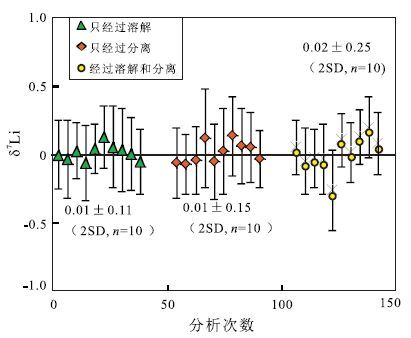
3 结果和讨论 3.1 前处理流程中的Li同位素分馏6Li和7Li较大的质量差异使其在前处理流程中会发生较大的分馏,需要对由此引起的同位素分馏分别进行系统评估(图 1)。使Li同位素的标准溶液L-SVEC分别经过样品溶解、化学分离以及样品溶解和化学分离的处理,3个不同的化学处理流程得到的同位素比值分别为0.01±0.11(2SD,n=10)、0.01±0.15(2SD,n=10)和0.02±0.25(2SD,n=10)。尽管化学前处理流程可能会引起较大的Li同位素分馏,但是实验结果表明,本实验采用的化学前处理流程引起的Li同位素分馏都在分析测定误差范围之内(±0.25‰)。为保证数据质量,在对样品进行溶解和纯化时,一定要对Li同位素比值的分馏情况进行监控,以免影响测定结果。
|
图 1 3种处理条件得到的L-SVEC溶液的δ7Li 值 Fig. 1 Li values of the L-SVEC solution only with dissolution, only with separation, and with dissolution and separation |
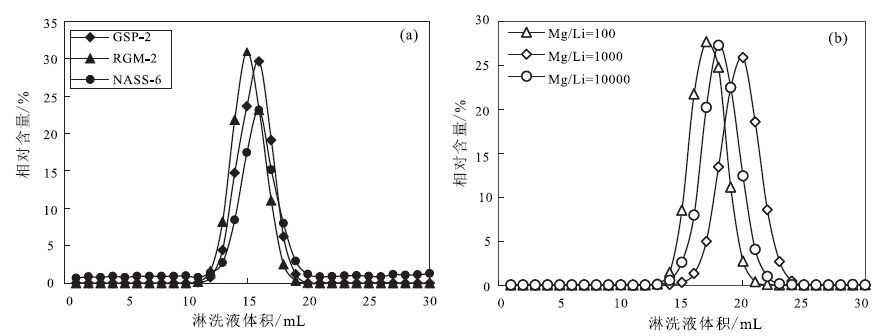
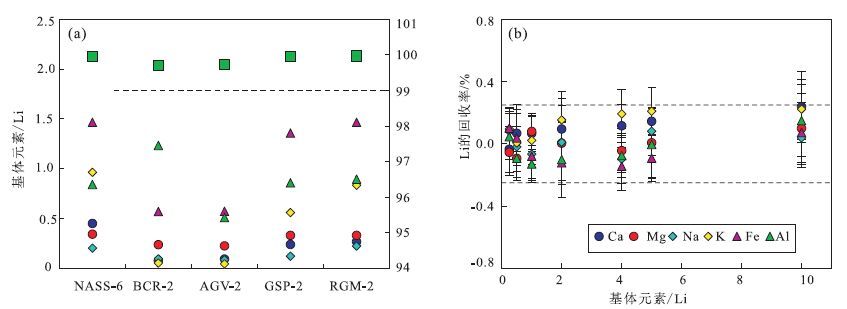
为确定不同基体样品的Li淋洗曲线,对 GSP-2、RGM-2和NASS-63个不同标样的淋洗曲线进行比较,结果显示Li的淋洗曲线与样品的类型无关(图 2a),淋洗区间都可选择为10~25 mL,且回收率约为101.5‰±1.5%(2SD,n=5)(图 3a)。为了进一步验证Li的淋洗曲线是否与样品的Mg ︰ Li值有关(Moriguti and Nakamura,1998; James and Palmer,2000; Chan et al.,2002; Magna et al.,2004),对3个只含有Mg和Li且Mg/Li值不同(Mg/Li=100、1000和10000)的溶液进行淋洗曲线研究,结果表明这3个溶液的最佳淋洗区间也在10~25 mL范围内,并且Li的峰值并不随Mg/Li值的升高而前移(图 2b)。
|
图 2 (a)3个实际样品GSP-2、RGM-2和NASS-6的淋洗曲线;(b)3个只含有Mg和Li且Mg/Li比值不同(Mg/Li=100、 1000和10000)溶液的淋洗曲线 Fig. 2 (a)Elution profiles of Li in GSP-2,RGM-2 and NASS-6;(b)Elution profiles of Li in samples with only Mg and Li and different Mg/Li ratios(Mg/Li=100,1000 and 10000) |
|
图 3 (a)不同样品的Li回收率以及残余离子/Li的值;(b)残余离子对Li同位素比值的影响,每个数据是4次测试结果的统计值,虚线表示方法的长期外部精度(±0.25‰)。误差棒代表的是测定值的2SD Fig. 3 (a)Recovery of Li and ratios of residual ions and Li for different sample matrix.(b)Effects of co-existent residual ions on the measurement of Li isotopes. Each symbol represents the average of four single measurements. The dashed lines outline the long-term external precision of the method(±0.25‰). The error bar is 2SD |
为提高Li的回收率,将淋洗区间扩大到10~25 mL,但同时也提高了残余离子在Li接收液中的含量,从而影响结果的精度(Tomascak et al.,1999; Nishio and Nakai,2002),因此有必要对淋洗区间中残余离子对Li同位素比值的影响进行评估。
向100 ng/g L-SVEC溶液中分别添加已知含量的Na、K、Ca、Fe、Mg和Al,得到的元素混合溶液作为样品,而纯的100 ng/g L-SVEC溶液作为标样,结果显示当(残余离子/Li)比值小于10时,残余离子对Li同位素引起的质量歧视都在误差范围内(图 3b)。在本研究所确定的淋洗区间中,残余离子/Li都小于1.5,并且大部分都远远小于1(图 3a)。因此,残余离子引起的影响基本上是可以忽略不计的。
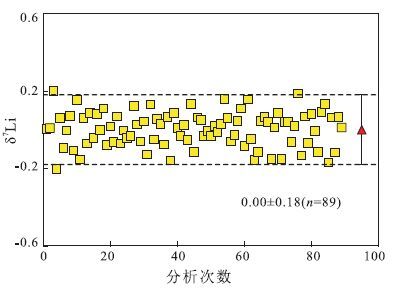
3.4 MC-ICP-MS测定Li同位素的稳定性为了评估MC-ICP-MS测定Li同位素的稳定性,对Li同位素标准溶液L-SVEC进行测定表明7Li/6Li的测定值在14.64~15.12的范围内波动,质量歧视为20.3%~24.2%, 1997)],但是在~10 min内L-SVEC的同位素比值波动很小,约为0.01‰。为了评估MC-ICP-MS测定Li同位素的长期重现性,笔者对Li同位素标准溶液L-SVEC(100 ng/g)进行多次测定,数据结果显示L-SVEC的测定结果为0.00±0.18‰(n=89)。本研究的长期重现性即外部精度,在95%的置信区间内为±0.18‰(2 SD)(图 4)。
|
图 4 MC-ICP-MS测定Li同位素的长期重现性 Fig. 4 he long reproducibility of Li isotopic ratio measured by MC-ICP-MS |
3.5 非基体匹配法测定天然样品的Li同位素组成
使用5% NaCl溶液可以非常有效地控制Li记忆效应(Lin et al.,2016)。在样品测试之前,将5% NaCl溶液进样约1 min再通入2% HNO3 2 min后,Li的空白值可以由30~110 mV降低到1.5~2 mV,即空白信号降低了15~70倍而仪器灵敏度不会受到影响。使用5% NaCl溶液清洗一次得到的较低Li空白信号可以维持3 h。使用5% NaCl溶液对Li的记忆效应进行消除后,可以减小浓度效应和酸效应对Li同位素比值的影响。在此基础上笔者建立了一种非严格基体匹配的Li同位素测定方法。
为了检验方法的实用性,测定6个不同岩性的天然岩石样品(AGV-1、 AGV-2、 BHVO-2、 GSP-2、 JG-2和RGM-2)、1个海水标样(NASS-6)和1个碳酸锂标样(IRMM-016)的Li同位素比值。在称样量和稀释重统一到50 mg(3 g 海水)和4 mL时,由于不同标样的Li含量不同,最终溶液中的Li浓度是不同的,其中使用的标样为100 ng/g的L-SVEC溶液。虽然样品与标样中的Li浓度没有保持完全一致,但是除了AGV-2和AGV-1外,最终得到的6个样品的Li同位素比值与其推荐值在误差范围内一致,并且外部精度优于±0.25‰(2 SD)(表 1)。获得的AGV-2和AGV-1的Li同位素比值与推荐值相差较大,原因可能是该样品的均一性较差(苏嫒娜等,2011)。

|
表 1 标样Li同位素的测定值 Table 1 δ7Li values of standards used in this experiment |
使用AG50W-x8(200~400目,2.7 mL)阳离子交换树脂和1 mol/L HNO3 /80%(V/V)CH3OH作为淋洗液建立的一柱分离法可以实现岩石样品和海水的Li同位素分离,且Li的淋洗曲线与样品岩性和Mg ︰ Li值无关。不同残余离子对Li同位素比值的影响不同,本实验中(残余离子/Li)的浓度比值控制在10以内,残余离子对Li同位素比值的影响不大。
使用5% NaCl溶液降低Li的仪器空白以及记忆效应后,由样品和标样的元素浓度和酸浓度不匹配引起的质量歧视大大降低。基于该结论,采用非严格浓度匹配的方法对8个标样进行了Li同位素比值的准确测定。该方法的建立不仅仅节约了样品的制备时间,还减少了影响Li同位素准确测定的因素。此外,本研究中对MC-ICP-MS测定Li同位素比值的稳定性高达0.18‰,并且溶样和化学分离不会引起明显的Li同位素分馏。
致谢: 衷心感谢田世洪研究员提出的宝贵意见。
| [1] | An Y J, Wu F, Xiang Y X, Nan X Y, Yu X, Yang J H, Yu H M, Xie L W, Huang F. 2014. High-precision Mg isotope analyses of low-Mg rocks by MC-ICP-MS. Chemical Geology, 390: 9-21 |
| [2] | Bouman C, Vroon P Z, Elliott T R, Schwieters J B, Hamester M. 2002. Determination of lithium isotope compositions by MC-ICPMS(Thermo Finnigan MAT Neptune). Geochimica et Cosmochimica Acta, 66: A97 |
| [3] | Brant C, Coogan L A, Gillis K M, Seyfried W E, Pester N J, Spence J. 2012. Lithium and Li-isotopes in young altered upper oceanic crust from the East Pacific Rise. Geochimica et Cosmochimica Acta, 96: 272-293 |
| [4] | Bryant C J, McCulloch M T, Bennett V C. 2003. Impact of matrix effects on the accurate measurement of Li isotope ratios by inductively coupled plasma mass spectrometry(MC-ICP-MS) under "cold" plasma conditions. Journal of Analytical Atomic Spectrometry, 18(7): 734-737 |
| [5] | Chan L H. 1987. Lithium isotope analysis by thermal ionization mass spectrometry of lithium tetraborate. Analytical Chemistry, 59(22): 2662-2665 |
| [6] | Chan L H, Leeman W P, You C F. 1999. Lithium isotopic composition of Central American volcanic arc lavas: Implications for modification of subarc mantle by slab-derived fluids. Chemical Geology, 160(4): 255-280 |
| [7] | Chan L H, Leeman W P, You C F. 2002. Lithium isotopic composition of Central American volcanic arc lavas: Implications for modification of subarc mantle by slab-derived fluids: Correction. Chemical Geology, 182(2-4): 293-300 |
| [8] | Chen J B, Louvat P, Gaillardet J, Birck J L. 2009. Direct separation of Zn from dilute aqueous solutions for isotope composition determination using multi-collector ICP-MS. Chemical Geology, 259(3-4): 120-130 |
| [9] | Choi M S, Ryu J S, Park H Y, Lee K S, Kil Y, Shin H S. 2013. Precise determination of the lithium isotope ratio in geological samples using MC-ICP-MS with cool plasma. Journal of Analytical Atomic Spectrometry, 28(4): 505-509 |
| [10] | Chu Z Y, Yang Y H, Qiao G S. 2006. A calculation method to eliminate gain effect on isotopic measurement using the virtual amplifier multi-collector mass spectrometer. International Journal of Mass Spectrometry, 253(1-2): 130-135 |
| [11] | Elliott T, Thomas A, Jeffcoate A, Niu Y L. 2006. Lithium isotope evidence for subduction-enriched mantle in the source of mid-ocean-ridge basalts. Nature, 443(7111): 565-568 |
| [12] | Flesch G D, Anderson A R Jr, Svec H J. 1973. A secondary isotopic standard for6Li/7Li determinations. International Journal of Mass Spectrometry and Ion Physics, 12(3): 265-272 |
| [13] | Gao Y J, Casey J F. 2012. Lithium isotope composition of ultramafic geological reference materials JP-1 and DTS-2. Geostandards and Geoanalytical Research, 36(1): 75-81 |
| [14] | Garrett D E. 2004. Handbook of lithium and natural calcium chloride. Amsterdam: Elsevier |
| [15] | He Y S, Ke S, Teng F Z, Wang T T, Wu H J, Lu Y H, Li S G. 2015. High-precision iron isotope analysis of geological reference materials by high-resolution MC-ICP-MS. Geostandards and Geoanalytical Research, 39(3): 341-356 |
| [16] | Hu Z C, Qi L. 2014.15.5-Sample digestion methods. In: Turekian H D H K, ed. Treatise on Geochemistry(Second Edition). Oxford: Elsevier, 87-109 |
| [17] | Huang F, Glessner J, Ianno A, Lundstrom C, Zhang Z F. 2009. Magnesium isotopic composition of igneous rock standards measured by MC-ICP-MS. Chemical Geology, 268(1-2): 15-23 |
| [18] | Huang K F, You C F, Liu Y H, Wang R M, Lin P Y, Chung C H. 2010. Low-memory, small sample size, accurate and high-precision determinations of lithium isotopic ratios in natural materials by MC-ICP-MS. Journal of Analytical Atomic Spectrometry, 25(7): 1019-1024 |
| [19] | James R H, Palmer M R. 2000. The lithium isotope composition of international rock standards. Chemical Geology, 166(3-4): 319-326 |
| [20] | Jeffcoate A B, Elliott T, Thomas A, Bouman C. 2004. Precise, small sample size determinations of lithium isotopic compositions of geological reference materials and modern seawater by MC-ICP-MS. Geostandards and Geoanalytical Research, 28(1): 161-172 |
| [21] | Lin J, Liu Y S, Hu Z C, Yang L, Chen K, Chen H H, Zong K Q, Gao S. 2016. Accurate determination of lithium isotope ratios by MC-ICP-MS without strict matrix-matching by using a novel washing method. Journal of Analytical Atomic Spectrometry, 31: 390-397 |
| [22] | Liu S A, Li D D, Li S G, Teng F Z, Ke S, He Y S, Lu Y H. 2014. High-precision copper and iron isotope analysis of igneous rock standards by MC-ICP-MS. Journal of Analytical Atomic Spectrometry, 29(1): 122-133 |
| [23] | Magna T, Wiechert U H, Halliday A N. 2004. Low-blank isotope ratio measurement of small samples of lithium using multiple-collector ICPMS. International Journal of Mass Spectrometry, 239(1): 67-76 |
| [24] | Millot R, Guerrot C, Vigier N. 2004. Accurate and high-precision measurement of lithium isotopes in two reference materials by MC-ICP-MS. Geostandards and Geoanalytical Research, 28(1): 153-159 |
| [25] | Misra S, Froelich P N. 2009. Measurement of lithium isotope ratios by quadrupole-ICP-MS: Application to seawater and natural carbonates. Journal of Analytical Atomic Spectrometry, 24(11): 1524-1533 |
| [26] | Misra S, Froelich P N. 2012. Lithium isotope history of Cenozoic seawater: Changes in silicate weathering and reverse weathering. Science, 335(6070): 818-823 |
| [27] | Moriguti T, Nakamura E. 1998. High-yield lithium separation and the precise isotopic analysis for natural rock and aqueous samples. Chemical Geology, 145(1-2): 91-104 |
| [28] | Moriguti T, Makishima A, Nakamura E. 2004. Determination of lithium contents in silicates by isotope dilution ICP-MS and its evaluation by isotope dilution thermal ionisation mass spectrometry. Geostandards and Geoanalytical Research, 28(3): 371-382 |
| [29] | Nishio Y, Nakai S I. 2002. Accurate and precise lithium isotopic determinations of igneous rock samples using multi-collector inductively coupled plasma mass spectrometry. Analytica Chimica Acta, 456(2): 271-281 |
| [30] | Nishio Y, Ijiri A, Toki T, Morono Y, Tanimizu M, Nagaishi K, Inagaki F. 2015. Origins of lithium in submarine mud volcano fluid in the Nankai accretionary wedge. Earth and Planetary Science Letters, 414: 144-155 |
| [31] | Qi H P, Taylor P D P, Berglund M, De Bièvre P. 1997. Calibrated measurements of the isotopic composition and atomic weight of the natural Li isotopic reference material IRMM-016. International Journal of Mass Spectrometry and Ion Processes, 171(1-3): 263-268 |
| [32] | Rosner M, Ball L, Peucker-Ehrenbrink B, Blusztajn J, Bach W, Erzinger J. 2007. A simplified, accurate and fast method for lithium isotope analysis of rocks and fluids, and δ7Li values of seawater and rock reference materials. Geostandards and Geoanalytical Research, 31(2): 77-88 |
| [33] | Rudnick R L, Tomascak P B, Njo H B, Gardner L R. 2004. Extreme lithium isotopic fractionation during continental weathering revealed in saprolites from South Carolina. Chemical Geology, 212(1-2): 45-57 |
| [34] | Rudnick R L, Ionov D A. 2007. Lithium elemental and isotopic disequilibrium in minerals from peridotite xenoliths from far-east Russia: Product of recent melt/fluid-rock reaction. Earth and Planetary Science Letters, 256(1-2): 278-293 |
| [35] | Tang Y J, Zhang H F, Nakamura E, Moriguti T, Kobayashi K, Ying J F. 2007a. Lithium isotopic systematics of peridotite xenoliths from Hannuoba, North China Craton: Implications for melt-rock interaction in the considerably thinned lithospheric mantle. Geochimica et Cosmochimica Acta, 71(17): 4327-4341 |
| [36] | Tang Y J, Zhang H F, Ying J F. 2007b. Review of the lithium isotope system as a geochemical tracer. International Geology Review, 49(4): 374-388 |
| [37] | Taylor T I, Urey H C. 1938. Fractionation of the lithium and potassium isotopes by chemical exchange with zeolites. The Journal of Chemical Physics, 6(8): 429-438 |
| [38] | Teng F Z, McDonough W F, Rudnick R L, Dalpé C, Tomascak P B, Chappell B W, Gao S. 2004. Lithium isotopic composition and concentration of the upper continental crust. Geochimica et Cosmochimica Acta, 68(20): 4167-4178 |
| [39] | Teng F Z, McDonough W F, Rudnick R L, Wing B A. 2007. Limited lithium isotopic fractionation during progressive metamorphic dehydration in metapelites: A case study from the Onawa contact aureole, Maine. Chemical Geology, 239(1-2): 1-12 |
| [40] | Teng F Z, Rudnick R L, McDonough W F, Gao S, Tomascak P B, Liu Y S. 2008. Lithium isotopic composition and concentration of the deep continental crust. Chemical Geology, 255(1-2): 47-59 |
| [41] | Teng F Z, Yang W. 2014. Comparison of factors affecting the accuracy of high-precision magnesium isotope analysis by multi-collector inductively coupled plasma mass spectrometry. Rapid Communications in Mass Spectrometry, 28(1): 19-24 |
| [42] | Tomascak P B, Carlson R W, Shirey S B. 1999. Accurate and precise determination of Li isotopic compositions by multi-collector sector ICP-MS. Chemical Geology, 158(1-2): 145-154 |
| [43] | Van Hoecke K, Belza J, Croymans T, Misra S, Claeys P, Vanhaecke F. 2015. Single-step chromatographic isolation of lithium from whole-rock carbonate and clay for isotopic analysis with multi-collector ICP-mass spectrometry. Journal of Analytical Atomic Spectrometry, 30: 2533-2540 |
| [44] | von Strandmann P A E P, Jenkyns H C, Woodfine R G. 2013. Lithium isotope evidence for enhanced weathering during Oceanic Anoxic Event 2. Nature Geoscience, 6(8): 668-672 |
| [45] | Weyer S, Schwieters J B. 2003. High precision Fe isotope measurements with high mass resolution MC-ICPMS. International Journal of Mass Spectrometry, 226(3): 355-368 |
| [46] | Xu R, Liu Y S, Tong X R, Hu Z C, Zong K Q, Gao S. 2013. In-situ trace elements and Li and Sr isotopes in peridotite xenoliths from Kuandian, North China Craton: Insights into Pacific slab subduction-related mantle modification. Chemical Geology, 354: 107-123 |
| [47] | 苏嫒娜, 田世洪, 李真真, 侯增谦, 侯可军, 胡文洁, 高延光, 杨丹, 李延河, 杨竹森. 2011. MC-ICP-MS高精度测定Li同位素分析方法. 地学前缘, 18(2): 304-314 |