 2017, Vol. 23
 doi:
doi: 


在 20 世纪 80 年代,移栽油菜在我国全面推广并长期应用[1]。随着农村劳动力转移,具有操作简单、省时省工、易于机械化播种和收获的直播油菜,成为冬油菜发展的主要方向[2]。直播油菜无需育苗和移栽,在苗期的管理较为粗放,杂草危害远比移栽油菜严重,如果得不到有效防控,杂草与油菜剧烈竞争养分、光照、水分等资源,通常可造成油菜籽粒减产 10%~20%,严重时减产达 50% 以上,甚至颗粒无收,降低油菜品质[3-4]。目前杂草防治主要采用化学除草剂,但化学防治存在较多问题,包括防控效果不佳、杂草抗药性等[5-7],因此,直播油菜田杂草竞争仍是一个值得关注的问题。除化学防治外,还有其他一些较为有效的措施,例如秸秆和农膜覆盖抑草,以及通过提高种植密度和加快油菜苗期生长来提高油菜竞争力,其中提高直播油菜种植密度和通过养分合理施用加快油菜生长来提高油菜的竞争力目前关注还较少。
直播油菜个体生产能力差,对养分缺乏比较敏感,依靠个体优势很难获得高产[1]。通过控制油菜播种量调控直播油菜植株生长和群体结构,充分利用生存空间和光照资源,可以获得直播油菜的高产潜能[8]。移栽油菜合理密植,加速油菜封行,利用油菜个体和群体的优势也可以收到明显控草效果[9]。田间杂草与土壤肥力和施肥关系密切。前人在其它作物上研究表明,土壤氮含量显著影响稻麦轮作杂草群落[10],适宜的施肥模式既能保证水稻的优质高产,也可以控制杂草群落生物多样性[11],肥料投入增强大麦的竞争能力,从而显著影响杂草群落[12]。在移栽油菜田中,平衡施肥可以有效降低杂草的数量,减少杂草对空间、光照和养分的竞争[13]。然而关于直播油菜与杂草养分竞争情况,及其对施氮量增加的响应并不明确。为此,在大田条件下开展了直播油菜播种量和施氮量对油菜和杂草氮素吸收影响的试验,以探究直播油菜和杂草生物量和氮素积累量对施氮量和油菜播种量的响应特征,揭示油菜与杂草的氮素竞争关系,为直播油菜生产提供相关依据。
1 材料与方法 1.1 试验设计试验安排在湖北省武汉市华中农业大学校内试验基地。供试油菜品种为‘华油杂 62’,前茬作物为水稻。供试土壤为红棕壤发育而成的水稻土,耕层土壤基本理化性状为 pH 6.26、有机质 12.24 g/kg、全氮 0.87 g/kg、速效磷 18.9 mg/kg、速效钾 102.4 mg/kg。
采用双因素多水平设计,设置 3 个播种量 1.5 kg/hm2 (D1.5)、4.5 kg/hm2 (D4.5) 和 7.5 kg/hm2 (D4.5) 和5 个氮梯度 N 0 (N0)、60 (N60)、120 (N120)、180 (N180) 和 240 kg/hm2 (N240)。各处理均施 P2O5 90 kg/hm2、K2O 120 kg/hm2 和硼砂 15 kg/hm2。供试肥料分别为尿素 (N 46%)、过磷酸钙 (P2O5 12%)、氯化钾 (K2O 60%) 和硼砂 (B 10.8%)。磷钾硼肥全部作基肥一次性施用,氮肥的 50% 作基肥,油菜出苗 3~4 叶时追施 20% 做苗肥,越冬肥和薹肥分别追施 15%。每个处理 3 次重复,小区面积为 15 m2,随机区组排列。油菜采用直播的方式,于 2014 年 10 月 28 日播种。播种前用“金都尔”除草剂喷雾除草,油菜生长过程中不再除草。
1.2 测定项目与方法 1.2.1 土壤样品采集与测定油菜基肥施用前,采用多点采样法采集耕层 (0—20 cm) 土壤。风干磨细过筛后按照常规方法测定各项指标[14]:pH 按照水土比 2.5∶1,用 pH 计测定;有机质用外加热-重铬酸钾容量法;全氮用半微量开氏法;速效磷用 0.5 mol/L NaHCO3 浸提—钼锑抗比色法;速效钾用 1 mol/L NH4OAc 浸提—火焰光度法。
1.2.2 植物样品采集与测定直播冬油菜在盛花期后期生物量达到最大[15],试验在 2015 年 4 月 12 日用 0.36 m2 样方取油菜和杂草地上部。油菜烘干、称重、磨碎后测定养分,杂草分四类 (救荒野豌豆、豚草、牛繁缕和其他杂草) 分别烘干、称重,再混匀、磨碎后测定养分。采用 H2SO4-H2O2 联合消煮,流动注射分析仪 (AA3,德国) 测定植物全氮。
1.3 数据处理与分析物种均匀度指数计算方法[16]:
均匀度 Pielou 指数 E = H/lnS
Shannon 指数 H =-Σ (Pi × lnPi) (i = 1、2、……S)
式中,Pi 为第 i 种物种的比例多度,Pi = Ni/N,S 为物种数,N 为单位面积全部杂草的总干物质重,Ni 为第 i 种物种的干物质量。
油菜对氮素相对竞争力计算方法[16]:油菜对氮素相对竞争力 = 油菜氮素积累量/杂草氮素积累量
所有数据均用 Excel 2003 和 SPSS 18.0 分析处理,采用 LSD 法检验差异显著性 (P < 0.05)。
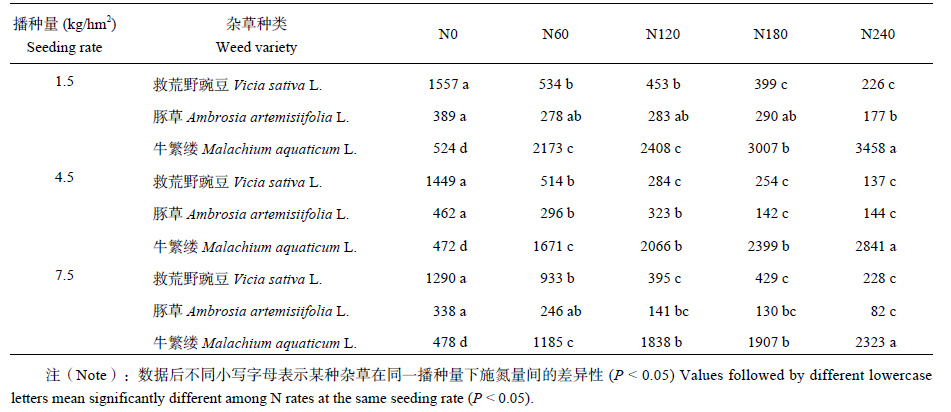
2 结果与分析 2.1 播种量和施氮量对三种主要杂草种群的影响施氮肥可以改变杂草的优势种,影响种群结构 (表 1)。不施氮时救荒野豌豆是杂草中的优势种,占三种杂草总生物量的 61%~63%;而豚草和牛繁缕分别只有 16%~19% 和 20%~23%。增加施氮量,救荒野豌豆比例迅速减少,在 N240 处理中占三种杂草总生物量的 4%~9%;牛繁缕的比重快速增大,N240 处理中占三种杂草总生物量的 88%~91%,成为优势种。
| 表1 不同油菜播种量和施氮量下三种主要杂草的生物量 (kg/hm2) Table 1 Biomass of the three major weeds affected by rapeseed seeding rates and N rates |
 |
生物群落的α多样性指数反映群落物种多样性和个体的均匀度,其中物种均匀度指数反映群落中各个种的相对密度,均匀度指数越小,群落物种的均匀度越低。以这三种主要杂草为杂草的生态群落,随着施氮量的增加,群落分布越不均匀,而种植密度对群落均匀度无明显影响 (表 2),说明增施氮肥会降低杂草的群落均匀度。
| 表2 不同油菜播种量和施氮量下杂草群落均匀度指数 Table 2 Pielou evenness of weed community under different rapeseed seeding rates and N rates |
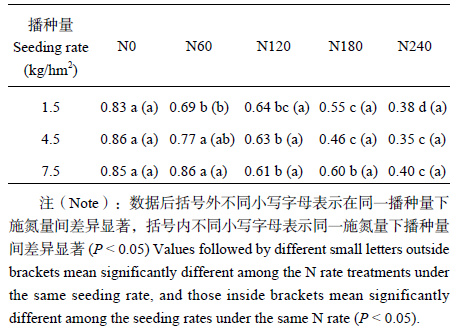 |
图 1 表明,施氮肥可以极显著提高油菜的生物量,N240 油菜生物量比 N0 增加 2.5~2.9 倍。适当提高播种量,油菜生物量随施氮量增加的幅度增大,相同施氮量下 D7.5 和 D4.5 比 D1.5 处理分别增加了 28.5%~81.6% 和 15.4%~37.2%。杂草对施氮量和播种量有不同的响应。在低播种量下,杂草生物量随施氮量增加有小幅上升;增加播种量,杂草生物量增幅减小;在高播种量下,杂草生物量基本持平,由此可见,增大油菜播种量杂草生物量受抑制。在不施氮处理中,杂草生物量比油菜生物量大;增加施氮量,油菜生物量显著增加,除 D1.5/N60 处理外,其它施肥处理油菜生物量均大于杂草生物量,说明油菜对氮素敏感度较强。在高密高氮条件下,油菜生长旺盛,生物量大,而杂草生物量较小。
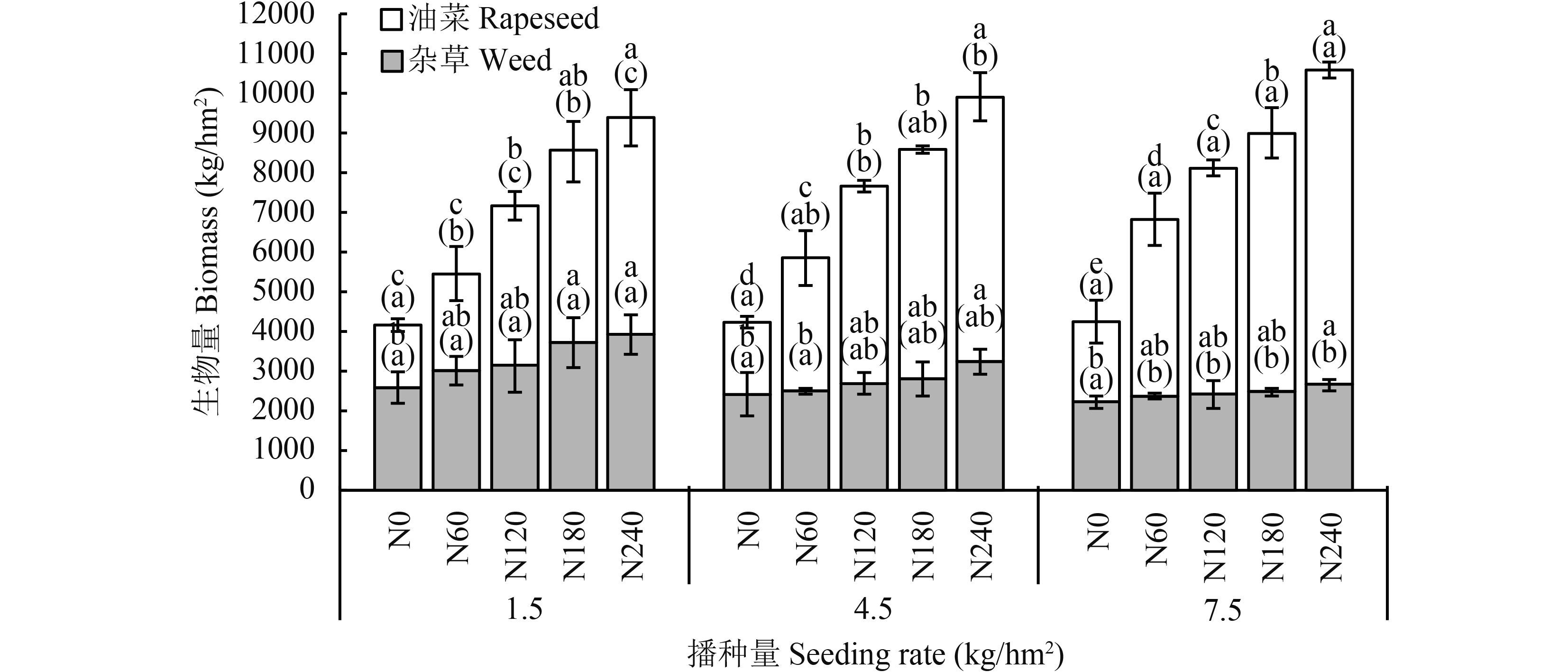 |
| 图1 不同油菜播种量和施氮量下油菜和杂草生物量 Fig. 1 Biomass of rapeseed and weeds under different rapeseed seeding rates and N rates [注(Note):柱上括号外不同小写字母表示在同一播种量下施氮量间差异显著,括号内不同小写字母表示同一施氮量下播种量间差异显著 (P < 0.05) Different small letters outside brackets mean significantly different among the N rate treatments under the same seeding rate, and those inside brackets mean significantly different among the seeding rates under the same N rate (P < 0.05).] |
表 3 表明,播种量对油菜和杂草的氮含量无明显影响;施氮肥对油菜的氮含量影响显著,对杂草的氮含量影响不大。增加施氮量,油菜和杂草的氮含量均有所增加,但油菜增幅大于杂草,N240 处理油菜和杂草的氮含量比 N0 处理分别增加了 43%~63% 和 22%~30%,说明油菜对氮素响应的敏感度比杂草的强。
| 表3 不同油菜播种量和施氮量下油菜和杂草氮含量 (%) Table 3 N contents of rapeseed and weeds under different rapeseed seeding rates and N rates |
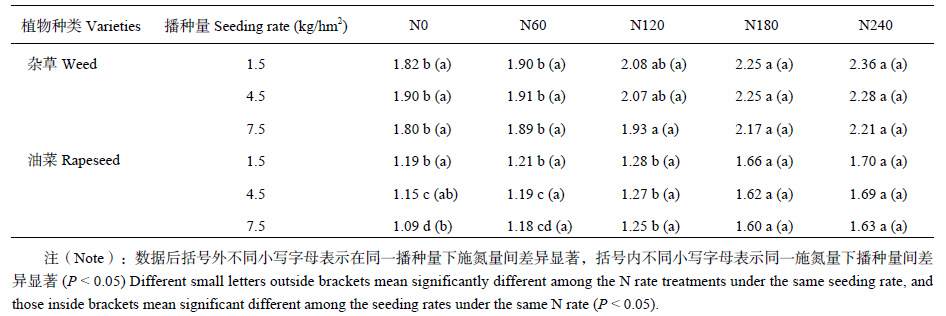 |
图 2 表明,施用氮肥极显著促进油菜氮积累量的增加,随着播种量的增加,增加的幅度越大。在低密条件下,增加施氮量,杂草氮积累量显著增加;提高播种量,杂草氮积累量增加幅度减小,与不施肥相比,施氮 240 kg/hm2 杂草氮积累量的增幅高密比低密降低了 51.7%。不同播种量之间地上部总氮素积累量差异不大,但是低密条件下杂草的氮素积累量要大于高密条件下的杂草氮素积累量,随着密度的增加,杂草的氮积累量减少,油菜的氮积累量增加。
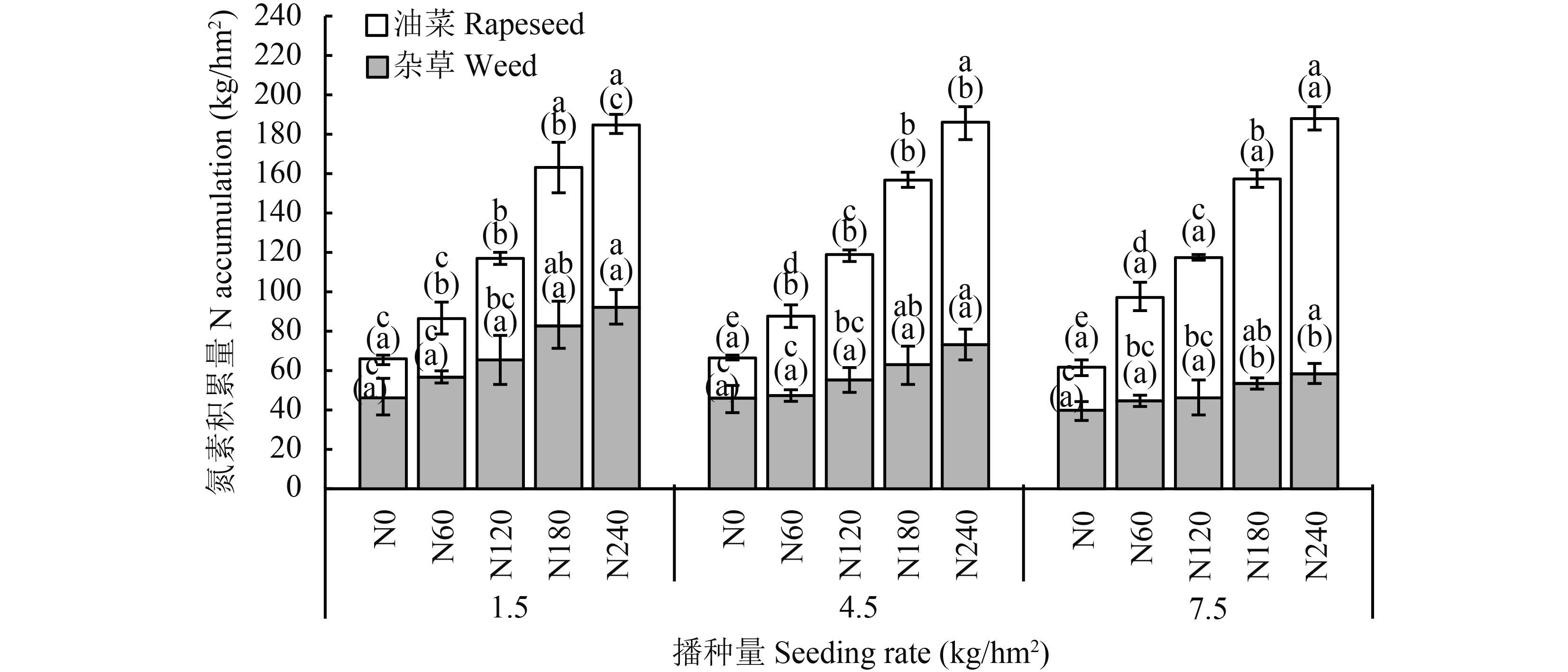 |
| 图2 不同油菜播种量和施氮量下油菜和杂草氮素积累量 Fig. 2 N accumulation amounts of rapeseed and weeds under different rapeseed seeding rates and N rates [注(Note):括号外不同小写字母表示在同一播种量下施氮量间差异显著,括号内不同小写字母表示同一施氮量下播种量间差异显著 (P < 0.05) Different small letters outside brackets mean significantly different among the N rate treatments under the same seeding rate, and those inside brackets mean significantly different among the seeding rates under the same N rate (P < 0.05).] |
油菜相对竞争力值越大,表示氮素向油菜的分配比例越高,油菜竞争力越强。低密条件下油菜相对竞争力值均不大于 1 (D1.5/N240 处理最大为 1.0),高密条件下施用氮肥处理油菜相对竞争力值均大于 1。相同施氮量下播种量越大,油菜相对竞争力值越大,可见,提高播种量,能够提高油菜的竞争力,使氮素更多的向油菜分配,从而提高肥料利用率。播种量相同时,增加施氮量,油菜相对竞争力值增大,油菜竞争力增强。D7.5/N240 处理的值最大,达到 2.2,表明高密高氮可以提高油菜的竞争力,抑制杂草的生长 (图 3)。
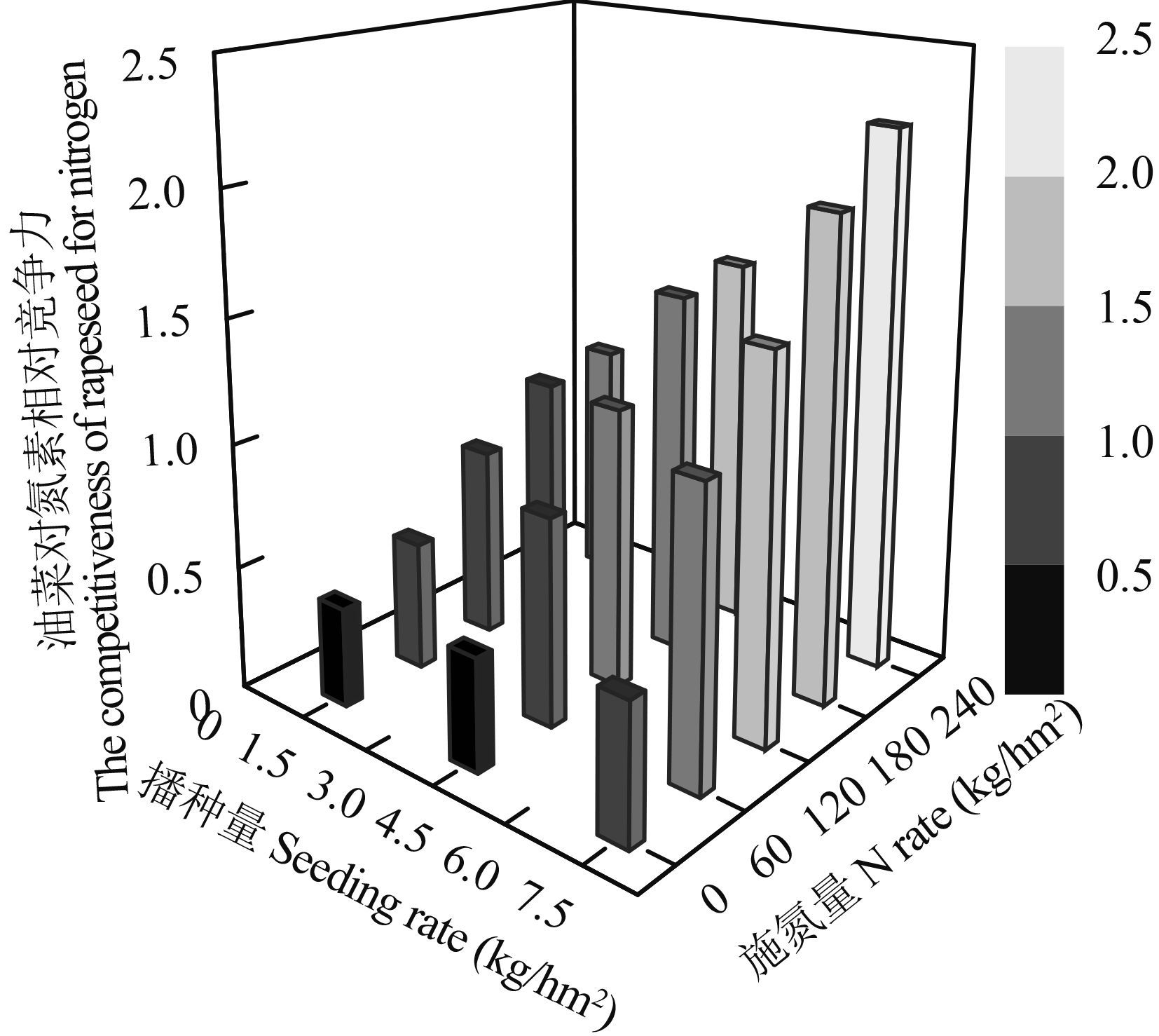 |
| 图3 不同油菜播种量和施氮量对油菜氮素相对竞争力的影响 Fig. 3 Effects of rapeseed seeding rates and N rates on the relative nitrogen competitiveness of rapeseed |
在本研究的直播油菜田中,杂草在油菜生物量最大时期占农田生物量的 25%~63%,占氮吸收总量的 31%~72%,其中有近一半处理的杂草吸氮量超过了油菜的吸氮量,杂草对油菜的生存资源与空间的侵占度是惊人的,必须引起高度重视。
植株氮素积累量由生物量和养分含量共同影响。提高施氮量,油菜和杂草的生物量、氮含量以及氮素积累量均增加;增加播种量,油菜的生物量、氮素积累量显著增加,而杂草生物量和氮素积累量减小,播种量对氮含量无明显影响;可见,氮素积累量的变化趋势与生物量相同,这表明油菜主要通过提高生物量来提高氮素竞争力。增加播种量可以提高群体密度,较早形成作物覆盖层,最终抑制杂草生长[17]。施氮量对前期杂草种类和密度没有影响,但会显著影响后期杂草密度和生物量[18]。增加施氮量,促进油菜个体生长,提高后期田间郁闭度,从而改变田间光照条件,抑制杂草生长。因此,在播种量较低时,即使施氮量偏高导致油菜个体植株较大,田间郁闭度依旧较小,杂草生长空间充足、竞争养分能力强,使得油菜仍为养分竞争弱势者。而在高密高氮条件下,早期群体密度大,后期个体生长旺盛,田间油菜生物量比杂草的大,油菜氮素竞争力强,氮向油菜分配得多,得以保证油菜的高产和氮肥的高效。
油菜田杂草出苗主要发生在冬前[19-20]。冬前移栽油菜个体较大,对田间不利环境有较强的抗性[21]。相比于移栽油菜,直播油菜个体相对瘦弱,其苗期生长受到田间环境影响较大,一旦出现杂草,就极易出现大规模杂草侵袭。对杂草防治最为直观有效的方法是喷洒除草剂,但是长江流域雨水资源丰富,农药喷洒后存在药效不佳或者农药无法及时喷施的情况;而且除草剂种类功能多样化,受到土壤类型和环境影响较大[22],有的只能杀死单、双子叶杂草中的一种,有的可同时杀死但是对油菜有明显的伤害[23]。杂草生物量在 3 月以后迅速增加[9],移栽油菜田可以通过中耕除草防治杂草,而在直播油菜田中无法推广使用。移栽油菜经过 20 多年的长期推广及全面应用,栽培技术成熟。随着农业轻简化推行,直播油菜种植面积逐渐增加,但是相应的杂草防治技术并不全面,农民沿袭移栽油菜除草管理模式,春后在直播油菜田中忽视除草剂的使用。因此,直播油菜田杂草的综合防治技术还需探究。本试验结果说明,在氮肥施用量较少时,杂草氮素积累量较高,适当增加施氮量,油菜氮素积累量增加,超过杂草氮素积累量;在低播种量时,杂草氮素积累量高,适当增加播种量,油菜氮素积累量增加,施肥处理均高于杂草氮素积累量。增加油菜播种量和氮肥施用量能明显提高油菜对田间杂草的抑制力,是控制直播油菜杂草危害的一种有效手段。
4 结论在直播冬油菜田,杂草对油菜氮素侵占量极大。增加施氮量和播种量,显著提高油菜的生物量和氮含量;杂草的生物量和氮含量,在增加施氮量时小幅上升,在增加播种量时被抑制。在高密高氮条件下,油菜氮素竞争力极显著大于杂草,生长旺盛,但是杂草占农田的生物量仍高达 25%,氮素吸收量高达 31%。直播油菜田,杂草竞争氮养分量需要引起重视。
| [1] |
王寅, 鲁剑巍. 中国冬油菜栽培方式变迁与相应的养分管理策略[J].
中国农业科学, 2015, 48(15): 2952–2966.
Wang Y, Lu J W. The transitional cultivation patterns of winter oilseed rape in China and the corresponding nutrient management strategies[J]. Scientia Agricultura Sinica, 2015, 48(15): 2952–2966. |
| [2] |
官春云. 改变冬油菜栽培方式, 提高和发展油菜生产[J].
中国油料作物学报, 2006, 28(1): 83–85.
Guan C Y. The cultivation pattern change of winter rapeseed to increase and develop production[J]. Chinese Journal of Oil Crop Sciences, 2006, 28(1): 83–85. |
| [3] |
李扬汉.
中国杂草志
[M]. 北京: 中国农业出版社, 1998: 1-32.
Li Y H. Weed in China [M]. Beijing: China Agriculture Press, 1998: 1-32. |
| [4] | Diepenbrock W. Yield analysis of winter oilseed rape (Brassica napus L.):a review[J]. Field Crops Research, 2000, 67: 35–49. DOI:10.1016/S0378-4290(00)00082-4 |
| [5] | Timmons, F L. A history of weed control in the United States and Canada[J]. Weed Science, 2005, 53(6): 748–761. DOI:10.1614/0043-1745(2005)053[0748:AHOWCI]2.0.CO;2 |
| [6] |
强胜. 我国杂草学研究现状及其发展策略[J].
植物保护, 2010, 36(4): 1–5.
Qiang S. Current status and development strategy for weed science in China[J]. Plant Protection, 2010, 36(4): 1–5. |
| [7] |
朱文达, 魏守辉, 刘学, 等. 油菜田杂草发生规律及化学防除技术[J].
湖北农业科学, 2007, 46(6): 936–938.
Zhu W D, Wei S H, Liu X, et al. Occurrence rule and chemical control of weed community in rape field[J]. Hubei Agricultural Sciences, 2007, 46(6): 936–938. |
| [8] | Li Y S, Yu C B, Zhu S, et al. High planting density benefits to mechanized harvest and nitrogen application rates of oilseed rape (Brassica napus L)[J]. Soil Science and Plant Nutrition, 2014, 60: 384–392. DOI:10.1080/00380768.2014.895417 |
| [9] |
赵延存. 稻茬移栽油菜田杂草群落发生规律及化学防除研究[D]. 南京:南京农业大学硕士学位论文, 2006.
Zhao Y C. A study on occurance rule of weed community and chemical control in transplanted rape fields after rice[D]. Nanjing:MS Thesis of Nanjing Agricultural University, 2006. |
| [10] |
施林林, 沈明星, 蒋敏, 等. 长期不同施肥方式对稻麦轮作田杂草群落的影响[J].
中国农业科学, 2013, 46(2): 310–316.
Shi L L, Shen M X, Jiang M, et al. Effect of long-term different fertilization management on weed community in rice-wheat rotation field[J]. Scientia Agricultura Sinica, 2013, 46(2): 310–316. |
| [11] |
潘俊峰, 万开元, 李祖章, 等. 施肥模式对晚稻田杂草群落的影响[J].
植物营养与肥料学报, 2015, 21(1): 200–210.
Pan J F, Wan K Y, Li Z Z, et al. Effect of fertilization patterns on weed community in late rice fields[J]. Journal of Plant Nutrition and Fertilizer, 2015, 21(1): 200–210. |
| [12] | Pyšek P, Lepš J. Response of a weed community to nitrogen fertilization:a multivariate analysis[J]. Journal of Vegetation Science, 1991, 2(2): 237–244. |
| [13] |
陆志峰, 鲁剑巍, 鲁君明, 等. 施肥对油菜及田间杂草物质养分积累的影响[J].
杂草科学, 2013, 31(1): 10–14.
Lu Z F, Lu J W, Lu J M, et al. Effects of fertilization on nutrient accumulation in rape and weeds in the field[J]. Weed Science, 2013, 31(1): 10–14. |
| [14] |
鲍士旦.
土壤农化分析(第三版)
[M]. 北京: 中国农业出版社, 2000: 14-107.
Bao S D. Analysis method for soil agro-chemistry (3rd Edn.) [M]. Beijing: China Agriculture Press, 2000: 14-107. |
| [15] |
刘晓伟, 鲁剑巍, 李小坤, 等. 冬油菜叶片的物质及养分积累与转移特性研究[J].
植物营养与肥料学报, 2011, 17(4): 956–963.
Liu X W, Lu J W, Li X K, et al. Study on characteristics of dry matter and nutrient accumulation and transportation in leaves of winter oilseed rape[J]. Plant Nutrition and Fertilizer Science, 2011, 17(4): 956–963. |
| [16] |
侯红乾. 冬小麦-杂草氮素营养竞争研究[D]. 陕西杨凌:西北农林科技大学硕士学位论文, 2007.
Hou H Q. Study on nitrogen competition between winter-wheat and weed[D]. Yangling,Shaanxi:Ms Thesis of Northwest Agriculture and Forestry University, 2007. |
| [17] |
朱文达, 张朝贤, 魏守辉. 农作措施对油菜田杂草的生态控制作用[J].
华中农业大学学报, 2005, 24(2): 125–128.
Zhu W D, Zhang C X, Wei S H. Ecological weed control by agronomic practices in rape fields[J]. Journal of Huazhong Agricultural University, 2005, 24(2): 125–128. |
| [18] |
娄群峰, 张敦阳, 黄建中, 等. 氮肥用量对三种杂草与油菜间竞争关系的影响[J].
南京农业大学学报, 2000, 23(1): 23–26.
Lou Q F, Zhang D Y, Huang J Z, et al. Influence of nitrogen on competition between three weed species and bird rape[J]. Journal of Nanjing Agricultural University, 2000, 23(1): 23–26. |
| [19] |
鲁军雄, 陈社员, 官春云, 等. 长江中下游油菜田杂草发生规律及实用防治策略[J].
作物研究, 2012, 26(6): 639–642.
Lu J X, Chen S Y, Guan C Y, et al. Occurrence regularity of weeds and its control techniques in winter rape fields of the middle and lower reaches of the Yangtze River[J]. Crop Research, 2012, 26(6): 639–642. |
| [20] |
朱文达. 湖北省油菜田灾害性杂草高效防控技术研究进展[J].
中国油料作物学报, 2010, 32(1): 156–162.
Zhu W D. Research progress on high-efficiency control technology of disastrous weeds in rape field in Hubei province[J]. Chinese Journal of Oil Crop Sciences, 2010, 32(1): 156–162. |
| [21] | Wang H Z, Guan C Y, Zhang C L. Studies on rapeseed production and cultivation science and technology in China[C]. The 12th International Rapeseed Congress Proceeding[M]. Monmouth Junction:Science Press, USA Inc, 2007. |
| [22] |
陈坤荣, 王婧, 王成玉, 等. 七种除草剂防除冬油菜田杂草的效果比较[J].
湖北农业科学, 2014, 53(3): 569–571.
Chen K R, Wang J, Wang C Y, et al. Comparing the efficacies of seven herbicides in winter oilseed rape field[J]. Hubei Agricultural Sciences, 2014, 53(3): 569–571. |
| [23] |
王国槐, 官春云, 陈社员, 张振乾. 免耕直播油菜田主要杂草发生规律及其防治的研究[J].
湖南农业科学, 2011, Z1: 37–38,55.
Wang G H, Guan C Y, Chen S Y, Zhang Z Q. Study on occurrence regularity and control of main weeds in rape field with no tillage and direct seeding[J]. Hunan Agricultural Sciences, 2011, Z1: 37–38,55. |