 2023, Vol. 50
文章信息
- 孟德尔随机化方法在胃癌危险因素研究中的应用
- Mendelian Randomization Analysis of Research on Risk Factors for Gastric Cancer
- 肿瘤防治研究, 2023, 50(5): 470-476
- Cancer Research on Prevention and Treatment, 2023, 50(5): 470-476
- http://www.zlfzyj.com/CN/10.3971/j.issn.1000-8578.2023.22.1411
- 收稿日期: 2022-11-28
- 修回日期: 2023-01-30
引用本文 |


2. 100191 北京,北京大学基础医学院
2. School of Basic Medical Science, Peking University, Beijing 100191, China
胃癌严重威胁着人类的生命健康。目前,除幽门螺杆菌感染外[1],我们对胃癌相关危险因素的认知仍明显不足[2]。孟德尔随机化(mendelian randomization, MR)方法应用与暴露因素强相关的遗传变异作为工具变量(instrument variable, IV),以推断暴露与研究结局的因果关系[3],可提供优于观察性研究的证据。
近年来,胃癌领域已经开展了多项危险因素MR研究[4-33],但尚无系统整理和汇总。本文对既往胃癌危险因素MR研究进行系统综述,以期为胃癌的病因学研究和防控策略制定提供依据。
1 资料与方法 1.1 文献检索策略检索PubMed、Web of Science、EMBASE、中国知网和万方数据库,查找应用MR方法的胃癌危险因素研究。语言限定为中文和英文,中文数据库以“孟德尔随机化”为主题词、以全文包含“胃癌”为必要条件进行检索;英文数据库检索策略见表 1。检索时间为自数据库建库至2022年11月19日,共检索到100篇相关文献。

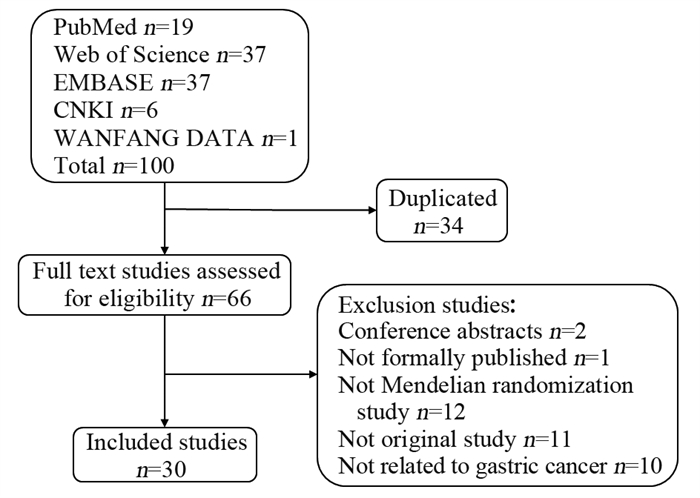
将检索到的文献导入至文献管理软件EndNote X9(Bld 12062),由两名研究人员独立阅读、筛选和核对文献。采用的筛选策略、纳入和排除标准,见图 1。排除在不同数据库中重复的文献、会议摘要、未正式发表文献、非MR研究文献、非原创性研究文献(综述)和与胃癌无关文献,最终纳入30篇合格文献,其中中文文献1篇[4]。摘录文献的基本信息、暴露特征和工具变量解释的暴露变异比例、结局特征(人群、样本量、数据来源)、研究结果和结论,并进行质量评价。本系统综述所纳入研究的筛选、信息提取和质量评估均由两位研究者独立进行,出现分歧时相互讨论达成共识。
|
| 图 1 文献检索与筛选流程图 Figure 1 Flow chart of literature search and selection process |
Skrivankova等已开发《孟德尔随机化研究的报告规范(Strengthening the Reporting of Observational Studies in Epidemiology Using Mendelian Randomization, STROBE-MR)》[34]。鉴于该规范并无方法学质量分级的依据,我们在STROBE-MR基础上,参考既往针对MR研究的其他系统综述[35]制定了MR研究质量评价方法,包括是否进行了完整的工具变量分析、对关联性假设的验证、对独立性和排他性假设的验证、开展敏感度分析、考虑人群分层情况、对非线性关联假设的探讨等六部分,各部分的判定原则见表 2。
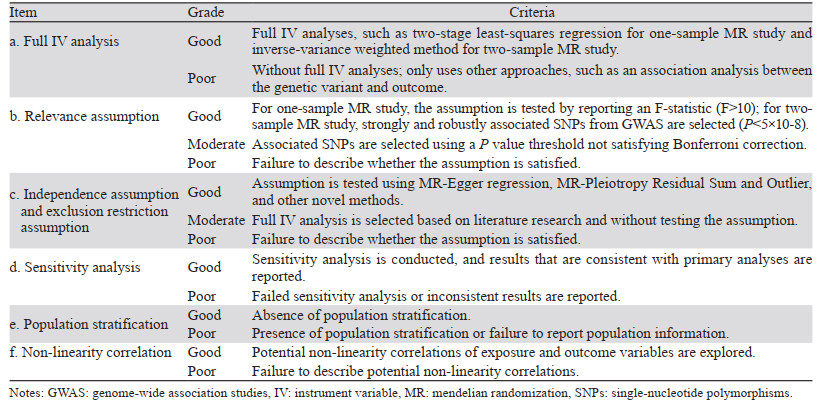
MR研究需要进行完整的IV分析(表 2,条目a)以确保质量。IV同时满足关联性(遗传变异与暴露表型相关)、独立性(遗传变异与影响关联的混杂因素独立)和排他性(遗传变异仅通过暴露影响结局)3个核心假设是结果可靠的必要条件。单样本和两样本MR研究通常依托不同方法来验证遗传变异与暴露表型的关联性假设(表 2,条目b)。遗传变异的多效性效应普遍存在,如果遗传工具通过感兴趣的暴露以外的因素影响结局,则可能被违反独立性和排他性假设,两个假设一般可以一起检验(表 2,条目c)。MR研究通过敏感度分析评估结果的稳健程度[36](表 2,条目d)。鉴于遗传易感性在不同种族间存在异质性[37],还需关注人群分层的潜在影响(表 2,条目e)。此外,我们还关注研究对暴露与结局间潜在非线性关联的探索情况并进行评级(表 2,条目f)。鉴于尚无使用汇总统计数据探究非线性关联的MR方法,多数MR研究仅关注暴露因素与结局之间的线性关联情况,因此我们主要依托表 2中的条目a~e,将该五项评级均为“良好”的研究判定为高质量MR研究。
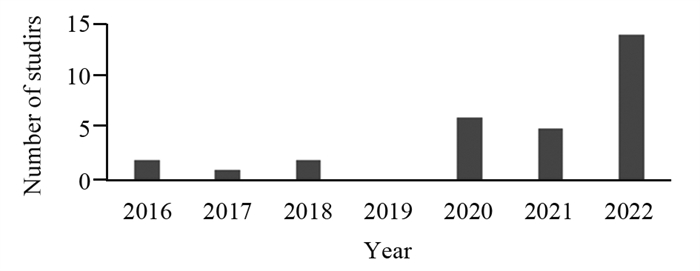
2 结果 2.1 文献基本特征本研究共纳入2016—2022年发表的30篇应用MR方法的研究,见图 2。这些研究探讨行为与生活方式、人体测量特征、其他疾病罹患情况及机体生物暴露指标等与胃癌的关系,除一项研究的结局为胃癌死亡风险外,其他均探讨与胃癌发生风险的关联。研究报告的遗传工具解释暴露变异的比例为0.1%~37.6%,其中4项MR分析仅使用1个SNP位点作为工具变量。胃癌结局数据集主要来自英国生物银行(UKB)、日本生物样本库(BBJ)、FinnGen等大型队列,其样本量的中位数为308 908(范围:3 725~456 348),中位胃癌病例数为994(范围:105-6 563)。
|
| 图 2 2016-2022年胃癌危险因素孟德尔随机化研究数量 Figure 2 Number of Mendelian randomization studies related to risk factors of gastric cancer published from 2016 to 2022 |
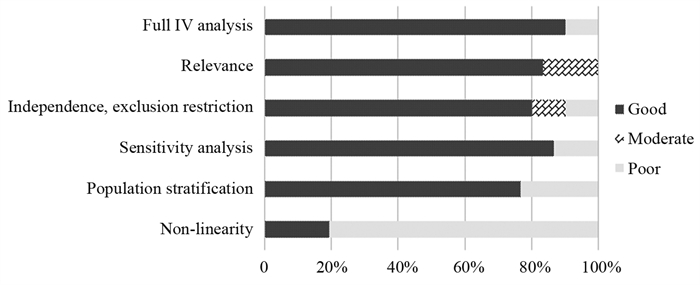
30项研究中,27项研究(90.0%)进行了完整的IV分析,23项研究(76.7%)验证了MR研究的3个核心假设,26项研究(86.7%)进行了敏感度分析,23项研究(76.7%)不存在人群分层问题,最终有20项研究(60.7%)的研究判定为高质量MR研究,见图 3。
|
| 图 3 胃癌危险因素孟德尔随机化研究方法学质量评价结果 Figure 3 Methodological quality assessment of the included MR studies related to risk factors of gastric cancer |
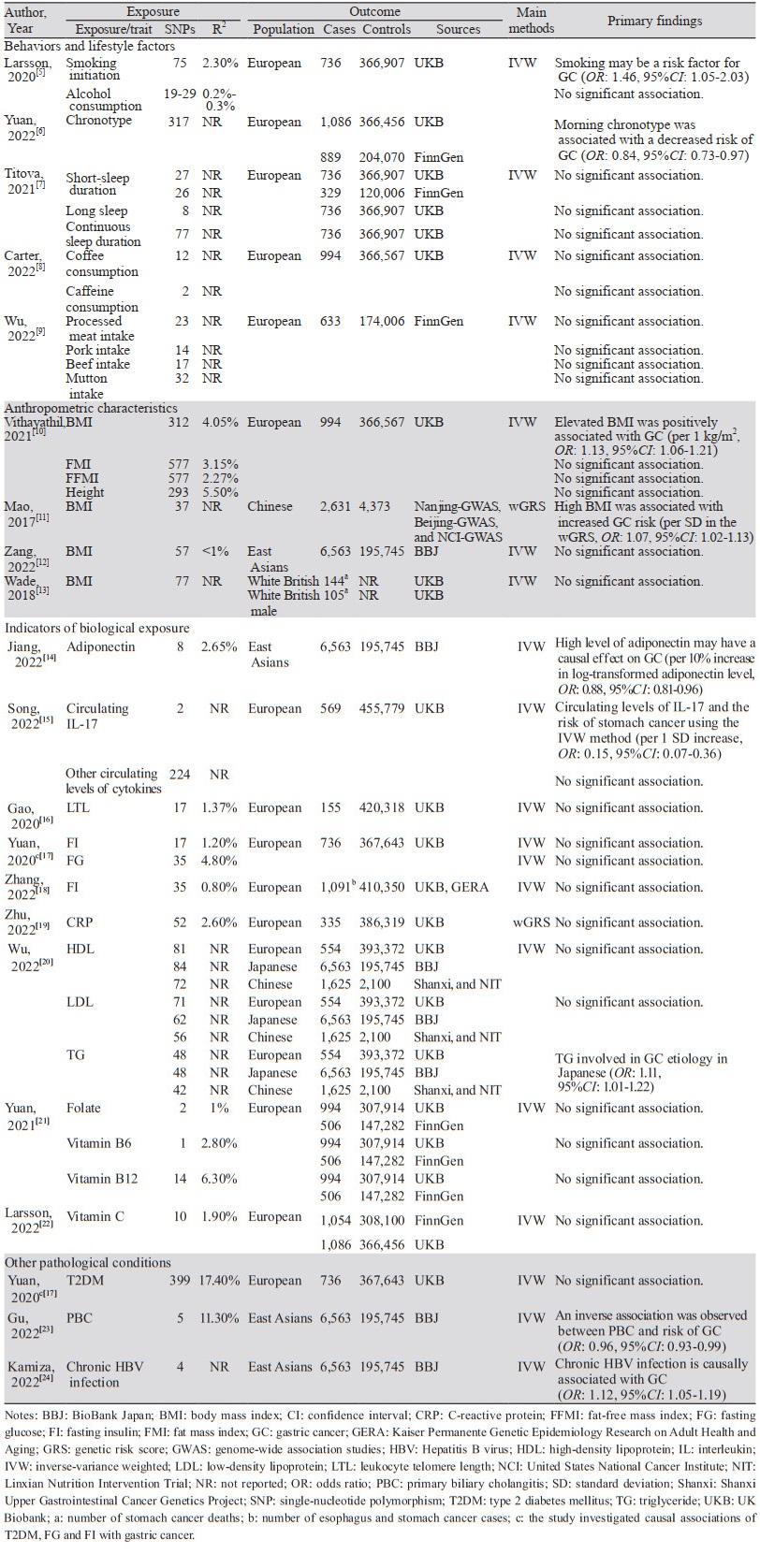
本研究共汇总20项高质量MR研究的研究进展,见表 3。
|
MR研究支持吸烟是胃癌的危险因素(OR=1.46, 95%CI: 1.05~2.03, P=0.024),未发现饮酒是胃癌的危险因素[5]。在睡眠方面,倾向于早起者的胃癌发病风险比“夜猫子”型显著降低(OR=0.84, 95%CI: 0.73~0.97)[6],但睡眠时长并未发现与胃癌有关[7]。此外,既往MR研究也不支持咖啡[8]、加工肉类及红肉[9]摄入量改变胃癌发生风险。
2.3.2 人体测量特征多项研究探讨了人体测量指征与胃癌之间的因果关联。研究表明,脂肪质量指数、非脂肪质量指数和身高均与胃癌发生无关[10]。既往基于欧洲人群[10](OR=1.13, 95%CI: 1.06~1.21, P < 0.001)和中国人群[11](OR=1.07, 95%CI: 1.02~1.13, P=4.94×10−3)的两项研究报告较高的体质指数(body mass index, BMI)是胃癌发生的危险因素,但另一项基于日本人群的MR研究得到不一致结论[12]。此外,既往基于欧洲人群的MR研究也不支持BMI与胃癌死亡风险相关[13]。
2.3.3 生物暴露指标共有9项MR研究探讨生物暴露指标(激素、细胞因子、脂蛋白、循环维生素水平等)与胃癌发生风险的因果关联。有研究表明,具有较高的脂联素(OR=0.88, 95%CI: 0.81~0.96, P=0.009)[14]或白细胞介素-17(OR= 0.15, 95%CI: 0.07~0.36, P=1.25×10⁻⁵)[15]水平者胃癌发生的风险显著降低。而白细胞端粒长度[16]、空腹血糖[17]、空腹胰岛素水平[17-18]、C-反应蛋白[19]及其他细胞因子[15]与胃癌的发生风险无关。
基于日本人群的MR研究还报告血清甘油三酯水平与胃癌发生的因果关联(OR=1.11, 95%CI: 1.01~1.22, P=0.034),但基于中国和欧洲人群的研究则不然[20]。此外,血清高密度脂蛋白[20]、低密度脂蛋白[20]、循环B族维生素[21]和维生素C[22]水平等也与胃癌的发生风险无关。
2.3.4 其他疾病罹患情况原发性胆汁性胆管炎(OR=0.96, 95%CI: 0.93~0.99, P=0.02)[23]和慢性乙型肝炎病毒感染(OR=1.12, 95%CI: 1.05~1.19, P=0.0001)[24]可能是胃癌的病因学因素。2型糖尿病与胃癌的发生风险无关[17]。
3 讨论基于观察性研究探究危险因素时可能受到混杂因素或反向因果偏误等干扰,导致因果推断能力受限[38]。随机对照试验虽是确证因果关联的金标准,但常受限于外部条件。鉴于遗传变异不受环境等混杂因素的影响,且与结局之间具有时序合理性,MR方法可为评估暴露与结局之间的因果关系提供重要证据[39]。本文对MR方法在胃癌危险因素研究中的应用现状进行了系统的文献整理、信息提取和质量评价,总结了既往胃癌危险因素MR研究的主要研究结果。
胃癌危险因素MR研究结果的质量受诸多因素的影响。在设计严谨和工具变量满足核心假设的前提下,MR研究可以为暴露与胃癌结局之间是否具有因果关联提供一定的线索,也为基础实验室研究和机制探索提供理论依据。例如,既往基于不同人种的前瞻性研究表明,吸烟显著增加胃癌的发生风险[40],对贲门癌和非贲门癌均如此[41]。前期MR研究同样提示吸烟是胃癌发生的危险因素,支持吸烟可能与胃癌发生风险存在因果关联。然而,该研究仅涵盖了欧洲人群,目前尚无针对亚洲人群的相关MR研究。BMI是超重和肥胖最常用的衡量标准。纳入22项队列研究的meta分析显示,超重和肥胖显著增加食管或贲门胃癌的发生风险[42],但针对非贲门胃癌的研究仍缺少此类证据。汇总既往MR研究,两项分别基于欧洲人群[10]和中国人群[11]的MR研究支持高BMI增加胃癌风险,但一项基于日本人群的MR研究结论并不一致[12]。一般认为欧洲人群中贲门胃癌比例高,而亚洲人群非贲门胃癌比例高。这三项MR研究均未区分贲门或非贲门胃癌,因而BMI与不同胃癌亚型的关系仍有待后续研究探讨。
应用MR研究进行因果推断还受到方法学局限性的影响:第一,当选择的工具变量只能解释一小部分暴露时,弱工具变量偏倚的存在可能导致MR分析不足以检测因果效应[37];第二,鉴于人群分层的广泛存在,工具变量的选择如源自具有遗传异质性的群体,则产生有偏的效应估计[43];第三,多数MR分析尚无能力评估暴露与结局之间可能的非线性关系;第四,MR研究对样本量有较高的要求。即便依托具有大样本量的BBJ汇总数据(病例:6 563例,对照:195 754例)作为结局样本来源,选择可解释1%暴露的遗传工具探究与疾病之间的关联时,也仅能对关联效应OR≥1.4的遗传位点达到80%以上的统计学把握度;第五,与观察性研究一样,MR研究虽然可提示危险因素与胃癌发生的潜在因果关系,但增加或降低胃癌风险的潜在机制并不清楚。
目前,诸多胃癌危险因素MR研究存在报告不规范的问题,MR分析本身也受到方法学局限性的制约。研究者应致力于开展高质量的MR研究,并结合既往观察性队列研究、生物学合理性等多方面证据对潜在的因果关系进行综合解读,以为胃癌的病因学研究和预防策略制定提供科学依据。
利益冲突声明:
所有作者均声明不存在利益冲突。
作者贡献:
王梦圆:研究设计与实施、论文构思与撰写
许恒敏:研究设计指导、文章审阅及修改
汪靖暄:文献检索与筛选、信息提取与核查
潘凯枫:文章审阅及修改
李文庆:研究设计指导、文章审阅及修改
| [1] |
Li WQ, Zhang JY, Ma JL, et al. Effects of Helicobacter pylori treatment and vitamin and garlic supplementation on gastric cancer incidence and mortality: follow-up of a randomized intervention trial[J]. BMJ, 2019, 366: l5016. |
| [2] |
Thrift AP, El-Serag HB. Burden of Gastric Cancer[J]. Clin Gastroenterol Hepatol, 2020, 18(3): 534-542. DOI:10.1016/j.cgh.2019.07.045 |
| [3] |
Smith GD, Ebrahim S. 'Mendelian randomization': can genetic epidemiology contribute to understanding environmental determinants of disease?[J]. Int J Epidemiol, 2003, 32(1): 1-22. DOI:10.1093/ije/dyg070 |
| [4] |
毛盈颖, 俞飞, 汪天培, 等. 体脂含量与胃癌发生的孟德尔随机化研究[J]. 浙江中医药大学学报, 2018, 42(5): 333-338. [Mao YY, Yu F, Wang TP, et al. Body Fat Percentage and Risk of Gastric Cancer-a Mendelian Randomization Study[J]. Zhejiang Zhong Yi Yao Da Xue Xue Bao, 2018, 42(5): 333-338. DOI:10.16466/j.issn1005-5509.2018.05.001] |
| [5] |
Larsson SC, Carter P, Kar S, et al. Smoking, alcohol consumption, and cancer: A mendelian randomisation study in UK Biobank and international genetic consortia participants[J]. PLoS Med, 2020, 17(7): e1003178. DOI:10.1371/journal.pmed.1003178 |
| [6] |
Yuan S, Mason AM, Titova OE, et al. Morning chronotype and digestive tract cancers: Mendelian randomization study[J]. Int J Cancer, 2022, 152(4): 697-704. |
| [7] |
Titova OE, Michaelsson K, Vithayathil M, et al. Sleep duration and risk of overall and 22 site-specific cancers: A Mendelian randomization study[J]. Int J Cancer, 2021, 148(4): 914-920. DOI:10.1002/ijc.33286 |
| [8] |
Carter P, Yuan S, Kar S, et al. Coffee consumption and cancer risk: a Mendelian randomisation study[J]. Clin Nutr, 2022, 41(10): 2113-2123. DOI:10.1016/j.clnu.2022.08.019 |
| [9] |
Wu K, Liu L, Shu T, et al. The relationship between processed meat, red meat, and risk of types of cancer: A Mendelian randomization study[J]. Front Nutr, 2022, 9: 942155. DOI:10.3389/fnut.2022.942155 |
| [10] |
Vithayathil M, Carter P, Kar S, et al. Body size and composition and risk of site-specific cancers in the UK Biobank and large international consortia: A mendelian randomisation study[J]. PLoS Med, 2021, 18(7): e1003706. DOI:10.1371/journal.pmed.1003706 |
| [11] |
Mao YY, Yan CW, Lu Q, et al. Genetically predicted high body mass index is associated with increased gastric cancer risk[J]. Eur J Hum Genet, 2017, 25(9): 1061-1066. DOI:10.1038/ejhg.2017.103 |
| [12] |
Zang ZP, Shao Y, Nakyeyune R, et al. Association of Body Mass Index and the Risk of Gastro-Esophageal Cancer: A Mendelian Randomization Study in a Japanese Population[J]. Nutr Cancer, 2022, 1-10. |
| [13] |
Wade KH, Carslake D, Sattar N, et al. BMI and Mortality in UK Biobank: Revised Estimates Using Mendelian Randomization[J]. Obesity(Silver Spring), 2018, 26(11): 1796-1806. |
| [14] |
Jiang H, Hu DJ, Wang J, et al. Adiponectin and the risk of gastrointestinal cancers in East Asians: Mendelian randomization analysis[J]. Cancer Med, 2022, 11(12): 2397-2404. DOI:10.1002/cam4.4735 |
| [15] |
Song J, Li A, Qian Y, et al. Genetically Predicted Circulating Levels of Cytokines and the Risk of Cancer[J]. Front Immunol, 2022, 13: 886144. DOI:10.3389/fimmu.2022.886144 |
| [16] |
Gao Y, Wei Y, Zhou X, et al. Assessing the Relationship Between Leukocyte Telomere Length and Cancer Risk/Mortality in UK Biobank and TCGA Datasets With the Genetic Risk Score and Mendelian Randomization Approaches[J]. Front Genet, 2020, 11: 583106. DOI:10.3389/fgene.2020.583106 |
| [17] |
Yuan S, Kar S, Carter P, et al. Is Type 2 Diabetes Causally Associated With Cancer Risk? Evidence From a Two-Sample Mendelian Randomization Study[J]. Diabetes, 2020, 69(7): 1588-1596. DOI:10.2337/db20-0084 |
| [18] |
Zhang H, Li D, Liu X, et al. Fasting Insulin and Risk of Overall and 14 Site-Specific Cancers: Evidence From Genetic Data[J]. Front Oncol, 2022, 12: 863340. DOI:10.3389/fonc.2022.863340 |
| [19] |
Zhu M, Ma Z, Zhang X, et al. C-reactive protein and cancer risk: a pan-cancer study of prospective cohort and Mendelian randomization analysis[J]. BMC Med, 2022, 20(1): 301. DOI:10.1186/s12916-022-02506-x |
| [20] |
Wu YL, Xin JY, Loehrer EA, et al. High-density lipoprotein, low-density lipoprotein and triglyceride levels and upper gastrointestinal cancers risk: a trans-ancestry Mendelian randomization study[J]. Eur J Clin Nutr, 2022, 76(7): 995-1002. DOI:10.1038/s41430-022-01078-6 |
| [21] |
Yuan S, Carter P, Vithayathil M, et al. Genetically predicted circulating B vitamins in relation to digestive system cancers[J]. Br J Cancer, 2021, 124(12): 1997-2003. DOI:10.1038/s41416-021-01383-0 |
| [22] |
Larsson SC, Mason AM, Vithayathil M, et al. Circulating vitamin C and digestive system cancers: Mendelian randomization study[J]. Clin Nutr, 2022, 41(9): 2031-2035. DOI:10.1016/j.clnu.2022.07.040 |
| [23] |
Gu D, Zhang M, Wang Y, et al. Causal effect of autoimmune liver diseases on cancer: meta-analyses of cohort studies and Mendelian randomization study[J]. Liver Int, 2022, 42(10): 2216-2226. DOI:10.1111/liv.15355 |
| [24] |
Kamiza AB, Fatumo S, Singini MG, et al. Hepatitis B infection is causally associated with extrahepatic cancers: A Mendelian randomization study[J]. EBioMedicine, 2022, 79: 104003. DOI:10.1016/j.ebiom.2022.104003 |
| [25] |
Fadista J, Yakimov V, Võsa U, et al. Genetic regulation of spermine oxidase activity and cancer risk: a Mendelian randomization study[J]. Sci Rep, 2021, 11(1): 17463. DOI:10.1038/s41598-021-97069-x |
| [26] |
Larsson SC, Carter P, Vithayathil M, et al. Insulin-like growth factor-1 and site-specific cancers: A Mendelian randomization study[J]. Cancer Med, 2020, 9(18): 6836-6842. DOI:10.1002/cam4.3345 |
| [27] |
Larsson SC, Carter P, Vithayathil M, et al. Genetically predicted plasma phospholipid arachidonic acid concentrations and 10 site-specific cancers in UK biobank and genetic consortia participants: A mendelian randomization study[J]. Clin Nutr, 2021, 40(5): 3332-3337. DOI:10.1016/j.clnu.2020.11.004 |
| [28] |
Larsson SC, Kar S, Perry JRB, et al. Serum Estradiol and 20 Site-Specific Cancers in Women: Mendelian Randomization Study[J]. J Clin Endocrinol Metab, 2022, 107(2): e467-e474. DOI:10.1210/clinem/dgab713 |
| [29] |
Niu WQ, Pang Q, Lin T, et al. A Causal Role of Genetically Elevated Circulating Interleukin-10 in the Development of Digestive Cancers: Evidence from Mendelian Randomization Analysis Based on 29, 307 Subjects[J]. Medicine(Baltimore), 2016, 95(7): e2799. |
| [30] |
Wang TP, Ren CL, Ni J, et al. Genetic Association of Plasma Homocysteine Levels with Gastric Cancer Risk: A Two-Sample Mendelian Randomization Study[J]. Cancer Epidemiol Biomarkers Prev, 2020, 29(2): 487-492. DOI:10.1158/1055-9965.EPI-19-0724 |
| [31] |
Xu W, Cheng YL, Zhu HR. Evaluation of an Association of Blood Homocysteine Levels With Gastric Cancer Risk From 27 Case-Control Studies[J]. Medicine(Baltimore), 2016, 95(20): e3700. |
| [32] |
Yin L, Yan H, Chen K, et al. Diet-Derived Circulating Antioxidants and Risk of Digestive System Tumors: A Mendelian Randomization Study[J]. Nutrients, 2022, 14(16): 3274. DOI:10.3390/nu14163274 |
| [33] |
Yuan S, Vithayathil M, Kar S, et al. Assessing the protective role of allergic disease in gastrointestinal tract cancers using Mendelian randomization analysis[J]. Allergy, 2021, 76(5): 1559-1562. DOI:10.1111/all.14616 |
| [34] |
Skrivankova VW, Richmond RC, Woolf BAR, et al. Strengthening the Reporting of Observational Studies in Epidemiology Using Mendelian Randomization: The STROBE-MR Statement[J]. JAMA, 2021, 326(16): 1614-1621. DOI:10.1001/jama.2021.18236 |
| [35] |
van de Luitgaarden IAT, van Oort S, Bouman EJ, et al. Alcohol consumption in relation to cardiovascular diseases and mortality: a systematic review of Mendelian randomization studies[J]. Eur J Epidemiol, 2022, 37(7): 655-669. DOI:10.1007/s10654-021-00799-5 |
| [36] |
Skrivankova VW, Richmond RC, Woolf BAR, et al. Strengthening the reporting of observational studies in epidemiology using mendelian randomisation (STROBE-MR): explanation and elaboration[J]. BMJ, 2021, 375: n2233. |
| [37] |
高雪, 薛付忠, 黄丽红, 等. 孟德尔随机化模型及其规范化应用的统计学共识[J]. 中国卫生统计, 2021, 38(3): 471-475, 480. [Gao X, Xue F, Huang L, et al. Statistical consensus on mendelian randomization model and its standardized application[J]. Zhongguo Wei Sheng Tong Ji, 2021, 38(3): 471-475, 480.] |
| [38] |
Smith GD. Reflections on the limitations to epidemiology[J]. J Clin Epidemiol, 2001, 54(4): 325-331. DOI:10.1016/S0895-4356(00)00334-6 |
| [39] |
Nelson CP, Hamby SE, Saleheen D, et al. Genetically determined height and coronary artery disease[J]. N Engl J Med, 2015, 372(17): 1608-1618. DOI:10.1056/NEJMoa1404881 |
| [40] |
Guo Y, Li ZX, Zhang JY, et al. Association Between Lifestyle Factors, Vitamin and Garlic Supplementation, and Gastric Cancer Outcomes: A Secondary Analysis of a Randomized Clinical Trial[J]. JAMA Netw Open, 2020, 3(6): e206628. DOI:10.1001/jamanetworkopen.2020.6628 |
| [41] |
Ladeiras-Lopes R, Pereira AK, Nogueira A, et al. Smoking and gastric cancer: systematic review and meta-analysis of cohort studies[J]. Cancer Causes Control, 2008, 19(7): 689-701. DOI:10.1007/s10552-008-9132-y |
| [42] |
Turati F, Tramacere I, La Vecchia C, et al. A meta-analysis of body mass index and esophageal and gastric cardia adenocarcinoma[J]. Ann Oncol, 2013, 24(3): 609-617. DOI:10.1093/annonc/mds244 |
| [43] |
Davey Smith G, Hemani G. Mendelian randomization: genetic anchors for causal inference in epidemiological studies[J]. Hum Mol Genet, 2014, 23(R1): R89-R98. DOI:10.1093/hmg/ddu328 |