 2020, Vol. 18
引用本文 |

| 基于ReHo方法探究针刺百会穴脑效应的性别差异 |  [PDF全文] [PDF全文] |

 ,
,
,
,
,
,
,
,
,
,
,
,
,
,
,
,
,
,
,
,
百会穴位于头顶正中、两耳尖连线的中点处,为督脉要穴[1-2],是治疗抑郁[3]、失眠[4]、癫痫[5]、脑卒中[6]等情感或脑部疾病,以及缓解认知障碍症状及不同疾病导致焦虑情绪的重要腧穴[7-9]。针灸治疗抑郁症效果显著[10-12]。根据美国《精神障碍诊断与统计手册(第五版)》(DSM-5)的诊断标准,抑郁症是以持续2周以上的情绪寡淡、食欲减退、思维僵化及反复出现自杀想法为临床特征的一种情感性障碍疾患,其自杀率位居精神科疾病之首,也是世界疾病负担最重的10种最致残疾病之一。全球约3亿多人患有抑郁症[13],我国发病率约3.02%,目前超过500万人患病[14]。该病存在明显的性别差异,女性发病率远高于男性,尤其女性患重度抑郁症(major depressive disorder,MDD)概率是男性的2倍[15];且男性和女性的抑郁症首次发作率及持续性抑郁的发生率在青少年时期就出现差异[16];不同性别患者的临床表现、病程和治疗反应也有所不同[17]。随着fMRI等技术的发展,其越来越多地被用于抑郁症病因的探究[18]。本研究使用fMRI技术,基于局部一致性(regional homogencity,ReHo)方法探究针刺百会穴在不同性别的健康受试者身上产生的中枢效应的差异。
1 资料与方法 1.1 一般资料2019年2—3月纳入上海高校本科或以上学历健康受试者20例,分为男性组、女性组各10例,平均年龄(26.3±1.7)岁,中位年龄26.5岁。纳入标准:①右利手;②头颅结构正常;③无MRI检查禁忌证;④无慢性疼痛、脑部疾病、心血管疾病及遗传性疾病等;⑤非孕期、哺乳期及经期女性;⑥2个月内未服用止痛类或精神类药物;⑦既往体健,无重大外伤及手术史。受试者均签署知情同意书。
1.2 实验方案实验采用非重复性事件相关设计。受试者平卧休息,扫描前配戴耳塞以降低噪声干扰;实验过程中全程闭眼,保持安静,意识清醒,无认知相关神经活动。先行5 min静息态扫描,扫描结束后由1名具针灸经验的医师进入MRI室为受试者进行针刺,在前发际直上5寸,相当于两耳尖连线的中点选择GV20,使用顺磁性金材质针具,平刺0.5寸,行平补平泻捻转法,先顺时针捻转30 s,再逆时针捻转30 s,重复3次,速度约60次/min,共捻转3 min,以受试者得气为度,得气后留针,留针过程中再次行5 min静息态扫描(图 1)。扫描结束后受试者填写视觉模拟评分法(visual analogue scale,VAS)针感量表。
 |
| 图 1 百会穴针刺fMRI扫描流程 |
1.3 fMRI扫描参数
采用联影公司uMR 780 3.0 T MRI机及14通道头颅柔性线圈。先对受试者常规头颅MRI扫描,采用平面回波序列,确保无颅内器质性病变及重大结构异常。结构像采用三维解剖像T1WI磁化准备快速梯度回波序列,TR 1 900 ms,TE 2.0 ms,翻转角9°,FOV 250 mm×250 mm,层厚1 mm,扫描层数180层。功能像采用T2WI BOLD脉冲序列,TR 2 000 ms,TE 30 ms,翻转角90°,层厚3.5 mm,无间隔,相位分辨率100%,FOV 250 mm×250 mm,矩阵64×64,扫描层数33层。
1.4 图像处理采用统计参数图软件SPM12(https://www.fil.ion.ucl.ac.uk/spm/)对数据进行预处理。剔除Rs-fMRI前10个数据点,避免初始阶段信号未稳或受试者对环境不适的影响,对Rs-fMRI数据作时间校正和头动校正,剔除各方向(X,Y,Z)最大头动>1.5 mm及转动角度>1.5°的数据,后将图像空间归一化到蒙特利尔神经学研究所标准空间,重采样大小设定为3 mm×3 mm×3 mm。随后进行去线性漂移和滤波(0.01<频率<0.08 Hz)处理,去除低频漂移和高频的呼吸、心跳噪声。
1.5 统计学方法ReHo分析采用RestPlus软件。首先计算全脑每个体素与其相邻体素时间序列的一致性,得到全脑ReHo信号图。采用配对t检验分别分析男性和女性受试者在手针刺激后脑部的受激活区,以阈值体素水平P<0.05为差异有统计学意义。采用两独立样本t检验比较2组的脑激活区,以阈值体素水平P<0.05为差异有统计学意义。2组一般资料及针灸相关数据分析采用SPSS 25.0软件,2组的年龄、受教育年限及针感数据行两独立样本t检验,以P<0.05为差异有统计学意义,其中针感评分采VAS评分量表。
2 结果 2.1 一般资料2组年龄、受教育年限比较,差异均无统计学意义(均P>0.05)(表 1)。
| 表 1 2组年龄及受教育程度比较(x±s) |
 |
2.2 针感比较
2组针感评分均采用VAS评分量表,记录包含痛感、酸感、胀感、麻感及传导感在内的5种针感。在针刺刺激量尽可能保持一致的情况下,2组除胀感和传递感,其余针感间差异均无统计学意义(均P>0.05)(表 2)。
| 表 2 2组VAS针感评分比较(分,x±s) |
 |
2.3 fMRI结果比较 2.3.1 2组脑部受激活区
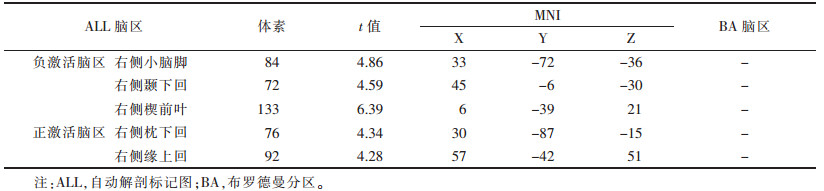
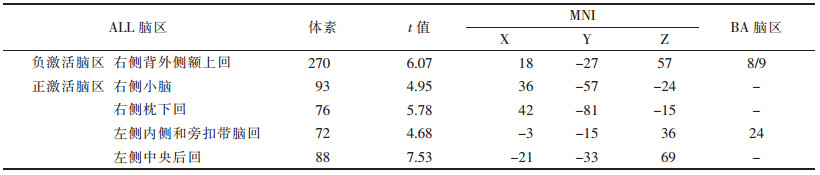
手针刺激3 min后,男性正激活脑区集中在右侧枕下回及右侧缘上回,负激活脑区集中在右侧小脑脚、右侧颞下回及右侧楔前叶(表 3);女性正激活脑区有右侧枕下回、右侧小脑、左侧中央后回、左侧内侧和旁扣带脑回,负激活区为右侧背外侧额上回(表 4)。受激活脑区使用基于使用预定义的自动解剖标记图(automated anatomical labeling,AAL)及布罗德曼分区(brodmann area,BA)表示。
| 表 3 男性受激活脑区(n=10) |
 |
| 表 4 女性受激活脑区(n=10) |
 |
2.3.2 2组脑部受激活区差异对比
手针刺激后,仅存在男性ReHo值高于女性的脑区(图 2,3)。该脑区为双侧丘脑,女性受试者所有脑区的受激活程度均低于男性(表 5)。
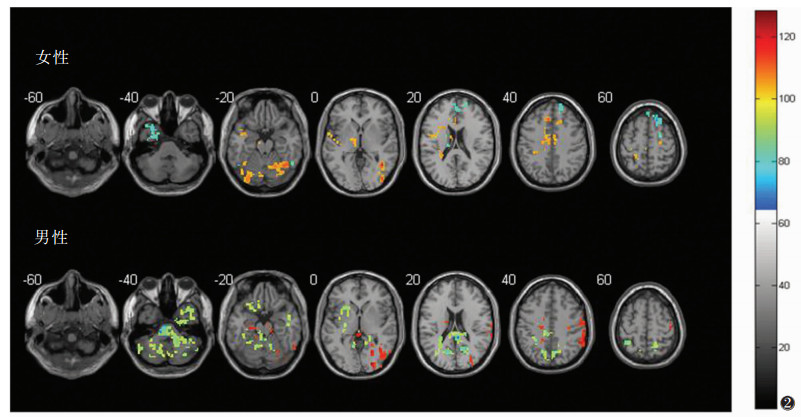 |
| 图 2 男性和女性受试者(ReHo值)增强或减弱的脑区对比(红色代表ReHo值增强的脑区,蓝色代表ReHo值减弱的脑区)。统计方法为配对t检验,P<0.05 |
| 表 5 男性ReHo值高于女性的差异脑区 |
 |
3 讨论
人类大脑在解剖学上的性别差异已被大量的影像学及尸体解剖证据所证实,随着神经影像学技术的发展,针对大脑功能性别差异的静息态研究逐渐增多。本研究探讨了针灸百会穴引起的神经影像学反应的性别差异,既往类似的研究[19-20]多选用体穴进行针刺,鲜少选择头部穴位。本研究使用14通道头颅柔性线圈,其采集的信号质量与常规线圈一致,且与头部更贴合,可在针刺头部穴位的同时采集到SNR良好的MRI信号,并在留针过程获得实时采集的数据[21]。
本研究发现,2组针刺后脑区均出现激活反应,既有相同脑区也有不同脑区(图 2)。2组枕下回均有正激活反应,枕叶属视觉联合皮层,参与处理视觉刺激[22]。有研究[23-24]认为抑郁症患者静息态下枕叶的活动特征和皮质结构与健康人有显著差异,枕叶皮质结构在MDD患者身上同样存在异常,这可能与抑郁症患者的情感及认知网络障碍相关。针灸百会穴对抑郁症的治疗作用已有大量临床和动物实验方面的研究[25-27],其对枕叶的激活或许可解释相关治疗机制,亦不排除实验过程中受试者眼球运动引起的枕叶激活,但本研究中受试者全程闭眼,因此这种可能性较少。
另外,本研究男性组颞下回及楔前叶有负激活反应,颞下回与认知功能密切相关,在Alder等[28]一项基于fMRI研究MDD患者的实验中发现,患者颞下回、枕叶皮质等脑区出现血流活动降低的征象。楔前叶与自我意识和认知功能相关,如阿尔茨海默病及帕金森病患者伴认知障碍时可能会出现楔前叶的结构异常。女性组额上回出现负激活反应,张琪等[29]在一项基于独立成分分析方法的研究中指出抑郁症患者的额上回较健康人激活程度高。此外,2组针刺后小脑脑区的激活效应相反,男性为负激活,女性为正激活,小脑主要负责协调肢体运动,也参与精神疾病的情感调节,是多重效应的处理枢纽;可见针刺百会穴对不同性别间可能引起情感处理脑区的活动差异。
本研究显示仅存在男性ReHo值比女性高的脑区(图 3),主要集中在双侧丘脑,与以往针灸中枢效应性别差异的研究结论相反。Yeo等[20]在一项针刺膝盖附近穴位的研究中提出女性对针灸敏感程度更高,但疼痛针感较男性强,而本研究疼痛针感差异无统计学意义,但男性的胀感更强,使得男性对针刺的敏感性比女性更高,这或许能解释针感是引起针灸中枢效应差异重要因素的原因。
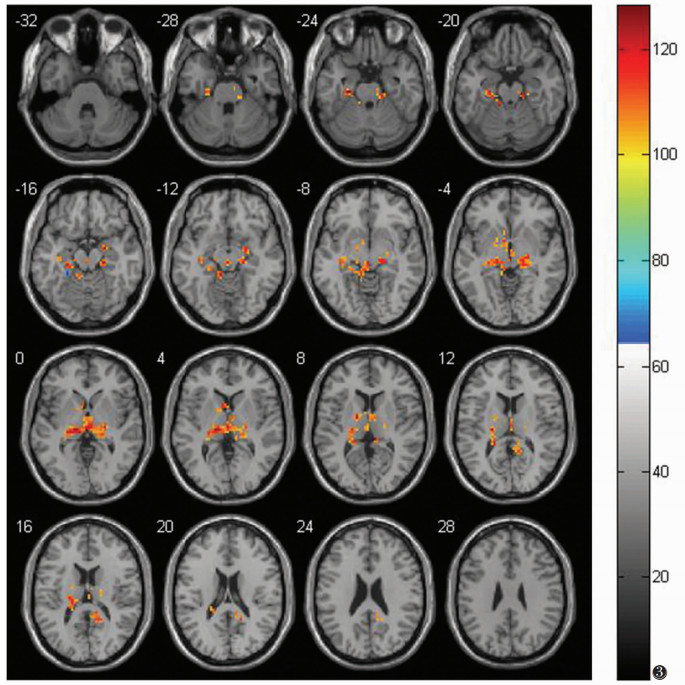 |
| 图 3 男性与女性受试者受激活脑区的差异,男性比女性ReHo值大的脑区主要集中在双侧丘脑。统计方法为两独立样本t检验,P<0.05 |
丘脑与边缘系统脑区联系广泛,参与调节情感与本能行为,与抑郁症发病关系密切,既往研究[30]表明MDD患者的丘脑结构很可能存在异常。Kong等[31]研究指出,MDD患者丘脑与顶叶、前额叶及双侧额中回等脑区连接降低,与小脑及左侧岛叶的连接却增加。Wang等[32]研究了14例MDD患者经抗抑郁药治疗前后的脑部ReHo值差异,发现治疗后双侧丘脑ReHo值有所下降,说明抗抑郁药可能是通过调节边缘系统及其关联脑区的静息态活动起作用。丘脑是抑郁症发病机制的一个重要环节,本研究发现,相较于男性,针刺百会穴对降低女性双侧丘脑活动度的作用更强,这或许能解释百会穴治疗抑郁症的机制。
综上所述,不同性别健康受试者针刺百会穴后脑部ReHo值发生变化,提示性别差异也应成为针灸实践中需考虑的要素,将有助于解释针灸治疗抑郁症的作用机制。
| [1] |
王茹, 张捷, 韦玲, 等. 百会穴在神志病中的临床应用[J]. 山西中医, 2018, 34(1): 59-60. |
| [2] |
马冉, 孔立红, 齐凤军, 等. 百会穴对脑的作用之古今研究探析[J]. 辽宁中医杂志, 2019, 46(2): 425-428. |
| [3] |
Wen X, Wu Q, Liu J, et al. Randomized single-blind multicenter trial comparing the effects of standard and augmented acupuncture protocols on sleep quality and depressive symptoms in patients with depression[J]. Psychol Health Med, 2018, 23: 375-390. |
| [4] |
Li S, Yin P, Yin X, et al. Effect of acupuncture on insomnia in menopausal women:a study protocol for a randomized controlled trial[J]. Trials, 2019, 20: 308. |
| [5] |
王志坚, 江永, 李凌恩. 电针治疗青少年癫痫伴发抑郁状态40例临床观察[J]. 光明中医, 2018, 33(8): 1144-1146. |
| [6] |
Chavez LM, Huang SS, MacDonald I, et al. Mechanisms of acupuncture therapy in ischemic stroke rehabilitation:a literature review of basic studies[J]. Int J Mol Sci, 2017, 18: 2270. |
| [7] |
Isoyama D, Cordts EB, de Souza van Niewegen AM, et al. Effect of acupuncture on symptoms of anxiety in women undergoing in vitro fertilisation:a prospective randomised controlled study[J]. Acupunct Med, 2012, 30: 85-88. |
| [8] |
Rosted P, Bundgaard M, Gordon S, et al. Acupuncture in the management of anxiety related to dental treatment:a case series[J]. Acupunct Med, 2010, 28: 3-5. |
| [9] |
Suh HW, Kim J, Kwon O, et al. Neurocircuitry of acupuncture effect on cognitive improvement in patients with mild cognitive impairment using magnetic resonance imaging:a study protocol for a randomized controlled trial[J]. Trials, 2019, 20: 310. |
| [10] |
Ma S, Qu S, Huang Y, et al. Improvement in quality of life in depressed patients following verum acupuncture or electroacupuncture plus paroxetine:a randomized controlled study of 157 cases[J]. Neural Regen Res, 2012, 7: 2123-2129. |
| [11] |
Litscher G, Cheng G, Wang L, et al. Biomedical teleacupuncture between China and Austria using heart rate variability-part 2:patients with depression[J]. Evid Based Complement Alternat Med, 2012, 2012: 145904. |
| [12] |
白艳甫, 杨帆. 针刺四关配合艾灸百会治疗围绝经期妇女抑郁症20例疗效观察[J]. 云南中医中药杂志, 2016, 37(4): 45-46. |
| [13] |
World Health Organization. Depression and other common mental disorders: global health estimates[R].World Health Organization, 2017.
|
| [14] |
Smith K. Mental health:a world of depression[J]. Nature News, 2014, 515: 180. |
| [15] |
Goldstein JM, Hale T, Foster SL, et al. Sex differences in major depression and comorbidity of cardiometabolic disorders:impact of prenatal stress and immune exposures[J]. Neuropsychopharmacology, 2019, 44: 59-70. |
| [16] |
Breslau J, Gilman SE, Stein BD, et al. Sex differences in recent first-onset depression in an epidemiological sample of adolescents[J]. Transl Psychiatry, 2017, 7: e1139. |
| [17] |
LeGates TA, Kvarta MD, Thompson SM. Sex differences in antidepressant efficacy[J]. Neuropsychopharmacology, 2019, 44: 140-154. |
| [18] |
Young KD, Bodurka J, Drevets WC. Functional neuroimaging of sex differences in autobiographical memory recall in depression[J]. Psychol Med, 2017, 47: 2640-2652. |
| [19] |
Li A, Wang YH, Zhang F, et al. Acupuncture for gender differences and similarities in cerebral activity of health volunteers:a pilot fMRI study[J]. Medicine, 2018, 97: e13655. |
| [20] |
Yeo S, Rosen B, Bosch P, et al. Gender differences in the neural response to acupuncture:clinical implications[J]. Acupunct Med, 2016, 34: 364-372. |
| [21] |
谭文莉, 詹松华, 康英杰, 等. 头颅柔性线圈与硬质线圈成像质量的比较研究[J]. 中国医学计算机成像杂志, 2017, 23(6): 575-579. |
| [22] |
崔曼曼, 王霁蕾, 肖芳莉, 等. fMRI技术在探索原发性三叉神经痛患者静息态下脑功能变化的研究[J]. 安徽医科大学报, 2017, 52(7): 1029-1032. |
| [23] |
赖明君, 潘小平, 魏新华, 等. 抑郁症患者静息态功能磁共振与睡眠结构研究[J]. 中国医学创新, 2019, 16(3): 25-29. |
| [24] |
Schmitgen MM, Depping MS, Bach C, et al. Aberrant cortical neurodevelopment in major depressive disorder[J]. J Affect Disord, 2019, 243: 340-347. |
| [25] |
Wen X, Wu Q, Liu J, et al. Randomized single-blind multicenter trial comparing the effects of standard and augmented acupuncture protocols on sleep quality and depressive symptoms in patients with depression[J]. Psychol Health Med, 2018, 23: 375-390. |
| [26] |
Han X, Wu H, Yin P, et al. Electroacupuncture restores hippocampal synaptic plasticity via modulation of 5-HT receptors in a rat model of depression[J]. Brain Res Bull, 2018, 139: 256-262. |
| [27] |
Li W, Zhu Y, Saud SM, et al. Electroacupuncture relieves depression-like symptoms in rats exposed to chronic unpredictable mild stress by activating ERK signaling pathway[J]. Neurosci Lett, 2017, 642: 43-50. |
| [28] |
Alder GL, Davis AD, MacQueen G, et al. Reduced accuracy accompanied by reduced neural activity during the performance of an emotional conflict task by unmedicated patient with major depression:a CAM-BIND fMRI study[J]. J Affect Disord, 2019, 257: 765-773. |
| [29] |
张琪, 毛宁, 宋筱蕾, 等. 重度抑郁症静息态fMRI的独立成分分析[J]. 国际医学放射学杂志, 2019, 42(3): 260-263. |
| [30] |
Lu Y, Liang H, Han D, et al. The volumetric and shape changes of the putamen and thalamus in first episode, untreated major depressive disorder[J]. Neuroimage Clin, 2016, 11: 658-666. |
| [31] |
Kong QM, Qiao H, Liu CZ, et al. Aberrant intrinsic functional connectivity in thalamo-cortical networks in major depressive disorder[J]. CNS Neurosci Ther, 2018, 24: 1063-1072. |
| [32] |
Wang L, Li K, Zhang Q, et al. Short-term effects of escitalopram on regional brain function in first-episode drug-naive patients with major depressive disorder assessed by resting-state functional magnetic resonance imaging[J]. Psychol Med, 2014, 44: 1417-1426. |