 2019, Vol. 17
引用本文 |

| MRI多参数定量分析在鉴别肾透明细胞癌与乏脂型血管平滑肌脂肪瘤中的应用 |  [PDF全文] [PDF全文] |


肾透明细胞癌(clear cell renal cell carcinoma,CCRCC)是肾脏最常见的恶性肿瘤,临床多手术切除,然而因肾脏肿瘤行手术切除的患者中有相当部分病理最终证实为良性肿瘤,其中最常见的是肾血管平滑肌脂肪瘤(angiomyolipoma,AML)。因此,早期准确诊断尤为重要。本研究回顾性分析CCRCC和乏脂型AML的MRI及手术病理资料,以评价MRI多参数定量分析在2种肿瘤鉴别上的应用价值。
1 资料与方法 1.1 一般资料收集2011年7月至2019年3月我院31例经手术病理证实的CCRCC或乏脂型AML的MRI资料,其中男18例,女13例;年龄18~84岁,中位年龄53岁。CCRCC 19例,其中16例行MRI平扫、DWI及增强扫描,3例行MRI平扫及DWI检查;乏脂型AML 12例,其中10例行MRI平扫、DWI及增强扫描,2例行MRI平扫及DWI检查。
1.2 仪器与方法采用Philips Achieva 1.5 T超导型MRI系统、体线圈及呼吸门控。扫描序列与参数:冠状位BTFE-BH序列(TR 500 ms,TE 50 ms,FOV 360 mm×360 mm,矩阵232×233)、轴位T2WI-SPAIRBH序列(TR 1 200 ms,TE 80 ms,FOV 360 mm×360 mm,矩阵236×166)、轴位DWI序列(b=0、800 s/mm2,TR 1 000 ms,TE 70 ms,FOV 360 mm×360 mm,矩阵236×166)、轴位DUAL-FFE-BH序列(TR 500 ms,TE 2.3 ms、4.6 ms,FOV 360 mm×360 mm,矩阵236 ×166)。增强扫描对比剂为马根维显(15~20 mL),经肘前静脉注射,剂量0.2 mL/kg体质量,流率2~3 mL/s;行轴位E-THRIVE-dyn-BH序列(TR 500 ms,TE 50 ms,FOV 360 mm×360 mm,矩阵236×166)扫描,注药25 s后行皮质期扫描,随后重复扫4次(每次扫描间隔20 s),4 min行延迟扫描。层厚4 mm,层距0.8 mm。
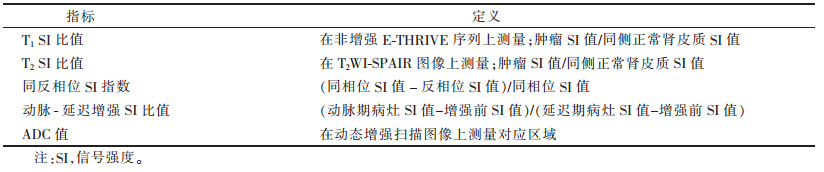
1.3 图像分析由2名影像诊断医师(腹部诊断经验5年以上)分别对图像进行观察、测量,取平均值。各观察指标及定义见表 1。病灶测量选择实性部分,并避开坏死、囊变、出血及血管区。动态增强扫描图像的测量分别选择动脉期及延迟期病灶内强化最明显的非血管区域、并保证在同一解剖层面和位置测量。同反相位测量选择信号差异最明显区。DWI图像信号测量选择与动态增强扫描相对应区域。
| 表 1 MRI图像观察指标及其定义 |
 |
1.4 统计学分析
采用SPSS 23.0统计软件。单样本Levene检验行正态性分析。2组间各观察指标的差异行两独立样本t检验。以P<0.05为差异有统计学意义。
2 结果CCRCC的T2WI常呈明显高信号,肿瘤较大,发生囊变、坏死、出血时呈不均匀高信号。乏脂型AML的T2WI常呈低或稍低信号,且信号较均匀。Levene检验结果显示,2组数据均符合正态性分布。2组各MRI观察指标见表 2。与乏脂型AML相比,CCRCC具有更高的T2 SI比值、动脉-延迟增强SI比值、ADC值,更低的同反相位SI值(均P<0.05)(图 1~3);两者的T1 SI比值差异无统计学意义(P>0.05)。
| 表 2 2组各MRI观察指标结果(x±s) |
 |
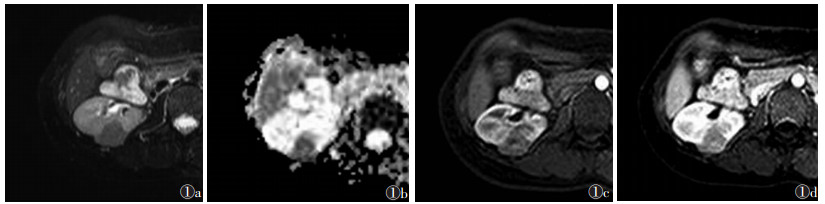 |
| 图 1 右肾乏脂型平滑肌脂肪瘤 图 1a 与肾皮质相比,T2WI-SPAIR呈均匀低信号 图 1b ADC呈明显低信号,ADC值1.152×10⁻³ mm2/s 图 1c 增强扫描动脉期病灶明显不均匀强化 图 1d 延迟期仍可见持续强化,动脉-延迟强化SI比值为0.925 |
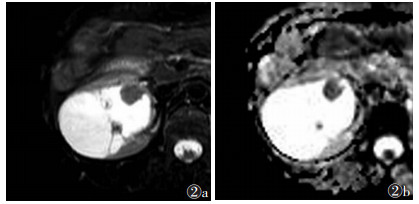 |
| 图 2 右肾透明细胞癌(CCRCC),WHO/国际泌尿病理协会(ISUP)分级Ⅰ~Ⅱ级 图 2a 与肾皮质相比,T2WI-SPAIR呈以高信号为主的不均匀信号 图 2b 壁结节ADC呈低信号,ADC值1.522×10⁻³ mm2/s |
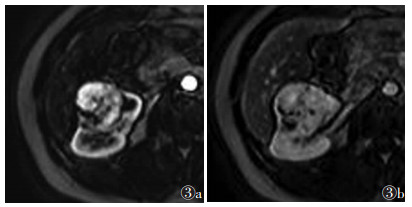 |
| 图 3 右肾CCRCC,WHO/ISUP分级Ⅰ级 图 3a 增强扫描动脉期明显不均匀强化 图 3b 延迟期明显减退,动脉-延迟强化SI比值1.497 |
3 讨论
肾脏AML和CCRCC分别是最常见的肾脏良、恶性肿瘤,两者均为富血供肿瘤,大块脂肪信号/密度是诊断AML的重要依据。然而约22.5%的AML脂肪含量少于25%,病理上将其定义为乏脂型AML,同时CCRCC易于积聚细胞内脂肪[1-3],此时两者影像学表现有一定程度的重叠,鉴别较困难。
病理上CCRCC肿瘤细胞体积大,胞质丰富透明,间质内含丰富的毛细血管和血窦,肿瘤较大时易发生出血、坏死、囊变。乏脂型AML由不同比例的厚壁血管、平滑肌及少量脂肪组织构成。本研究CCRCC在T2WI上常呈明显高信号,肿瘤较大,发生囊变、坏死、出血时呈不均匀高信号。乏脂型AML的T2WI常呈低及稍低信号,且信号较均匀。Choi等[4]认为,乏脂型AML在T2WI上呈低信号与病变内平滑肌含量相关。T2 SI比值,即肿瘤SI/同侧正常肾皮质SI,本研究结果显示T2 SI比值对两者鉴别具有重要意义,Schieda等[5-6]的研究结果也证实了这点。
化学位移成像序列可评价体素内脂肪含量,CCRCC和乏脂型AML均含有脂质成分,两者反相位SI较同相位均不同程度降低。本研究乏脂型AML的反相位SI值下降程度大于CCRCC(P<0.05),提示同反相位SI指数对两者鉴别有一定的临床意义,与Kim等[7-8]的报道结果一致。但Hindman等[9]认为同反相位MRI对CCRCC及乏脂型AML的鉴别诊断准确性差;Chen等[10]认为同反相位SI指数仍未被证实可用于乏脂型AML与CCRCC的鉴别诊断。CCRCC与乏脂型AML间脂肪含量存在一定重叠,且CCRCC内的出血、坏死造成测量数据偏差,可能是研究结果不一致的原因,仍需大样本研究分析。
增强扫描病灶的强化特点与其血流动力学及病理学特征密切相关。CCRCC含有丰富、粗大的肿瘤血管,且肿瘤内有较多的动静脉瘘。乏脂型AML除含较多平滑肌成分外,尚含条状、放射状等形态的血管,且血管发育成熟,内皮细胞间隙小。本研究采用动脉-延迟强化SI比值,反映肿瘤强化的动态变化特征,结果表明CCRCC的动脉-延迟强化SI比值大于乏脂型AML,与其病理上不成熟血管内皮间隙大、渗透性强及存在动静脉瘘的特点相符合。Kim等[11]发现,在双期CT增强扫描中68%的乏脂型AML呈渐进性和延迟强化,而85%的CCRCC呈早期廓清,本研究结论与之相符。Ho等[12-13]利用MRI动态增强扫描研究两者的差别,结论也相同。
DWI信号强度主要反映组织结构、细胞核浆比、细胞内外水分子分布及细胞密度等情况。大量研究[14-15]表明,ADC值在肾脏良恶性肿瘤的鉴别诊断中具有重要价值;与单指数弥散衰减模式相比,双指数弥散衰减模式DWI能够更准确反映弥散情况;b值为800 s/mm2时的诊断效能最高。Li等[16-18]认为乏脂型AML的ADC值明显低于CCRCC。Tanaka等[18]认为,乏脂型AML与CCRCC的ADC平均值分别为0.80×10-3、1.54×10-3 mm2/s。本研究结果与上述文献相符。
综上所述,MRI多参数图像定量分析在乏脂型AML及CCRCC的鉴别诊断中具有一定临床价值。更高的T2SI比值、动脉-延迟增强SI比值、ADC值及更低的同反相位SI指数提示CCRCC的诊断,同时再结合其他形态学特征,能够提高肾乏脂型AML和CCRCC的早期诊断准确率,为临床治疗方案的选择提供依据。
| [1] |
王海屹, 叶慧义, 袁静, 等. 乏脂肪肾脏血管平滑肌脂肪瘤的MR表现[J]. 中华放射学杂志, 2010, 44(12): 1268-1271. DOI:10.3760/cma.j.issn.1005-1201.2010.12.010 |
| [2] |
Jinzaki M, Silverman SG, Akita H, et al. Renal angiomyolipoma:a radiological classification and update on recent developments in diagnosis and management[J]. Abdom Imaging, 2014, 39: 588604. |
| [3] |
Pedrosa I, Chou MT, Ngo L, et al. MR classification of renal masses with pathologic correlation[J]. Eur Radiol, 2008, 18: 365-375. DOI:10.1007/s00330-007-0757-0 |
| [4] |
Choi HJ, Kim JK, Ahn H, et al. Value of T2-weighted MR imaging in differentiating low-fat renal angiomyolipomas from other renal tumors[J]. Acta Radiol, 2011, 52: 349-353. DOI:10.1258/ar.2010.090491 |
| [5] |
Schieda N, Dilauro M, Moosavi B, et al. MRI evaluation of small (< 4 cm) solid renal masses:multivariate modeling improves diagnostic accuracy for angiomyolipoma without visible fat compared to univariate analysis[J]. Eur Radiol, 2016, 26: 2242-2251. DOI:10.1007/s00330-015-4039-y |
| [6] |
Kay FU, Canvasser NE, Xi Y, et al. Diagnostic performance and interreader agreement of a standardized MR imaging approach in the prediction of small renal mass histology[J]. Radiology, 2018, 287: 543-553. DOI:10.1148/radiol.2018171557 |
| [7] |
Kim JK, Kim SH, Jang YJ, et al. Renal angiomyolipoma with minimal fat:differentiation from other neoplasms at double-echo chemical shift FLASH MR imaging[J]. Radiology, 2006, 239: 174180. |
| [8] |
Sasiwimonphan K, Takahashi N, Leibovich BC, et al. Small (< 4 cm) renal mass:differentiation of angiomyolipoma without visible fat from renal cell carcinoma utilizing MR imaging[J]. Radiology, 2012, 263: 160-168. DOI:10.1148/radiol.12111205 |
| [9] |
Hindman N, Ngo L, Genega EM, et al. Angiomyolipoma with minimal fat:can it be differentiated from clear cell renal cell carcinoma by using standard MR techniques?[J]. Radiology, 2012, 265: 468-477. DOI:10.1148/radiol.12112087 |
| [10] |
Chen LS, Zhu ZQ, Wang ZT, et al. Chemical shift magnetic res-onance imaging for distinguishing minimal-fat renal angiomyoli-poma from renal cell carcinoma:a metaanalysis[J]. Eur Radiol, 2018, 28: 1854-1861. DOI:10.1007/s00330-017-5141-0 |
| [11] |
Kim JK, Park SY, Shon JH, et al. Angiomyolipoma with minimal fat:differentiation from renal cell carcinoma at biphasic helical CT[J]. Radiology, 2004, 230: 677-684. DOI:10.1148/radiol.2303030003 |
| [12] |
Ho VB, Allen SF, Hood MN, et al. Renal masses:quantitative as-sessment of enhancement with dynamic MR imaging[J]. Radio-logy, 2002, 224: 695-700. DOI:10.1148/radiol.2243011048 |
| [13] |
韩文斐, 花蒨蒨, 王亮, 等. 3.0T MR对肾透明细胞癌和血管平滑肌脂肪瘤的鉴别诊断价值[J]. 医学影像学杂志, 2014, 24(3): 445-450. |
| [14] |
Lassel EA, Rao R, Schwenke C, et al. Diffusion-weighted imagi-ng of focal renal lesions:a meta-analysis[J]. Eur Radiol, 2014, 24: 241-249. DOI:10.1007/s00330-013-3004-x |
| [15] |
Kang SK, Zhang A, Pandharipande PV, et al. DWI for renal mass characterization:systematic review and metaanalysis of diagnost-ic test performance[J]. AJR Am J Roentgenol, 2015, 205: 317-324. DOI:10.2214/AJR.14.13930 |
| [16] |
Li H, Liang L, Li A, et al. Monoexponential, biexponential, and stretched exponential diffusion-weighted imaging models:quant-itative biomarkers for differentiating renal clear cell carcinoma and minimal fat angiomyolipoma[J]. J Magn Reson Imaging, 2017, 46: 240-247. DOI:10.1002/jmri.25524 |
| [17] |
Li H, Li A, Zhu H, et al. Whole-Tumor quantitative apparent di-ffusion coefficient histogram and texture analysis to differentia-tion of minimal fat angiomyolipoma from clear cell renal cell carcinoma[J]. Acad Radiol, 2019, 26: 632-639. DOI:10.1016/j.acra.2018.06.015 |
| [18] |
Tanaka H, Yoshida S, Fujii Y, et al. Diffusion-weighted magnetic resonance imaging in the differentiation of angiomyolipoma with minimal fat from clear cell renal cell carcinoma[J]. Int J Urol, 2011, 18: 727-730. DOI:10.1111/j.1442-2042.2011.02824.x |