 2024, Vol. 53
文章信息
- 冯欢, 王博, 张龙, 杨晨, 林丽慧
- FENG Huan, WANG Bo, ZHANG Long, YANG Chen, LIN Lihui
- 腹部恶性肿瘤患者放疗物理参数与肠道菌群改变对继发放射性肠炎风险的影响
- Effects of physical parameters of radiotherapy and changes in intestinal flora on the risk of secondary radiation enteritis in patients with abdominal malignant tumors
- 中国医科大学学报, 2024, 53(11): 1025-1030, 1035
- Journal of China Medical University, 2024, 53(11): 1025-1030, 1035
-
文章历史
- 收稿日期:2023-11-28
- 网络出版时间:2024-11-21 11:42:26


引用本文 |


2. 安阳市肿瘤医院放疗科, 河南 安阳 455001
2. Radiotherapy Department, Anyang Cancer Hospital, Anyang 455001, China
腹部恶性肿瘤主要是指发生在胃、肠、宫颈和胰腺等腹部脏器的肿瘤,大部分腹部肿瘤恶性程度较高,早期治疗以外科手术为主,但由于肿瘤早期症状隐匿,部分患者早期诊断较难,错失了最佳治疗时机[1]。有研究[2-3]显示,腹部恶性肿瘤患者接受放疗可明显延长生存期,提高生存质量,但在治疗过程中难免损伤正常肠道组织。放射性肠炎(radiation enteritis,RE)是腹部恶性肿瘤在放疗期间或放疗结束后常见的并发症,其发病机制复杂,患者继发RE不仅影响放疗进程,还会使肠道菌群紊乱,严重损害患者的胃肠功能[4]。越来越多的研究[5-6]显示,肠道菌群紊乱与恶性肿瘤放疗相关的不良反应有关,肠道菌群失调可以促进RE发展。但临床关于腹部恶性肿瘤放疗物理参数、肠道菌群改变对RE的影响鲜有报道。本研究旨在探讨腹部恶性肿瘤患者放疗物理参数与肠道菌群改变对继发RE风险的影响。
1 材料与方法 1.1 一般资料选取濮阳市安阳地区医院2020年4月至2023年8月收治的98例腹部恶性肿瘤患者,均接受放疗,根据是否发生RE分为RE组(n = 26)和无RE组(n = 72)。纳入标准:经临床病理证实为腹部恶性肿瘤;均接受放疗;卡氏评分≥60分;临床分期处于Ⅱ期、Ⅲ期、Ⅳ期。排除标准:预计生存期 < 6个月;入组前1个月接受过化疗、靶向治疗等;合并其他恶性肿瘤;自身免疫性疾病;血液系统疾病;近1个月内使用过抗生素、免疫抑制剂和益生菌等药物。本研究获得濮阳市安阳地区医院伦理委员会批准。
1.2 放疗方法和物理参数所有受试者取平卧位,使用荷兰飞利浦Big Bore大孔径CT机扫描患者腹部,结果传送至Monaco 5.4计划系统,勾画治疗靶区,范围内上界达腹主动脉分叉分为左右髂总动脉处,下界为直肠系膜区淋巴结、直肠病灶、髂内淋巴引流区等区域。治疗靶区外扩0.5 cm,选用6 MV X射线进行治疗,剂量为50 Gy/25 F,覆盖剂量达到95%。
按照GEC-ESTRO的建议[7],对高风险靶区直肠、结肠、小肠、股骨头轮廓进行分析,在Monaco治疗计划系统中统计高风险靶区V20、V40、2 cm3所受剂量(dose received 2 cubic centimeters,D2cc)。
1.3 肠道菌群检测收集患者放疗前、放疗第3周新鲜粪便各10 g,提取患者粪便基因组DNA,对16S rDNA高变区域进行扩增,构建区域特点小片段文库,利用illumina NovaSeq测序软件对文库进行双末端测序。采用QIIME2软件中DADA2法对其拼接、去低质量、去嵌合体和降噪,获得最终ASVs,随后对获得数据进行序列分析,收集样本物构成情况,分析肠道菌群α多样性Chao1指数、Shannon指数和Simpson指数。
1.4 观察指标记录2组临床资料,包括年龄、性别、体重指数(body mass index,BMI)、肿瘤类型、肿瘤直径、临床分期、放疗方式、是否化疗、同步放化疗、小肠、直肠、结肠、股骨头放疗物理参数(V20、V40、D2cc)。比较2组放疗前、放疗第3周肠道菌群α多样性Chao1指数、Shannon指数、Simpson指数及放疗前后下降幅度。分析小肠、直肠、结肠、股骨头放疗物理参数与肠道菌群α多样性Chao1指数、Shannon指数、Simpson指数下降幅度的相关性及对继发RE风险的影响。受试者操作特征(receiver operating characteristic,ROC)曲线分析放疗物理参数、肠道菌群改变预测继发RE风险的价值。
1.5 统计学分析采用SPSS 25.0软件分析数据,计数资料以率(%)表示,2组比较采用χ2检验,等级资料采用秩和检验;计量资料行K-S正态性检验、Levene方差齐性检验,确认呈方差齐性、近似服从呈正态分布,以x±s表示,2组比较采用t检验;采用Pearson相关分析进行相关性的分析,logistic回归分析进行多因素分析,效能分析采用ROC曲线、曲线下面积(area under the curve,AUC)。P < 0.05为差异有统计学意义。
2 结果 2.1 2组临床资料比较比较2组年龄、性别、体重指数、肿瘤类型、临床分期、肿瘤直径、放疗方式及是否化疗差异无统计学意义(P > 0.05);RE组同步放化疗比例高于无RE组,差异有统计学意义(P < 0.05),见表 1。
| Item | RE group(n = 26) | Non-RE group(n = 72) | t/χ2 | P |
| Age(year) | 55.42±5.18 | 56.17±6.04 | 0.562 | 0.575 |
| Sex [n(%)] | 0.024 | 0.878 | ||
| Male | 18(69.23) | 51(70.83) | ||
| Female | 8(30.77) | 21(29.17) | ||
| BMI(kg/m2) | 21.26±1.44 | 20.97±1.60 | 0.813 | 0.419 |
| Tumor type [n(%)] | 0.121 | 0.903 | ||
| Rectal cancer | 20(76.92) | 54(75.00) | ||
| Cervical cancer | 5(19.23) | 16(22.22) | ||
| Other | 1(3.85) | 2(2.78) | ||
| Tumor diameter(cm) | 3.72±0.66 | 3.65±0.57 | 0.514 | 0.608 |
| Clinical stage [n(%)] | 0.392 | 0.645 | ||
| Stage Ⅱ | 4(15.38) | 13(20.97) | ||
| Stage Ⅲ | 13(50.00) | 37(43.55) | ||
| Stage Ⅳ | 9(34.62) | 22(35.48) | ||
| Radiotherapy mode [n(%)] | 0.045 | 0.831 | ||
| Radical radiotherapy | 16(61.54) | 46(63.89) | ||
| Postoperative adjuvant radiotherapy | 10(38.46) | 26(36.11) | ||
| Chemotherapy [n(%)] | 0.088 | 0.767 | ||
| Yes | 21(80.77) | 60(83.33) | ||
| No | 5(19.23) | 12(16.67) | ||
| Concurrent chemoradiotherapy | 14(53.85) | 15(20.83) | 9.991 | 0.002 |
2.2 2组放疗物理参数比较
2组直肠、结肠V20、V40、股骨头V20、V40、D2cc比较差异无统计学意义(P > 0.05);RE组小肠V20、V40、D2cc、直肠D2cc、结肠D2cc高于无RE组(P < 0.05),见表 2。
| Item | RE group(n = 26) | Non-RE group(n = 72) | t | P |
| Small intestine | ||||
| V20(%) | 86.52±9.23 | 78.29±6.51 | 4.916 | < 0.001 |
| V40(%) | 21.30±2.04 | 19.47±1.26 | 5.323 | < 0.001 |
| D2cc | 82.77±11.47 | 71.65±9.83 | 4.727 | < 0.001 |
| Rectum | ||||
| V20(%) | 100.00 | 100.00 | ||
| V40(%) | 80.63±5.62 | 80.09±4.92 | 0.462 | 0.695 |
| D2cc | 76.21±15.80 | 62.39±12.41 | 4.516 | < 0.001 |
| Colon | ||||
| V20(%) | 100.00 | 100.00 | ||
| V40(%) | 80.37±5.12 | 79.96±4.77 | 0.368 | 0.713 |
| D2cc | 78.19±6.35 | 65.39±5.80 | 9.045 | < 0.001 |
| Head of femur | ||||
| V20(%) | 42.61±5.28 | 43.08±4.63 | 0.427 | 0.671 |
| V40(%) | 10.06±2.11 | 10.23±2.05 | 0.360 | 0.720 |
| D2cc | 38.72±4.29 | 39.13±4.06 | 0.435 | 0.665 |
2.3 2组肠道菌群改变情况比较
放疗前2组肠道菌群α多样性Chao1指数、Shannon指数、Simpson指数无统计学差异(P > 0.05);RE组放疗第3周肠道菌群α多样性Chao1指数、Shannon指数、Simpson指数低于无RE组(P < 0.05);RE组放疗前后肠道菌群α多样性Chao1指数、Shannon指数、Simpson指数下降幅度大于无RE组(P < 0.05),见表 3。
| Item | RE group(n = 26) | Non-RE group(n = 72) | t | P |
| Preradiotherapy | ||||
| Chao1 index | 380.42±55.60 | 385.19±48.72 | 0.412 | 0.681 |
| Shannon index | 4.67±0.83 | 4.71±1.01 | 0.181 | 0.857 |
| Simpson index | 0.92±0.15 | 0.94±0.12 | 0.680 | 0.498 |
| Week 3 of radiotherapy | ||||
| Chao1 index | 358.09±41.29 | 380.13±50.34 | 2.001 | 0.048 |
| Shannon index | 3.85±0.40 | 4.27±0.63 | 3.171 | 0.002 |
| Simpson index | 0.81±0.08 | 0.90±0.10 | 4.132 | < 0.001 |
| The decrease before and after radiotherapy | ||||
| Chao1 index | 22.33±7.38 | 5.06±1.47 | 19.000 | < 0.001 |
| Shannon index | 0.82±0.30 | 0.44±0.18 | 7.628 | < 0.001 |
| Simpson index | 0.11±0.03 | 0.04±0.01 | 17.423 | < 0.001 |
2.4 放疗物理参数与肠道菌群改变的相关性
Pearson相关分析结果显示,直肠、结肠V20、V40、股骨头V20、V40、D2cc与肠道菌群α多样性Chao1指数、Shannon指数、Simpson指数放疗前后下降幅度无明显相关性(P > 0.05);小肠V20、V40、D2cc、直肠D2cc、结肠D2cc与肠道菌群α多样性Chao1指数、Shannon指数、Simpson指数放疗前后下降幅度呈正相关(P < 0.05),见表 4。
| Item | Decline of Chao1 index | Shannon index decline | Simpson index decline | |||||
| r | P | r | P | r | P | |||
| Small intestine | ||||||||
| V20 | 0.421 | < 0.001 | 0.442 | < 0.001 | 0.408 | < 0.001 | ||
| V40 | 0.506 | < 0.001 | 0.518 | < 0.001 | 0.492 | < 0.001 | ||
| D2cc | 0.573 | < 0.001 | 0.569 | < 0.001 | 0.557 | < 0.001 | ||
| Rectum | ||||||||
| V20 | 0.177 | > 0.05 | 0.103 | > 0.05 | 0.119 | > 0.05 | ||
| V40 | 0.189 | > 0.05 | 0.201 | > 0.05 | 0.147 | > 0.05 | ||
| D2cc | 0.480 | < 0.001 | 0.462 | < 0.001 | 0.413 | < 0.001 | ||
| Colon | ||||||||
| V20 | 0.162 | > 0.05 | 0.157 | > 0.05 | 0.176 | > 0.05 | ||
| V40 | 0.211 | > 0.05 | 0.192 | > 0.05 | 0.131 | > 0.05 | ||
| D2cc | 0.503 | < 0.001 | 0.477 | < 0.001 | 0.510 | < 0.001 | ||
| Head of femur | ||||||||
| V20 | 0.114 | > 0.05 | 0.108 | > 0.05 | 0.112 | > 0.05 | ||
| V40 | 0.106 | > 0.05 | 0.129 | > 0.05 | 0.135 | > 0.05 | ||
| D2cc | 0.150 | > 0.05 | 0.144 | > 0.05 | 0.127 | > 0.05 | ||
2.5 放疗物理参数和肠道菌群改变对继发RE风险的影响
logistic回归分析结果显示,小肠V20、V40、D2cc、直肠D2cc、结肠D2cc、肠道菌群α多样性Chao1指数、Shannon指数、Simpson指数下降幅度是继发RE的独立危险因素(P < 0.05),见表 5。小肠V20、V40、D2cc、直肠D2cc、结肠D2cc与肠道菌群α多样性Chao1指数、Shannon指数、Simpson指数下降幅度相关系数均 < 0.7,且共线性诊断显示方差膨胀因子 < 10,提示不存在多重共线性。
| Variable | OR | 95%CI | P |
| Small intestine V20 | 4.006 | 1.762-9.106 | < 0.001 |
| Small intestine V40 | 6.170 | 2.347-16.218 | < 0.001 |
| Small intestine D2cc | 5.437 | 2.094-14.117 | < 0.001 |
| Rectal D2cc | 4.192 | 1.523-11.539 | < 0.001 |
| Colon D2cc | 5.738 | 1.807-18.221 | < 0.001 |
| Chao1 index decline | 5.043 | 2.055-12.374 | < 0.001 |
| Shannon index decline | 4.578 | 1.926-10.883 | < 0.001 |
| Simpson index decline | 6.117 | 2.392-15.642 | < 0.001 |
2.6 放疗物理参数和肠道菌群改变预测继发RE风险的价值
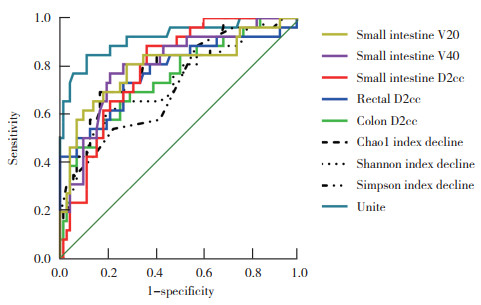
ROC曲线分析结果显示,小肠V20、V40、D2cc、直肠D2cc、结肠D2cc、肠道菌群α多样性Chao1指数、Shannon指数、Simpson指数下降幅度联合预测RE风险的AUC为0.920(95%CI:0.847~0.965),大于各指标单独预测,灵敏度为84.62%,特异度为88.89%,见图 1。
|
| 图 1 放疗物理参数和肠道菌群改变预测继发RE风险的价值 Fig.1 The physical parameters of radiotherapy and changes in intestinal flora in predicting the risk of RE |
3 讨论
RE是腹部恶性肿瘤常见的并发症,严重者可出现肠壁溃疡、肠穿孔或窦道形成等,降低患者的放疗依从性[8]。RE的病理生理可分为2个阶段:(1)溃疡形成阶段,是肠黏膜与肠道菌群相互作用的结果,可诱发多种临床症状;(2)创面愈合阶段,多种生长因子直接作用表皮细胞、成纤维细胞及内皮细胞,促进创面组织修复能力[9-10]。
在放疗过程中,病灶组织和正常组织均可受到电离辐射影响[11-12]。腹部恶性肿瘤中直肠、结肠、小肠、股骨头是高风险靶区,对放疗具有较高敏感性[13]。本研究发现RE组小肠V20、V40、D2cc、直肠D2cc、结肠D2cc高于无RE组,这与余富强等[14]研究结论相似,提示放疗物理参数与RE的发生有关。分析可能的原因:(1)本研究中直肠癌比例较高,小肠照射体积百分比、D2cc大,辐射诱导可促进急性肠毒性;(2)相对于小肠,直肠对放疗具有较高抵抗性,可能是因为肠上皮联合复合体与黏膜屏障功能对射线有较高的敏感性;(3)结肠对放疗具有较高抗性,结肠由远侧和近侧两部分组成,近端结肠用于血液供应(有多层毛细血管结构),远端结肠有较长、较大的隐窝(含较多免疫细胞)[15];患者直肠D2cc、结肠D2cc较大,增加了继发RE的风险。
肠道菌群失调能够促进RE的发生,患者接受放疗后,放射剂量高低直接影响机体肠道菌群紊乱程度[16]。动物模型实验[17]发现,小鼠接受60Co光源辐照器不同剂量γ射线可引起肠道菌群改变,肠道损伤程度、辐射剂量与菌群丰度增加呈正相关。研究[18]发现,放疗小鼠接受粪菌(正常小鼠粪便)移植后,肠道菌群结构可明显改善,小鼠存活时间延长。本研究结果显示,RE组放疗第3周肠道菌群α多样性Chao1指数、Shannon指数、Simpson指数低于无RE组,RE组放疗前后肠道菌群α多样性Chao1指数、Shannon指数、Simpson指数下降幅度大于无RE组,可见肠道菌群组成和丰度失调与RE的发生密切相关。患者Chao1指数、Shannon指数、Simpson指数越低,肠道菌群表明肠道菌群丰度分布均匀性和物种越低。肠道菌群可影响肠道循环代谢产物、炎性细胞因子、黏膜屏障等[19],从而继发RE。
相关性分析结果显示,小肠V20、V40、D2cc、直肠D2cc、结肠D2cc与肠道菌群α多样性Chao1指数、Shannon指数、Simpson指数放疗前后下降幅度呈正相关;logistic结果证实,上述因素(放疗物理参数、肠道菌群改变)均是继发RE的独立危险因素,ROC曲线结果显示,放疗物理参数、肠道菌群改变联合预测RE风险的AUC大于各指标单独预测,表明放疗物理参数、肠道菌群改变联合预测RE的发生具有良好参考价值。
综上所述,腹部恶性肿瘤患者放疗物理参数与肠道菌群改变呈正相关,小肠V20、V40、D2cc、直肠D2cc、结肠D2cc与肠道菌群α多样性Chao1指数、Shannon指数、Simpson指数可共同增加RE的发生风险,上述指标联合在预测腹部恶性肿瘤RE发生风险中价值较高。
| [1] |
DAS CJ, REDNAM N, VORA Z, et al. Abdominal visceral tuberculosis: a malignancy mimic[J]. Abdom Radiol (NY), 2023, 48(8): 2705-2715. DOI:10.1007/s00261-023-03939-5 |
| [2] |
CHMURA S, WINTER KA, ROBINSON C, et al. Evaluation of the safety of stereotactic body radiotherapy for the treatment of patients with multiple metastases: Findings from the NRG-BR001 phase 1 trial[J]. JAMA Oncol, 2021, 7(6): 845-852. DOI:10.1001/jamaoncol.2021.0687 |
| [3] |
周云, 黄鹤, 万挺, 等. 盆腔恶性肿瘤辅助放疗后放射性直肠损伤的发生现状: 一项基于三期随机临床试验的报告[J]. 中华胃肠外科杂志, 2021, 24(11): 962-968. DOI:10.3760/cma.j.cn441530-20210720-00292 |
| [4] |
YANG XF, ZHENG MY, An LY, et al. Quality evaluation of guidelines for the diagnosis and treatment of[J]. Radiat Oncol, 2023, 18(1): 14. DOI:10.1186/s13014-023-02204-9 |
| [5] |
MORAITIS I, GUIU J, RUBERT J. Gut microbiota controlling radia- tion-induced enteritis and intestinal regeneration[J]. Trends Endocrinol Metab, 2023, 34(8): 489-501. DOI:10.1016/j.tem.2023.05.006 |
| [6] |
王跃, 谭艳琼, 杨玲, 等. 肠道菌群失调促进放射性肠炎发生的研究进展[J]. 中国微生态学杂志, 2023, 35(5): 612-614, 620. DOI:10.13381/j.cnki.cjm.202305021 |
| [7] |
GUINOT JL, REMBIELAK A, PEREZ-CALATAYUD J, et al. GEC-ESTRO ACROP recommendations for skin brachytherapy[J]. Radiother Oncol, 2018, 126(3): 377-385. DOI:10.1016/j.radonc.2018.01.013 |
| [8] |
LIU T, SU D, LEI C, et al. Treatment of radiation enteritis with fecal transplantation[J]. Am Surg, 2023, 89(6): 2999-3001. DOI:10.1177/00031348221091954 |
| [9] |
HOKAMA A. Endoscopic findings of radiation ileitis[J]. Rev Esp Enferm Dig, 2023, 115(3): 144. DOI:10.17235/reed.2022.9036/2022 |
| [10] |
CHEN DM, ZHAO KB, GUO YQ, et al. Global trends in research on radioactive enteritis: a bibliometric and visualization study[J]. Medicine, 2022, 101(37): e30714. DOI:10.1097/MD.0000000000030714 |
| [11] |
DURNO K, POWELL ME. Role of radiotherapy in ovarian cancer[J]. Int J Gynecol Cancer, 2022, 32(3): 366-371. DOI:10.1136/ijgc-2021-002462 |
| [12] |
WU CY, TSENG LM, CHEN HH, et al. Fatal rectovaginal fistula after radiotherapy in patients with locally advanced cervical cancer patients[J]. Taiwan J Obstet Gynecol, 2022, 61(6): 1069-1072. DOI:10.1016/j.tjog.2022.01.007 |
| [13] |
YAMADA S, TAKIYAMA H, ISOZAKI Y, et al. Carbon ion radiotherapy for colorectal cancer[J]. J Anus Rectum Colon, 2021, 5(2): 113-120. DOI:10.23922/jarc.2020-082 |
| [14] |
余富强, 黄维, 李英. 直肠癌短程放疗联合序贯化疗所致急性骨髓抑制的相关因素分析[J]. 中国医学物理学杂志, 2022, 39(8): 941-945. DOI:10.3969/j.issn.1005-202X.2022.08.004 |
| [15] |
SHINJI S, YAMADA T, MATSUDA A, et al. Recent advances in the treatment of colorectal cancer: a review[J]. J Nippon Med Sch, 2022, 89(3): 246-254. DOI:10.1272/jnms.JNMS.2022_89-310 |
| [16] |
REN HW, WU Q, SUN ZQ, et al. Research progress and treatment of radiation enteritis and gut microbiota[J]. Radiat Oncol J, 2023, 41(2): 61-68. DOI:10.3857/roj.2023.00346 |
| [17] |
ZHANG LY, MIAO ZM, LI YY, et al. A potential radiation marker based on 16S rDNA in a rat model of intestinal flora[J]. PLoS One, 2023, 18(8): e0286026. DOI:10.1371/journal.pone.0286026 |
| [18] |
GERASSY-VAINBERG S, BLATT A, DANIN-POLEG Y, et al. Radiation induces proinflammatory dysbiosis through the transmission of inflammatory susceptibility via host cytokine induction[J]. Gut, 2018, 67(1): 97-107. DOI:10.1136/gutjnl-2017-313789 |
| [19] |
DI PIETRO M, FILARDO S, SIMONELLI I, et al. Cervicovaginal microbiota composition in Chlamydia trachomatis infection: a systematic review and meta-analysis[J]. Int J Mol Sci, 2022, 23(17): 9554. DOI:10.3390/ijms23179554 |