 2021, Vol. 50
文章信息
- 施琳, 赵剑
- SHI Lin, ZHAO Jian
- 褪黑素对爆震伤诱导小鼠肺损伤的保护作用及机制
- Protective effect and mechanism of melatonin against blast-induced lung injury in mice
- 中国医科大学学报, 2021, 50(9): 804-808
- Journal of China Medical University, 2021, 50(9): 804-808
-
文章历史
- 收稿日期:2021-01-26
- 网络出版时间:2021-09-09 16:37


引用本文 |


爆震伤是一种较常见的严重创伤[1]。肺和胃肠道是最易受爆震伤影响的器官,肺损伤是导致高死亡率的主要原因[2]。足够的能量暴露会导致毛细血管-肺泡界面的破坏,从而导致实质出血和肺泡壁的破坏[3]。急性肺间质改变逐渐发展为急性呼吸窘迫综合征,严重影响患者的生活质量和预后。因此,明确肺爆震伤的机制对伤员的救治有重要意义。
肺冲击伤的早期症状严重,是造成人员伤亡的重要原因[4]。其早期症状体征不明显,具有“外轻内重,发展迅速”的特点[5]。爆震冲击波通过胸壁组织扩散到全身,导致肺泡毛细血管破裂、肺内出血和水肿,进而导致自由基形成、水肿、炎性细胞因子的积聚和氧化损伤[6]。
褪黑素(N-乙酰基-5-甲氧基色胺) 具有抗氧化、抗炎、免疫调节和血管舒缩作用[7-9],可以改善轻度炎症,并诱导分泌强有力的促炎细胞因子[10]。此外,褪黑素还可以通过抑制肺脏炎性小体的激活来减轻炎症反应[11]。然而,褪黑素对爆震伤诱导的肺损伤的保护作用及机制仍不清楚。本研究拟探讨褪黑素对爆震伤诱导小鼠肺损伤的保护作用及机制。
1 材料与方法 1.1 材料实验动物及试剂:雄性C57BL/6小鼠30只,体质量20~22 g,6~8周龄,由本溪长生生物科技有限公司提供。所有小鼠在实验开始前1周安置于标准实验室条件下,温度稳定(20~24 ℃),湿度稳定(55%±5%),光/暗循环12/12 h,随意进食和饮水。本研究经北部战区总医院伦理委员会批准。褪黑素购自美国Sigma公司。实验所需一抗白细胞介素-6 (interleukin-6,IL-6)、白细胞介素-17 (interleukin-17,IL-17)、白细胞介素-23 (interleukin-17,IL-23)、重组人Semaphorin 7a蛋白(Semaphorin 7a,Sema7a)、人胎球蛋白A (fetuin-A,Ahsg)、p38、核因子κB (nuclear factor kappa-B,NF-κB) 和磷酸甘油醛脱氢酶(glyceraldehyde phosphate dehydrogenase,GAPDH),以及相应二抗、酶联免疫吸附(enzyme-linked immunosorbent assay,ELISA) 检测试剂盒均购自英国Abcam公司。苏木精、伊红和Masson染色试剂盒购自珠海贝索公司。
1.2 方法 1.2.1 肺爆震伤模型建立小鼠腹腔注射2%戊巴比妥钠(1.5 mL/kg) 麻醉。用螺丝钉固定装置后,将小鼠放在装置顶部有10个规则孔的橡胶垫上。压力泵连接到装置底部,不断加压,直到铝膜破裂。压缩空气迅速从爆破口高速膨胀,形成冲击波冲击小鼠的胸部。压力传感器检测到的压力通过数据电缆传输并由计算机记录。采用以下公式获得压力波形:压力(pounds per square inch,PSI) =电压值×1 000/50.08。瞬时冲击波超压为321±24压力/平方英尺。
1.2.2 实验分组适应环境7 d后,将30只小鼠随机分为3组:假手术(Sham) 组、爆震伤(Blast) 组及爆震伤+褪黑素(Blast+Mel) 组,每组10只。爆震伤+褪黑素组于爆震伤前1周腹腔注射30 mg/kg褪黑素,其余组给予生理盐水,1次/d,连续7 d。
1.2.3 标本收集及处理冲击伤后48 h,用2%戊巴比妥钠(1.5 mL/kg) 腹腔麻醉,俯卧位固定于手术台上。处死小鼠,采集肺和血液样本。将左肺浸入10%甲醛缓冲液中固定,用于后续病理分析。用滤纸干燥右肺上叶,在分析天平上称重,得到湿质量。在60 ℃烘箱中干燥72 h后,记录右肺上叶的干质量。W/D=湿质量/干质量。将剩余的肺组织置于液氮罐中用于后续蛋白分析。
1.2.4 ELISA用ELISA试剂盒测定血清中IL-4和肿瘤坏死因子-α (tumor necrosis factor-a,TNF-α) 的含量。具体操作方法见试剂说明书。
1.2.5 组织病理学检查对10%中性甲醛固定的肺组织进行脱水、包埋和切片处理。对切片进行HE染色和Masson染色。具体操作方法见试剂说明书。
1.2.6 Western blotting检测检测肺组织促炎因子IL-6、IL-17和IL-23的表达,同时检测肺组织炎症相关通路蛋白Sema7a、Ahsg、p38和NF-κB的表达。
1.3 统计学分析采用SPSS 20.0统计软件进行统计分析。数据以x±s表示。采用t检验和单因素方差分析。P < 0.05为差异有统计学意义。
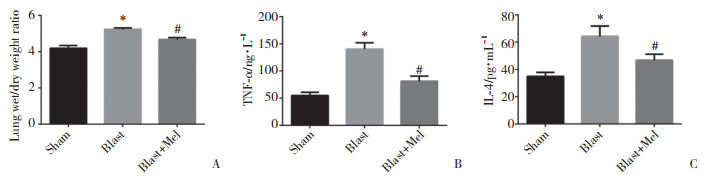
2 结果 2.1 褪黑素减轻爆震伤导致的血清炎症因子表达与假手术组相比,爆震伤组小鼠肺W/D比值从4.18±0.15增加至5.23±0.07,而褪黑素显著降低爆震伤组小鼠肺湿重/干重比值,W/D比值为4.66±0.11,有统计学差异(P < 0.05)。此外,与对照组[(54.79±6.03) ng/L和(34.85±2.96) ng/L]相比,爆震伤组小鼠血清TNF-α和IL-4的表达分别为(140.12±11.71) ng/L和(64.28±7.46) ng/L,而褪黑素处理显著抑制血清TNF-α和IL-4的表达,分别为(81.00±9.56) ng/L和(46.76±4.34) ng/L,见图 1。
|
| A, lung wet/dry weight ratio; B, expression of TNF-α in serum detected by ELISA; C, expression of IL-4 in serum detected by ELISA. *P < 0.05 vs Sham group; #P < 0.05 vs Blast group. 图 1 肺湿质量/干质量和血清炎性细胞因子表达 Fig.1 Lung wet/dry weight ratio and serum inflammatory factor expression |
2.2 褪黑素改善爆震伤导致的肺组织病理学改变
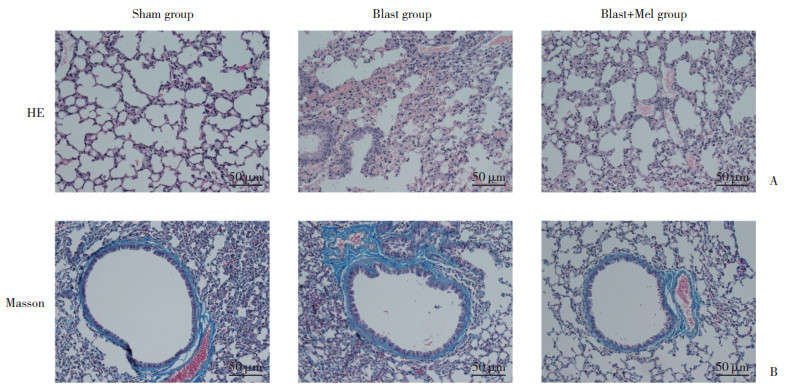
与对照组相比,爆震伤导致肺组织出现明显的出血、水肿、肺泡隔破裂和炎症细胞浸润,经过褪黑素处理后明显改善。同时,爆震伤组小鼠支气管及血管周围可见明显的纤维沉积,而褪黑素组纤维化程度有所改善,见图 2。
|
| A, HE staining; B, Masson staining. Scale bar = 50 μm. 图 2 肺组织病理学改变 Fig.2 Pathological alterations in lung tissue |
2.3 褪黑素减少爆震伤诱导的肺组织炎性细胞因子产生
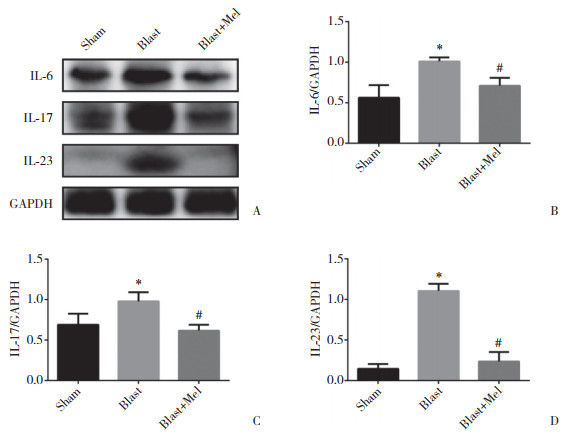
与对照组相比(0.56±0.23、0.82±0.24、0.15±0.04),爆震伤组小鼠肺组织促炎因子IL-6、IL-17和IL-23表达显著增加,分别为1.01±0.05、0.98±0.17和1.10±0.11,有统计学差异(P < 0.05),而褪黑素处理则显著降低促炎因子IL-6、IL-17和IL-23表达,分别为0.71±0.20、0.62±0.14、0.23±0.02,差异有统计学意义(P < 0.05),见图 3。
|
| A, Western blotting; B, gray scale analysis of IL-6;C, gray scale analysis of IL-17;D, gray scale analysis of IL-23. *P < 0.05 vs Sham group; #P < 0.05 vs Blast group. 图 3 各组肺组织IL-6、IL-17和IL-23表达情况 Fig.3 Expression of IL-6, IL-17, and IL-23 in lung tissues of the different groups |
2.4 褪黑素降低爆震伤诱导的肺组织炎症相关通路蛋白表达
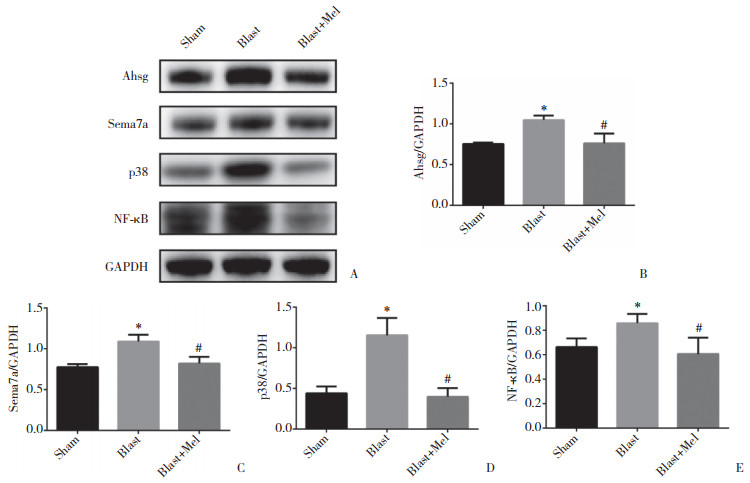
与对照组相比(0.77±0.06、0.76±0.03),爆震伤组小鼠肺组织促炎因子Sema7a和Ahsg蛋白表达显著增加,分别为1.12±0.13和1.02±0.06,有统计学差异(P < 0.05),而褪黑素处理则显著降低促炎因子Sema7a和Ahsg表达,分别为0.80±0.13和0.77±0.24。此外,与对照组(0.44±0.05和0.61±0.13)相比,爆震伤组小鼠肺组织p38和NF-κB蛋白表达显著增加,分别为1.15±0.30和0.85±0.13,而褪黑素处理后肺组织p38和NF-κB蛋白表达水平显著降低,分别为0.40±0.06和0.59±0.14,差异有统计学意义(P < 0.05),见图 4。
|
| A, Western blotting; B, gray scale analysis of Ahsg; C, gray scale analysis of Sema7a;D, gray scale analysis of p38;E, gray scale analysis of NF-κB. * P < 0.05 vs Sham group; # P < 0.05 vs Blast group. 图 4 各组肺组织Ahsg、Sema7a、p38和NF-κB蛋白表达情况 Fig.4 Expression of Ahsg, Sema7a, p38, and NF-κB proteins in lung tissues of different groups |
3 讨论
本研究结果显示,褪黑素可显著抑制爆震伤诱导的肺W/D比值,降低血清炎性细胞因子表达,改善爆震伤导致的肺组织病理改变。此外,褪黑素还可显著降低p38和NF-κB蛋白表达。褪黑素对肺爆震伤的保护作用可能与其抗炎活性有关,其机制可能与p38/NF-κB信号通路密切相关。
作为一种抗炎和抗氧化药物,褪黑素可抑制脂多糖诱导的促炎介质(细胞因子和趋化因子) 和活性氧的释放[12]。本研究发现,褪黑素显著抑制爆震伤诱导的肺湿重/干重比值,降低血清炎性细胞因子表达,降低肺组织IL-6、IL-17和IL-23表达。据文献[13]报道,褪黑素预处理对缺血再灌注肺损伤有保护作用,其作用可能与褪黑素的抗炎和抗氧化作用有关。同时,褪黑素被报道可以部分通过抗炎作用防止四氯化碳暴露造成的组织损伤[14]。此外,褪黑素还可以通过减轻组织水肿、中性粒细胞浸润,降低支气管灌注液中TNF-α、IL-1β和IL-6等炎性细胞因子,对热射病造成的急性肺损伤发挥保护作用[15]。
本研究发现,褪黑素明显抑制爆震伤导致的小鼠Sema7a和Ahsg蛋白表达,显著降低p38和NF-κB蛋白表达。研究[16]发现,褪黑素能抑制炎症体基因NLRP3、Asc、Caspase1和IL-1β的表达,而NF-κB可以与TLR4和NLRP3启动子区域结合,提示NF-κB对TLR4和NLRP3及其下游靶点的转录调控。同时,有研究[17]发现NF-κB信号是一种胞质感受器,激活并促进其核转位和DNA结合而褪黑素在不同细胞中的促炎作用与NF-κB密切相关介。此外,褪黑素还能通过调节核κα途径来抑制NF-κB/NLRP3的激活,有效减少NF-RRPB的磷酸化[18]。NF-κB信号是褪黑素发挥抗炎功能的中心,褪黑素还可以通过促进NF-κB/p65从细胞质向胞核转位[19]。
综上所述,褪黑素可能通过抑制p38/NF-κB信号通路发挥抗炎活性,进而对爆震伤诱导的肺损伤进行保护。
| [1] |
ROZENFELD M, GIVON A, RIVKIND A, et al. New trends in terrorism-related injury mechanisms: is there a difference in injury severity?[J]. Ann Emerg Med, 2019, 74(5): 697-705. DOI:10.1016/j.annemergmed.2019.02.034 |
| [2] |
LI N, GENG CH, HOU Sk, et al. Damage-associated molecular patterns and their signaling pathways in primary blast lung injury: new research progress and future directions[J]. Int J Mol Sci, 2020, 21(17): 6303. DOI:10.3390/ijms21176303 |
| [3] |
ALBIN D, LOUISE ED, ERIK VO, et al. Blast polytrauma with hemodynamic shock, hypothermia, hypoventilation and systemic inflammatory response: description of a new porcine model[J]. Eur J Trauma Emerg Surg, 2020, 30: 1-9. DOI:10.1007/s00068-020-01476-0 |
| [4] |
YANG A, CAI H, LIANG Y, et al. Comparison of blast lung injury in infant and adult rabbits[J]. Pediatr Pulmonol, 2020, 55(2): 474-483. DOI:10.1002/ppul.24593 |
| [5] |
LIU Y, LIU Y, TONG C, et al. Quantitative analysis of the global proteome in lung from mice with blast injury[J]. Exp Lung Res, 2020, 46(8): 308-319. DOI:10.1080/01902148.2020.1801896 |
| [6] |
SMITH JE, GARNER J. Pathophysiology of primary blast injury[J]. J R Army Med Corps, 2019, 165(1): 57-62. DOI:10.1136/jramc-2018-001058 |
| [7] |
LIU ZJ, GAN L, ZHANG TT, et al. Melatonin alleviates adipose inflammation through elevating α-ketoglutarate and diverting adipose-derived exosomes to macrophages in mice[J]. J Pineal Res, 2018, 64(1): e12455. DOI:10.1111/jpi.12455 |
| [8] |
LAN M, ZHANG Y, WAN X, et al. Melatonin ameliorates ochratoxin A-induced oxidative stress and apoptosis in porcine oocytes[J]. Environ Pollut, 2020, 256: 113374. DOI:10.1016/j.envpol.2019.113374 |
| [9] |
MANCHESTER LC, COTO-MONTES A, BOGA JA, et al. Melatonin: an ancient molecule that makes oxygen metabolically tolerable[J]. J Pineal Res, 2015, 59(4): 403-419. DOI:10.1111/jpi.12267 |
| [10] |
LIU ZJ, GAN L, XU YT, et al. Melatonin alleviates inflammasome-induced pyroptosis through inhibiting NF-κB/GSDMD signal in mice adipose tissue[J]. J Pineal Res, 2017, 63(1): e12414. DOI:10.1111/jpi.12414 |
| [11] |
ZHANG Y, LI X, GRAILER JJ, et al. Melatonin alleviates acute lung injury through inhibiting the NLRP3 inflammasome[J]. J Pineal Res, 2016, 60(4): 405-414. DOI:10.1111/jpi.12322 |
| [12] |
DENG SL, ZHANG BL, REITER RJ, et al. Melatonin ameliorates inflammation and oxidative stress by suppressing the p38MAPK signaling pathway in LPS-induced sheep orchitis[J]. Antioxidants, 2020, 9(12): 1277. DOI:10.3390/antiox9121277 |
| [13] |
WANG ML, WEI CH, WANG WD, et al. Melatonin attenuates lung ischaemia-reperfusion injury via inhibition of oxidative stress and inflammation[J]. Interact Cardiovasc Thorac Surg, 2018, 26(5): 761-767. DOI:10.1093/icvts/ivx440 |
| [14] |
RADOVIC M, RISTIC L, KRTINIC D, et al. Melatonin treatment prevents carbon tetrachloride-induced acute lung injury in rats by mitigating tissue antioxidant capacity and inflammatory response[J]. Bratisl Lek Listy, 2019, 120(7): 527-531. DOI:10.4149/bll_2019_085 |
| [15] |
WU WS, CHOU MT, CHAO CM, et al. Melatonin reduces acute lung inflammation, edema, and hemorrhage in heatstroke rats[J]. Acta Pharmacol Sin, 2012, 33(6): 775-782. DOI:10.1038/aps.2012.29 |
| [16] |
HUANG CC, CHIOU CH, LIU SC, et al. Melatonin attenuates TNF-α and IL-1β expression in synovial fibroblasts and diminishes cartilage degradation: implications for the treatment of rheumatoid arthritis[J]. J Pineal Res, 2019, 66(3): e12560. DOI:10.1111/jpi.12560 |
| [17] |
LIU ZJ, GAN L, XU YT, et al. Melatonin alleviates inflammasome-induced pyroptosis through inhibiting NF-κB/GSDMD signal in mice adipose tissue[J]. J Pineal Res, 2017, 63(1): e12414. DOI:10.1111/jpi.12414 |
| [18] |
QIN W, LI J, ZHU R, et al. Melatonin protects blood-brain barrier integrity and permeability by inhibiting matrix metalloproteinase-9 via the NOTCH3/NF-κB pathway[J]. Aging (Albany NY), 2019, 11(23): 11391-11415. DOI:10.18632/aging.102537 |
| [19] |
TANG YL, SUN X, HUANG LB, et al. Melatonin inhibits MLL-rearranged leukemia via RBFOX3/hTERT and NF-κB/COX-2 signaling pathways[J]. Cancer Lett, 2019, 443: 167-178. DOI:10.1016/j.canlet.2018.11.037 |