 2021, Vol. 50
文章信息
- 曲艺, 刘畅, 张若馨
- QU Yi, LIU Chang, ZHANG Ruoxin
- 沈阳市养老机构老年人认知功能与日常生活能力的相关性研究
- Correlation between cognitive ability and daily living ability of older adults in nursing homes in Shenyang
- 中国医科大学学报, 2021, 50(11): 970-975
- Journal of China Medical University, 2021, 50(11): 970-975
-
文章历史
- 收稿日期:2021-07-12
- 网络出版时间:2021-11-03 16:58


引用本文 |


2. 东北大学江河建筑学院建筑系, 沈阳 110169
2. Department of Architecture, Jangho Architecture College, Northeastern University, Shenyang 110169, China
近年来我国人口老龄化问题日趋严重,国家高度重视并加大扶持社会养老服务体系,但目前仍存在对健康老龄化针对性了解不足的问题[1]。2021年5月11日公布的第七次全国人口普查公报(第五号)[2]显示,辽宁省60岁及以上人口占比为25.72%,远超全国平均水平,老龄化现象较为严重。机构养老在养老体系中占主要位置,是患有认知障碍的老年人最重要的保障。调查老年人认知功能情况可以为制定预防和延缓老年人认知能力下降的措施提供参考[3]。因此,本研究选择沈阳市养老机构的老年人作为研究对象,探讨其认知功能、日常生活能力情况及其关系。
1 材料与方法 1.1 研究对象采用分层整群随机抽样法,随机选取2017年9月至2021年6月沈阳市九城区在册且营业的26所养老机构的老年人为调查对象。纳入标准:(1)年龄≥60岁;(2)入住养老机构时间≥3个月;(3)自愿参加本次调查,并签署知情同意书。排除标准:意识不清或无法沟通,不能完成调查问卷者。
1.2 研究方法 1.2.1 一般情况调查问卷自行设计,主要包括老年人编号、所在机构、性别、年龄、文化程度等基础信息。向老年人现场发放问卷并指导填写。
1.2.2 简易精神状态量表(mini-mental state examination,MMSE)分为定向力(10分)、即刻记忆力(3分)、注意力和计算力(5分)、回忆能力(3分)、语言能力(9分),共5个条目,满分30分。判断是否存在认知障碍要考虑老年人的文化程度及MMSE得分,其中文盲且得分≤17分、小学学历且得分≤20分、初中及以上学历且得分≤24分为认知障碍。患有认知障碍的老年人中,得分≥13分为轻度,6~12分为中度,≤5分为重度。
1.2.3 日常生活能力量表(activity of daily living scale,ADL)使用ADL量表中的Katz指数分级评定表,分为洗澡、穿着、使用厕所、转移、控制大小便、进餐6个条目。每个条目按照自理能力不同计分,完全自理计3分,部分自理计2分,完全不能自理计1分,满分18分。本研究中,按照得分情况进行分组,18分者为正常,11~17分且完全不能自理的条目不超过2项者为下降,0~10分或完全不能自理的条目超过2项者为障碍。
1.3 统计学分析采用EpiData3.1软件进行数据双轨录入,当录入结果不一致时,回溯调查表进行纠错。采用R软件4.1.0和SPSS 23.0软件进行统计学处理,通过Shapiro-Wilk检验数据的正态性。服从正态分布的计量资料以x±s来表示,两独立样本组间比较采用t检验;不服从正态分布的计量资料以中位数(四分位间距)表示,组间比较采用Wilcoxon检验。多组均数比较采用Kruskal-Wallis检验(数据不服从正态分布)和单侧方差分析(数据服从正态分布),组内两两比较采用Tukey检验。采用一元线性回归分析和多元线性回归分析研究ADL评级与MMSE得分的关系。P < 0.05为差异有统计学意义。
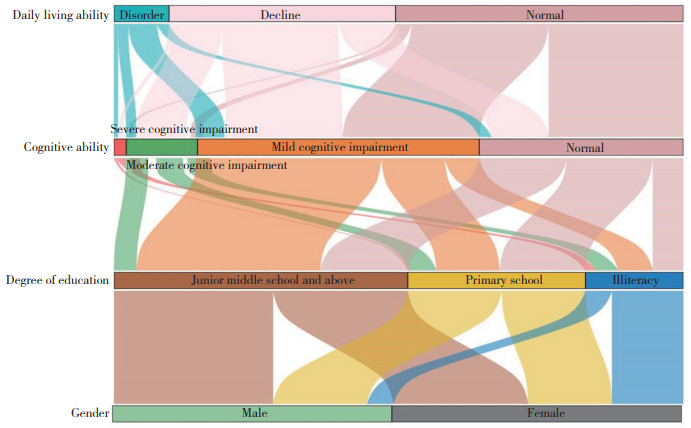
2 结果 2.1 基本信息、认知功能及日常生活能力概况本研究共纳入研究对象279人,其中,男137人,女142人,年龄60~96岁,中位年龄78(68~85)岁。对其性别、文化程度、认知功能以及日常生活能力进行分析,结果显示,性别方面,男女比例约为1︰1;文化程度方面,初中及以上学历人数最多(144人),小学学历87人,文盲人数最少(48人);认知功能方面,正常100人,认知障碍179人,其中,轻度认知障碍138人,中度认知障碍35人,重度认知障碍6人;日常生活能力方面,正常141人,下降111人,障碍27人。见图 1、表 1。
|
| 图 1 养老机构老年人概况 Fig.1 Overview of the older adults in nursing home |
| Base situation | n(%) |
| Gender | |
| Male | 137(49) |
| Female | 142(51) |
| Facility | |
| Dabei Welfare Centre | 5(2) |
| Dadong District Shengaituo Maintenance Center | 6(2) |
| Dadong District Zhongjie Caring Nursing Home | 2(1) |
| Huanggu District Blessing Apartment For the Elderly | 10(4) |
| Huanggu District Songhui Nursing Nome | 5(2) |
| Huanggu District Tawan New Home | 7(3) |
| Huanggu District New Paradise Apartment For the Elderly | 2(1) |
| Hunnan District Fuxing Nursing Home | 6(2) |
| Hunnan District Central Nursing Home | 24(9) |
| Golden Old Age Nursing Home | 12(4) |
| Shandong Miao Area Senior Apartment | 3(1) |
| Shenhe District Guangjun Sunshine Nursing Home | 1(0) |
| Shenhe District Family Nursing Home | 2(1) |
| Sujiatun Fuwa Caring | 6(2) |
| Sujiatun 99 Tsinghua Nursing Home | 51(18) |
| Sujiatun Shengxiandu Nursing Home | 4(1) |
| Sujiatun Suojia Nursing Home | 6(2) |
| Tiexi District Cihui Caring Nursing Home | 7(3) |
| Tiexi District Fuxingju Nursing Home | 13(5) |
| Tiexi District Jianing Nursing Home | 11(4) |
| Tiexi District Golden Sunshine Nursing Home | 12(4) |
| Tiexi District Qianyuan Nursing Home | 14(5) |
| Tiexi District Xiangfu Nursing Home | 32(11) |
| Xinyijia Nursing Home | 28(10) |
| Yuhong District Hemu Nursing Home | 7(3) |
| Yuhong District Happy Home | 3(1) |
| Age(≥75 years) | 161(58) |
| Degree of education | |
| Illiteracy | 48(17) |
| Primary school | 87(31) |
| Junior middle school and above | 144(52) |
老年人中,初中及以上文化程度男性多于女性,女性文盲明显多于男性。文盲老年人中,存在认知障碍的比例明显高于其余2组,但初中及以上文化程度老年人存在认知障碍的比例并不低于小学组。此外,随着文化程度提高,患有中度和重度认知障碍症者比例存在下降的趋势,重度认知障碍老年人多为文盲。认知功能较好的老年人中,日常生活能力正常的比例较高,相反,认知功能较差的老年人中,日常生活能力存在障碍的比例较高。
2.2 认知功能情况养老机构老年人MMSE平均得分为(19.47±6.249)分,认知障碍者占64.16%。即刻记忆力与语言能力得分率较高,中位数分别为3分和7分,注意力和计算力、回忆能力得分率较低,中位数分别为2分和1分。见表 2。
| Entry | Score distribution(n) | M(IQR) | ||||||||||
| 0 | 1 | 2 | 3 | 4 | 5 | 6 | 7 | 8 | 9 | 10 | ||
| Orientation ability | 6 | 4 | 15 | 12 | 23 | 24 | 32 | 26 | 25 | 38 | 74 | 7.00(5) |
| Immediate memory ability | 19 | 11 | 23 | 226 | - | - | - | - | - | - | - | 3.00(0) |
| Attention and computation ability | 71 | 64 | 27 | 40 | 32 | 45 | - | - | - | - | - | 2.00(4) |
| Recall ability | 126 | 34 | 57 | 62 | - | - | - | - | - | - | - | 1.00(2) |
| Language ability | 3 | 3 | 3 | 8 | 22 | 37 | 42 | 61 | 50 | 50 | - | 7.00(3) |
| Total | - | - | - | - | - | - | - | - | - | - | - | 20.00(9) |
| M,median;IQR,interquartile range. | ||||||||||||
2.3 日常生活能力情况
养老机构老年人ADL平均得分为(16.09±2.884)分,其中,ADL得分下降者占49.46%。6个条目得分情况差别较小,其中,洗澡得分较低,具体各项得分情况见表 3。不同性别老年人得分情况无统计学差异。
| Entry | Quantity(n) | ADL score [M(IQR)] | W | P | ||||
| 3 | 2 | 1 | Male | Female | Total | |||
| Bathe | 146 | 45 | 88 | 3.00(2) | 2.00(2) | 3.00(2) | 18 806.5 | 0.079 |
| Dress | 210 | 21 | 48 | 3.00(0) | 3.00(1) | 3.00(0) | 19 389.5 | 0.334 |
| Use toilet | 237 | 18 | 24 | 3.00(0) | 3.00(0) | 3.00(0) | 19 211.0 | 0.110 |
| Move | 237 | 29 | 13 | 3.00(0) | 3.00(0) | 3.00(0) | 19 173.0 | 0.091 |
| Control urination | 250 | 14 | 15 | 3.00(0) | 3.00(0) | 3.00(0) | 19 418.0 | 0.195 |
| Eat | 258 | 24 | 9 | 3.00(0) | 3.00(0) | 3.00(0) | 19 577.5 | 0.511 |
| Total | - | - | - | 18.00(2) | 17.00(3) | 18.00(2) | 18 891.0 | 0.115 |
2.4 认知功能与ADL得分比较分析 2.4.1 ADL得分与MMSE得分及其各条目得分的相关分析
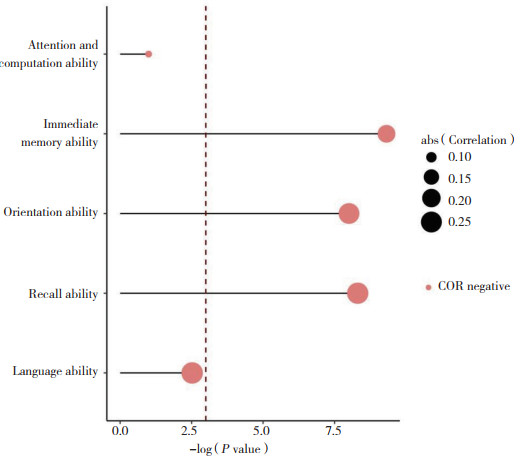
养老机构老年人ADL得分与MMSE得分存在显著正相关(r = 0.196,P = 0.01)。将养老机构老年人ADL评级进行赋值,正常为1,下降为2,障碍为3,通过一元线性回归分析发现,ADL等级与MMSE各条目中的定向力(β = -0.05,P < 0.05)、注意力和计算力(β = -0.07,P < 0.05)、语言能力(β = -0.10,P < 0.05)得分均存在显著负相关。见图 2。
|
| 图 2 养老机构老年人ADL评级与MMSE得分一元线性回归分析 Fig.2 Relationship between ADL levels of the older adults in nursing homes and MMSE entries |
2.4.2 不同认知功能老年人ADL各条目得分情况
将养老机构老年人按照认知功能情况分为正常、轻度认知障碍、中度认知障碍、重度认知障碍4组,分别统计其在ADL各条目中的得分情况。如表 4所示,重度认知障碍老年人的生活能力较差,且其使用厕所和控制大小便的能力与正常老年人相比明显下降,差异有统计学意义(P < 0.05),尽管其余条目得分均呈现出认知功能障碍程度越严重得分越低的趋势,但差异无统计学意义(均P > 0.05)。
| Cognitive ability | ADL score | |||||
| Bathe | Dress | Use toilet | Move | Control urination | Eat | |
| Normal | 2.47±0.810 | 2.68±0.695 | 2.84±0.507 | 2.87±0.418 | 2.93±0.355 | 2.93±0.355 |
| Mild cognitive impairment | 2.17±0.909 | 2.58±0.772 | 2.73±0.622 | 2.79±0.505 | 2.83±0.507 | 2.88±0.402 |
| Moderate cognitive impairment | 1.69±0796 | 2.40±0.847 | 2.77±0.598 | 2.71±0.622 | 2.71±0.622 | 2.86±0.430 |
| Severe cognitive impairment | 1.83±0.983 | 2.00±1.095 | 2.17±0.9831) | 2.50±0.837 | 2.33±0.8162) | 2.67±0.816 |
| 1)compared with normal group,t = -2.72,P = 0.03;2)compared with normal group,t = -2.94,P = 0.02. | ||||||
2.4.3 养老机构老年人日常生活能力的多元线性回归分析
对养老机构老年人年龄、性别、文化程度、MMSE各条目得分情况与ADL等级进行多元线性回归分析,定向力、语言能力和注意力与计算能力之间不存在共线性(膨胀因子VIF均 < 10),且各因素之间相互独立。最终发现语言能力可显著影响老年人ADL评级。见表 5。
| Entry | B | Standard error | β | t | P | 95%CI | Tolerance | VIF |
| Constant | 2.379 | 0.147 | 16.172 | < 0.001 | 2.089-2.669 | |||
| Gender | -0.148 | 0.076 | -0.112 | -1.958 | 0.051 | -0.298-0.001 | 0.981 | 1.019 |
| Orientation ability | -0.019 | 0.016 | -0.081 | -1.170 | 0.243 | -0.051-0.013 | 0.673 | 1.486 |
| Language ability | -0.083 | 0.022 | -0.243 | -3.829 | < 0.000 1 | -0.125--0.040 | 0.806 | 1.241 |
| Attention and computation ability | -0.018 | 0.025 | -0.049 | -0.719 | 0.472 | -0.067-0.031 | 0.684 | 1.462 |
| VIF,variance inflation factor. | ||||||||
3 讨论
本研究通过对沈阳市养老机构老年人认知功能及日常生活能力的分析,发现养老机构老年人中认知障碍老年人数量较多,MMSE评分低于社区老年人[4],且显著低于其他城市养老机构中老年人MMSE评分[5-6]。本研究中,沈阳市养老机构中认知障碍老年人以轻度认知障碍为主,文化程度较低者认知功能相对较差,更易发生认知障碍,且认知障碍程度较严重,与其他研究[7-8]结果一致,提示教育有延缓认知功能下降的作用。本研究结果还显示,养老机构老年人的日常生活能力情况较好,且日常生活能力与认知功能呈正相关,认知功能下降对老年人日常生活能力存在不利影响,与其他研究[9]结果一致。本研究发现,老年人语言能力的下降可显著影响其日常生活能力(P < 0.05)。老年人的语言能力与多种神经性疾病有关,患有认知障碍的老年人可能为了避免在活动中遇到困难,而减少日常生活活动与交流的次数,从而影响了相关能力。其中,中度和重度认知障碍的老年人部分生活活动对养老机构护理人员的依赖性较强,如中度认知障碍老年人的洗澡行为以及重度认知障碍老年人的洗澡、穿着行为,得分均低于2分,表明中、重度认知障碍老年人的部分或全部行为需要协助。
综上所述,养老机构老年人认知功能变化会对日常生活能力产生影响,因此,在建设健康养老环境中,应在照护管理、养老机构设计等方面为老年人提供轻松舒适且有助于其参与交流娱乐、体育锻炼活动的生活环境,弱化语言能力下降对日常生活能力的影响,有利于老年人生活能力及认知功能的维持。同时,还应更加关注文化程度较低老年人的认知功能情况,在为老年人提供生活支持时,应优先考虑提供洗澡、穿着等老年人自理能力较弱的方面的支持。此外,老年人生活能力和认知功能还会受到其他因素的影响,如光环境、声环境等养老机构建筑物理环境因素[10-11],本研究中并未涉及,今后将针对上述影响因素进行更深入的研究。
| [1] |
陆杰华, 阮韵晨, 张莉. 健康老龄化的中国方案探讨: 内涵、主要障碍及其方略[J]. 国家行政学院学报, 2017(5): 40-47, 145. DOI:10.14063/j.cnki.1008-9314.2017.05.030 |
| [2] |
国家统计局. 第七次全国人口普查公报(第五号)[R/OL]. (2021-05-11)[2021-07-08]. http://www.stats.gov.cn/tjsj/tjgb/zxfb/202105/t20210510_1817181.html.
|
| [3] |
YU R, MORLEY JE, KWOK T, et al. The effects of combinations of cognitive impairment and pre-frailty on adverse outcomes from a prospective community-based cohort study of older Chinese people[J]. Front Med, 2018, 5: 50. DOI:10.3389/fmed.2018.00050 |
| [4] |
刘淼, 王建华, 吴蕾, 等. 城乡两社区老年人群轻度认知功能障碍的患病状况[J]. 上海预防医学, 2018, 30(1): 32-37. DOI:10.19428/j.cnki.sjpm.2018.18367 |
| [5] |
饶婷, 王丽婷, 唐浪娟. 南昌市养老机构老年人认知功能现状调查[J]. 职业与健康, 2020, 36(6): 771-774. DOI:10.13329/j.cnki.zyyjk.2020.0205 |
| [6] |
陈艳莉, 袁碧, 李燕飞, 等. 乌鲁木齐市养老机构老年人健康素养与认知功能[J]. 中国老年学杂志, 2016, 36(24): 6257-6259. DOI:10.3969/j.issn.1005-9202.2016.24.102 |
| [7] |
FEINKOHL I, KOZMA P, BORCHERS F, et al. Contribution of IQ in young adulthood to the associations of education and occupation with cognitive ability in older age[J]. BMC Geriatr, 2021, 21(1): 1-10. DOI:10.1186/s12877-021-02290-y |
| [8] |
YU WC, CHOU MY, PENG LN, et al. Synergistic effects of cognitive impairment on physical disability in all-cause mortality among men aged 80 years and over: results from longitudinal older veterans study[J]. PLoS One, 2017, 12(7): e0181741. DOI:10.1371/journal.pone.0181741 |
| [9] |
LEE MT, JANG Y, CHANG WY. How do impairments in cognitive functions affect activities of daily living functions in older adults?[J]. PLoS One, 2019, 14(6): e0218112. DOI:10.1371/journal.pone.0218112 |
| [10] |
FIGUEIRO MG, PLITNICK B, ROOHAN C, et al. Effects of a tailored lighting intervention on sleep quality, rest-activity, mood, and behavior in older adults with alzheimer disease and related dementias: a randomized clinical trial[J]. J Clin Sleep Med, 2019, 15(12): 1757-1767. DOI:10.5664/jcsm.8078 |
| [11] |
CHAUDHURY H, COOKE HA, COWIE H, et al. The influence of the physical environment on residents with dementia in long-term care settings: a review of the empirical literature[J]. Gerontologist, 2018, 58(5): e325-e337. DOI:10.1093/geront/gnw259 |