 2020, Vol. 49
文章信息
- 徐丹, 邱雪杉
- XU Dan, QIU Xueshan
- ETV4在胃肠道间质瘤中的表达及其临床意义
- ETV4 expression in gastrointestinal stromal tumors and its clinical significance
- 中国医科大学学报, 2020, 49(4): 321-325, 330
- Journal of China Medical University, 2020, 49(4): 321-325, 330
-
文章历史
- 收稿日期:2019-03-11
- 网络出版时间:2020-04-16 11:22


引用本文 |


2. 中国医科大学 基础医学院病理学教研室, 沈阳 110122
2. Department of Pathology, College of Basic Medical Sciences, China Medical University, Shenyang 110122, China
胃肠道间质瘤(gastrointestinal stromal tumor,GIST)是胃肠道最常见的间叶源性肿瘤[1],可发生C-KIT和血小板衍生生长因子受体α(platelet-derived growth factor receptors-α,PDGFR-α)基因突变[2]。大约10%~30%的GIST发生转移,是具有恶性潜能的肿瘤[3]。准确判断GIST生物学行为是治疗的关键。迄今为止,尚没有公认的生物学指标来判断其生物学行为。
ETV4是多瘤促活化因子3(polyoma enhancer activator 3,PEA3)家族成员之一,在细胞的生长、侵袭以及转移中发挥着重要的作用[4-5]。因此,本研究旨在探讨ETV4转录因子在GIST的表达及其与临床病理特征的关系,以及ETV4与C-KIT、PDGFR-α基因突变的关系。
1 材料与方法 1.1 标本收集2012年至2018年2月中国医科大学附属第一医院病理科确诊为GIST的石蜡标本,共91例为实验组。同时随机选取10例实验组的癌旁正常胃肠道组织设为对照组。纳入标准:病理及免疫组化确诊,免疫组化项目包含Ki67;危险度分级明确;完整的临床病历资料;组织蜡块材料充足。排除标准:病理或免疫组化无法确诊;危险度分级不明确;不具有完整的临床病历资料;组织蜡块材料较少。
1.2 试剂及仪器兔抗人多克隆抗体ETV4(HPA005768)购自美国Sigma公司。兔SP检测试剂盒(KIT-9710),PBS缓冲液以及DAB显色液均购于福州迈新生物有限公司。
1.3 方法 1.3.1 免疫组化采用免疫组化SP法,测定ETV4在GIST组织中的表达情况。标本石蜡块切片4 μm厚,在75 ℃恒温箱中放置4 h,取出后自然冷却。将切片脱蜡、水合,放置于高压水浴锅内的枸橼酸钠缓冲液中进行热修复,滴加内源性过氧化物酶阻断剂,37 ℃静置30 min后,PBS缓冲液洗片3次,一次5 min,随后滴加山羊血清封闭液,37 ℃静置40 min后,滴加ETV4抗体(1:200)切片在4 ℃过夜。复温、PBS缓冲液洗片后滴加生物素标记的第二抗体,37 ℃静置30 min,PBS缓冲液洗片3次,一次5 min,随后滴加链霉菌抗生素蛋白-过氧化物酶,37 ℃静置30 min后,PBS缓冲液洗片后滴加DAB显色液,自来水冲洗终止显色,苏木素复染,脱水,最后用中性树胶封片。
1.3.2 基因检测用直接测序法对所有病例进行C-KIT和PDGFR-α测序,测序由厦门艾德生物有限公司完成。
1.4 GIST术后危险度评分标准2008年4月,美国国立卫生研究院(national institutes of health,NIH)重新发布了关于原发可切除GIST的危险度评分标准。与FLETCHER等[6]提出的相比,增加了原发肿瘤的部位以及肿瘤破裂作为评判危险度的指标。见表 1。
| Risk level | Tumor size(cm) | Mitotic count(50/HPF) | Primary tumor location |
| Very low | ≤2 | ≤5 | Any |
| Low | > 2-5 | ≤5 | Any |
| Medium | ≤2 | > 5 | Non stomach |
| > 2-5 | > 5 | Stomach | |
| > 5-10 | ≤5 | Stomach | |
| High | Any | Any | Tumor rupture |
| > 10 | Any | Any | |
| Any | > 10 | Any | |
| > 5 | > 5 | Any | |
| > 2-5 | > 5 | Non stomach | |
| > 5-10 | ≤5 | Non stomach |
1.5 结果判定
由2名病理科医师在400倍的光学显微镜下随机观察5个视野,每个视野至少计数100个完整肿瘤细胞。肿瘤细胞核中出现棕黄色染色为阳性,以阳性细胞比例得分乘以染色强度得分为最终评判得分。阳性细胞比例评分:< 5%为0分,5%~ < 25%为1分,25%~ < 50%为2分,50%~ < 75%为3分,≥75%为4分。染色强度评分:未染色为0分,淡黄色为1分,棕黄色为2分,棕褐色为3分。在统计学分析中,最终得分≤4分为弱阳性(+),5~8分为中等阳性(++),≥9分为强阳性(+++)。
1.6 统计学分析采用SPSS 20.0统计软件进行统计学分析。计数资料应用行×列联表的χ2检验或Fisher确切概率法;相关性分析应用Spearman相关分析。P < 0.05为差异有统计学意义。
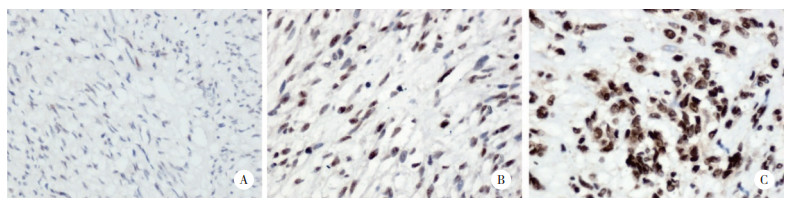
2 结果 2.1 GIST中ETV4的表达情况在91例GIST组织中,有18例(19.8%)ETV4呈弱阳性表达,34例(37.4%)ETV4呈中等阳性表达,39例(42.9%)呈强阳性表达。见图 1。ETV4在癌旁正常组织中呈弱阳性表达。
|
| A, low ETV4 expression in a gastrointestinal stromal tumor; B, moderate ETV4 expression in a gastrointestinal stromal tumor; C, high ETV4 expression in a gastrointestinal stromal tumor. 图 1 ETV4在GIST中的表达 免疫组化SP法 × 400 Fig.1 ETV4 expression in a gastrointestinal stromal tumor SP × 400 |
2.2 ETV4在GIST中的表达与临床病理特征的关系
ETV4转录因子在GIST中的表达水平与患者的性别,年龄,发生部位,组织学类型无关(P > 0.05),而与肿瘤大小、核分裂像、Ki-67增殖指数有关(P < 0.05)。GIST最常见的转移部位是肝脏,在本研究中共有8例发生肝脏转移,其中6例在最初诊断时已有肝转移,ETV4转录因子表达水平与肝转移有关(P < 0.05),ETV4表达水平越高,患者发生转移的可能也越大。见表 2。此外,采用Spearman相关分析结果显示,ETV4转录因子表达水平越高,其危险度越高,并且两者具有显著正相关(r = 0.387,P < 0.001)。见表 3。
| Clinicopathological features | n(%) | ETV4 | χ2 | P | ||
| Low | Moderate | High | ||||
| Gender | ||||||
| Male | 47(52) | 12 | 17 | 18 | 2.134 | 0.352 |
| Female | 44(48) | 6 | 17 | 21 | ||
| Age(year) | ||||||
| ≤50 | 24(26) | 7 | 8 | 9 | 1.812 | 0.429 |
| > 50 | 67(74) | 11 | 26 | 30 | ||
| Location | ||||||
| Stomach | 49(54) | 7 | 21 | 21 | 2.478 | 0.310 |
| Non-stomach | 42(46) | 11 | 13 | 18 | ||
| Tumor diameter(cm) | ||||||
| < 5 | 31(34) | 11 | 15 | 5 | 16.132 | 0.002 |
| 5-10 | 34(37) | 3 | 10 | 21 | ||
| > 10 | 26(29) | 4 | 9 | 13 | ||
| Histological type | ||||||
| Spindle cell | 88(97) | 18 | 33 | 37 | 1.037 | 0.804 |
| Epithelioid cell | 3(3) | 0 | 1 | 2 | ||
| Mitotic count(50/HPF) | ||||||
| < 5 | 60(66) | 16 | 26 | 18 | 12.140 | 0.011 |
| 5-10 | 22(24) | 2 | 6 | 14 | ||
| > 10 | 9(10) | 0 | 2 | 7 | ||
| Proliferation index of Ki67 | ||||||
| ≤5 | 38(42) | 12 | 18 | 8 | 13.578 | 0.001 |
| > 5 | 53(58) | 6 | 16 | 31 | ||
| Metastasis | ||||||
| No metastasis | 83(91) | 18 | 33 | 32 | 5.983 | 0.042 |
| Liver metastasis | 8(9) | 0 | 1 | 7 | ||
| Item | n(%) | ETV4 | r | P | ||
| Low | Moderate | High | ||||
| Risk rank of GIST | ||||||
| Very low-low | 26(29) | 11 | 14 | 1 | 0.387 | < 0.001 |
| Moderate | 16(17) | 0 | 5 | 11 | ||
| High | 49(54) | 7 | 15 | 27 | ||
| C-KIT gene | ||||||
| Non-mutation | 26(29) | 9 | 12 | 5 | 0.324 | 0.008 |
| Mutation | 65(71) | 9 | 22 | 34 | ||
| PDGFR-α gene | ||||||
| Non-mutation | 80(88) | 17 | 27 | 36 | -0.044 | 0.213 |
| Mutation | 11(12) | 1 | 7 | 3 | ||
| Genotyping | ||||||
| Wild type | 18(20) | 8 | 7 | 3 | 0.325 | 0.005 |
| Mutation type | 73(80) | 10 | 27 | 36 | ||
2.3 ETV4在突变型和野生型GIST的表达的相关性
在91例GIST组织中,11例发生PDGFR-α基因突变,65例发生C-KIT基因突变,其中60例发生外显子11突变,4例发生外显子9突变,1例发生外显子13突变,野生型18例,Spearman相关分析发现ETV4转录因子表达水平与C-KIT基因突变呈显著正相关(r = 0.324,P = 0.008),差异有统计学意义。此外,ETV4转录因子表达水平与突变型GIST也呈显著正相关(r = 0.325,P = 0.005),然而ETV4蛋白表达水平与PDGFR-α基因突变无关(P > 0.05)。见表 3。
3 讨论GIST多见于50岁以上的老年人[1],最常发生于胃部(60%~70%),其次为小肠(25%~36%),结直肠(5%)以及食管(5%)[7]。显微镜下大多数GIST由梭形细胞组成(70%),少数由上皮样细胞(20%)或混合细胞型(10%)构成。GIST为具有恶性潜能的肿瘤,大约10%~30%的GIST发生转移等恶性生物学行为[3],最常见的转移部位为肝脏(65%),其次为腹膜(21%),也可转移至骨和肺(10%),但极为罕见[8]。因此准确判断其生物学行为是治疗GIST的关键。
ETS家族是最大的转录调控因子家族之一,其亚家族PEA3家族主要参与多种生理过程,如早期发育,器官发生和形态发生[9]。在胚胎形成时期,ETV4广泛表达于各个组织,促进肾脏、肺、乳腺等上皮源性器官的形态发生[4],然而ETV4很少表达于成人的正常组织中,主要表达于乳腺癌,胃癌,前列腺癌,结肠癌和卵巢癌等肿瘤组织[10]。大量研究[10-14]表明,ETV4在前列腺、乳腺癌、结直肠癌、胰腺癌、胆管癌的高度表达往往提示预后不良。在本研究中,ETV4在GIST中呈中强度阳性率为80.2%,并且与肿瘤大小,核分裂像,Ki67增殖指数,肝转移有关。因此,ETV4的异常表达与GIST细胞的增殖,转移等生物学行为有关。这与ZENG等[15]的研究结果一致。此外,本研究还发现ETV4转录因子在GIST的表达水平与肿瘤的危险度呈显著相关,ETV4转录因子表达水平越高,危险度越高。因此ETV4转录因子可与危险度一起作为临床判定GIST生物学行为的重要指标。
此外,本研究还探讨ETV4转录因子的表达与野生型,突变型GIST的关系。C-KIT以及PDGFR-α基因突变是人类患有GIST的主要原因。70%~80%的GIST有C-KIT突变,最常见的是外显子11突变,而5%~10%GIST存在PDGFR-α突变[16]。对于既没有C-KIT基因突变,也没有PDGFR-α基因突变的GIST为野生型GIST[17]。在本研究中,突变型GIST中ETV4呈中强度阳性率为86.3%,并且ETV4转录因子的表达水平与突变型GIST显著相关,发生C-KIT基因突变的GIST中ETV4呈中强度阳性率为86.2%,并且ETV4转录因子的表达水平与C-KIT基因突变具有显著相关,然而ETV4转录因子的表达水平与PDGFR-α基因突变无关。因此,ETV4转录因子的表达水平与C-KIT基因有关。RAN等[18]研究报道PEA3家族另一成员ETS变异体1通过结合KIT增强子区域从而正调节KIT的表达水平,促进肿瘤的发生发展。大量研究[11, 19-20]表明,PEA3家族具有很高的序列同源性以及相似的高度保守的DNA结合结构域,然而调节C-KIT表达的是否是这组同源序列或者DNA结合结构域目前尚不清楚,仍需要进一步的研究。
综上所述,GIST的生物学行为除了依靠肿瘤大小,核分裂像来判断外,ETV4转录因子的表达也可以作为生物学指标,以便综合性地判断GIST的生物学行为,更有助于指导治疗。此外,ETV4转录因子的表达水平,还与C-KIT突变型GIST显著相关,为GIST的治疗提供新的方向和思路。
| [1] |
RUSAKIEWICZ S, PERIER A, SEMERARO M, et al. NKp30 isoforms and NKp30 ligands are predictive biomarkers of response to imatinib mesylate in metastatic GIST patients[J]. Oncoimmunology, 2017, 6(1): e1137418. DOI:10.1080/2162402X.2015.1137418 |
| [2] |
SCHAEFER IM, MARIÑO-ENRÍQUEZ A, FLETCHER JA. What is new in gastrointestinal stromal tumor?[J]. Adv Anat Pathol, 2017, 24(5): 259-267. DOI:10.1097/PAP.0000000000000158 |
| [3] |
SUPSAMUTCHAI C, WILASRUSMEE C, HIRANYATHEB P, et al. A cohort study of prognostic factors associated with recurrence or metastasis of gastrointestinal stromal tumor (GIST) of stomach[J]. Ann Med Surg (Lond), 2018, 35: 1-5. DOI:10.1016/j.amsu.2018.08.010 |
| [4] |
OH S, SHIN S, JANKNECHT R. ETV1, 4 and 5:an oncogenic subfamily of ETS transcription factors[J]. Biochim Biophys Acta, 2012, 1826(1): 1-12. DOI:10.1016/j.bbcan.2012.02.002 |
| [5] |
KELD R, GUO B, DOWNEY P, et al. PEA3/ETV4-related transcription factors coupled with active ERK signalling are associated with poor prognosis in gastric adenocarcinoma[J]. Br J Cancer, 2011, 105(1): 124-130. DOI:10.1038/bjc.2011.187 |
| [6] |
FLETCHER CD, BERMAN JJ, CORLESS C, et al. Diagnosis of gastrointestinal stromal tumors:a consensus approach[J]. Hum Pathol, 2002, 33(5): 459-465. DOI:10.1053/hupa.2002.123545 |
| [7] |
LIU Z, TIAN YZ, LIU SS, et al. Clinicopathological feature and prognosis of primary hepatic gastrointestinal stromal tumor[J]. Cancer Med, 2016, 5(9): 2268-2275. DOI:10.1002/cam4.808 |
| [8] |
SALAME H, ISSA M, NICOLAS G, et al. A rare case of a ruptured metastatic hepatic lesion from a jejunal gastrointestinal stromal tumor (GIST) treated by arterial embolization[J]. Am J Case Rep, 2018, 19: 1480-1487. DOI:10.12659/AJCR.910061 |
| [9] |
AKAGI T, KUURE S, URANISHI K, et al. ETS-related transcription factors ETV4 and ETV5 are involved in proliferation and induction of differentiation-associated genes in embryonic stem (ES) cells[J]. J Biol Chem, 2015, 290(37): 22460-22473. DOI:10.1074/jbc.M115.675595 |
| [10] |
TYAGI N, DESHMUKH SK, SRIVASTAVA SK, et al. ETV4 facilitates cell-cycle progression in pancreatic cells through transcriptional regulation of cyclin D1[J]. Mol Cancer Res, 2018, 16(2): 187-196. DOI:10.1158/1541-7786.MCR-17-0219 |
| [11] |
DUMORTIER M, LADAM F, DAMOUR I, et al. ETV4 transcription factor and MMP13 metalloprotease are interplaying actors of breast tumorigenesis[J]. Breast Cancer Res, 2018, 20(1): 73. DOI:10.1186/s13058-018-0992-0 |
| [12] |
QI M, LIU ZY, SHEN CW, et al. Overexpression of ETV4 is associated with poor prognosis in prostate cancer:involvement of uPA/uPAR and MMPs[J]. Tumour Biol, 2015, 36(5): 3565-3572. DOI:10.1007/s13277-014-2993-7 |
| [13] |
MESCI A, TAEB S, HUANG XY, et al. Pea3 expression promotes the invasive and metastatic potential of colorectal carcinoma[J]. World J Gastroenterol, 2014, 20(46): 17376-17387. DOI:10.3748/wjg.v20.i46.17376 |
| [14] |
SINGSUKSAWAT E, THUWAJIT C, CHARNGKAEW K, et al. Increased ETV4 expression correlates with estrogen-enhanced proliferation and invasiveness of cholangiocarcinoma cells[J]. Cancer Cell Int, 2018, 18: 25. DOI:10.1186/s12935-018-0525-z |
| [15] |
ZENG S, SEIFERT AM, ZHANG JQ, et al. ETV4 collaborates with Wnt/β-catenin signaling to alter cell cycle activity and promote tumor aggressiveness in gastrointestinal stromal tumor[J]. Oncotarget, 2017, 8(69): 114195-114209. DOI:10.18632/oncotarget.23173 |
| [16] |
SHI E, CHMIELECKI J, TANG CM, et al. FGFR1 and NTRK3 actionable alterations in "Wild-Type" gastrointestinal stromal tumors[J]. J Transl Med, 2016, 14: 339. DOI:10.1186/s12967-016-1075-6 |
| [17] |
NANNINI M, BIASCO G, DI SCIOSCIO V, et al. Clinical, radiological and biological features of lung metastases in gastrointestinal stromal tumors (case reports)[J]. Oncol Rep, 2011, 25(1): 113-120. |
| [18] |
RAN LL, SIROTA I, CAO Z, et al. Combined inhibition of MAP kinase and KIT signaling synergistically destabilizes ETV1 and suppresses GIST tumor growth[J]. Cancer Discov, 2015, 5(3): 304-315. DOI:10.1158/2159-8290.CD-14-0985 |
| [19] |
COOPER CD, NEWMAN JA, AITKENHEAD H, et al. Structures of the ets protein DNA-binding domains of transcription factors etv1, etv4, etv5, and fev:determinants of dna binding and redox regulation by disulfide bond formation[J]. J Biol Chem, 2015, 290(22): 13692-13709. DOI:10.1074/jbc.M115.646737 |
| [20] |
KHERROUCHE Z, MONTE D, WERKMEISTER E, et al. PEA3 transcription factors are downstream effectors of Met signaling involved in migration and invasiveness of Met-addicted tumor cells[J]. Mol Oncol, 2015, 9(9): 1852-1867. DOI:10.1016/j.molonc.2015.07.001 |