 2020, Vol. 50


2. 中国海洋大学山东省海洋工程重点实验室, 山东 青岛 266100;
3. 海军研究院海防工程设计研究所, 北京 100070
再分析风场被广泛用于各类海浪后报及波候研究[1-3],在没有实测数据的海域,可采用再分析风场驱动波浪数学模型获得连续多年的波浪数据开展相关研究。
研究人员对再分析风场驱动下的波浪数值模型进行了大量的校核及检验工作[4-7],由于风场精度及模型模拟机制本身的因素,计算值和实测值之间总会存在一定的误差。基于WAVEWATCH III模型(下文简称WW3)结果的研究发现,模型计算误差在不同海域的具有不同的特征[6],且呈现出一定的趋势性[8]。在已有研究中,针对再分析风场驱动下的中国海域波浪模型误差研究成果不多。
本文对比了国际上应用广泛的3类再分析风场产品的波浪后报结果,对南海海域的波浪模型误差特点进行分析,得到的相关结论对指导合理使用后分析风场产品具有实际参考价值。
1 波浪模型设置 1.1 再分析风场数据国际上一些气象研究机构提供了不同的再分析风场产品[9],应用较广泛的有欧洲中期天气预报中心(ECMWF)的ERA-40数据、美国国家海洋大气管理局的CFSR数据(NOAA/NCEP)[10]和卫星融合数据(NOAA/NCDC)[11]。
表 1列出上述3个再分析风场产品的基本信息,各风场时间精度均为6 h,空间解析精度约为0.25°左右。实际应用表明,再分析风场能够较好地后报模拟0.1~0.99分位数之间的波高数据,准确复演海域波高的平均、整体、长期趋势,但在此时间及空间精度下对大风过程刻画不足,在采用大值波高时需谨慎[12],文献[12]认为CFSR风场相对ERA风场更适合做极值大浪分析。
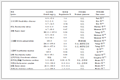
|
表 1 常用再分析风场数据基本信息 Table 1 Brief information of the reanalysis wind products widely used in the research |
CFSR再分析风场以微波成像仪探测数据为基础数据,通过神经网络转换函数得到。神经网络训练数据中的大值风速缺失会导致最终再分析产品数据无大值风速过程[13]。NCDC卫星融合数据是综合利用不同卫星遥测设备同化得到的数据,从后文对比可以发现,NCDC风场数据产品能够较好地后报大值波浪过程。
1.2 WAVEWATCH III模型设置第三代波浪数值模型广泛用于海洋波浪数据的后报研究,WW3作为其中的代表模型主要用于中、大尺度海域的波浪数值研究。该模型作为NOAA的业务化预报平台为美国诸多研究结构提供基础波浪数据[14],国际上WW3也广泛用于波浪后报及波候研究,其可靠性得到一致认可[2, 14-16]。
本文采用WW3模型搭建中国海及附近海域波浪后报数学模型,波浪模型采用Tolman的经典输入耗散组合项,即Tolman Chalikov计算组合。模型采用ETOPO2地形数据作为水深基础地形[17],在解析岛屿(“障碍物”)及大陆岸线时采用全球高精度岸线形状数据,既能满足水深精度要求,又能较好模拟大陆岸线对波浪场的影响。在全球或中大尺度海洋波浪模型中,计算网格间距往往较大,地形网格数据无法精确解析大洋岛屿,WW3模型通过加入“障碍物”数据,在数值方法上考虑了岛屿的影响[17],表 2为本文所用WW3模型的基本参数设置。
|
|
表 2 WW3模型设置参数列表 Table 2 Wave model setup of WW3 |
研究采用浮标实测波浪数据和卫星高度计波高数据作为模型验证和误差分析的依据。
QF301~QF303波浪浮标位处广东东南沿海,浮标所处海域开敞无岛屿,3个浮标距离大陆海岸线在50~85 km之间,其中QF301距QF302约200 km,QF302距QF303约130 km。实测数据中包括Hs波高,平均周期(Tr)及波向,采集时间间隔为1 h,采集时间为2009—2013年,各浮标位置见图 1。
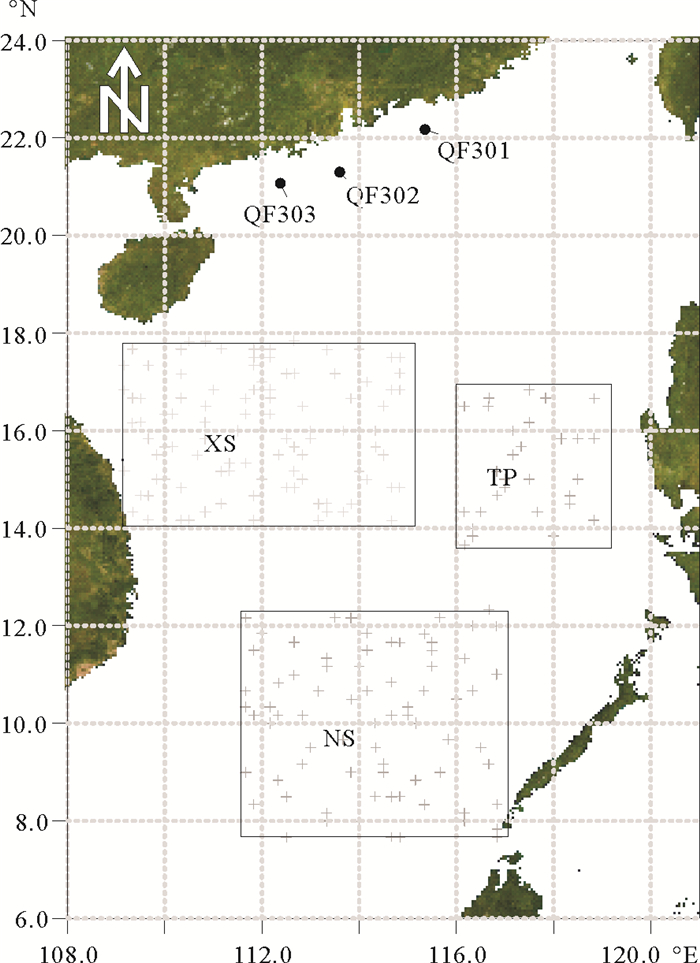
|
图 1 浮标位置及卫星高度计数据提取范围 Fig. 1 Locations of buoys and covering oceans of altimeter data |
随着卫星遥感测量技术的不断提高,卫星高度计数据精度得到一致认可[18],在验证中、大尺度海域波浪数学模型时,常常采用卫星高度计数据作为验证依据[5, 19-20]。本研究选用GlobWAVE项目发布的全球卫星高度计波高融合数据(http://globwave.ifremer.fr/)作为验证及分析的依据,该数据产品期限为1993—2016年,数据质量可靠[21-22]。本文用到了3个海域的卫星同步模型数据进行分析,即图 1中的XS、NS和TP海域,其中XS覆盖西沙群岛海域,NS覆盖南沙群岛海域,TP海域位于菲律宾西侧。
3 再分析风场比较图 2、3分别是不同再分析风场驱动WW3模型在XS、NS海域的卫星同步波高数据对比图,图 4、5为对应的卫星高度计实测数据和同步模型数据分位数对比图。
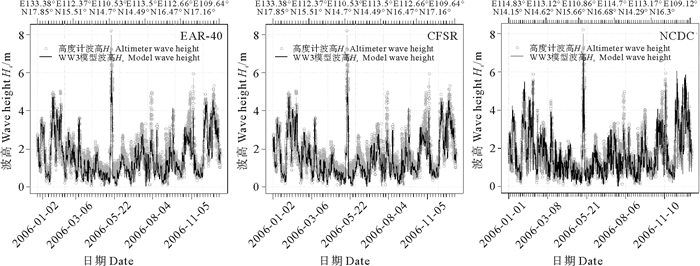
|
图 2 不同再分析风场驱动下XS海域卫星高度计波高与WW3模型结果对比图(2006) Fig. 2 Time series comparison of altimeter wave height and WW3 modeling results forced by different reanalysis wind data(2006) |
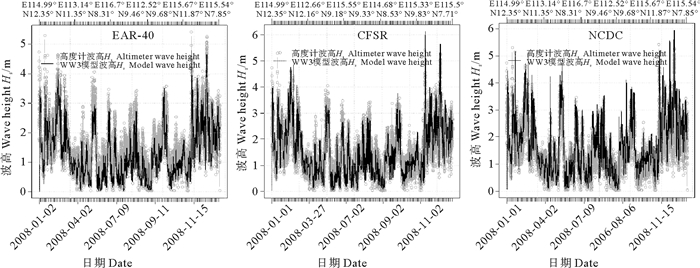
|
图 3 不同再分析风场驱动下NS海域卫星高度计波高与WW3模型结果对比图(2008) Fig. 3 Time series comparison of altimeter wave height and WW3 modeling results forced by different reanalysis wind data(2008) |
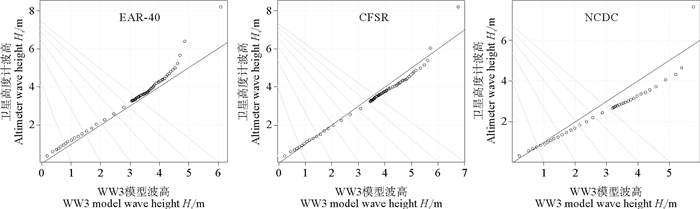
|
图 4 不同再分析风场驱动下XS海域卫星高度计波高及模型同步结果分位数对比图(2006) Fig. 4 Quantiles comparison of altimeter wave height and WW3 modeling results forced by different reanalysis wind data(2006) |
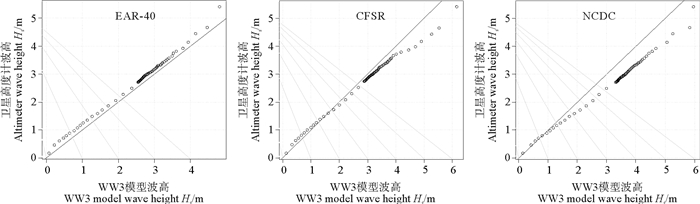
|
图 5 不同再分析风场驱动下NS海域卫星高度计波高及模型同步结果分位数对比图(2006) Fig. 5 Quantiles comparison of altimeter wave height and WW3 modeling results forced by different reanalysis wind data(2006) |
综合以上各图,ERA-40风场得到的模型波高整体低于卫星高度计实测值; CFSR风场驱动下低值波高符合程度较好,但对大值波浪过程捕捉能力相对较弱; NCDC卫星融合风场能够很好地捕捉大浪过程,但略微高估小值波浪。
根据上述风场误差特点,在选用驱动风场时需考虑实际研究的需要,如在研究长期波候变化时宜采用CFSR风场,但如果为海洋(岸)工程提供波浪数据,应当选用能够较好捕捉大浪过程的NCDC风场数据。
4 基于浮标数据的模型误差分析本节及第5节将依据NCDC融合风场后报波浪数据进行WW3模型模拟误差分析。
高度计受卫星绕轨周期影响,无法采集到定点海域的逐时数据,为提高卫星高度计数据的使用效率,从1990年代开始有学者尝试采用“平均海域”的方法基于高度计数据计算重现期波高及风速[23],之后,不同学者对卫星高度计数据在不同范围海域的均质性进行了研究[24-26],认为在经纬度2°×2°范围海域内的波浪与同海域中心处浮标数据具有一致的随机特性[24],即某处海域波浪数据样本,可由该点周边2°×2°海域内的卫星高度计数据组建,如以QF301浮标为中心2°×2°海域的卫星高度计数据与QF301浮标数据具有较高一致性。该方法得到的样本数据虽然无法完全取代浮标逐时数据,但在没有浮标数据的条件下,不失为一个替代方法,下文将该取样方法简称为“2度法”。本节采用“2度法”提取了三个3标附近2°范围海域的波高数据,并进行了统计分析。
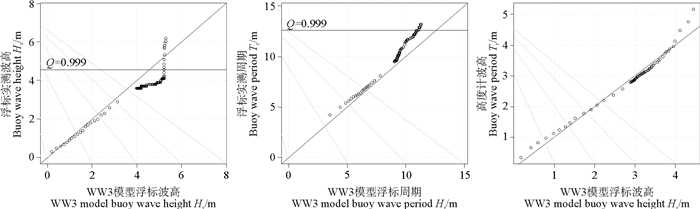
图 6~8为浮标QF301在2010、2012和2013年浮标波高、周期及2°范围高度计波高模拟结果分位数对比图,QF302、QF303浮标模拟结果与此基本类似,表 3~5为各浮标模拟结果及附近海域卫星高度计模拟结果统计结果。
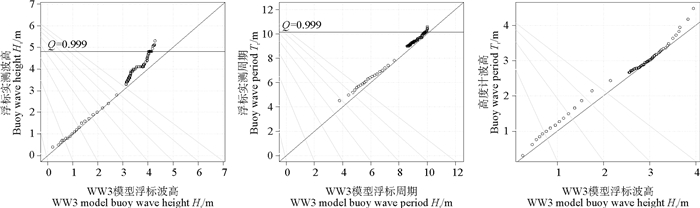
|
图 6 浮标QF301波高(左)、周期(中)及附近2°海域卫星高度计模拟波高(右)分位数对比图(2010) Fig. 6 Quantiles comparison of buoy QF301 wave height(Left), wave period (Middle)and altimeter wave height in the vicinity of 2°(Right) with equivalent modeling results (2010) |
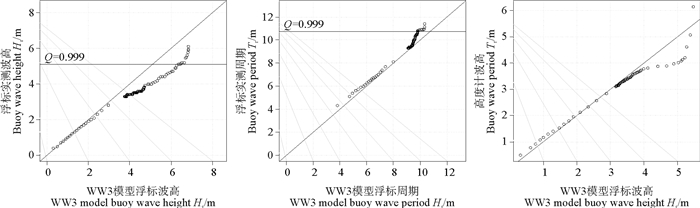
|
图 7 浮标QF301波高(左)、周期(中)及附近2°海域卫星高度计模拟波高(右)分位数对比图(2012) Fig. 7 Quantiles comparison of buoy QF301 wave height(Left), wave period (Middle)and altimeter wave height in the vicinity of 2°(Right) with equivalent modeling results (2012) |
|
图 8 浮标QF301波高(左)、周期(中)及附近2°海域卫星高度计模拟波高(右)分位数对比图(2013) Fig. 8 Quantiles comparison of buoy QF301 wave height(Left), wave period (Middle)and altimeter wave height in the vicinity of 2°(Right) with equivalent modeling results (2013) |
|
|
表 3 浮标QF301及周边海域波浪模拟结果对比表(2010、2012、2013) Table 3 Validation of modeling wave results for buoy QF301 and it vicinity oceans (2010、2012、2013) |
|
|
表 4 浮标QF302及周边海域波浪模拟结果对比表(2010、2012、2013) Table 4 Validation of modeling wave results for QF302 and it vicinity oceans (2010、2012、2013) |
|
|
表 5 浮标QF303及周边海域波浪模拟结果对比表(2010、2012、2013) Table 5 Validation of modeling wave results for QF303 and it vicinity oceans (2010、2012、2013) |
综合上述图表,WW3模型能够较好地复演研究海域的主要波浪特征,但WW3模型整体低估波浪周期,该类问题在第三代波浪数值模型中普遍存在。波高则在不同的年份出现不同的差异,如2010年浮标实测波高数据及高度计实测波高数据均整体大于对应的模型值,而2012和2013年则与之不同,波高误差的年际性差异主要与不同年份的风场精度有关。
对比同一年份的浮标波高数据和周边海域卫星高度计波高数据可以发现,浮标周边海域波高模型值与浮标同步模型值具有近似一致的误差趋势。
基于“2度法”的卫星高度计波高统计特征值与浮标波高统计特征值整体接近,分位数0.999以下的波高数据两者基本一致。若以研究波高整体平均趋势为目的,则浮标数据与“2度法”提取的卫星高度计数据结论相差不大,但若以研究大值波高为目的(如推算重现期波浪要素),“2度法”数据无法满足实际应用需要。
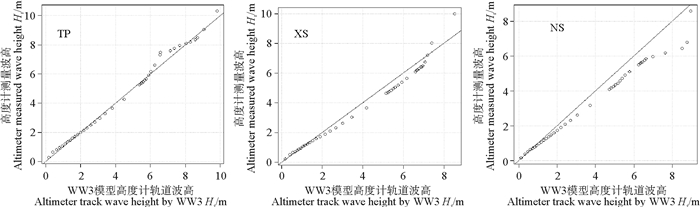
5 基于卫星高度计数据的误差分析图 9给出了TP、XS和NS海域在1991—2008年波高模拟结果与实测值的分位数对比图,表 6给出了相应的分位数统计结果。
|
图 9 卫星高度计波高模拟结果分位数对比图(1991—2008) Fig. 9 Quantiles comparison of altimeter wave height and equivalent modeling results (1991—2008) |
|
|
表 6 1991—2008年卫星高度计波高数据模型验证结果分位数对比表 Table 6 Quantile statistics of altimeter wave height and equivalent modeling results (1991—2008) |
综合图表,WW3波浪模型整体较好地再现了各个海域的波浪特征,但在同一个NCDC再分析风场驱动下,南海不同海域的波高误差特点有明显不同。
在TP海域,模型值和高度计实测值整体符合较好,模型略高估一些低值波浪,模型高估的波浪集中分布在2~5 m之间。由于受到西侧菲律宾半岛的遮护,台风过程未在该海域产生极端大浪,低值波高和大值波高均在模型中得到良好复演。
在XS海域,WW3模型高估低值波高,高估程度略大于TP海域,但由于受到风场时间精度(相邻风场时间间隔为6 h)影响,再分析风场低估台风大浪过程,导致模型结果丢失大浪数据。
在NS海域,冬季受东北季风影响较大,在自然界中,实际风速过程通常具有一定波动性,不会保持恒定风速的持续作用,而由时间精度为6 h的再分析风场插值得到风速过程比较光滑,不会出现风速的波动过程,容易导致波高持续增大,致使WW3模型高估波高。
6 结论本文依据我国沿海浮标数据和全球卫星高度计数据对ERA-40、CFSR、NCDC融合风场驱动下的WW3模型结果进行了对比分析,并基于NCDC融合风场驱动的WW3模型结果分析了模型模拟误差分析,结论如下:
(1) WW3模型结果受风场影响明显,不同的再分析风场产品误差特点各异,其中ERA-40风场风速整体偏小,CFSR风场适合平常天气的波浪模拟,能够较好地模拟波浪过程的长期趋势,而NCDC风场能够较好地捕捉大浪过程,实际应用中需根据研究目的确定采用合适的再分析风场产品,如CFSR风场适合研究波候的平均趋势,而NCDC风场更适合研究大值波浪。
(2) 误差分析表明各浮标在不同年份的波浪周期模拟结果整体偏低,而波高在不同年份、不同海域的误差趋势各异。通过分析可认为由再分析风场驱动的WW3模型波高误差具有“海域性、年际性和趋势性”特点,WW3模型整体低估波浪周期。
(3) 浮标周边2°范围海域内的卫星高度计波高模拟误差趋势与浮标波高模拟误差趋势具有一定相似性,浮标波高数据的统计特征值与“2度法”提取的卫星高度计数据统计特征值具有较高的一致性,两者分位数0.999以下的统计值符合良好。
(4) 6 h间隔的后分析风场较难准确复演高分位数波高,尤其在台风频发的南海北部海域,易造成大值波浪缺失,低估大值波浪,而在季风影响明显的南海南部海域,同样受输入风场时间精度影响,易高估波高。
| [1] |
Musić S, Nicković S. 44-year wave hindcast for the eastern Mediterranean[J]. Coastal Engineering, 2008, 55(11): 872-880. DOI:10.1016/j.coastaleng.2008.02.024
(  0) 0) |
| [2] |
Amrutha M M, Kumar V S, Sandhya K G, et al. Wave hindcast studies using SWAN nested in WAVEWATCH Ⅲ-comparison with measured nearshore buoy data off Karwar, eastern Arabian Sea[J]. Ocean Engineering, 2016, 119: 114-124. DOI:10.1016/j.oceaneng.2016.04.032
( 0) |
| [3] |
Orimolade A P, Haver S, Gudmestad O T. Estimation of extreme significant wave heights and the associated uncertainties: A case study using NORA10 hindcast data for the Barents Sea[J]. Marine Structures, 2016, 49: 1-17. DOI:10.1016/j.marstruc.2016.05.004
( 0) |
| [4] |
Liu P C, Schwab D J, Jensen R E. Has wind-wave modeling reached its limit?[J]. Ocean Engineering, 2002, 29(1): 81-98.
( 0) |
| [5] |
Janssen P A E M. Progress in ocean wave forecasting[J]. Journal of Computational Physics, 2008, 227(7): 3572-3594. DOI:10.1016/j.jcp.2007.04.029
( 0) |
| [6] |
Hanson J L, Tracy B A, Tolman H L, et al. Pacific hindcast performance of three numerical wave models[J]. Journal of Atmospheric and Oceanic Technology, 2009, 26(8): 1614-1633. DOI:10.1175/2009JTECHO650.1
( 0) |
| [7] |
Tolman H L, Chalikov D. Source terms in a third-generation wind wave model[J]. Journal of Physical Oceanography, 1996, 26(11): 2497-2518. DOI:10.1175/1520-0485(1996)026<2497:STIATG>2.0.CO;2
( 0) |
| [8] |
Chawla A, Tolman H L, Gerald V, et al. A multigrid wave forecasting model: A new paradigm in operational wave forecasting[J]. Weather and Forecasting, 2013, 28(4): 1057-1078. DOI:10.1175/WAF-D-12-00007.1
( 0) |
| [9] |
Bao X, Zhang F. Evaluation of NCEP-CFSR, NCEP-NCAR, ERA-Interim, and ERA-40 reanalysis datasets against independent sounding observations over the Tibetan Plateau[J]. Journal of Climate, 2013, 26(1): 206-214. DOI:10.1175/JCLI-D-12-00056.1
( 0) |
| [10] |
Saha S, Moorthi S, Pan H L, et al. The NCEP climate forecast system reanalysis[J]. Bulletin of the American Meteorological Society, 2010, 91(8): 1015-1058. DOI:10.1175/2010BAMS3001.1
( 0) |
| [11] |
Zhang H M, Reynolds R W, Bates J J. Blended and gridded high resolution global sea surface wind speed and climatology from multiple satellites: 1987-present[C]. //Proceedings of the 14th Conference on Satellite Meteorology and Oceanography. Atlant: American Meteorological Society, 2006: 2-23.
( 0) |
| [12] |
Stopa J E, Cheung K F. Intercomparison of wind and wave data from the ECMWF Reanalysis Interim and the NCEP Climate Forecast System Reanalysis[J]. Ocean Modelling, 2014, 75: 65-83. DOI:10.1016/j.ocemod.2013.12.006
( 0) |
| [13] |
Krasnopolsky V M, Breaker L C, Gemmill W H. A neural network as a nonlinear transfer function model for retrieving surface wind speeds from the special sensor microwave imager[J]. Journal of Geophysical Research: Oceans, 1995, 100(C6): 11033-11045. DOI:10.1029/95JC00857
( 0) |
| [14] |
Dykes J D, Rogers W E. WAVEWATCH Ⅲ: Transition to Naval Operations (Session Paper)[EB/OL]. (2011-11-17)https://scholarworks.uno.edu/oceanwaves/2011.
( 0) |
| [15] |
Wang D P, Oey L Y. Hindcast of waves and currents in Hurricane Katrina[J]. Bulletin of the American Meteorological Society, 2008, 89(4): 487-496. DOI:10.1175/BAMS-89-4-487
( 0) |
| [16] |
Chawla A, Tolman H L, Gerald V, et al. A multigrid wave forecasting model: A new paradigm in operational wave forecasting[J]. Weather and Forecasting, 2013, 28(4): 1057-1078. DOI:10.1175/WAF-D-12-00007.1
( 0) |
| [17] |
Chawla A, Tolman H L. Automated Grid Generation for WAVEWATCH Ⅲ[M]. Washington, DC: Technical Bulletin 254, NCEP/NOAA/NWS, National Center for Environmental Prediction, 2007.
( 0) |
| [18] |
Mirzaei A, Tangang F, Juneng L, et al. Wave climate simulation for southern region of the South China Sea[J]. Ocean Dynamics, 2013, 63(8): 961-977. DOI:10.1007/s10236-013-0640-2
( 0) |
| [19] |
Young I R, Babanin A V, Zieger S. The decay rate of ocean swell observed by altimeter[J]. Journal of Physical Oceanography, 2013, 43(11): 2322-2333. DOI:10.1175/JPO-D-13-083.1
( 0) |
| [20] |
Ardhuin F, Rogers E, Babanin A V, et al. Semiempirical dissipation source functions for ocean waves. Part I: Definition, calibration, and validation[J]. Journal of Physical Oceanography, 2010, 40(9): 1917-1941. DOI:10.1175/2010JPO4324.1
( 0) |
| [21] |
David W, Erick R. Validation of global WAVEWATCH Ⅲ Hindcasts Using Merged Altimeter Data[EB/OL]. http://globwave.ifremer.fr/tools/case-studies-tutorials/validation-of-global-wavewatch-iii-hindcasts-using-merged-altimeter-data.
( 0) |
| [22] |
Ellis A. GlobWave_D.7 Product User Guide Phase 3[M]. Leatherhead, Surrey, UK: Logica UK Ltd, 2013.
( 0) |
| [23] |
Carter D J T. Estimating Extreme Wave Heights in the NE Atlantic from GEOSAT Data[M]. London: Health and Safety Executive, 1993.
( 0) |
| [24] |
Vinoth J, Young I R. Global estimates of extreme wind speed and wave height[J]. Journal of Climate, 2011, 24(6): 1647-1665. DOI:10.1175/2010JCLI3680.1
( 0) |
| [25] |
Alves J H G M, Young I R. On estimating extreme wave heights using combined Geosat, Topex/Poseidon and ERS-1 altimeter data[J]. Applied Ocean Research, 2003, 25(4): 167-186. DOI:10.1016/j.apor.2004.01.002
( 0) |
| [26] |
Challenor P G, Wimmer W, Ashton I. Climate Change and Extreme Wave heights in the North Atlantic[C]. Salzbkurg, Austria: Envisat& ERS Symposium, 2005: 572.
( 0) |
2. Shandong Province Key Laboratory of Ocean Engineering, Ocean University of China, Qingdao 266100, China;
3. NAVY Institute of Engineering Design & Research, Beijing 100070, China