 2020, Vol. 50


2. 青岛海洋科学与技术试点国家实验室 海洋渔业科学与食物产出过程功能实验室,山东 青岛 266237
虹鳟(Oncorhynchus mykiss)属于鲑科鱼类的一种,是世界上最重要的养殖品种之一[1],深受中国消费者喜爱。随着对虹鳟需求量的增加,近年来,我国科技工作者开始在黄海冷水团采用层跃式网箱、养殖工船和智能化全潜式网箱进行大规格鳟鱼的养殖[2]。在鱼类的大规模养殖模式下,合理化投喂频率是降低饲料成本,提高饲料利用率,促进生长效率的保证[3]。
鱼类的胃排空率(Gastric evacuation rate, GER)是指摄食后食物从鱼类胃中排出的速率,是研究鱼类生理学和生态学的重要参数[4]。鱼类食欲的恢复和胃排空率密切相关[5],因此,可以利用胃排空率来制定鱼类的合理投喂策略[6-7],该方法尤其适用于采用自动投喂装置模式的大规模养殖系统[8-9]。Seymour[10]认为鱼类的最佳投喂频率是其投喂间隔和胃排空率保持一致。过于频繁地投喂不能提高鱼类生长效率,且会导致体脂率的上升[6]。此外,过量投喂会导致鱼类饲料利用率下降,增加养殖成本,残余饲料还会破坏水质,造成养殖系统氨氮升高、溶氧降低、pH下降等负面影响[11-14]。
鱼类胃含物随时间呈曲线式下降[15],胃含物分析是研究鱼类胃排空率的常用方法[9]。此外,胃排空时间和鱼体规格具有相关性,小规格的鱼消化速率更快[5, 15]。对不同规格的鱼采用不同的合理投喂频率可以提高养殖生产效率[6]。但是采用解剖法分析鱼类胃含物,需要鱼体达到一定规格才能比较准确地进行测定,若鱼体太小则不容易准确称量胃含物重量(胃含物太少,误差大)。此外,随着虹鳟个体的生长,口径增大,其摄食饲料的粒径大小也发生改变。为了避免饲料粒径的影响,本实验选择两种规格(30和100 g左右)虹鳟进行胃排空实验,建立符合虹鳟胃排空特征最佳数学模型。基于此判断投喂后虹鳟食欲恢复情况,提出合理化投喂建议,以期为虹鳟智能化投喂系统提供一个数学参考模型,为深远海绿色鱼类养殖的早期大规格苗种培育技术提供理论依据。
1 材料与方法 1.1 实验材料及暂养条件本实验在中国海洋大学海水养殖教育部重点实验室的养殖生态学实验室进行,实验材料为三倍体虹鳟,取自日照万泽丰渔业有限公司鲑鳟鱼繁育基地(山东日照)。实验开始前,将虹鳟在圆形水槽(180 L;高0.60 m;上直径0.65 m;下直径0.60 m)中暂养2周。期间,于每天08:00和16:00各饱食投喂商品配合饲料一次(能量(19.12±0.16)kJ/g,蛋白质48.36%±1.54%,脂肪13.20%±3.89%,灰分8.19%±0.14%,水分4.33%±0.15%)。每天12:00换水一次,换水量为70%。每天使用YSI专业水质检测仪(Yellow Spring,Ohio,USA)检测并记录水温、溶解氧、pH等水质数据。为保证水中溶氧充足,每个水槽用气泵24 h充气。实验期间溶解氧为(8.25±0.33) mg/L,温度为(16±0.9) ℃,pH为7.88±0.12,氨氮小于0.5 mg/L。
1.2 实验设计本实验设置2个不同规格虹鳟幼鱼进行胃排空实验,其初始重量分别为(32.94±4.21) g(小规格)和(105.15±9.41) g(大规格)。每个规格设3个重复,每个重复放20尾鱼。实验期间,水质条件和暂养时保持一致。实验开始前72 h停止投喂,保证其消化道彻底排空。每个规格随机选取3尾鱼进行解剖,观察到胃内均无饲料残余。然后用上述商品饲料进行一次饱食投喂,0.5 h后清除残饵。为减少实验过程中对鱼的应激,在虹鳟摄食后0、3、6、12、18、24、36和48 h,依次从6个养殖水槽各取2尾鱼解剖取样(即每个规格在每个取样点取6尾鱼)。取样时,用麻醉剂MS-222对鱼进行麻醉,然后将虹鳟胃含物取出并称重(湿重)。随后将胃含物置于烘箱中60 ℃烘72 h至恒重,然后记录重量(干重)。计算各个时间点其胃含物含水量及相对胃含物重量。胃含物含水量以平均值±标准差来表示,每个规格每个取样点的数据皆由6尾鱼计算得出。
1.3 数据分析及计算方法胃含物水分=100×(胃含物湿重-胃含物干重)/胃含物湿重。
胃含物相对重量P=W0/W1。式中:W0表示在任一取样时间时胃内容物的重量;W1表示实验鱼饱食状态下的总摄食量。
用线性、指数、平方根和逻辑斯蒂模型分别拟合胃内容物的重量[16]。各模型的表达式为:
线性模型:Y=A-B×t;
指数模型:Y=A×e-B×t;
平方根模型:Y0.5=A-B×t;
逻辑斯蒂模型:Y=A+(C-A)/ [1+ (t/D)E]。
式中:Y为胃含物相对重量;A、B、C、D、E为常数;B为瞬时排空率(g/h);t为摄食后时间(h)。
特定胃排空率所需时间计算如下:令Y=(1-特定胃排空率)求t值即可。计算50%、80%和99%胃排空所需时间,分别令Y=0.5、0.2和0.01,求t值即可。
本文采用Microsoft Excel对所有实验数据进行储存、运算和常规处理。实验数据用SAS 9.4(SAS Institute Inc., Cary, North Carolina, USA)软件进行单因素方差分析(One-way ANOVA),用SNK(Student-Newman-Keuls)多重范围检验组间差异,以P<0.05作为显著差异水平。采用Origin 2018进行绘图。通过比较分析各模型的相关系数(R2)、残差标准差(SDR)、残差平方和(RSS)值,确定不同规格虹鳟最佳胃排空模型。
2 实验结果 2.1 不同规格虹鳟胃含物含水量变化摄食后48 h内不同规格虹鳟胃含物水分变化如图 1所示。两个规格虹鳟胃含物水分均在投喂后6 h显著上升(P < 0.05)。小规格虹鳟胃含物水分在12~48 h呈现先上升后下降的趋势,但各时间点无显著差异(P>0.05)。大规格虹鳟胃含物水分在12~36 h内保持稳定(P>0.05),在第48小时显著上升(P < 0.05)。

|
图 1 两种规格虹鳟胃含物水分变化 Fig. 1 The dynamic change of gastric content moisture in rainbow trout with two sizes |
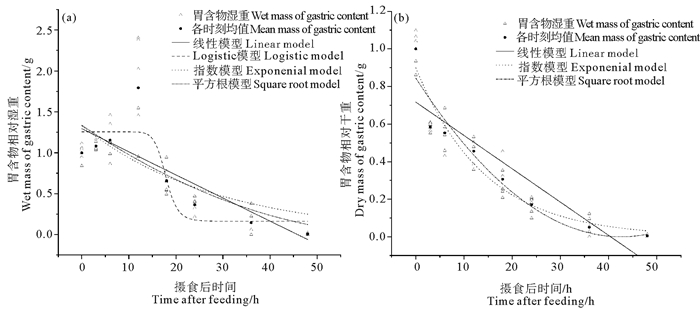
小规格虹鳟胃含物排空变化如图 2所示。小规格虹鳟胃含物相对湿重在投喂后48 h内呈现先上升后下降的趋势,在第12小时达到峰值;平均胃含物相对湿重在第24小时低于50%,在第48小时趋近于零。小规格虹鳟胃含物相对干重在投喂后48小时内呈现持续下降的趋势,在0~24小时下降最快,24~48小时下降速率减缓;胃含物相对干重在第24小时约为20%(胃含物排空80%)。
|
图 2 (32.94±4.21) g虹鳟摄食后胃排空变化情况 Fig. 2 Gastric evacuation of rainbow trout (32.94±4.21) g after feeding |
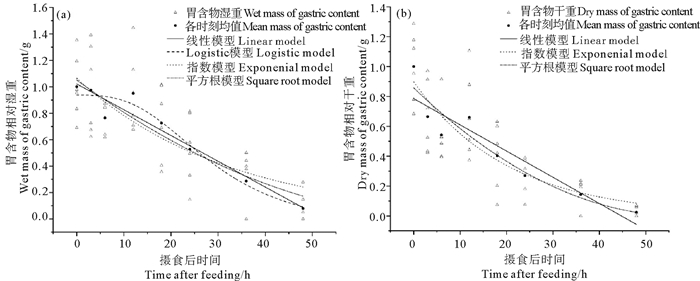
大规格虹鳟胃含物排空变化如图 3。大规格虹鳟胃含物相对湿重在投喂后0~6 h呈下降趋势,在第12小时又上升;从12 h开始持续下降,在第24小时胃含物排空率趋近于50%,在第48小时胃含物相对湿重趋近于零。大规格虹鳟胃含物相对干重在0~6 h快速下降,在第6小时时平均胃含物相对干重低于60%;在18~48 h下降速率减缓,第48小时趋近于零。
|
图 3 (105.15±9.41) g虹鳟摄食后胃排空变化情况 Fig. 3 Gastric evacuation of rainbow trout (105.15±9.41) g after feeding |
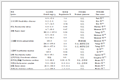
4种模型对不同规格虹鳟胃含物变化的拟合情况见表 1。根据R2判断4种模型对小规格虹鳟胃含物湿重的拟合程度都不高,其中逻辑斯蒂模型优于线性模型和平方根模型,指数模型拟合最差。小规格虹鳟胃含物干重变化趋势无法用逻辑斯蒂模型拟合,线性模型对其拟合度不高。而指数模型和平方根模型能够较好地拟合该规格虹鳟胃含物干重变化,R2高于0.9。其中指数模型R2最大,RSS和SDR最低,该模型拟合度最高。
|
表 1 两种规格虹鳟胃排空模型拟合参数比较 Table 1 Comparation of fitting degree parameters of gastric evacuation models of rainbow trout with two sizes |
如表 1所示,4种模型都能够较好地拟合大规格虹鳟胃含物湿重变化趋势,其中线性模型和逻辑斯蒂模型拟合程度最高,指数模型和平方根模型次之。其中,线性模型的R2最高。大规格虹鳟胃含物干重变化无法用逻辑斯蒂模型进行拟合,而线性模型、指数模型和平方根模型均能较好地拟合该趋势。其中,平方根模型R2最高,SDR最小,拟合程度最佳。
不同规格虹鳟胃排空时间预测如表 2所示。利用胃含物湿重估算出两种规格虹鳟50%胃排空时间约为胃含物干重估算值的2倍。利用胃含物湿重和干重估算出小规格虹鳟80%胃排空时间相似,均为20 h左右,但利用胃含物湿重估算出大规格虹鳟80%胃排空的时间远高于其胃含物干重估算值,分别为41.10和29.92 h。利用胃含物湿重和干重估算出大规格虹鳟99%胃排空时间相近。本实验无法利用逻辑斯蒂模型获得小规格虹鳟99%胃排空所需时间。
|
|
表 2 两种规格虹鳟胃排空时间预测 Table 2 Predicted gastric evacuation time of rainbow trout with two sizes |
不论利用胃含物湿重还是干重进行拟合,大规格虹鳟胃排空50%和80%的时间均高于小规格虹鳟。但利用胃含物干重估算出的大规格虹鳟99%胃排空时间约为51.54 h,低于小规格虹鳟的63.97 h。
3 讨论本实验发现,两个规格虹鳟胃含物水分均在第3小时显著上升,然后基本保持不变,这和鱼类消化的机理相一致。研究表明饲料进入鱼类胃部后其水分增加是消化的主要步骤[17]。鱼类胃含物的水分主要来源于三个方面:饵料本身的水分、吞饮的水分和胃分泌的水分[18]。此外,饲料中含有的渗透物质会使鱼类胃含物相对细胞外液为高渗环境,从而使水分不断进入胃部[19]。
鱼类胃含物的水分会直接影响到胃排空的模型的建立。本研究发现,小规格虹鳟胃含物相对湿重在0~12 h持续升高,在第12 h达到峰值,同时大规格虹鳟胃含物相对湿重在前12 h并未出现明显下降。这是由于虹鳟胃含物所吸收的水分弥补了排空饵料的质量损失。利用胃含物的湿重来估算鱼类胃排空是一种常见的方法,但由于水分因素,湿重估计结果一般很差[20]。Hopkins和Larson[21]以及Olson和Boggs[22]等也认为用湿重来估计鱼类胃排空率有可能高估胃内实际的食物数量。这和本实验结果相一致,本实验发现利用胃含物湿重来估算为胃排空时间会比用干重长得多。这是因为胃含物吸收的水分使虹鳟胃内食物残留量被高估了,从而降低了模型的可靠性。此外,本实验小规格虹鳟胃含物湿重拟合结果并不理想,因此,本实验采用胃含物干重来评估虹鳟胃排空模型。
由于鱼类食性的差异,其消化道也存在多种类型,因此其胃排空的模型也复杂多样[23]。鱼类胃排空主要有三种类型:(1)指数模型,表现为先快后慢,主要多为食浮游生物的小型海洋鱼类[24];(2)线性模型,表现为直线下降,多为肉食性鱼类[22-23];(3)平方根模型,表现为排空速度由慢及快再减慢[17]。已有研究发现,银大马哈鱼(Oncorhynchus kisutch)幼鱼和褐鳟(Salmo trutt)在摄食时,其胃含物是以指数方式排空[25-26],平方根模型也是被用来估计虹鳟的胃排空的一种常用模型[27]。根据本实验拟合结果,指数模型和平方根模型分别是用来估算小规格和大规格虹鳟胃排空(基于胃含物干重)的最佳模型。
本实验根据胃含物干重指数模型拟合公式Y=0.899e-0.070t计算出小规格虹鳟50%胃排空所需时间为8.36 h,80%胃排空所需时间为21.43 h;根据平方根模型Y0.5=0.926-0.016t拟合的结果计算出大规格虹鳟50%胃排空需要13.68 h,80%胃排空需要29.92 h。本实验结果表明虹鳟规格越小消化越快,这可能和能量的供应有关。因为研究发现鱼类的代谢速率和体重密切相关,鱼类规格越小,其代谢速率和生长速率也越快[28-29],快速的生长和高代谢率需要更多能量的供应,而食物是能量的来源,因此小规格鱼的消化速率会快于大规格鱼[15]。然而,根据胃含物干重指数模型和平方根模型分别得出小规格和大规格虹鳟99%胃排空的时间为63.97和51.54 h,这表明在消化后期大规格虹鳟具有更快的消化率。相似地,Tekinay等[30]发现70 g虹鳟胃排空95%大约需要54.3 h,而Tekinay和Guner[27]报道186.2 g虹鳟胃排空95%则需要38.2~42.2 h。这表明不同规格虹鳟的消化模式不同,小规格虹鳟在消化前期消化速率较快,80%胃排空后消化速率减慢;而大规格虹鳟前期消化速率较慢,但后期消化速率快于小规格虹鳟。
鱼类食欲的恢复与其胃排空程度关系密切[31],一般认为当胃内残余物质为50%时,鱼类食欲恢复一半;当胃排空率超过80%时,鱼类食欲基本得到恢复;当胃内残余饲料量为零时,鱼类食欲完全恢复[3, 11, 23]。当鱼类胃排空80%时进行投喂可以取得较好的结果,饵料利用率较高[32]。依据此原则,本实验小规格和大规格虹鳟食欲基本恢复分别需要21.43和29.92 h。在生产实践中,我们建议基于饱食投喂模式下应对不同规格的虹鳟采取不同的投喂频率,小规格和大规格虹鳟的投喂间隔应分别为20和30 h左右。已有研究表明对同一鱼种不同发育阶段采取变化的投喂频率能够取得更好的效果,如Lee等[33]基于胃排空实验提出应对6~20 g和25~60 g的韩国石首鱼(Sebastes schlegeli)分别采取1次/d和1次/2d的投喂频率来确保饵料的利用率和鱼的快速生长。依据鱼种对饵料需求进行科学投喂可极大地增加养殖效益,然而以往养殖模式的投喂活动主要依靠人工投喂,这给科学投喂频率的执行带来困难。但是随着水产养殖业智能化、自动化、机械化的发展,投喂活动逐渐摆脱对人力的依赖,科学投喂技术的确定愈发重要。本实验所获得的投喂频率参数,可为鲑鳟鱼类智能化投喂策略提供理论依据。
4 结论相对于胃含物湿重,利用胃含物干重拟合虹鳟胃排空情况可以取得较好效果,小规格((32.94±4.21) g)和大规格((105.15±9.41) g)虹鳟胃排空模式分别符合指数模型和平方根模型。小规格虹鳟胃排空速率较大规格虹鳟更快,其投喂间隔应分别为20和30 h左右。
| [1] |
Esmaeili M, Kenari A A, Rombenso A N. Effects of fish meal replacement with meat and bone meal using garlic (Allium sativum) powder on growth, feeding, digestive enzymes and apparent digestibility of nutrients and fatty acids in juvenile rainbow trout (Oncorhynchus mykiss Walbaum, 1792)[J]. Aquaculture Nutrition, 2017, 23(6): 1225-1234. DOI:10.1111/anu.12491
(  0) 0) |
| [2] |
董双林. 黄海冷水团大型鲑科鱼类养殖研究进展与展望[J]. 中国海洋大学学报(自然科学版), 2019, 49(3): 1-6. Dong S L. Research progress and prospect on large Salmonidae at the areas of Cold Water Mass in Yellow sea[J]. Periodical of Ocean University of China, 2019, 49(3): 1-6. ( 0) |
| [3] |
Riche M, Haley D I, Oetker M, et al. Effect of feeding frequency on gastric evacuation and the return of appetite in tilapia Oreochromis niloticus (L.)[J]. Aquaculture, 2004, 234(1-4): 657-673. DOI:10.1016/j.aquaculture.2003.12.012
( 0) |
| [4] |
曾令清, 李凤杰, 曹振东, 等. 南方鲇幼鱼的胃排空特征及其数学模型[J]. 水产学报, 2011, 35(2): 231-237. Zeng L Q, Li F J, Cao Z D, et al. The analysis of gastric evacuation characteristic and associated mathematical models in junile southern catfish (Silurus meridionalis)[J]. Journal of Fisheries of China, 2011, 35(2): 231-237. ( 0) |
| [5] |
Grove D, Crawford C. Correlation between digestion rate and feeding frequency in the stomachless teleost, Blennius pholis L[J]. Journal of Fish Biology, 1980, 16(3): 235-247. DOI:10.1111/j.1095-8649.1980.tb03701.x
( 0) |
| [6] |
Lee S M, Hwang U G, Cho S H. Effects of feeding frequency and dietary moisture content on growth, body composition and gastric evacuation of juvenile Korean rockfish (Sebastes schlegeli)[J]. Aquaculture, 2000, 187(3-4): 399-409. DOI:10.1016/S0044-8486(00)00318-5
( 0) |
| [7] |
Windell J, Hubbard J, Horak D. Rate of gastric evacuation in rainbow trout fed three pelleted diets[J]. The Progressive Fish-Culturist, 1972, 34(3): 156-159.
( 0) |
| [8] |
McCarthy I D, Houlihan D F, Carter C G, et al. Variation in individual food-consumption rates of fish and its implications for the study of fish nutrition and physiology[J]. Proceedings of the Nutrition Society, 1993, 52(3): 427-436. DOI:10.1079/PNS19930083
( 0) |
| [9] |
Wang N, Hayward R S, Noltie D B. Effect of feeding frequency on food consumption, growth, size variation, and feeding pattern of age-0 hybrid sunfish[J]. Aquaculture, 1998, 165(3-4): 261-267. DOI:10.1016/S0044-8486(98)00266-X
( 0) |
| [10] |
Seymour E. Devising optimum feeding regimes and temperatures for the warmwater culture of eel, Anguilla anguilla L[J]. Aquaculture Research, 1989, 20(3): 311-324. DOI:10.1111/j.1365-2109.1989.tb00356.x
( 0) |
| [11] |
Grove D, Loizides L, Nott J. Satiation amount, frequency of feeding and gastric emptying rate in Salmo gairdneri[J]. Journal of Fish Biology, 1978, 12(5): 507-516. DOI:10.1111/j.1095-8649.1978.tb04195.x
( 0) |
| [12] |
Windell J, Norris D. Gastric digestion and evacuation in rainbow trout[J]. The Progressive Fish-Culturist, 1969, 31(1): 20-26. DOI:10.1577/1548-8640(1969)31[20:GDAEIR]2.0.CO;2
( 0) |
| [13] |
Windell J T, Norris D O, Kitchell J F, et al. Digestive response of rainbow trout, Salmo gairdneri, to pellet diets[J]. Journal of the Fisheries Board of Canada, 1969, 26(7): 1801-1812. DOI:10.1139/f69-164
( 0) |
| [14] |
Bascinar N, Bascinar N S, Seyhan K, et al. The effect of temperature on the rate of gastric evacuation in brook trout Salvelinus fontinalis fed on commercial pellets: Group-feeding[J]. Pakistan Journal of Zoology, 2016, 48(6): 1899-1904.
( 0) |
| [15] |
Mills E L, Ready R C, Jahncke M, et al. A gastric evacuation model for young yellow perch, Perca flavescens[J]. Canadian Journal of Fisheries and Aquatic Sciences, 1984, 41(3): 513-518. DOI:10.1139/f84-061
( 0) |
| [16] |
郭浩宇, 张秀梅, 张宗航, 等. 许氏平鲉仔、稚鱼的摄食特性及幼鱼胃排空率[J]. 水产学报, 2017, 41(2): 285-296. Guo H Y, Zhang X M, Zhang Z H, et al. Study on feeding habits of Sebastes schlegelii larvae and gastric evacuation rate of juvenile[J]. Journal of Fisheries of China, 2017, 41(2): 285-296. ( 0) |
| [17] |
朱伟星, 华雪铭, 钟国防, 等. 斑点叉尾鮰对全植物蛋白饲料的胃排空及消化道内容物特性研究[J]. 水产学报, 2015, 39(4): 529-538. Zhu W X, Hua X M, Zhong G F, et al. Patterns of gastric evacuation and digesta characteristics in the gastrointestinal tract of channel catfish (Ictalurus punctatus) when fed plant protein based diet[J]. Journal of Fisheries of China, 2015, 39(4): 529-538. ( 0) |
| [18] |
Kristiansen H R, Rankin J C. Discrimination between endogenous and exogenous water sources in juvenile rainbow trout fed extruded dry feed[J]. Aquatic Living Resources, 2001, 14(6): 359-366. DOI:10.1016/S0990-7440(01)01131-7
( 0) |
| [19] |
张波, 孙耀, 唐启升. 鱼类的胃排空率及其影响因素[J]. 生态学报, 2001(4): 665-670. Zhang B, Sun Y, Tang Q S. Gastric evacuation rate of fish and its influence factors[J]. Acta Ecological Sinica, 2001(4): 665-670. ( 0) |
| [20] |
Pääkkänen J P, Marjomäki T. Gastric evacuation rate of burbot fed single-fish meals at different temperatures[J]. Journal of Fish Biology, 1997, 50(3): 555-563. DOI:10.1111/j.1095-8649.1997.tb01949.x
( 0) |
| [21] |
Hopkins T, Larson R. Gastric evacuation of three food types in the black and yellow rockfish Sebastes chrysomelas (Jordan and Gilbert)[J]. Journal of Fish Biology, 1990, 36(5): 673-681.
( 0) |
| [22] |
Olson R J, Boggs C H. Apex predation by yellowfin tuna (Thunnus albacares): Independent estimates from gastric evacuation and stomach contents, bioenergetics, and cesium concentrations[J]. Canadian Journal of Fisheries and Aquatic Sciences, 1986, 43(9): 1760-1775. DOI:10.1139/f86-220
( 0) |
| [23] |
王伟, 张凯强, 温海深, 等. 投喂频率对花鲈幼鱼胃排空、生长性能和体组分的影响[J]. 中国海洋大学学报(自然科学版), 2018, 48(6): 55-62. Wang W, Zhang K Q, Wen H S, et al. Effects of feeding frequency on gastric evacuation, growth performance and body compisition of juvenile Lateolabrax maculatus[J]. Periodical of Ocean University of China, 2018, 48(6): 55-62. ( 0) |
| [24] |
孙耀, 刘勇, 张波, 等. 渤、黄海4种小型鱼类摄食排空率的研究[J]. 海洋与湖沼, 2002(6): 679-684. Sun Y, Liu Y, Zhang B, et al. Gastric evacuation rates of 4 small-size fish species in bohai and yellow seas[J]. Oceanologia Et Limnologia Sinica, 2002(6): 679-684. ( 0) |
| [25] |
Elliott J. Rates of gastric evacuation in brown trout, Salmo trutta L[J]. Freshwater Biology, 1972, 2(1): 1-18. DOI:10.1111/j.1365-2427.1972.tb01575.x
( 0) |
| [26] |
Ruggerone G. Gastric evacuation rates and daily ration of piscivorous coho salmon, Oncorhynchus kisutch Walbaum[J]. Journal of Fish Biology, 1989, 34(3): 451-463. DOI:10.1111/j.1095-8649.1989.tb03326.x
( 0) |
| [27] |
Tekinay A A, Guner Y. Effects of high dietary protein and high energy density on gastric evacuation and return of appetite in the Rainbow trout, Oncorhynchus mykiss[J]. Turkish Journal of Biology, 2001, 25(2): 229-240.
( 0) |
| [28] |
牟希东, 王培欣, 胡隐昌, 等. 亚洲龙鱼形态结构及幼鱼生长特性[J]. 水产学报, 2010, 34(9): 1379-1386. Mou X D, Wang P X, Hu W C, et al. Morphological structure and growth characteristics of juvenile Asian arowana (Scleropages formosus)[J]. Journal of Fisheries of China, 2010, 34(9): 1379-1386. ( 0) |
| [29] |
杨莹, 李二超, 姜雪芹, 等. 瓦氏黄颡鱼幼鱼标准代谢的初步研究[J]. 水产科学, 2011, 30(4): 192-196. Yang Y, Li E C, Jiang X Q, et al. The Standard metabolism of juvenile darkbarbel catfish, Pelteobagrus vachelli[J]. Fisheries Science, 2011, 30(4): 192-196. ( 0) |
| [30] |
Tekinay A A, Guner Y, Akbas I, et al. The influence of multiple meals on the gastric evacuation rate in rainbow trout (Oncorhynchus mykiss)[J]. Israeli Journal of Aquaculture-Bamidgeh, 2003, 55(2): 123-131.
( 0) |
| [31] |
Ware D M. Predation by rainbow trout (Salmo gairdneri): The influence of hunger, prey density, and prey size[J]. Journal of the Fisheries Board of Canada, 1972, 29(8): 1193-1201.
( 0) |
| [32] |
张涛, 李伟杰, 庄平, 等. 俄罗斯鲟幼鱼的胃排空特征及其数学模型[J]. 海洋渔业, 2015, 37(2): 151-155. Zhang T, Li W J, Zhuang P, et al. Analysis of gastric evacuation characteristics and associated mathematical models in juvenile Acipenser gueldenstaedtii[J]. Marine Fisheries, 2015, 37(2): 151-155. ( 0) |
| [33] |
Lee S M, Kim S H, Jeon I G, et al. Effects of feeding frequency on grwoth, feed efficiency and body composition of juvenile korean rockfish (Sebastes schlegeli)[J]. Journal of Aquaculture, 1996, 9(4): 385-394.
( 0) |
2. Function Laboratory for Marine Fisheries Science and Food Production Processes, Pilot National Laboratory for Marine Science and Technology(Qingdao), Qingdao 266237, China