 2026, Vol. 56


2. 中国海洋大学海洋环境与生态教育部重点实验室,山东 青岛 266100
2, 4-二氨基丁酸(2, 4-diaminobutyric acid, DAB)是一种非蛋白氨基酸,具有两个氨基和一个羧基基团,在中性或碱性条件下呈现正电性,在室温下为无色结晶固体,化学性质较稳定。该化合物最早是在细菌代谢物多粘菌素A(一种多肽类抗生素)的酸性水解物中被发现[1],之后在其他细菌[2]、植物[3-4]、藻类[5-7]、水生动物[5, 8-9]等生物样品中也有检出。DAB对肝脏[10]和神经系统[11-13]具有毒性作用,可导致小鼠或大鼠出现肝损伤症状和惊厥、抽搐、运动不协调等神经中毒症状[12, 14];在细胞水平上,也会导致氧化损伤、肿胀和溶解[13, 15]、能量消耗[16]、氨基酸动态失衡[17],甚至凋亡[18]。
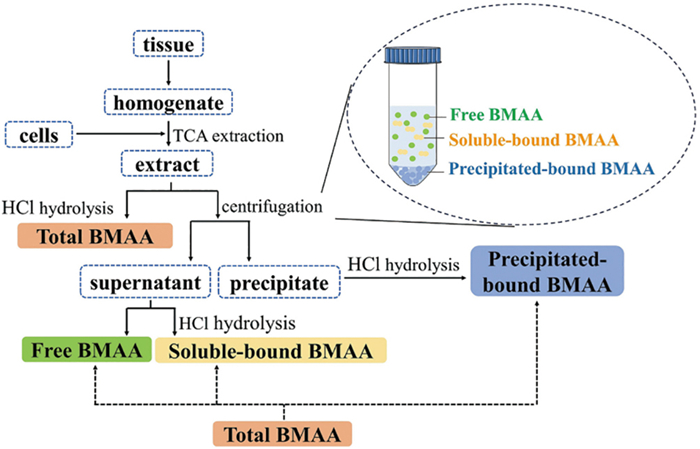
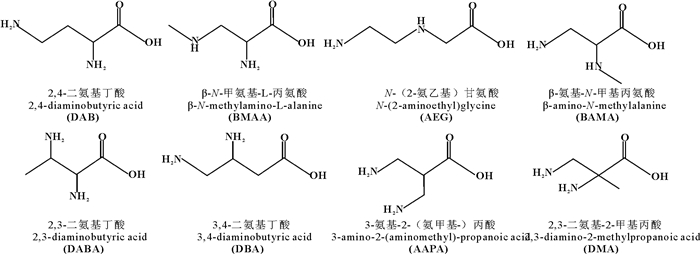
根据DAB的同分异构体β-N -甲氨基-L-丙氨酸(β-N -methylamino-L-alanine, BMAA)提取工艺(见图 1)[19-20],研究人员将DAB分为游离态、溶解结合态和沉淀结合态三种存在形式,其中游离态和溶解结合态统称为总溶解态。游离态是经三氯乙酸提取后直接溶解在上清液中的毒素分子;溶解结合态是经三氯乙酸提取后分布在上清液中,再经盐酸水解后释放出的毒素分子;沉淀结合态是经三氯乙酸提取后分布在沉淀物中,再经盐酸水解后释放出游离态毒素的蛋白结合态形式。DAB的同分异构体包括BMAA、N -(2-氨乙基)甘氨酸(N -(2-aminoethyl)glycine, AEG)、β-氨基-N -甲基丙氨酸、2, 3-二氨基丁酸、3, 4-二氨基丁酸、3-氨基-2-(氨甲基-)丙酸和2, 3-二氨基-2-甲基丙酸[21],其中BMAA、AEG是最常见的两种同分异构体(见图 2)。
鉴于DAB在不同营养级的生物样品中被广泛检出,且具有神经毒性,本文对DAB的生物来源、检出情况、致毒机制等进行综述,以期为DAB的毒理学与健康风险研究提供重要参考。
2 神经毒素DAB及其同分异构体的生物来源2008年,研究人员首次在蓝细菌(Calothrix sp.)的单种培养物中检测出DAB[22],之后在硅藻、甲藻、隐藻等单种培养物中检出DAB。因此,蓝细菌与真核细胞藻类被认为是DAB的生物来源。此外,在多种十字花科(Cruciferae)、豆科(Fabaceae)等植物中也发现该化合物[3-4, 14]。
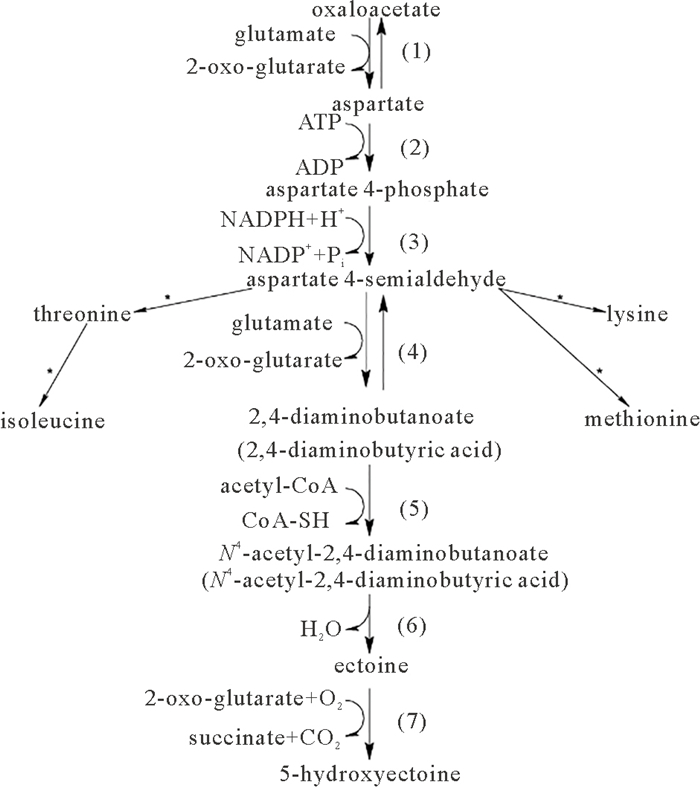
2.1 DAB毒素的原核生物来源 2.1.1 蓝细菌目前,在微囊藻属(Microcystis )、聚球藻属(Synechococcus )、念珠藻属(Nostoc )、鱼腥藻属(Anabaena )、鞘丝藻属(Lyngbya )、节球藻属(Nodularia )等蓝细菌(也称蓝藻)中检出DAB毒素,且主要以游离态和溶解结合态形式存在[7, 22-28](见表 1)。蓝细菌中DAB毒素的产量具有显著的种间和区域差异性,这种差异可能与蓝细菌的基因组、共生细菌类群和生长环境等多种因素的差异有关。Downing等运用15N(NH4Cl)标记发现,微囊藻在氮限制条件下,DAB产量呈增加趋势[29];在高磷酸盐水平(8.75 mmol·L-1)、强光照(9 000 Lux)和高温(25、30 ℃)等培养条件下,DAB产量显著增加[27]。这说明蓝细菌DAB的合成可能与其应激响应机制相关。蓝细菌基因组中存在天冬氨酸4-磷酸途径(见图 3)的关键酶编码基因,包括转氨酶等[30],表明蓝细菌可能通过该代谢途径合成DAB,但目前未有直接的遗传学证据验证这一假设。然而DAB毒素在蓝藻培养体系中的生物来源模糊,已在微囊藻、束毛藻等蓝细菌培养物中发现共生细菌的存在[31-32],并且以上研究均未排除共生细菌的存在。未来研究需结合分子生物学手段和生态学调查,以阐明DAB的合成机制及其在生态系统中的潜在影响。
|
表 1 蓝藻中检出DAB的含量 Table 1 The contents of DAB detected in cyanobacteria |
除蓝细菌外,研究人员在分离自土壤[33-34]、水体[35-36]、大气[37-38]等不同环境介质的细菌样品中检出DAB,甚至在沙漠[39-40]、冰川[41-42]等极端环境中分离的细菌也检出该毒素。细菌中DAB参与肽聚糖交联,并以细胞壁结构成分的形式稳定存在。这些细菌附着或共生于某些动植物,例如艾草、人参等根部[43-44],夹竹桃和杨树的树皮[45-46],扁玉螺及高原鼠兔的肠道、奶牛瘤胃等[5, 47-48]。此外,蝙蝠、猕猴、牛等多种生物排泄物分离的细菌[49-51],以及海洋与淡水环境中细菌形成的生物膜[49-51]均检出DAB毒素。法国泻湖贻贝外壳生物膜中总溶解态DAB的平均浓度为3.3 μg·g-1干重(dry weight, DW)[7],而加拿大温尼伯湖淡水沉积物生物膜中总溶解态DAB浓度范围为0.5~77.6 ng·g-1 DW[52]。由此来看,产生DAB的细菌类群具有非常高的生物多样性。
关于细菌合成DAB的过程机制研究表明,DAB合成可能与特定转氨酶的催化反应有关,谷氨酸和天冬氨酸-4-半醛可逆反应生成DAB和2-酮戊二酸。不动杆菌(Acinetobacter spp.)、大肠杆菌(Escherichia coli )均含有编码转氨酶的dat(以及ddc基因)基因[53],在四种假单胞菌(Pseudomonas spp.)[54]、Ⅰ型好氧性甲烷氧化菌(Methylomicrobium alcaliphilum 20Z)[55]中也发现了DAB转氨酶的基因。DAB的这种生物合成途径仍需要进一步研究确认。
2.2 DAB毒素的真核生物来源水环境中真核细胞藻类也是DAB毒素的重要来源。Réveillon等在法国泻湖的硅藻、甲藻、隐藻、绿藻和金藻样品中检出DAB[7-8];Violi等在澳大利亚淡水环境中分离的5株硅藻中也检出DAB[28];中国学者在海洋硅藻中检出DAB,其中拟菱形藻的含量最高(406.96 μg·g-1),远高于国外水环境中藻类样品的检出量[5]。因此,硅藻作为海洋生态系统的重要浮游植物类群和DAB毒素的重要生物来源,潜在威胁海洋生态系统与人类的健康。从毒素的存在形式来看,真核藻类样品中总溶解态DAB含量远高于沉淀结合态毒素的含量(见表 2)。
|
|
表 2 真核藻类DAB的检出量 Table 2 The contents of DAB detected in eukaryotic algae |
研究人员在陆生十字花科、豆科的山黧豆属、猪屎豆属、野豌豆属等高等植物中也检出DAB[4, 14, 24, 57-60]。金边苏铁(Cycas revoluta )的种子[24]、根[27]和德保苏铁(Cycas debaoensis )的叶子[61]以及番茄(Solanum lycopersicum )的花柱代谢物[62]中也检出DAB毒素(见表 3)。
|
|
表 3 高等植物DAB的检出量 Table 3 The contents of DAB detected in plants |
BMAA是DAB的一种同分异构体,最初被发现自苏铁种子,而后发现BMAA的最初来源极有可能是与苏铁珊瑚状根部共生的念珠藻(Nostoc sp.)[63]。之后在不同种类的蓝细菌如微囊藻属(Microcystis )、色球藻属(Chroococcales )、集胞藻属(Synechocystis )和细鞘丝藻属(Leptolyngbya )等样品中普遍检出BMAA[64-65]。由于使用非特异性的氨基酸分析方法使得实验室菌株[65]、野外分离株[66]、野外样品[67]中BMAA检测含量过高,而在HILIC柱使用未衍生化方法中BMAA含量低[68-69]甚至未检出[22]。使得人们对蓝细菌作为BMAA生物来源的结论仍存在争议。Jiang等人首次在5株硅藻[70]以及Violi等人在4株淡水硅藻[56]中检出BMAA,说明海洋硅藻和淡水硅藻可能是BMAA的生物来源。目前仅在实验室培养的海洋链状裸甲藻(Gymnodinium catenatum )[71]以及三角异冒藻(Heterocapsa triquetra )[72]等甲藻样品中检出BMAA,暂未见其他种类的甲藻检出BMAA的报道。Li等人证明了极小海链藻(Thalassiosira minima )中BMAA是由硅藻自身产生的[73],进一步研究海洋硅藻的分子机制发现,BMAA的产生是由铁限制强烈诱导的,是通过胞内CysK基因催化肽链中半胱氨酸残基和甲胺发生亲核反应原位生成BMAA[74]。BMAA同样存在于细菌中,粉状芽孢杆菌(Bacillus pulvifaciens )产生的一种抗生素galantin Ⅰ经酸水解后可释放S-2, 3-DAP和S-BMAA[75],该化合物是目前已知的唯一含有BMAA结构的肽类化合物[76]。因此,BMAA的生物来源较为广泛,主要包括硅藻等藻类,同时也涵盖细菌。
AEG已在淡水、海洋、陆生、温泉等多种生境的蓝细菌中被检出,主要包括集胞藻属(Synechocystis sp.)、色球藻属(Chroococcidiopsis sp.)、鱼腥藻属(Anabaena sp.)、念珠藻属(Nostoc sp.)、鞘丝藻属(Lyngbya sp.)以及细鞘丝藻属(leppolyynbya sp.)等[77-78],这些蓝细菌主要分布于淡水和海洋环境中。AEG在硅藻、甲藻、绿藻等真核生物中也曾被检出,主要包括骨条藻属、亚历山大藻属、原甲藻属、微拟球藻属、衣藻属等[7-8]。目前,关于藻类AEG合成的遗传学证据尚未见报道。迄今为止,针对DAB的其他同分异构体,亦缺乏系统性研究。
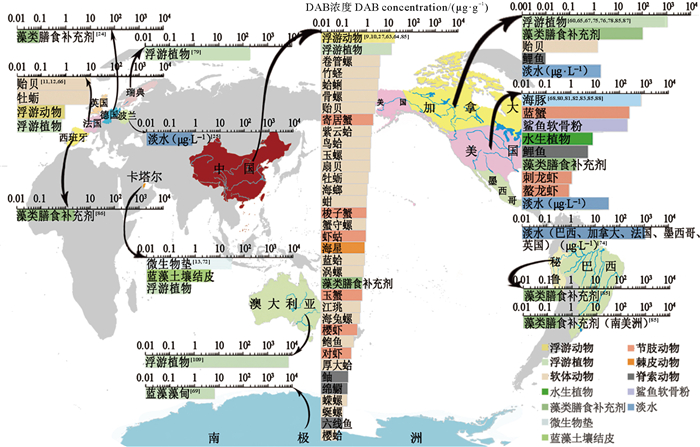
3 环境样品中神经毒素DAB及其同分异构体的分布当前,不同国家的研究人员在淡水、空气介质、水生生物等不同样品中检出DAB毒素,表明其在世界范围广泛存在(见图 4)。在环境样品BMAA的调查研究中,科学家通常会同时检测其同分异构体DAB。通常相较于BMAA,藻类样品[7, 8, 23-24, 27-28, 56, 79]、多数水生动物样品[5-8, 23, 80-85]以及南极洲[86]蓝藻藻甸和阿拉伯湾[9]海洋微生物结皮中DAB含量更高,检出率相近或更高。水处理过程中,常规工艺(紫外线、消毒剂氯/氯胺)难以有效去除DAB及其消毒副产物等有害物质[87],严重威胁饮用水水质安全,危害人体健康。
|
( 图中显示检出各个科类生物的DAB最高浓度。The figure shows the highest concentration of DAB detected for each category of organisms. ) 图 4 世界范围内环境生物样品中DAB的检出情况 Fig. 4 Global detection of DAB in environmental and biological samples |
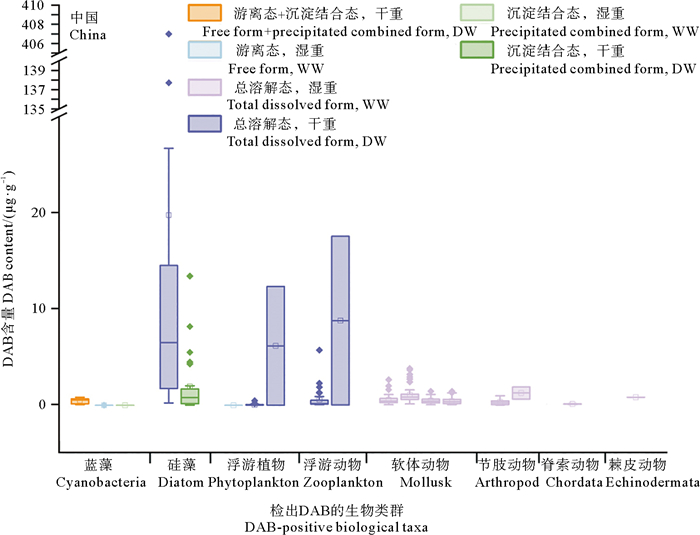
中国淡水环境中浮游植物游离态DAB含量相对较低,0.37~3.82 ng·g-1WW,且未检出BMAA[27],在太湖水样中也曾检出游离态DAB(1.83~2.09 ng·L-1)而BMAA的浓度范围为0.89~230.8 ng·L-1[88],说明在水体介质中BMAA的波动性更大,可能受更复杂的环境因素(如藻类群落结构、水文条件等)影响。我国沿海采集的生物样品中DAB毒素的调查结果显示,浮游植物(0.01~12.34 μg·g-1 DW)、浮游动物(0.03~17.56 μg·g-1 DW)、贝类软体动物(0.05~3.82 μg·g-1 WW)、虾和蟹类节肢动物(0.02~1.91 μg·g-1 WW)、鱼类(0.09~0.16 μg·g-1 WW)等不同营养级的生物样品中均含有DAB毒素(见图 5)[5-6, 80-81],但未表现出明显的生物放大现象,而BMAA在硅藻为主的海洋生态系统的食物网中表现出生物放大现象,这种食物链传递效率的差异可能是BMAA源于其硅藻内源性合成机制[74]直接进入食物链,而DAB可能为细菌外源性来源[73]、易代谢分解而未能形成显著放大。近年来,海洋软体动物(0.04~3.82 μg·g-1 WW)[5-6, 80-81]、节肢动物(0.02~1.91 μg·g-1 WW)[5, 81]中总溶解态DAB毒素水平相对稳定,这提示DAB毒素可能不是由初级生产者浮游植物产生的,且海洋生物可能具有高效的DAB毒素排出机制。
|
图 5 中国水环境中采集的生物样品中DAB的检出量 Fig. 5 The contents of DAB detected in biological samples collected from aquatic environments in China |
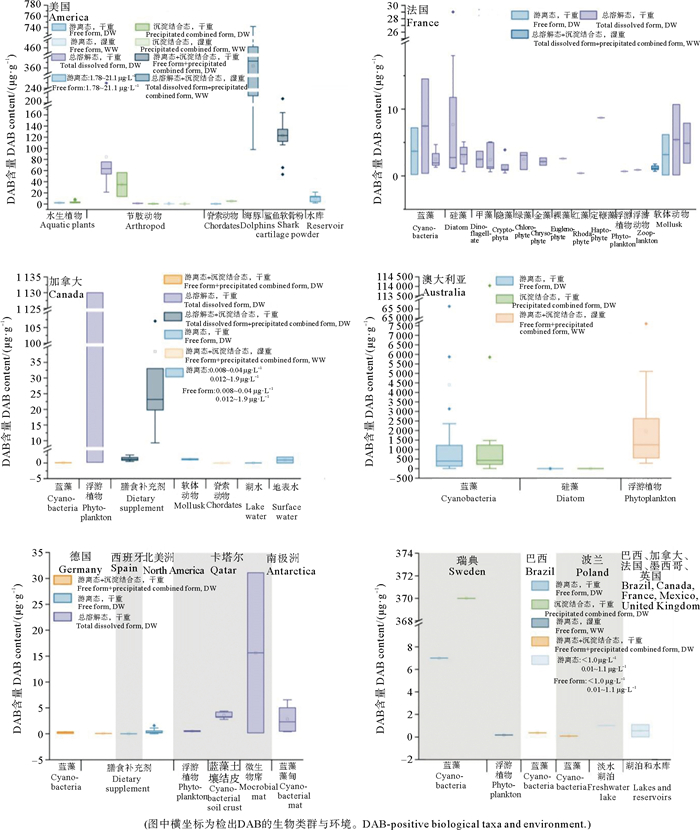
1901—1904年采集的南极淡水蓝藻藻甸中检出总溶解态DAB[86],且浓度(0.40~6.56 μg·g-1 DW)(见图 6)和检出率(85.7%)较高[9, 86],AEG(0.74~6.79 μg·g-1 DW)含量较高而总溶解态BMAA含量较低(0.53 μg·g-1 DW)。后来研究人员在阿拉伯湾的海洋微生物结皮[9](0.19~31.08 μg·g-1 DW)、卡塔尔沙漠的蓝藻土壤结皮(2.8~4.4 μg·g-1 DW)[89]样品中也检出不同浓度的DAB,且随采样深度(0~105 cm)增加逐渐递减至0.5 μg·g-1 DW以下[90]。AEG含量(0.003 4~6.03 μg·g-1 DW;0.7~4.4 μg·g-1 DW)高而BMAA含量(1.4~9.1 ng·g-1 DW;未检出)低,这可能是因为蓝藻种类特异性代谢或极端环境因子调控作用不同。在淡水环境中,也能够检测到DAB(0.01~21.1 μg·L-1)、BMAA(0.01~25.3 μg·L-1)以及AEG(0.01~19 μg·L-1)[91-94]。
|
图 6 国外水环境采集的生物样品中DAB的检出量 Fig. 6 The contents of DAB detected in biological samples collected from aquatic environments in other countries and regions |
淡水环境中浮游植物(澳大利亚[95]、加拿大[96])样品的DAB含量(212 ng·g-1~7.61 mg·g-1)明显高于半咸水环境中浮游植物(瑞典波罗的海[97]、法国地中海泻湖[7])样品的DAB含量(平均浓度0.69 μg·g-1 DW)。AEG和BMAA的含量分布也呈现类似规律:淡水环境中AEG(2.02 ng·g-1~23.9 mg·g-1)和BMAA含量(47.26 μg·g-1~2.63 ng·g-1)高于半咸水环境中AEG(ND)和BMAA含量(平均浓度为0.49 μg·g-1 DW)。然而BMAA的含量较低,这可能与其合成物种种类少、降解效率高等多因素有关。该现象与中国水环境中DAB毒素的检出情况截然相反,中国水环境中较高含量的DAB毒素出现在海洋环境样品中,而澳洲和北美洲地区淡水环境样品中DAB的浓度更高。
法国地中海泻湖环境样品中总溶解态DAB和BMAA随着食物链浮游植物-浮游动物-贻贝(0.69、0.92、7.2 μg·g-1 DW;0.49、0.63、4.0 μg·g-1 DW)呈现生物放大现象(见图 6)[7]。但在法国的泻湖和双壳类养殖区采集的贝类样品中DAB含量无显著季节性差异,且较为稳定[7-8, 23],然而藻类存在显著的季节性动态变化,这表明高密度生长的浮游植物并未使贝类体内的DAB含量显著增加,说明食物链传递对贝类体内DAB含量的贡献不明显。这提示浮游植物可能不是DAB生产者,而细菌可能是其主要的生产者。
美国内布拉斯加州水库的调查结果显示,游离态和沉淀结合态DAB和BMAA在水生植物、鱼类等不同营养级生物中未见明显的生物放大作用[94]。南佛罗里达地区生长的龙虾含有游离态BMAA(0.01~11 μg·g-1 WW)、游离态和沉淀结合态DAB毒素(0.51~2.34 μg·g-1 WW)、以及微量的AEG和β-氨基-N -甲基丙氨酸毒素[98-99],且BMAA主要富集在卵中,DAB主要富集在卵和尾巴部位[98]。美国海域海豚的脑组织中检出总BMAA(20~328 μg·g-1 WW)和DAB(98~742 μg·g-1 WW)[100],但西班牙加利西亚生长的海豚的肝脏、肾脏或肌肉样品中未检出BMAA和DAB[101],这可能与不同海域BMAA和DAB的生物来源差异有关,也可能与毒素在海豚体内的富集部位有关。
藻类膳食补充剂通常是由螺旋藻或其他蓝绿藻制成的,是研究人员关注的焦点之一。最早研究人员在德国市售的一种水华束丝藻的膳食补充剂中检出DAB(0.08 μg·g-1),未检出BMAA[24],之后加拿大、北美洲、西班牙市售的藻类膳食补充剂中也检出DAB、BMAA、AEG,其中DAB的检出率≥78%,且含量最高[61, 102-104]。其中,加拿大市售的藻类膳食补充剂检出的BMAA(0.13~2.52 μg·g-1)和DAB含量(0.49~107.06 μg·g-1)最高[104],而北美洲、西班牙地区市售的藻类膳食补充剂的BMAA未检出,且DAB含量较低(0.003 5~2.40 μg·g-1)[24, 61, 102-103]。此外,研究人员在鲨鱼软骨粉中也检出BMAA(86~265 μg·g-1)和DAB(53~207 μg·g-1)[105]。
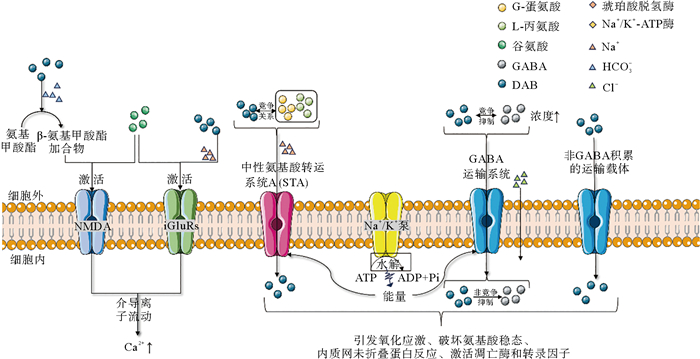
4 神经毒素DAB的致毒机制目前有关DAB神经毒性致毒机制的解释主要包括三种作用途径:触发兴奋性毒性、干扰γ-氨基丁酸(γ-aminobutyric acid, GABA)能神经系统、引发肝源性神经损伤(见图 7)[13, 18, 106]。
|
图 7 DAB神经毒性的经典致毒机制示意图 Fig. 7 Classical mechanisms of DAB neurotoxicity |
谷氨酸作为中枢神经系统核心兴奋性神经递质,通过激活配体门控离子通道型受体(如N-甲基-D-天冬氨酸(N-methyl-D-aspartate, NMDA)/离子型谷氨酸受体AMPA)介导神经元去极化。受体过度激活引发细胞内Ca2+超载,导致兴奋性毒性,表现为细胞长期的去极化、细胞内Ca2+信号的激活以及细胞凋亡酶的激活[107-110]。DAB能够作为谷氨酸受体(如NMDA、离子型谷氨酸受体(iGluRs))的激动剂引起兴奋性毒性[13, 107]。
DAB在碳酸氢盐存在下形成的β-氨基甲酸酯加合物可激活NMDA受体从而引起神经兴奋性毒性。具体表现为显著的去极化效应和乳酸脱氢酶释放增加[13],表明DAB可严重破坏细胞膜的完整性[111]。DAB通过调控动作电位相关离子(如Na+、K+)通道,诱导细胞去极化。研究表明,DAB能够导致小鼠艾氏腹水癌细胞内Na+及K+含量下降、Cl-及水含量上升[17],这种离子组成的改变直接影响细胞膜的电化学性质,一方面引起膜电位去极化甚至无法恢复[112],另一方面显著降低膜输入电阻[107]。科学家提出了DAB诱导细胞溶解的双重作用机制假说,一种是DAB在胞内蓄积引起持续去极化破坏了渗透平衡[18, 113],另一种是DAB通过激活机械力敏感型Cl-通道降低膜输入阻力[107, 114]。
DAB进入细胞内是通过钠依赖性的系统A中性氨基酸转运体[107, 115],该转运过程与L-丙氨酸和G-蛋氨酸存在竞争性抑制关系[18, 107]。DAB对细胞内外游离氨基酸浓度有显著影响,能够抑制原代皮质神经元细胞摄取L-胱氨酸[111],并导致胶质母细胞外的氨基酸如谷氨酸、天冬氨酸等阴离子氨基酸和丙氨酸、甘氨酸等中性氨基酸的增加[16]。此外,钠离子依赖性的DAB摄入细胞过程消耗大量能量,腺嘌呤核苷三磷酸(Adenosine triphosphate, ATP)是通过Na+/K+-ATP酶获取的[16]。
4.2 DAB干扰GABA能神经系统给药DAB后,研究人员发现出现惊厥反应的大鼠脑组织中GABA浓度升高[10, 106],DAB通过多种途径干扰GABA能神经系统功能。在神经突触体中,DAB除通过系统A中性氨基酸转运体外,还可经由GABA系统转运[116]。生理状态下,GABA通过激活GABAA受体-氯离子通道复合体,并引起超极化,进而产生抗惊厥效应[117]。DAB作为GABA的结构类似物,能够竞争性结合神经元表面GABA的高亲和力摄取位点[116],从而干扰正常的抑制性神经传递并引起惊厥。DAB能有效抑制3H-GABA在Na+依赖性神经末梢的摄取过程[118],DAB和GABA在短期(0~10 min)暴露过程中表现出竞争性抑制伴随细胞内DAB积累,而长期(50~100 min)暴露表现出非竞争性抑制[116]。GABA摄取的抑制可能来自胞外竞争性和胞内非竞争性抑制的混合作用[119],并呈现非线性特征[120]。然而,由于发现对非钠依赖性GABA通道的抑制是非立体特异性的,这表明DAB的神经毒性机制并非通过抑制GABA摄取,而是主要源于与突触后GABA受体的直接相互作用[119]。
4.3 DAB诱导慢性氨中毒引发神经毒性通过对暴露大鼠的多组织分析发现,其肝脏、血液及脑组织中的尿素浓度均呈现显著性升高。研究发现,DAB通过抑制大鼠肝脏中鸟氨酸氨甲酰基转移酶的活性,从而抑制尿素循环引起肝损伤[10]。尿素循环的抑制导致血氨浓度显著增加,引发慢性氨中毒。而脑中谷氨酰胺浓度的长期微量增加间接地导致继发性脑神经毒性,这一过程是DAB通过阳离子氨基酸转运系统y+穿过血脑屏障[121]引发的。
对DAB与其同分异构体BMAA、AEG的毒性效应开展了比较研究[15, 122-123],发现这三种化合物的致毒机制有相似或相同之处。其中,BMAA的神经毒性是通过激活谷氨酸受体(如代谢型谷氨酸受体mGluRs、NMDA和离子型谷氨酸受体AMPA)结合和错误嵌入肽链来介导的[21],而AEG的神经毒性是通过诱导氧化应激和激活谷氨酸受体(代谢型谷氨酸受体5)来介导的[111]。DAB与BMAA的毒性效应存在显著的物种和细胞类型差异性,表现出不同的敏感性。在细胞水平,DAB对小鼠巨噬细胞RAW264.7、小胶质细胞BV-2[15]以及皮质神经元细胞[111]的毒性更强,导致细胞活力降低和死亡率增加,还诱导水蛭Retzius神经元细胞更高的去极化水平[112, 122]。BMAA对N2a细胞、小鼠神经元NSC-34细胞[15, 124]的毒性更强,除了细胞活力降低以外,还诱导NSC-34细胞的膜透性增加、线粒体脱氢酶活性降低[124],对星形胶质细胞摄取体外L-胱氨酸的抑制作用更强[111]。在生物个体水平,DAB对斑马鱼幼鱼(孵化后6 h)的致死率更高。有一项研究表明同等浓度下BMAA和DAB毒性相近,造成人神经母细胞瘤细胞SH-SY5Y的死亡率无显著差异[125]。DAB与AEG的毒性比较的研究中,DAB对斑马鱼幼鱼(孵化后6 h)的毒性更强,致死率更高[122],然而AEG对小鼠皮质神经元细胞的毒性更强,其半数致死浓度EC50更低,还对星形胶质细胞摄取体外L-胱氨酸的抑制程度更强[111]。
5 展望本文系统梳理了不同生物样品中神经毒素DAB的检出情况,对其神经毒性致毒机制进行了归纳总结。从现有的文献来看,全球分布的淡水或海洋环境中的细菌、蓝细菌、微藻、大型藻、水生动物及陆生高等植物等多种生物样品中检出DAB毒素,由此引起的健康风险应予以关注。但目前对DAB的真正生产者及其生物合成机制的认识非常有限,且缺少DAB的水生生物的环境质量基准,对其生态环境风险管控提出了挑战。建议今后从以下几个方面开展研究:
(1) 当前有关DAB毒素的真实生产者尚存在争议,真核浮游植物和蓝细菌可能不是DAB毒素的初始生产者,尚未排除这些生物的共生或寄生细菌产生DAB的可能。尽管已有多项研究在放射菌中检出DAB,但人们对其合成机制尚不清楚。开展DAB生物合成机制的探索,将有助于理解其生物学意义。
(2) 深入研究DAB在不同动物、植物生物体中的吸收、分布、代谢及排泄规律,揭示其富集和代谢途径,以进一步解释DAB的毒性机制。
(3) 基于DAB的毒性数据和环境赋存,建立DAB的水生生物的环境质量基准,并开展环境风险评估,提高对该毒素的动态监测与风险预警能力。
| [1] |
Catch J R, Jones T S, Wilkinson S. The chemistry of polymyxin A; isolation of the amino-acids D-leucine, L-threonine, L-alpha gamma-diamiobutyric acid, and an unknown fatty acid[J]. Biochemical Journal, 1948, 43(2): xxvii. (  0) 0) |
| [2] |
Schleifer K H, Kandler O. Peptidoglycan types of bacterial cell walls and their taxonomic implications[J]. Bacteriological reviews, 1972, 37(2): 258. ( 0) |
| [3] |
VanEtten C H, Miller R W. The neuroactive factor alpha-gamma diaminobutyric acid in angiospermous seeds[J]. Economic Botany, 1963, 17(2): 107-109. ( 0) |
| [4] |
Bell E A, Tirimanna S L. Associations of amino acids and related compounds in the seeds of forty-seven species of Vicia : Their taxonomic and nutritional significance[J]. The Journal of Biochemistry, 1965, 97(1): 104-111. ( 0) |
| [5] |
Wang C, Yan C, Qiu J, et al. Food web biomagnification of the neurotoxin β-N -methylamino-L-alanine in a diatom-dominated marine ecosystem in China[J]. Journal of Hazardous Materials, 2021, 404: 124217. ( 0) |
| [6] |
Yan G, Qiu J, Li A, et al. Spatiotemporal distribution of neurotoxin β-N -methylamino-L-alanine and 2, 4-diaminobutyric acid in offshore aquaculture area of Shandong province, China[J]. Journal of Hazardous Materials, 2024, 480: 135970. ( 0) |
| [7] |
Réveillon D, Abadie E, Séchet V, et al. β-N -methylamino-L-alanine (BMAA) and isomers: Distribution in different food web compartments of Thau lagoon, French Mediterranean Sea[J]. Marine Environmental Research, 2015, 110: 8-18. ( 0) |
| [8] |
Réveillon D, Séchet V, Hess P, et al. Systematic detection of BMAA (β-N -methylamino-l-alanine) and DAB (2, 4-diaminobutyric acid) in mollusks collected in shellfish production areas along the French coasts[J]. Toxicon, 2016b, 110: 35-46. ( 0) |
| [9] |
Chatziefthimiou A D, Deitch E J, Glover W B, et al. Analysis of neurotoxic amino acids from marine waters, microbial mats, and seafood destined for human consumption in the Arabian Gulf[J]. Neurotoxicity Research, 2018, 33(1): 143-152. ( 0) |
| [10] |
O'Neal R M, Chen C H, Reynolds C S, et al. The 'neurotoxicity' of L-2, 4-diaminobutyric acid[J]. Biochemical Journal, 1968, 106: 699-706. ( 0) |
| [11] |
Chen C H, Flory W, Koeppe R E. Variation of neurotoxicity of L-and D-2, 4-diaminobutyric acid with route of administration[J]. Toxicology and Applied Pharmacology, 1972, 23: 334-338. ( 0) |
| [12] |
Riggs T R, Coyne B A, Christensen H N. Amino acid concentration by a free cell neoplasm. Structural influences[J]. Journal of Biological Chemistry, 1954, 209(1): 395-411. ( 0) |
| [13] |
Weiss J H, Christine C W, Choi D W. Bicarbonate dependence of glutamate receptor activation by beta-N-methylamino-L-alanine: Channel recording and study with related compounds[J]. Neuron, 1989, 3(3): 321-326. ( 0) |
| [14] |
Ressler C, Redstone P A, Erenberg R H. Isolation and identification of a neuroactive factor from Lathyrus latifolius [J]. Science, 1961, 134(3473): 188-190. ( 0) |
| [15] |
Takser L, Benachour N, Husk B, et al. Cyanotoxins at low doses induce apoptosis and inflammatory effects in murine brain cells: Potential implications for neurodegenerative diseases[J]. Toxicology Reports, 2016, 3: 180-189. ( 0) |
| [16] |
Bergenheim A T, Roslin M, Ungerstedt U, et al. Metabolic manipulation of glioblastoma in vivo by retrograde microdialysis of L-2, 4 diaminobutyric acid (DAB)[J]. Journal of Neuro-Oncology, 2006, 80(3): 285-293. ( 0) |
| [17] |
Christensen H N, Riggs T R, Fischer H, et al. Intense concentration of α, γ-diaminobutyric acid by cells[J]. Journal of Biological Chemistry, 1952, 198(1): 17-22. ( 0) |
| [18] |
Ronquist G, Hugosson R, Westermark B. Antitumor activity of L-2, 4 diaminobuturic acid against mouse fibrosarcoma cells in vitro and in vivo [J]. Journal of Cancer Research and Clinical Oncology, 1980, 96(3): 259-268. ( 0) |
| [19] |
Faassen E, Antoniou M, Beekman-Lukassen W, et al. A collaborative evaluation of LC-MS/MS based methods for BMAA analysis: Soluble bound BMAA found to be an important fraction[J]. Marine Drugs, 2016, 14(3): 45. ( 0) |
| [20] |
Jiang L, Aigret B, De Borggraeve W M, et al. Selective LC-MS/MS method for the identification of BMAA from its isomers in biological samples[J]. Analytical and Bioanalytical Chemistry, 2012, 403(6): 1719-1730. ( 0) |
| [21] |
Li M, Qiu J, Yan G, et al. How does the neurotoxin β-N-methylamino-L-alanine exist in biological matrices and cause toxicity?[J]. Science of The Total Environment, 2024, 922: 171255. ( 0) |
| [22] |
Rosén J, Hellenäs K E. Determination of the neurotoxin BMAA (β-N -methylamino-L-alanine) in cycad seed and cyanobacteria by LC-MS/MS (liquid chromatography tandem mass spectrometry)[J]. The Analyst, 2008, 133(12): 1785. ( 0) |
| [23] |
Réveillon D, Abadie E, Séchet V, et al. Beta-N -Methylamino-L-Alanine: LC-MS/MS optimization, screening of canobacterial strains and occurrence in shellfish from Thau, a French mediterranean lagoon[J]. Marine Drugs, 2014, 12(11): 5441-5467. ( 0) |
| [24] |
Krüger T, Mönch B, Oppenhäuser S, et al. LC-MS/MS determination of the isomeric neurotoxins BMAA (β-N -methylamino-L-alanine) and DAB (2, 4-diaminobutyric acid) in cyanobacteria and seeds of Cycas revoluta and Lathyrus latifolius [J]. Toxicon, 2010, 55(2-3): 547-557. ( 0) |
| [25] |
Rzymski P, Poniedziałek B, Mankiewicz-Boczek J, et al. Polyphasic toxicological screening of Cylindrospermopsis raciborskii and Aphanizomenon gracile isolated in Poland[J]. Algal Research, 2017, 24: 72-80. ( 0) |
| [26] |
Li A, Fan H, Ma F, et al. Elucidation of matrix effects and performance of solid-phase extraction for LC-MS/MS analysis of β-N -methylamino-L-alanine (BMAA) and 2, 4-diaminobutyric acid (DAB) neurotoxins in cyanobacteria[J]. Analyst, 2012, 137(5): 1210. ( 0) |
| [27] |
Fan H, Qiu J, Fan L, et al. Effects of growth conditions on the production of neurotoxin 2, 4-diaminobutyric acid (DAB) in Microcystis aeruginosa and its universal presence in diverse cyanobacteria isolated from freshwater in China[J]. Environmental Science and Pollution Research, 2015, 22(8): 5943-5951. ( 0) |
| [28] |
Violi J P, Mitrovic S M, Colville A, et al. Prevalence of β-methylamino-L-alanine (BMAA) and its isomers in freshwater cyanobacteria isolated from eastern Australia[J]. Ecotoxicology and Environmental Safety, 2019b, 172: 72-81. ( 0) |
| [29] |
Downing S, Banack S A, Metcalf J S, et al. Nitrogen starvation of cyanobacteria results in the production of β-N -methylamino-L-alanine[J]. Toxicon, 2011, 58(2): 187-194. ( 0) |
| [30] |
Mantas M J Q, Nunn P B, Ke Z, et al. Genomic insights into the biosynthesis and physiology of the cyanobacterial neurotoxin 2, 4-diaminobutanoic acid (2, 4-DAB)[J]. Phytochemistry, 2021, 192. ( 0) |
| [31] |
Tu J, Chen L, Gao S, et al. Obtaining genome sequences of mutualistic bacteria in single Microcystis colonies[J]. International Journal of Molecular Sciences, 2019, 20(20): 5047. ( 0) |
| [32] |
Basu S, Gledhill M, de Beer D, et al. Colonies of marine cyanobacteria Trichodesmium interact with associated bacteria to acquire iron from dust[J]. Communications Biology, 2019, 2: 284. ( 0) |
| [33] |
Zhang Y, Zhao J, Hu J, et al. Agromyces mariniharenae sp. nov., a novel indole-acetic acid producing actinobacterium isolated from marine sand[J]. International Journal of Systematic and Evolutionary Microbiology, 2021, 71(9): 005026. ( 0) |
| [34] |
Lee S D. Humibacter antri sp. nov., an actinobacterium isolated from a natural cave, and emended description of the genus Humibacter [J]. International Journal of Systematic and Evolutionary Microbiology, 2013, 63: 4315-4319. ( 0) |
| [35] |
Villalobos A S, Wiese J, Aguilar P, et al. Subtercola vilae sp. nov., a novel actinobacterium from an extremely high-altitude cold volcano lake in Chile[J]. Antonie van Leeuwenhoek, 2018, 111(6): 955-963. ( 0) |
| [36] |
Kim S J, Lee S S. Amnibacterium kyonggiense gen. nov., sp. nov., a new member of the family Microbacteriaceae [J]. International Journal of Systematic and Evolutionary Microbiology, 2011, 61(1): 155-159. ( 0) |
| [37] |
Weon H Y, Kim S J, Jang Y H, et al. Naasia aerilata gen. nov., sp. nov., a member of the family Microbacteriaceae isolated from air[J]. International Journal of Systematic and Evolutionary Microbiology, 2013, 63: 2436-2441. ( 0) |
| [38] |
Martin E, Lodders N, Jäckel U, et al. Leucobacter aerolatus sp. nov., from the air of a duck barn[J]. International Journal of Systematic and Evolutionary Microbiology, 2010, 60(12): 2838-2842. ( 0) |
| [39] |
Liu S W, Li F N, Zheng H Y, et al. Planctomonas deserti gen. nov., sp. nov., a new member of the family Microbacteriaceae isolated from soil of the Taklamakan desert[J]. International Journal of Systematic and Evolutionary Microbiology, 2019, 69(3): 616-624. ( 0) |
| [40] |
Li X J, Wang C M, Feng X M, et al. Planctomonas psychrotolerans sp. nov., isolated from rhizosphere soil of Suaeda salsa [J]. International Journal of Systematic and Evolutionary Microbiology, 2020, 70(10): 5271-5279. ( 0) |
| [41] |
Schumann P, Zhang D C, Redzic M, et al. Alpinimonas psychrophila gen. nov., sp. nov., an actinobacterium of the family Microbacteriaceae isolated from alpine glacier cryoconite[J]. International Journal of Systematic and Evolutionary Microbiology, 2012, 62: 2724-2730. ( 0) |
| [42] |
Zhang D C, Wang H X, Cui H L, et al. Cryobacterium psychrotolerans sp. nov., a novel psychrotolerant bacterium isolated from the China No.1 glacier[J]. International Journal of Systematic and Evolutionary Microbiology, 2007, 57(4): 866-869. ( 0) |
| [43] |
Qiu F, Huang Y, Sun L, et al. Leifsonia ginsengi sp. nov., isolated from ginseng root[J]. International Journal of Systematic and Evolutionary Microbiology, 2007, 57(2): 405-408. ( 0) |
| [44] |
Kim Y R, Kim T S, Han J H, et al. Allohumibacter endophyticus gen. nov., sp. nov., isolated from the root of wild Artemisia princeps (mugwort)[J]. International Journal of Systematic and Evolutionary Microbiology, 2016, 66(4): 1823-1827. ( 0) |
| [45] |
Tuo L, Yan X R, Li F N, et al. Amnibacterium flavum sp. nov., a novel endophytic actinobacterium isolated from bark of Nerium indicum Mill[J]. International Journal of Systematic and Evolutionary Microbiology, 2019, 69(1): 285-290. ( 0) |
| [46] |
Fang W, Li X, Tan X M, et al. Leucobacter populi sp. nov. isolated from a symptomatic bark of Populus ×euramericana canker[J]. International Journal of Systematic and Evolutionary Microbiology, 2016, 66(6): 2254-2258. ( 0) |
| [47] |
Li J, Lu S, Jin D, et al. Agromyces badenianii sp. nov., isolated from plateau pika (Ochotona curzoniae )[J]. International Journal of Systematic and Evolutionary Microbiology, 2020, 70(4): 2247-2253. ( 0) |
| [48] |
Chun B H, Lee H J, Jeong S E, et al. Leucobacter ruminantium sp. nov., isolated from the bovine rumen[J]. International Journal of Systematic and Evolutionary Microbiology, 2017, 67(8): 2634-2639. ( 0) |
| [49] |
Cheng Y, Bai Y, Huang Y, et al. Agromyces laixinhei sp. nov. isolated from bat feces in China[J]. Journal of Microbiology, 2021, 59(5): 467-475. ( 0) |
| [50] |
Weon H Y, Anandham R, Tamura T, et al. Leucobacter denitrificans sp. nov., isolated from cow dung[J]. The Journal of Microbiology, 2012, 50(1): 161-165. ( 0) |
| [51] |
Li G, Li Q, Chen X, et al. Gulosibacter macacae sp. nov., a novel actinobacterium isolated from Macaca mulatta faeces[J]. International Journal of Systematic and Evolutionary Microbiology, 2020, 70(9): 5115-5122. ( 0) |
| [52] |
Bishop S L, Tymm F J M, Perry K, et al. Early-earth nonprotein amino acid metabolites in modern cyanobacterial microbialites[J]. Environmental Chemistry Letters, 2020, 18(2): 467-473. ( 0) |
| [53] |
Ikai H, Yamamoto S. Identification and analysis of a gene encoding L-2, 4-diaminobutyrate: 2-ketoglutarate-4-aminotransferase involved in the 1, 3-diaminopropane production pathway in Acinetobacter baumannii[J]. Journal of Bacteriology, 1997, 179(16): 5118-5125. ( 0) |
| [54] |
Nunn P B, Codd G A. Metabolic solutions to the biosynthesis of some diaminomonocarboxylic acids in nature: Formation in cyanobacteria of the neurotoxins 3-N-methyl-2, 3-diaminopropanoic acid (BMAA) and 2, 4-diaminobutanoic acid (2, 4-DAB)[J]. Phytochemistry, 2017, 144: 253-270. ( 0) |
| [55] |
Reshetnikov A S, Khmelenina V N, Trotsenko Y A. Characterization of the ectoine biosynthesis genes of haloalkalotolerant obligate methanotroph "Methylomicrobium alcaliphilum 20Z"[J]. Archives of Microbiology, 2006, 184(5): 286-297. ( 0) |
| [56] |
Violi J P, Facey J A, Mitrovic S M, et al. Production of β-methylamino-L-alanine (BMAA) and its isomers by freshwater diatoms[J]. Toxins, 2019, 11(9): 512. ( 0) |
| [57] |
Bell E A. α, γ-diaminobutyric acid in seeds of twelve species of Lathyrus and identification of a new natural amino-acid, L-homoarginine, in seeds of other species toxic to man and domestic animals[J]. Nature, 1962, 193: 1078-1079. ( 0) |
| [58] |
Nigam S N, Ressler C. Biosynthesis of 2, 4-diaminobutyric acid from L-[3H] homoserine and DL-[1-14C]aspartic acid in Lathyrus sylvestris W.[J]. Biochemistry, 1966, 5(11): 3426-3431. ( 0) |
| [59] |
Pilbeam D J, Bell E A. Free amino acids in Crotalaria seeds[J]. Phytochemistry, 1979, 18: 973-985. ( 0) |
| [60] |
Samardzic K, Steele J R, Violi J P, et al. Toxicity and bioaccumulation of two non-protein amino acids synthesised by cyanobacteria, β-N -Methylamino-L-alanine (BMAA) and 2, 4-diaminobutyric acid (DAB), on a crop plant[J]. Ecotoxicology and Environmental Safety, 2021, 208: 111515. ( 0) |
| [61] |
McCarron P, Logan A C, Giddings S D, et al. Analysis of β-N -methylamino-L-alanine (BMAA) in spirulina-containing supplements by liquid chromatography-tandem mass spectrometry[J]. Aquatic Biosystems, 2014, 10: 5. ( 0) |
| [62] |
Zhao P, Pan Q, Yu W, et al. Dissect style response to pollination using metabolite profiling in self-compatible and self-incompatible tomato species[J]. Journal of Chromatography B, 2016, 1017-1018: 153-162. ( 0) |
| [63] |
Cox P A, Richer R, Metcalf J S, et al. Cyanobacteria and BMAA exposure from desert dust: A possible link to sporadic ALS among Gulf War veterans[J]. Amyotrophic Lateral Sclerosis, 2009, 10(sup2): 109-117. ( 0) |
| [64] |
Cervantes Cianca R C, Baptista M S, Lopes V R, et al. The non-protein amino acid β-N -methylamino-L-alanine in Portuguese cyanobacterial isolates[J]. Amino Acids, 2012, 42(6): 2473-2479. ( 0) |
| [65] |
Cox P A, Banack S A, Murch S J, et al. Diverse taxa of cyanobacteria produce beta-N- methylamino-L-alanine, a neurotoxic amino acid[J]. Proceedings of the National Academy of Science of the United States of America, 2005, 102(14): 5074-5078. ( 0) |
| [66] |
Esterhuizen M, Downing T G. Beta-N-methylamino-L-alanine (BMAA) in novel South African cyanobacterial isolates[J]. Ecotoxicology and Environmental Safety, 2008, 71(2): 309-313. ( 0) |
| [67] |
Metcalf J S, Banack S A, Lindsay J, et al. Co-occurrence of β-N -methylamino-l-alanine, a neurotoxic amino acid with other cyanobacterial toxins in British waterbodies, 1990—2004[J]. Environmental Microbiology, 2008, 10(3): 702-708. ( 0) |
| [68] |
Faassen E J, Gillissen F, Zweers H A J, et al. Determination of the neurotoxins BMAA (β-N -methylamino -L -alanine ) and DAB (α-, γ-diaminobutyric acid) by LC-MSMS in Dutch urban waters with cyanobacterial blooms[J]. Amyotrophic Lateral Sclerosis, 2009, 10(sup2): 79-84. ( 0) |
| [69] |
Jonasson S, Eriksson J, Berntzon L, et al. Transfer of a cyanobacterial neurotoxin within a temperate aquatic ecosystem suggests pathways for human exposure[J]. Proceedings of the National Academy of Science of the United States of America, 2010, 107(20): 9252-9257. ( 0) |
| [70] |
Jiang L, Eriksson J, Lage S, et al. Diatoms: A novel source for the neurotoxin BMAA in aquatic environments[J]. PLoS One, 2014, 9(1): e84578. ( 0) |
| [71] |
Lage S, Costa P R, Moita T, et al. BMAA in shellfish from two Portuguese transitional water bodies suggests the marine dinoflagellate Gymnodinium catenatum as a potential BMAA source[J]. Aquatic Toxicology, 2014, 152: 131-138. ( 0) |
| [72] |
Jiang L, Ilag L L. Detetion of endogenous BMAA in dinoflagellate (Heterocapsa triquetra ) hints at evolutionary conservation and environmental concern[J]. PubRaw Science, 2014, 1(2): 1-8. ( 0) |
| [73] |
Li A, Yan Y, Qiu J, et al. Putative biosynthesis mechanism of the neurotoxin β-N -methylamino-L-alanine in marine diatoms based on a transcriptomics approach[J]. Journal of Hazardous Materials, 2023, 441: 129953. ( 0) |
| [74] |
Zheng X, Wu S, Qiu J, et al. Induction of a neurotoxin in diatoms by iron limitation via cysteine synthase[J]. Proceedings of the National Academy of Science of the United States of America, 2025, 122(24): e2424843122. ( 0) |
| [75] |
Shoji J, Sakazaki R, Wakisaka Y, et al. Isolation of galantins Ⅰ and Ⅱ, water-soluble basic peptides. Studies on antibiotics from the genus Bacillus. Ⅲ[J]. The Journal of Antibiotics, 1975, 28(2): 122-125. ( 0) |
| [76] |
Sakai N, Ohfune Y. Total synthesis of galantin I. Revision of the original structure[J]. Tetrahedron Letters, 1990, 31(22): 3183-3186. ( 0) |
| [77] |
Banack S A, Metcalf J S, Jiang L, et al. Cyanobacteria produce N -(2 -aminoethyl)glycine, a backbone for peptide nucleic acids which may have been the first genetic molecules for life on earth[J]. PLoS One, 2012, 7(11): e49043. ( 0) |
| [78] |
Reveillon D, Abadie E, Savar V, et al. Beta-N -methylamino-L-alanine (BMAA): Optimization of identification and quantification in biological samples[J]. Toxicon, 2014, 91: 168. ( 0) |
| [79] |
Réveillon D, Séchet V, Hess P, et al. Production of BMAA and DAB by diatoms (Phaeodactylum tricornutum , Chaetoceros sp., Chaetoceros calcitrans and, Thalassiosira pseudonana ) and bacteria isolated from a diatom culture[J]. Harmful Algae, 2016a, 58: 45-50. ( 0) |
| [80] |
Li A, Song J, Hu Y, et al. New typical vector of neurotoxin β-N -Methylamino-L-Alanine (BMAA) in the marine benthic ecosystem[J]. Marine Drugs, 2016, 14(11): 202. ( 0) |
| [81] |
Li A, Hu Y, Song J, et al. Ubiquity of the neurotoxin β-N -methylamino-L-alanine and its isomers confirmed by two different mass spectrometric methods in diverse marine mollusks[J]. Toxicon, 2018, 151: 129-136. ( 0) |
| [82] |
Metcalf J S, Banack S A, Wyatt P B, et al. A direct analysis of β-N -methylamino-L-alanine enantiomers and isomers and its application to cyanobacteria and marine mollusks[J]. Toxins, 2023, 15(11): 639. ( 0) |
| [83] |
Masseret E, Banack S, Boumédiène F, et al. Dietary BMAA exposure in an amyotrophic lateral sclerosis cluster from Southern France[J]. PLoS One, 2013, 8(12): e83406. ( 0) |
| [84] |
Banack S, Caller T, Henegan P, et al. Detection of cyanotoxins, β-N -methylamino-L-alanine and microcystins, from a lake surrounded by cases of amyotrophic lateral sclerosis[J]. Toxins, 2015, 7(2): 322-336. ( 0) |
| [85] |
Field N C, Metcalf J S, Caller T A, et al. Linking β-methylamino-L-alanine exposure to sporadic amyotrophic lateral sclerosis in Annapolis, MD[J]. Toxicon, 2013, 70: 179-183. ( 0) |
| [86] |
Jungblut A D, Wilbraham J, Banack S A, et al. Microcystins, BMAA and BMAA isomers in 100-year-old Antarctic cyanobacterial mats collected during captain R.F. Scott's discovery expedition[J]. European Journal of Phycology, 2018, 53(2): 115-121. ( 0) |
| [87] |
Huang J, Wu Y, Wu Y, et al. Comparison of UV and UV/chlorine system on degradation of 2, 4-diaminobutyric acid and formation of disinfection byproducts in subsequent chlorination[J]. Separation and Purification Technology, 2022, 284: 120264. ( 0) |
| [88] |
Cao Y, Hu S, Gong T, et al. Decomposition of β-N -methylamino-L-alanine (BMAA) and 2, 4-diaminobutyric acid (DAB) during chlorination and consequent disinfection byproducts formation[J]. Water Research, 2019, 159: 365-374. ( 0) |
| [89] |
Richer R, Banack S A, Metcalf J S, et al. The persistence of cyanobacterial toxins in desert soils[J]. Journal of Arid Environments, 2015, 112: 134-139. ( 0) |
| [90] |
Chatziefthimiou A D, Banack S A, Cox P A. Biocrust-produced cyanotoxins are found vertically in the desert soil profile[J]. Neurotoxicity Research, 2021, 39(1): 42-48. ( 0) |
| [91] |
Abbes S, Vo Duy S, Munoz G, et al. Occurrence of BMAA isomers in bloom-impacted lakes and reservoirs of Brazil, Canada, France, Mexico, and the United Kingdom[J]. Toxins, 2022, 14(4): 251. ( 0) |
| [92] |
Roy-Lachapelle A, Solliec M, Sauvé S. Determination of BMAA and three alkaloid cyanotoxins in lake water using dansyl chloride derivatization and high-resolution mass spectrometry[J]. Analytical and Bioanalytical Chemistry, 2015, 407(18): 5487-5501. ( 0) |
| [93] |
Sung V D, Gabriel M, Tuc D Q, et al. Analysis of the neurotoxin β-N -methylamino-L-alanine (BMAA) and isomers in surface water by FMOC derivatization liquid chromatography high resolution mass spectrometry[J]. PLoS One, 2019, 14(8): e0220698. ( 0) |
| [94] |
Al-Sammak M, Hoagland K, Cassada D, et al. Co-occurrence of the cyanotoxins BMAA, DABA and Anatoxin-a in Nebraska reservoirs, fish, and aquatic plants[J]. Toxins, 2014, 6(2): 488-508. ( 0) |
| [95] |
Main B J, Bowling L C, Padula M P, et al. Detection of the suspected neurotoxin β -methylamino-L-alanine (BMAA) in cyanobacterial blooms from multiple water bodies in eastern Australia[J]. Harmful Algae, 2018, 74: 10-18. ( 0) |
| [96] |
Bishop S L, Kerkovius J K, Menard F, et al. N -β-Methylamino-L-Alanine and its naturally occurring isomers in cyanobacterial blooms in Lake Winnipeg[J]. Neurotoxicity Research, 2018, 33(1): 133-142. ( 0) |
| [97] |
Spáčil Z, Eriksson J, Jonasson S, et al. Analytical protocol for identification of BMAA and DAB in biological samples[J]. Analyst, 2010, 135(1): 127-132. ( 0) |
| [98] |
Sandhu P K, Solonenka J T, Murch S J. Neurotoxic non-protein amino acids in commercially harvested Lobsters (Homarus americanus H. Milne-Edwards)[J]. Scientific Reports, 2024, 14(1): 8017. ( 0) |
| [99] |
Banack S A, Metcalf J S, Bradley W G, et al. Detection of cyanobacterial neurotoxin β-N-methylamino-l-alanine within shellfish in the diet of an ALS patient in Florida[J]. Toxicon, 2014, 90: 167-173. ( 0) |
| [100] |
Davis D A, Mondo K, Stern E, et al. Cyanobacterial neurotoxin BMAA and brain pathology in stranded dolphins[J]. PLoS ONE, 2019, 14(3): e0213346. ( 0) |
| [101] |
Soliño L, Kim S Y, López A, et al. No β-N -Methylamino-L-alanine (BMAA) was detected in stranded cetaceans from Galicia (North-West Spain)[J]. Journal of Marine Science and Engineering, 2022, 10(3): 314. ( 0) |
| [102] |
Fontaine J, Vo Duy S, Troncy C, et al. Screening of multi-class cyanotoxins in algal dietary supplements marketed in North America[J]. Algal Research, 2023, 73: 103162. ( 0) |
| [103] |
Aparicio-Muriana M d M, Lara F J, Olmo-Iruela M D, et al. Determination of multiclass cyanotoxins in blue-green algae (BGA) dietary supplements using hydrophilic interaction liquid chromatography-tandem mass spectrometry[J]. Toxins, 2023, 15(2): 127. ( 0) |
| [104] |
Glover W B, Baker T C, Murch S J, et al. Determination of β-N -methylamino-L-alanine, N-(2-aminoethyl)glycine, and 2, 4-diaminobutyric acid in food products containing cyanobacteria by ultra-performance liquid chromatography and tandem mass spectrometry: single-laboratory validation[J]. Journal of AOAC international, 2015, 98(6): 1559-1565. ( 0) |
| [105] |
Mondo K, Broc Glover W, Murch S J, et al. Environmental neurotoxins β-N -methylamino-l-alanine (BMAA) and mercury in shark cartilage dietary supplements[J]. Food and Chemical Toxicology, 2014, 70: 26-32. ( 0) |
| [106] |
Vivanco F, Ramos F, Jimenez-Diaz C. Determination of γ -aminobutyric acid and other free amino acids in whole brains of rats poisoned with β, β '-iminodipropionitrile and α, γ-diaminobutyric acid with, or without, administration of thyroxine[J]. Journal of Neurochemistry, 1966, 13(12): 1461-1467. ( 0) |
| [107] |
Spasic S, Stanojevic M, Nesovic Ostojic J, et al. Two distinct electrophysiological mechanisms underlie extensive depolarization elicited by 2, 4 diaminobutyric acid in leech Retzius neurons[J]. Aquatic Toxicology, 2020, 220: 105398. ( 0) |
| [108] |
Choi D W. Ionic dependence of glutamate neurotoxicity[J]. Journal of Neuroscience, 1987, 7(2): 369-379. ( 0) |
| [109] |
Doble A. The role of excitotoxicity in neurodegenerative disease: implications for therapy[J]. Pharmacology and Therapeutics, 1999, 81(3): 163-221. ( 0) |
| [110] |
Blasco H, Mavel S, Corcia P, et al. The glutamate hypothesis in ALS: Pathophysiology and drug development[J]. Current Medicinal Chemistry, 2014, 21(31): 3551-3575. ( 0) |
| [111] |
Schneider T, Simpson C, Desai P, et al. Neurotoxicity of isomers of the environmental toxin L-BMAA[J]. Toxicon, 2020, 184: 175-179. ( 0) |
| [112] |
Spasic S, Stanojevic M, Nesovic Ostojic J, et al. Extensive depolarization and lack of recovery of leech Retzius neurons caused by 2, 4 diaminobutyric acid[J]. Aquatic Toxicology, 2018, 199: 269-275. ( 0) |
| [113] |
Kiedrowski L, Wroblewski J T, Costa E. Intracellular sodium concentration in cultured cerebellar granule cells challenged with glutamate[J]. Molecular pharmacology, 1994, 45(5): 1050-1054. ( 0) |
| [114] |
Coulon P, Wüsten H J, Hochstrate P, et al. Swelling-activated chloride channels in leech Retzius neurons[J]. Journal of Experimental Biology, 2008, 211(4): 630-641. ( 0) |
| [115] |
Christensen H N, Ronquist G. Membrane transport properties of L-2, 4-diaminobutyrate revisited[J]. Membrane Biology, 1992, 127: 1-7. ( 0) |
| [116] |
Simon J R, Martin D L. The effects of L-2, 4-diaminobutyric acid on the uptake of gamma-aminobutyric acid by a synaptosomal fraction from rat brain[J]. Archives of Biochemistry and Biophysis, 1973, 157(2): 348-355. ( 0) |
| [117] |
Perucca E, Bialer M, White H S. New GABA-targeting therapies for the treatment of seizures and epilepsy: I. role of GABA as a modulator of seizure activity and recently approved medications acting on the GABA system[J]. CNS Drugs, 2023, 37(9): 755-779. ( 0) |
| [118] |
Dick F, Kelly J S. L-2, 4-diaminobutyric acid (L-DABA) as a selective marker for inhibitory nerve terminals in rat brain[J]. The British Journal of Pharmacology, 1975, 53(3): 439. ( 0) |
| [119] |
Johnston G A, Twitchin B. Stereospecificity of 2, 4-diaminobutyric acid with respect to inhibition of 4-aminobutyric acid uptake and binding[J]. The British Journal of Pharmacology, 1977, 59(1): 218-219. ( 0) |
| [120] |
Beart P M, Bilal K. L-2, 4-Diaminobutyric acid and the GABA system[J]. Neuroscience Letters, 1977, 5(3-4): 193-198. ( 0) |
| [121] |
Stoll J, Wadhwani K C, Smith Q R. Identification of the cationic amino acid transporter (System y+) of the rat blood-brain barrier[J]. Journal of Neurochemistry, 1993, 60(5): 1956-1959. ( 0) |
| [122] |
Martin R M, Bereman M S, Marsden K C. The cyanotoxin 2, 4-DAB reduces viability and causes behavioral and molecular dysfunctions associated with neurodegeneration in larval zebrafish[J]. Neurotoxicity Research, 2022, 40(2): 347-364. ( 0) |
| [123] |
Tan V X, Mazzocco C, Varney B, et al. Detection of the cyanotoxins L-BMAA uptake and accumulation in primary neurons and astrocytes[J]. Neurotoxicity Research, 2018, 33(1): 55-61. ( 0) |
| [124] |
Martin R M, Stallrich J, Bereman M S. Mixture designs to investigate adverse effects upon co-exposure to environmental cyanotoxins[J]. Toxicology, 2019, 421: 74-83. ( 0) |
| [125] |
Main B J, Rodgers K J. Assessing the combined toxicity of BMAA and its isomers 2, 4-DAB and AEG in vitro using human neuroblastoma cells[J]. Neurotoxicity Research, 2018, 33(1): 33-42. ( 0) |
2. Key Laboratory of Marine Environment and Ecology, Ministry of Education, Ocean University of China, Qingdao 266100, China