 2026, Vol. 56


2. 中国海洋大学环境科学与工程学院,山东 青岛 266100;
3. 青岛众瑞智能仪器有限公司,山东 青岛 266108
随着城市化快速推进和人口增长,空气污染已成为全球关注的公共健康问题,其中室内空气质量尤为关键。研究显示,现代人群大部分时间(约90%)在室内度过[1],而室内空气污染物的浓度通常高于室外[2],其暴露水平与多种健康风险显著正相关[3]。COVID-19、SARS、肺结核等呼吸道传染病在全球的流行进一步凸显了室内空气环境管理的重要性。作为空气污染的关键组分,生物气溶胶包含细菌、病毒、真菌等微生物及其代谢产物,这些可吸入颗粒物经呼吸道暴露可引发传染病、过敏反应等健康风险[4-6],因此研究其分布特征与影响因素具有重要的公共卫生价值。
空气中的微生物约占室内空气污染总量的5%~34%[7-8],其浓度和分布受多种环境因素的影响。其中,颗粒物是生物气溶胶中微生物的主要载体,在微生物的传播过程中起到重要作用,显著影响其在室内环境中的存活和扩散[9-11]。此外,温度和相对湿度(Relative humidity,RH)也是影响空气中微生物增长和传播的关键因素[7, 12],建筑物潮湿、老化、裂缝等不良条件会加速微生物繁殖[13-15]。研究表明,SARS-CoV-2等病原体的存活能力同RH、温度、通风状况及空气污染物密切相关[16-18]。通常,低RH会降低微生物的存活率[19]。保持室内RH在40%~70%可以减少病毒和其他微生物的传播,适当调整空调系统可以优化室内RH水平[20-21]。此外,研究发现,当温度高于30 ℃且RH低于78%时,SARS-CoV-2的传播能力显著下降[22-23]。
精准监测并预测空气中微生物浓度是室内空气质量管理与疾病防控的关键。传统培养法虽可鉴别出微生物类群[24-25],但受限于48~72 h的培养周期,难以实现实时监测及大规模连续采样[26-27]。当前环境传感技术已实现温度、RH、CO2浓度等参数的实时监测[28-30],结合颗粒物-温湿度联变特征与微生物浓度的显著相关性,为构建简单、快速、低成本的实时预测模型提供了技术基础。目前多元线性回归(Multiple linear regression,MLR)、机器学习算法(如随机森林、支持向量机)以及统计建模方法(如Poisson回归、负二项回归)已被证明可以有效预测室内细菌和真菌的浓度[31]。其中,MLR虽在台北办公楼研究中展现出一定预测能力[11],但受限于微生物浓度与环境参数间的非线性关联及局部空间异质性,其预测精度存在显著波动。Ridge回归通过L2正则化缓解共线性问题,在保持线性框架的同时提升模型稳健性[32]。Poisson回归则基于稀有事件假设(λ < 10),适用于低浓度生物气溶胶的离散分布建模[31]。微生物浓度与环境参数(如温、湿度)的关联性可通过线性或对数转换实现拟合[33]。相较于机器学习模型,传统回归模型对数据的分布假设更明确,更有利于解析环境因子的物理意义。
目前,针对有关室内空气中微生物浓度动态变化规律仍缺乏系统性分析和预测的问题,无法明确环境参数影响的定量关系。因此,本研究以沿海城市室内环境为对象,通过长期观测了解空气中微生物的浓度分布特征,结合温度、RH、颗粒物浓度等关键环境参数解析其与空气中微生物浓度的定量关系,构建MLR、Ridge回归与Poisson回归的预测模型,利用室内环境监测传感器,实时预测空气中微生物浓度,实现空气中微生物浓度的实时预测与连续趋势输出,为应对潜在健康风险和室内空气污染防控措施的制定提供科学依据。
1 材料与方法 1.1 样品采集青岛(35°35′N—37°09′N,119°30′E—121°00′E)地处山东半岛东南部,属温带季风气候,并兼具海洋性特征。受黄海季风调节,年均相对湿度为73%,主导风向呈季节性转换(春季东南风,冬季西北风)。本研究于2024年1—4月在青岛三所高校开展室内生物气溶胶采样,采样点包括:中国海洋大学(OUC: 36°10′10.851″N,120°30′17.713″E)、山东大学(SDU: 36°22′14.300″N, 120°41′38.598″E)和青岛大学(QDU: 36°04′20.01″N,120°25′20.73″E),具体位置如图 1所示。

|
(SDU: 山东大学Shandong University; OUC: 中国海洋大学Ocean University of China; QDU: 青岛大学Qingdao University; OF: 办公室Office; LA: 实验室Laboratory.) 图 1 空气中微生物采样点 Fig. 1 Location of the sampling site for bioaerosols |
2023年9月—2024年4月,采用离线分析-传感器联用的方法对上述三所高校中的中国海洋大学进行室内环境监测,共采集54组样本数据,其中实验室27组、办公室27组;样本指标包括空气中微生物浓度、分级颗粒物(PM1.0、PM2.5、PM10和总悬浮颗粒物(Total suspended particulates,TSP))、温度、RH及人口密度(基于人均面积(人/m2)计算)。参照《室内环境空气质量监测技术规范HJ/T 167—2004》中的布点要求,选用对角线布点法进行采样,两台FA-1采样器对角放置,2个样品为一组,每组采集30 min。具体采样设备及作用如下:FA-1型6级筛孔撞击式空气微生物采样器(供应商:辽阳康洁仪器研究所),用于生物气溶胶采集;OPM-6303颗粒物在线检测仪(供应商:众瑞仪器有限公司),用于测量分级颗粒物浓度;HTC-1数字温湿度计(供应商:昕薇电子科技有限公司),用于记录环境参数。
1.2 样品处理采样前,所有耗材(聚碳酸酯膜、离心管等)经超纯水清洗后,于121 ℃高压灭菌15 min,采样器用75%乙醇擦拭并紫外灭菌15 min。采样结束后,在超净工作台使用灭菌镊子将样品膜转移至20 mL生理盐水(NaCl浓度介于0.85%~0.9%之间)中,充分浸泡后,在37 ℃、150 r/min条件下振荡30 min,制成菌悬液。取5 mL用于总微生物(Total microorganisms,TAMs)浓度测定,10 mL用于活、死细菌(VBs、NVBs)浓度测定。
用Whatman黑色核孔滤膜(供应商:Whatman Inc., USA)过滤部分菌悬液,在5 mL样品溶液中加入4′, 6-二脒基-2-苯基吲哚(4′, 6-diamidino-2-phenylindole,DAPI)染色剂600 μL,避光染色8 min,然后抽滤至干。制备样品贴片后,立即在显微镜下进行观察。在荧光显微镜蓝色激发光(330~385 nm)下,随机取20个视野,记录呈蓝色的微生物个数。根据视野中的平均微生物个数来计算样品中各级总微生物粒子数。用同样的方法过滤菌悬液10 mL,在样品溶液中加入Backlight染色剂(L-13152,Thermo Fisher Scientific,USA,包含36 nmol/L SYTO-9和180 nmol/L碘化丙啶(Propidium iodide,PI))。在避光条件下,染色15 min后,抽滤至干,制成贴片后,立即在显微镜下观察。在荧光显微镜蓝色激发光(450~480 nm)下观察记录具有细菌形态且呈现绿色的VBs个数;再在荧光显微镜绿色激发光(510~550 nm)下观察并记录呈现红色的NVBs个数。
随机取20个视野,根据以下表达式计算空气中死/活细菌浓度及总微生物浓度:
| $ C_x=\frac{N_{\mathrm{a}} \cdot S \cdot V_1}{S_{\mathrm{f}} \cdot V_2 \cdot V_3}, $ | (1) |
| $ C_{\mathrm{T}}=\sum\limits_{x=1}^6 C_x。$ | (2) |
式中:Cx为x粒径段上总微生物或总细菌浓度(cells·m-3);CT为不同粒径段微生物浓度之和(cells·m-3);Na为视野平均粒子数(cells);S为核孔滤膜过滤面积(mm2);Sf为荧光显微镜视野面积(mm2);V1为0.85%~0.9%生理盐水体积(mL);V2为样品过滤体积(mL);V3为空气采样体积(m3)。
1.3 数据来源与处理办公室和实验室同时采样,分别获得两组空气中微生物浓度数据,计算同一空间浓度平均值,将其作为模型输入数据。使用颗粒物在线检测仪记录每秒的颗粒物浓度,连续测量30 min(共获得54组数据),温度和RH也均以该方式记录。最后,以7个参数(温度、RH、人口密度、PM1.0、PM2.5、PM10和TSP)为输入因子,以空气中微生物浓度数据为目标因子,对室内生物气溶胶中微生物浓度预测模型进行探究。分析整个模型的P值,若P小于0.05,则模型有效,否则无效。当指标的P值小于0.05时,表明该指标会影响空气中的微生物。数据处理和分析使用Microsoft Excel和SPSS 27.0。所有测量数据存储在Excel中,并在应用于模型前经过以下三步处理,以进行数据质量控制:(1)剔除异常值:由于异常值在整体数据集中占比较低(< 1%),因此分析过程中直接删除异常值;(2)缺失值填补:对数据集中缺失的数值,用该变量的所有数据平均值进行填充;(3)数据平均:对每组连续30 min监测的PM数据取平均值,作为模型输入数据。
1.4 预测模型开发多元线性回归(MLR)通过建立因变量与多个自变量的定量关系模型,分析其统计依赖性[34]。模型显著性通过F检验评估(p < 0.05),方差膨胀因子(Variance inflation factor,VIF)用于诊断多重共线性(阈值大于5),Durbin-Watson(D-W)检验(D-W值介于1.7~2.3)判断残差自相关。模型拟合优度由决定系数R2表征,当自变量较多时采用调整R2以提高准确性。MLR模型表达式为
| $ U=\beta_0+\sum\limits_{i=1}^7 \beta_i P_i。$ | (3) |
式中:U为空气中的微生物浓度(cells/m3);β0为校正常数;Pi为自变量参数(μg/m3),其中i∈{PM1.0,PM2.5,PM10,TSP,RH,温度,人口密度};βi为每组自变量对应的系数。
Ridge回归通过在损失函数中加入L2正则化项,约束模型系数。正则化强度参数λ通过交叉验证确定,以平衡模型的偏差与方差。Ridge回归的损失函数表达式为
| $ f_{\text {loss }}=\sum\limits_{i=1}^n\left(y_i-y_0\right)^2+\lambda \sum\limits_{j=1}^p \beta_j^2 \text { 。} $ | (4) |
式中:yi为实际值;y0为预测值;βj为回归系数;λ为正则化参数。
Poisson回归方程式为
| $ U=F \times \mathrm{e}^{\sum\limits_{i=1}^n \alpha_i P_i}。$ | (5) |
式中:U为空气中微生物浓度,cells/m3;F为校正常数,由实测和仿真综合分析得出;Pi为自变量参数(μg/m3),其中i∈{PM1.0,PM2.5,PM10,TSP,RH,温度,人口密度};αi为每组自变量对应的系数。
在模型拟合过程中,采用最大似然估计(Maximum likelihood estimate, MLE)方法优化模型参数,评估其拟合优度,并通过交叉验证评估模型的稳健性。
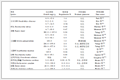
2 结果与讨论 2.1 室内微生物浓度特征及变化趋势 2.1.1 室内微生物浓度空间分布特征本研究于2024年1—4月在青岛三所高校开展了同步对比实验(见表 1),采样时段覆盖处于清洁状态和污染状态的天气,结果显示,三所高校室内TAMs浓度范围为1.17×10⁵~3.84×10⁵ cells/m3,室内VBs的浓度范围为2.98×103~5.95×103 cells/m3,NVBs的浓度范围为4.82×104~1.54×105 cells/m3。室内细菌存活率(Bacterial viability,BV)波动范围为2.57%~8.58%[35]。尽管三所高校生物微生物浓度有一定波动,但未呈现出显著差异(p>0.05),这可能是因为高校之间地理位置相近。
|
表 1 不同高校室内微生物浓度方差分析结果 Table 1 Results of variance analysis on indoor microbial concentrations across different universities |
以往,国内室内的微生物研究[36-38]主要聚焦于可培养细菌和真菌,为了解国内不同地区室内微生物的空间分布规律,本文将测定得到的总微生物浓度换算为可培养细菌和真菌浓度。调查显示,青岛空气中可培养细菌和真菌分别约占总微生物的0.49%和0.68%[39],利用此比例结合观测数据,估算出青岛高校室内细菌和真菌浓度分别为573和796 CFU/m3,处于国内室内可培养细菌和真菌的调查浓度范围(93~9 672 CFU/m3)。研究表明,中国五类气候区室内微生物浓度存在明显空间差异(见表 2)[36],严寒区冬季细菌浓度明显高于夏热冬寒地区,如哈尔滨的细菌浓度(550 CFU/m3)高于同一时期南京的细菌浓度(191 CFU/m3),而夏热冬暖区真菌浓度较高,其中台湾冬季达9 730 CFU/m3。南、北方城市在细菌和真菌浓度上呈现不同特征[37],北方冬季细菌浓度普遍高于南方,如2018年北京冬季细菌浓度为788 CFU/m3,哈尔滨细菌浓度为550 CFU/m3,均高于南京的细菌浓度(191 CFU/m3)[39],这可能与冬季室内供暖有关;而南方真菌浓度显著高于北方,如深圳真菌浓度为(1 714±908) CFU/m3、台湾的真菌浓度为4 380.86 CFU/m3,均高于北京的真菌浓度(104±68) CFU/m3[37-38],这可能与南方湿热气候相关。
|
|
表 2 全国不同地区不同年份不同季节室内真菌/细菌浓度 Table 2 Indoor fungal/bacterial concentrations across different regions, years, and seasons in China |
室内微生物浓度的变化不仅与地域气候有关,还可能受到室内环境参数、人类活动和建筑材料等多种因素共同调控。为进一步探究室内微生物浓度的影响因素,本研究以OUC为独立观测点,调查春、冬季室内微生物浓度分布的影响因素。
2.1.2 室内微生物浓度及其环境因子的变化趋势以OUC作为独立观测点,在其办公室和实验室各采集27个日期的空气中微生物样本(见图 2),结果显示,VBs浓度介于0.10×10⁴~1.97×10⁴ cells/m3,NVBs和TAMs的浓度分别介于3.11×104~12.63×104和1.09×105~9.42×105 cells/m3。初步分析表明,TAMs同PM2.5和PM10均呈同步波动趋势,且高湿度时段细菌存活率有所提升。办公室与实验室因环境条件差异呈现不同的微生物浓度特征,颗粒物与微生物的潜在关联性需进一步验证。

|
(OF: 办公室Office; LA: 实验室Laboratory.) 图 2 室内空气中微生物浓度分布及环境因素变化趋势 Fig. 2 Distribution of indoor bioaerosol concentrations and trends of environmental factors |
Pearson相关性分析显示(见图 3),TAMs浓度与RH显著正相关(r=0.55, p < 0.01),这与湿润环境促进微生物存活的研究结论一致[59-60],但温度影响未达显著性(r=0.13, p=0.347),此结果同Ayesha等[61]和Quintero等[62]的报道存在差异,这可能与区域气候及微生物种群特异性有关。

|
(RH和TSP分别为相对湿度和总悬浮颗粒物。RH and TSP are relative humidity and total suspended particulate matter respectively.) 图 3 室内TAMs浓度与各环境要素之间的Pearson相关性分析 Fig. 3 Pearson correlation analysis between indoor TAMs concentration and environmental factors |
TAMs浓度与人口密度无显著相关性(r=0.18, p=0.19),由于实验条件限制,本研究未直接测量空气交换率,但通过文献对比发现,通风良好的环境中人口密度影响较弱[59],但Madureira等[63]在住宅环境中的发现与此存在差异。同时,TAMs同PM1.0、PM10和TSP均无显著关联(p>0.05),这与地铁站环境中的研究[64]相一致,但Liu等[65]报道,家庭环境中PM2.5和PM10均与真菌浓度正相关。这些矛盾表明,室内空气中微生物浓度受多因子协同调控,单一环境参数的影响可能被其他因素(如通风条件、颗粒物沉降、空间类型等)所掩盖[66]。RH虽与TAMs显著相关,但其效应可能随环境条件改变而波动,需进一步关注变量间的交互作用。
2.2 不同预测模型的构建和分析本文以不同粒径颗粒物、温度、相对湿度和人口密度为自变量建立多元线性框架,通过MLR、Ridge及Poisson回归模型解析其与空气中微生物浓度的剂量-响应关系,重点评估各影响要素的交互效应。
2.2.1 MLRMLR结果表明,对单个因素进行F检验时,模型没有通过F检验,这意味着分别对不同粒径的颗粒物、温度、RH和人口密度同室内空气中微生物浓度进行线性回归分析并不可行。因此,将PM1.0、PM2.5、PM10、TSP、温度、RH和人口密度同时作为自变量,室内TAMs浓度作为因变量进行分析,结果如表 3所示。模型通过了F检验(F=8.513,p=0.000 < 0.05),这表明PM1.0、PM2.5、PM10、TSP、温度、RH和人口密度至少有一个会影响室内空气中微生物浓度。模型方程为
| $ \begin{gathered} U=159\ 175.615-671.676 \times P_{\mathrm{PM} 1.0}-1\ 382.323 \times \\ P_{\mathrm{PM} 2.5}+3\ 070.208 \times P_{\mathrm{PM} 10}-1\ 336.283 \times P_{\mathrm{TSP}}- \\ 1\ 129.817 \times P_{\mathrm{RH}}+1\ 989.836 \times P_{\text {温度 }}+ \\ 129\ 347.444 \times P_{\text {人口密度 }}。\end{gathered} $ | (6) |
|
|
表 3 多元线性回归分析结果(n=52) Table 3 Results of multiple linear regression analysis (n=52) |
式中:U为空气中的微生物浓度,cells/m3;159 175.615为校正常数;Pi为自变量参数(μg/m3),其中i∈{PM1.0,PM2.5,PM10,TSP,RH,温度,人口密度}。
模型的R2值为0.575,这表明PM1.0、PM2.5、PM10、TSP、温度、RH和人口密度可以解释室内空气中微生物浓度变化的57.5%。另外,PM10和RH会对室内空气中微生物浓度产生正向影响,而PM1.0、PM2.5、TSP、温度和人口密度对室内空气中微生物浓度的影响较弱。
2.2.2 Ridge回归Ridge回归通过引入L2正则化项,约束模型系数,减少了MLR中多重共线性对模型稳定性的干扰。结果表明,对单个因素进行F检验时,模型仍然未通过F检验,这表明单一变量与室内空气中微生物浓度进行Ridge回归分析不可行。将PM1.0、PM2.5、PM10、TSP、T、RH和人口密度同时作为自变量,室内TAMs浓度作为Ridge回归分析的因变量进行分析,结果如表 4所示。Ridge回归模型通过了F检验(F=7.663,p=0.000 < 0.05),这表明至少有一个自变量对空气中微生物浓度存在显著影响,表达式为
| $ \begin{gathered} U=154\ 485.274-991.632 \times P_{\mathrm{PM} 1.0}+49.173 \times \\ P_{\mathrm{PM} 2.5}+527.631 \times P_{\mathrm{PM} 10}+64.527 \times \\ P_{\mathrm{TSP}}-1\ 123.167 \times P_{\mathrm{RH}}+2\ 093.622 \times \\ P_{\text {温度 }}+169745.230 \times P_{\text {人口密度 }}。\end{gathered} $ | (7) |
|
|
表 4 Ridge回归分析结果(n=52) Table 4 Results of ridge regression analysis (n=52) |
式中:U为空气中的微生物浓度,cells/m3;Pi为自变量参数, μg/m3,其中i∈{PM1.0,PM2.5,PM10,TSP,RH,温度,人口密度}。
模型R2值为0.549,这表明上述变量可解释空气中微生物浓度变化的54.9%。另外,PM10和RH会对室内空气中微生物浓度产生正向影响,而温度和PM1.0对室内空气中微生物产生负向抑制作用,PM2.5、TSP和人口密度对室内空气中微生物浓度的影响较弱。
尽管Ridge回归有效解决了MLR中因多重共线性导致的系数不稳定问题,提升了PM1.0和PM10的显著性,但其线性假设仍限制了对TAMs浓度数据的适配性,需进一步采用其他回归优化分析。
2.2.3 Poisson回归Poisson回归结果显示,所有模型均能通过F检验,这意味着上述参数可分别对室内空气中微生物浓度进行Poisson回归分析,但解释度较差(R2均小于0.4)。因此将上述所有变量作为自变量构建Poisson回归模型,采用MLE检验模型的整体有效性。P值小于0.05,这意味着本次模型构建中输入的自变量有效,即模型构建是有意义的。结果如表 5所示。模型的R2为0.562,与MLR和Ridge的结果持平。
|
|
表 5 Poisson回归分析结果(n=52) Table 5 Results of Poisson regression analysis (n=52) |
空气中微生物浓度与自变量之间的MLR、Ridge和Poisson回归的R2统计如表 6所示。温度、PM10、人口密度等单一指标在MLR/Ridge模型中均未通过显著性检验(p>0.05),可解释性较低(R2 < 0.05),Poisson回归虽呈现统计学显著性(P=0.000),但R2仍低于0.03,证实单因素建模确有缺陷。PM10、RH、温度等多变量组合后,MLR与Ridge回归的可解释性显著提升(0.55<R2<0.57,P=0.000),其中PM10(β=3.521)和RH(β=0.489)为关键显著变量(见表 2和表 3)。Ridge回归通过正则化将PM10的VIF从541.7降至3.3,有效缓解共线性,但PM2.5/TSP仍无显著贡献。
|
|
表 6 MLR、Ridge和Poisson回归结果对比 Table 6 Comparison of MLR, Ridge, and Poisson regression results |
三类模型均验证PM10与微生物浓度存在稳定的相关性,与Aileen等[67]的研究一致。Ridge回归优化了变量的显著性(如PM1.0的p值从0.535降至0.001),但受限于线性假设,无法有效利用所有变量(如PM2.5和TSP仍不显著)。Poisson回归全变量显著(p=0.000),OR值呈现剂量-响应关系(如PM10的OR为1.008),适配TAMs数据特征,可解释性较高。
综合来看,Poisson回归模型解释性能最优。尽管机器学习机器算法已被广泛应用,相比之下,传统回归模型通过正则化或Possion分布假设可抑制噪声干扰,避免机器学习因过拟合导致泛化能力下降的问题。后续研究将探索深度学习模型在微生物气溶胶预测中的潜力。
2.3 影响要素分析及预测模型建立 2.3.1 可能影响机制Poisson回归模型(R2=0.562)表明,颗粒物、温度、RH及人口密度共同解释53.7%的空气中微生物浓度变化。其中,PM10、RH和人口密度均表现出显著的正向效应,而PM1.0、PM2.5、TSP和温度则表现为负向效应(见表 5)。粒径分析显示,颗粒物影响强度随粒径增大而增强,PM10因较大的比表面积和质量使得微生物更容易附着在PM10颗粒上[68],但超10 μm颗粒的影响呈减弱趋势[69]。这一粒径依赖效应表明,PM10可作为室内空气中微生物浓度的间接评估参数。
温度和RH均通过调节微生物水分平衡与沉降行为影响其存活和传播[70]。高温(>30 ℃)加速水分蒸发,导致细胞损伤,但部分细菌(如大肠杆菌)仍可长期存活,而蒙氏肠球菌等菌种在中温(20 ℃)时存活最久[20]。低温(10 ℃)虽减缓代谢,却可能引发冷损伤。RH方面,高湿环境(>60% RH)延长微生物存活时间,低湿(< 40% RH)促进脱水失活,并改变其在气溶胶中的附着特性[71]。此外,温、湿度交互作用进一步影响微生物的生存模式。低温高湿条件下微生物存活时间最长但繁殖受限[72],而高温低湿虽加速细胞失活,却增强空气传播距离[73]。因此,适当控制空气中的温、湿度有助于平衡微生物存亡并控制传播。
室内人口密度通过皮肤细胞脱落、颗粒扰动直接调控微生物浓度动态[74]。高人口密度环境中的行走、交谈、进食等活动不仅提升微生物排放量,更通过扰动沉积颗粒延长其空气悬浮时间[75]。研究表明,学校[76]、医院[19, 76]、餐厅[76]等高密度场所的细菌/真菌浓度较无人环境显著提高,且微生物组成和扩散模式也受之影响,加剧了病原体传播风险。持续监测显示,人类相关微生物随入住时长而不断积累,而增强通风可削减40%~60%的微生物载量[77]。因此,优化通风系统配合高频次表面清洁是控制高密度环境微生物污染的关键措施。
然而,由于实验条件的限制,本研究未能直接测量通风效率(如换气频率、CO2浓度),可能低估其对微生物浓度的调控作用,未来研究可增设CO2传感器实时监测换气效率,结合计算流体动力学(Computational fluid dynamics, CFD)模拟量化气流组织对微生物扩散的影响。
2.3.2 预测模型建立根据Poisson回归模型的结果,拟合出最终室内空气中微生物浓度方程式:
| $ \begin{gathered} \ln u_0=12.023-0.004 \times P_{\mathrm{PM}_{1.0}}+0.003 \times P_{\mathrm{PM}_{2.5}}+ \\ 0.008 \times P_{\mathrm{PM}_{10}}-0.003 \times P_{\mathrm{TSP}_2}-0.008 \times P_{\mathrm{RH}}+ \\ 0.010 \times P_{\text {温度 }}+0.657 \times P_{\text {人口密度 }}。\end{gathered} $ | (8) |
式中:u0为模型预测值;Pi为自变量参数(μg/m3),其中i∈{PM1.0,PM2.5,PM10,TSP,RH,温度,人口密度}。PM10、RH和人口密度会对室内空气中微生物浓度产生显著的正向影响,PM1.0、PM2.5、TSP、温度会对室内空气中微生物浓度产生显著的负向影响。将原始数据代入式(3)中验证,然后根据所得预测值与测量值的误差均值计算修正系数,修正后的办公楼室内空气中微生物浓度预测方程为式(6),其中修正系数F=1.063 69。
| $ u_1=u_0 \times F 。$ | (9) |
如图 4所示,修正后模拟数据(u1)的平均误差率为6.61%,绝对误差为4.80×10³ cells/m3,与实测值中位数接近,这表明预测结果总体可靠。然而,第51组数据(2024年3月17日获得)的绝对误差达1.36×105 cells/m3,显著偏离预测值,可能与未纳入模型的偶然因素(如突发性人为活动)有关。需指出,本研究未考虑定量CO2浓度、通风率的影响,这可能是存在部分预测偏差的原因。

|
图 4 Poisson回归模型预测后的修正值与实际测量值 Fig. 4 Comparison of actual measured values and adjusted predicted values from the Poisson regression model |
本研究测定了沿海城市高校室内生物气溶胶中TAMs、VBs和NVBs浓度。通过对比多元线性回归(MLR)、Ridge回归和Poisson回归模型发现,MLR受共线性干扰,Ridge回归受限于线性假设,而Poisson回归能更准确地解释和预测空气中微生物浓度。结果显示,温度、相对湿度(RH)、颗粒物浓度(尤其是PM10)及人类活动均对微生物浓度具有显著影响,其中颗粒物作为载体作用明显,PM10为主要影响因素。适宜的温、湿度条件有助于延长微生物的存活时间并提升其传播能力。室内人口密度通过增加微生物排放量和使颗粒再次悬浮可导致室内微生物浓度升高。
基于青岛高校场景,本研究构建了区域适应性预测模型,通过易监测的环境参数(颗粒物浓度、温度、RH和人口密度)实现生物气溶胶浓度的实时预测。该模型揭示了微生物浓度与室内环境参数的关联机制。但需注意,在气候条件显著差异地区(如南方高温高湿或东北极寒冷干燥环境), 需结合实地数据进行本地化校准,以确保跨区域适用性。
| [1] |
Branco P T B S, Alvim-Ferraz M C M, Martins F G, et al. Children's exposure to indoor air in urban nurseries-partⅠ: CO2 and comfort assessment[J]. Environmental Research, 2015, 140: 1-9. DOI:10.1016/j.envres.2015.03.007 (  0) 0) |
| [2] |
Yang J, Nam I, Yun H, et al. Characteristics of indoor air quality at urban elementary schools in Seoul, Korea: Assessment of effect of surrounding environments[J]. Atmospheric Pollution Research, 2015, 6(6): 1113-1122. DOI:10.1016/j.apr.2015.06.009 ( 0) |
| [3] |
Salthammer T, Uhde E, Schripp T, et al. Children's well-being at schools: Impact of climatic conditions and air pollution[J]. Environment International, 2016, 94: 196-210. DOI:10.1016/j.envint.2016.05.009 ( 0) |
| [4] |
Soleimani Z, Goudarzi G, Sorooshian A, et al. Impact of middle eastern dust storms on indoor and outdoor composition of bioaerosol[J]. Atmospheric Environment, 2016, 138: 135-143. DOI:10.1016/j.atmosenv.2016.05.023 ( 0) |
| [5] |
Douwes J. Bioaerosol Health effects and exposure assessment: Progress and prospects[J]. The Annals of Occupational Hygiene, 2003, 47(3): 187-200. ( 0) |
| [6] |
Pastuszka J S, Kyaw T H A, Paw U K T, et al. Bacterial and fungal aerosol in indoor environment in Upper Silesia, Poland[J]. Atmospheric Environment, 2000, 34(22): 3833-3842. DOI:10.1016/S1352-2310(99)00527-0 ( 0) |
| [7] |
Kim K, Kim H, Kim D, et al. Distribution characteristics of airborne bacteria and fungi in the feedstuff-manufacturing factories[J]. Journal of Hazardous Materials, 2009, 169(1-3): 1054-1060. DOI:10.1016/j.jhazmat.2009.04.059 ( 0) |
| [8] |
Awad A H, Saeed Y, Hassan Y, et al. Air microbial quality in certain public buildings, Egypt: A comparative study[J]. Atmospheric Pollution Research, 2018, 9(4): 617-626. DOI:10.1016/j.apr.2017.12.014 ( 0) |
| [9] |
Atarodi Z, Karimyan K, Gupta V K, et al. Evaluation of indoor air quality and its symptoms in office building—A case study of Mashhad, Iran[J]. Data in Brief, 2018, 20: 74-79. DOI:10.1016/j.dib.2018.07.051 ( 0) |
| [10] |
Bartlettkh K S B M. Evaluation and a predictive model of airborne fungal concentrations in school classrooms[J]. The Annals of Occupational Hygiene, 2004, 48(6): 547-554. ( 0) |
| [11] |
Chao H J, Schwartz J, Milton D K, et al. Populations and determinants of airborne fungi in large office buildings[J]. Environmental Health Perspectives, 2002, 110(8): 777-782. DOI:10.1289/ehp.02110777 ( 0) |
| [12] |
Yassin M F, Almouqatea S. Assessment of airborne bacteria and fungi in an indoor and outdoor environment[J]. International Journal of Environmental Science & Technology, 2010, 7(3): 535-544. ( 0) |
| [13] |
Salonen H, Duchaine C, Mazaheri M, et al. Airborne culturable fungi in naturally ventilated primary school environments in a subtropical climate[J]. Atmospheric Environment, 2015, 106: 412-418. DOI:10.1016/j.atmosenv.2014.07.052 ( 0) |
| [14] |
Crawford J A, Rosenbaum P F, Anagnost S E, et al. Indicators of airborne fungal concentrations in urban homes: Understanding the conditions that affect indoor fungal exposures[J]. Science of the Total Environment, 2015, 517: 113-124. DOI:10.1016/j.scitotenv.2015.02.060 ( 0) |
| [15] |
Haas D, Habib J, Luxner J, et al. Comparison of background levels of culturable fungal spore concentrations in indoor and outdoor air in southeastern Austria[J]. Atmospheric Environment, 2014, 98: 640-647. DOI:10.1016/j.atmosenv.2014.09.039 ( 0) |
| [16] |
Chao H J, Schwartz J, Milton D K, et al. Populations and determinants of airborne fungi in large office buildings[J]. Environmental Health Perspectives, 2002, 110(8): 777-782. DOI:10.1289/ehp.02110777 ( 0) |
| [17] |
Aganovic A, Bi Y, Cao G, et al. Estimating the impact of indoor relative humidity on SARS-CoV-2 airborne transmission risk using a new modification of the Wells-Riley model[J]. Building and Environment, 2021, 205: 108278. DOI:10.1016/j.buildenv.2021.108278 ( 0) |
| [18] |
Lin K, Marr L C. Humidity-dependent decay of viruses, but not bacteria, in aerosols and droplets follows disinfection kinetics[J]. Environmental Science & Technology, 2020, 54(2): 1024-1032. ( 0) |
| [19] |
Pertegal V, Lacasa E, Canizares P, et al. Understanding the influence of the bioaerosol source on the distribution of airborne bacteria in hospital indoor air[J]. Environmental Research, 2023, 216(1): 114458. ( 0) |
| [20] |
Park H J, Lee S, Oh J S, et al. The effects of indoor temperature and humidity on local transmission of COVID-19 and how it relates to global trends[J]. PLoS One, 2022, 17(8): e271760. ( 0) |
| [21] |
Raines K S, Doniach S, Bhano G. The transmission of SARS-CoV-2 is likely comodulated by temperature and by relative humidity[J]. PLoS One, 2021, 16(7): e255212. ( 0) |
| [22] |
Rodriguez D, Urbieta I R, Velasco Á, et al. Assessment of indoor air quality and risk of COVID-19 infection in Spanish secondary school and university classrooms[J]. Building and Environment, 2022, 226: 109717. DOI:10.1016/j.buildenv.2022.109717 ( 0) |
| [23] |
Hospodsky D, Qian J, Nazaroff W W, et al. Human occupancy as a Source of Indoor airborne bacteria[J]. PLoS One, 2012, 7(4): e34867. DOI:10.1371/journal.pone.0034867 ( 0) |
| [24] |
Heo K J, Lim C E, Kim H B, et al. Effects of human activities on concentrations of culturable bioaerosols in indoor air environments[J]. Journal of Aerosol Science, 2017, 104: 58-65. DOI:10.1016/j.jaerosci.2016.11.008 ( 0) |
| [25] |
Zhao C, Chen C, Miao D, et al. Seasonal concentrations and size distributions of culturable bacterial aerosols inside and outside university classrooms——A case study in Beijing[J]. Atmospheric Environment, 2022, 270: 118865. DOI:10.1016/j.atmosenv.2021.118865 ( 0) |
| [26] |
Dudquenne P. On the identification of culturable microorganisms for the assessment of biodiversity in bioaerosols[J]. Annals of Work Exposures and Health, 2018, 62(2): 139-146. DOI:10.1093/annweh/wxx096 ( 0) |
| [27] |
Schaefer J, Weiss S, Jackel U. Preliminary validation of a method combining cultivation and cloning-based approaches to monitor airborne bacteria[J]. Annals of Work Exposures and Health, 2017, 61(6): 633-642. DOI:10.1093/annweh/wxx038 ( 0) |
| [28] |
Ribeiro B V, Cordeiro T A R, Oliveira E, et al. Biosensors for the detection of respiratory viruses: A review[J]. Talanta Open, 2020, 2: 100007. DOI:10.1016/j.talo.2020.100007 ( 0) |
| [29] |
Saad Baqer N, Mohammed H A, Albahri S, et al. Development of the internet of things sensory technology for ensuring proper indoor air quality in hospital facilities: Taxonomy analysis, challenges, motivations, open issues and recommended solution[J]. Measurement, 2022, 192: 110920. DOI:10.1016/j.measurement.2022.110920 ( 0) |
| [30] |
Wang J, Du W, Lei Y, et al. Quantifying the dynamic characteristics of indoor air pollution using real-time sensors: Current status and future implication[J]. Environment International, 2023, 175: 107934. DOI:10.1016/j.envint.2023.107934 ( 0) |
| [31] |
Seo J H, Jeon H W, Choi J S, et al. Prediction model for airborne microorganisms using particle number concentration as surrogate markers in hospital environment[J]. International Journal of Environmental Research and Public Health, 2020, 17(19): 7237. DOI:10.3390/ijerph17197237 ( 0) |
| [32] |
Nitish Sardana S S E M. Chapter 6-Qualitative and quantitative research methods[M]. New York: Substance Use and Addiction Research, New York: Academic Press, 2023: 65-69.
( 0) |
| [33] |
Tseng C, Wang H, Xiao N, et al. Examining the feasibility of prediction models by monitoring data and management data for bioaerosols inside office buildings[J]. Building and Environment, 2011, 46(12): 2578-2589. DOI:10.1016/j.buildenv.2011.06.016 ( 0) |
| [34] |
Wu L Q J. Chapter 8 linear and nonlinear regression models, applied multivariate statistical analysis and related topics with R[M]//Zelterman D. Applied Multivariate Statistical Analysis and Related Topics with R. Les Ulis: EDP Sciences, 2021: 111-130.
( 0) |
| [35] |
Ru Zhao L G J Q. Indoor and outdoor bioaerosol distributions and concentration profiles during different seasons and pollution events in Qingdao city[J]. Building and Environment, 2025, 279: 113056. DOI:10.1016/j.buildenv.2025.113056 ( 0) |
| [36] |
Wang S, Qian H, Sun Z, et al. Comparison of airborne bacteria and fungi in different built environments in selected cities in five climate zones of China[J]. Science of the Total Environment, 2023, 860: 160445. DOI:10.1016/j.scitotenv.2022.160445 ( 0) |
| [37] |
Guo K, Qian H, Zhao D, et al. Indoor exposure levels of bacteria and fungi in residences, schools, and offices in China: A systematic review[J]. Indoor Air, 2020, 30(6): 1147-1165. DOI:10.1111/ina.12734 ( 0) |
| [38] |
Su H J, Wu P, Lin C. Fungal exposure of children at homes and schools: A health perspective[J]. Archives of Environmental Health: An International Journal, 2001, 56(2): 144-149. DOI:10.1080/00039890109604066 ( 0) |
| [39] |
Li M, Qi J, Zhang H, et al. Concentration and size distribution of bioaerosols in an outdoor environment in the Qingdao coastal region[J]. Science of the Total Environment, 2011, 409(19): 3812-3819. DOI:10.1016/j.scitotenv.2011.06.001 ( 0) |
| [40] |
Zhao A L, Gao Y M, Wu S, et al. Indoor air microbial pollution in classrooms and dormitories in a university in China[J]. Journal of Environmental Health, 2009, 6(26): 512-513. ( 0) |
| [41] |
王智. 不同功能建筑室内微生物浓度水平及相关参数影响研究[D]. 北京: 北京建筑大学, 2019. Zhi W, Study on the Influence of Indoor Vicrobial Concentration Level and Related Parameters in Different Functional Buildings[D]. Beijing: Beijing University of Civil Engineering and Architecture, 2019. ( 0) |
| [42] |
Fan G, Xie J, Liu J, et al. Investigation of indoor environmental quality in urban dwellings with schoolchildren in Beijing, China[J]. Indoor and Built Environment, 2017, 26(5): 694-716. DOI:10.1177/1420326X16636184 ( 0) |
| [43] |
Lv Y, Wang Z, Zhao T, et al. Indoor environment in children's dwellings in Dalian and Beijing, China[J]. Science and Technology for the Built Environment, 2019, 25(4): 373-386. DOI:10.1080/23744731.2018.1533337 ( 0) |
| [44] |
Fan G, Xie J, Yoshino H, et al. Investigation of fungal contamination in urban houses with children in six major Chinese cities: Genus and concentration characteristics[J]. Building and Environment, 2021, 205: 108229. DOI:10.1016/j.buildenv.2021.108229 ( 0) |
| [45] |
陈新宇, 毕新慧, 盛国英, 等. 广州市秋季室内外大气中细菌气溶胶粒径分布特征[J]. 中国热带医学, 2008, 8(2): 201-203. Chen X Y, Bi X H, Sheng G Y, et al. Bacterium aerosol grain-size distribution characteristics indoor and outdoor Guangzhou ordinary residential district room[J]. China Tropical Medicine, 2008, 8(2): 201-203. ( 0) |
| [46] |
Chen Y, Liang Z, Li G, et al. Indoor/Outdoor airborne microbiome characteristics in residential areas across four seasons and its indoor purification[J]. Environment International, 2024, 190: 108857. DOI:10.1016/j.envint.2024.108857 ( 0) |
| [47] |
陈新宇, 徐巧兰, 李名钊, 等. 撞击法和自然沉降法监测室内空气细菌总数捕获效果的研究[J]. 热带医学杂志, 2007, 7(3): 282-284. Chen X Y, Xu Q L, Li M Z, et al. Study of natural precipitation method and impacting method for measurement of bacterial count in air[J]. Journal of Tropical Medicine, 2007, 7(3): 282-284. ( 0) |
| [48] |
Wu P C, Li Y Y, Chiang C M, et al. Changing microbial concentrations are associated with ventilation performance in Taiwan's air-conditioned office buildings[J]. Indoor Air, 2005, 15(1): 19-26. DOI:10.1111/j.1600-0668.2004.00313.x ( 0) |
| [49] |
Su H J, Wu P C, Chien H P. Levels of indoor airborne microbes associated with ventilation efficiency in naturally-ventilated residences[J]. International Journal of Ventilation, 2016, 5(3): 313-321. ( 0) |
| [50] |
Su H J, Wu P, Lin C. Fungal exposure of children at homes and schools: A health perspective[J]. Archives of Environmental Health: An International Journal, 2001, 56(2): 144-149. DOI:10.1080/00039890109604066 ( 0) |
| [51] |
王兰萍. 校园空气微生物污染的监测与分析[J]. 中国卫生检验杂志, 2015, 15(11): 1354-1355. Wang L P. Monitoring and analysis of microbial pollution in campus air[J]. Chinese Journal of Health Inspection, 2015, 15(11): 1354-1355. ( 0) |
| [52] |
Wang X, Huang C, Liu W, et al. On-site measurement of airborne fungi in Shanghai residences[J]. Procedia Engineering, 2015, 121: 404-409. DOI:10.1016/j.proeng.2015.08.1085 ( 0) |
| [53] |
Guo K, Qian H, Ye J, et al. Assessment of airborne bacteria and fungi in different-type buildings in Nanjing, a hot summer and cold winter moist Chinese city[J]. Building and Environment, 2021, 205: 108258. DOI:10.1016/j.buildenv.2021.108258 ( 0) |
| [54] |
郝翠梅. 杭州市居家空气可培养微生物特征研究[D]. 杭州: 浙江工商大学, 2015. Hao C M. Characteristics of Culturable Airborne Microbes in Indoor Environments in Hangzhou[D]. Hangzhou: Zhejiang Gongshang University, 2015. ( 0) |
| [55] |
蔡增林, 胡庆轩. 室内空气中微生物粒子沉降量与其浓度的关系[J]. 中国消毒学杂志, 1996, 13(3): 151-155. Cai Z, Hu Z X. Relationship between sedimentation amount and concentration of microorganism particles in air[J]. Chinese Journal of Disinfection, 1996, 13(3): 151-155. ( 0) |
| [56] |
胡庆轩, 鹿建春, 刘敏霞, 等. 沈阳市某办公室内空气细菌粒子的研究[J]. 环保科技, 1994(2): 1-5. Hu Q X, Lu J C, Liu M X, et al. Study on airborne bacterial particles in office environments in Shenyang city[J]. Environmental Protection Technology, 1994(2): 1-5. ( 0) |
| [57] |
喻道军, 叶丽杰, 程明, 等. 校园空气微生物浓度的监测与分析[J]. 微生物学杂志, 2011, 31(2): 102-105. Yu D J, Ye L J, Cheng M, et al. Monitoring and analysis of microbial concentration in campus air[J]. Microbiology Journal, 2011, 31(2): 102-105. ( 0) |
| [58] |
刘玉琦, 王连生. 哈尔滨铁路局锅炉烟气治理对策思考[J]. 哈尔滨铁道科技, 1999(4): 17-20. Liu Y Q, Wang L S. Research on governance strategies for boiler flue gas in Harbin railway bureau[J]. Harbin Railway Science and Technology, 1999(4): 17-20. ( 0) |
| [59] |
Abdel Hameed A A, Khoder M I, Ibrahim Y H, et al. Study on some factors affecting survivability of airborne fungi[J]. Science of the Total Environment, 2012, 414: 696-700. DOI:10.1016/j.scitotenv.2011.10.042 ( 0) |
| [60] |
Wu D, Zhang Y, Qin W, et al. Assessment of seasonal variations in concentration, particle-size distribution, and taxonomic composition of airborne fungi in a courtyard space[J]. Atmospheric Pollution Research, 2021, 12(2): 113-121. DOI:10.1016/j.apr.2020.10.014 ( 0) |
| [61] |
Asif A, Zeeshan M, Hashmi I, et al. Microbial quality assessment of indoor air in a large hospital building during winter and spring seasons[J]. Building and Environment, 2018, 135: 68-73. DOI:10.1016/j.buildenv.2018.03.010 ( 0) |
| [62] |
Quintero E, Rivera-Marian F, Bolanos-Rosero B. Analysis of environmental factors and their effects on fungal spores in the atmosphere of a tropical urban area (San Juan, Puerto Rico)[J]. Aerobiologia, 2010, 26(2): 113-124. DOI:10.1007/s10453-009-9148-0 ( 0) |
| [63] |
Madureira J, Paciencia I, Rufo J C, et al. Assessment and determinants of airborne bacterial and fungal concentrations in different indoor environments: Homes, child day-care centres, primary schools and elderly care centres[J]. Atmospheric Environment, 2015, 109: 139-146. DOI:10.1016/j.atmosenv.2015.03.026 ( 0) |
| [64] |
Sousa S I V, Martins F G, Pereira M C, et al. Influence of atmospheric ozone, PM10 and meteorological factors on the concentration of airborne pollen and fungal spores[J]. Atmospheric Environment, 2008, 42(32): 7452-7464. DOI:10.1016/j.atmosenv.2008.06.004 ( 0) |
| [65] |
Liu Z, Li A, Hu Z, et al. Study on the potential relationships between indoor culturable fungi, particle load and children respiratory health in Xi'an, China[J]. Building and Environment, 2014, 80: 105-114. DOI:10.1016/j.buildenv.2014.05.029 ( 0) |
| [66] |
Zhai Y, Li X, Wang T, et al. A review on airborne microorganisms in particulate matters: Composition, characteristics and influence factors[J]. Environment International, 2018, 113: 74-90. DOI:10.1016/j.envint.2018.01.007 ( 0) |
| [67] |
Baird A B, Bannister E J, Mackenzie A R, et al. Mass concentration measurements of autumn bioaerosol using low-cost sensors in a mature temperate woodland free-air carbon dioxide enrichment (FACE) experiment: Investigating the role of meteorology and carbon dioxide levels[J]. Biogeosciences, 2022, 19(10): 2653-2669. DOI:10.5194/bg-19-2653-2022 ( 0) |
| [68] |
Zhao C, Chen C, Miao D D, et al. Sources and influence factors of bacterial aerosol in university classrooms[J]. Building Science, 2020(10): 20-26. ( 0) |
| [69] |
Huang H, Lee M, Shih H. Assessment of indoor bioaerosols in public spaces by real-time measured airborne particles[J]. Aerosol and Air Quality Research, 2017, 17(9): 2276-2288. DOI:10.4209/aaqr.2017.02.0089 ( 0) |
| [70] |
Hoeksma P, Aarnink A, Ogink N. Effect of temperature and relative humidity on the survival of airborne bacteria[R]. Wageningen: Wageningen University & Research Livestock Research, 2015.
( 0) |
| [71] |
Kokubo M, Fujiyoshi S, Ogura D, et al. Relationship between the microbiome and indoor temperature/humidity in a traditional Japanese house with a thatched roof in Kyoto, Japan[J]. Diversity, 2021, 13(10): 475. DOI:10.3390/d13100475 ( 0) |
| [72] |
Bertolini V, Gandolfi I, Ambrosini R, et al. Temporal variability and effect of environmental variables on airborne bacterial communities in an urban area of Northern Italy[J]. Applied microbiology and Biotechnology, 2013, 97(14): 6561-6570. DOI:10.1007/s00253-012-4450-0 ( 0) |
| [73] |
Rai S, Singh D K, Kumar A. Microbial, environmental and anthropogenic factors influencing the indoor microbiome of the built environment[J]. Journal of Basic Microbiology, 2021, 61(4): 267-292. DOI:10.1002/jobm.202000575 ( 0) |
| [74] |
Adams R I, Bhangar S, Pasut W, et al. Chamber bioaerosol study: Outdoor air and human occupants as sources of indoor airborne microbes[J]. PLoS One, 2015, 10(5): e128022. ( 0) |
| [75] |
Licina D, Boor B E. Size-resolved inhalation intake fractions for particles released from human activities in residential indoor environments[J]. Building and Environment, 2023, 244: 110763. DOI:10.1016/j.buildenv.2023.110763 ( 0) |
| [76] |
Nath A, Baruah N, Nonglait M L, et al. Biological contaminants in indoor environments of educational institutions[J]. Aerobiologia, 2023, 39(1): 1-20. DOI:10.1007/s10453-022-09771-6 ( 0) |
| [77] |
Adams R I, Bateman A C, Bik H M, et al. Microbiota of the indoor environment: A meta-analysis[J]. Microbiome, 2015, 3(1): 49. DOI:10.1186/s40168-015-0108-3 ( 0) |
2. College of Environmental Science and Engineering, Ocean University of China, Qingdao 266100, China;
3. Qingdao Junray Intelligent Instrument Limited Company, Qingdao 266108, China