 2025, Vol. 55


在全球变暖的背景下,极端高温事件发生频率显著增加,强度明显增强,持续时间更长,严重影响到人们的社会生活和身心健康,成为气象灾害研究的热点[1-8]。2003年夏季,西欧地中海沿岸地区最高气温打破自上世纪40年代以来的历史同期记录[9],中国江南、华南地区也出现大规模异常高温天气[10]; 2013年夏季中国东部热浪天气频发,长江流域平均热浪日数达到历史最高值,达31 d,其持续时间之长、影响范围之大均为历史所罕见[11]; 2018年夏季,在异常西伸北抬的西太平洋副热带高压(简称:西太副高)影响下,华北及周边区域气温异常达到1961—2018年气温异常的两倍标准差以上[3]; 2022年6、7月,华南地区经历一次强而持续的高温热浪事件,部分区域高温日超过40 d,在华南地区引起了大范围的干旱,对华南地区人民生产、生活产生了巨大的影响[12]。
热浪发生区域上空的异常高压是引发热浪事件的主要原因之一。异常高压控制的区域会产生明显的下沉气流引起绝热压缩增温,不利于云的形成,到达地面的太阳短波辐射增多,多种因素共同作用导致地面气温升高[13-15]。南亚高压以及西太副高的强度及位置变化对初夏中国南方地区的高温事件有较大影响[4,16],北方地区主要受西风带上的长波槽脊影响[17-18],但盛夏时节西太副高北抬时也可以对北方地区的高温热浪事件起主导作用[3]。欧亚大陆上空的波列也与中国华北地区气温相关,环球遥相关在东欧与中国华北地区上空的同向变化的作用中心可导致东欧与中国华北地区夏季温度呈现同位相变化[14]; 东亚-太平洋型遥相关在盛夏时可促使西太副高北抬,进而导致华北地区的气温异常[20]; 北大西洋-欧亚遥相关是发源于大西洋沿欧亚大陆中高纬度传播的波列,其在华北上空的作用中心可对华北地区的气温变化产生影响[21]。因此,在对华北地区的气温异常进行研究时,需要分析激发这些远距离传播波列的因素。
2023年6月,华北地区124个国家气象站记录日最高气温超过40 ℃。北京南郊天文台首次连续3 d记录到气温超过40 ℃,为北京地区有观测记录以来的第一次气温连续3 d超过40 ℃,其强度之强,范围之大,对华北地区水电能源调控、户外作业等社会生产活动造成了严重的影响[8,22]。本文对此期间发生热浪事件的发生发展机制进行研究,加深对我国华北地区热浪事件的认识,为未来极端热浪事件的预测提供参考。
1 资料和方法 1.1 资料本文使用的资料有:(1)美国环境预测中心/国家大气研究中心(National Centers for Environmental Prediction/National Center for Atmospheric Research,NCEP/NCAR) 提供的逐日再分析资料[23],包括各等压面上的位势高度、水平风(u、v)和垂直速度(ω),水平分辨率为2.5°×2.5°; (2)欧洲中期预报中心的ERA5-LAND产品的降水资料[24],水平分辨率0.25°×0.25°; (3)美国国家气候预测中心(Climate Prediction Center,CPC)提供的日最高气温(Tmax)资料,水平分辨率为0.5°×0.5°。本研究选取1991—2020年的平均值作为气候态。
1.2 方法介绍本文采用相对阈值法对热浪事件的发生进行判断,当Tmax连续3 d超过1979—2023年夏季日最高气温的90%温度值[22]时,判定华北地区发生一次热浪事件。
为了确定各种物理过程对热浪事件的贡献,使用温度倾向方程进行定量计算,温度倾向方程的异常形式如下:
| $ \left(\frac{\partial T}{\partial t}\right)^{\prime}=-(V \times \nabla T)^{\prime}+\left(\omega S_{\mathrm{p}}\right)^{\prime}+Q^{\prime} 。$ | (1) |
式中:
为了研究欧亚大陆上空Rossby波能量的传播情况,使用Takaya和Nakamura[25]定义的波活动通量(WAF)进行计算,表达式为
| $ W=\frac{p \cos \varphi}{2|U|} \cdot\left(\begin{array}{l} \frac{U}{a^2 \cos 2}\left[\left(\frac{\partial \psi^{\prime}}{\partial \lambda}\right)^2-\psi^{\prime} \frac{\partial^2 \psi^{\prime}}{\partial \lambda^2}\right]+ \\ \frac{V}{a^2 \cos \varphi}\left[\frac{\partial \psi^{\prime}}{\partial \lambda} \frac{\partial \psi^{\prime}}{\partial \varphi}-\psi^{\prime} \frac{\partial^2 \psi^{\prime}}{\partial \lambda \partial \varphi}\right] \\ \frac{U}{a^2 \cos \varphi}\left[\frac{\partial \psi^{\prime}}{\partial \lambda} \frac{\partial \psi^{\prime}}{\partial \varphi}-\psi^{\prime} \frac{\partial^2 \psi^{\prime}}{\partial \lambda \partial \varphi}\right]+ \\ \frac{V}{a^2}\left[\left(\frac{\partial \psi^{\prime}}{\partial \varphi}\right)^2-\psi^{\prime} \frac{\partial^2 \psi^{\prime}}{\partial \varphi^2}\right] \end{array}\right) 。$ | (2) |
式中:U=(U,V)为基本气流速度; a为地球半径; φ和λ分别代表纬度和经度; p为等压面气压数值与1 000 hPa的比值; ψ代表地转流函数; ′代表物理量相对于气候态的异常。由于本文研究的是6月的热浪事件,因此将6月的气候平均值定义为基本气流。
为了解大气中罗斯贝波的起源,本文还计算了线性化的罗斯贝波源[26],表达式为
| $ S^{\prime}=-\nabla_{\mathrm{H}} \cdot\left\{\boldsymbol{u}_\chi^{\prime}(f+\zeta)\right\}-\nabla_{\mathrm{H}} \cdot\left\{\boldsymbol{u}_\chi^{\prime} \zeta^{\prime}\right\} 。$ | (3) |
式中:▽H为水平梯度算子; u=(u,v)代表水平风场; f和ζ分别代表地转涡度和相对涡度; χ代表辐散分量。
为了计算降水凝结潜热释放的异常热源分布,我们根据Yanni等[27]的公式计算了降水所释放的非绝热加热,表达式为
| $ q 1=\frac{\partial T}{\partial t}-(\omega \sigma-V \cdot \nabla T) 。$ | (4) |
式中:T,t和ω为气温、时间以及垂直速度;
本文利用线性斜压模式(linear baroclinic model,LBM)[28]模拟大气对降水释放的非绝热加热的线性响应。此模式是根据大气环流模式(atmospheric general circulation models, AGCMs)的动力学模型开发出的线性版本的干模式,基于基本状态线性化的原始方程,采用了三角形截断的谱展开方法。本文中使用的模型水平分辨率为T42(约为2.8°),垂直方向上有20个不均匀分布的σ层。LBM已被广泛用于模拟大气对理想非绝热加热的稳定线性响应[29-31],故本文选择使用LBM检验大气对给定加热的响应,该模式稳定运行了30 d,我们选择其中结果已经基本稳定的第15天进行分析。
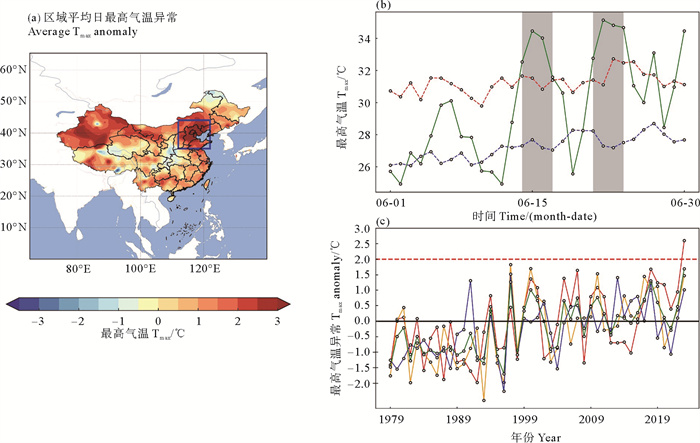
2 2023年6月华北高温热浪事件及大气环流概况 2.1 高温的时空分布特征2023年6月,中国北方大部分地区气温异常偏高,其中华北地区平均Tmax距平达到2.53 ℃,相较北方,南方地区的气温距平相对较小,陕西-湖北-重庆交界处、东北北部、青海及西藏南部存在一定范围的Tmax负距平区域(见图 1(a))。1979—2023年夏季三月平均Tmax距平还是6、7、8三月Tmax距平,华北地区的Tmax距平仅在2023年6月超过了2.0 ℃(见图 1(c))。根据对高温热浪事件的定义,华北地区在6月14—17日及21—24日发生过两次热浪事件(见图 1(b)),下文以热浪(Ⅰ)(Ⅱ)进行区分,其中6月15日出现热浪(Ⅰ)的Tmax距平最大值,6月22日出现热浪(Ⅱ)的Tmax距平最大值达到7.8 ℃,为45年来最高。2023年华北地区Tmax正距平的天数为22 d(见图 1(b)),但不是45年中Tmax正距平的最多天数,两次高温热浪事件对2023年6月异常高Tmax距平值的贡献比较大。
|
( (a)中蓝框区域为华北区域(112°E—122°E,35°N—44°N); (b)中蓝色虚线为气候态值,红色虚线为90%温度阈值,阴影为识别的热浪事件; (c)中红线表示6月,橙线为7月,蓝线为8月,绿线为夏季平均。The blue boxes in (a) represent the North China (112°E—122°E, 35°N—44°N); (b) The blue dashed line represents the climate state value, the red dashed line represents the 90% temperature threshold, and the shadow represents the identified heat wave event; (c) The red line is June, orange line is July, blue line is August, and green line is summer mean. ) 图 1 (a) 2023年6月平均日最高气温(Tmax)距平(单位:℃)、(b)2023年6月华北地区区域平均日最高气温序列、(c)1979—2023年6、7、8月华北平均Tmax异常 Fig. 1 (a) The average maximum temperature (Tmax) anomaly distribution in June, 2023 (unit: ℃), (b) the average Tmax time series in the North China in June 2023, (c) the average Tmax anomaly in North China from June, July, and August during 1979 to 2023 |
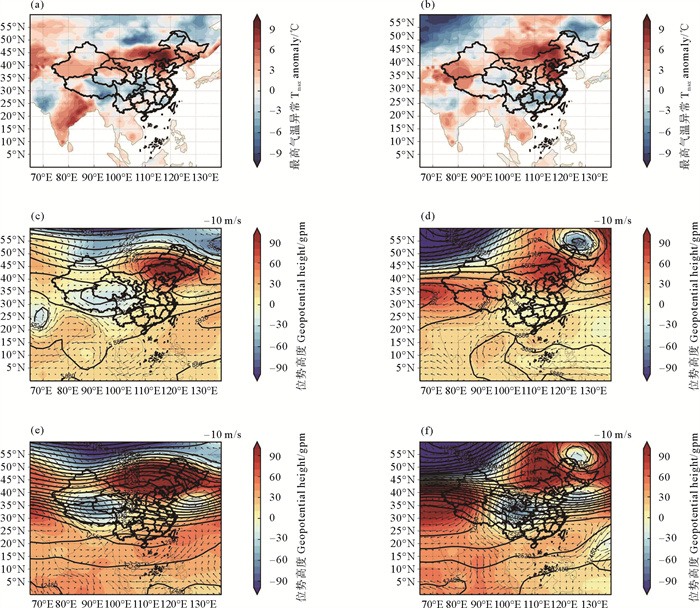
对热浪期间地面Tmax异常分布及其上空的主要天气系统进行分析,两次热浪过程中温度异常分布情况基本相同,中国北部普遍为温度正异常,南部负异常(见图 2(a)、2(b))。热浪(Ⅰ)的高温中心较为偏北,华北南部区域无显著高温(见图 2(a)); 热浪(Ⅱ)的高温中心较为分裂,华北尤其是京津冀地区为其中一个正中心,这可能是热浪(Ⅱ)温度异常达到最大值的原因之一(见图 2(b))。两次热浪过程对应的大气环流图上的局地环流较为相似,两次过程中华北均受高压异常的控制,华北地区北部上空存在一个高压脊。热浪(Ⅰ)的高压脊上游的低压槽比热浪(Ⅱ)更深; 热浪(Ⅱ)的高压脊南部存在一个明显的低槽(见图 2(c)、2(d))。在高压异常的南部,中国的西南部区域附近均存在一个低压异常中心,且热浪(Ⅱ)中高低压异常更强,位置更偏东。
|
( 图(a、c、e)为6月14—17日平均,(b、d、f)为6月21—24日平均。Fig.(a, c, e) denote June 14—17 mean, Fig.(b, d, f) denote June 21—24 mean. ) 图 2 平均日最高气温距平(a、b)、500 hPa(c、d)、200 hPa(e、f)位势高度和风场(矢量,单位:m/s)距平 Fig. 2 Average Tmax (a, b), 500 hPa (c, d)、200 hPa (e、f) potential height and wind field (vector, Unit: m/s) anomaly |
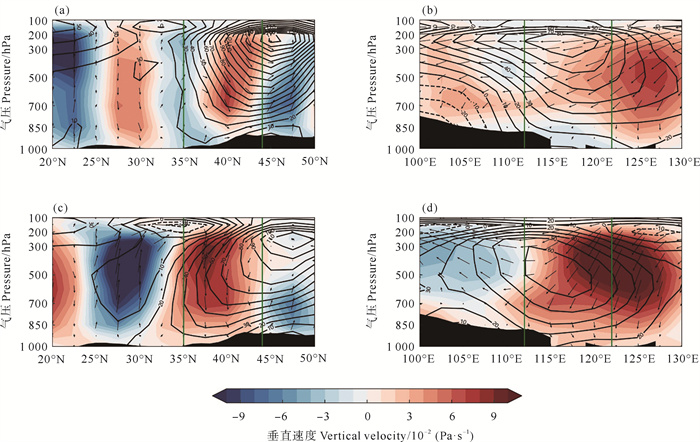
从热浪发生期间华北上空的垂直剖面图来看,控制华北地区的高压异常中心均偏北且位于200 hPa上空(见图 3(a)、3(c))。热浪(Ⅰ)中华北上空大气呈现正压结构,高压异常没有向低纬延伸的趋势,对华北地区对流层中低层的控制不强,由此造成高压控制下盛行的下沉气流在低层较弱,部分地区存在轻微上升气流(见图 3(b))。热浪(Ⅱ)中高压异常中心有明显的向低空、向南延伸的趋势。尽管位于华北北部的高压异常中心相比热浪(Ⅰ)的强度更弱,但热浪(Ⅱ)中华北地区低层高压异常更强,华北上空整层均为下沉气流(见图 3(c)、3(d))。同时热浪(Ⅱ)中位于高压异常南部的上层辐散、下层辐合的垂直上升气流与垂直下沉气流形成垂直环流(见图 3(c)),加强了华北区域上空的下沉气流,有利于高温的增强和维持,可能是热浪(Ⅱ)强于热浪(Ⅰ)的原因之一。
|
( (a、c)的经度平均范围为112°N—122°N,时间分别为2023年6月14—17日和21—24日; (b、d)的纬度平均范围为35°E—44°E,时间同(a)、(c); 绿色线条为华北所处的经纬度范围。(a), (c) The average range of longitude in height-latitude profiles is 112°N—122°N, and the times are June 14—17 and June 21—24, respectively; (b, d) The average range of latitude in height-longitude profiles is 35°E—44°E, with the same time as (a) and (c); green solid line indicating the latitude and longitude of North China. ) 图 3 平均的位势高度(等值线,单位:gpm)、风矢量(单位:m·s-1(水平),Pa·s-1(垂直))和垂直速度异常的高度-纬度剖面(a、c)和高度-经度剖面(b、d) Fig. 3 Anomalies of height-latitude profile of geopotential height (contour, unit: gpm), wind vector (unit: m·s-1 (horizontal), Pa·s-1 (vertical)) (a, c) and divergence and height-longitude profile (b, d) |
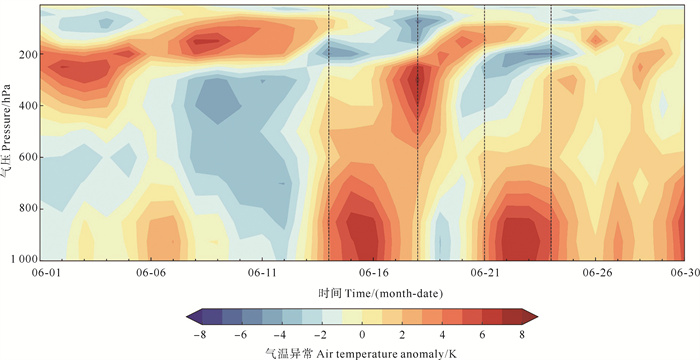
为进一步比较不同物理过程对华北地区2023年6月两次热浪事件的贡献,使用温度倾向方程对导致热浪过程的物理过程进行了定量计算。图 4为2023年6月华北区域气温异常的高度-时间演变序列,从6月的高低层气温异常演变来看,低层的气温异常变化较为一致,因此本节考虑在850 hPa等压面上进行分析。
|
( 黑色虚线表示已识别的热浪事件时间段。The black dashed line represents the time period of identified heat wave events. ) 图 4 2023年6月华北区域气温异常的高度-时间序列 Fig. 4 Time series of anomalous temperature of North China in June, 2023 |
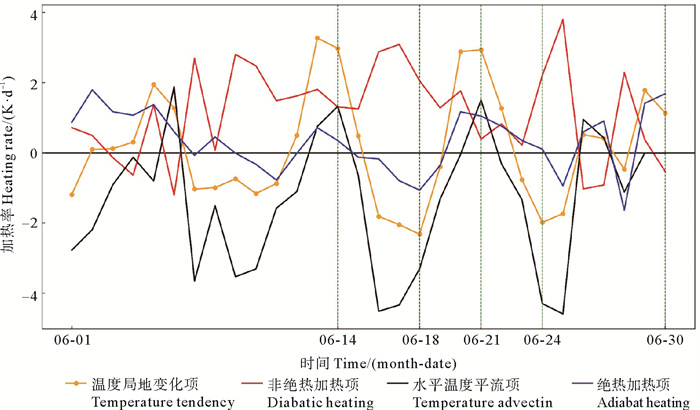
图 5给出2023年6月华北地区850 hPa的温度倾向方程中各项诊断量随时间的演变。图中可见华北地区局地温度升高主要发生在热浪事件发生前,两次热浪发生期间非绝热加热项一直维持着正值。热浪(Ⅰ)发生前,非绝热加热项对华北地区的升温起了主要作用。热浪期间非绝热加热项维持正值,而绝热加热与水平温度平流项在6月15日由正转负,并因此导致温度局地变化出现负值,非绝热加热项部分抵消了降温作用,直到6月17日热浪事件结束。热浪(Ⅱ)发生前非绝热加热项维持正值,随着水平平流项和绝热加热项在6月20日开始相继由负转正,温度局地变化呈现持续的升温趋势。6月21日,热浪(Ⅱ)发生。在此后几天的热浪过程中,非绝热加热项仅在21日当天低于绝热加热项及水平平流项。21日后,水平平流项在热浪期间由正转负,绝热加热项一直维持正值但逐渐减小,非绝热加热与绝热加热抵消了部分冷平流的作用,使得热浪事件维持数天。
|
图 5 2023年6月华北区域平均的850 hPa温度倾向方程各项诊断量的演变 Fig. 5 Evolution of diagnostic variables in the 850 hPa average temperature tendency equation of North China in June, 2023 |
可以看出,在两次热浪过程中,非绝热加热项均对升温起主要贡献。根据方程(1)绝热加热项为ωSp,其中静力稳定度Sp的量级要小于ω,因此该项主要由ω主导。热浪(Ⅱ)中华北上空为整层垂直下沉运动且稳定维持,ω为正,而热浪(Ⅰ)中华北低层为上升运动,ω为负,在热浪发生期,(Ⅰ)的绝热加热项为明显的负值,因此绝热加热项在热浪(Ⅱ)过程中起到的升温贡献比热浪(Ⅰ)中大。水平平流项则在降温方面起主要作用。
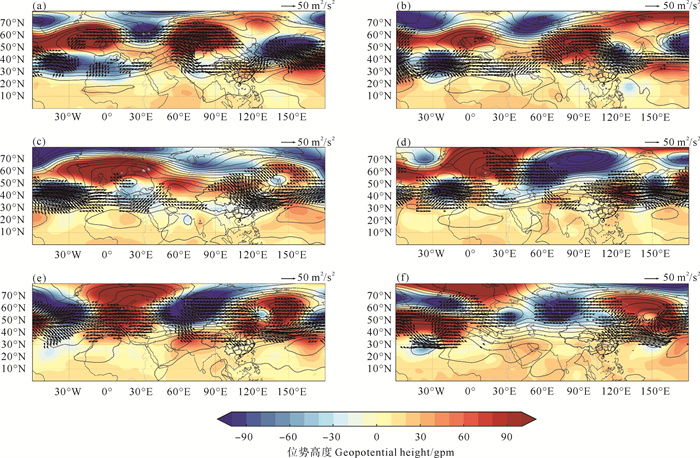
3 2023年6月华北热浪事件主导天气系统的发生维持机制 3.1 6月欧亚大陆大气环流的演变为探究2023年6月华北地区热浪事件与欧亚大陆上空波列的关系,对欧亚大陆上空的大气环流进行了分析。6月初,在乌拉尔山地区有一个强度极大的高压脊,受到自北欧上空东传的波作用通量的影响(见图 6(a)),在热浪(Ⅰ)发生前东移至中国北部区域,此时副热带区域存在明显的连续的波作用通量(见图 6(b))。随后该高压脊分为南北两部分,其中北支继续东移至鄂霍次克海区域,南支则在中国北方维持,即将控制中国华北地区造成了热浪(Ⅰ)。此时,造成热浪(Ⅱ)的高压脊也恰好东移到里海东部,副热带有明显的波作用通量由大西洋向里海传播(见图 6(c))。热浪(Ⅰ)结束后,北欧出现一支波列向东传播,受波作用通量的影响,西伯利亚低压强度增大,造成中纬度西风带较为平浅的环流形势(见图 6(d)),有利于华北地区长时间的高温天气形式。6月21日前后,西伯利亚低压减弱,华北地区上空的浅脊受上游波作用通量的影响加强维持,导致了热浪(Ⅱ)(见图 6(e))。6月末热浪事件结束,西伯利亚低压中心逐渐减弱为低压槽(见图 6(f))。从两次热浪过程中的异常环流场来看,欧洲中部及中国北部区域存在异常高压,在西伯利亚北部及里海西部存在异常低压,欧亚大陆上空出现了特殊的波列结构,表明这可能有利于中国华北地区的热浪事件发生(见图 6(c)、6(d)、6(e))。
|
图 6 2023年6月(a)1—5、(b)6—10、(c)11—15、(d)16—20、(e)21—25、(f)25—30日平均的500 hPa位势高度异常和大于10 m2·s-2的200 hPa波作用通量(矢量) Fig. 6 Averaged geopotential height anomaly at 500 hPa and WAF at 200 hPa of magnitude not less than 10 m2·s-2 (vector) on (a) June 1—5, (b)June 6—10, (c)June 11—15, (d) June 16—20, (e)June 21—25, (f)June 26—30, 2023 |
综上所述,两次热浪事件的成因均为欧洲上游东移而来的高压脊在中国华北地区发展增强维持数日,最后产生了热浪事件。两次高压脊东移过程中,均受到了南北两支波列的加强,其中南支主要经地中海地区向东传播,北支主要经北欧向东南传播。在两支波列向下游频散的作用下,中国华北上空的高压脊得到进一步发展,最后导致了2023年6月两次极端高温热浪事件。
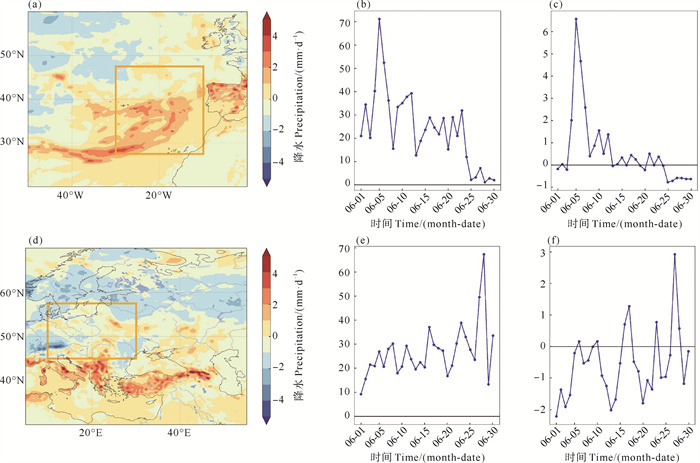
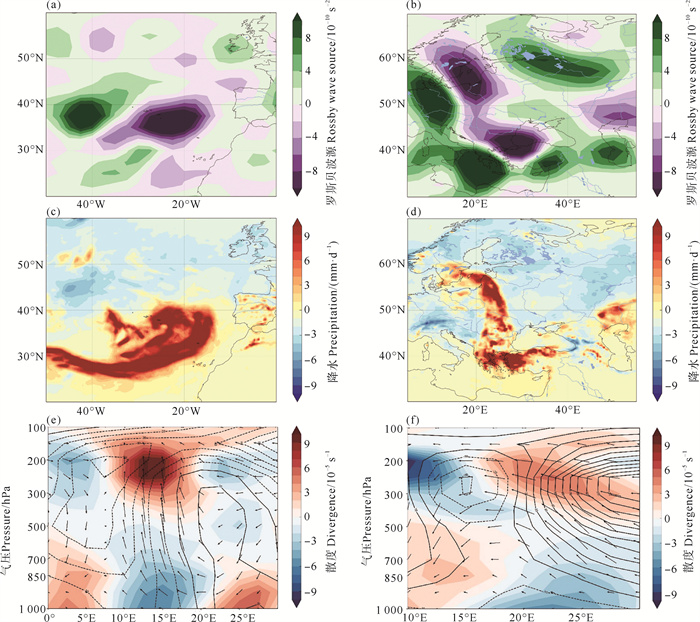
3.2 异常大气环流的形成机制降水系统对应的高低空辐合辐散异常与罗斯贝波源的产生密切相关[33]。根据对6月欧亚大陆区域的降水异常分析,大西洋东部有异常偏多的降水(见图 7(a)),在6月中上旬,大西洋地区的降水极值与区域平均降水均异常偏大(见图 7(b)、7(c))。欧洲中部区域的月平均降水异常较小(见图 7(d)),但在热浪(Ⅱ)发生前仍有较大异常降水过程(见图 7(e)、7(f))。我们以该两处关键区在热浪发生前的最大一次降水过程为例,进一步对罗斯贝波源进行分析。2023年6月4—6日,大西洋东部出现最大降水过程,且在降水区域有明显的负波源(见图 8(a)、8(c)),6月17—18日,波罗的海上空存在降水异常与另一负波源(见图 8(b)、8(d))。降水区域的环流场在低层有辐合异常,高层有辐散异常(见图 8(e)、8(f)),两次降水高层的辐散中心均位于200 hPa高度上,且高低空辐合辐散相对应的垂直环流所在的经度范围均与罗斯贝负波源所在位置匹配,与前人结论一致[33]。
|
( (a、d)中橙色框为大西洋东部(10°W—30°W,27.5°N—47.5°N)与欧洲中部(10°E—30°E,45°N—57.5°N)最大和平均降水异常的框选区域。The orange boxes in (a, d) represent the selected areas with the maximum and average precipitation anomalies in the region. ) 图 7 6月平均降水异常(a、d)、关键区域的最大降水异常(b、e)和区域平均降水异常(c、f)(单位:mm) Fig. 7 Average precipitation anomaly in June (a, d), maximum precipitation anomaly (b, e), and average precipitation anomaly (c, f) (unit: mm) |
|
( (a、c、e)为6月4—6日平均,(b、d、f)为6月17—18日平均。高度-经度剖面的纬度平均范围分别为30°N—40°N和50°N—57°N。(a, c, e) denote June 4—6 mean, (b, d, f) denote June 17—18 mean. The average range of latitude in height-longitude profiles is 30°N—40°N and 50°N—57°N, respectively. ) 图 8 200 hPa罗斯贝波源(a、b)、异常降水(c、d)和异常散度、位势高度(等值线,单位:gpm)和风矢量(单位:m·s-1(水平),Pa·s-1(垂直))的高度-经度剖面(e、f) Fig. 8 Rossby wave source at 200 hPa (a, b), precipitation anomaly (c, d), and the height-longitude profile of anomalous divergence, geopotential height (contour, Unit: gpm) and wind vector (unit: m·s-1 (horizontal), Pa·s-1 (vertical)) (e, f) |
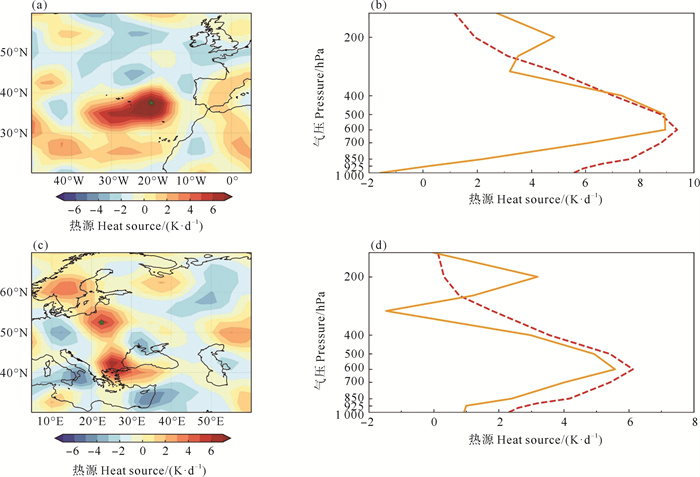
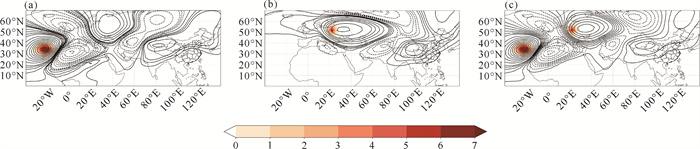
使用公式(4)对两次异常降水过程中释放的潜热进行了计算,计算结果显示,大西洋东部及欧洲中部地区上空分别在2023年6月4—6日及17—18日存在明显的异常热源,均位于600 hPa上空(见图 9(a)、9(c)),大西洋东部上空异常热源的最大值点位于20°W,37.5°N,最大值为8.9 K·d-1,而欧洲中部地区上空600 hPa异常热源的最大值点位于22.5°E,52.5°N,最大值为5.5 K·d-1。为进一步验证两处与异常降水相关的异常热源在导致华北地区高温热浪的异常环流的形成和维持过程中的作用,利用LBM数值试验模拟了大气对异常热源的稳定线性响应。基于得到的热源位置及垂直廓线分布,我们设置了三组试验:第一组试验的热源以20°W,37.5°N为中心,垂直廓线如图 9(b)红色虚线,第二组试验的热源以22.5°E,52.5°N为中心,垂直廓线如图 9(d)红色虚线,第三组试验则为前两组试验的热源共同计算得到。图 10给出200 hPa位势高度大气的响应情况,可以看到,在大西洋热源的强迫下,波列在欧亚大陆上空传播,形成了一系列的高低压异常中心,且其表现出从欧洲西部分为南北两支东传的特征,华北地区位于其正位势异常控制区(见图 10(a)); 欧洲中部热源的强迫下,存在两条从欧洲向东传播的波列,一条经更高纬度东传,另一条则向东南传播至中国北部,中国华北仍处于正位势异常控制区(见图 10(b)); 在两处热源的共同作用下,欧亚大陆上空存在明显的波列传播,与热浪(Ⅰ)、(Ⅱ)期间的大气环流情况基本一致(见图 6(d)、6(f)),中国北方大部分区域位于正位势异常控制区(见图 10(c)),有利于热浪事件的发生。
|
图 9 2023年6月(a)4—6日和(c)17—18日平均的600 hPa的异常热源(单位:K·d-1)及其(b、d)最大值点(绿色星星标记)的实际垂直廓线(黄色实线)和LBM数值试验结果的垂直廓线(红色虚线) Fig. 9 Anomalous heat source (unit: K·d-1) at 600 hPa (a) averaged over June 4—6 and (c) averaged over June 17—18 and (b, d) the corresponding vertical profile in actual (orange solid line) and LBM experiment (red dashed line) at the point of maximum |
|
图 10 LBM数值试验中(a)大西洋东部和(b)欧洲中部的热源强迫(填色,单位:K·d-1)和200 hPa位势高度(黑色等值线,单位:gpm)的稳定响应和(c)两处热强迫的共同作用(即(a)+(b)) Fig. 10 The imposed heat forcing (shading, unit: K·d-1) and the corresponding steady response of geopotential height (black contour, Unit: gpm) at 200 hPa by (a) Eastern Atlantic and (b) Central Europe in LBM experiment and (c) the combined effect of the two heat forcing ((a)+(b)) |
试验结果证明了大西洋东部及欧洲中部与降水异常相关的异常热源能激发欧亚大陆上空的南北两支罗斯贝波列,异常活跃的两支波列形成了有利于华北地区热浪发生的环流形势。
4 结论与讨论2023年6月,华北地区的Tmax距平达到1979—2023年最大值,该月发生的两次极端热浪事件起到了重要作用,对华北地区的人民生产生活以及社会发展产生了较大影响。本文从热浪事件的概况及大气环流异常特征的角度出发,利用再分析资料探讨了两次极端热浪事件的成因,得到以下主要结论:
(1) 2023年6月,华北地区共发生了两次极端高温热浪事件,时间分别为6月14—17日和21—24日,热浪发生过程中,华北地区上空均为显著的高压脊,对欧亚大陆上空环流的分析发现,导致2023年6月华北热浪的高压脊均为中纬度欧亚大陆上游东移而来,在东移的过程中获得欧亚大陆上游向下游传播的Rossby波能量,从而在华北地区上空加强维持,导致了华北地区的高温热浪事件。
(2) 定量比较不同物理过程对华北两次热浪事件的贡献,指出异常非绝热加热在全过程中对升温起主要贡献,非绝热加热项在第二次热浪中的升温作用大于第一次,水平平流项在两次过程中均为热浪发生前有短暂的升温作用,但在热浪事件开始后起到主要的降温作用。
(3) 6月大西洋东部和欧洲中部区域存在偏大的异常降水过程,异常降水所产生的潜热释放导致了对流层中层较强的异常热源,对流层高层出现了较强的罗斯贝波源。通过LBM数值试验,进一步证明了大西洋东部和欧洲中部区域的异常降水释放的凝结潜热对欧亚大陆高空有利于华北地区热浪事件的异常环流的形成、加强和维持有重要作用。
本文从2023年6月高温热浪的个例出发,指出了欧亚大陆上游区域异常降水对中国华北地区环流形势的调控作用,但能够影响到华北地区气温的因素是复杂的,Ding等[3]表明,黑潮延伸体区域的海温有利于西太副高的北上,从而使得华北地区上空为有利于热浪事件发生的位势高度正异常。Kim等[34]指出,对流层上层的涡度平流可以通过加强北极-西伯利亚平原(Arctic-Siberian Plain, ASP) 上空的反气旋中心从而激发向东亚地区传播的Rossby波作用通量,增强东亚热浪的强度。Zhou等[35]发现,华北地区上游区域的干旱也可以通过感热平流的形式对华北地区的高温事件起到有利作用。因此后续有必要继续对华北地区热浪事件与海温及邻近地区气象要素等其他因素的联系做进一步研究。
致谢: 首先感谢匿名审稿人的宝贵意见与建议, 这对我们工作的进一步完善具有重要作用。此外也要感谢无私提供数据资料的NCEP/NCAR、ECMWF、CPC。最后对本文创作过程中的参与、关心人员表示衷心感谢。
| [1] |
Deng K, Yang S, Lin A, et al. Unprecedented East Asian warming in spring 2018 linked to the North Atlantic tripole SST mode[J]. Atmospheric and Oceanic Science Letters, 2019, 12(4): 246-253. DOI:10.1080/16742834.2019.1605807 (  0) 0) |
| [2] |
Pi Y, Yu Y, Zhang Y, et al. Extreme temperature events during 1960-2017 in the Arid Region of Northwest China: Spatiotemporal dynamics and associated large-scale atmospheric circulation[J]. Sustainability, 2020, 12(3): 1198-1198. DOI:10.3390/su12031198 ( 0) |
| [3] |
Ding T, Yuan Y, Zhang J, et al. 2018: The hottest summer in China and possible causes[J]. Journal of Meteorological Research, 2019, 33(4): 259-273. ( 0) |
| [4] |
Tang S, Qiao S, Wang B, et al. Linkages of unprecedented 2022 Yangtze River Valley heatwaves to Pakistan flood and triple-dip La Niña[J]. Climate and Atmospheric Science, 2023, 6: 44-51. DOI:10.1038/s41612-023-00386-3 ( 0) |
| [5] |
Lu R, Xu K, Chen R, et al. Heat waves in summer 2022 and increasing concern regarding heat waves in general[J]. Atmosphere and Oceanic Science Letters, 2023, 16(1): 100290. DOI:10.1016/j.aosl.2022.100290 ( 0) |
| [6] |
Perkins-Kirkpatrick S E, Lewis S C. Increasing trends in regional heatwaves[J]. Nature Communications, 2020, 11: 3357. DOI:10.1038/s41467-020-16970-7 ( 0) |
| [7] |
李艳, 栗晗, 叶培龙. 1980-2010年华北地区极端高温天气气候事件特征分析[J]. 兰州大学学报(自然科学版), 2014, 50(6): 832-837. Li Y, Li H, Ye P L. Analysis of extreme high temperature events in summer during 1980-2010 over North China[J]. Journal of Lanzhou University (Natural Sciences), 2014, 50(6): 832-837. ( 0) |
| [8] |
Qian C, Ye Y, Jiang J, et al. Rapid attribution of the record-breaking heatwave event in North China in June 2023 and future risks[J]. Environmental Research Letters, 2024, 19(1): 014028. DOI:10.1088/1748-9326/ad0dd9 ( 0) |
| [9] |
WMO. The Global Climate System Review 2003[R]. Geneva: WMO, 2005: 41-43.
( 0) |
| [10] |
国家气候中心, 全国气候影响评价[R]. 北京: 国家气候中心, 2003: 42-44. National Climate Center, China Climate Impact Assessment[R]. Beijing: National Climate Center, 2003: 42-44. ( 0) |
| [11] |
Sun Y, Zhang X, Zwiers F W, et al. Rapid increase in the risk of extreme summer heat in Eastern China[J]. Nature Climate Change, 2014, 4: 1082-1085. DOI:10.1038/nclimate2410 ( 0) |
| [12] |
Ye Y, Qian C. Conditional attribution of climate change and atmospheric circulation contributing to the record-breaking precipitation and temperature event of summer 2020 in southern China[J]. Environmental Research Letters, 2021, 16(4): 044058. DOI:10.1088/1748-9326/abeeaf ( 0) |
| [13] |
Yin Z, Yang S, Wei W. Prevalent atmospheric and oceanic signals of the unprecedented heatwaves over the Yangtze River Valley in July-August 2022[J]. Atmospheric Research, 2023, 295: 107018. DOI:10.1016/j.atmosres.2023.107018 ( 0) |
| [14] |
Deng K, Yang S, Ting M, et al. An intensified mode of variability modulating the summer heat waves in Eastern Europe and Northern China[J]. Geophysical Research Letters, 2018, 45(20): 11361-11369. ( 0) |
| [15] |
Xu P, Wang L, Deng Z, et al. The British-Okhotsk Corridor Pattern and its linkage to the Silk Road Pattern[J]. Journal of Climate, 2022, 35(17): 5787-5804. DOI:10.1175/JCLI-D-21-0705.1 ( 0) |
| [16] |
Liu B, Zhu C, Ma S, et al. Subseasonal processes of triple extreme heatwaves over the Yangtze River Valley in 2022[J]. Weather and Climate Extremes, 2023, 40: 100572. DOI:10.1016/j.wace.2023.100572 ( 0) |
| [17] |
Chen R, Lu R. Comparisons of the circulation anomalies associated with extreme heat in different regions of Eastern China[J]. Journal of Climate, 2015, 28(14): 5830-5844. DOI:10.1175/JCLI-D-14-00818.1 ( 0) |
| [18] |
Xu K, Lu R, Mao J, et al. Circulation anomalies in the mid-high latitudes responsible for the extremely hot summer of 2018 over Northeast Asia[J]. Atmospheric and Oceanic Science Letters, 2019, 12(4): 231-237. DOI:10.1080/16742834.2019.1617626 ( 0) |
| [19] |
Schumacher D L, Keune J, Heerwaarden C C, et al. Amplification of mega-heatwaves through heat torrents fuelled by upwind drought[J]. Nature Geoscience, 2019, 12: 712-717. DOI:10.1038/s41561-019-0431-6 ( 0) |
| [20] |
Chen W, Lu R. The interannual variation in monthly temperature over Northeast China during summer[J]. Advances in Atmospheric Sciences, 2014, 31(3): 515-524. DOI:10.1007/s00376-013-3102-3 ( 0) |
| [21] |
Li J, Ruan C. The North Atlantic-Eurasian teleconnection in summer and its effects on Eurasian climates[J]. Environmental Research Letters, 2018, 13(2): 024007. DOI:10.1088/1748-9326/aa9d33 ( 0) |
| [22] |
Xiao H, Xu P, Wang L. The unprecedented 2023 North China heatwaves and their S2S predictability[J]. Geophysical Research Letters, 2024, 51(6): e2023GL107642. DOI:10.1029/2023GL107642 ( 0) |
| [23] |
Kalnay E, Kanamitsu M, Kistler R, et al. The NCEP/NCAR 40-Year reanalysis project[J]. Bulletin of the American Meteorological Society, 1996, 77(3): 437-472. DOI:10.1175/1520-0477(1996)077<0437:TNYRP>2.0.CO;2 ( 0) |
| [24] |
Muňoz-Sabater J, Dutra E, Agustí-Panareda A, et al. ERA5-Land: A state-of-the-art global reanalysis dataset for land applications[J]. Earth System Science Data, 2021, 13(9): 4349-4383. DOI:10.5194/essd-13-4349-2021 ( 0) |
| [25] |
Takaya K, Nakamura H. A formulation of a phase-independent wave-activity flux forstationary and migratory quasigeostrophic eddies on a zonally varying basic flow[J]. Journal of the Atmospheric Sciences, 2001, 58(6): 608-627. DOI:10.1175/1520-0469(2001)058<0608:AFOAPI>2.0.CO;2 ( 0) |
| [26] |
Sardeshmukh P D, Hoskins B J. The generation of global rotational flow by steady idealized tropical divergence[J]. Journal of the Atmospheric Sciences, 1988, 45(7): 1228-1251. DOI:10.1175/1520-0469(1988)045<1228:TGOGRF>2.0.CO;2 ( 0) |
| [27] |
Yanni M, Esbensen S, Chu J H. Determination of bulk properties of tropical cloud clusters from large-scale heat and moisture budgets[J]. Journal of the Atmospheric Sciences, 1973, 30(4): 611-627. DOI:10.1175/1520-0469(1973)030<0611:DOBPOT>2.0.CO;2 ( 0) |
| [28] |
Watanabe M, Kimoto M. Atmosphere-ocean thermal coupling in the North Atlantic: A positive feedback[J]. Quarterly Journal of the Royal Meteorological Society, 2000, 126(570): 3343-3369. ( 0) |
| [29] |
An X, Sheng L, Li C, et al. Effect of rainfall-induced diabatic heating over southern China on the formation of wintertime haze on the North China Plain[J]. Atmospheric Chemistry and Physics, 2022, 22(2): 725-738. DOI:10.5194/acp-22-725-2022 ( 0) |
| [30] |
Wang P, Tang J, Sun X, et al. Heat waves in China: Definitions, leading patterns, and connections to large-scale atmospheric circulation and SSTs[J]. Journal of Geophysical Research: Atmospheres, 2017, 122(20): 10679-10699. ( 0) |
| [31] |
Luo Y, Shi J, An X, et al. The combined impact of subtropical wave train and Polar-Eurasian teleconnection on the extreme cold event over North China in January 2021[J]. Climate Dynamics, 2022, 60(11-12): 3339-3352. ( 0) |
| [32] |
杨萍, 刘伟东, 王启光, 等. 近40年我国极端温度变化趋势和季节特征[J]. 应用气象学报, 2010, 21(1): 29-36. Yang P, Liu W D, Wang Q G, et al. The climatic change trend and seasonal characteristics of daily temperature extremes in China for the latest 40 years[J]. Journal of Applied Meteorological Science, 2010, 21(1): 29-36. ( 0) |
| [33] |
Watanabe M. Asian jet waveguide and a downstream extension of the North Atlantic Oscillation[J]. Journal of Climate, 2004, 17(24): 4674-4691. DOI:10.1175/JCLI-3228.1 ( 0) |
| [34] |
Kim J H, Kim S J, Kim J H, et al. East Asian heatwaves driven by Arctic-Siberian warming[J]. Scientific Reports, 2022, 12: 18025. DOI:10.1038/s41598-022-22628-9 ( 0) |
| [35] |
Zhou S, Yuan X. Upwind droughts enhance half of the heatwaves over North China[J]. Geophysical Research Letters, 2022, 49(2): e2021GL096639. DOI:10.1029/2021GL096639 ( 0) |