 2025, Vol. 55


2. 信阳市气象台, 河南 信阳 464000
欧亚大陆西北部及巴伦支海区域是连接北大西洋和中国东北部的枢纽区域,对中国秋冬季气候变化具有重要影响[1]。该区域表面气温的变化受其上空大气遥相关型的影响,比如北极涛动(Arctic oscillation,AO)[2],北大西洋涛动(North Atlantic oscillation,NAO)[3],斯堪的纳维亚型(Scandinavian,SCA)遥相关模态[4]等,而北大西洋海温异常则可通过影响海表热通量异常、降水及非绝热加热等影响大气遥相关[5-6]。近年来北大西洋海温异常对大气遥相关型及欧亚大陆西北部表面气温的影响持续受到关注,比如王庭轩[7]发现秋季北大西洋海温年际变化第一模态呈马蹄型分布特征(North Atlantic horseshoe,NAH),且对NAO等大气遥相关型具有重要影响。而Song等[8]发现晚冬北大西洋三极子型(North Atlantic tripolar,NAT)海温异常有利于增强大气斜压性、促进瞬变涡旋活动、加强高空大气波动信号,从而对春季欧亚大陆西北部表面温度异常产生影响。Jung等[9]发现,与晚秋欧亚大陆西北部表面温度异常密切相关的高空位势异常呈现SCA遥相关模态,而北大西洋海温,尤其是湾流区域的海温异常变化对SCA波列及欧亚大陆西北部表面温度存在重要影响。
然而,在年代际时间尺度上,北大西洋海温异常与大气遥相关型之间的关系并不稳定。Wang等[10]研究表明,在年代际时间尺度上,冬季北大西洋海温异常与欧亚遥相关型(Eurasian teleconnection,EU)的相关性呈现持续数年的高低变化,其中在高相关期北大西洋海温异常超前4个月对大气存在显著影响。Chen等[11]研究指出,春季NAT与欧亚大陆表面温度异常的相关性存在明显的年代际变化,在高相关期间大气波列更加明显。但是对于秋季北大西洋海温异常和欧亚大陆西北部表面温度间相关性的年代际变化特征尚未有深入研究。在晚秋(10~12月)季节,逐日的海温变化会较冬季更活跃,同时大气内部变率较小[12],但是大气涡旋-基本气流相互作用仍然显著[13]。Nie等[14]研究指出,在晚秋不同海温模态对大气有不同的作用,其中NAT型海温异常主要受NAO影响,而NAH型海温异常则对NAO具有重要反馈作用。那么,在晚秋季节北大西洋海温异常对欧亚大陆西北部及巴伦支海区域表面气温具有怎样的影响?在年代际时间尺度上,两者的相关性是否会发生变化?导致两者关系发生改变的物理机制又是什么?
针对上述问题,本文将主要利用1940—2022年ERA5再分析数据,对年代际时间尺度上北大西洋海温异常对欧亚大陆西北部表面气温的影响开展研究,并进一步讨论两者间相关性的变化特征及成因。
1 资料与方法 1.1 数据资料本文所用资料来自欧洲中期数值预报中心(European Center for Medium-Range Weather Forecasts,ECMWF)第五代再分析资料(ERA5),变量包括海温、地表 2m温度、各层位势高度风场等相关气象要素,资料水平分辨率为1°×1°。时间段为1940—2022年晚秋(10、11、12月)。在处理逐日数据时,首先去除季节循环,季节循环的定义是所有年份中某一天的31 d滑动平均值,去除季节循环的方法是将实际值减去对应的季节循环滑动平均值[5]。
1.2 方法与计算本文采用最大协方差分析(maximum covariance analysis,MCA)方法[15]分解提取两个场的时空变化特征,即对北大西洋海温场(20°N—80°N,90°W—0°)和欧亚大陆西北部地区的表面温度场(40°N—70°N,0°—70°E)进行分析,得到的第一模态解释总协方差平方的26.44%。
NAO指数的计算参考Barnes等[16]。对北大西洋区域(20°N—90°N,90°W—40°E)的1 000 hPa位势高度进行EOF分析,提取时间序列得到逐日NAO指数。
考虑波流相关作用的动力过程,本文通过计算风暴轴,计算斜压增长率来分析大气的斜压不稳定性,并结合线性化正压罗斯贝波源,以及T-N波作用通量来分析瞬变涡旋的活动。
其中风暴轴用扰动动能来表示,通过对300 hPa风场进行天气尺度2~8 d带通滤波,然后再计算扰动动能[17-19]。
| $ \sigma=0.31 \frac{\left|f \boldsymbol{U}_z\right|}{N} 。$ | (1) |
式中: f为地转参数; Uz为垂直风切变; N为Brunt-Väisälä频率。
线性化正压罗斯贝波波源(Rossby wave source,RWS)的表达式为[22-23]
| $ S=-\nabla_{\mathrm{H}} \cdot\left\{\boldsymbol{u}_\chi^{\prime}(f+\bar{\zeta})\right\}-\nabla_{\mathrm{H}} \cdot\left(\bar{\boldsymbol{u}}_\chi^{\prime} \zeta\right) 。$ | (2) |
式中: uχ=(uχ,vχ)为风的辐散风分量; ζ为相对涡度; f为地转涡度; ▽H为水平梯度; 上划线表示平均态; 撇号表示扰动。其中正值表示气旋性涡度增加的趋势,负值表示反气旋性涡度减少的趋势。
| $ \begin{gathered} W= \\ \frac{1}{|\overline{\boldsymbol{u}}|}\left(\begin{array}{c} \bar{u}\left(\psi_x^{\prime 2}-\psi^{\prime} \psi_{x x}^{\prime}\right)+\bar{v}\left(\psi_x^{\prime} \psi_y^{\prime}-\psi^{\prime} \psi_{x y}^{\prime}\right) \\ \bar{u}\left(\psi_x^{\prime} \psi_y^{\prime}-\psi^{\prime} \psi_{x y}^{\prime}\right)+\bar{v}\left(\psi_y^{\prime}-\psi^{\prime} \psi_{y y}^{\prime}\right) \\ \frac{f^2}{R \sigma / p}\left\{\bar{u}\left(\psi_x^{\prime} \psi_p^{\prime}-\psi^{\prime} \psi_{x p}^{\prime}\right)+\bar{v}\left(\psi_y^{\prime} \psi_p^{\prime}-\psi^{\prime} \psi_{x p}^{\prime}\right)\right\} \end{array}\right) \end{gathered} 。$ | (3) |
式中:
考虑湾流带来的水汽导致的热力作用,通过计算垂直积分的水汽输送,以及非绝热加热来诊断大气热力过程。
计算垂直积分的水汽输送(IVT)的[26]公式如下:
| $ I V T=\sqrt{\left(\frac{1}{g} \int_{1000 \mathrm{~Pa}}^{300 \mathrm{~Pa}} q u \mathrm{~d} p\right)^2+\left(\frac{1}{g} \int_{1000 \mathrm{~Pa}}^{300 \mathrm{~Pa}} q v \mathrm{~d} p\right)^2} $ | (4) |
式中: q是比湿,单位为kg/kg; g为重力加速度; u和v为纬向和经向风分量。
| $ Q 1=c_{\mathrm{p}}\left(\frac{p}{p_0}\right)^\kappa\left(\frac{\partial \theta}{\partial t}+\boldsymbol{V} \cdot \nabla \theta+\omega \frac{\partial \theta}{\partial p}\right), $ | (5) |
| $ { Integral }=\frac{\int_{300 \mathrm{~Pa}}^{1000 \mathrm{~Pa}}(Q 1) \mathrm{d} x}{g} 。$ | (6) |
式中: θ为位温; p0为1 000 hPa; g为重力加速度; cp为定压比热;
此外本文用到的统计方法有滑动相关分析,回归分析等,显著性检验为双尾t检验。
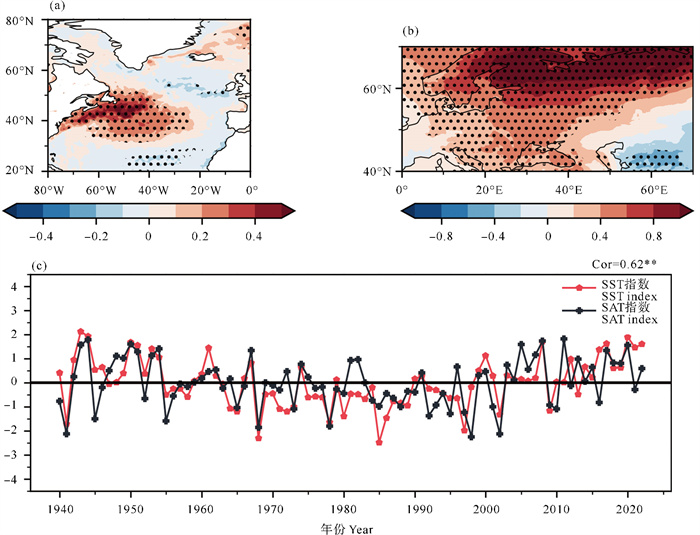
2 北大西洋海温异常与NWESAT相关性的年代际变化为研究北大西洋SST异常和NWESAT的相关性质,对1940—2022年10—12月(晚秋)的北大西洋SST场和欧亚大陆西北部表面2 m气温场进行MCA分析,获得第一模态的海表温度(sea surface temperature, SST)和表面气温(surface air temperature,SAT)两个时间序列,分别作为SST指数和SAT指数,然后对各指数进行回归,得到相应的SST和SAT异常的分布(见图 1(a)、1(b))。从图中可见海温对SAT指数的响应模态表现为在北大西洋中部大范围显著的暖异常信号,且其南北两侧为负海温异常,整体上呈现出类似马蹄形的分布[14]; 而欧亚大陆西北部表面气温则呈现一致变暖信号,表明NAH型海温异常与NWESAT在同期为显著的正相关关系。两个指数时间序列的逐年分布见图 1(c),两者相关系数为0.61,达到了0.01显著性水平的t检验。我们注意到,在不同年份,两个指数间的相关性存在差异。为进一步考察两者相关性的年代际变化特征,后续首先将对两个指数的相关性、显著周期等进行分析。
|
( 打点区域表示通过了0.05显著性水平的t检验。The dotted area indicates that the t-test has passed the significance level of 0.05. ) 图 1 1940—2022年晚秋(a)北大西洋(20°N—80°N,90°W—0°)海温异常(填色,单位:℃)MCA分解的第一异类空间分布模态、(b)欧亚大陆西北部(40°N—70°N,0°—70°E)表面气温异常(填色,单位:℃)MCA分解的第一异类空间分布模态及(c)MCA第一对异类模态对应的时间序列 Fig. 1 Late Autumn (1940—2022) (a) the first heterogeneous spatial distribution mode of MCA decomposition for North Atlantic (20°N—80°N, 90°W—0°)sea surface temperature anomalies (shaded, units: ℃), (b) the first heterogeneous spatial distribution mode of MCA decomposition for surface temperature anomalies in the northwest of the Eurasian continent(40°N—70°N, 0°—70°E)(shaded, units: ℃) and (c) the time series corresponding to the first pair of heterogeneous modes of MCA decomposition |
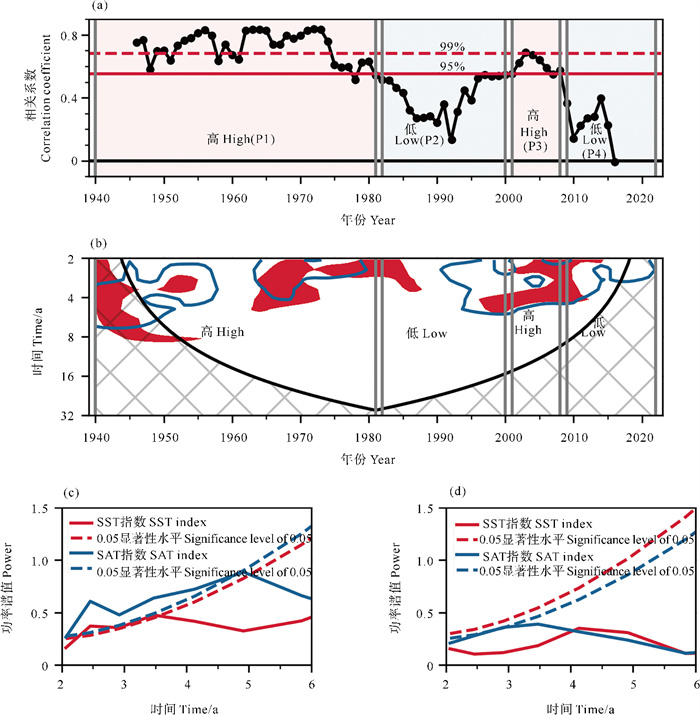
Wang等[10]发现EU指数大约存在为6~8 a左右的周期,因此采取15 a窗口进行滑动相关探究北大西洋海温与EU关系的年代际变化。考虑到SST指数和SAT指数存在2~5 a左右的周期,因此对SST指数和SAT指数进行了13 a滑动相关分析,发现两者间相关性质存在明显的年代际变化(滑动窗口大小的改变对高低相关区间没有显著影响)。根据滑动相关系数的显著性水平,当滑动相关系数超过95%的显著性水平时,为高相关期,否则为低相关期。其中,高相关期为P1(1940—1981年)和P3(2001—2008年),共50 a;低相关期为P2(1982—2000年)和P4(2009—2022年),共33 a(见图 2(a))。为进一步考察两者相关性发生变化的原因,对SST指数和SAT指数进行了小波分析和功率谱分析(见图 2(b)和2(c)),发现这两个时间序列均呈现2~5 a左右的显著周期,其中SST指数的周期与相关文献[7]中NAH的周期一致。从小波分析可知,在1980年之前和2000—2010年间,两者均存在上述周期,而在1980—2000年间和2010年以后时期,两个指数上述周期均较弱,这可能暗示两者关系在这些年份发生了变化[10-11]。
|
( (a)中的红色(蓝色)阴影区域为高(低)相关期,红色实线表示0.05显著性水平t检验,红色虚线表示0.01显著性水平t检验, (b)中黑色实线表示0.05显著性水平检验,SST指数和SAT指数小波分析周期低于0.05显著性水平未显示,(c)和(d)里虚线表示0.05显著性水平检验。In figure (a), the red (blue) shaded areas indicate periods of high (low) epoch. The solid red line represents a t-test at a significance level of 0.05, while the dashed red line indicates a t-test at a significance level of 0.01. In figure (b), the black solid line denotes the significance level of 0.05, and periods where the SST index and SAT index fall below the significance level of 0.05 are not displayed. In figures (c) and (d), the dashed lines indicate the significance level of 0.05. ) 图 2 (a) SST指数与SAT指数的13年滑动相关、(b)SST指数和SAT指数的小波分析(其中SST指数小波功率谱为红色填色,SAT指数小波功率谱为蓝色等值线)、(c)高相关期SST指数和SAT指数的功率谱分析、(d)低相关期SST指数和SAT指数的功率谱分析 Fig. 2 (a) The 13-year running correlation between the SST index and the SAT index; (b) wavelet analysis of SST index and SAT index, with the wavelet power spectrum of the SST index (red shaded) and that of the SAT index (blue contours); (c) SST index and SAT index power spectrum analysis during high epoch; (d) SST index and SAT index power spectrum analysis during low epoch |
在天气至季节内时间尺度上,北大西洋海温,尤其是湾流区海温可通过影响大气瞬变涡旋活动及高空波列而对欧亚大陆产生影响[29-30]。Pang等[31]也提到2000年代初期以后SCA波列发生突变,变得更加显著。Essa等[32]也指出2000年以后的ERA5数据较之前更为准确。因此为进一步探究高、低相关期海温影响NWESAT的物理机制,利用逐日数据对高相关期P3(2001—2008年)和低相关期P4(2009—2022年)进行研究,考察两个时间段内海洋与大气异常信号的超前滞后关系。选取与前面相同的区域对逐日数据进行MCA分解,其时间序列及模态分布和利用逐月数据得出的结果一致。
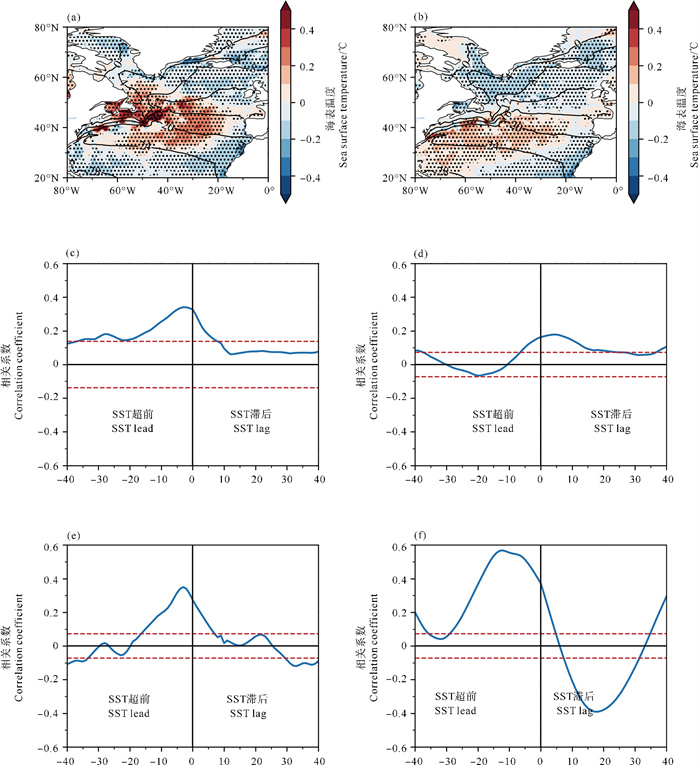
用MCA分解得出的SAT指数回归高低相关期的北大西洋SST,并将SST指数和SAT指数进行超前滞后相关分析(见图 3)可见,在高低相关期,和NWESAT关系密切的海温模态呈现不同的分布特征,其中在高相关期,回归的SST信号呈现更明显的NAH型分布特征,其最大值主要沿湾流海洋锋及其北侧分布,且正异常明显偏北。而在低相关期,正信号偏弱且偏南,更接近NAT型分布特征。此外,在高低相关期两个指数间的超前滞后相关关系也存在显著差异。其中高相关期两者间的相关系数明显偏高,从SST超前20 d到滞后5 d左右均存在显著的相关性,且SST指数超前5 d左右相关系数最大,因此在高相关期,两者之间关系以海洋驱动大气为主,该结果与Tao等[19]提到的海表面热通量超前大气风场的结果一致;在低相关期,从SST指数超前5 d到SST滞后15 d存在显著的相关性,且SST滞后5 d左右相关系数最大。为了进一步揭示低相关期SAT超前SST的关系,通过进一步做在低相关期NAO指数与SAT指数及SST指数的超前滞后相关可见,低相关期NAO对SST异常具有显著的驱动作用。因此,在低相关期,两者关系以大气驱动海洋为主。总之,NWESAT和北大西洋SST异常之间的关系存在高低时期的明显差异,在高相关期,与NWESAT密切相关的SST异常呈NAH型分布特征,且对大气具有显著驱动作用,在低相关期,SST异常呈NAT型分布特征,主要受大气的影响。
|
( (a)和(b)中的打点区域表示通过了0.05显著性水平t检验,(c)、(d)、(e)和(f)中的红色虚线表示0.01的显著性水平t检验。The dotted areas in (a) and (b) indicate that the t-test has passed the significance level of 0.05. The red dashed lines in (c), (d), (e), and (f) represent the t-test at the 0.01 significance level. ) 图 3 P3、P4时期对SAT指数回归的(a)高相关期海温异常(填色,单位:℃,等值线为气候态海温)、(b)低相关期海温异常(填色,单位:℃,等值线为气候态海温)、(c)高相关期SST指数与SAT指数的超前滞后相关、(d)低相关期SST指数与SAT指数的超前滞后相关、(e)低相关期NAO指数与SAT指数的超前滞后相关、(f)低相关期NAO指数与SST指数的超前滞后相关 Fig. 3 Regression of SST (shaded; units: ℃) on the SAT index during (a) the high epoch (P3), (b) the low epoch (P4) (climatological SST is shown by contours, shaded units: ℃), (c) lead-lag correlation between the SST index and SAT index during the high epoch, (d) lead-lag correlation between the SST index and SAT index during the low epoch, (e) Lead-lag correlation between the NAO index and SAT index during the low epoch and (f) lead-lag correlation between the NAO index and SST index during the low epoch |
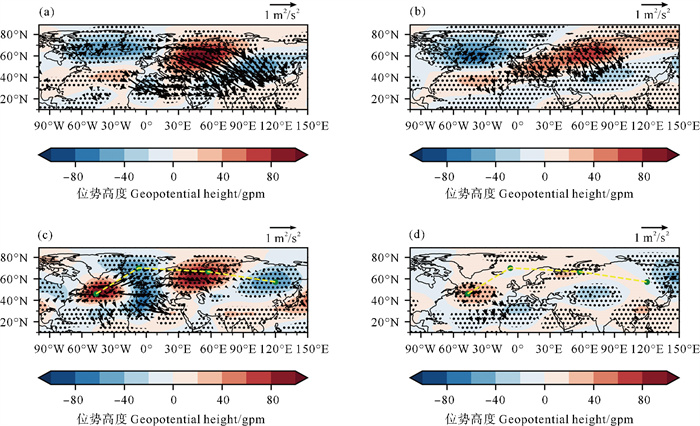
为了探究高低相关期SST异常对NWESAT的不同影响,用高低相关期SST指数和SAT指数分别回归300 hPa的位势高度得图 4。从图中可见,用SAT指数回归的位势异常在高低相关期均呈现明显的SCA波列特征,只是在低相关期,位于欧亚大陆西北部的正位势异常偏弱。而用SST指数回归的位势高度异常则在高低相关期存在明显差异。其中,在高相关期SCA波列结构更加明显,该波列沿着高纬度呈现SCA波列的特征,各正负信号大小及位置与SAT指数回归的位势异常一致,波作用通量也沿着异常位势中心连续分布。在低相关期,SST指数回归的波列信号明显减弱,这可能是因为这一时期北大西洋SST异常对大气的影响较弱。
|
( 波通量的计算为用SST指数回归异常的背景风场和位势场,然后再计算出波通量,其中波通量低于0.1值未显示,(c),(d)中的绿色散点为选取的异常中心,黄线为连接散点的折线,打点区域表示通过了0.05显著性水平t检验。The calculation of wave flux was by regressing the anomalous background wind and geopotential fields onto the SST index, followed by the computation of the wave flux. Wave activity flux values below 0.1 are not shown. The green scatter points in (c) and (d) represent the selected anomaly centers, and the yellow lines are the polylines connecting the scatter points. The dotted area indicates that has passed the t-test at the significance level of 0.05. ) 图 4 (a) SAT指数回归的高相关期300 hPa位势高度和波通量(矢量,单位:m2·s-2)、(b)同(a)但是为低相关期、(c)SST指数回归的高相关期300 hPa位势高度和波通量(矢量,单位:m2·s-2)、(d)同(c)但是为低相关期 Fig. 4 (a) Regression of the SAT index during the high epoch: 300 hPa geopotential height and wave activity flux (vectors; units: m2·s-2)、(b) same as (a), but for the low epoch; (d) regression of the SST index during the high epoch: 300 hPa geopotential height and wave activity flux (vectors; units: m2·s-2); (d) same as (c), but for the low epoch |
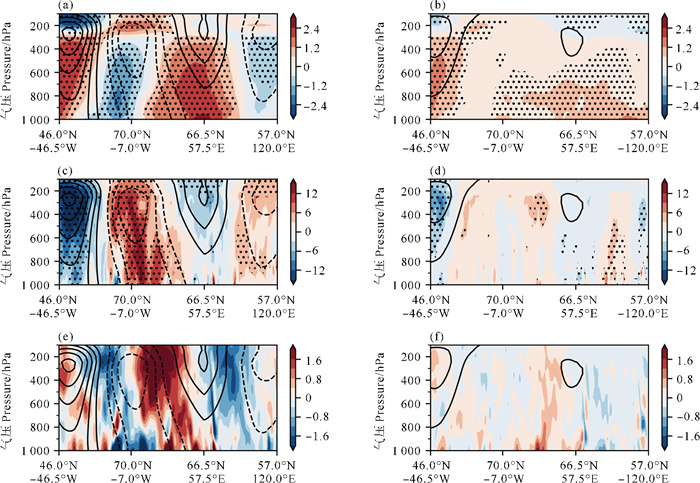
为了研究高低相关期与SST异常有关的波列垂向结构的差异,沿着图 4(c)中波列的各异常中心连线绘制了温度、涡度及散度对SST指数的回归系数垂直剖面图,得到图 5。可见,在高相关期间,沿波列异常中心的垂直剖面上,温度异常呈现出高低空偶极子的分布特征,其中第一个异常中心从低空延伸到高空,呈现显著的暖异常信号,高低空偶极子的分界面大约在300 hPa左右。在低相关期,高低空偶极子的分布仅在第一个异常中心上空存在,并且回归系数明显较弱,仅为高相关期的50%。而涡度场的回归结果在高相关期呈现出4个显著的异常中心,分别对应波列的4个中心:北大西洋湾流区域、欧亚高纬度地区的异常反气旋、北大西洋近极地高纬度地区和东亚地区的异常气旋。涡度的垂直分布呈现准正压结构,涡度异常数值随着高度增加,在300 hPa左右处达到峰值。尤其值得注意的是负涡度异常中心的西北侧对应着正温度异常中心,即温度场落后于涡度场。这种垂直结构中温度场和涡度场的配置有利于波列的发展,能量从有效位能转化到波列的动能,从而为波列发展提供能量[24]。然而在低相关期,温度场和涡度场的显著信号较少,温度场与涡度场的配置并不明显。在高相关期散度场的回归结果明显较低相关期强,在高空沿着波列依次出现辐散-辐合-辐散-辐合中心,北大西洋上空的辐合中心位于波列的第一个和第二个异常中心中间,该中心可能会伴随水汽的辐合和热量的释放从而有利于波列的发展。上述研究表明,在高相关期,北大西洋SST异常更有利于高空类似SCA波列的发展,而SST指数与NWESAT间相关性的年代际变化主要是由北大西洋SST异常对大气波列调制作用的年代际变化所造成。
|
( (a)温度(填色,单位:℃),(c)绝对涡度(填色,单位:10-6s-1),(e)散度(填色,单位:10-6s-1);(b),(d),(f)同(a),(c),(e),但是为低相关期。等值线为回归的位势高度(单位:gpm)。打点区域表示通过了0.05显著性水平t检验,等值线间隔为20,零值未显示,正值为实线,负值为虚线。(a) Temperature (shaded, units: ℃); (c) Absolute vorticity (shaded, units: 10-6s-1); (e) Divergence (shaded, units: 10-6s-1). Panels (b), (d), and (f) correspond to (a), (c), and (e), respectively, but for the low epoch. The contour lines represent the regressed geopotential height (units: gpm). The dotted area indicates that the t-test has passed the significance level of 0.05. The contours interval is 20, with zero values not displayed. Positive values are represented by solid lines, and negative values by dashed lines. ) 图 5 高相关期SST指数回归沿着图 4(c)黄色虚线的高度—纬度垂直剖面 Fig. 5 Regression of the SST index height-latitude vertical cross-section along the yellow dashed line in Fig. 4(c) for the high epoch |
前人[33-34]研究表明,暖海温异常主要通过涡旋介导过程对上空大气产生调制作用:首先大气对暖海温的响应是向上的热通量增强,导致大气斜压性增强,产生低空低压中心和高空高压中心的斜压响应,然后通过涡旋介导过程将低层的低压响应反演成高压响应,将线性斜压响应转化为等效正压响应。前人[8-9]也指出北大西洋海温异常通过影响涡旋介导过程对其上空大气产生调制作用,激发出波列影响下游欧亚高纬度地区。为了进一步探究高低相关期SST异常对波列及NWESAT产生影响的差异,下文将对与SST异常变化有关的涡旋介导过程进行分析。
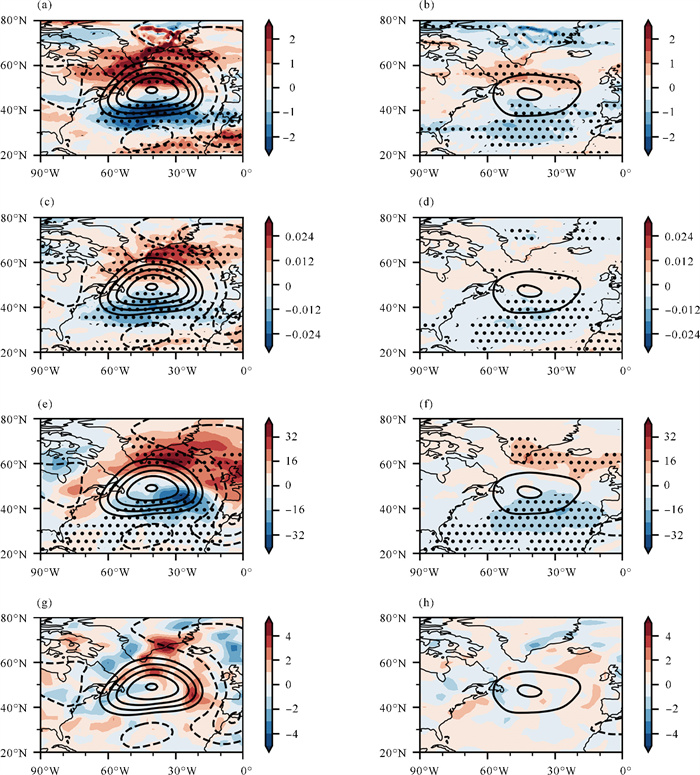
用SST指数回归700 hPa的经向温度梯度、700 hPa的斜压增长率、300 hPa的风暴轴以及300 hPa的罗斯贝波源(见图 6)。在高相关期,经向温度梯度在北大西洋区域呈现南负-北正的偶极子结构分布,其中在湾流区域以北呈现显著的正异常分布,这一正梯度反映了中纬度与极地地区的温度差异,即热量的向极输送。
|
( (a)700 hPa的经向温度梯度(填色,单位:10-6K·m-1),(c)700 hPa的斜压增长率(填色,单位:d-1),(e)300 hPa的风暴轴(填色,单位:m2·s-2),(g)300 hPa的RWS(填色,单位:10-11s-1);(b),(d),(f),(h)同(a),(c),(e),(g)但是为低相关期。等值线为回归的300 hPa位势高度(单位:gpm)。打点区域表示通过了0.05显著性水平t检验,等值线间隔为20,零值未显示,正值为实线,负值为虚线。(a) meridional temperature gradient at 700 hPa (shaded, units: 10-6K·m-1), (c) baroclinic growth rate at 700 hPa (shaded, units: d-1), (e) storm track at 300 hPa (shaded, units: m2·s-2), and (g) 300 hPa Rossby wave source (RWS, shaded, units: 10-11s-1); (b), (d), (f), (h) are the same as (a), (c), (e), (g), but for the low epoch. The contour lines represent the regressed geopotential height at 300 hPa (units: gpm). The dotted area indicates that the t-test has passed the significance level of 0.05. The contours interval is 20, with zero values not displayed. Positive values are represented by solid lines, and negative values by dashed lines. ) 图 6 高相关期SST指数回归 Fig. 6 Regression of the SST index for the high epoch |
但是在低相关期间,湾流区域的正温度梯度较高相关期减少了约50%。而高相关期大气斜压增长率及风暴轴对SST指数的响应与温度梯度的分布一致,均呈现南负-北正的偶极子结构。在低相关期,大气斜压增长率及风暴轴的响应均减弱30%~50%。根据前人研究结果,北大西洋上空南负-北正偶极子型的风暴轴变化特征,有利于北大西洋向极的风暴轴活动[35]。可见,在高相关期SST指数会引起更为活跃的大气风暴轴活动。因瞬变涡旋活动可以作为罗斯贝波的源激发波列,因此,我们进一步计算了高低相关期对SST指数回归的罗斯贝波源,在高相关期沿湾流海洋锋面上空存在明显的波源负值,其东北侧是波源正值,这导致该地区反气旋性、气旋性涡度增加,分别与SCA波列第一、第二个正、负中心相对应。在低相关期,与减弱的大气波列响应相对应,波源明显减弱。上述分析表明,在高相关期,湾流北部区域出现强的向北的温度输送,斜压增长率增强,这导致风暴轴向北增强,并且加强了大气波列信号。
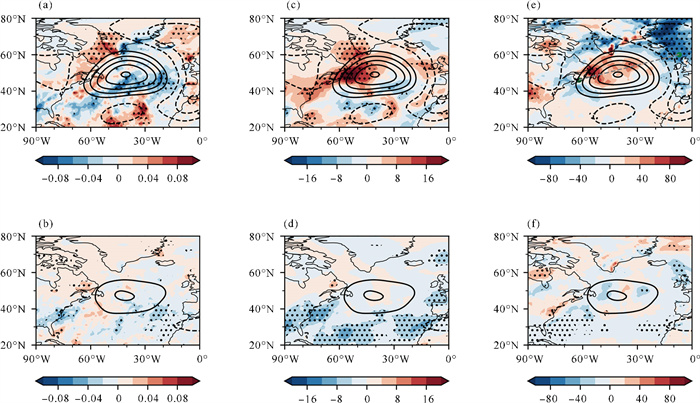
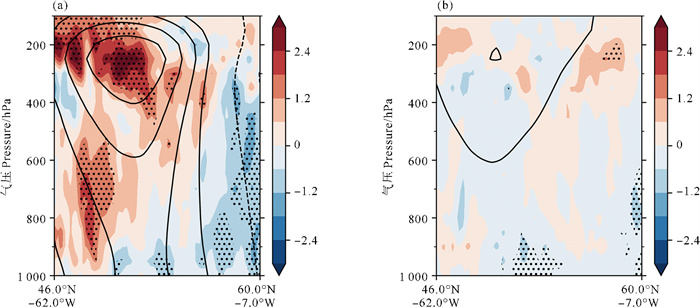
3.3 湾流区上空的非绝热加热过程在海洋影响大气波列中的作用根据前人结果,Tao等[19]发现在湾流北部区域的非绝热加热过程对大气起着非常重要的调制作用,为了进一步探究高低相关期SST指数引起大气波列差异的原因,本章分析了与SST异常变化有关的非绝热加热过程。用SST指数回归高低相关期的降水、水汽输送(intergrated vapor tronsport, IVT)以及非绝热加热(Q1),得到图 7。其中在高相关期,湾流海洋锋面区及其北部存在显著的降水正异常,这和IVT在该区域的显著正异常分布有关。与降水相对应,在湾流海洋锋面及北侧上空存在显著的非绝热加热信号。对比图 6(g)和6(h)发现,该非绝热加热和高空的正的罗斯贝波源相对应[30]。这表明在高相关期,湾流区域存在着有利的水汽输送条件,这增强了该区域的降水和高空的非绝热加热,并促进了大气波源的发展。而在低相关期,并没有明显的降水及非绝热加热信号。为了进一步探究高低相关期与SST指数相关的热力过程差异,用SST指数回归Q1,得出沿SCA波列第一个正信号中心的Q1垂向剖面(见图 7(e)中灰线),如图 8所示。在高相关期,与第一个正位势异常相对应,正的非绝热加热信号从低空延伸到高空,而在低相关期,Q1明显减弱。这表明湾流区域海洋锋面引起的水汽输送、降水及高空加热在SST指数影响高空波列的过程中也起着非常重要的作用。
|
( (a)降水(填色,单位:mm·d-1), (b)IVT(填色,单位:kg·m-1·s-1), (c)整层Q1;(d)—(f)同(a)—(c)但是为低相关期。等值线为回归的300 hPa位势高度(单位:gpm)。(e)中绿色散点为选取的异常中心,打点区域表示通过了0.05显著性水平t检验,等值线间隔为20,零值未显示,正值为实线,负值为虚线。(a) precipitation (shaded, units: mm·d-1); (b) Integrated vapor transport (IVT) (shaded, units: kg·m-1·s-1); (c) Integrate Q1 (shading; Unit: 10-11 W/m2); (d)—(f) same as (a)—(c), but for the low epoch. The contour lines represent the regressed 300 hPa geopotential height (units: gpm). In (e), the green scatter points represent the selected anomaly centers. The dotted area indicates that the t-test has passed the significance level of 0.05. The contours interval is 20, with zero values not displayed. Positive values are represented by solid lines, and negative values by dashed lines. ) 图 7 高相关期SST指数回归 Fig. 7 Regression of the SST index for the high epoch |
|
( (a)高相关期沿着上图 7(e)灰线的垂直剖面的非绝热加热(填色,单位:K/d-1);(b)同(a),但为低相关期。等值线为回归的位势高度(等值线,单位:gpm)。打点区域表示通过了0.05显著性水平t检验,等值线间隔为20,零值未显示,正值为实线,负值为虚线。(a) Diabatic heating (shaded; unit: K/d-1) along the vertical cross-section following the grey line in Fig. 7(e) during the high epoch; (b) Same as (a), but for the low epoch, with contours indicating the regressed geopotential height (unit: gpm). The dotted area indicates that the t-test has passed the significance level of 0.05. The contours interval is 20, with zero values not displayed. Positive values are represented by solid lines, and negative values by dashed lines. ) 图 8 SST指数回归 Fig. 8 Regression onto the SST index |
欧洲西北部及巴伦支海区域表面气温的变化主要受SCA波列的影响,在年代际时间尺度上,北大西洋海温异常通过影响SCA波列对该区域的表面气温产生重要影响。本文利用1940—2022年的ERA5再分析资料,通过MCA分析揭示了晚秋季节北大西洋海温异常和NWESAT之间相关性的年代际变化特征,发现两者间的相关关系存在明显的高低期变化,其中在1940—1981年和2001—2008年为高相关期,期间SST与SAT异常具有相近的显著周期。为进一步研究两者相关性发生变化的物理机制,选取2001年以后的时间段对天气至季节内时间尺度上的海洋相互作用进行分析。发现在高相关期,海温异常的变化超前NWESAT约5 d,在该时期北大西洋海温呈马蹄型分布特征,与低相关期相比,湾流区海洋锋面以北海温较高,这为大气提供了更好的水汽条件、更多的降水及更强的高空非绝热加热,同时,湾流上空涡旋介导过程更为活跃,湾流北部高空出现更显著的波源,上述过程均促进了高相关期高空波列的发展。而在低相关期,海温异常主要呈现三极子型分布特征,海洋引起的高空加热及波源较弱,其变化主要受NAO的影响,因此海温异常的变化滞后NWESAT。
那么,为什么北大西洋SST异常对大气波列调制作用存在明显的年代际变化呢?高、低相关期北大西洋SST异常的分布形态有什么差异?为进一步探讨这个问题,图 9给出了高、低相关期的北大西洋SST的经验正交函数分解(the empirical orthogonal function, EOF)模态,从图中可见,在高相关期,北大西洋EOF主模态(占17%)呈现NAH型分布特征,其分布与图 3(a)中MCA结果一致,因此在高相关期北大西洋SST异常对大气波列具有较强的强迫作用[15],这使得SST与NWESAT异常的相关性更高。而在低相关时期,北大西洋SST的前两个模态中湾流区正信号均偏南偏弱,尤其是第二模态(12%)呈现NAT型分布特性,与图 3(b)中MCA结果一致,对大气的反馈较弱。可见,在不同的年代际变化时间段,北大西洋海温异常的分布特征存在差异,在海洋异常呈NAH型分布的时间段,海洋对大气的影响更显著,和NWESAT间的相关性更强。因此北大西洋海温异常与NWESAT异常相关性的年代际变化主要是由北大西洋海温异常分布特征的差异及其对大气波列调制作用的年代际变化所造成。另外,本文仅给出了在高相关期,与SST指数相关的涡旋介导过程及非绝热加热均显著加强,那么,上述过程影响大气波列的物理过程具体是怎样的,上述两个过程的相对重要性如何,这些问题尚未解决。在以后的工作中,将利用数值试验针对上述问题进行研究。
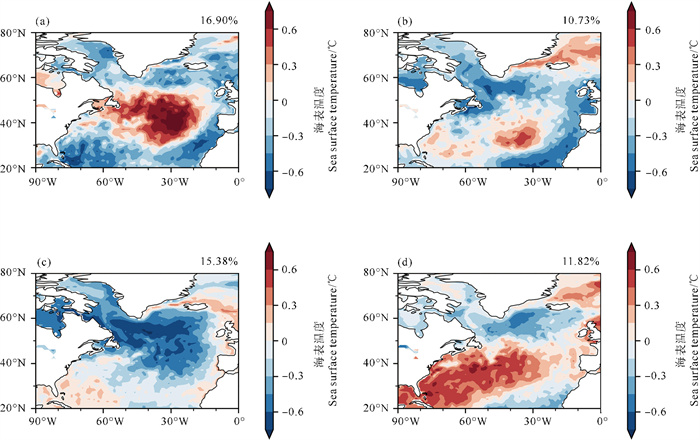
|
( 图右上角为模态所占方差百分比。The percentage of variance explained by the mode is shown in the upper right corner of the figure. ) 图 9 高低相关期北大西洋海温经验正交函数(a)第一模态(b)第二模态;(c), (d)同(a), (b)但是为低相关期 Fig. 9 The empirical orthogonal function of the North Atlantic SST during high epoch (a) first pattern and (b) second pattern; (c) first pattern and (d) second pattern during low epoch |
| [1] |
时晓曚. 中高纬海洋对中国东北部气候变化影响的研究[D]. 青岛: 中国海洋大学, 2014. Shi X M. The Impact of the Mid-High Latitude Oceans on Climate Change over North and Northeast China[D]. Qingdao: Ocean University of China, 2014. (  0) 0) |
| [2] |
Chen S W, Chen W, Wei K. Recent trends in winter temperature extremes in eastern China and their relationship with the Arctic Oscillation and ENSO[J]. Advances in Atmospheric Sciences, 2013, 30: 1712-1724. DOI:10.1007/s00376-013-2296-8 ( 0) |
| [3] |
Hurrell J W, Van L, H. Decadal variations in climate associated with the North Atlantic Oscillation[J]. Climatic Change at High Elevation Sites, 1997, 36: 301-326. ( 0) |
| [4] |
Wang M, Tan B. Two types of the Scandinavian Pattern: Their formation mechanisms and climate impacts[J]. Journal of Climate, 2020, 33(7): 2645-2661. DOI:10.1175/JCLI-D-19-0447.1 ( 0) |
| [5] |
Peng S, Robinson W A, Li S. Mechanisms for the NAO responses to the North Atlantic SST tripole[J]. Journal of Climate, 2003, 16(12): 1987-2004. DOI:10.1175/1520-0442(2003)016<1987:MFTNRT>2.0.CO;2 ( 0) |
| [6] |
Pan L L. Observed positive feedback between the NAO and the North Atlantic SSTA tripole[J]. Geophysical Research Letters, 2005, 32(6): 83-100. ( 0) |
| [7] |
王庭轩. 秋季北大西洋马蹄型海温模态与我国初冬气温异常的联系[D]. 南京: 南京信息工程大学, 2023. Wang T X. The Relationship Between the North Atlantic Horseshoe Sea Surface Temperature Pattern During Autumn and the Anomaly Early Winter Temperatures in China[D]. Nanjing: Nanjing University of Information and Technology, 2023. ( 0) |
| [8] |
Song Y, Chen H. Influence of thelate-winter North Atlantic tripole sea surface temperature anomalies on spring land surface temperature in mid-to-high latitudes of Western Eurasia[J]. Journal of Climate, 2023, 36(15): 4933-4950. DOI:10.1175/JCLI-D-22-0846.1 ( 0) |
| [9] |
Jung O, Sung M K, Sato K, et al. How does the SST variability over the western North Atlantic ocean control Arctic warming over the Barents-Kara seas?[J]. Environmental. Research Letters, 2017, 12(3): 034021. DOI:10.1088/1748-9326/aa5f3b ( 0) |
| [10] |
Wang L, Liu Y, Zhang Y, et al. Time-varying structure of the wintertime Eurasian pattern: Role of the North Atlantic sea surface temperature and atmospheric mean flow[J]. Climate Dynamics, 2019, 52(3): 2467-2479. ( 0) |
| [11] |
Chen S, Wu R. Interdecadal changes in the relationship between interannual variations of spring North Atlantic SST and Eurasian surface air temperature[J]. Journal of Climate, 2017, 30(10): 3771-3787. DOI:10.1175/JCLI-D-16-0477.1 ( 0) |
| [12] |
Deser C, Alexander M A, Xie S P, et al. Sea surface temperature variability: Patterns and mechanisms[J]. Annual Review of Marine Science, 2010, 2: 115-143. DOI:10.1146/annurev-marine-120408-151453 ( 0) |
| [13] |
Peixoto J P, Oort A H. Physics of Climate[M]. American: American Institute of Physics, 1992.
( 0) |
| [14] |
Nie Y, Ren H L, Zhang Y. The role of extratropical air-sea interaction in the autumn subseasonal variability of the North Atlantic Oscillation[J]. Journal of Climate, 2019, 32(22): 7697-7712. DOI:10.1175/JCLI-D-19-0060.1 ( 0) |
| [15] |
Bretherton C S, Smith C, Wallace J M. An intercomparison of methods for finding coupled patterns in climate data[J]. Journal of Climate, 1992, 5(6): 541-560. DOI:10.1175/1520-0442(1992)005<0541:AIOMFF>2.0.CO;2 ( 0) |
| [16] |
Barnes E A, Hartmann D L. Dynamical feedbacks and the persistence of the NAO[J]. Journal of the Atmospheric Sciences, 2010, 67(3): 851-865. DOI:10.1175/2009JAS3193.1 ( 0) |
| [17] |
Lau N C, Holopainen E O. Transient eddy forcing of the time-mean flow as identified by geopotential tendencies[J]. Journal of the Atmospheric Sciences, 1984, 41(3): 313-328. DOI:10.1175/1520-0469(1984)041<0313:TEFOTT>2.0.CO;2 ( 0) |
| [18] |
Small R J, Tomas R A, Bryan F O. Storm track response to ocean fronts in a global high-resolution climate model[J]. Climate Dynamics, 2014, 43(3): 805-828. ( 0) |
| [19] |
Tao L, Fang J, Yang X, et al. Role of North Atlantic tripole SST in mid-winter reversal of NAO[J]. Geophysical Research Letters, 2023, 50: e2023GL103502. DOI:10.1029/2023GL103502 ( 0) |
| [20] |
Eady E T. Long waves and cyclone waves[J]. Tellus, 1949, 1: 33-52. ( 0) |
| [21] |
Shaman J, Samelson R M, Skyllingstad E. Air-sea fluxes over the Gulf Stream region: Atmospheric controls and trends[J]. Journal of Climate, 2010, 23(10): 2651-2670. DOI:10.1175/2010JCLI3269.1 ( 0) |
| [22] |
Sardeshmukh P D, Hoskins B J. The generation of global rotational flow by steady idealized tropical divergence[J]. Journal of the Atmospheric Sciences, 1988, 45(7): 1228-1251. DOI:10.1175/1520-0469(1988)045<1228:TGOGRF>2.0.CO;2 ( 0) |
| [23] |
Hu K, Huang G, Wu R, et al. Structure and dynamics of a wave train along the wintertime Asian jet and its impact on East Asian climate[J]. Climate Dynamics, 2018, 51(11): 4123-4137. ( 0) |
| [24] |
Takaya K, Nakamura H. A formulation of a phase-independent wave-activity flux for stationary and migratory quasigeostrophic eddies on a zonally varying basic low[J]. Journal of the Atmospheric Sciences, 2001, 58(6): 608-627. DOI:10.1175/1520-0469(2001)058<0608:AFOAPI>2.0.CO;2 ( 0) |
| [25] |
Kosaka Y, Nakamura H. Structure and dynamics of the summertime Pacific-Japan teleconnection pattern[J]. Quarterly Journal of the Royal Meteorological Society, 2006, 132(619): 2009-2030. DOI:10.1256/qj.05.204 ( 0) |
| [26] |
Zhu Y, Newell R E. A proposed algorithm for moisture fluxes from atmospheric rivers[J]. Monthly Weather Review, 1998, 126(3): 725-735. DOI:10.1175/1520-0493(1998)126<0725:APAFMF>2.0.CO;2 ( 0) |
| [27] |
Yanai M, Esbensen S, Chu J H. Determination of bulk properties of tropical cloud clusters from large-scale heat and moisture budgets[J]. Journal of the Atmospheric. Sciences, 1973, 30(4): 611-627. DOI:10.1175/1520-0469(1973)030<0611:DOBPOT>2.0.CO;2 ( 0) |
| [28] |
Yanai M, Li C, Song Z. Seasonalheating of the Tibetan plateau and its effects on the evolution of the Asian summer monsoon[J]. Journal of the Meteorological Society of Japan. Ser. Ⅱ, 1992, 70(1B): 319-351. DOI:10.2151/jmsj1965.70.1B_319 ( 0) |
| [29] |
Xie X, Jia Y, Han Z. The Gulf Stream front amplifies large-scale SST feedback to the atmosphere in North Atlantic winter[J]. Atmosphere, 2023, 14(12): 1758. DOI:10.3390/atmos14121758 ( 0) |
| [30] |
Ma X, Jia Y, Han Z. Impact of the Gulf Stream front on atmospheric rivers and Rossby wave train in the North Atlantic[J]. Climate Dynamics, 2024, 62(7): 5827-5843. ( 0) |
| [31] |
Pang B, Scaife A A, Lu R, et al. Interdecadal variations of the Scandinavian pattern[J]. Journal of Climate, 2023, 36(10): 3275-3288. DOI:10.1175/JCLI-D-22-0494.1 ( 0) |
| [32] |
Essa Y H, Cagnazzo C, Madonna F, et al. Intercomparison of atmospheric upper-air temperature from recent global reanalysis datasets[J]. Frontiers in Earth Science, 2022, 10. ( 0) |
| [33] |
Kushnir Y, Robinson W A, Bladé I, et al. Atmospheric GCM response to extratropical SST anomalies: synthesis and evaluation[J]. Journal of Climate, 2002, 15(16): 2233-2256. DOI:10.1175/1520-0442(2002)015<2233:AGRTES>2.0.CO;2 ( 0) |
| [34] |
Zhou G. Atmospheric response to sea surface temperature anomalies in the mid-latitude oceans: A brief review[J]. Atmosphere-Ocean, 2019, 57(5): 319-328. DOI:10.1080/07055900.2019.1702499 ( 0) |
| [35] |
Sung M K, Kim S H, Kim B M, et al. Interdecadal variability of the warm Arctic and cold Eurasia pattern and its North Atlantic origin[J]. Journal of Climate, 2018, 31(15): 5793-5810. DOI:10.1175/JCLI-D-17-0562.1 ( 0) |
2. Xinyang Meteorological Observatory, Xinyang 464000, China