 2025, Vol. 55


2. 大连市气象台,辽宁 大连 116001
湾流(gulf stream,GS)区域(含延伸体区)分布着强的、大尺度海表温度(sea surface temperature,SST)锋面, 其梯度在晚冬可超过10 K/200 km[1],是冬季海气相互作用最剧烈的地区之一。受强SST梯度影响,感热通量在海洋锋面南北两侧有着很大的经向差异,这导致大气风暴轴被“锚定”在海洋锋上空[2]。与此同时,表征风暴轴和涡旋活动是否活跃的涡动动能(eddy kinetic energy,EKE)同样在此地有一极值中心[3],温带气旋也常在GS区迅速加强[4]。当温带气旋位于海洋锋区时,中尺度SST异常为气旋提供了更加湿润的环境,这有利于非绝热加热和平均有效位能(mean available potential energy,MAPE)转化为涡动有效位能(eddy available potential energy,EAPE)以及EAPE转化为EKE,从而促进气旋发展[5]。然而,随着温带气旋在GS区上空发展,海洋锋在气旋内EAPE和EKE的变化中所起到的作用尚未有深入研究。
关于海洋锋强度对气旋的影响,Small等[6]和Tsopouridis等[7]都指出,海洋锋可改变气旋的活动频次,SST梯度变小将导致气旋活动减少。此外,de Vries等[8]还发现,海洋锋可改变气旋强度。在SST梯度变化后,与气旋发展密切相关的潜热通量和低空大气斜压性都将作出响应,其中,前者可影响边界层过程(如垂直混合)和非绝热过程,后者可影响从大气低层到对流层中层的温度结构,这两个重要因素共同作用于气旋强度。而海洋锋在影响气旋强度的同时,也影响着气旋内的暖输送带。暖输送带是气旋内暖湿的上升气流[9-10],与气旋北侧的强上升运动直接相关。Booth等[11]对GS区的一个迅速加强的气旋进行了数值试验研究,发现气旋中的暖输送带对海洋锋暖侧的海温变化的响应和它对海洋锋强度变化的响应同等重要。Sheldon等[12]的结果则表明,GS区海洋锋南侧的暖海温使得暖输送带中的气块在向高纬运动的过程中始终保持较高的等效位温,这有利于气块上升至对流层上层。另外,Hirata等[13-15]的一系列工作又进一步明确了气旋内的暖输送带和冷输送带与海洋锋之间的相互作用对气旋的发展具有重要影响。但海洋锋影响气旋内上升气流发展变化的物理机制还未有深入探讨。
总之,前人研究表明,海洋锋通过影响大气水汽含量和斜压性改变着气旋内的大气背景层结以及暖输送带,从而加强了气旋。但是,海洋锋在气旋内上升气流的发展以及能量转换中所起到的作用尚不清楚。针对上述问题,本文将主要利用公共大气模式(community atmosphere model version 5,CAM5)的逐日数据,使用SLP异常场识别气旋,通过对相关物理量场进行合成分析并对比控制试验和弱锋面试验(平滑试验)的结果,探究海洋锋影响气旋性扰动异常内上升气流的物理机制。
1 模式简介与数据、研究方法 1.1 模式简介与数据本文使用的是公共地球系统模式(community earth system model,CESM)的大气分量模式即CAM5,其空间分辨率约为0.25°×0.25°。模式对2000—2013年间的13个冬季(DJF)进行模拟,每次从12月1日积分至翌年2月28日(90 d),共积分13次,以此得到13个冬季的逐日输出数据。为了减少模式启动对结果的影响,本文取每年冬季后74 d(12月17日至翌年2月28日)的数据进行分析。这样,13 a的时间样本共有962个。为探讨海洋锋的作用,本文设计了各有5个子集的控制试验和平滑试验,各子集的大气初始场是不同的。另外,驱动控制试验的SST场为最优插值海表温度(optimum interpolation sea surface temperature,OISST)的逐日资料(空间分辨率为0.25°×0.25°);驱动平滑试验的SST场是对GS区域(25°N—57°N,81.25°W—20°W)内的SST进行4°×4°的Boxcar空间滤波后得到的。在平滑后,该区域内SST场的标准差减弱了30%~50%。各试验设置及平滑前后的SST场详见文献[16]。该数值试验结果揭示了GS区海洋锋面对风暴轴和大气中的水汽输送存在显著影响[16]。
1.2 研究方法 1.2.1 气旋的识别以及对有无气旋的判定本文使用海平面气压(sea level pressure,SLP)异常场来识别气旋性扰动异常,具体算法可参考文献[17],其主要步骤如下:首先把SLP场减去气候平均值得到异常场,然后将SLP异常极小值的位置确定为气旋性扰动异常的中心;接着确定包含某一气旋性扰动异常中心的最外围闭合SLP异常等值线,该等值线以内的区域即为气旋性扰动异常区域。在本文中,如果气旋性扰动异常中心位于GS区(35°N—55°N,80°W—30°W)内,则视为该区域内存在气旋性扰动异常。需要说明的是,为避免无法在GS区边缘检测出气旋性扰动异常最外围的闭合等值线,在进行气旋性扰动异常识别时,本文扩大了SLP异常场的空间范围,具体为0°—90°N,179°W—120°E。
1.2.2 非绝热加热率的计算本文使用倒算法[18]来计算非绝热加热率,具体计算公式如下:
| $ Q_1=c_{\mathrm{p}}\left(\frac{p}{P_0}\right)^{\frac{R}{c_{\mathrm{p}}}}\left(\frac{\partial \theta}{\partial t}+\boldsymbol{V} \cdot \nabla \theta+\omega \frac{\partial \theta}{\partial p}\right) 。$ | (1) |
式中:Q1是视热源;cp是比定压热容;R是比气体常数;θ是位温;V是水平风矢量;ω是P坐标系下的垂直速度;P0=1 000 hPa;
为考察在气旋性扰动异常发展过程中海洋锋对扰动异常内上升气流及能量转换的影响,本文分别讨论了EKE和EAPE方程各项。其中,EKE方程如下[3]:
| $ \begin{gathered} \frac{\partial K^{\prime}}{\partial t}=-\nabla_3 \cdot\left(\boldsymbol{V}_{\mathrm{M}} K^{\prime}+\varPhi^{\prime} \boldsymbol{V}_3^{\prime}\right)-\boldsymbol{V}^{\prime} \cdot\left(\boldsymbol{V}_3^{\prime} \cdot\right. \\ \left.\nabla_3 \boldsymbol{V}_{\mathrm{M}}\right)-\omega^{\prime} \alpha^{\prime}-\boldsymbol{V}^{\prime} \cdot\left(\boldsymbol{V}_{3 \mathrm{~T}}^{\prime} \cdot \nabla_3 \boldsymbol{V}_{\mathrm{T}}\right)^{\prime}+\boldsymbol{F}_{\mathrm{r}}^{\prime} \cdot \boldsymbol{V}^{\prime}。\end{gathered} $ | (2) |
式中:()′表示2~10 d带通滤波,下标M和T分别表示某变量的时间平均值(2000—2012年冬季的时间平均值)以及某变量减去时间平均值后的扰动值,这里,
| $ \begin{aligned} & \frac{\partial A^{\prime}}{\partial t}=-\nabla_3 \cdot\left(\boldsymbol{V}_{3 \mathrm{M}} A^{\prime}\right)+\frac{\alpha_{\mathrm{M}}}{\theta_{\mathrm{M}} \varGamma} \boldsymbol{V}^{\prime} \theta^{\prime} \cdot \nabla \theta_{\mathrm{M}}+\omega^{\prime} \alpha^{\prime}+ \\ & \frac{\alpha_{\mathrm{M}}}{\theta_{\mathrm{M}} \varGamma} \theta^{\prime} \cdot\left(\boldsymbol{V}_{3 \mathrm{~T}} \cdot \nabla_3 \theta_{\mathrm{T}}\right)^{\prime}-\frac{\alpha_{\mathrm{M}}}{\theta_{\mathrm{M}} c_{\mathrm{p}} \varGamma} \theta^{\prime} Q_1{ }^{\prime}\left(\frac{P_0}{p}\right)^{R / c_{\mathrm{p}}}。\end{aligned} $ | (3) |
式中:
在分析EKE和EAPE方程各项的平面分布时,本文使用了孙照渤和朱伟军[23]所定义的质量加权的垂直平均算子,以探究整层大气的能量分布特征。对任一变量Z,该算子的定义如下:
| $ \hat{Z}=\frac{1}{p_{\mathrm{s}}-p_{\mathrm{t}}} \int_{p_{\mathrm{t}}}^{p_{\mathrm{s}}} Z \mathrm{~d} p 。$ | (4) |
式中:ps取1 000 hPa,pt取100 hPa。
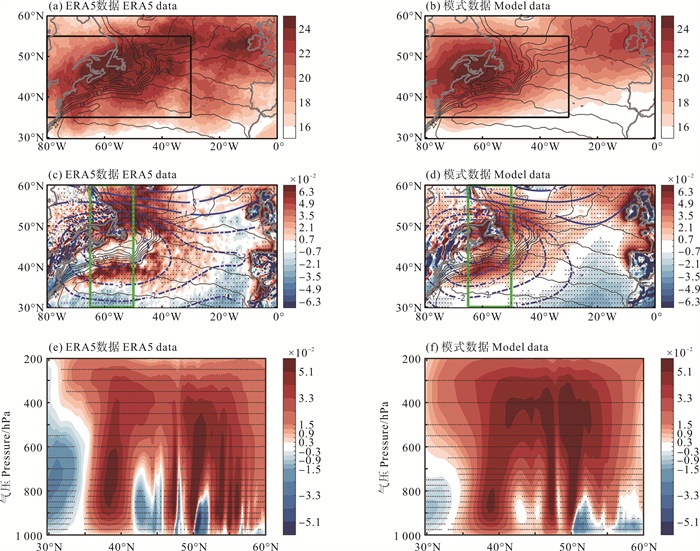
2 GS区海洋锋对气旋内上升气流的加强作用 2.1 GS区气旋内上升气流的发展过程为验证模式模拟结果,本文对比了控制试验数据和ERA5再分析资料。图 1(a)和1(b)给出了北大西洋中部的气旋性扰动异常发生频率(2000—2012年冬季)。在控制试验中,气旋性扰动异常活动最频繁的区域主要位于GS区,此处的扰动异常发生频率高达25%。这与ERA5结果一致,也和Wu等[24]计算得到的风暴轴大值区对应。另外,在控制试验里,气旋性扰动异常出现在GS区的天数占总天数的41%,和ERA5结果(47%)相近。为探讨GS区海洋锋上空的气旋性扰动异常的发展变化特征,本文依据气旋性扰动异常发生频率的分布特征选取了一范围(35°N—55°N,80°W—30°W,见图 1(a)中的黑框),并对出现在该区域的气旋性扰动异常进行固定区域的合成分析。由SLP异常的合成结果可见,与ERA5结果(-4.7 hPa)较为一致,模式里的SLP负异常的最大强度约为-5.6 hPa,其中心位于GS区海洋锋北侧(见图 1(c),1(d))。而为了考察气旋性扰动异常内上升气流的特征,图 1(c)和1(d)还给出了700 hPa处的垂直速度(-ω)原始场的分布。当气旋性扰动异常位于GS区海洋锋上空时,其内部存在南北两支上升流: 一支位于海洋锋南侧,这是海洋锋通过压力调整机制而激发的次级环流的上升支[25-26],本文称之为南支上升流;另一支则位于海洋锋以北(扰动异常中心北侧),它主要因气旋性扰动异常的存在而产生,本文称之为北支上升流。下面,我们对气旋性扰动异常中心区域(65°W—50°W,见图 1(c)中的绿框)的-ω进行纬向平均,从而得到其垂直剖面,以讨论上升气流的垂向分布特征。需要指出的是,在后续分析中,经向-气压剖面也都经过了同样的纬向平均处理。从图 1(e)和1(f)可以更清楚地看到,南支上升流位于海洋锋南侧(40°N以南),在气旋性扰动异常的作用下而形成的北支上升流位于50°N附近、扰动异常中心的北侧,且后者的强度更强。Gong等[27]也研究了冬季北大西洋(60°W以东)的温带气旋,他们建立了以气旋中心为原点的坐标系,并在此坐标系下对垂直速度进行了合成分析。虽然研究区域和本文有所差别,方法与本文使用的合成方法不同,但他们同样发现,强上升运动存在于气旋以北、900~400 hPa上空。依据Dacre等[28]的工作可知,这里的上升运动和气旋东侧的暖输送带直接相关。
|
( (a)—(b)中的黑框为本文划定的GS区域,其范围是(35°N—55°N,80°W—30°W);(c)—(d)中的蓝色等值线分别代表利用ERA5数据和控制试验数据得到的第0天SLP异常的合成(单位:hPa);(c)—(d)中的绿色方框划定了一个纬向范围(65°W—50°W),为分析各相关变量的垂直结构,文章对此范围内的变量进行纬向平均,而后得到经向-气压剖面图。黑色等值线为2000—2012年的冬季平均SST(单位:℃);灰色散点表示通过了显著性水平为5%的t检验。The black box in (a)—(b) is the GS region delineated in this paper, which ranges from (35°N—55°N, 80°W—30°W). Blue contours in (c)—(d) represent composites of SLP anomaly on day 0 derived from ERA5 data and data in control experiment, respectively (Unit: hPa). The green box in (c)—(d) delineates a latitudinal range (65°W—50°W). To analyze the vertical structure of each related variable, the variables in this range are averaged in the latitudinal direction, and then meridional-pressure profiles are obtained. Black contours represent mean SST in winter from 2000 to 2012 (Unit: ℃). Grey scatters indicate the composites and differences passed t test with a significance level of 5%. ) 图 1 使用ERA5数据和控制试验数据得到的2000—2012年冬季的气旋性扰动异常发生频率((a),(b),填色,单位:%)、第0天700 hPa处的垂直速度(填色,单位:Pa·s-1)的合成((c),(d))以及第0天的垂直速度(填色,单位:Pa·s-1)的剖面((e),(f)) Fig. 1 Cyclonic turbulence frequency(shading, Unit: %) of wintertime in 2000—2012 ((a), (b)), composites of 700 hPa vertical velocity(shading, Unit: Pa·s-1) on day 0 ((c), (d)) and vertical profiles of vertical velocity(shading, Unit: Pa·s-1) on day 0 ((e), (f))) derived from ERA5 data and data in control experiment |
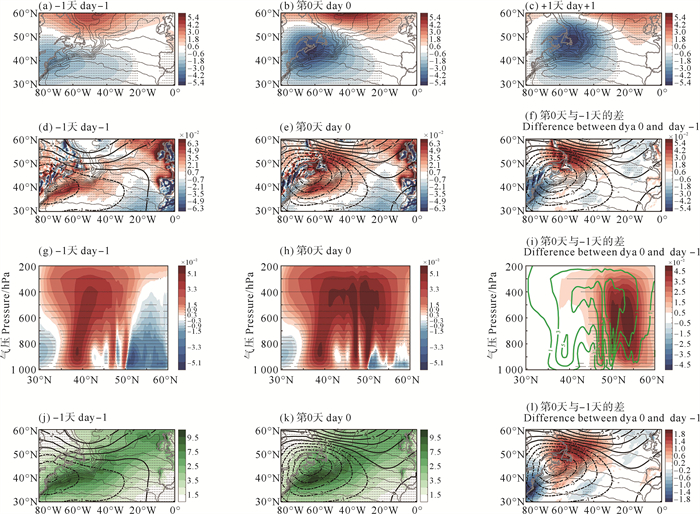
为考察气旋性扰动异常中各变量的发展演变情况,本文基于合成分析结果,将气旋性扰动异常中心到达GS区海洋锋上空时定义为第0天,把气旋性扰动异常中心到达海洋锋上空的前一天和后一天定义为-1天和+1天。在-1天时,气旋性扰动异常前部已到达海洋锋上空(见图 2(a))。在第0天,与前一天相比,扰动异常中心的SLP异常加强了约80%(见图 2(b))。而到了+1天,SLP负异常的最值基本不变,其中心向东北方向移动(见图 2(c))。从垂直速度来看,在-1天,仅存在南支上升流(见图 2(d),2(g));到了第0天,随着扰动异常的加强,位于50°N附近的北支上升流形成(见图 2(e)—2(f),2(h)—2(i)),且此处上升气流的最大强度超过0.05 Pa/s,可影响300 hPa附近的高空(见图 2(h))。此外,随着气旋性扰动异常的发展和上升运动的加强,扰动异常中心北侧的降水也在第0天加强了约10%~80%(见图 2(j)—2(l))。
|
( 图中变量均为控制试验的数据。(a)—(c)分别为-1天、第0天和+1天的SLP异常的合成(填色,单位:hPa)。(d)—(e)分别为-1天和第0天的700 hPa处的垂直速度的合成(填色,单位:Pa·s-1);(f)为第0天与-1天的700 hPa处的垂直速度之差(填色,单位:Pa·s-1)。(g)—(i)同(d)—(f),但为垂直速度剖面(填色,单位:Pa·s-1)。(j)—(l)同(d)—(f),但为降水量(填色,单位:mm·d-1)。(d),(j)中的黑色粗等值线为-1天的SLP异常的合成(单位:hPa);(e),(f),(k),(l)中的黑色粗等值线为第0天的SLP异常的合成(单位:hPa);(i)中的绿色等值线为第0天垂直速度剖面(单位:Pa·s-1)。黑色细等值线为2000—2012年的冬季平均SST(单位:℃),灰色散点表示通过了显著性水平为5%的t检验。All these variables are derived from control experiment. (a)—(c) are composites of SLP anomaly on day-1, day 0, and day +1, respectively (shading, Unit: hPa). (d)—(e) are composites of 700 hPa vertical velocity on day-1, and day 0, respectively (shading, Unit: Pa·s-1). And (f) is the difference between 700 hPa vertical velocity on day 0 and day-1 (shading, Unit: Pa·s-1). (g)—(i) as in (d)—(f), but for vertical profiles of vertical velocity (shading, Unit: Pa·s-1). (j)—(l) as in (d)—(f), but for precipitation (shading, Unit: mm·d-1). Black thick contours in (d), (j) represent composites of SLP anomaly on day -1 (Unit: hPa). Black thick contours in (e), (f), (k), (l) represent composites of SLP anomaly on day 0 (Unit: hPa). Green contours in (i) represent vertical profiles of vertical velocity on day 0 (Unit: Pa·s-1). Black thin contours represent mean SST in winter from 2000 to 2012 (Unit: ℃). Grey scatters indicate the composites and differences passed t test with a significance level of 5%. ) 图 2 气旋性扰动异常发展过程中SLP异常((a),(b),(c))、700 hPa处的垂直速度((d),(e),(f))、垂直速度剖面((g),(h),(i))、降水量((j),(k),(l))的分布及变化 Fig. 2 The distribution and variation of SLP anomaly ((a), (b), (c)), 700 hPa vertical velocity ((d), (e), (f)), vertical profiles of vertical velocity ((g), (h), (i)), and precipitation ((j), (k), (l)) in the process of the development of cyclonic turbulence |
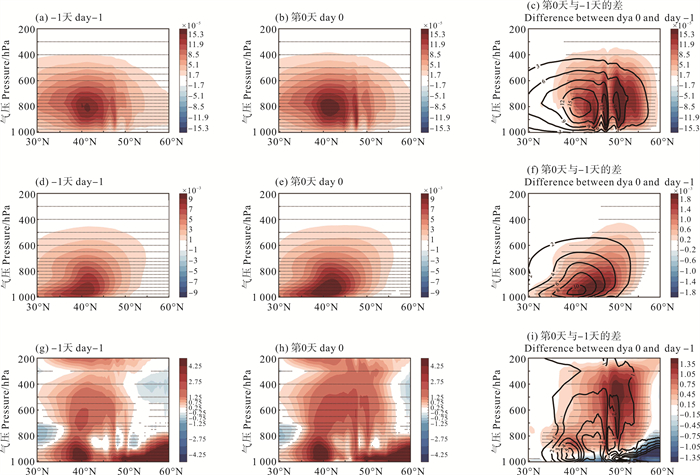
接下来,本文进一步讨论了涡动水汽通量。涡动水汽通量在水汽输送中具有重要意义[29],它影响着局地降水和蒸发过程。由图 3(a)和3(d)可知,垂向和经向的涡动水汽通量大值区均主要位于海洋锋北侧(40°N—45°N),随着气旋性扰动异常的发展,第0天的垂向涡动水汽通量主要在50°N附近显著变大(见图 3(a)—3(c)),这是由北支上升流的发展所造成的。而第0天的经向涡动水汽通量主要在40°N—50°N处(扰动异常中心附近)显著增强(见图 3(d)—3(f)),表明海洋锋上空的海气相互作用过程增强了向气旋性扰动异常的水汽输送。这有利于气旋性扰动的进一步发展。此外,从非绝热加热率的垂直剖面图能更清楚地看到,在水汽输送变强的背景下,伴随着强上升运动,气旋性扰动异常中心以北的非绝热加热也显著加强(见图 3(g)—3(i)),这和垂直速度以及降水量的变化是大体对应的。
|
( 图中变量均为控制试验的数据。(a)—(b)分别为-1天和第0天的垂向涡动水汽通量(-ω’q’,填色,单位:Pa·kg·s-1·kg-1)的合成,(c)是第0天与-1天的垂向涡动水汽通量(填色,单位:Pa·kg·s-1·kg-1)之差以及第0天的垂向涡动水汽通量的合成(等值线,单位:Pa·kg·s-1·kg-1); (d)—(f)同(a)—(c),但为经向涡动水汽通量(v’q’,单位:m·kg·s-1·kg-1); (g)—(i)同(a)—(c),但为非绝热加热率(单位:K·d-1)。灰色散点表示通过了显著性水平为5%的t检验。All these variables are derived from control experiment. (a) —(b) are composites of vertical eddy moisture flux (-ω'q', shading, Unit: Pa·kg·s-1·kg-1) on day-1 and day 0, respectively. (c) are the difference between vertical eddy moisture flux(shading, Unit: Pa·kg·s-1·kg-1) on day 0 and day-1, and composites of vertical eddy moisture flux on day 0 (contours, Unit: Pa·kg·s-1·kg-1). (d) —(f) as in (a) —(c), but for meridional eddy moisture flux (v'q', Unit: m·kg·s-1·kg-1). (g) —(i) as in (a) —(c), but for diabatic heating rate (Unit: K·d-1). Grey scatters indicate the composites and differences passed t test with a significance level of 5%. ) 图 3 气旋性扰动异常发展过程中垂向涡动水汽通量((a),(b),(c))、经向涡动水汽通量((d),(e),(f))和非绝热加热率((g),(h),(i))的垂直分布及变化 Fig. 3 The vertical distribution and variation of vertical eddy moisture flux ((a), (b, ) (c)), meridional eddy moisture flux ((d), (e), (f)), and diabatic heating rate ((g), (h), (i)) in the process of the development of cyclonic turbulence |
总之,随着气旋性扰动异常在GS区海洋锋上空迅速发展,强烈的海气相互作用激发了气旋性扰动异常北侧(海洋锋以北)的强上升运动和高空非绝热加热的释放。那么,伴随着扰动异常快速加强,涡动能量是如何转换的?海洋锋又起着什么样的作用?为回答这些问题,我们将从EKE和EAPE方程入手,并分析在扰动异常发展过程中,海洋锋如何影响涡动能量收支变化。
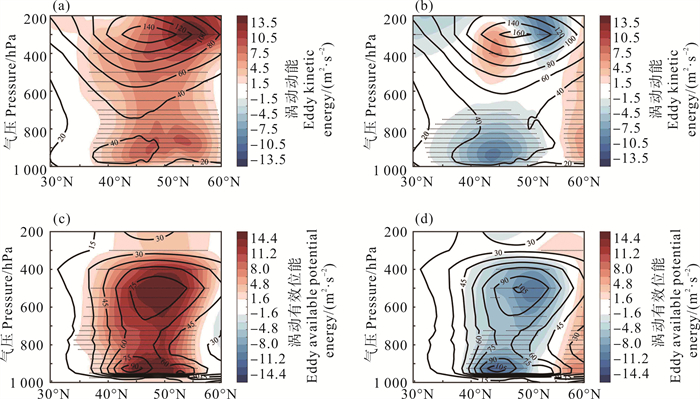
2.2 GS区气旋内上升气流快速发展的物理机制图 4给出了在气旋性扰动异常发展过程中的EKE和EAPE的垂向剖面。EKE的中心位于40°N—50°N、300 hPa附近(见图 4(a))。从-1天到第0天,EKE在45°N以北出现了大幅增长,其最大强度增加了约5.7%(见图 4(a)),和气旋性扰动异常在海洋锋上空快速加强一致。而到了+1天,它在50°N以南的低空减弱,在EKE大值中心以及55°N以北增强(见图 4(b)),表明气旋性扰动异常在向高空及向北发展。EAPE则有两个极值中心:一个位于低空海洋锋面北侧(40°N—50°N);另一个位于45°N以北、500 hPa上空附近(见图 4(c))。与-1天相比,第0天的EAPE主要在40°N—55°N大幅增强,其最大强度增大了约15.6%(见图 4(c)),为此处EKE的增强提供了能量来源。到了+1天,和EKE一致,它继续向北发展(见图 4(d))。
|
( 图中变量均为控制试验的数据。(a)—(b)中的变量为EKE(单位:m2·s-2),其中(a)为-1天的EKE合成(等值线)和第0天与-1天的EKE之差,(b)为第0天的EKE合成(等值线)和+1天与第0天的EKE之差;(c)—(d)同(a)—(b),但为EAPE(单位:m2·s-2)。灰色散点表示通过了显著性水平为5%的t检验。All these variables are derived from control experiment. The variable in (a) —(b) is EKE (Unit: m2·s-2). (a) are composites of EKE on day-1 (contours) and differences between EKE on day 0 and day-1, (b) are composites of EKE on day 0 (contours) and differences between EKE on day +1 and day 0. (c) —(d) as in (a) —(b), but for EAPE (Unit: m2·s-2). Grey scatters indicate the composites and differences passed t test with a significance level of 5%. ) 图 4 气旋性扰动异常发展过程中EKE((a),(b))和EAPE((c),(d))的垂直分布及变化 Fig. 4 The vertical distribution and variation of EKE ((a), (b)) and EAPE ((c), (d)) in the process of the development of cyclonic turbulence |
为探究气旋性扰动异常中的涡动能量转换和发展的物理机制,下面将对EKE和EAPE方程进行能量收支分析。能量学分析是我们理解大气环流的重要部分[3],最初由Lorenz[20]开展了一系列的开创性工作。对于局地能量收支分析,我们往往需要将某一基本变量看做时间平均量和扰动量之和[30],这也是本文采用的分析方法。Kuo等[31]发现,斜压动力过程和非绝热过程之间的非线性相互作用可导致温带气旋的生成和快速发展。因此我们推测,在气旋性扰动异常发展过程中,和斜压过程有关的斜压产生项、斜压转换项以及与非绝热过程相关的非绝热加热项对EKE和EAPE的变化起到了重要作用。为了验证这一猜想,我们接下来分析第0天的EKE、EAPE方程各项,比较它们对涡动能量变化的贡献。
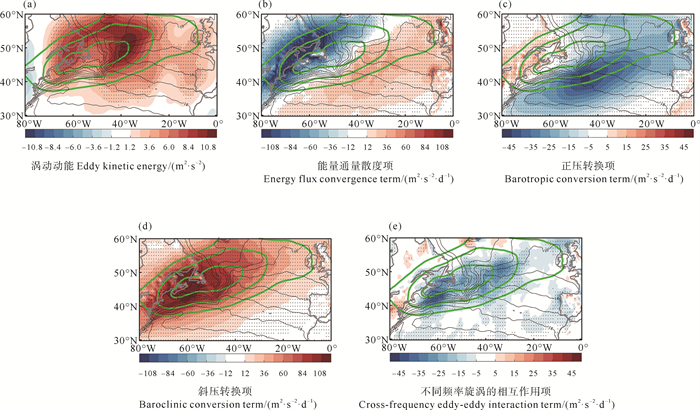
EKE的空间分布呈“西南-东北”走势,其最大强度超过80 m2·s-2(见图 5(a)),与Dai等[22]的结果相似。在EKE方程的各项中,斜压转换项为正,其大值区与EKE时间变化的大值区近乎重合,且它的最大强度超过了110 m2·s-2·d-1(见图 5(d)),是EKE最主要的源。曾鼎文等[32]也指出,在0°以西的区域,与斜压转换项相关的斜压转换机制是促进EKE增强的最主要机制。能量通量散度项在北美大陆东部以及海盆西侧有着很强的负值,在东部海域则有着较弱的正值(见图 5(b))。该项的作用是把EKE再分配到下游(东部)斜压性更弱的地区,使风暴轴向下游延伸,即“下游发展效应”[33-34]。另外,正压转换项和不同频率涡旋的相互作用项总体上起到对高频EKE的耗散作用,且它们对EKE变化的贡献小于能量通量散度项和斜压转换项(见图 5(c),5(e))。通过对EKE方程的分析,我们发现能量通量散度项和斜压转换项是量级最大的两项,而斜压转换机制是EKE增长的最重要的物理机制。
|
( 图中变量均为控制试验的数据。(a)—(e)中的绿色等值线为第0天的垂直平均EKE的合成,等值线的数值分别为60、70和80 m2·s-2。黑色等值线为控制试验的2000—2012年的冬季平均SST(单位:℃)。灰色散点表示通过了显著性水平为5%的t检验。All these variables are derived from control experiment. Green contours in (a) —(e) represent composites of vertical average EKE on day 0 (contour level: 60, 70, 80 m2·s-2). Black contours represent mean SST of control experiment in winter from 2000 to 2012 (Unit: ℃). Grey scatters indicate the composites and differences passed t test with a significance level of 5%. ) 图 5 (a) 第0天与-1天的垂直平均的EKE之差、以及第0天的垂直平均的(b)能量通量散度项、(c)正压转换项、(d)斜压转换项、(e)不同频率涡旋的相互作用项的合成 Fig. 5 (a) Differences between vertical average EKE on day 0 and day -1, (b) vertical average energy flux convergence term, (c) vertical average barotropic conversion term, (d) vertical average baroclinic conversion term and (e) vertical average cross-frequency eddy-eddy interaction term on day 0 |
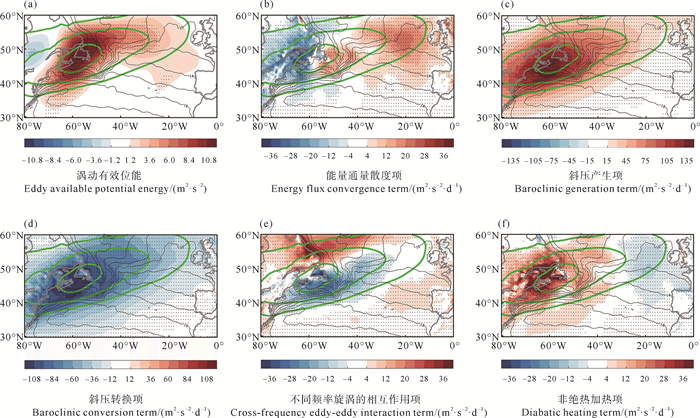
EAPE的空间分布同样呈“西南-东北”走势,且EAPE比EKE小(见图 6(a))。从方程各项来看,斜压产生项的空间分布和EAPE时间变化大体一致,其作用是把MAPE转化为EAPE;从数值上来看,此项最大,其最大值超过140 m2·s-2·d-1(见图 6(c)),故该项是EAPE最主要的源。斜压转换项在EAPE方程和EKE方程中大小相等、符号相反(见图 6(d)),是EAPE最主要的汇。能量通量散度项仍会将EAPE再分配到东部地区(60°W以东),但和EKE方程中的能量通量散度项不同,此项对EAPE的再分配作用相对更弱(见图 6(b))。不同频率涡旋的相互作用项则在高频EAPE的大值区及南侧起到耗散作用,此项较小(见图 6(e))。与Bui和Spengler[35]的工作一致,由于发现它对EKE和EAPE变化的贡献相对较小,本文略去了关于该项的讨论。此外,非绝热加热项量化了由非绝热过程所产生的EAPE[36],它在EAPE的大值区附近为正,是EAPE的另一个源(见图 6(f))。从各项的大小和作用可知,对EAPE来说,斜压产生项、斜压转换项和非绝热加热项更为主要。
|
( 图中变量均为控制试验的数据。(a)—(f)中的绿色等值线为第0天的垂直平均EAPE的合成,等值线的数值分别为35、50和65 m2·s-2。黑色等值线为控制试验的2000—2012年的冬季平均SST(单位:℃)。灰色散点表示通过了显著性水平为5%的t检验。All these variables are derived from control experiment. Green contours in (a) —(f) represent composites of vertical average EAPE on day 0 (contour level: 35, 50, 65 m2·s-2). Black contours represent mean SST of control experiment in winter from 2000 to 2012 (Unit: ℃). Grey scatters indicate the composites and differences passed t test with a significance level of 5%. ) 图 6 (a) 第0天与-1天的垂直平均的EAPE之差、以及第0天的垂直平均的(b)能量通量散度项、(c)斜压产生项、(d)斜压转换项、(e)不同频率涡旋的相互作用项、(f)非绝热加热项的合成 Fig. 6 (a) Differences between vertical average EAPE on day 0 and day -1, and (b) vertical average energy flux convergence term, (c) vertical average baroclinic generation term, (d) vertical average baroclinic conversion term, (e) vertical average cross-frequency eddy-eddy interaction term, and (f) vertical average diabatic heating term on day 0 |
为进一步考察EKE、EAPE方程各项在气旋性扰动异常发展过程中的变化,我们分析了斜压产生项、斜压转换项和非绝热加热项的垂向分布。作为EKE的源,斜压转换项的大值区位于45°N—50°N、600—500 hPa附近(见图 7(a))。如前所述,它代表着涡动热量垂向输送,说明EKE和EAPE之间的转换是通过冷暖空气的上升下沉运动来完成的。在第0天,此项在45°N以北迅速加强,其最大强度增加了约27%(见图 7(a)),这促进了此处向上的涡动热量输送和EKE的生成。作为EAPE最主要的源,与EAPE一致,斜压产生项在低空和500 hPa附近有两个极值中心(见图 7(b))。在第0天,该项在50°N附近的500 hPa处加强了40%以上(见图 7(b)),有利于MAPE转化为EAPE。同时,EAPE的增加也更有利于其转化为EKE,这和斜压转换项以及EKE在这一天大幅加强相对应。而作为EAPE的另一个源,非绝热加热项主要在垂直运动和非绝热加热率大幅变化的区域(50°N附近、800 hPa以上的高空)起作用(见图 7(c))。总之,我们通过能量收支分析发现,在气旋性扰动异常到达海洋锋上空时,其中心及北侧的EAPE和EKE显著加强,这与斜压产生项、非绝热加热项、斜压转换项有关。

|
( 图中变量均为控制试验的数据。等值线代表-1天的合成,填色的变量代表第0天与-1天的差。灰色散点表示通过了显著性水平为5%的t检验。All these variables are derived from control experiment. Contours represent composites on day-1, and shading variables represent differences between day 0 and day-1. Grey scatters indicate the composites and differences passed t test with a significance level of 5%. ) 图 7 在气旋性扰动异常发展过程中(a)斜压转换项、(b)斜压产生项和(c)非绝热加热项的垂直分布和变化 Fig. 7 The vertical distribution and variation of (a) baroclinic conversion term, (b) baroclinic generation term, and (c) diabatic heating term in the process of the development of cyclonic turbulence |
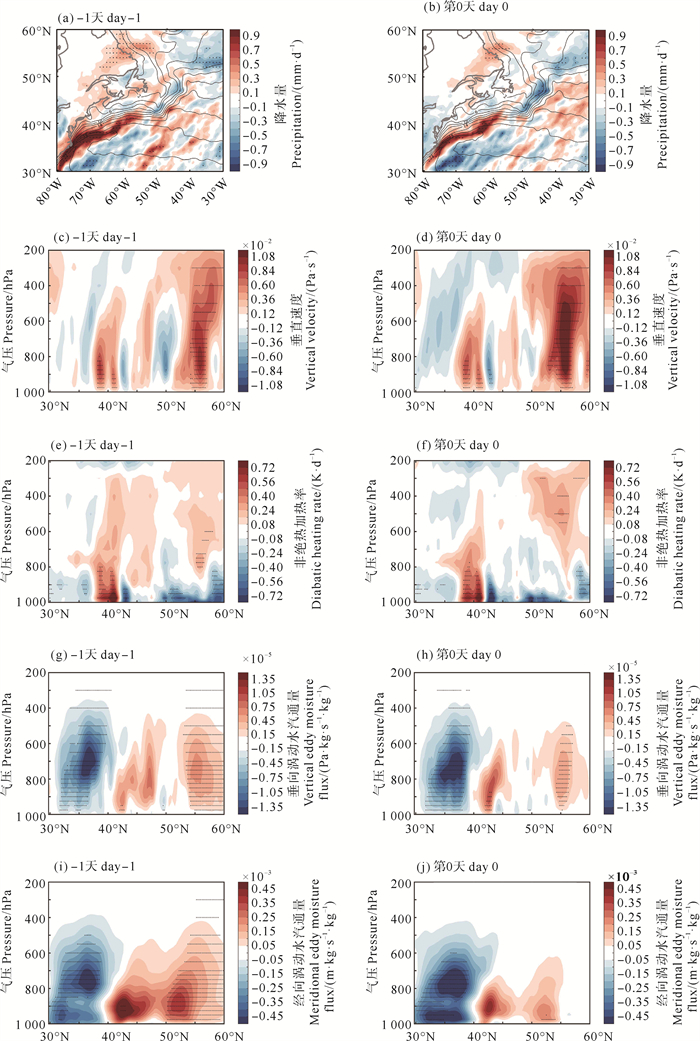
通过比较控制试验与平滑试验中的垂直速度及其它相关变量,我们可以探讨海洋锋面在气旋性扰动异常内上升气流快速发展中的作用。海洋锋面上空的降水对海洋锋的响应强于扰动异常中心以北(见图 8(a),8(b))。南北两支上升流则均对海洋锋强度的变化存在显著响应,随着气旋性扰动异常的发展,位于50°N北侧的北支上升流在海洋锋的作用下显著增强。而且从-1天到第0天,50°N以北的垂直速度对海洋锋强度变化的响应增强了约30%(见图 8(c),8(d))。此外,到了第0天,在北支上升流的影响下,控制试验中位于50°N北侧的降水(见图 8(b))和非绝热加热(见图 8(f))都显著加强,且55°N附近的非绝热加热正响应主要存在于高空(600 hPa以上),表明控制试验中该处有着深厚的对流降水机制。而从水汽输送对海洋锋的响应来看,垂向和经向涡动水汽通量均呈现向极地增强的特征(见图 8(g)—8(j))。另外,在40°N以北,垂向和经向涡动水汽通量对海洋锋的正响应和上升流较为一致(见图 8(d),8(h),8(j))。这表明,在控制试验中,通过向北和向高空的水汽输送,海洋锋为北支上升流的发展提供了水汽和能量来源。
|
( 第一列的各图为使用-1天的数据得到的结果;第二列的各图为使用第0天的数据得到的结果。灰色散点表示通过了显著性水平为5%的t检验。Figures in the first column are the results derived from data on day-1, and figures in the second column are the results derived from data on day 0. Grey scatters indicate the composites and differences passed t test with a significance level of 5%. ) 图 8 控制试验与平滑试验的降水量之差((a),(b))、垂直速度之差((c),(d))、非绝热加热率之差((e),(f))、垂向涡动水汽通量之差((g),(h))和经向涡动水汽通量之差((i),(j)) Fig. 8 Differences of precipitation ((a), (b)), vertical velocity ((c), (d)), diabatic heating rate ((e), (f)), vertical eddy moisture flux ((g), (h)), and meridional eddy moisture flux ((i), (j)) between control experiment and smoothing experiment |
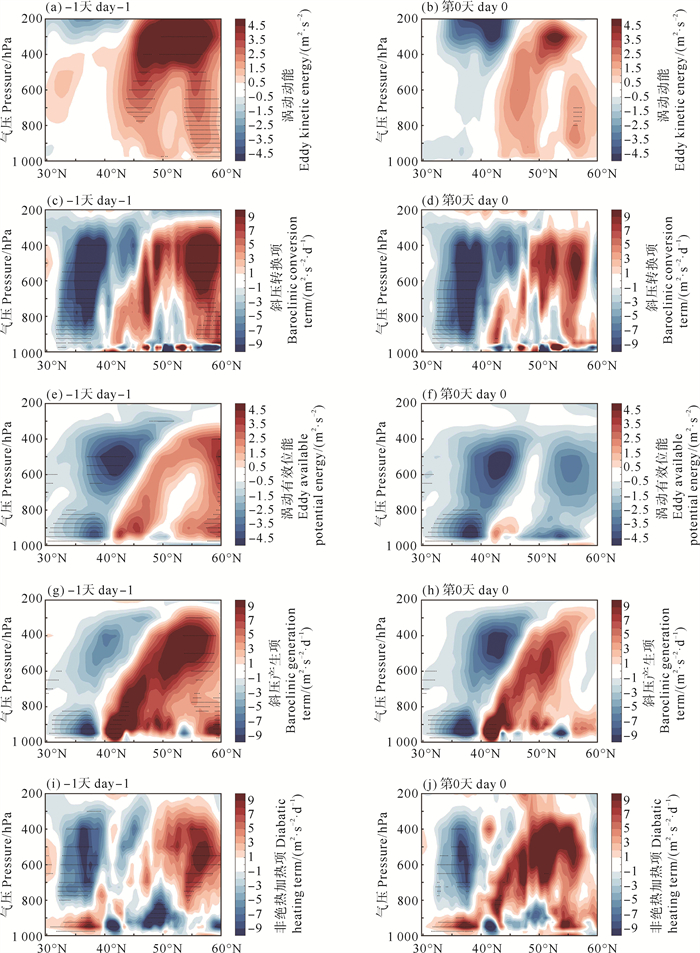
图 9给出了海洋锋对EKE和EAPE方程各主要项的影响。从第-1天到第0天,在海洋锋的作用下,EKE呈现南部减弱、北部加强的变化形态(见图 9(a),9(b)),和Small等[37]以及Foussard等[38]的结果一致。斜压转换项对海洋锋的响应和EKE对应也呈向北偏移的形态(见图 9(c),9(d)), 这是因为在海洋锋面以北,ω′和T′的相关性变高,EAPE向EKE的斜压转化效率随之变高[39]。另外,斜压转换项和EKE的增长幅度均在-1天更大(见图 9(a),9(c)),说明海洋锋的作用在气旋性扰动异常前部接触到海洋锋时(-1天)更强。从EAPE方程出发,注意到EAPE也呈南负北正的响应(见图 9(e),9(f))。而作为EAPE的源,斜压产生项同样在-1天的海洋锋北侧有更大幅度的增长(见图 9(g),9(h)),这是由于v′和T′在海洋锋北部的相关性变得更高,MAPE向EAPE的斜压转化效率也变得更高[39];高空非绝热加热项的响应则在第0天更大(见图 9(i),9(j)),与非绝热加热率的响应在第0天更大一致(见图 8(e),8(f))。
|
( 第一列的各图为使用-1天的数据得到的结果;第二列的各图为使用第0天的数据得到的结果。灰色散点表示通过了显著性水平为5%的t检验。Figures in the first column are the results derived from data on day-1, and figures in the second column are the results derived from data on day 0. Grey scatters indicate the composites and differences passed t test with a significance level of 5%. ) 图 9 控制试验与平滑试验的EKE之差((a),(b))、斜压转换之差((c),(d))、EAPE之差((e),(f))、斜压产生项之差((g),(h))和非绝热加热项之差((i),(j)) Fig. 9 Differences of EKE ((a), (b)), baroclinic conversion term ((c), (d)), EAPE ((e), (f)), baroclinic generation term ((g), (h)), and diabatic heating term ((i), (j)) between control experiment and smoothing experiment |
总之,在-1天,气旋性扰动异常中心位于40°N附近、海洋锋上空。依据Hirata等[13]的研究,此时,气旋西北部的冷输送带将干冷空气吹向暖湿的海洋锋南侧,从而释放出大量的水汽和潜热通量。这促进了海洋锋面上空的垂直上升运动,并进一步激发了强降水及高空非绝热加热。同时,在气旋性扰动异常内扰动风场的作用下,海洋锋将水汽及热量向扰动异常中心以北输送,因此EAPE方程中的斜压产生项对海洋锋的响应也显著增强。这加强了EAPE,并进一步导致EKE显著变大。而在第0天,受海洋锋影响,气旋性扰动异常内的北支上升流显著增强,这加强了扰动异常中心以北的降水和高空非绝热加热,所以EAPE方程中的非绝热加热项在第0天大幅加强。除此之外,斜压产生项也在第0天继续促进高空EKE变大。
3 结论本文主要利用CAM5模式结果,并结合ERA5再分析数据分析了位于GS区海洋锋上空的气旋内上升气流的特征、发展过程以及相关物理机制,通过比较由SST驱动的CAM5模式的控制试验和平滑试验结果,本文还探讨了GS区海洋锋在气旋内上升气流发展过程中的作用。研究表明:
(1) 当气旋性扰动异常中心位于海洋锋上空时,海洋锋上空及扰动异常中心以北(50°N附近)出现了两支强上升流。与前一天相比,垂直速度、降水和高空非绝热加热率都在扰动异常中心及其北侧(40°N以北)大幅加强(增强幅度超过50%),扰动异常内的EKE和EAPE也迅速变大。其中,对EAPE增长贡献最大的是斜压产生项和非绝热加热项,它们分别与向高纬的涡动热量输送以及非绝热加热率有关。而对EKE增长贡献最大的是斜压转换项,通过增强向高空的涡动热量输送,该项消耗EAPE并加强了气旋性扰动异常中心北侧的EKE。
(2) 在气旋性扰动异常中心到达海洋锋上空前后,海洋锋对气旋内上升气流、以及EAPE和EKE方程的影响不同。在气旋性扰动异常前部到达海洋锋上空时,扰动异常西北侧的干冷空气已经和暖湿洋面接触,受其影响,暖洋面上空出现了强的垂直上升运动、降水及高空加热;同时,受扰动异常内扰动风场的影响,向高纬的涡动热量和水汽输送迅速加强,锋面北侧的斜压产生项和EAPE也随之变大,这为气旋性扰动异常中心北侧(海洋锋面北侧)的EKE发展提供了能量来源。而在气旋性扰动异常中心到达海洋锋上空后,海洋锋对扰动异常中心以北的上升支、降水以及EAPE方程中的非绝热加热项的作用更强,这进一步增强了扰动异常北部的EAPE和EKE,从而继续促进了扰动异常发展。
本文使用的是海洋驱动的全球大气模式。实际上,模式的空间分辨率对涡旋活动的模拟结果具有重要影响[40],它的变化将改变气旋发展的速度[41]。因此,为进一步探究气旋和海洋锋的相互作用,利用海气耦合模式并采用更高分辨率的数值试验是我们下一步研究的方向。
| [1] |
Kelly K A, Small R J, Samelson R M, et al. Western boundary currents and frontal air-sea interaction: Gulf Stream and Kuroshio Extension[J]. Journal of Climate, 2010, 23(21): 5644-5667. DOI:10.1175/2010JCLI3346.1 (  0) 0) |
| [2] |
Nakamura H, Sampe T, Tanimoto Y, et al. Observed associations among storm tracks, jet streams and midlatitude oceanic fronts[C]//Earth's Climate: The Ocean-Atmosphere Interaction. Washington D C: American Geophysical Union, 2004: 329-345.
( 0) |
| [3] |
Jiang T, Deng Y, Li W. Local kinetic energy budget of high-frequency and intermediate-frequency eddies: Winter climatology and interannual variability[J]. Climate Dynamics, 2013, 41: 961-976. DOI:10.1007/s00382-013-1684-1 ( 0) |
| [4] |
Seiler C, Zwiers F W. How well do CMIP5 climate models reproduce explosive cyclones in the extratropics of the Northern Hemisphere[J]. Climate Dynamics, 2016, 46: 1241-1256. DOI:10.1007/s00382-015-2642-x ( 0) |
| [5] |
Ma X, Chang P, Saravanan R, et al. Importance of resolving Kuroshio front and eddy influence in simulating the North Pacific storm track[J]. Journal of Climate, 2017, 30(5): 1861-1880. DOI:10.1175/JCLI-D-16-0154.1 ( 0) |
| [6] |
Small R J, Msadek R, Kwon Y, et al. Atmosphere surface storm track response to resolved ocean mesoscale in two sets of global climate model experiments[J]. Climate Dynamics, 2019, 52: 2067-2089. DOI:10.1007/s00382-018-4237-9 ( 0) |
| [7] |
Tsopouridis L, Spengler T, Spensberger C. Smoother versus sharper gulf stream and Kuroshio sea surface temperature fronts: Effects on cyclones and climatology[J]. Weather and Climate Dynamics, 2021, 2(4): 953-970. DOI:10.5194/wcd-2-953-2021 ( 0) |
| [8] |
de Vries H, Scher S, Haarsma R, et al. How Gulf-Stream SST-fronts influence Atlantic winter storms[J]. Climate Dynamics, 2019, 52: 5899-5909. DOI:10.1007/s00382-018-4486-7 ( 0) |
| [9] |
Zhou G, Cheng X. Impacts of oceanic fronts and eddies in the Kuroshio-Oyashio extension region on the atmospheric general circulation and storm track[J]. Advances in Atmospheric Sciences, 2022, 39(1): 22-54. DOI:10.1007/s00376-021-0408-4 ( 0) |
| [10] |
王迪, 张熠, 储可宽, 等. 理想模拟的温带气旋中冷暖输送带特征分析[J]. 大气科学, 2022, 46(2): 346-358. Wang D, Zhang Y, Chu K K, et al. Characteristic analysis of cold and warm conveyor belts in an idealized extratropical cyclone simulation[J]. Chinese Journal of Atmospheric Sciences, 2022, 46(2): 346-358. ( 0) |
| [11] |
Booth J F, Thompson L, Patoux J, et al. Sensitivity of midlatitude storm intensification to perturbations in the sea surface temperature near the Gulf Stream[J]. Monthly Weather Review, 2012, 140(4): 1241-1256. DOI:10.1175/MWR-D-11-00195.1 ( 0) |
| [12] |
Sheldon L, Czaja A, Vannière B, et al. A 'warm path' for gulf stream-troposphere interactions[J]. Tellus A: Dynamic Meteorology and Oceanography, 2017, 69(1): 1299397. DOI:10.1080/16000870.2017.1299397 ( 0) |
| [13] |
Hirata H, Kawamura R, Kato M, et al. Influential role of moisture supply from the Kuroshio/Kuroshio Extension in the rapid development of an extratropical cyclone[J]. Monthly Weather Review, 2015, 143(10): 4126-4144. DOI:10.1175/MWR-D-15-0016.1 ( 0) |
| [14] |
Hirata H, Kawamura R, Kato M, et al. Response of rapidly developing extratropical cyclones to sea surface temperature variations over the western Kuroshio-Oyashio confluence region[J]. Journal of Geophysical Research: Atmospheres, 2016, 121(8): 3843-3858. DOI:10.1002/2015JD024391 ( 0) |
| [15] |
Hirata H, Kawamura R, Kato M, et al. A positive feedback process related to the rapid development of an extratropical cyclone over the Kuroshio/Kuroshio Extension[J]. Monthly Weather Review, 2018, 146(2): 417-433. DOI:10.1175/MWR-D-17-0063.1 ( 0) |
| [16] |
Ma X, Jia Y, Han Z. Impact of the Gulf Stream front on atmospheric rivers and Rossby wave train in the North Atlantic[J/OL]. (2024-03-27)[2024-06-08]. https://doi.org/10.1007/s00382-024-07178-2.
( 0) |
| [17] |
Wernli H, Schwierz C. Surface cyclones in the ERA-40 dataset (1958-2001). Part Ⅰ: Novel identification method and global climatology[J]. Journal of the Atmospheric Sciences, 2006, 63(10): 2486-2507. DOI:10.1175/JAS3766.1 ( 0) |
| [18] |
Yanai M, Esbensen S, Chu J-H. Determination of bulk properties of tropical cloud clusters from large-scale heat and moisture budgets[J]. Journal of the Atmospheric Sciences, 1973, 30(4): 611-627. DOI:10.1175/1520-0469(1973)030<0611:DOBPOT>2.0.CO;2 ( 0) |
| [19] |
胡凤良, 王丽琼, 左瑞亭, 等. 北太平洋风暴轴对黑潮延伸体系统变异的响应及其能量转换机制[J]. 气候与环境研究, 2018, 23(6): 702-714. Hu F L, Wang L Q, Zuo R T, et al. Response of the North Pacific storm track to systematic variation in Kuroshio extension and its energy transformation mechanism[J]. Climatic and Environmental Research, 2018, 23(6): 702-714. ( 0) |
| [20] |
Lorenz E N. Available potential energy and the maintenance of the general circulation[J]. Tellus, 1955, 7(2): 157-167. DOI:10.3402/tellusa.v7i2.8796 ( 0) |
| [21] |
Orlanski I, Katzfey J. The life cycle of a cyclone wave in the Southern Hemisphere. Part Ⅰ: Eddy energy budget[J]. Journal of the Atmospheric Sciences, 1991, 48(17): 1972-1998. DOI:10.1175/1520-0469(1991)048<1972:TLCOAC>2.0.CO;2 ( 0) |
| [22] |
Dai X, Zhang Y, Yang X. The budget of local available potential energy of low-frequency eddies in Northern Hemispheric winter[J]. Journal of Climate, 2021, 34(4): 1241-1258. DOI:10.1175/JCLI-D-19-1007.1 ( 0) |
| [23] |
孙照渤, 朱伟军. 冬季北半球风暴轴能量演变的个例分析[J]. 南京气象学院学报, 2000, 23(2): 147-155. Sun Z B, Zhu W J. A case study of energy temporal variation for synoptic disturbances over the northern winter storm track[J]. Journal of Nanjing Institute of Meteorology, 2000, 23(2): 147-155. DOI:10.3969/j.issn.1674-7097.2000.02.001 ( 0) |
| [24] |
Wu Y, Jia Y, Ji R, et al. SST warming in recent decades in the Gulf Stream Extension region and its impact on atmospheric rivers[J]. Atmosphere, 2020, 11(10): 1109. DOI:10.3390/atmos11101109 ( 0) |
| [25] |
Lindzen R S, Nigam S. On the role of sea surface temperature gradients in forcing low-level winds and convergence in the tropics[J]. Journal of the Atmospheric Sciences, 1987, 44(17): 2418-2436. DOI:10.1175/1520-0469(1987)044<2418:OTROSS>2.0.CO;2 ( 0) |
| [26] |
Minobe S, Kuwano-Yoshida A, Komori N, et al. Influence of the Gulf Stream on the troposphere[J]. Nature, 2008, 452: 206-209. DOI:10.1038/nature06690 ( 0) |
| [27] |
Gong Q, Diao Y, Sun R, et al. Diagnostic analysis of the generative mechanism of extratropical cyclones in the Northwest Pacific and Northwest Atlantic[J]. Atmosphere, 2021, 12(10): 1326. DOI:10.3390/atmos12101326 ( 0) |
| [28] |
Dacre H F, Martínez-Alvarado O, Mbengue C O. Linking atmospheric rivers and warm conveyor belt airflows[J]. Journal of Hydrometeorology, 2019, 20(6): 1183-1196. DOI:10.1175/JHM-D-18-0175.1 ( 0) |
| [29] |
Takahashi C, Shirooka R. Storm track activity over the North Pacific associated with the Madden-Julian Oscillation under ENSO conditions during boreal winter[J]. Journal of Geophysical Research: Atmospheres, 2014, 119(18): 10663-10683. DOI:10.1002/2014JD021973 ( 0) |
| [30] |
Murakami S. Atmospheric local energetics and energy interactions between mean and eddy fields. Part Ⅰ: Theory[J]. Journal of the Atmospheric Sciences, 2011, 68(4): 760-768. DOI:10.1175/2010JAS3664.1 ( 0) |
| [31] |
Kuo Y H, Shapiro M A, Donall E G. The interaction between baroclinic and diabatic processes in a numerical simulation of a rapidly intensifying extratropical marine cyclone[J]. Monthly Weather Review, 1991, 119(2): 368-384. DOI:10.1175/1520-0493(1991)119<0368:TIBBAD>2.0.CO;2 ( 0) |
| [32] |
曾鼎文, 朱伟军, 李耀辉, 等. 冬季北大西洋风暴轴的东西变化及其能量诊断[J]. 气象科学, 2015, 35(6): 691-700. Zeng D W, Zhu W J, Li Y H, et al. Zonal variations and its energy budget analysis of North Atlantic storm track in winter[J]. Journal of the Meteorological Sciences, 2015, 35(6): 691-700. ( 0) |
| [33] |
Mak M, Cai M. Local barotropic instability[J]. Journal of the Atmospheric Sciences, 1989, 46(21): 3289-3311. DOI:10.1175/1520-0469(1989)046<3289:LBI>2.0.CO;2 ( 0) |
| [34] |
Chang E K M. Downstream development of baroclinic waves as inferred from regression analysis[J]. Journal of the Atmospheric Sciences, 1993, 50(13): 2038-2053. DOI:10.1175/1520-0469(1993)050<2038:DDOBWA>2.0.CO;2 ( 0) |
| [35] |
Bui H, Spengler T. On the influence of sea surface temperature distributions on the development of extratropical cyclones[J]. Journal of the Atmospheric Sciences, 2021, 78(4): 1173-1188. DOI:10.1175/JAS-D-20-0137.1 ( 0) |
| [36] |
Yang M, Luo D, Li C, et al. Influence of atmospheric blocking on storm track activity over the North Pacific during boreal winter[J]. Geophysical Research Letters, 2021, 48(17): e2021GL093863. DOI:10.1029/2021GL093863 ( 0) |
| [37] |
Small R J, Tomas R A, Bryan F O. Storm track response to ocean fronts in a global high-resolution climate model[J]. Climate Dynamics, 2014, 43: 805-828. DOI:10.1007/s00382-013-1980-9 ( 0) |
| [38] |
Foussard A, Lapeyre G, Plougonven R. Storm track response to oceanic eddies in idealized atmospheric simulations[J]. Journal of Climate, 2019, 32(2): 445-463. DOI:10.1175/JCLI-D-18-0415.1 ( 0) |
| [39] |
Nakamura H, Izumi T, Sampe T. Interannual and decadal modulations recently observed in the Pacific storm track activity and East Asian winter monsoon[J]. Journal of Climate, 2002, 15(14): 1855-1874. DOI:10.1175/1520-0442(2002)015<1855:IADMRO>2.0.CO;2 ( 0) |
| [40] |
Sang X, Yang X, Tao L, et al. Evaluation of synoptic eddy activities and their feedback onto the midlatitude jet in five atmospheric reanalyses with coarse versus fine model resolutions[J]. Climate Dynamics, 2022, 58: 1363-1381. DOI:10.1007/s00382-021-05965-9 ( 0) |
| [41] |
Willison J, Robinson W A, Lackmann G M. The importance of resolving mesoscale latent heating in the North Atlantic storm track[J]. Journal of the Atmospheric Sciences, 2013, 70(7): 2234-2250. DOI:10.1175/JAS-D-12-0226.1 ( 0) |
2. Dalian Meteorological Observatory, Dalian 116001, China