 2025, Vol. 55


中层鱼类栖息在海洋弱光层区域(海表面以下200~1 000 m),以超过10亿t的总量在世界海洋鱼类中占据主导地位[1]。在南大洋,中层鱼类是高级捕食者(如企鹅、海豹和海鸟)的主要猎物,也是次级消费者(桡足类等)的主要捕食者[2-4]。因此中层鱼类在低营养级和高营养级之间的碳循环和海洋食物网中发挥着重要作用[5]。灯笼鱼科(Myctophidae)是世界上大多数海洋中(包括南大洋)最丰富、种类最多的中层鱼类之一[6],目前在南大洋调查记录的35种灯笼鱼科物种中,南极电灯鱼(Electrona antarctica)是生物量最为丰富的灯笼鱼类之一,广泛分布于南大洋,其分布范围横跨南极极锋(Antarctic polar front,APF)至南极高纬度海域[7]。得益于其庞大的生物量以及在食物网中的关键位置,南极电灯鱼成为评估南大洋在气候变化背景下维持生物多样性能力的理想研究对象。
近期研究表明,气候变化对海洋物理和生物地球化学过程产生影响,进而改变了海洋鱼类的栖息地分布[8-9]。在不同的气候变化情景下,南大洋中层鱼类的栖息地预计将向极地移动[10]。这种变化对南大洋中层鱼类的迁徙和群体补充施加了压力,可能对高级捕食者和低营养物种产生综合影响,从而影响南大洋生态系统[3, 11-12]。尽管南大洋中层鱼类的生态重要性得到广泛认可,但关于其栖息地变化的研究仍相对较少[7, 10, 12],特别是对南极电灯鱼栖息地的研究仍然有限[8]。因此,在气候变化的背景下,对南极电灯鱼类栖息地变化的研究仍有待深入。
物种分布模型(Species distribution models,SDMs)是预测物种空间分布的重要工具,通过量化物种与环境的关系来实现[13]。越来越多的国内外研究开始预测南极物种的分布,国内主要集中在南极半岛区域的南极磷虾预测[14-15],以及通过遥感技术对企鹅种群栖息地变动分析[16]。国外对于南极物种分布的研究包括高级捕食者(海豹、海鸟、企鹅)[17]、南极磷虾(Euphausia superba)[18]、底栖生物(海胆、海星)[19]、头足类动物[20]和桡足类动物[21]。近几年,学者们逐渐关注南大洋中层鱼类,开始研究侧纹南极鱼(Pleuragramma antarctica)等典型中层鱼类的生长[22]、早期生活史[23]、鱼类群落[24]、生境适宜性[25-27]以及物种分布模型[28-29]。
本研究通过历史调查数据、全球公开生物多样性数据、中国南极科考调查数据,结合第六次国际耦合模式比较计划(Coupled Model Intercomparison Project in its sixth phase,CMIP6),构建了物种分布模型,分析南极电灯鱼栖息地分布规律,并分析南极电灯鱼栖息地变动的主要影响因子,预测和评估未来不同气候变化场景下南极电灯鱼栖息地的潜在变化。
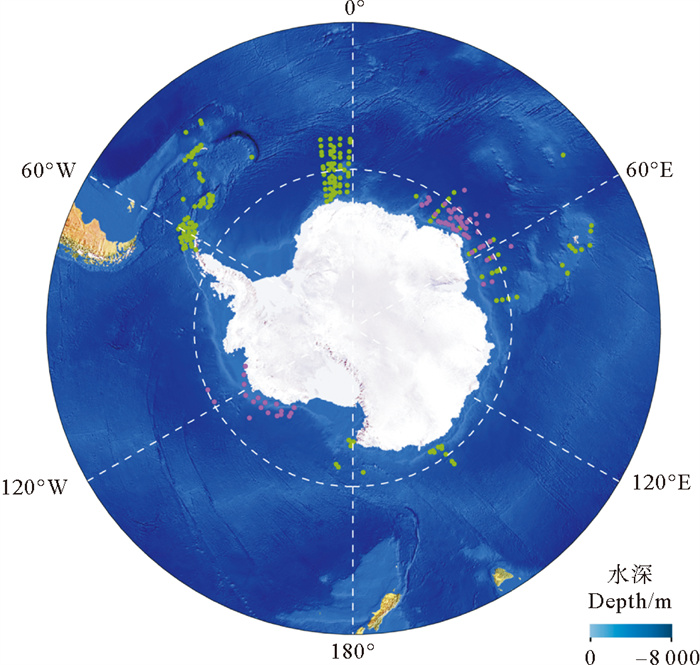
1 材料与方法 1.1 研究区域及分布数据为研究南极电灯鱼在当前和未来栖息地变化,本研究选取了40°S以南的海域作为研究区域。南极电灯鱼分布数据源于全球生物多样性信息数据库(Global Biodiversity Information Facility,GBIF http://www.gbif.org)2004—2014年的记录数据。由于GBIF整合了来自世界各地的许多数据源,同一物种的记录可能被多个组织独立地收录和提交,本研究去除了数据库中冗余的分布数据。为了与环境数据的分辨率相匹配(1°×1°),同一栅格内仅随机保留一条南极电灯鱼的分布记录,以减少采样偏差(见图 1)。
|
(
 : 中国第36~39次南极科考南极电灯鱼分布数据, : 中国第36~39次南极科考南极电灯鱼分布数据, :GBIF 2004—2014年南极电灯鱼分布数据。: Distribution data of Electrona antarctica from the 36th—39th Chinese Antarctic reaearch expedition, : GBIF distribution data of Electrona antarctica from 2004—2014.
)
图 1 南极电灯鱼分布数据图 Fig. 1 Position map of Electrona antarctica distribution data :GBIF 2004—2014年南极电灯鱼分布数据。: Distribution data of Electrona antarctica from the 36th—39th Chinese Antarctic reaearch expedition, : GBIF distribution data of Electrona antarctica from 2004—2014.
)
图 1 南极电灯鱼分布数据图 Fig. 1 Position map of Electrona antarctica distribution data |
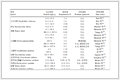
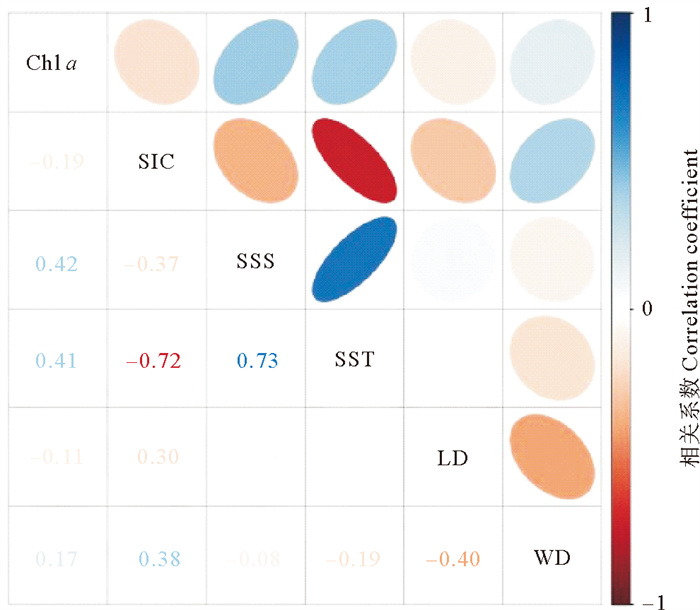
由于预测变量之间存在共线性以及模型可能过于参数化,在预测模型中使用过多的环境变量会显著降低其预测能力, 因此必须结合海洋鱼类生物学相关知识和变量选择方法来进行变量筛选[30]。同时,许多研究表明,少量的环境变量足以准确预测物种分布[31-32]。因此,本研究根据海洋鱼类的生物学相关知识、数据可用性以及南大洋的环境特征,在Earth System Grid Federation(https://aims2.llnl.gov/search/cmip6/)中选用了四个时间动态环境变量:海洋表面温度(Sea surface temperature,SST)、叶绿素浓度(Chlorophyll-a concentration,Chl a)、海洋表面盐度(Sea surface salinity,SSS)、海冰密集度(Sea ice concentration,SIC)。在Global Marine Environment Datasets数据库(http://gmed.auckland.ac.nz/index.html)中获取两个时间静态环境变量:离岸距离(Land Distance,LD)和水深(Water Depth,WD)(见表 1)。在未来环境变量的选取中,本研究选取SSP1-2.6、SSP2-4.5、SSP3-7.0以及SSP5-8.5这四种情景集,数字表示到21世纪末在相应社会发展路径以及辐射强迫下,对应温度分别上升0.86、1.51、2.19和2.89 ℃。考虑到不同环境变量之间存在相关性,本研究基于各个环境数据图层的Pearson相关系数进行了相关性分析,保留相关系数绝对值低于0.75的环境变量,以避免模型拟合过程中的共线性问题。
|
表 1 环境变量 Table 1 Environmental variables |
BIOMOD2是一个在R环境下运行的软件包,广泛应用于生态学和生物地理学研究的集成模型建模中,它提供了多种主流的SDM建模技术,其中包括:人工神经网络(Artificial neural network,ANN)、分类与回归树分析(Classification tree analysis,CTA)、判别函数分析(Flexible discriminant analysis,FDA)、广义加性模型(Generalized additive model,GAM)、广义提升模型(Gradient boosting machine,GBM)、广义线性模型(Generalized linear model,GLM)、多元自适应回归样条(Multivariate adaptive regression splines,MARS)、最大熵模型(Maximum entropy model,MaxEnt)、表面范围包络模型(Surface range envelope,SRE)。这些模型能够有效地预测物种在不同环境条件下的潜在分布[33]。为了提高建模的准确性,大多数物种分布模型还需要补充物种缺失分布的数据[34]。为了解决南大洋极端气候条件以及有限的科研活动所带来的物种缺失分布数据收集困难的问题,生成了伪分布数据作为一种实用的解决方案[35]。本研究根据现有分布数据,在研究区域范围内随机生成了相当于分布数据数量10倍的伪分布数据并重复3次。在模型的评估过程中,采用10折交叉验证方法,其中80%的数据用于训练,20%用于测试。
本研究选用了在物种分布模型评估中常用的两个统计学评价指标对单一模型的模型性能进行评估和选择:真实技巧统计值(True skill statistic,TSS)和受试者工作特征曲线(Receiver operating characteristic,ROC)下的面积(Area under the ROC,AUC)。TSS与AUC的取值范围从0到1,TSS值大于0.7且AUC值大于0.9的模型被纳入集成模型的构建[10, 36]。并根据其统计学评价指标分配集成模型中各模型的权重。本研究将连续数值转化为二分类的0-1分布,转化阈值遵循TSS最大化原则,根据阈值提取了当前气候情景及未来气候情景下南极电灯鱼的栖息地适宜性指数(Habitat suitability index,HSI),并将集成模型的预测结果重新投影到南极兰伯特方位角等面积投影坐标系上,以减少因栅格大小不一致而产生的地理偏差[37]。
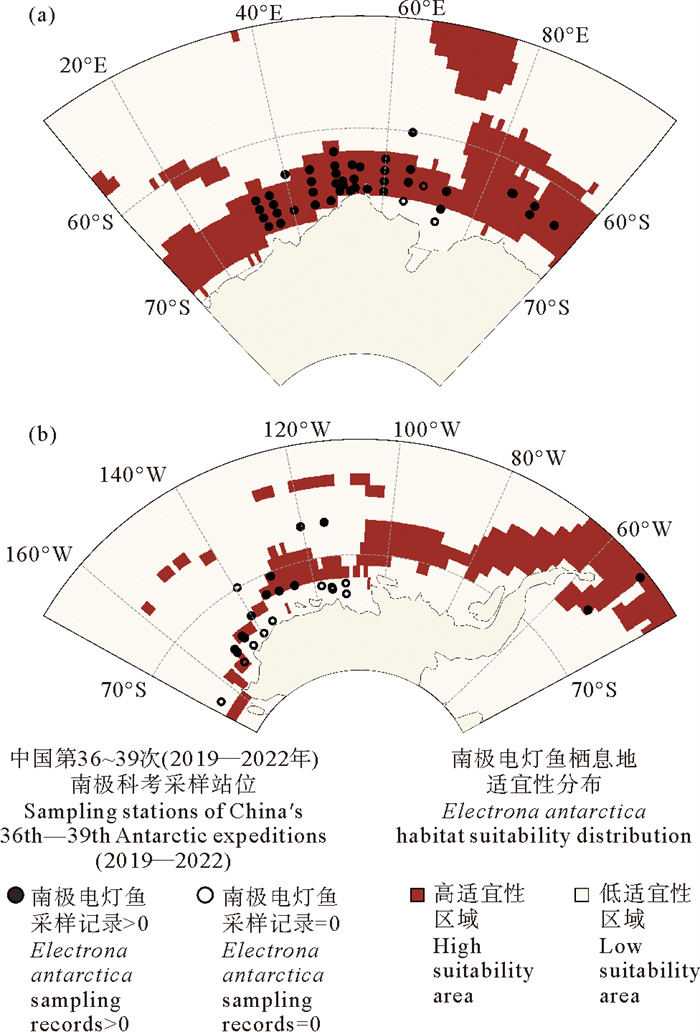
1.4 模型验证本研究利用中国南极科学考察队第36~39次考察期间(2019—2022年)在宇航员海以及阿蒙森海两个海域的南极电灯鱼数据,对构建的栖息地模型进行精度验证。具体验证步骤包括:(1)数据筛选与整理:筛选和整理南极电灯鱼数据,生成南极电灯鱼的存在与不存在记录。(2)环境数据匹配:为了避免使用不同环境数据来源导致的系统误差,本研究选择与建模环境数据同源的CMIP6环境数据。由于CMIP6环境数据历史模拟数据仅覆盖至2014年,而2015年之后的数据为预测数据,因此选取与当前变化情景最接近的SSP2-4.5情景下2019—2022年的环境数据。(3)栖息地预测:基于上述数据,使用构建的集成模型预测南极电灯鱼的栖息地。(4)精度评估:根据南极电灯鱼的调查结果与预测结果生成混淆矩阵,并计算准确率以评估模型精度。
2 结果 2.1 数据筛选结果本研究在GBIF数据库中检索到2004—2014年期间南极电灯鱼4 550条分布记录。经过筛选,共有178条记录被纳入模型构建过程。所使用的6种环境变量均未显示出与其他变量的高相关性(见图 2)。
|
图 2 环境变量相关系数 Fig. 2 Correlation coefficients of environmental variables |
本研究对9种单一模型进行了评估,其中GBM模型的TSS值为0.83,AUC值达到了0.96;CTA模型的TSS值为0.81,AUC值为0.93;GAM模型TSS值为0.78,AUC值为0.94;MARS模型TSS值为0.70,AUC值为0.91。其余5种模型TSS及AUC值均未达到筛选标准,因此未被纳入集成模型建模。由以上4种模型构建出的集成模型展现出了良好的预测能力,其TSS值为0.79,AUC值为0.950(见表 2)。
|
|
表 2 9种单一模型和集成模型(EM)的AUC和TSS值 Table 2 AUC and TSS values of nine single models and the ensemble model (EM) |
经过数据筛选后,中国第36~39次南极科学考察中共有70个采样站位被纳入研究,其采样站位如图 3所示。
|
( (a)为宇航员海调查海域,(b)为阿蒙森海调查海域。(a) shows the survey area of the Cosmonauts Sea, and (b) shows the survey area of the Amundsen Sea. ) 图 3 采样站位分布与模型验证结果 Fig. 3 Spatial distribution of sampling stations and model validation results |
所有采样记录大于0的站位, 我们认为该区域存在南极电灯鱼;而采样记录为0的站位,我们认为该区域不存在南极电灯鱼。模型验证结果显示,集成模型在宇航员海和阿蒙森海的预测准确率分别为91%和83%,证明模型有良好的泛化能力(见表 3)。
|
|
表 3 南极电灯鱼栖息地适宜性混淆矩阵 Table 3 Confusion matrix of habitat suitability for Electrona antarctica |
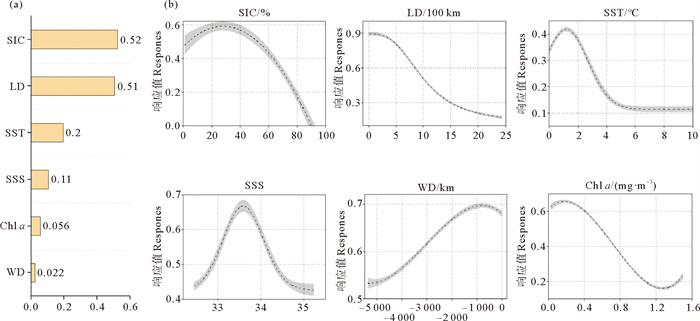
Biomod2包能够计算运行时各环境因子对不同模型的贡献程度。集成模型运行的结果如图 4所示。影响南极电灯鱼空间分布贡献度最大的三个环境因子分别是海冰密集度、离岸距离以及海洋表面温度,其贡献度分别为0.52、0.51、0.2。环境变量的响应曲线显示,在海冰密集度为35%,离岸距离为200 km,海表温度为1 ℃的海域,更适宜南极电灯鱼的分布。
|
( SIC代表海冰密集度,LD代表离岸距离,SST代表海洋表面温度,SSS代表海洋表面盐度,WD代表水深,Chl a代表叶绿素浓度。SIC stands for sea ice concentration, LD stands for land distance, SST stands for sea surface temperature, SSS stands for Sea surface salinity, WD stands for water depth, and Chl a stands for chlorophyll-a concentration. ) 图 4 环境变量对集成模型的贡献度(a)及响应曲线(b) Fig. 4 Contribution of environmental variables to the ensemble model (a) and response curve (b) |
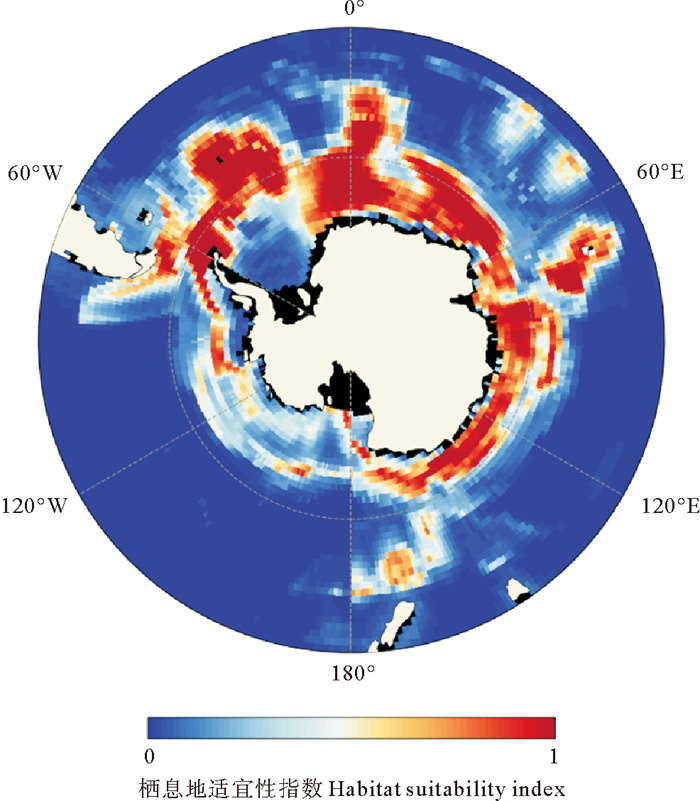
根据集成模型预测的结果显示,在当前的气候情景下南极电灯鱼在南大洋中呈环极分布。栖息地适宜性指数(HSI)的高值主要出现在东南极海域以及南极半岛的东部海域。HSI的低值区域主要出现在威德尔海、罗斯海以及阿蒙森海(见图 5)。
|
图 5 当前气候条件(2004—2014年)下南极电灯鱼分布 Fig. 5 Distribution of Electrona antarctica under current climate conditions (2004—2014) |
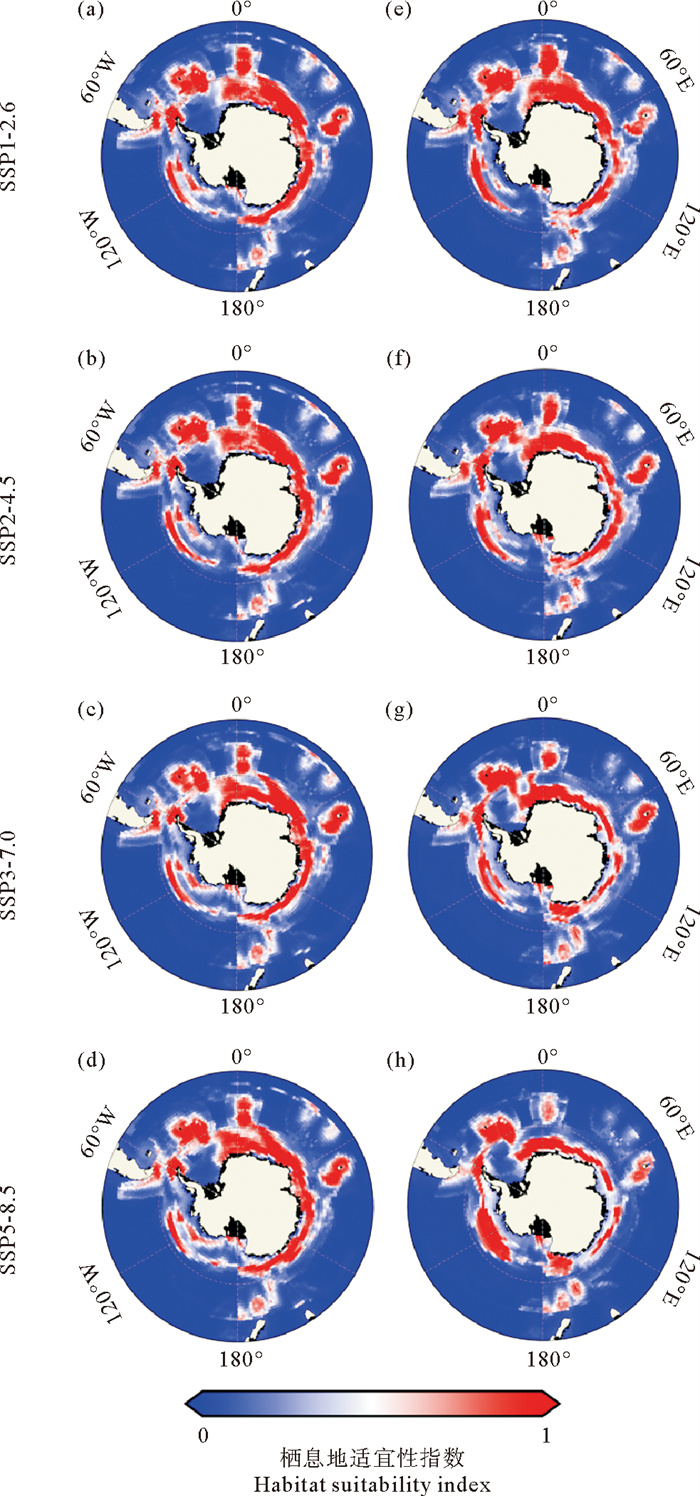
南极电灯鱼的栖息地在未来4种气候情景下,均经历不同程度的丧失(见图 6)。在相同的气候情境下,南极电灯鱼的适宜栖息地范围随着时间的变化(21世纪中期到末期)而减少;在不同气候情景下,南极电灯鱼从21世纪中期到末期的栖息地丧失幅度随着气候变化幅度(SSP1-2.6到SSP5-8.5)越来越大。然而,在SSP1-2.6情境下,相较于21世纪中期,21世纪末期南极电灯鱼的栖息地出现了增加趋势。
|
( (a)、(b)、(c)和(d)表示在21世纪中期(2040—2050年)SSP1-2.6、SSP2-4.5、SSP3-7.0和SSP5-8.5预测结果。(e)、(f)、(g)和(h)表示在21世纪末期(2090—2100年)SSP1-2.6、SSP2-4.5、SSP3-7.0和SSP5-8.5预测结果。(a), (b), (c) and (d) represents mid-century (2040—2050) SSP1-2.6, SSP2-4.5, SSP3-7.0 and SSP5-8.5 projections. (e), (f), (g) and (h) represents the end-of-century (2090—2100) SSP1-2.6, SSP2-4.5, SSP3-7.0, and SSP5-8.5 projections. ) 图 6 集成模型预测未来四种气候情景下南极电灯鱼在21世纪中期和末期的栖息地适宜性分布 Fig. 6 Habitat suitabilitydistribution for Electrona antarctica under four future climate scenarios projected to the mid-21st and late 21st centuries using ensemble model |
模型验证结果显示,模型在预测建模数据以外地区的南极电灯鱼栖息地适宜性时,有着较高的准确度。在所有实际数据与预测结果不一致的8个站位中,6个站位是因为模型低估了其适宜栖息地范围(见表 3),这主要与南极科考的夏季采样有关。本研究基于CMIP6的11年平均数据进行了南极电灯鱼栖息地适宜性分布的分析与预测,忽略了季节性波动,导致了对夏季南极电灯鱼分布的低估。此外,本研究基于南极电灯鱼的基础生态位,而不是基于现实生态位,忽略了物种的捕食、竞争等生物交互因素,这些因素对南极电灯鱼的潜在适宜栖息地预测具有一定影响,会导致预测结果的偏差。
3.2 环境因子对南极电灯鱼栖息地适宜性的影响本研究利用6种环境因子对南极电灯鱼的栖息地适宜性进行研究,其中海冰密集度、离岸距离、海表面温度的变量重要性位居前三位(见图 4(a))。
海冰为物种的早期生命阶段提供了合适的摄食条件、产卵栖息地和庇护所[38-39]。在海冰覆盖率低于40%的水域,初级生产力显著增加,浮游植物在春季至夏季期间大量繁殖[40]。一些桡足类动物的繁殖时间与此高生产力的时期相吻合,以便充分利用丰富的食物资源[41]。南极电灯鱼的仔鱼主要以桡足类为食[42]。在威德尔海的边缘冰区,也发现了密度较高的南极电灯鱼[43],这进一步表明,南极电灯鱼的分布与冰缘的浮游植物和浮游动物生物量的增加有关。海冰中高密度的微生物群在春季和夏季海冰融化期间释放,为南极电灯鱼的仔鱼提供了丰富的营养来源[44],而海冰厚度会影响仔鱼的摄食。在往后的研究中应当补充更多的海冰信息,以探究海冰对南极电灯鱼的影响机制。
南极电灯鱼适宜分布在离岸约200 km,1 000 m水深的水域内(见图 4(b)),这与以往研究中南极电灯鱼通常分布在南极大陆架以外的深海区域的结论一致[32]。南极电灯鱼主要在中层带(Mesopelagic zone)活动,这个区域大致位于200~1 000 m水深之间,这主要是因为南极电灯鱼具有昼夜垂直迁移(Diel vertical migration,DVM)的行为,夜间上升到较浅水层觅食,而白天下潜到深层水域以躲避天敌[45]。南极大陆架的平均宽度在125 km,平均深度在450 m[46],影响了南极电灯鱼的昼夜垂直迁移行为。此外,有研究表明,南极电灯鱼的分布与绕极深层水(Circumpolar deep water,CDW)分布密切相关,而绕极深层水不会延伸至大陆架[47],这进一步限制了南极电灯鱼在近岸的分布。
海洋表面温度是影响南极电灯鱼分布的关键环境因子[48]。南极电灯鱼体内缺乏抗冻糖蛋白和抗冻蛋白质,对低温的耐性较低,而罗斯海和威德尔海温度常年处于-2 ℃,因此不利于南极电灯鱼在此处栖息[48],这与我们预测南极电灯鱼在罗斯海和威德尔海栖息地适宜性指数低的结果相一致。
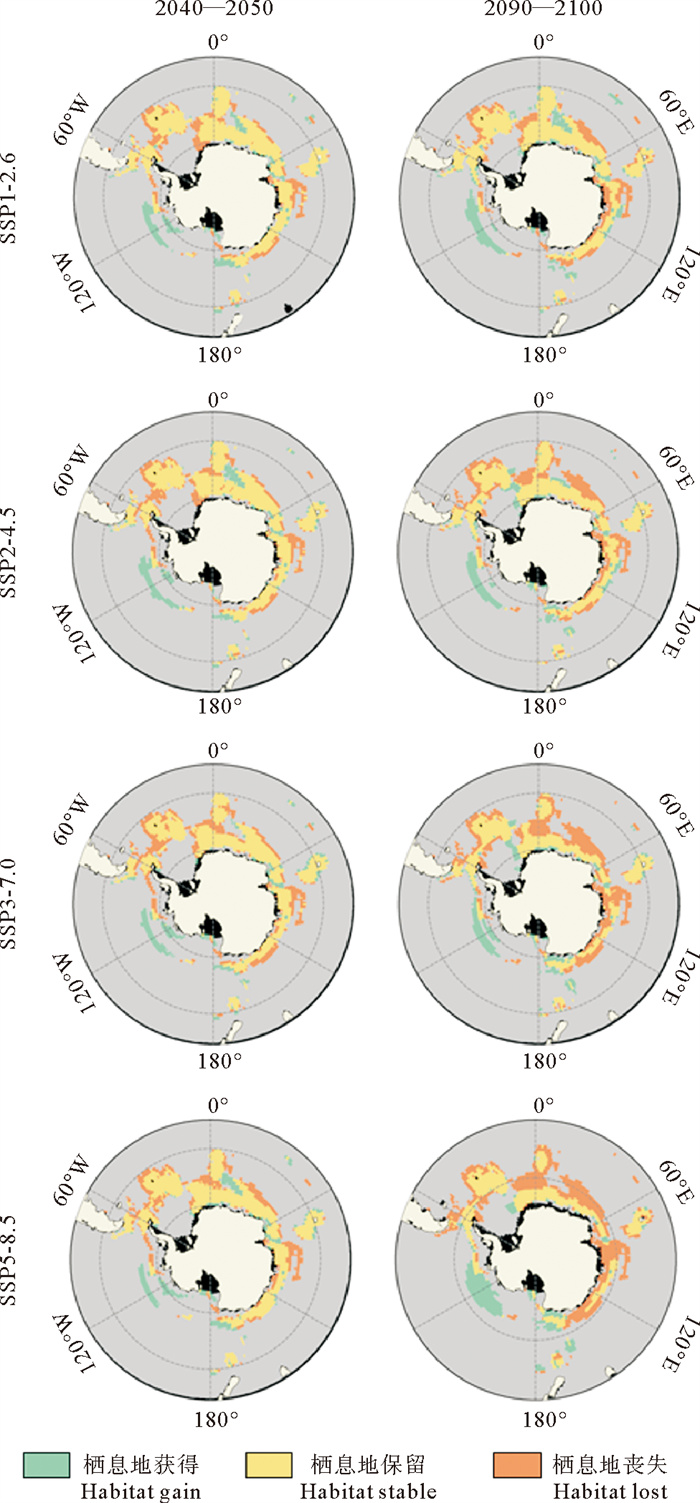
3.3 南极电灯鱼栖息地适宜性变化特征为了能更加直观地感受到栖息的变化,我们通过比较未来气候情景与当前气候情景的二值化栖息地,计算出了南极电灯鱼栖息地的丧失、保留、与获得情况。在SSP1-2.6情景下,预测显示在21世纪中期(2040—2050年)其适宜栖息地将缩小6.95%,而到21世纪末期(2090—2100年),缩小幅度略有减缓,达到5.87%。对于SSP2-.45情景,适宜栖息地的减少幅度更为显著,21世纪中期预计减少8.53%,而21世纪末期的减少幅度预计达到12.72%。在SSP3-7.0情景中,模型预测21世纪中期适宜栖息地将减少14.30%,到21世纪末期将进一步减少至23.65%。最极端的SSP5-8.5情景下,虽然21世纪中期适宜栖息地的减少幅度为7.61%,但到21世纪末期,预计其栖息地将显著减少26.15%(见表 4)。
|
|
表 4 未来气候情景下南极电灯鱼适宜栖息地分布范围变化 Table 4 Changes in the extent of distribution of suitable habitat for Electrona antarctica under future climate scenarios |
在全球气候变化的影响下,南大洋生态环境发生了变化,许多海洋鱼类不断向极地迁徙以寻找新的适宜栖息地[49]。本研究中,南极电灯鱼也表现出了向极地移动的趋势,从而导致其失去了原有的栖息地,这与其他南大洋中层鱼类的迁移行为一致[29]。但相比于其他中层鱼,南极电灯鱼具有狭窄的热生态位,这使得它们更容易受到气候变化的影响,未来可能导致其栖息地进一步丧失[10]。
南极电灯鱼的适宜栖息地分布在南大洋不同扇区之间存在差异。在太平洋扇区中,南极电灯鱼的适宜栖息地占比为12%;而在印度洋扇区和大西洋扇区,其适宜栖息地占比分别为45%和43%。在不同气候情景下,不同扇区之间同样存在差异。在太平洋扇区中,南极电灯鱼的适宜栖息地面积呈现增长趋势;而在大西洋扇区以及印度洋扇区,南极电灯鱼的适宜栖息地出现减少趋势(见表 5)。
|
|
表 5 未来气候情景下不同扇区中南极电灯鱼适宜栖息地分布范围变化 Table 5 The future suitable habitat distribution range of Electrona antarctica varies across different sectors under different climate scenarios |
将未来南极电灯鱼适宜栖息地与当前气候情景下的南极电灯鱼的空间分布进行比较可以看出,在印度洋扇区和大西洋扇区,南极电灯鱼对气候变化的响应与其他中层鱼一致,表现出向极地迁徙的行为。在太平洋扇区的阿蒙森海远离大陆架的海域预计会出现新的南极电灯鱼适宜栖息地(见图 7)。
|
图 7 未来气候条件下南极电灯鱼分布范围变化 Fig. 7 Changes in the range of Electrona antarctica under future climate conditions |
本研究中,南极电灯鱼的低栖息地适宜性指数出现在罗斯海、阿蒙森海以及威德尔海三个南大洋高纬度海域中。海冰覆盖是这些海域的典型特征,尤其在冬季,海冰范围显著扩大,几乎覆盖整个海域[50]。其中威德尔海有着由南极洲最大的冰架之一罗纳冰架构成的菲尔希纳-罗纳冰架系统,罗斯海的罗斯冰架西起罗斯岛,东至爱德华七世半岛。由于其巨大的规模以及得益于西风带和南极绕极流的影响,仅在夏季会有部分表面融化和边缘冰退缩的季节性的变化[51],对于年际间的变化并不明显,保持着较高的海冰密集度。相应地,海表面温度与海冰密集度呈现较高的负相关(见图 2),较高的海冰密集度意味着海水温度较低,而南极电灯鱼由于缺乏寒冷耐受性,限制了其在高纬度海域的分布。但近几十年来,气候变化对南极海冰的影响并不均匀。虽然总体上南极海冰面积呈现增加趋势,但在不同区域的变化存在差异。在罗斯海、威德尔海以及印度洋扇区,海冰面积增加,而在别林斯高晋海-阿蒙森海和太平洋扇区,海冰面积减少[52]。阿蒙森海的海冰减少主要是由于绕极深层水向陆架的入侵,这些较暖的水流到达陆坡附近后,沿着海槽与陆架水团混合,进而向南侵袭冰盖基底,加速冰架融化[53]。海冰覆盖范围以及海冰面积的变化会导致洋流的变化[54],以及海洋温度的变化[55]。气候变化导致阿蒙森海海冰面积减少,使其能在未来可能成为南极电灯鱼适宜的栖息地。而在罗斯海和威德尔海,由于海冰变化较小[50],南极电灯鱼的分布仍然受到限制。此外,躲避捕食者是驱使南极中层鱼类进行昼夜垂直迁移的主导因素之一,而高纬度极地地区较为短暂的夜晚以及较为明亮的夜晚可能会对南极电灯鱼的昼夜垂直迁移行为产生影响,进而影响其在高纬度海域的分布。因此,在未来阿蒙森海的远海的低纬度区域,可能更适合南极电灯鱼的分布。
4 结论本研究以南大洋中层鱼类优势种南极电灯鱼为研究对象,利用GBIF中的南极电灯鱼分布数据,结合CMIP6中提供的不同气候情景下的环境变量,通过统计学方法筛选出4种模型进行集成建模,并结合中国南极科考队的实测数据对模型进行验证,对南极电灯鱼的未来适宜栖息地进行预测。本研究得出以下主要结论:
(1) 南极电灯鱼在南大洋呈环极分布,南极半岛的东部海域和东南极海域栖息地适宜性指数较高,在罗斯海、阿蒙森海、威德尔海的栖息地适宜性指数较低。
(2) 南极电灯鱼的未来栖息地分布趋势在不同扇区之间存在差异,印度洋扇区和大西洋扇区表现出栖息地向极地收缩的趋势,太平洋扇区的阿蒙森海的远海区域将出现南极电灯鱼新的适宜栖息地。
(3) 影响南极电灯鱼分布的主要环境因子是海冰密集度、离岸距离以及海洋表面温度。本文可为南极电灯鱼栖息地的保护提供参考依据,同时为研究南极其他物种分布提供思路。
| [1] |
Irigoien X, Klevjer T A, Røstad A, et al. Large mesopelagic fishes biomass and trophic efficiency in the open ocean[J]. Nature Communications, 2014, 5(1): 3271. DOI:10.1038/ncomms4271 (  0) 0) |
| [2] |
Saunders R A, Collins M A, Ward P, et al. Predatory impact of the myctophid fish community on zooplankton in the Scotia Sea (Southern Ocean)[J]. Marine Ecology Progress Series, 2015, 541: 45-64. DOI:10.3354/meps11527 ( 0) |
| [3] |
Saunders R A, Hill S L, Tarling G A, et al. Myctophid fish (family Myctophidae) are central consumers in the food web of the Scotia Sea (Southern Ocean)[J]. Frontiers in Marine Science, 2019, 6: 530. DOI:10.3389/fmars.2019.00530 ( 0) |
| [4] |
McCormack S A, Melbourne T J, Trebilco R, et al. Decades of dietary data demonstrate regional food web structures in the Southern Ocean[J]. Ecology and Evolution, 2021, 11(1): 227-241. DOI:10.1002/ece3.7017 ( 0) |
| [5] |
Saba G K, Burd A B, Dunne J P, et al. Toward a better understanding of fish-based contribution to ocean carbon flux[J]. Limnology and Oceanography, 2021, 66(5): 1639-1664. DOI:10.1002/lno.11709 ( 0) |
| [6] |
Collins M A, Stowasser G, Fielding S, et al. Latitudinal and bathymetric patterns in the distribution and abundance of mesopelagic fish in the scotia sea[J]. Deep Sea Research Part Ⅱ: Topical Studies in Oceanography, 2012, 59-60: 189-198. DOI:10.1016/j.dsr2.2011.07.003 ( 0) |
| [7] |
Duhamel G. Biogeographic patterns of fish[M]//De Broyer C, Koubbi P, Griffiths H J, et al. Biogeographic Atlas of the Southern Ocean. Cambridge: Scientific Committee on Antarctic Research, 2014: 328-362.
( 0) |
| [8] |
Pinsky M L, Selden R L, Kitchel Z J. Climate-driven shifts in marine species ranges: Scaling from organisms to communities[J]. Annual Review of Marine Science, 2020, 12: 153-179. DOI:10.1146/annurev-marine-010419-010916 ( 0) |
| [9] |
Pinsky M L, Worm B, Fogarty M J, et al. Marine taxa track local climate velocities[J]. Science, 2013, 341(6151): 1239-1242. DOI:10.1126/science.1239352 ( 0) |
| [10] |
Freer J J, Tarling G A, Collins M A, et al. Predicting future distributions of lanternfish, a significant ecological resource within the Southern Ocean[J]. Diversity and Distributions, 2019, 25(8): 1259-1272. DOI:10.1111/ddi.12934 ( 0) |
| [11] |
Caccavo J A, Christiansen H, Constable A J, et al. Productivity and change in fish and squid in the Southern Ocean[J]. Frontiers in Ecology and Evolution, 2021, 9: 624918. DOI:10.3389/fevo.2021.624918 ( 0) |
| [12] |
Dowd S, Chapman M, Koehn L E, et al. The economic tradeoffs and ecological impacts associated with a potential mesopelagic fishery in the california current[J]. Ecological Applications, 2022, 32(4): e257. ( 0) |
| [13] |
Araújo M B, Anderson R P, Márcia Barbosa A, et al. Standards for distribution models in biodiversity assessments[J]. Science Advances, 2019, 5(1): 4858. DOI:10.1126/sciadv.aat4858 ( 0) |
| [14] |
陈洵子, 朱国平. 基于物种分布集成模型的布兰斯菲尔德海峡南极磷虾栖息地研究[J]. 水产学报, 2022, 46(3): 390-401. Chen X Z, Zhu G P. Habitat of Antarctic krill (Euphausia superba) in the Bransfield Strait based on ensembled species distribution model[J]. Journal of Fisheries of China, 2022, 46(3): 390-401. ( 0) |
| [15] |
董思宋, 朱国平. 自愿限制区对南极半岛南极磷虾渔业及渔场分布的影响[J]. 海洋渔业, 2022, 44(4): 409. Dong S, Zhu G P. Effect of voluntary restriction zone on Antarctic krill fishery and fishing ground distribution in the Antarctic Peninsula[J]. Marine Fisheries, 2022, 44(4): 409. DOI:10.3969/j.issn.1004-2490.2022.04.003 ( 0) |
| [16] |
沈校熠, 柯长青, 张杰. 南极帝企鹅种群栖息地动态变化遥感分析[J]. 地球信息科学学报, 2017, 19(8): 1132-1140. Shen X Y, Ke C Q, Zhang J. Analysis of Antarctic emperor penguins colonies changes based on remote sensing[J]. Journal of Geo-Information Science, 2017, 19(8): 1132-1140. ( 0) |
| [17] |
Hindell M A, Reisinger R R, Ropert C Y, et al. Tracking of marine predators to protect Southern Ocean ecosystems[J]. Nature, 2020, 580(7801): 87-92. DOI:10.1038/s41586-020-2126-y ( 0) |
| [18] |
Sylvester Z T, Long M C, Brooks C M. Detecting climate signals in Southern Ocean krill growth habitat[J]. Frontiers in Marine Science, 2021, 8: 669508. DOI:10.3389/fmars.2021.669508 ( 0) |
| [19] |
Fabri R S, Danis B, Navarro N, et al. Benthic ecoregionalization based on echinoid fauna of the Southern Ocean supports current proposals of Antarctic Marine Protected Areas under IPCC scenarios of climate change[J]. Global Change Biology, 2020, 26(4): 2161-2180. DOI:10.1111/gcb.14988 ( 0) |
| [20] |
Xavier J C, Raymond B, Jones D C, et al. Biogeography of cephalopods in the Southern Ocean using habitat suitability prediction models[J]. Ecosystems, 2016, 19: 220-247. DOI:10.1007/s10021-015-9926-1 ( 0) |
| [21] |
Pinkerton M H, Smith A N, Raymond B, et al. Spatial and seasonal distribution of adult Oithona similis in the Southern Ocean: Predictions using boosted regression trees[J]. Deep Sea Research Part Ⅰ: Oceanographic Research Papers, 2010, 57(4): 469-485. DOI:10.1016/j.dsr.2009.12.010 ( 0) |
| [22] |
Duan M, Zhang C, Liu Y, et al. Growth and early life stage of antarctic silverfish (Pleuragramma antarctica) in the amundsen sea of the Southern Ocean: Evidence for a potential new spawning/nursery ground[J]. Polar Biology, 2022, 45(2): 359-368. DOI:10.1007/s00300-021-02994-2 ( 0) |
| [23] |
Brooks C M, Caccavo J A, Ashford J, et al. Early life history connectivity of antarctic silverfish (Pleuragramma antarctica) in the Ross Sea[J]. Fisheries Oceanography, 2018, 27(3): 274-287. DOI:10.1111/fog.12251 ( 0) |
| [24] |
Iglesias I S, Santora J A, Fiechter J, et al. Mesopelagic fishes are important prey for a diversity of predators[J]. Frontiers in Marine Science, 2023, 10: 1220088. DOI:10.3389/fmars.2023.1220088 ( 0) |
| [25] |
Caccavo J A, Papetti C, Wetjen M, et al. Along-shelf connectivity and circumpolar gene flow in antarctic silverfish (Pleuragramma antarctica)[J]. Scientific Reports, 2018, 8(1): 17856. DOI:10.1038/s41598-018-36030-x ( 0) |
| [26] |
Chawarski J, Klevjer T A, Cote D, et al. Evidence of temperature control on mesopelagic fish and zooplankton communities at high latitudes[J]. Frontiers in Marine Science, 2022, 9: 917985. DOI:10.3389/fmars.2022.917985 ( 0) |
| [27] |
Ran Q, Duan M, Wang P, et al. Predicting the current habitat suitability and future habitat changes of antarctic jonasfish notolepis coatsorum in the Southern Ocean[J]. Deep Sea Research Part Ⅱ: Topical Studies in Oceanography, 2022, 199: 105077. DOI:10.1016/j.dsr2.2022.105077 ( 0) |
| [28] |
Woods B, Trebilco R, Walters A, et al. Myctobase, a circumpolar database of mesopelagic fishes for new insights into deep pelagic prey fields[J]. Scientific Data, 2022, 9(1): 404. DOI:10.1038/s41597-022-01496-y ( 0) |
| [29] |
Liu S, Liu Y, Teschke K, et al. Correction: Incorporating mesopelagic fish into the evaluation of marine protected areas under climate change scenarios[J]. Marine Life Science & Technology, 2023, 6(2): 363. ( 0) |
| [30] |
Tyberghein L, Verbruggen H, Pauly K, et al. Bio-oracle: A global environmental dataset for marine species distribution modelling[J]. Global Ecology and Biogeography, 2012, 21(2): 272-281. DOI:10.1111/j.1466-8238.2011.00656.x ( 0) |
| [31] |
Bosch S, Tyberghein L, Deneudt K, et al. In search of relevant predictors for marine species distribution modelling using the MarineSPEED benchmark dataset[J]. Diversity and Distributions, 2018, 24(2): 144-157. DOI:10.1111/ddi.12668 ( 0) |
| [32] |
Zhang Z, Xu S, Capinha C, et al. Using species distribution model to predict the impact of climate change on the potential distribution of japanese whiting Sillago japonica[J]. Ecological Indicators, 2019, 104: 333-340. DOI:10.1016/j.ecolind.2019.05.023 ( 0) |
| [33] |
Thuiller W, Lafourcade B, Engler R, et al. BIOMOD—A platform for ensemble forecasting of species distributions[J]. Ecography, 2009, 32(3): 369-373. DOI:10.1111/j.1600-0587.2008.05742.x ( 0) |
| [34] |
Iturbide M, Bedia J, Herrera S, et al. A framework for species distribution modelling with improved pseudo-absence generation[J]. Ecological Modelling, 2015, 312: 166-174. DOI:10.1016/j.ecolmodel.2015.05.018 ( 0) |
| [35] |
Barbet M M, Jiguet F, Albert C H, et al. Selecting pseudo-absences for species distribution models: How, where and how many?[J]. Methods in Ecology and Evolution, 2012, 3(2): 327-338. DOI:10.1111/j.2041-210X.2011.00172.x ( 0) |
| [36] |
Fielding A H, Bell J F. A review of methods for the assessment of prediction errors in conservation presence/absence models[J]. Environmental Conservation, 1997, 24(1): 38-49. DOI:10.1017/S0376892997000088 ( 0) |
| [37] |
Budic L, Didenko G, Dormann C F. Squares of different sizes: Effect of geographical projection on model parameter estimates in species distribution modeling[J]. Ecology and Evolution, 2016, 6(1): 202-211. DOI:10.1002/ece3.1838 ( 0) |
| [38] |
Agostini C, Patarnello T, Ashford J R, et al. Genetic differentiation in the ice-dependent fish Pleuragramma antarctica along the antarctic peninsula[J]. Journal of Biogeography, 2015, 42(6): 1103-1113. DOI:10.1111/jbi.12497 ( 0) |
| [39] |
Griffiths H, Grant S A. Biogeographic Atlas of the Southern Ocean[M]. Cambridge: Scientific Committee on Antarctic Research, 2014.
( 0) |
| [40] |
Lancelot C, Mathot S, Veth C, et al. Factors controlling phytoplankton ice-edge blooms in the marginal ice-zone of the northwestern Weddell Sea during sea ice retreat 1988: Field observations and mathematical modelling[J]. Polar Biology, 1993, 13: 377-387. DOI:10.1007/BF01681979 ( 0) |
| [41] |
Atkinson A. Life cycle strategies of epipelagic copepods in the Southern Ocean[J]. Journal of Marine Systems, 1998, 15(1-4): 289-311. DOI:10.1016/S0924-7963(97)00081-X ( 0) |
| [42] |
Duan M, Zhang C, Luo Y, et al. The feeding strategies of the antarctic lanternfish Electrona antarctica (pisces: Myctophidae) in the amundsen and cosmonaut seas (Southern Ocean), assessed with a classification tree analysis[J]. Polar Biology, 2024, 47(5): 515-532. DOI:10.1007/s00300-024-03249-6 ( 0) |
| [43] |
Donnelly J, Sutton T T, Torres J J. Distribution and abundance of micronekton and macrozooplankton in the NW Weddell Sea: Relation to a spring ice-edge bloom[J]. Polar Biology, 2006, 29: 280-293. DOI:10.1007/s00300-005-0051-z ( 0) |
| [44] |
Bluhm B A, Gradinger R R, Schnack-Schiel S B. Sea ice meio-and macrofauna[J]. Sea Ice, 2010, 2: 357-393. ( 0) |
| [45] |
Moteki M, Fujii K, Amakasu K, et al. Distributions of larval and juvenile/adult stages of the Antarctic myctophid fish, Electrona antarctica, off Wilkes Land in East Antarctica[J]. Polar Science, 2017, 12: 99-108. DOI:10.1016/j.polar.2017.02.004 ( 0) |
| [46] |
Clarke A, Johnston N M. Antarctic marine benthic diversity[M]// Oceanography and Marine Biology. [S. l. ]: CRC Press, 2003: 55-57.
( 0) |
| [47] |
Duan M, Ashford J R, Bestley S, et al. Otolith chemistry of Electrona antarctica suggests a potential population marker distinguishing the southern Kerguelen Plateau from the eastward-flowing Antarctic Circumpolar Current[J]. Limnology and Oceanography, 2021, 66(2): 405-421. DOI:10.1002/lno.11612 ( 0) |
| [48] |
Cullins T L, DeVries A L, Torres J J. Antifreeze proteins in pelagic fishes from Marguerite Bay (Western Antarctica)[J]. Deep Sea Research Part Ⅱ: Topical Studies in Oceanography, 2011, 58(13-16): 1690-1694. DOI:10.1016/j.dsr2.2009.05.034 ( 0) |
| [49] |
Morato T, González-Irusta J M, Dominguez-Carrió C, et al. Climate-induced changes in the suitable habitat of cold-water corals and commercially important deep-sea fishes in the North Atlantic[J]. Global Change Biology, 2020, 26(4): 2181-2202. DOI:10.1111/gcb.14996 ( 0) |
| [50] |
Zanchettin D, Modali K, Müller W A, et al. Ross-Weddell dipole critical for Antarctic Sea ice predictability in MPI-ESM-HR[J]. Atmosphere, 2024, 15(3): 295. DOI:10.3390/atmos15030295 ( 0) |
| [51] |
Raphael M N, Marshall G, Turner J, et al. The Amundsen Sea low: Variability, change, and impact on Antarctic climate[J]. Bulletin of the American Meteorological Society, 2016, 97(1): 111-121. DOI:10.1175/BAMS-D-14-00018.1 ( 0) |
| [52] |
Stammerjohn S, Massom R, Rind D, et al. Regions of rapid sea ice change: An inter-hemispheric seasonal comparison[J]. Geophysical Research Letters, 2012, 39(6): L06501. ( 0) |
| [53] |
Nakayama Y, Menemenlis D, Zhang H, et al. Origin of CircumPolar Deep water intruding onto the Amundsen and Bellingshau-sen Sea continental shelves[J]. Nature Communications, 2018, 9(1): 3403. DOI:10.1038/s41467-018-05813-1 ( 0) |
| [54] |
Godfred-Spenning C R, Simmonds I. An analysis of Antarctic Sea-ice and extratropical cyclone associations[J]. International Journal of Climatology: A Journal of the Royal Meteorological Society, 1996, 16(12): 1315-1332. ( 0) |
| [55] |
Jacka T H, Budd W F. Detection of temperature and sea-ice-extent changes in the Antarctic and Southern Ocean, 1949—96[J]. Annals of Glaciology, 1998, 27: 553-559. DOI:10.3189/1998AoG27-1-553-559 ( 0) |