 2025, Vol. 55


2. 中国海洋大学三亚海洋研究院,海南 三亚 572025;
3. 崂山实验室,山东 青岛 266237
北太平洋经向模态(North Pacific meridional mode, NPMM)是副热带东北太平洋海气耦合的主导模态,对气候系统有重要影响[1]。NPMM的正位相事件表现为暖的海表面温度异常(sea surface temperature anomaly, SSTA)自下加利福尼亚沿岸向西南延伸至赤道中太平洋,并伴随着西南风异常。NPMM的SSTA主要由北半球冬季北太平洋大气环流异常强迫产生[2],例如,当北太平洋涛动(North Pacific oscillation)[3-4]位于负位相时,其南支呈现气旋式风场异常,并减弱NPMM海区东北信风的强度,从而减少潜热释放,激发出正NPMM事件[5]。激发的NPMM事件在春季达到最强,并通过风-蒸发-海表面温度(wind-evaporation-SST)正反馈机制维持到夏季[6-7]。
在夏季,大气热带辐合带(intertropical convergence zone, ITCZ)北移至NPMM附近,此时ITCZ容易受到NPMM的影响[8]。当NPMM位于正位相时,暖的SSTA会使得ITCZ向北偏移,形成北多南少的降水异常空间分布,并通过潜热释放激发大气罗斯贝波[9-10]。NPMM激发的大气波列在西风带的作用下向下游传播,形成类似于绕球遥相关波列(circumglobal teleconnection, CGT)[11-12]。有研究发现,夏季正NPMM激发的类CGT波列在中国东部上空表现为正位势高度异常,其伴随的下沉气流不利于云的形成,增加了向下的短波辐射,使得表面气温(surface air temperature, SAT)升高。此外,类CGT波列还在中国北部上空呈现正位势高度异常,其伴随的上升气流有利于云的形成并减少向下的短波辐射,使得SAT降低[13-14]。
以上对NPMM影响北半球夏季SAT的研究主要集中于中国,而由于夏季NPMM激发的大气波列类似于CGT波列,该波列在北半球其他地区(如北美和欧亚大陆)也有显著的大气环流异常,很可能对这些地区的SAT也产生重要影响,但其影响的空间分布和机理尚不明确。本文旨在从半球视角探究夏季NPMM影响SAT的分布和机理,这对理解夏季NPMM的气候效应机理、提高区域气候的预测水平具有重要意义。
1 数据和方法 1.1 观测数据本文SST观测数据为哈德利中心海冰和海表面温度数据(HadISSTv1.1)[15],空间分辨率为1°×1°。净短波辐射、云覆盖率、大气风场和位势高度数据来自于欧洲中期天气预报中心的再分析资料(ECMWF Reanalysis v5, ERA5)[16],空间分辨率均为1°×1°。SAT数据为英国国家大气科学中心(climate research unit, CRU)[17]的高分辨率数据,空间分辨率为0.5°×0.5°。所有数据的时间范围为1950—2014年,去除了1950—2014年的逐月气候态和线性趋势,取6—8月(June-August, JJA)进行季节平均。
1.2 罗斯贝波源的计算为了确定夏季NPMM在对流层上层激发罗斯贝波的位置,这里使用了Sardeshmukh和Hoskins[18]的线性罗斯贝波源(Rossby wave source; RWS)的计算方法:
| $ R W S=-\nabla_{\mathrm{H}} \cdot\left\{\vec{u}_\chi^{\prime}(f+\bar{\zeta})\right\}-\nabla_{\mathrm{H}} \cdot\left\{\vec{u}^{\prime} \zeta^{\prime}\right\} 。$ | (1) |
式中:
为了研究夏季NPMM激发的大气罗斯贝波能量的传播路径,这里采用了Takaya和Nakamura[19]提出的水平波通量计算公式:
| $ \left( {\begin{array}{*{20}{c}} {\vec w = \frac{{P\cos \phi }}{{2|U|}} \cdot }\\ {\frac{U}{{{a^2}{{\cos }^2}\phi }}\left[ {{{\left( {\frac{{\partial {\psi ^\prime }}}{{\partial \lambda }}} \right)}^2} - {\psi ^\prime }\frac{{{\partial ^2}{\psi ^\prime }}}{{\partial {\lambda ^2}}}} \right] + \frac{V}{{{a^2}\cos \phi }}\left[ {\frac{{\partial {\psi ^\prime }}}{{\partial \lambda }}\frac{{\partial {\psi ^\prime }}}{{\partial \phi }} - {\psi ^\prime }\frac{{{\partial ^2}{\psi ^\prime }}}{{\partial \lambda \partial \phi }}} \right]}\\ {\frac{U}{{{a^2}{{\cos }^2}\phi }}\left[ {\frac{{\partial {\psi ^\prime }}}{{\partial \lambda }}\frac{{\partial {\psi ^\prime }}}{{\partial \phi }} - {\psi ^\prime }\frac{{{\partial ^2}{\psi ^\prime }}}{{\partial \lambda \partial \phi }}} \right] + \frac{V}{{{a^2}}}\left[ {{{\left( {\frac{{\partial {\psi ^\prime }}}{{\partial \phi }}} \right)}^2} - {\psi ^\prime }\frac{{{\partial ^2}{\psi ^\prime }}}{{\partial {\phi ^2}}}} \right]} \end{array}} \right)。$ | (2) |
式中:
为了验证NPMM与SAT之间的关系不受热带中太平洋的影响,本文计算了在控制热带中太平洋下的NPMM与SAT之间的偏相关,计算公式如下:
| $ \rho_{x y \cdot z}=\frac{\rho_{x y}-\rho_{x z} \cdot \rho_{y z}}{\sqrt{1-\rho_{x z}^2} \sqrt{1-\rho_{y z}^2}} 。$ | (3) |
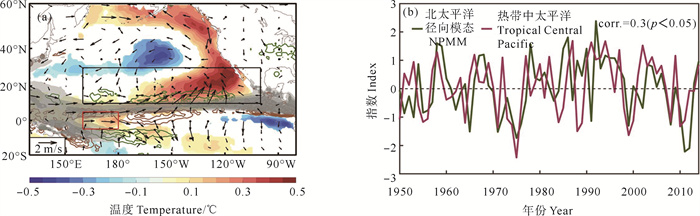
式中:x, y, z分别代表NPMM,SAT和热带中太平洋指数([160°E—180°,5°S—5°N]SSTA的区域平均;见图 1红色框);ρxy代表NPMM和每个格点SAT的相关系数,ρxz和ρyz同理;ρxy·z代表在控制热带中太平洋指数下NPMM和SAT的偏相关系数。
|
( (a) 图中填色为SSTA(仅显示通过显著性水平0.05的双边学生氏t检验部分), 等值线为降水分布(绿色为正降水异常,棕色为负降水异常,间隔为0.1 mm/d);黑色箭头为10 m风矢量; 灰色阴影为1979—2014年夏季气候态降水分布(6,8,10 mm/d); 黑色框为NPMM的定义区域,红色框为热带中太平洋定义区域。(b) 绿线为夏季NPMM指数,紫线为夏季热带中太平洋指数SSTA区域平均。(a) The shading represents the regressed SSTA (shown only significant at the 0.05 significance level based on the two-tailed Student's t-test); The contours represent the distribution of precipitation, with green indicating positive anomalies and brown indicating negative anomalies, at intervals of 0.1 mm·d-1. The gray shading represents the climatological summer precipitation distribution from 1950 to 2014 (6, 8, 10 mm·d-1). The black box denotes the NPMM region. The red box denotes the central tropical Pacific region. (b) The green line represents JJA NPMM index; The red line represents JJA central tropical Pacific index (SSTA averaged over.) ) 图 1 夏季NPMM指数回归SSTA、10 m风矢量异常和降水异常的空间分布以及夏季气候态降水分布(a)和夏季NPMM指数与热带中太平洋指数(b) Fig. 1 Spatial distributions of the regressed JJA SSTA, 10 m wind, and precipitation anomalies against the JJA NPMM index, as well as JJA climatological precipitation (a), and JJA NPMM index and central tropical Pacific index (b) |
NPMM指数定义区域为160°E—100°W,10°N—30°N(见图 1黑色框)。首先对该区域10 m风矢量异常和SSTA线性回归去除冷舌指数(180°—90°W,6°S—6°N区域SSTA平均),再对去除后的10 m风矢量异常和SSTA进行奇异值分解,得到的第一主模态SSTA的时间序列,取JJA季节平均并标准化,即为夏季NPMM指数[20]。前人对NPMM的定义区域通常选为175°E—95°W,21°S—32°N[1],本文分析发现这两种NPMM定义不影响本文得到的主要结论,因此本文在分析时采用了区域为160°E—100°W,10°N—30°N的NPMM指数。
2 夏季NPMM对北半球SAT影响的分布特征图 1(a)为夏季NPMM相关的SSTA、10 m风矢量异常以及降水异常的空间分布,叠加上夏季气候态降水分布。SSTA的空间分布特征表现为暖SSTA自下加利福尼亚沿岸向西南延伸至赤道中太平洋,风场异常在副热带太平洋海区表现为气旋式环流。降水异常表现为北多南少的经向偶极子结构,这是ITCZ受NPMM暖SSTA的影响向北移动的表现。
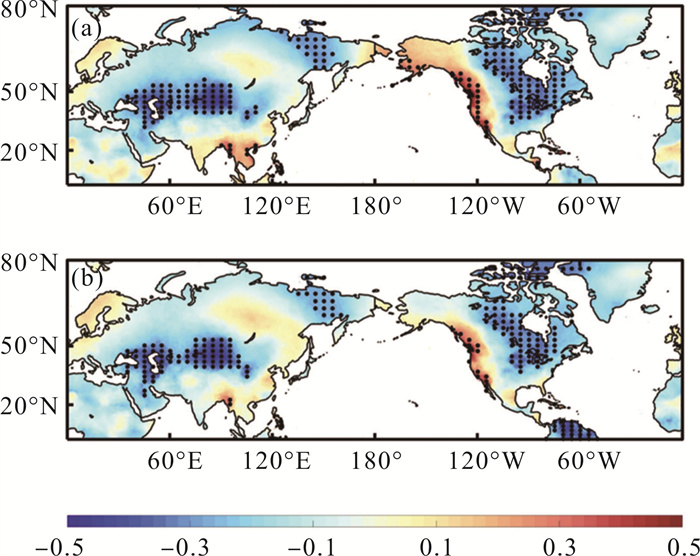
为了探究夏季NPMM对北半球SAT影响的分布特征,图 2(a)绘制了夏季NPMM指数与北半球SAT的相关系数分布。从图中可以看出,在中国北部存在负相关,东部存在弱的正相关,整体分布与Luo等[13]发现结果基本一致。除了在中国,在北美还呈现出显著的东西向偶极子式分布:沿落基山脉西侧为正相关,而东侧表现为负相关。此外,在欧亚大陆中部以及东北部都存在显著的负相关。这些地区的SAT相关系数分布相比中国更为显著,表明夏季NPMM对北半球这些地区SAT的影响更为重要。由于NPMM的SSTA空间分布在热带中太平洋有显著的暖异常(见图 1(a)红色框),为了验证夏季NPMM与北半球SAT的相关系数分布是否受该热带SSTA的影响,我们选取了160°E—180°,5°S—5°N SSTA的区域平均作为热带中太平洋指数。图 1(b)为夏季NPMM指数和热带中太平洋指数,两者存在显著相关,相关系数达到0.3。通过控制热带中太平洋指数,做夏季NPMM与北半球SAT的偏相关系数分布图,发现夏季NPMM对北半球SAT的影响独立于热带中太平洋SSTA(见图 2(b))。
|
( 图中填色为相关系数分布;黑点为通过显著性水平0.05的双边学生氏t检验。The shading represents the distribution of correlation coefficients; Black dots indicate the coefficients significant at the 0.05 significance level based on the two-tailed Student's t-test. ) 图 2 夏季NPMM指数与北半球SAT异常的同期相关系数分布图(a)和偏相关系数分布图(b) Fig. 2 Simultaneous correlation (a) and partial correlation (b) maps between the JJA NPMM index and SAT anomalies |
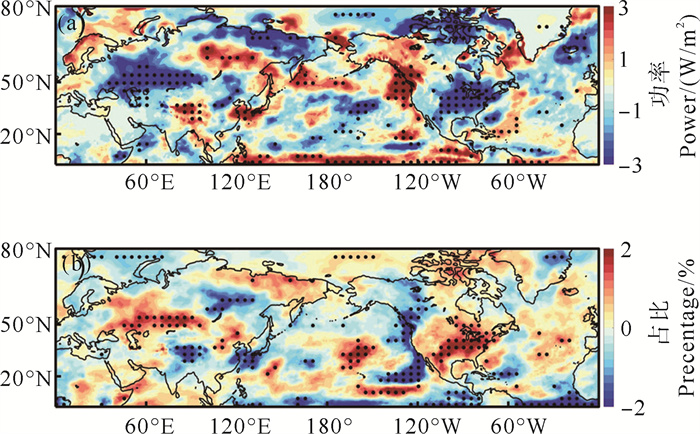
夏季NPMM对北半球SAT(北美和欧亚大陆)有显著影响,而由何种因素主导需进一步阐明。图 3(a)刻画了夏季NPMM指数回归短波辐射异常的空间分布。在北美SAT正相关区域(见图 2),向下的正短波辐射异常加热SAT,而在北美与欧亚大陆SAT负相关区域,向下的负短波辐射异常冷却了SAT。这种短波辐射与SAT异常基本一致的空间分布,表明短波辐射是夏季NPMM影响北半球SAT的主导因素。为了进一步确认短波辐射的作用,图 3(b)绘制了夏季NPMM指数回归的云覆盖率异常的空间分布。在正短波辐射区(见图 3(a)),云覆盖率异常显著减少,更多的短波辐射穿透至低层大气,使得SAT升高。相反,在负短波辐射区,云覆盖率的异常增加有效阻挡了短波辐射,使得SAT冷却。
|
( (a) 红色代表正的向下短波辐射异常,蓝色则相反;(b) 红色代表云覆盖率增多,蓝色则相反。黑点为通过显著性水平0.05的双边学生氏t检验。(a) Red indicates enhanced downward shortwave radiation anomalies, while blue indicates the opposite; (b) Red indicates increased cloud cover anomalies, while blue indicates the opposite. Black dots indicate the coefficients significant at the 0.05 significance level based on the two-tailed Student's t-test. ) 图 3 夏季NPMM指数同期回归短波辐射异常(a)和云覆盖率异常(b) Fig. 3 Simultaneous regressions of downward shortwave radiation (a) and cloud cover (b) anomalies against the JJA NPMM index |
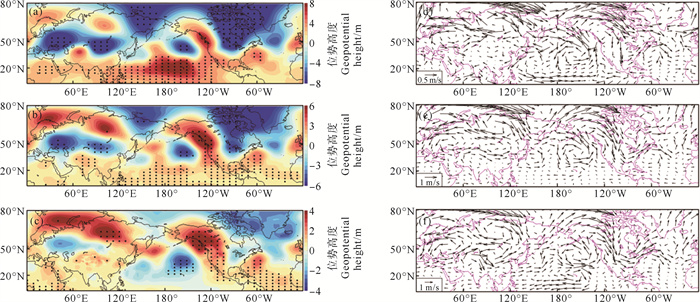
为了揭示夏季NPMM是如何控制云覆盖率异常,进而影响短波辐射异常,作者从大气环流的角度对其进行解释。图 4为夏季NPMM指数分别回归200、500和850 hPa的位势高度异常和风场异常。这三层位势高度异常分布相似,表明夏季NPMM激发的大气环流异常为相当正压结构,并且它们与SAT分布(见图 2)基本对应:在暖SAT异常区,位势高度异常增加,伴随反气旋式风场异常,这种风场结构不利于云的形成,从而增强了向下的短波辐射,加热SAT,反之亦然。
|
( 图(a), (b), (c)中红色代表正的位势高度异常,蓝色则相反,黑点为通过显著性水平0.05的双边学生氏t检验;(d), (e), (f) 中黑色箭头为200、500和850 hPa的风场异常。In (a), (b), (c) red indicates positive geopotential height anomalies, while blue indicates the opposite; Black dots indicate the coefficients significant at the 0.05 significance level based on the two-tailed Student's t-test. In (d), (e), (f) wind anomalies at 200, 500, and 850 hPa, respectively. ) 图 4 夏季NPMM指数同期回归200 hPa((a), (d))、500 hPa((b), (e))和850 hPa((c), (f))位势高度异常以及对应的风场异常 Fig. 4 Simultaneous regressions of geopotential height and wind anomalies against the JJA NPMM index at 200 hPa((a), (d)), 500 hPa((b), (e))and 850 hPa((c), (f)) |
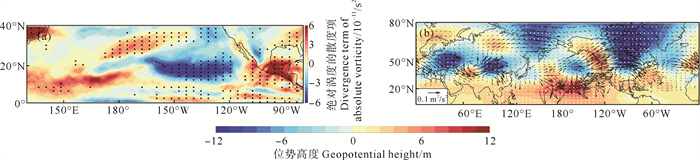
以上结果表明,夏季NPMM激发的大气环流异常是影响北半球SAT的关键。那么,夏季NPMM是如何激发这种大气环流异常的呢?夏季NPMM引起的降水异常(见图 1)会在对流层上层产生罗斯贝波波源(见图 5(a)中20°N左右负值区域),激发的定常罗斯贝波在西风急流的作用下向下游传播,形成类CGT波列(见图 5(b))[12]。该波列自NPMM海区出发沿东北方向传播,在北美西部和东部分别形成高压和低压;到达北大西洋上空后,通过副热带西风急流传播至欧亚大陆中部,在欧亚大陆形成两个低压中心;东侧的低压中心会向东北方向传播至欧亚大陆东北部,形成低压中心。这种类似于CGT波列的空间分布与前人利用观测数据诊断和大气模式试验结果基本一致[11, 13]。
|
( 图(a)中黑点为通过显著性水平0.05的双边学生氏t检验;(b)中黑色箭头为罗斯贝波波通量,白点为通过显著性水平0.05的双边学生氏t检验。In (a) black dots indicate the coefficients significant at the 0.05 significance level based on the two-tailed Student's t-test. In (b) the black arrows represent wave activity fluxes. White dots indicate the coefficients significant at the 0.05 significance level based on the two-tailed Student's t-test. ) 图 5 夏季NPMM指数同期回归200 hPa罗斯贝波波源(a)和200 hPa位势高度异常并叠加罗斯贝波波通量(b) Fig. 5 Simultaneous regressions of 200 hPa Rossby wave sources (a) and geopotential height anomalies against the JJA NPMM index, overlaid with wave activity fluxes(b) |
本文利用观测数据和大气动力学诊断方法,研究了夏季NPMM对北半球SAT影响的分布特征和主导物理机制。研究发现,夏季NPMM的暖SSTA使ITCZ向北偏移,形成北多南少的经向偶极子降水异常分布,通过潜热释放激发罗斯贝波,在西风急流的作用下向下游传播,形成类CGT波列。该波列自NPMM海区出发沿东北方向传播,在北美西侧形成高压,东侧形成低压;到达北太平洋后,进而传播到欧亚大陆中部,形成两个低压中心;东侧的低压异常进一步沿东北方向传播至欧亚大陆东北部,形成低压中心。这些低压中心伴随的气旋式环流异常有利于云的形成,减少了向下的短波辐射,使得SAT降低。类似的,北美西侧的高压异常不利于云的形成,增加了向下的短波辐射,使得SAT升高。本文从半球视角阐明了夏季NPMM影响SAT的分布和机理, 对理解夏季NPMM的气候效应机理、提高区域气候的预测水平有重要意义。
| [1] |
Chiang J C H, Vimont D J. Analogous Pacific and Atlantic meri-dional modes of tropical atmosphere-ocean variability[J]. Journal of Climate, 2004, 17(21): 4143-4158. DOI:10.1175/JCLI4953.1 (  0) 0) |
| [2] |
Zhang Y, Yu S Y, Amaya D J, et al. Atmospheric forcing of the Pacific meridional mode: Tropical Pacific-driven versus internal variability[J]. Geophysical Research Letters, 2022, 49(7): e2022GL098148. DOI:10.1029/2022GL098148 ( 0) |
| [3] |
Rogers J C. The North Pacific oscillation[J]. Journal of Climatology, 1981, 1(1): 39-57. DOI:10.1002/joc.3370010106 ( 0) |
| [4] |
Linkin M E, Nigam S. The North Pacific oscillation-west Pacific teleconnection pattern: Mature-phase structure and winter impacts[J]. Journal of Climate, 2008, 21(9): 1979-1997. DOI:10.1175/2007JCLI2048.1 ( 0) |
| [5] |
Zhang Y, Yu S, Amaya D J, et al. Pacific meridional modes without Equatorial Pacific influence[J]. Journal of Climate, 2021, 34(13): 5285-5301. ( 0) |
| [6] |
Xie S P, Philander S G H. A coupled ocean-atmosphere model of relevance to the ITCZ in the Eastern Pacific[J]. Tellus Series A-Dynamic Meteorology and Oceanography, 1994, 46(4): 340-350. DOI:10.3402/tellusa.v46i4.15484 ( 0) |
| [7] |
Chang P, Ji L, Li H. A decadal climate variation in the Tropical Atlantic Ocean from thermodynamic air-sea interactions[J]. Nature, 1997, 385: 516-518. DOI:10.1038/385516a0 ( 0) |
| [8] |
Amaya D J, Yu K, Zhou W, et al. The North Pacific pacemaker effect on historical ENSO and its mechanisms[J]. Journal of Climate, 2019, 32(22): 7643-7661. DOI:10.1175/JCLI-D-19-0040.1 ( 0) |
| [9] |
Straus D M, Shukla J. Does ENSO force the PNA?[J]. Journal of Climate, 2002, 15(17): 2340-2358. DOI:10.1175/1520-0442(2002)015<2340:DEFTP>2.0.CO;2 ( 0) |
| [10] |
Liu Z, Risi C, Codron F, et al. Acceleration of Western Arctic sea ice loss linked to the Pacific north American pattern[J]. Nature Communications, 2021, 12: 1519. DOI:10.1038/s41467-021-21830-z ( 0) |
| [11] |
Li C, Wu L, Chang P. A far-reaching footprint of the Tropical Pacific meridional mode on the summer rainfall over the Yellow River loop valley[J]. Journal of Climate, 2011, 24(10): 2585-2598. DOI:10.1175/2010JCLI3844.1 ( 0) |
| [12] |
Ding Q, Wang B. Circumglobal teleconnection in the Northern Hemisphere summer[J]. Journal of Climate, 2005, 18(17): 3483-3505. DOI:10.1175/JCLI3473.1 ( 0) |
| [13] |
Luo M, Lau N, Zhang W, et al. Summer high temperature extremes over China linked to the Pacific meridional mode[J]. Journal of Climate, 2020, 33(14): 5905-5917. DOI:10.1175/JCLI-D-19-0425.1 ( 0) |
| [14] |
Liu Z, Gao T, Zhang W, et al. Implications of the Pacific meridional mode for summer precipitation extremes over China[J]. Weather and Climate Extremes, 2021, 33: 100359. DOI:10.1016/j.wace.2021.100359 ( 0) |
| [15] |
Rayner N A, Parker D E, Horton E B, et al. Global analyses of sea surface temperature, sea ice, and night marine air temperature since the late nineteenth century[J]. Journal of Geophysical Research, 2003, 108(D14): 4407. ( 0) |
| [16] |
Hersbach H, Bell B, Berrisford P, et al. The ERA5 global reanalysis[J]. Quarterly Journal of the Royal Meteorological Society, 2020, 146(730): 1999-2049. DOI:10.1002/qj.3803 ( 0) |
| [17] |
Harris I, Osborn T J, Jones P, et al. Version 4 of the CRU TS monthly high-resolution gridded multivariate climate dataset[J]. Scientific Data, 2020(7): 109. ( 0) |
| [18] |
Sardeshmukh P D, Hoskins W A. The generation of global rotational flow by steady idealized tropical divergence[J]. Journal of Atmospheric Science, 1988, 45(7): 1228-1251. DOI:10.1175/1520-0469(1988)045<1228:TGOGRF>2.0.CO;2 ( 0) |
| [19] |
Takaya K, Nakamura H. A formulation of a phase-independent wave-activity flux for stationary and migratoryquasigeostrophic eddies on a zonally varying basic flow[J]. Journal of the Atmospheric Sciences, 2001, 58(6): 608-627. DOI:10.1175/1520-0469(2001)058<0608:AFOAPI>2.0.CO;2 ( 0) |
| [20] |
Shu Q, Zhang Y, Amaya D J, et al. Role of ocean advections during the evolution of the Pacific meridional modes[J]. Journal of Climate, 2023, 36(13): 4327-4343. DOI:10.1175/JCLI-D-22-0296.1 ( 0) |
2. Sanya Oceanographic Institution, Ocean University of China, Sanya 572025, China;
3. Laoshan Laboratory, Qingdao 266237, China