 2025, Vol. 55


2. 山东大学环境研究院,山东 青岛 266237
海洋作为地球表面重要的碳汇,吸收了自工业革命以来接近1/3的人为排放二氧化碳[1],因此成为减缓全球气候变暖的重要圈层[2]。海洋中碳循环、氮循环和其他生源要素(如磷、硅等)的生物地球化学循环过程既是研究地球系统气候变化的重要方向[3],同时也是联系生物圈的重要过程[4]。
海洋中碳、氮等元素循环过程中很重要的一部分便是海洋浮游植物进行初级生产的过程。相较于开阔大洋,陆架浅海生态系统虽然只占全球海洋面积的7%,但却贡献了全球海洋初级生产的14%,这与近海受到包括大气沉降、河流输入、地下水和外海输入等外部来源营养盐的贡献有直接关系[5]。准确把握近海生态系统演变规律及其机制既是近海可持续发展的重要基础,又是深刻理解全球气候变化的内在需求。
渤海和黄海毗邻山东半岛。渤海三面环陆,平均水深18 m,是半封闭内海,入海的主要河流有黄河、辽河、滦河、海河和小清河等。黄海通过渤海海峡与渤海相连,平均水深约40 m,是半封闭边缘海,入海的主要河流有鸭绿江和汉江等。渤、黄海作为西北太平洋中典型的陆架浅海,其生态系统的演变也受到大气沉降、河流输入等外部营养盐源的影响,是受到人类活动影响的典型富营养化海域[6]。在输入总量上,赵晨英等[7]通过构建收支模型,认为大气沉降对渤、黄海水体DIN(溶解无机氮)的输入约为河流输入的两倍,对DIP(活性磷酸盐)的输入大约与河流输入相当。同时,两种外部营养盐源对水体影响的空间差异同样值得关注[8]。
三维水动力-生态耦合模型是研究海洋生态系统演变的重要工具[9-10],可以较为准确地量化评估海洋生态系统对外部营养盐的直接影响和累计效应。本文以渤、黄海生态系统为研究对象,利用高分辨率的渤、黄海水动力-生态耦合模型评估大气沉降和河流输入对渤、黄海营养盐和叶绿素a浓度变化的影响,并通过数值试验对比分析二者的异同,重点关注这种影响的空间分布特征和季节变化。
1 方法 1.1 水动力-生态耦合模型基于水平分辨率为1/18(°)(约25 km)的三维水动力(POM)-生态(NORWECOM)耦合模型[11-12](下文称粗分辨率模型),通过嵌套加密针对渤、黄海构建1/54(°)的高分辨率(约1.7 km)的水动力生态模型。研究区域范围为117.4°E—127°E,35.2°N—41°N,包括渤海和黄海海域(见图 1)。水动力模块POM[13]为生态模块提供温度、水位、流场和湍流混合系数等。生态模块中的模拟变量包括:DIN、DIP、SIL(无机硅酸盐)、DET(碎屑)、SIS(生物硅)、FLA(鞭毛藻)和DIA(硅藻)。模型主要考虑了浮游植物的生长、呼吸、死亡、沉降、碎屑的沉降、再矿化、再悬浮等生态过程,以及河流输入、大气沉降和沉积物-水界面处的营养盐交换等[11]。模型外模时间步长为1.5 s,内模时间步长为45 s。模型结果每小时保存一次,并进行滤潮以去除潮信号[14]。

|
( 圆点表示河口位置,实线框表示观测数据较多的3个典型区域。The dot represents the estuary of the river; The solid line frame represents the three typical area with abundant observed data. ) 图 1 研究区域及水深分布 Fig. 1 Research area and water depth distribution |
水动力模型的水深数据由粗分辨率模型中的水深数据[15]线性插值得到,并针对黄河口附近海域,依据2006年电子海图对水深数据进行了适当调整。模型的外强迫大多来自原有粗分辨率气候态模型[12];海表面动力边界条件包括月平均的海表热通量、风应力、蒸发、降水、大气压强等,其数据均由粗分辨率模型的数据加密而来;开边界条件中的水位、流速、温盐数据和初始温盐场均来自粗模型的计算结果。水动力模型运行三年后达到稳定状态。开边界的营养盐等数据由粗分辨率模型给出,初始场来自粗分辨率模型的初始条件。
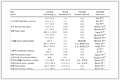
模型的大气硅沉降输入来自原有气候态模型[12]。模型输入包括DIN的大气干沉降和湿沉降,并考虑其时间变化和空间差异。DIN输入数据来自WRF-CMAQ模型[16]的输出结果(尚未发表),包括颗粒态硝酸盐、铵盐、气态硝酸、亚硝酸、氨气等,DIP干沉降资料来自文献中的观测数据[17],DIP湿沉降资料来自尚未发表的岸基(东营和烟台)观测数据。相关数据经插值得到模型网格格点数据。DIN和DIP大气沉降输入数据见表 1。
|
表 1 模型和观测得到的大气沉降输入数据 Table 1 Input data of atmospheric deposition from models and observations |
河流输入营养盐方面,鸭绿江、辽河、滦河、海河[18]和汉江[8]输入来自已发表的观测数据,黄河和小清河输入来自SWAT模型的输出结果。在SWAT模型中,氮、磷营养盐(主要形态为NO3-、PO43-)在黄河、小清河流域经过地表径流、入渗、地下流动、渗滤等过程进入土壤,最终进入河流[19],输出结果成为生态模型中的河流输入源,其模拟时间及月平均数值范围见表 2。其余河流的流量数据来自《2015中国河流泥沙公报》[20]。
|
|
表 2 SWAT模型得到的河流输入数据 Table 2 River input data from SWAT model |
为探究大气沉降和河流输入对渤、黄海水质及叶绿素a的影响,以2015年为基准年,该模型运行了2 a,达到稳定状态。本文采用第2年数据进行分析,设计了如下数值试验(见表 3)。Case 0用于验证并调试模型,通过关闭大气沉降(Case 1)或河流输入(Case 2)来对比大气沉降和河流输入对水体的影响程度,通过调整大气沉降的比例(Case 3—5)来量化大气沉降的影响。
|
|
表 3 模型数值实验设置 Table 3 Numerical experiments for the model |
水动力模块对渤、黄海水动力环境季节变化特征的模拟能力已得到验证[21-22],因此本研究仅关注营养盐和叶绿素a浓度,选取观测数据积累较丰富的典型区域(见图 1实线框)进行验证。在各典型区域内,表层(本文中“表层”指2 m以浅的水层)营养盐的模拟结果和现场观测(观测数据获取时间从2005年到2019年不等)[23-38]结果虽有偏差,但在季节变化特征上基本吻合。从整体上看,表层DIN浓度的模拟结果(见图 2(a)—2(c))相较于观测结果偏低,大多接近观测结果区间的下限,范围在0.6~7 mmol/m3; 而表层DIP浓度的模拟结果(见图 2(d)—2(f))相较于观测结果稍高,大多接近观测结果区间的上限,范围在0.12~0.77 mmol/m3。事实上,观测资料的采样年份、采样方式、分析方法等都存在差异,客观上观测数据之间也存在较大差异。总体而言,模拟结果基本可以反映典型区域表层营养盐浓度的季节变化。

|
( 红色实线表示模拟结果,蓝色圆点表示观测数据平均值,蓝色实线表示观测数据区间,粉色虚线表示2002—2022年平均MODIS卫星叶绿素a数据。The solid red line represents the simulation results; The blue dot represents the average value of the observations; The solid blue line represents the interval of the observations and the dotted pink line shows the average MODIS Chl-a data from 2002 to 2022. ) 图 2 三个典型区域表层DIN、DIP、表层叶绿素a浓度的模拟和观测对比 Fig. 2 Comparison of simulated and observed surface DIN, DIP and Chl-a concentration in three typical regions |
表层叶绿素a浓度的模拟结果(见图 2(g)—2(i))相较于观测结果[23, 31, 33, 39-40]偏低,接近观测结果区间的下限,但明显低于卫星反演的结果,范围在0~2.3 mg/m3。众所周知,由于碎屑和有色物质的影响,水色遥感卫星(如MODIS)对叶绿素a浓度的反演存在高估现象[41],特别是在冬季大风强化了垂向混合时尤为显著[42]。以Zone-3为例,在4月份表层Chl-a浓度模拟结果与MODIS卫星数据相差最大,约为2 mg/m3;而在夏季,表层Chl-a浓度模拟结果与MODIS卫星数据较为接近,误差不超过1 mg/m3,这与已有数值研究[43]的结果是一致的。
从季节尺度上来看,从冬季(1月)到夏季(8月),表层营养盐浓度呈降低的趋势,而叶绿素a浓度有升高趋势;从夏季(8月)到秋季(11月),表层营养盐浓度逐渐上升,而表层叶绿素a浓度下降,这一规律在渤海中部(Zone-1)最为明显。造成这种季节变化规律的原因有两方面:一是从冬季到夏季水温逐渐升高,有利于浮游植物生长并消耗营养盐,从夏季到秋季水温逐渐降低,浮游植物生长受到抑制[44];二是从春季(3月)开始,上层水体增温,温跃层逐渐增强,上下层水体交换受影响,底层营养盐无法向表层补充,而秋季垂向混合作用增强,底层营养盐可补充至表层。
2.2 表层营养盐和叶绿素a浓度的水平分布特征在所有季节,近岸表层DIN浓度(见图 3(a)—3(d))都显著高于离岸海域,河口区域尤为显著,这主要是由于河流输入的影响[24]。从冬季到夏季,表层DIN浓度逐渐降低,渤海中部DIN浓度从6~7 mmol/m3降低至0.5~1 mmol/m3,黄海中部DIN浓度从4~5 mmol/m3降低至0.5~1 mmol/m3;夏季到秋季,表层DIN浓度有所回升,渤海中部DIN浓度升高至5~6 mmol/m3,黄海中部DIN浓度升高至1~2 mmol/m3。这和图 2展示的营养盐和叶绿素a的季节变化一致。

|
图 3 冬(2月)、春(5月)、夏(8月)、秋季(11月)表层DIN、DIP、叶绿素a浓度的空间分布 Fig. 3 Spatial distribution of surface DIN, DIP and Chl-a concentration in winter (February), spring (May), summer (August), and autumn (November) |
冬季,表层DIP浓度(见图 3(e)—3(h))整体较高,在渤海中部可达0.6~0.8 mmol/m3,在黄海中部可达0.2~0.4 mmol/m3。从冬季到夏季,表层DIP浓度逐渐降低,但山东半岛附近海域出现明显的表层DIP高值区,这可能是由于冬季垂向混合作用将底层的DIN和DIP携带至表层,而春季初级生产过程中DIP相对过剩。秋季,随着水温下降,浮游植物初级生产受抑制,渤海中部的DIP浓度升高至0.5~0.7 mmol/m3,黄海中部则升高至0.1~0.25 mmol/m3。
表层叶绿素a浓度(见图 3(i)—3(l))也呈现出近岸高于离岸的特点,这和营养盐的分布特征一致。即使在浮游植物生长繁殖旺盛的春、夏季,表层叶绿素a浓度高值区仅在渤海较为明显,在渤海中部可达1~4 mg/m3,这可能是由于渤海是半封闭海且营养盐供应相对充足。黄海中部海域存在表层叶绿素a浓度低值区,浓度仅为0~0.5 mg/m3,这可能是由于春、夏季垂向混合作用弱,水体分层,限制了底层营养盐向上运输造成的[45]。
3 讨论 3.1 大气沉降对渤、黄海营养盐和叶绿素a的影响本研究用Case0的结果减去Case1的结果,以表征大气沉降对渤、黄海表层DIN、DIP和叶绿素a浓度的影响。如图 4所示,大气沉降增加了渤、黄海表层DIN的浓度(见图 4(a)—4(d)),渤海中部增加0.5~2 mmol/m3,黄海中部增加0~1 mmol/m3。在近岸,大气沉降的氮会显著累积,使近岸表层DIN浓度增加更加明显,可达4~14 mmol/m3。

|
图 4 大气沉降对研究海域DIN、DIP、叶绿素a浓度的影响 Fig. 4 Influence of atmospheric deposition on distribution of DIN, DIP and Chl-a concentration in the research area |
另一方面,与大气沉降对表层DIN浓度的正贡献(相比于不考虑大气沉降的数值实验情景,若考虑大气沉降后表层浓度上升,则称大气沉降做正贡献;反之则称大气沉降做负贡献)明显不同,大气沉降从冬季到夏季对表层DIP的负贡献区不断扩大(见图 4(e)—4(g)),渤海中部表层DIP浓度下降可达0.2 mmol/m3,黄海中部下降0~0.1 mmol/m3。大气沉降对DIP产生负贡献的原因是大气沉降的N/P远大于16,而浮游植物通常按照Redfield比值(N∶P=16∶1)对水体中的DIN和DIP进行吸收,大气输送的DIN进一步促进了浮游植物对原先水体DIP的吸收。从夏季到秋季(见图 4(g)—4(h)),大气沉降对渤海表层DIP浓度的负贡献明显减弱,而对黄海的负贡献增加且范围扩大,其原因是渤海水温降低,因此浮游植物对营养盐的利用能力减弱,且对比图 2(g)和图 2((h)—2(i))可发现,黄海初级生产受水温变化的影响较渤海小。
在夏季,大气沉降对表层叶绿素a浓度的影响最为明显(见图 4(k)),渤海中部增加0.5~1 mg/m3,黄海中部增加0~0.5 mg/m3,这一影响一直延续到秋季(见图 4(l))。但是在春季(见图 4(j)),在考虑大气沉降之后渤海中部的叶绿素a的浓度反而略微降低,这可能是由于利用Case0与Case1的差值来代表大气沉降的影响并不是十分严谨[11],两个Case中均有河流输入的背景浓度影响,相同的水动力场也会因为营养盐浓度差异从而导致平流扩散作用在局部发生变化;同时也考虑到渤海近岸水温较高且混合均匀,而渤海中部水温存在明显差异[21]。
3.2 河流输入对渤、黄海水质和叶绿素a的影响本研究用Case0的结果减去Case2的结果,以确定河流输入对渤、黄海表层DIN、DIP和叶绿素a浓度的影响。河流输入对表层DIN浓度的影响集中在河口附近海域,增幅可达10~90 mmol/m3,但在夏季的黄河、小清河口处(见图 5(c))并不明显,因为此时该处浮游植物生长旺盛(见图 5(k)),充分吸收利用了营养盐。

|
图 5 河流输入对研究海域DIN、DIP、叶绿素a浓度的影响 Fig. 5 Influence of river input on distribution of DIN, DIP and Chl-a concentration in the research area |
河流输入对河口处表层DIP浓度的增幅最大达0.2 mmol/m3以上。在鸭绿江河口附近及远离河口的海域,河流输入对表层DIP浓度做负贡献。对比图 5(e)—5(h))和图 5((i)—5(l))发现, 在鸭绿江河口附近河流输入对表层DIP浓度的负贡献区和对表层叶绿素a浓度的正贡献区形状一致,说明河流输入促进了浮游植物对DIP的吸收利用是造成该处表层DIP浓度负贡献区的原因。
河流输入的营养盐在各季节均显著增加了河口海域表层叶绿素a的浓度,部分海域增幅可达1 mg/m3以上(见图 5(i)—5(l))。叶绿素增加的海域与DIN增加和DIP减少的海域基本重合,也说明在春季到秋季的过程中初级生产主要受营养盐限制。特别地,在冬季,由于水温的限制导致初级生产水平较低,模型的模拟可能不尽如人意,从而出现略低的负值区域,这可能是模式本身误差导致的。
3.3 大气环境改善对渤、黄海的影响为了比较大气沉降和河流输入分别对渤、黄海水质和初级生产的影响,将渤海、北黄海和南黄海海域的Case0与Case1的差值、Case0与Case2的差值和Case0结果作比值,得到各海域大气沉降和河流输入导致从表层到底层整个水柱的DIN、DIP和叶绿素a浓度的变化率(见图 6)。除了黄河、鸭绿江流量夏季暴涨导致河流输入迅速增大,在其他情况下大气沉降导致DIN、DIP和叶绿素a浓度的变化率的绝对值均大于河流输入。因此,相比于控制河流输入,控制大气沉降可能是改善渤、黄海水质更直接有效的手段。由此,我们将大气沉降通量分别按照0%(Case1)、30%(Case3)、60%(Case4)、90%(Case5)和100%(Case0)的比例输入模型(见表 3),计算这5种沉降情境下各海域DIN(见图 7(a)—7(c))、DIP(见图 7(d)—7(f))和叶绿素a(见图 7(g)—7(i))的整个水柱的平均浓度,以研究大气环境改善对渤、黄海营养盐和叶绿素a浓度的影响。

|
图 6 大气沉降(atm)和河流输入(riv)导致的各海域DIN、DIP、Chl-a浓度的变化率 Fig. 6 Change rates of DIN(N), DIP(P) and Chl-a concentrations by atmospheric deposition(atm) and river input(riv) |

|
图 7 大气沉降通量变化对各海域DIN、DIP、Chl-a水体平均浓度的影响 Fig. 7 Effects of atmospheric deposition on the average concentrations of DIN, DIP, Chl-a in each sea |
随着大气沉降通量比例的增大,各海域绝大多数月份平均DIN(见图 7(a)—7(c))和叶绿素a(见图 7(g)—7(i))的浓度随之增大,这说明大气沉降的氮能促进浮游植物的生长,且被浮游植物吸收利用过后仍有剩余。值得注意的是,有些季节的平均浓度差异相较于其他季节较小,这说明不同季节间水体对大气沉降响应的敏感程度不同。为研究这一现象背后的机制,分析表层水体N/P的情况(见图 8,由于各Case水体N/P变化规律一致,只展示Case0的水体N/P水平分布图)。

|
图 8 1、4、7、10月表层N/P的空间分布 Fig. 8 Spatial distribution of surface N/P in January, April, July and October |
从图 8可以看出,在黄河、鸭绿江等河口附近水体N/P明显大于16,其余海域水体N/P小于16,整体接近N/P的观测数据范围[6]。但是,从水平分布上来说,模型所模拟的N/P与实际观测有所出入,这与海域现场观测数据间N/P变化幅度大有关。渤海中部在4个季节均处于氮限制状态,这与王燕等[46]的观测结果一致。对比图 7(a)和图 8可发现,渤海平均DIN浓度对大气沉降的敏感度和N/P趋势一致,在N/P最低的7月,各情景下的平均DIN浓度十分接近,说明水体对大气沉降的响应最弱,这是因为此时水体氮限制程度最严重,大气沉降的氮几乎全部被浮游植物吸收利用;各情景下的平均叶绿素a浓度(见图 7(g))差值在夏季更大,因为该季节更多的大气氮沉降被利用,有可能还受温度、光照等因素调控。北黄海、南黄海的叶绿素a浓度季节趋势与渤海相同。
在渤海,4月之前各情景下的平均DIP浓度几乎一致(见图 7(d)),水体平均DIP浓度对大气沉降几乎无响应,4月之后,随着大气沉降通量比例的增大,水体平均DIP浓度减小。造成这一现象的原因与水体中的N/P有关:4月之前渤海水体N/P较为稳定;从4月之后,水体N/P大幅下降,氮限制状态加深,浮游植物更多地利用大气沉降的氮(见图 7(a)),但大气沉降的N/P大于16,而浮游植物通常按照Redfield比值(N∶P=16∶1)对水体中的DIN和DIP进行吸收,因此浮游植物需额外利用水体原有的DIP,导致水体DIP浓度下降。北黄海、南黄海也适用这一结论。总的来说,DIP浓度对大气沉降的响应不如DIN更敏感,且其敏感度受水体N/P影响。
4 结语本研究利用三维水动力-生态耦合模型,定量分析了大气沉降和河流输入对渤、黄海营养盐和叶绿素a的影响。整体上,大气沉降对水体中DIN和叶绿素a做正贡献,而在某些海域对DIP存在负贡献,影响程度从近岸向中央海域递减;河流输入对水体中DIN做正贡献,对DIP和叶绿素a存在负贡献,其影响在河口区域最为显著。二者对比发现,除了丰水期,大气沉降对水体DIN、DIP和叶绿素a浓度的影响更加显著。数值试验表明,若大气沉降减少,水体中DIN和叶绿素a的平均浓度将随之减小,说明大气环境改善将对渤、黄海营养物质浓度和水质改善具有积极作用。
根据《2022年中国海洋生态环境状况公报》[47]数据,渤海未达到一类海水水质标准的海域面积同比增加11 800 km2,同比增长率约92%;黄海未达到一类海水水质标准的海域面积同比增加4 190 km2,同比增长率约44%。这说明渤、黄海环境治理仍有很大的提升空间,控制河流输入有利于缓解河口区的富营养化风险[48],而控制大气沉降将是改善近岸海域水质的一种直接有效的手段[49]。总之,在陆海统筹背景下, 实施大气沉降和河流输入的联合控制, 对海洋环境治理具有重要意义[50]。
| [1] |
Khatiwala S, Tanhua T, Mikaloff F S, et al. Global ocean storage of anthropogenic carbon[J]. Biogeosciences, 2013, 10(4): 2169-2191. DOI:10.5194/bg-10-2169-2013 (  0) 0) |
| [2] |
Lee H K, Calvin D, Dasgupta G, et al. Synthesis Report of the IPCC Sixth Assessment Report (AR6)[R]. Switzerland: Interlaken IPCC, 2023.
( 0) |
| [3] |
Ruiz-Cooley R I, Gerrodette T, Fiedler P C, et al. Temporal variation in pelagic food chain length in response to environmental change[J]. Science Advances, 2017, 3(10): e1701140. DOI:10.1126/sciadv.1701140 ( 0) |
| [4] |
Ratnarajah L, Abu-Alhaija R, Atkinson A, et al. Monitoring and modelling marine zooplankton in a changing climate[J]. Nature Communications, 2023, 14(1): 564. DOI:10.1038/s41467-023-36241-5 ( 0) |
| [5] |
Chen C A, Liu K, Macdonald R. Continental margin exchanges. //Fasham M J R Ed. Ocean Biogeochemistry: The Role of the Ocean Carbon Cycle in Global Change[M]. New York: Springer, 2003: 53-97.
( 0) |
| [6] |
Zheng L W, Zhai W D. Nutrient dynamics in the Bohai and North Yellow seas from seasonal to decadal scales: Unveiling Bohai Sea eutrophication mitigation in the 2010s[J]. Science of the Total Environment, 2023, 905: 167417. DOI:10.1016/j.scitotenv.2023.167417 ( 0) |
| [7] |
赵晨英, 臧家业, 刘军, 等. 黄渤海氮磷营养盐的分布、收支与生态环境效应[J]. 中国环境科学, 2016, 36(7): 2115-2127. Zhao C Y, Zang J Y, Liu J, et al. Distribution and budget of nitrogen and phosphorus and their influence on the ecosystem in the Bohai Sea and Yellow Sea[J]. China Environmental Science, 2016, 36(7): 2115-2127. ( 0) |
| [8] |
Liu S M, Zhang J, Chen S Z, et al. Inventory of nutrient compounds in the Yellow Sea[J]. Continental Shelf Research, 2003, 23(11-13): 1161-1174. DOI:10.1016/S0278-4343(03)00089-X ( 0) |
| [9] |
Fasham M J R, Ducklow H W, Mckelvie S M. A nitrogen-based model of plankton dynamics in the oceanic mixed layer[J]. Journal of Marine Research, 1990, 48(3): 591-639. DOI:10.1357/002224090784984678 ( 0) |
| [10] |
Fennel K, Wilkin J, Levin J, et al. Nitrogen cycling in the Middle Atlantic Bight: Results from a three-dimensional model and implications for the North Atlantic nitrogen budget[J]. Global Biogeochemical Cycles, 2006, 20(3): GB3007. ( 0) |
| [11] |
Zhao L, Guo X Y. Influence of cross-shelf water transport on nutrients and phytoplankton in the East China Sea: A model study[J]. Ocean Science, 2011, 7(1): 27-43. DOI:10.5194/os-7-27-2011 ( 0) |
| [12] |
Wang Y C, Guo X Y, Zhao L, et al. Seasonal variations in nutrients and biogenic particles in the upper and lower layers of East China Sea Shelf and their export to adjacent seas[J]. Progress in Oceanography, 2019, 176: 102138. DOI:10.1016/j.pocean.2019.102138 ( 0) |
| [13] |
Mellor G L. Users Guide for a Three-Dimensional, Primitive Equation, Numerical Ocean Model[M]. Princeton University USA: Program in Atmospheric and Oceanic Sciences, 1998.
( 0) |
| [14] |
Hanawa K, Mitsudera H. On daily average of oceanographic data (in Japanese)[J]. Coastal Oceanography Bulletin, 1985, 23(1): 79-87. ( 0) |
| [15] |
Choi B, Kim K O, Eum H. Digital bathymetric and topographic data for neighboring seas of Korea[J]. Journal of Korean Society of Coastal and Ocean Engineers, 2002, 14: 41-50. ( 0) |
| [16] |
Wang J, Zhang J, Liu X H, et al. Atmospheric input of silicon to the China adjacent seas: Non-negligible contributions from anthropogenic sources[J]. Science of the Total Environment, 2023, 857: 159540. DOI:10.1016/j.scitotenv.2022.159540 ( 0) |
| [17] |
Qi J H, Yu Y, Yao X H, et al. Dry deposition fluxes of inorganic nitrogen and phosphorus in atmospheric aerosols over the Marginal Seas and Northwest Pacific[J]. Atmospheric Research, 2020, 245: 105076. DOI:10.1016/j.atmosres.2020.105076 ( 0) |
| [18] |
Zhang J. Nutrient elements in large Chinese estuaries[J]. Continental Shelf Research, 1996, 16(8): 1023-1045. DOI:10.1016/0278-4343(95)00055-0 ( 0) |
| [19] |
Jiang M, Peng H, Liang S K, et al. Impact of extreme rainfall on non-point source nitrogen loss in coastal basins of Laizhou Bay, China[J]. Science of the Total Environment, 2023, 881: 163427. DOI:10.1016/j.scitotenv.2023.163427 ( 0) |
| [20] |
中华人民共和国水利部. 中国河流泥沙公报2015[EB/OL]. http://www.mwr.gov.cn/sj/tjgb/zghlnsgb/201612/t20161222_776071.html, 2015. Ministry of Water Resources of the People's Republic of China. China River Sediment Bulletin 2015[EB/OL]. http://www.mwr.gov.cn/sj/tjgb/zghlnsgb/201612/t20161222_776071.html, 2015. ( 0) |
| [21] |
Wang Q, Guo X, Takeoka H. Seasonal variations of the Yellow River plume in the Bohai Sea: A model study[J]. Journal of Geophysical Research-Oceans, 2008, 113(C8): C08046. ( 0) |
| [22] |
Zhu J Y, Shi J, Guo X Y, et al. Air-sea heat flux control on the Yellow Sea cold water mass intensity and implications for its prediction[J]. Continental Shelf Research, 2018, 152: 14-26. DOI:10.1016/j.csr.2017.10.006 ( 0) |
| [23] |
Zhou L M, Sun Y, Zhang H H, et al. Distribution and characteristics of inorganic nutrients in the surface microlayer and subsurface water of the Bohai and Yellow Seas[J]. Continental Shelf Research, 2018, 168: 1-10. DOI:10.1016/j.csr.2018.09.001 ( 0) |
| [24] |
Zheng L W, Zhai W D. Excess nitrogen in the Bohai and Yellow Seas, China: Distribution, trends, and source apportionment[J]. Science of the Total Environment, 2021, 794: 148702. DOI:10.1016/j.scitotenv.2021.148702 ( 0) |
| [25] |
Liang W, Wang Y, Liu S M, et al. Nutrient dynamics and coupling with biological processes and physical conditions in the Bohai Sea[J]. Frontiers in Marine Science, 2022, 9: 1025502. DOI:10.3389/fmars.2022.1025502 ( 0) |
| [26] |
郭全. 渤海夏季营养盐和叶绿素分布特征及富营养化状况分析[D]. 青岛: 中国海洋大学, 2005. Guo Q. Features in Distributions of Nutrients and Chlorophyll and Eutrophication Assessment in Bohai Sea in Summer[D]. Qingdao: Ocean University of China, 2005. ( 0) |
| [27] |
张莹. 渤海中部浮游植物与环境因子的空间关系及季节差异分析[D]. 烟台: 中国科学院烟台海岸带研究所, 2016. Zhang Y. Spatial Correlation and Seasonal Variation of Phytoplankton and Environmental Factors in the Central Bohai Sea[D]. Yantai: Yantai Institute of Coastal Zone Research Chinese Academy of Sciences, 2016. ( 0) |
| [28] |
王文涛. 中国东海、黄海和渤海微表层营养盐分布及富集研究[D]. 青岛: 中国海洋大学, 2013. Wang W T. Study on the Distribution and Enrichment of Nutrients in the Sea-Surface Microlayer of the East China Sea, the Yellow Sea and the Bohai Sea[D]. Qingdao: Ocean University of China, 2013. ( 0) |
| [29] |
臧璐. 北黄海生源要素的季节特征及冷水团对其影响的研究[D]. 青岛: 中国海洋大学, 2009. Zang L. The Research of Biogenic Elements' Seasonal Characteristics in the North Yellow Sea and the Contribution of the North Yellow Sea Cold Water Mass[D]. Qingdao: Ocean University of China, 2009. ( 0) |
| [30] |
Wei Q S, Yu Z G, Wang B D, et al. Coupling of the spatial-temporal distributions of nutrients and physical conditions in the southern Yellow Sea[J]. Journal of Marine Systems, 2016, 156: 30-45. DOI:10.1016/j.jmarsys.2015.12.001 ( 0) |
| [31] |
Jin J, Liu S M, Ren J L, et al. Nutrient dynamics and coupling with phytoplankton species composition during the spring blooms in the Yellow Sea[J]. Deep-Sea Research Part Ⅱ-Topical Studies in Oceanography, 2013, 97: 16-32. DOI:10.1016/j.dsr2.2013.05.002 ( 0) |
| [32] |
孙涛. 渤海与黄海水体和沉积物中硅的分布特征与影响因素[D]. 青岛: 国家海洋局第一海洋研究所, 2014. Sun T. Distribution Characteristics of Silica in Bohai and Yellow Seas[D]. Qingdao: The First Institute of Oceanography, SOA, 2014. ( 0) |
| [33] |
Guo C C, Zhang G C, Sun J, et al. Seasonal responses of nutrient to hydrology and biology in the southern Yellow Sea[J]. Continental Shelf Research, 2020, 206: 104207. DOI:10.1016/j.csr.2020.104207 ( 0) |
| [34] |
唐永, 孙语嫣, 石晓勇, 等. 黄渤海海域秋季营养盐及有色溶解有机物分布特征[J]. 环境科学, 2017, 38(11): 4501-4512. Tang Y, Sun Y Y, Shi X Y, et al. Distribution characteristics of chromophoric dissolved organic matter and nutrients from the Yellow Sea and Bohai Sea in autumn[J]. 环境科学, 2017, 38(11): 4501-4512. ( 0) |
| [35] |
王俊杰, 于志刚, 韦钦胜, 等. 2017年春、夏季南黄海西部营养盐的分布特征及其与浒苔暴发的关系[J]. 海洋与湖沼, 2018, 49(5): 1045-1053. Wang J J, Yu Z G, Wei Q S, et al. Distributions of nutrients in the western South Yellow Sea in spring and summer of 2017 and their relationship with ulva prolifera outbreaks[J]. Oceanologia et Limnologia Sinica, 2018, 49(5): 1045-1053. ( 0) |
| [36] |
刘丽雪, 王玉珏, 邸宝平, 等. 2012年春季渤海中部及邻近海域叶绿素a与环境因子的分布特征[J]. 海洋科学, 2014, 38(12): 8-15. Liu L X, Wang Y J, Di B P, et al. Spatial distribution of chlorophylla and environmental factors in the Bohai Sea in spring of 2012[J]. Marine Sciences, 2014, 38(12): 8-15. ( 0) |
| [37] |
金春洁, 张传松, 王丽莎, 等. 黄海溶解无机氮时空变化及其水团对DIN总量的影响[J]. 中国环境科学, 2021, 41(4): 1642-1654. Jin C J, Zhang C S, Wang L S, et al. Spatial-temporal variation of dissolved inorganic nitrogen (DIN) and impacts of water mass on the reserves estimation of the total DIN content in the Yellow Sea[J]. China Environmental Science, 2021, 41(4): 1642-1654. ( 0) |
| [38] |
李延伟, 胡莹莹, 陈淑梅. 夏、秋季北黄海营养盐的时空分布特征及其影响机制[J]. 中国环境科学, 2013, 33(6): 1060-1067. Li Y W, Hu Y Y, Chen S M. Distribution and influence factors of nutrients in the North Yellow Sea in summer and autumn[J]. China Environmental Science, 2013, 33(6): 1060-1067. ( 0) |
| [39] |
纪昱彤, 王宁, 陈洪举, 等. 2013年秋季渤黄海浮游植物的群落特征[J]. 中国海洋大学学报(自然科学版), 2018, 48(S2): 31-41. Ji Y T, Wang N, Chen H J, et al. Phytoplankton community structure in the Bohai and theHuanghai in autumn 2013[J]. Periodical of Ocean University of China, 2018, 48(S2): 31-41. DOI:10.16441/j.cnki.hdxb.20180165 ( 0) |
| [40] |
王丽莎, 魏西会, 张海波, 等. 渤海中部冬夏季叶绿素a和营养盐结构影响因素对比分析[J]. 海洋渔业, 2021, 43(4): 473-484. Wang L S, Wei X H, Zhang H B, et al. Comparative study on the influence factors of Chlorophyll-a and nutrient structure between winter and summer in the central Bohai Sea[J]. Marine Fisheries, 2021, 43(4): 473-484. ( 0) |
| [41] |
Xia L, Liu H, Lin L, et al. Surface chlorophyll-a fronts in the Yellow and Bohai Seas based on satellite data[J]. Journal of Marine Science and Engineering, 2021, 9(11): 1301. DOI:10.3390/jmse9111301 ( 0) |
| [42] |
Shi J, Liu Y, Mao X Y, et al. Interannual variation of spring phytoplankton bloom and response to turbulent energy generated by atmospheric forcing in the central Southern Yellow Sea of China: Satellite observations and numerical model study[J]. Continental Shelf Research, 2017, 143: 257-270. DOI:10.1016/j.csr.2016.06.008 ( 0) |
| [43] |
郭伟, 史洁, 朱君莹, 等. 大气氮沉降对南黄海初级生产过程影响的数值研究[J]. 中国海洋大学学报(自然科学版), 2020, 50(1): 115-125. Guo W, Shi J, Zhu J Y, et al. Modelling the effects of the atmospheric nitrogen deposition on the primary production process in the Southern Yellow Sea[J]. Periodical of Ocean University of China, 2020, 50(1): 115-125. DOI:10.16441/j.cnki.hdxb.20190028 ( 0) |
| [44] |
王丽芳, 翟惟东, 黄晓, 等. 渤、黄海在低氧形成期与消亡期生源要素的分布差异及响应特征[J]. 海洋环境科学, 2022, 41(3): 452-460. Wang L F, Zhai W D, Huang X, et al. Dynamics of biogenic elements before and after oxygen depletion in Yellow and Bohai Seas[J]. Marine Environmental Science, 2022, 41(3): 452-460. ( 0) |
| [45] |
乌伊寒, 张晶, 赵亮, 等. 黄海氮磷营养盐时空特征及影响过程分析[J]. 天津科技大学学报, 2021, 36(5): 30-40. Wu Y H, Zhang J, Zhao L, et al. Spatiotemporal characteristics of nitrogen and phosphorus and its influencing processes in the Yellow Sea[J]. Journal of Tianjin University of Science & Technology, 2021, 36(5): 30-40. ( 0) |
| [46] |
王燕, 姚振童, 祝艳君, 等. 2019年渤海氮磷营养盐季节变化及富营养化状况[J]. 海洋环境科学, 2021, 40(6): 915-921. Wang Y, Yao Z T, Zhu Y J, et al. Seasonal variation of nutrients and eutrophication of 2019 in Bohai Sea, China[J]. Marine Environmental Science, 2021, 40(6): 915-921. ( 0) |
| [47] |
中华人民共和国生态环境部. 中国海洋生态环境状况公报2022[EB/OL]. https://www.mee.gov.cn/hjzl/sthjzk/jagb/, 2022. Ministry of Ecology and Environment of the People's Republic of China. Bulletin of Marine Ecology and Environment Status of China[EB/OL]. https://www.mee.gov.cn/hjzl/sthjzk/jagb/, 2022. ( 0) |
| [48] |
王菊英, 郑楠, 马德毅. 近海生态系统的人为营养盐输入及其控制对策浅析[J]. 海洋学报, 2020, 42(6): 1-8. Wang J Y, Zheng N, Ma D Y. Anthropogenic inputs of nutrients to coastal ecosystem and mitigation actions[J]. Haiyang Xuebao, 2020, 42(6): 1-8. ( 0) |
| [49] |
Deng O P, Huang S, Wang C, et al. Atmospheric nitrogen pollution control benefits the coastal environment[J]. Environmental Science & Technology, 2023, 58(1): 449-458. ( 0) |
| [50] |
张桂成, 孙军. 渤海环境污染现状及研究进展[J]. 环境化学, 2023, 42(3): 918-930. Zhang G C, Sun J. State of environmental pollution in the Bohai Sea, China: A review[J]. Environmental Chemistry, 2023, 42(3): 918-930. ( 0) |
2. Environment Research Institute, Shandong University, Qingdao 266237, China