 2021, Vol. 20


Gracilariopsis lemaneiformis (Rhodophyta, Gigartinales, Gracilariaceae) is a red alga composed of agar (Freile-Pelegrín and Murano, 2005) and other important bioactive substances, such as polysaccharides and phycobiliproteins. It is widely grown in aquaculture and used in chemical and food industries. G. lemaneiformis cultivars 981 and 2007 are high-temperature-resistant strains (i.e., from wild type to cultivar 981 and to cultivar 2007). They have the advantages of significantly enhanced tensile strength, fast growth, high agar content, and good anti-adversity performance compared with wild-type G. lemaneiformis. Cultivar 2007 is bred from cultivar 981 and is considered superior because of its fast growth rate, high-quality agar, and high tolerance to increasing temperatures (Meng et al., 2009).
Oxygenic photosynthesis is the main reaction used by cyanobacteria, algae, and plants. In this process, light energy is converted into chemical energy. In photosynthesis, light-harvesting pigment complexes transfer light energy to the reaction center for the primary charge-separation reaction and participate in energy dissipation and state transitions in the light protection mechanism (Haldrup et al., 2001; Rochaix, 2007). There are many kinds of light-harvesting pigment complexes. For example, the light-harvesting pigment system of red algae consists of chlorophyll a (Chl a) protein complexes and phycobilisomes, which are composed of colored phycobiliproteins and nonpigmented linker proteins (Wu et al., 2016).
Phycobilisomes are supramolecular complexes that play an important role in the photosynthesis of red algae by absorbing and transmitting light energy and promoting photosynthesis (Maccoll, 1998). Phycobilisomes possess a class of major light-harvesting proteins called phycobiliproteins that efficiently transfer captured light energy to Chl a (Maccoll and Guard-Friar, 1987). Phycobiliproteins are classified into phycoerythrin (PE), phycocyanin (PC), and allophycocyanin (APC) according to the specific spectrum and composition of their chromophores (Gantt, 1980). PE is one of the most important light-harvesting proteins in red algae. G. lemaneiformis is rich in PE, which gives the algae a red appearance. PE has unique optical, antitumor, and antivirus properties and other important physiological functions (Huang et al., 2017). Thus, it can be used in medicine, food, and other industries.
PE consists of three subunits, namely, α, β, and γ (Ficner et al., 1992). Apophycobiliproteins are colorless and must be combined with phycobilins to present an optical activity. The chromophores of PEs include phycoerythrobilins (PEBs) and phycourobilins (PUBs). The fluorescence chromophore of PE is PEB. PUBs function in energy transfer. PEB biosynthesis requires two subsequent two-electron reductions. The first reduction reaction is catalyzed by the ferredoxin oxidoreductase PebA (15, 16-dihydrobiliverdin), which reduces the Δ15, 16 double bond of biliverdin IX α, which is a PEB precursor in red algae. The second reduction reaction is catalyzed by the PEB ferredoxin oxidoreductase PebB, which reduces the A-ring 2, 3, 3(1), 3(2)-diene structure of 15, 16-dihydrobiliverdin to yield PEB (Dammeyer and Frankenbergdinkel, 2006). Thus peA, peB (used to synthesize the α and β protein subunits of apo-PE), pebA, and pebB (involved in PEB synthesis) are key genes in the synthesis of optically active PE in G. lemaneiformis. Therefore, their expression patterns under different light conditions should be studied to elucidate the molecular mechanism of optically active PE synthesis.
In this study, the effects of changes in short-term light intensity on the PE, PC, APC, and Chl a contents of three G. lemaneiformis strains were determined and compared. The changes in the expression of four key genes associated with PE synthesis were examined and compared with the changes in pigments, as PE is an important light-harvesting protein complex in red algal photosynthesis and is also the most sensitive protein complex to light intensity fluctuations. Specifically, variations in the transcription levels of the α and β protein subunits of PE and two genes involved in the synthesis of the PEB moiety, namely, pebA and pebB, under different light intensities were determined. This study provided an experimental basis for the indepth understanding of the biosynthesis of optically active PE and a theoretical and technical basis for the screening of algae with strong agronomic traits.
2 Materials and Methods 2.1 Experimental MaterialsWild-type G. lemaneiformis was collected from Fushan Bay, Qingdao, China (E120.4, N36.1). Cultivars 981 and 2007, which are laboratory-bred varieties, were obtained from a farm area in Nan'ao Island, Shantou, China (E117.1, N23.4). The algae were washed with filtered seawater to remove contaminating algae and surface impurities and then placed in 1 L beakers with natural sea water that was replaced twice a week.
After the algae were allowed to adapt to laboratory culture conditions and grew well, 24 g (fresh weight) of algae was placed in 4500 mL Erlenmeyer flasks (with 1/3 volume of filtered and boiled seawater) and precultured in a light incubator (Ningbo Jiangnan Instrument Factory GXZ type) for 4 d at 23℃, salinity 33, pH 8.0, 60 μmol m-2 s-1 light intensity, and 12:12 light: dark photoperiod.
2.2 Experimental Design and CultivationAfter the preculture, the algae were placed in illumination incubators at light intensities of 10, 60, 100, and 200 μmol m-2 s-1. The other conditions were the same as the pretreatment conditions. Relevant tests were carried out on days 0, 2, 4, 6, and 8. A light intensity of 60 μmol m-2 s-1 under the preculture growth conditions was chosen as the control condition.
2.3 Research Methods 2.3.1 Determination of photosynthetic pigment contentsIn this procedure, 0.25 g of the fresh material sample was ground in liquid nitrogen after surface moisture was removed. Then, 4 mL of PB buffer (50 mmol L-1, pH 5.5) was added. Algal cells were ruptured (crushed for 2 s and paused for 3 s for a total time of 10 min) by using an ultrasonic crusher, and the samples were maintained in an ice bath. Frozen autolysis was performed at -20℃ for 2 h. Then, the samples were thawed rapidly at 35℃ in a water bath and centrifuged at 13000 g and 4℃ for 20 min. The supernatants were composed of the initial phycobiliprotein crude extracts. Afterward, 4 mL of 90% (v/v) acetone was added to the crude extracts in the dark for 20 min and centrifuged at 10000 g for 10 min to obtain the crude chlorophyll extracts. The process was carried out at 0 – 4℃ in the dark. For each group, measurements were made on three parallel samples. The absorbance of phycobiliprotein was measured at 498.5, 614, and 651 nm. The APC, PC, and PE contents were calculated using the following equations (Kursar et al., 1983). The unit was grams per milliliter converted to milligrams per gram (fresh weight of algae according to the amount of each sample).
| $ {\rm{APC}} = 181.3{A_{651}} - 22.3{A_{614}}, $ | (1) |
| ${\rm{PE}} = 151.1{A_{614}} - 99.1{A_{651}}, $ | (2) |
| $ {\rm{PE}} = 155.8{A_{498.5}} - 40.0{A_{614}} - 10.5{A_{651}}. $ | (3) |
The absorbance of chlorophyll was measured at 630, 645, and 662 nm. The Chl a content was determined as follows (UNESCO, 1966):
| ${\rm{Chl }}a = 11.64{A_{662}} - 2.16{A_{645}} + 0.1{A_{630}}.$ | (4) |
Total RNA was extracted with an OMEGA Plant RNA kit R6827 at a fixed time (15:00 daily) to avoid any photoperiod effect and immediately reversely transcribed to cDNA by using a PrimeScriptTM RT reagent kit with gDNA Eraser (Takara, Japan).
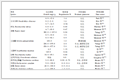
2.3.3 Quantitative real-time PCRThree pairs of specific primers were designed according to the cloned PE β-subunit gene peB (Genbank accession number: MH724192), the PE α-subunit gene peA (Genbank accession number: MH724191), and the ferredoxin oxidoreductase genes pebA (Genbank accession number: MH715937) and pebB (Genbank accession number: MH 725905) by using Primer Premier. The most suitable primers for quantitative real-time PCR (TaKaRa SBYR® Premix Ex TaqTM Ⅱ) were shown in Table 1. The actin gene ACT and the transcription factor gene eIF were selected as internal reference genes.
|
Table 1 Primer sequences of peB, peA, pebA, pebB, ACT, and eIF for real-time PCR |
The cDNA stock solution obtained through reverse transcription was diluted 100-fold and used as a template, and this procedure for each sample was repeated three times.
The following conditions were set for real-time PCR amplification: 95℃ for 30 s, followed by 40 cycles of 94℃ for 5 min, 55℃ for 20 s, 72℃ for 20 s.
2.4 Data AnalysisThe relative transcription levels of the genes in each treatment group were analyzed using the 2-ΔΔCt method (Livak and Schmittgen, 2001). The final data was displayed in the form of log10 (RQ) in which RQ was the relative quantitation. The mean Ct values of ACT and eIF were used for ΔCt, and the gene transcription level at 60 μmol m-2 s-1 was set as the control. Excel 2007 and Origin 8.5 were used for data processing and graphics analysis. ANOVA was conducted to examine significant differences, and the significance level was set at P < 0.05.
3 Results 3.1 Effect of Light Intensity on Photosynthetic Pigment Contents 3.1.1 Effect of light intensity on the photosynthetic pigment content of wild-type G. lemaneiformisTable 2 showed the contents of various photosynthetic pigments of wild-type G. lemaneiformis under different light intensities measured every other day for 8 d. The PE content ((0.83 ± 0.31) mg g-1) was significantly higher than the APC ((0.16 ± 0.08) mg g-1), PC ((0.16 ± 0.07) mg g-1), and Chl a ((0.14 ± 0.05) mg g-1) contents in wild-type G. lemaneiformis (light intensity: 60 μmol m-2 s-1; time: 0 d). The PE content was regulated by light. At a low light intensity (10 μmol m-2 s-1), the PE content significantly decreased (P < 0.05) on day 2. As time was prolonged, the PE content began to increase. The PE content at 10 μmol m-2 s-1 was higher than at other light intensities after 6 d, which might increase the amount of light captured for algal growth. At a high light intensity (200 μmol m-2 s-1), the PE content gradually decreased over time. This finding implied that high light intensities might inhibit PE accumulation in wildtype G. lemaneiformis. The APC and PC contents showed a similar trend. The Chl a content was stable within a range of 0.14 – 0.15 mg g-1.
|
|
Table 2 Photosynthetic pigment contents of wild G. lemaneiformis under different light intensities |
Table 3 showed the photosynthetic pigment contents of cultivar 981 under different light conditions monitored for 8 d. The most abundant photosynthetic pigment of cultivar 981 was PE ((1.81 ± 0.19) mg g-1), which was much higher than PC ((0.42 ± 0.02) mg g-1), APC ((0.28 ± 0.04) mg g-1), and Chl a ((0.17 ± 0.02) mg g-1). The PE content of cultivar 981 gradually decreased as the light intensity increased. A low light intensity promoted an increase in the PE content, whereas a high light intensity inhibited PE accumulation. The contents of the other three pigments did not change remarkably over time under different light intensities.
|
|
Table 3 Photosynthetic pigment contents of cultivar 981 under different light intensities |
The photosynthetic pigment content of cultivar 2007 did not change substantially under different light intensities for 8 d (Table 4). On day 0, at a low light intensity, the PE content ((1.49 ± 0.31) mg g-1) was the highest, followed by the PC ((0.36 ± 0.08) mg g-1), APC ((0.27 ± 0.06) mg g-1), and Chl a ((0.15 ± 0.04) mg g-1) contents. The PE content of cultivar 2007 was relatively stable compared with that of the wild type and cultivar 981. At a low light intensity (10 μmol m-2 s-1), the PE content slightly increased over time, thereby compensating for the reduced light capture to meet the growth needs. The PE content of cultivar 2007 remained stable or even increased at a high light intensity. The APC, PC, and Chl a contents remained relatively stable for 8 d at the four light intensities. Thus, cultivar 2007 appeared insensitive to light intensity and maintained high pigment contents in the entire range. This finding might be directly related to its fast growth and strong resistance to adverse conditions.
|
|
Table 4 Photosynthetic pigment contents of cultivar 2007 under different light intensities |
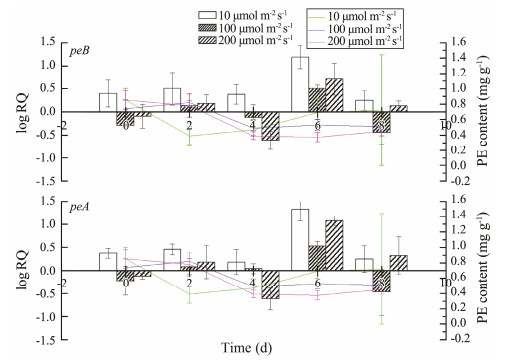
Genes peA and peB encode two major subunits, namely, α and β of PE. The gene transcription level at 60 μmol m-2 s-1 was set as the control. The transcription patterns of peA and peB were similar (Fig. 1). The maximum gene transcription level at each light intensity was reached on day 6. A low light intensity appeared to be conducive to higher relative transcription levels of peA and peB of the wild type. The changes of transcription levels of the PE α and β subunits were similar to the change in the PE content.
|
Fig. 1 Changes in the PE contents and peA and peB transcription in wild-type G. lemaneiformis under different light intensities. |
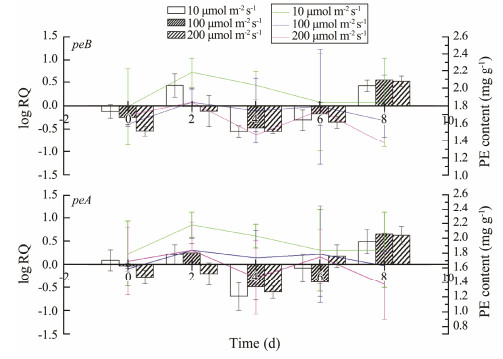
For cultivar 981, the genes of α and β of PE were generally upregulated at a low light intensity on the first 2 days, subsequently downregulated, and upregulated again on day 8 (Fig. 2). The upregulation and downregulation of the genes were based on the comparison of values (P < 0.05), and the difference was significant. In general, the transcription levels of peA and peB in cultivar 981 changed slightly and more uniformly than those of the wild type under different light intensities. The changes in the PE content were similar to the changes of transcription levels of the PE α and β subunits, especially at a low light intensity.
|
Fig. 2 Changes in the PE contents and peA and peB transcription of cultivar 981 under different light intensities. |
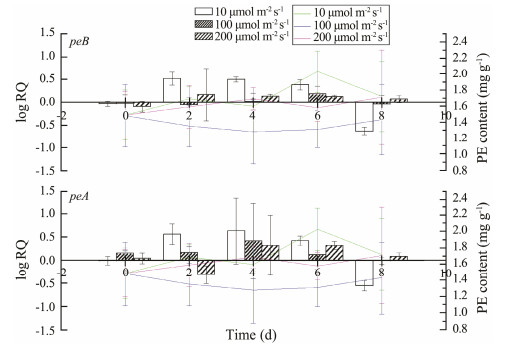
For cultivar 2007, the transcription levels of the genes encoding the α and β subunits of PE were mostly upregulated during the first 6 days at the three light intensities (10, 100, and 200 μmol m-2 s-1). On day 8, their levels decreased compared with that of the control group (60 μmol m-2 s-1). On day 2, the upregulation level at a low light intensity was significantly higher than that at a high light intensity (P < 0.05). The trends of the change in the PE content and transcription levels of the PE α and β subunits were similar, especially at a low light intensity of 10 μmol m-2 s-1.
|
Fig. 3 Changes in the PE contents and peA and peB transcription of cultivar 2007 under different light intensities. |
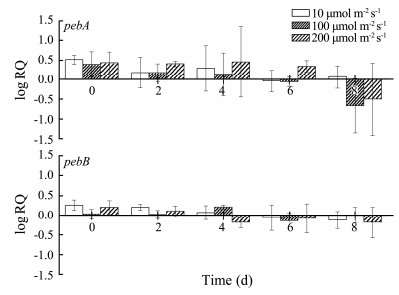
The relative transcription levels of pebA and pebB in wild-type G. lemaneiformis under different light intensities were measured over time (Fig. 4). Transcription of pebA was upregulated under both low and high light intensities compared with that of the control group at 60 μmol m-2 s-1 until day 6, and it declined significantly at a high light intensity (60 μmol m-2 s-1) on day 8 (P < 0.05). Conversely, the pebB transcription level only slightly changed.
|
Fig. 4 Changes in the pebA and pebB transcription of wild-type G. lemaneiformis under different light intensities. |
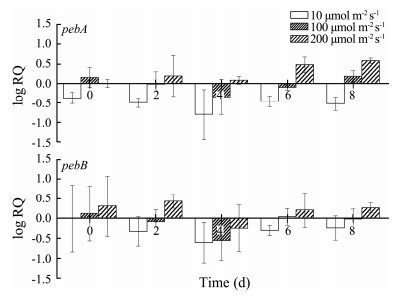
As shown in Fig. 5, the relative transcription levels of pebA and pebB of cultivar 981 decreased at a low light intensity. Conversely, their expression levels increased under high light conditions. The patterns of pebA and pebB transcription levels under different light conditions over time were similar.
|
Fig. 5 Changes in the pebA and pebB transcription of cultivar 981 under different light intensities over time. |
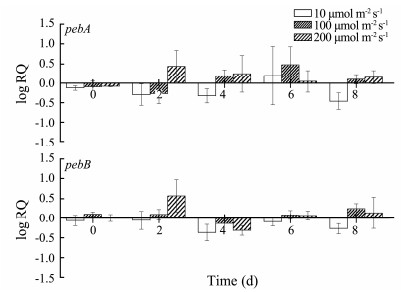
At high light intensities, the pebA and pebB expression levels of cultivar 2007 increased. By contrast, their levels decreased at low light intensities (Fig. 6).
|
Fig. 6 Changes in the pebA and pebB transcription of cultivar 2007 under different light conditions. |
Light intensity directly affects photosynthesis. The absorption and utilization of light energy are positively correlated as long as light intensity is within the tolerance level of plants. When light intensity exceeds a certain level, plants will absorb excessive light energy, and the unused light energy will lead to photoinhibition and a decreased light energy conversion rate. In red algae, long-term exposure to a high light intensity may damage phycobiliproteins and Chl a (Sommers, 2013). In our study, the photosynthetic pigment contents of wild type and cultivar 981 G. lemaneiformis decreased as light intensity increased to four different levels. This observation was similar to those in other studies on algae, i.e., the PE, PC, and Chl a contents of Gracilaria verrucosa decrease as light intensity increases (Ak and Yücesan, 2012). Our study further revealed that the PE content of cultivar 2007 did not decrease at a light intensity of 200 μmol m-2 s-1 because of its good performance at a high light intensity. Under low light conditions, plants increase the amount of light energy captured through physiological and biochemical regulation to maintain the normal photosynthetic efficiency (Zhang et al., 2003). A high PE content accumulates under low light conditions to compensate for the reduced light level (Talarico and Maranzana, 2000; Marinho-Soriano, 2012). In our research, the PE content of wild-type G. lemaneiformis was regulated by light, and it increased significantly at a low light intensity, thereby compensating for the decreased light energy to meet the growth requirements. This observation is also consistent with the important role of PE in the photosynthesis of G. lemaneiformis. The PE contents of cultivars 981 and 2007 were higher than those of the wild type, but the highest PE content was found in cultivar 981. Under the different light conditions, the PE content of cultivar 2007 remained relatively stable, and the short-term high and low light intensities favored PE accumulation. This observation may be associated with the fast growth rate and good tolerance of cultivar 2007 to a high light intensity (Chen et al., 2009; Meng et al., 2009). The shortterm (8 d) changes in light intensity slightly affected cultivar 2007.
PE is located at the periphery of phycobilisomes and directly absorbs light energy. Phycobilisomes can adapt to environmental changes by constantly adjusting their structure, so they can efficiently transfer the absorbed light energy. PE levels can also vary through the addition of more PE units to phycobilisomes and the formation of additional phycobilisomes, which can affect photosynthesis by altering the energy transfer efficiency (Grossman et al., 1993). A change in illumination inevitably leads to a variation in the transcription levels of PE subunit genes and other related genes. In the present study, at light intensities of 10, 60, 100, and 200 μmol m-2 s-1, the transcriptional changes in peA, peB, pebA, and pebB of wild-type, 981, and 2007 G. lemaneiformis were measured via realtime PCR. The results showed that the changes in the two PE subunit genes (α and β) were similar under the different light conditions, indicating that they were likely coordinated. This result was consistent with the fact that the gene loci of the α and β subunits are connected via a short linker in the genome, thereby allowing them to be transcribed synchronously and co-participate in the assembly of PE. The modifications in the transcription levels of the PE α and β subunits were similar to the change in the PE content, especially under low light conditions. This finding indicated that the PE α and β subunit genes were stably transcribed and translated to PE. The variations in the transcription levels of the PE genes of cultivar 981 and 2007 were lower than those of the wild type under different light conditions. These findings were consistent with their more stable PE levels under various light conditions.
The transcription trends of pebA and pebB under different light conditions were similar, indicating a coordinated expression, which was different from the transcription trends of PE subunit genes. Overall, pebA and pebB only changed slightly under different light conditions, and the gene transcription levels increased as the light intensity increased. No compensatory upregulation was found in pebA and pebB transcription levels at a low light intensity. By contrast, pebA and pebB of the three strains were upregulated at a high light intensity. The transcriptions of pebA and pebB were not remarkably inhibited by a high light intensity and did not reach a high level even at 200 μmol m-2 s-1. This result indicated that the change in the content of PE with light intensity was mainly due to the variation in the expression level of genes encoding PE rather than a variation in PEB synthesis.
5 ConclusionsThe highest PE content was observed in cultivar 981, followed by that in cultivar 2007, whereas the lowest PE content was found in the wild type. The effects of changing light intensity on the transcription of PE and related genes in cultivars 981 and 2007 were less than those in the wild type. Cultivar 2007 was superior to cultivar 981 in terms of maintaining high pigment levels in a wide range of light intensities, and can adapt to different light intensities. This finding was consistent with the fast growth rate and high adversity-tolerance of cultivar 2007 described in other studies (Chen et al., 2009; Meng et al., 2009). Thus, among the three strains studied in this research, cultivar 2007 was the most suitable for aquaculture.
AcknowledgementsThis research was supported by the National Natural Science Foundation of China (No. 31872555), the China Agriculture Research System (No. CARS-50), and the Key Program of Science and Technology Innovation Ningbo (No. 2019B10009). Critical comments and support were provided by Dr. John van der Meer.
Ak, I. and Yücesan, M., 2012. Effect of light intensity on the pigment composition of Gracilaria verrucosa (Rhodophyta). Fresenius Environmental Bulletin, 21: 2126-2131. (  0) 0) |
Chen, W. Z., Di, X. U., Wang, L. G., Meng, L., Hong, D. U. and Zhang, X. C., 2009. Preliminary study on economic characteristics and agar characteristics of two new strains of Gracilaria lemaneiformis. Periodical of Ocean University of China, 39(3): 437-442 (in Chinese with English abstract). ( 0) |
Dammeyer, T. and Frankenbergdinkel, N., 2006. Insights into phycoerythrobilin biosynthesis point toward metabolic channeling. Journal of Biological Chemistry, 281: 27081-27089. DOI:10.1074/jbc.M605154200 ( 0) |
Ficner, R., Lobeck, K., Schmidt, G. and Huber, R., 1992. Isolation, crystallization, crystal structure analysis and refinement of B-phycoerythrin from the red alga Porphyridium sordidum at 2.2 A resolution. Journal of Molecular Biology, 228: 935-950. DOI:10.1016/0022-2836(92)90876-L ( 0) |
Freile-Pelegrín, Y. and Murano, E., 2005. Agars from three species of Gracilaria (Rhodophyta) from Yucatán Peninsula. Bioresource Technology, 96: 295-302. DOI:10.1016/j.biortech.2004.04.010 ( 0) |
Gantt, E., 1980. Structure and function of phycobilisomes: Light harvesting pigment complexes in red and blue-green algae. International Review of Cytology, 66: 45-80. ( 0) |
Grossman, A. R., Schaefer, M. R., Chiang, G. G. and Collier, J. L., 1993. The phycobilisome, a light-harvesting complex responsive to environmental conditions. Microbiological Reviews, 57: 725. DOI:10.1128/mr.57.3.725-749.1993 ( 0) |
Haldrup, A., Jensen, P. E., Lunde, C. and Scheller, H. V., 2001. Balance of power: A view of the mechanism of photosynthetic state transitions. Trends in Plant Science, 6: 301-305. DOI:10.1016/S1360-1385(01)01953-7 ( 0) |
Huang, X., Zang, X., Wu, F., Jin, Y., Wang, H., Liu, C., Ding, Y., He, B., Xiao, D. and Song, X., 2017. Transcriptome sequencing of Gracilariopsis lemaneiformis to analyze the genes related to optically active phycoerythrin synthesis. PLoS One, 12: e0170855. DOI:10.1371/journal.pone.0170855 ( 0) |
Kursar, T. A., Van, D. M. J. and Alberte, R. S., 1983. Light-harvesting system of the red alga Gracilaria tikvahiae: Ⅱ. Phycobilisome characteristics of pigment mutants. Plant Physiology, 73: 361-369. DOI:10.1104/pp.73.2.361 ( 0) |
Livak, K. J. and Schmittgen, T. D., 2001. Analysis of relative gene expression data using real-time quantitative PCR and the 2(-Delta Delta C(T)) Method. Methods, 25: 402-408. DOI:10.1006/meth.2001.1262 ( 0) |
Maccoll, R., 1998. Cyanobacterial phycobilisomes. Journal of Struc tural Biology, 124: 311. DOI:10.1006/jsbi.1998.4062 ( 0) |
Maccoll, R., and Guard-Friar, D., 1987. Phycobiliproteins. CRC Press Inc., Boca Raton, 218pp.
( 0) |
Marinho-Soriano, E., 2012. Effect of depth on growth and pigment contents of the macroalgae Gracilaria bursa-pastoris. Revista Brasileira De Farmacognosia, 22: 730-735. DOI:10.1590/S0102-695X2012005000059 ( 0) |
Meng, L., Xu, D., Chen, W. Z. and Zhang, X. C., 2009. Selection and characterization of a new strain of Gracilaria lemaneiformis. Periodical of Ocean University of China, 39(S1): 94-98 (in Chinese with English abstract). ( 0) |
Rochaix, J. D., 2007. Role of thylakoid protein kinases in photosynthetic acclimation. FEBS Letters, 581: 2768-2775. DOI:10.1016/j.febslet.2007.04.038 ( 0) |
Sommers, E., 2013. A Look Into the Past: Photo-Physiology of Cyanobacterial Mat Pigments in Alpena, Michigan and Lake Huron Sinkholes. Presentation, Annis Water Resource Institute (AWRI).
( 0) |
Talarico, L. and Maranzana, G., 2000. Light and adaptive responses in red macroalgae: An overview 1. Journal of Photochemistry & Photobiology B Biology, 56: 1-11. ( 0) |
Wu, F., Zang, X., Zhang, X., Zhang, R., Huang, X., Hou, L., Jiang, M., Liu, C. and Pang, C., 2016. Molecular cloning of cpcU and heterodimeric bilin lyase activity analysis of CpcU and CpcS for attachment of phycocyanobilin to Cys-82 on the β-subunit of phycocyanin in Arthrospira platensis FACHB314. Molecules, 21: 357. DOI:10.3390/molecules21030357 ( 0) |
Zhang, Y., Feng, Y., Feng, Z. and Cao, K., 2003. Morphological and physiological acclimation to growth light intensities in Pometia tomentosa. Acta Photophysiologica Sinica, 29: 206-214. ( 0) |