 2020, Vol. 19


2) Key Laboratory of Estuarine Ecological Security and Environmental Health, Tan Kah Kee College, Zhangzhou 363105, China;
3) College of the Environment and Ecology, Xiamen University, Xiamen 361102, China;
4) Key Laboratory of the Ministry of Education for Coastal and Wetland Ecosystems, Xiamen University, Xiamen 361102, China
Mangroves are unique in their biodiversity, but few studies have considered their meiobenthic biodiversity in China (Liu and Huang, 2012). Fujian Province is the northernmost province in China containing natural mangroves and was also one of the earliest provinces to undergo mangrove forest construction in China (Guo et al., 2014). The nematode diversity in Fujian Province was previously investigated, and new species were found and described from mangrove wetlands in Xiamen Bay (Li and Guo, 2016; Fu et al., 2018). Only 300 species have been described in detail in China; among them, 90 species are newly found (Shi, 2016). There is still much work to be done on nematode classification, especially in mangrove wetlands.
We discovered two new species of the genera Metachromadora and Molgolaimus in the mangrove forests of Xiamen Bay. The genus Metachromadora includes six subgenera: Bradulaimus Stekhoven, 1951; Chromadoropsis Filipjev, 1918; Metachromadora Filipjev, 1918; Metachromadoroides Timm, 1961; Metonyx Chitwood, 1936; and Neonyx Cobb, 1933. Metachromadoroides contains 8 valid species. Metachromadora Filipjev, 1918 is characterized by a loop-shaped or round amphidialis, longitudinal lateral ridges (in some individuals), a pharynx bulb internal lining divided into two or three parts, and precloacal supplemental organs (in some individuals) (Gagarin and Tu, 2014). The genus Molgolaimus Ditlevsen, 1921, was most recently revised by Fonseca et al. (2006) and its latest species was described by Portnova (2009); Shi and Xu (2017) transferred the two reflexed ovaries species of Microlaimus to Molgolaimus, and Molgolaimus now contains 39 valid species.
Two new species, Metachromadora (Metachromadoroides) xiamenensis sp. nov. and Molgolaimus euryformis sp. nov., are described in this article.
2 Materials and Methods 2.1 Study AreaSamples of meiofauna were collected from the mangrove wetland of Tong'an Bay (24.65˚-24.70˚N, 118.20˚-118.30˚E) in summer and winter of 2014 in Xiamen Bay, Fujian Province.
2.2 Sampling Method and Sample ProcessingSediment core samples (2.9-cm inner diameter) were obtained, placed in plastic bottles and fixed with 5% formaldehyde. The samples were washed and filtered through 500- and 42-μm mesh sieves, and the material retained on the 42-μm mesh sieve was collected.
The nematodes were extracted using the flotation technique in Ludox-TM with a specific gravity of 1.15-1.18 (De Jonge and Bouwman, 1977). Nematodes were extracted from the samples under a stereoscopic microscope and transferred to a glycerin solution (McIntyre and Warwick, 1984) consisting of 9:1 (V:V) ethanol/glycerol in a cavity block. Then, the ethanol was gradually evaporated, and the nematode specimens were mounted permanently on slides.
Photographs and body measurements were taken with Nikon-50i microscopy equipment. Drawings were made by using a Wacom CTH-690 digital panel. Holotype and paratype specimens were deposited at the College of the Environment and Ecology, Xiamen University, China.
Measurements are in µm. Abbreviations are as follows: a = body length/maximum body diameter, b = body length/ esophagus length, c = body length/tail length, abd = anal body diameter, c' = tail length/abd, cbd = corresponding body diameter, V% = distance from vulval opening to the anterior end as percentage of total body length, outer labial setae% = outer labial setae length as a percentage of the cbd, and amphid% = amphid diameter as a percentage of the cbd.
3 Results 3.1 Species Description of Metachromadora xiamenensis sp. nov.Order Desmodorida De Coninck, 1965
Family Desmodoridae Filipjev, 1922
Diagnosis (Modified from Tchesunov, 2014)
Body cylindrical. Cuticle distinctly annulated, without dots, but spines, fringes or longitudinal ornamentations may be present. No specialized ambulatory setae at anterior or posterior body end. Locomotion sinuous, typical for nematodes.
Genus Metachromadora Filipjev, 1918
Spiriniinae. Cuticle of head longitudinally striated. Cephalic setae short or papillae. Amphideal fovea strongly cuticularized. Buccal cavity with distinct dorsal tooth. Posterior pharyngeal bulb well-developed with a thick internal cuticular lining partitioned into two or three sections (Tchesunov, 2014).
Subgenus Metachromadoroides Timm, 1961
Diagnosis (Modified from Gagarin and Tu, 2014)
Cuticle annulated with longitudinal lateral ridges. Inner labial sensilla papilliform, outer labial and cephalic sensilla elongated papillae or short thick setae. Amphidial foveae on cuticular thickening, circular or loop-shaped with double contours. Posterior pharyngeal bulb well developed, with strongly cuticularized internal lining often divided into two or three parts. Precloacal supplemental organs in the shape of short, faintly cuticularized tubules present or absent.
Type species
Metachromadora (Metachromadoroides) complexa Timm, 1961
Metachromadora xiamenensis sp. nov. (Figs. 1, 2, Table 1)
|
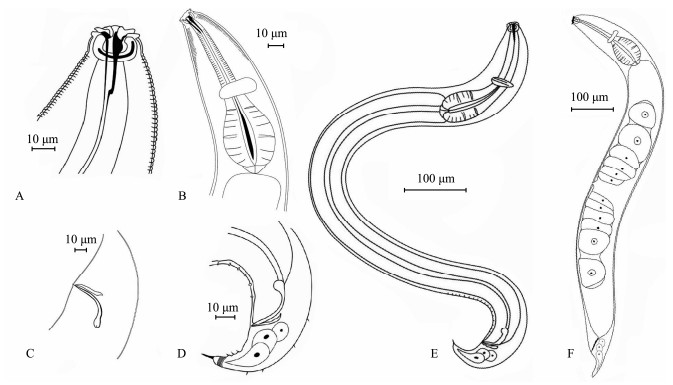
Fig. 1 Metachromadora xiamenensis sp. nov. A, male head; B, lateral view of female anterior end; C, male spicules and gubernaculum; D, male tail; E, entire view of male body; F, entire view of female body. |
|
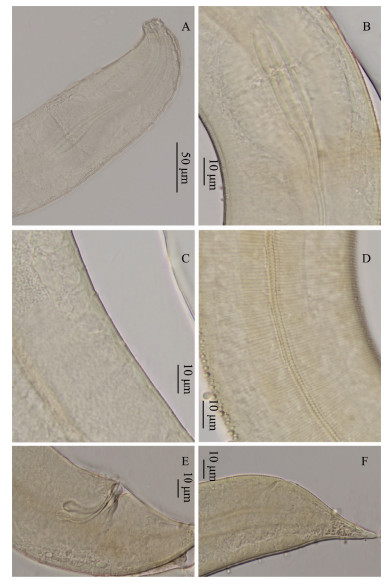
Fig. 2 Metachromadora xiamenensis sp. nov. A, head of male, showing buccal cavity and labial sense organ; B, finely annulated cuticle of male, with an esophageal bulb; C, eighteen precloacal supplements of male; D, lateral punctuation of female; E, male spicules and gubernaculum; F, tail of female. |
|
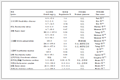
Table 1 Morphometrics of Metachromadora xiamenensis sp. nov. (in μm) |
Type material
Male holotype, slide 201402E311. Four male paratypes, slides 201402E311, 201402E312, 201402E211, and 201 402D102. Five female paratypes, slides 201402E306, 201402E308, 201402E312, 201402E314, and 201402E 314. All the specimens were collected from the muddy surface sediment layer (0-10 cm) in an artificial mangrove wetland located in Tong'an Bay in Xiamen. The mangrove species were mainly Kandelia obovata, also includes Aegiceras corniculatum, Avicennia marina and Sonneratia apetala.
Etymology
This species is named after the city Xiamen, where it was found.
Measurements
The morphometric characteristics of the holotype and paratypes are given in Table 1.
Description
Male. Body cylindrical, smooth head capsule set off from the rest of the body. Cuticle finely annulated, with a thickness of 1 μm at midbody. Lateral ridges beginning at the posterior end of the pharynx and extending to the middle of the tail. Somatic setae short and sparse, irregularly spaced. Labial sensilla indistinct, with four cephalic sensilla in the shape of large elongated papillae that are 2.5-2.7 μm long (16%-18% of the corresponding lip areawidth). Amphids 14.8-15.3 μm (59%-66% cbd) and loopshaped, doubly contoured with an open top. Amphids situated in the labial region, extending to the end of the head capsule and surrounded by a widened cuticular ring. Stoma 28.7-30.8 μm deep, with a strong dorsal tooth positioned in the anterior part. Pharynx cylindrical, 158.9- 172.3 μm long, posteriorly enlarged with a well-developed bipartite basal bulb, the internal lining of which is strongly cuticularized. Bulb length 33%-34% of the total pharynx length. Nerve ring indistinct, with small cardia.
Male with one anterior testis, positioned to the right of the intestine. Eighteen tubular precloacal supplements present. Paired curved spicules 46.0-55.6 μm long (1.0-1.4 abd), distinctly cephalated. Gubernaculum with middle piece and double dorsal apophyses. Tail 67.3-73.4 μm long, 1.5-1.7 anal diameter, with a finger-like tip. Three small protuberances with short setae positioned on the ventral side of the tail. Caudal glands present, but poorly visible.
Females. Females similar to males. Reproductive system didelphic, amphidelphic with reflexed ovaries. Anterior ovary positioned to the left of the intestine, posterior ovary to the right of the intestine. Vulva with thick walls, situated at the median body.
Differential diagnosis
M. (M.) xiamenensis sp. nov. is characterized by loopshaped amphidial foveae with an open top and double contours, a pharynx with a bipartite cuticularized internal cavity, arcuate spicules, proximal end strongly cephalated, 18 tubular precloacal supplements, and a short, conical tail with three small protuberances.
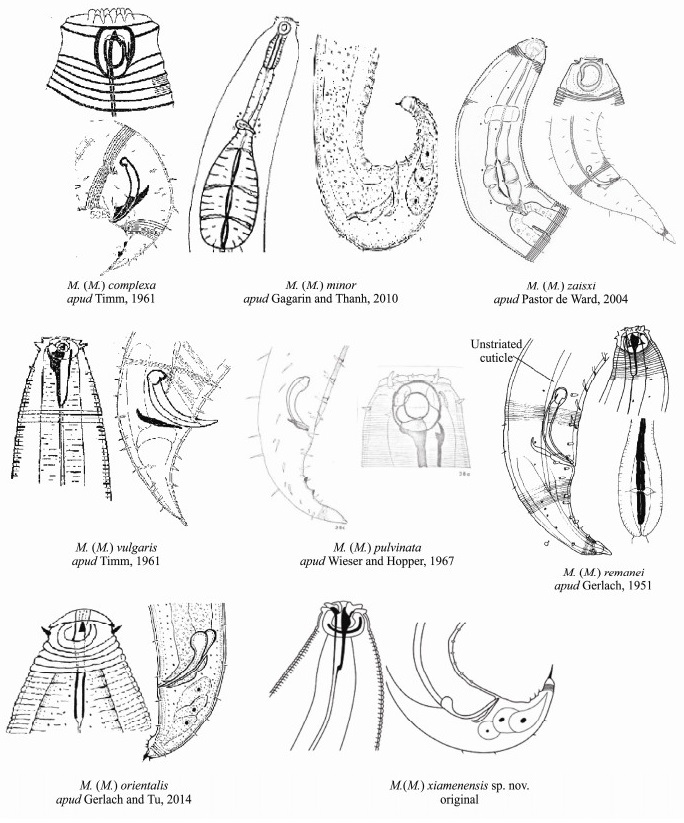
This new species is morphologically similar to M. (M.) orientalis (Gagarin and Tu, 2014) in the shape of the amphid and the head sensilla pattern, and has a similarly armed tail in males. Metachromadora xiamenensis sp.nov. is also similar to M. complexa in the length, a, b and c values, but A% (59-66% in M. (M.) xiamenensis sp. nov. vs. 41.6% in M. complex), with longer spicules (74 µm in M. (M.) xiamenensis sp. nov. vs. 46-56 µm in M. complexa), and different numbers of the internal lining of the pharyngeal bulb (2 in M. (M.) xiamenensis sp. nov. vs. 3 in M. complexa). However, the new species can be distinguished from the other species by the presence of 18 precloacal supplements, a longer and thinner tail (c = 10.1- 12.2 and с' =1.5-1.7 in M. (M.) xiamenensis sp. nov. vs. c =15.3-19.9 and с' =1.0-1.9 in M. (M.) orientalis) and wider lip area.
|
Fig. 3 Pictorial key to the species of Metachromadora (Metachromadoroides). |
The composite differentiating characters for all male Metachromadora (Metachromadoroides) species are provided to aid in identification (Table 2).
|
|
Table 2 Differential characters of males among Metachromadora species |
Genus Molgolaimus Ditlevsen, 1921
Diagnosis (Modified from Fonseca et al., 2006)
Cuticle finely annulated. Amphid situated behind the narrowing part of the head. Inner labial and outer labial sensilla small, hard to observe. Cephalic setae close to the cephalic constriction. Buccal cavity small and narrow with small teeth. Esophagus cylindrical with a pronounced posterior spherical bulb, heavily sclerotized at the bulb. Spicules of different lengths and shapes from short and bent to long and straight. Gubernaculum with or without apophysis. Precloacal supplements often present. Tail of varying shape and length, from short and conical to elongate and slender, cylindrical posteriorly.
Type species
Molgolaimus tenuispiculum Ditlevsen, 1921
|
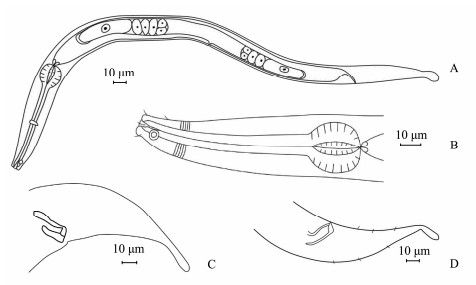
Fig. 4 Molgolaimus euryformis sp. nov. A, entire view of female body; B, male anterior region; C, structure of spicules and gubernaculum; D, lateral view of male tail. |
Molgolaimus euryformis sp. nov.
Type material
Male holotype, slide 201408C203. Five male paratypes, slides 201408C203, 201408C208, 201408B211, 201402 F210, and 201408C207. One female paratype, slide 2014 02C301.
Etymology
This species is named for its lower 'a value' compared to that of other species in the genus.
Measurements
The morphometric characteristics of the holotype and paratypes are given in Table 3.
|
|
Table 3 Morphometrics of Molgolaimus euryformis sp. nov. (in μm) |
Description
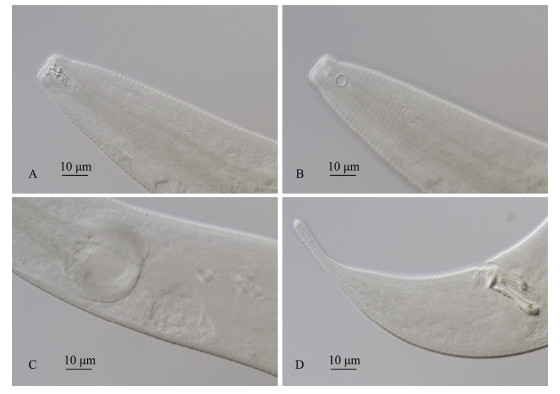
Male. Body relatively short, cylindrical. Cuticle finely annulated, particularly obvious on the tail. Head small and wide with intensive striation, separated from body by small narrowing before head setae. Inner and outer labial sensilla indistinct. Four cephalic setae approximately 3-4 µm long (30% of head diameter). Amphid fovea circular, 5-6 µm in diameter (28%-38% of cbd), located 11-13 µm from the anterior end. Buccal cavity small with teeth. Esophagus forms a pronounced spherical bulb posteriorly with a 31-µm diameter. Cardia is small and extended, and the glandular body lies posterior to the cardia. Excretory pore not observed. Reproductive system monarchic, outstretched testis situated to the left of the intestine. Spicules short with ventral apophysis, 20.9 µm in length (0.6-0.8 abd). Gubernaculum parallel to spicule, with a block-shaped hook on the terminus. Tail conical along 3/4 of its length, cylindrical posteriorly with a swollen tip, 2.2-2.8 anal diameter.
Female. Similar to male, reproductive system didelphic with reflexed ovaries. The ovaries situated to the left of the intestine. Anterior ovary slightly longer than the posterior ovary.
Differential diagnosis
M. euryformis sp. nov. is characterized by its short and relatively plump body (L = 485.6-620.7 µm, a = 11.3- 13.7), relatively short head setae, ventral apophysis (17.8-24.3 μm), gubernaculum with a block-shaped hook, conical-cylindrical shape with a swollen tail tip and absence of precloacal supplements.
|
|
Table 4 Comparison of Molgolaimus euryformis sp. nov. with allied species (male) |
|
Fig. 5 Molgolaimus euryformis sp. nov. A, anterior body of male, showing the buccal cavity and cephalic setae; B, anterior body of male with amphids; C, spherical esophageal bulb of male; D, spicules, gubernaculum and tail with swollen tip. |
Based on the morphological parameters, the new species belongs to group 1a in the identification key (Fonseca et al., 2006), members of which are characterized by short spicules (< 35 μm) and a spicule to abd ratio less than 1.
Among the species in the group (M. citrus (Gerlach, 1959), M. lazonus (Vitiello, 1971), M. turgofrons (Lorenzen, 1972), M. cuanensis (Platt, 1973) and M. parallgeni (Vitiello, 1973)), M. euryformis sp. nov. has the smallest value and spicule/abd ratio. This species is most closely related to M. lazonus and M. turgofrons but differs from them by its conical-cylindrical body with a swollen tail tip and short spicules with ventral apophysis.
The new species resembles M. drakus (Fonseca et al., 2006) in the ratio of body length to spicule length. How- ever, M. drakus differs from M. euryformis sp. nov. by its slim body, its spicule form (short and without ventral apophysis) and the presence of only one precloacal supplement.
AcknowledgementsThis study was funded by the National Natural Science Foundation of China (No. 41606119), the Provincial Natural Science Foundation of Fujian (No. 2017J05068), and the New Century Outstanding Talents Support Program for Institutions of Higher Learning in Fujian Province and Building Ecological Security for Urban Agglomeration and Integrating Ecological Restoration Techniques for Coastal Zones in Fujian River Deltas (No. 2016YFC0502900). The authors are also grateful to many postgraduates and undergraduates for their help during the field samplings and laboratory analysis. We are also very grateful to Prof. Yong Huang and Prof. Yuqing Guo for their help in the improving this manuscript respectively.
De Jonge, V. N. and Bouwman, L. A., 1977. A simple density separation technique for quantitative isolation of meiobenthos using the colloidal silica Ludox-TM. Marine Biology, 42: 143-148. DOI:10.1007/BF00391564 (  0) 0) |
De Ward, C. T., 2004. New species of Hopperia (Nematoda, Comesomatidae) and Metachromadora (Nematoda, Desmodoridae) from Patagonia, Chubut, Argentina. Zootaxa, 542(1): 1-15. DOI:10.11646/zootaxa.542.1.1 ( 0) |
Fonseca, G, Vanreusel, A. and Decraemer, W., 2006. Taxonomy and biogeography of Molgolaimus Ditlevsen, 1921 (Nematoda: Chromadoria) with reference to the origins of deep sea nematodes. Antarctic Science, 18(1): 23-50. DOI:10.1017/S0954102006000034 ( 0) |
Gagarin, V. G. and Tu, N. D., 2014. Two new species of freeliving nematodes (Nematoda and Chromadorea) from mangrove thicket in Vietnam. Inland Water Biology, 7(4): 338-347. DOI:10.1134/S1995082914030067 ( 0) |
Gerlach, S. A., 1951. Nematoden aus der familie der chromadoridae von den deutschen Küsten. Kieler Meeresforschungen, 8: 106-132. ( 0) |
Gerlach, S. A., 1959. Neue meers-nematoden aus dem Supralitoral der deutschen Küsten.Internationale revue der gesamten. Hydrobiologie und Hydrographie, 44(1-4): 463-467. ( 0) |
Guo, Y., Chang, Y., Chen, Y., Li, Y. and Liu, A., 2015. Description of a marine nematode Hopperia sinensis sp.nov. (Comesomatidae) from mangrove forests of Quanzhou, China, with a pictorial key to Hopperia species. Journal of Ocean University of China, 14(6): 1111-1115. DOI:10.1007/s11802-015-2742-6 ( 0) |
Fu, S. J., Zeng, J. L., Zhou, X. P., Tan, W. J. and Cai, L. Z., 2018. Two new species of free living nematodes of genus Tripyloides (Nematoda: Enoplida: Tripyloididae) from mangrove wetlands in the Xiamen Bay, China. Acta Oceanologica Sinica, 37(10): 168-174. DOI:10.1007/s13131-018-0000-01321-2 ( 0) |
Li, Y. X. and Guo, Y. Q., 2016. Two new free-living marine nematode species of the genus Anoplostoma (Anoplostomatidae) from the mangrove habitats of Xiamen Bay, East China Sea. Oceanic and Coastal Sea Research, 15(1): 11-18. DOI:10.1007/s11802-016-2896-x ( 0) |
Liu, J. L. and Huang, B., 2012. Progress in the studies of the meiofauna in mangrove ecosystem. Marine Sciences, 36(10): 118-122 (in Chinese with English abstract). ( 0) |
Lorenzen, S., 1972. Die nematodenfauna im verklappungsgebiet für industrieabwässer nordwestlich von helgoland: Ⅱ.Desmodorida und chromadorida. Zoologischer Anzeiger, 187: 287-302. ( 0) |
McIntyre, A. D. and Warwick, R. M., 1984. Meiofauna techniques.In: Methods for the Study of Marine Benthos. Holme N. A., and McIntyre A. D., eds., Blackwell, Oxford: 217-244. ( 0) |
Pastor, C. T. and Ward, D., 2004. New species of Hopperia (Nematoda, Comesomatidae) and Metachromadora (Nematoda, Desmodoridae) from Patagonia, Chubut. Zootaxa, 542: 1-15. DOI:10.11646/zootaxa.542.1.1 ( 0) |
Platt, H. M., 1973. Freeliving marine nematodes from Strangford Lough, Northern Ireland. Cahiers de Biologie Marine, 14(3): 295-321. ( 0) |
Portnova, D., 2009. Free-living nematodes from the deep-sea Håkon Mosby Mud Volcano, including the description of two new and three known species. Zootaxa, 2096: 197-213. DOI:10.11646/zootaxa.2096.1.13 ( 0) |
Shi, B., 2016. Taxonomy of nematodes and community structure of meiofauna in various marine habitats. PhD thesis. University of Chinese Academy of Sciences, Qingdao.
( 0) |
Shi, B. and Xu, K., 2017. Spirobolbolaimus undulatussp.nov. in intertidal sediment from the East China Sea, with transfer of two Microlaimus species to Molgolaimus (Nematoda, Desmodorida).. Journal of the Marine Biological Association of the United Kingdom, 97(6): 1335-1342. DOI:10.1017/S0025315416000606 ( 0) |
Tchesunov, 2014. Desmodorida De Coninck, 1965. In: Handbook of Zoology. Vol. 2 Nematoda. Schmidt-Rhaesa, A., ed., De Gruyter, Berlin, Boston, 399-420.
( 0) |
Timm, R. W., 1961. The marine nematodes of the Bay of Bengal. Proceedings of the Pakistan Academy of Sciences, 1(1): 1-88. ( 0) |
Vitiello, P., 1970. Nématodes libres marins des vases profondes du Golfe du Lion.Ⅲ. Monhysterida, Araeolaimida, Desmodorida. Tethys, 2: 647-690. ( 0) |
Vitiello, P., 1973. Nouvelles espèces de Desmodorida (Nematoda) des côtes de Provence. Tethys, 5: 137-146. ( 0) |
Vitiello, P. and Boucher, G., 1971. Nouvelles espèces de Chromadorida (Nematoda) des vases terrigènes méditerranéennes. Bulletin de la Société Zoologique de France, 96(2): 187-196. ( 0) |
Wieser, W. and Hopper, B., 1967. Marine nematodes of the east coast of North America.I Florida. Bulletin Museum of Comparative Zoology, 135(5): 239-344. ( 0) |