 2021, Vol. 20

Effect of a Seawater Channel


2) National Ocean Technology Center, Tianjin 300112, China
Ocean induction coupling anchor chains can collect temperature, depth, salinity, and other data using underwater sensors. The collected data can be used to realize largearea monitoring and the real-time data transmission of environmental parameters in an ocean and is suitable for multipoint, multisection, and long-term ocean monitoring (Kong et al., 2009). Seawater and steel cables constitute a complete transmission channel of induction coupling anchor chains (Sellschopp, 1997). Seawater is widely used as an important underwater wireless communication medium in various fields such as electromagnetic field (EMF) communication (Che et al., 2010), optical communication (Hanson and Radic, 2008), underwater acoustic communication (Stojanovic and Preisig, 2009), and current field communication (Zhou et al., 2016). Because of the high conductivity of seawater, the propagation range of high-frequency electromagnetic waves is limited by fundamental wave attenuation and noise factors (Che et al., 2010). The EMF communication attenuates approximately 1600 dB m−1 in seawater and can only provide tens of centimeters in the underwater while operating at a 2.4-GHz frequency (Lloret et al., 2012). Optical communication has high bandwidth and negligible latency. However, the absorption of light waves by seawater and suspended particles is severely attenuated. Underwater acoustic communication and current communication are more suitable for long-distance transmission in seawater than optical communication. However, the transmission of sound waves is affected by the multipath effect (Goh et al., 2009). The time delay fading effect and frequency selective fading effect cause signal distortion during a transmission (Preisig, 2007; Tippmann et al., 2016). A long-distance current transmission mainly applies the induction coupling transmission chain, and a seawater channel signal transmission frequency is controlled within a few hundred MHz (Momma and Tsuchiya, 1976). Because seawater is infinite, current distribution is in the form of a multipath channel in seawater, but its speed is close to the speed of light, which can reduce transmission delay multipath effects. However, with the increase in transmission distance and signal frequency, the multipath effect can influence transmission performance. Multipath effect is the main cause of signal fading. In underwater acoustic communication and power-line carrier communication, the multipath effect can result in a high bit error rate (BER) (Al-Rubaye et al., 2017; Ashri et al., 2017). In GPS, the multipath effect is one of the main reasons for a coupling error (Wang and Zhang, 2017). For example, the accuracy of signal transmission will influence the amplify-and-forward relay communication system (Magableh and Jafreh, 2017), transmission efficiency will be reduced in radio-wave transmission (Ku et al., 2017), and exchange information will decline in a wireless control system (Gama et al., 2017).
Currently, the ocean induction coupling communication system is widely used in oceanographic measurements. The most common methods are amplitude shift keying and differential phase-shift keying modulation and demodulation technologies. However, a signal transmission rate is usually below 10 kHz. At present, the single-carrier method is the most popular method for improving the transmission performance of a seawater channel (Yoshioka et al., 2007), followed by the circuit compensation method (Wu et al., 2016). Zheng et al. (2018) established the channel model and analyzed its transmission performance with the sweep frequency method. To effectively resist the interference of the multipath delay effect on the transmission of electrical signals in the infinite seawater space, orthogonal frequency-division multiplexing (OFDM) technology is commonly used. The OFDM can resist multipath delay extension and frequency selective fading (Li and Kavehrad, 1999) and has a high bandwidth utilization rate (Ha et al., 2016; Li et al., 2019).
It is important to overcome the multipath effect and improve the signal transmission performance in an actual ocean induction coupling chain communication system. In this study, we first design a field-programmable gate array (FPGA)-based multipath-channel simulator according to the mathematical model of a multipath channel established previously (Zheng et al., 2019). Then, according to the characteristics of the induction coupling channel, we propose an OFDM algorithm based on the communication transceiver system architecture of the FPGA. Finally, we set up the hardware platform of an ocean induction coupling transmission system based on the OFDM transceiver system and multipath simulator. The experimental evaluation demonstrates that the algorithm can effectively resist the seawater multipath effect.
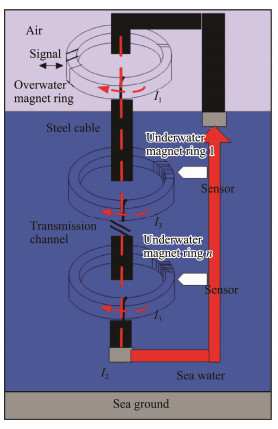
2 Realization of the Seawater Multipath-Channel Hardware Simulator Based on the Induction Coupling Chain Channel 2.1 Transmission Principle of the Ocean Induction Coupling Chain ChannelThe ocean anchor chain transmission channels mainly include transmission and processing equipment, long-distance transmission channels (composed of steel cables and seawater), underwater sensors, and other equipment nodes (Harris and Duennebier, 2002; Kojiya et al., 2005). The transmission principle is based on electromagnetic induction coupling (Zhou et al., 2016). Fig. 1 shows the working principle of the induction coupling seawater transmission channel. The current signal I1 is coupled to the loop composed of seawater and an underwater steel cable through the first-level coupling of an overwater magnet ring to form the current signal I2, whereas, the current signal I3 is formed through the second-level coupling to the underwater magnet ring to complete the signal transmission. In the second transmission loop composed of seawater and a steel cable, the infinite deep-water area serves as the transmission channel, and current signal is disturbed by the multipath effect in the transmission process.
|
Fig. 1 Working principle diagram of the induction coupling seawater transmission channel based on the current field mode. |
A seawater channel model of a 300-m-long steel cable is established using the COMSOL software according to the transmission structure of the induction coupling channel presented in Fig. 1 to analyze the influence of the seawater multipath effect on the transmitted signals. The size of the calculation domain (seawater area) is 1200×1200× 1200 m3; transport carrier frequency is 9.6 kHz; signal transmission speed is 3.3×10⁷ m s−1 in the seawater (Goh et al., 2009); dielectric constant and conductivity of the water are 81 and 4 s m−1, respectively; and coupling current on the steel cable is I2. The current density distribution in seawater is obtained using a simulation, and results show that the electrical signal transmission has the multipath effect. The finite element and meshing methods are used to determine the key parameters of the multipath-channel model, and the mathematical model of the finite impulse response (FIR) multipath transmission is established (Zheng et al., 2019) as
| $ H(f) = \sum\nolimits_{i = 1}^N {k(f) \cdot {g_i}} \cdot {{\rm{e}}^{ - \alpha }} \cdot {{\rm{e}}^{ - j2{\rm{ \mathsf{ π} }}f{\tau _i}}}, $ | (1) |
where f is the frequency of the transmitted signal, N is the number of paths, gi is the weighting factor for each path, k(f) is the normalized amplitude attenuation at different frequencies, τi is the time delay per path, and e−α is the channel attenuation parameter.
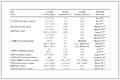
A 10-path channel model is established at a 300 m transmission distance (Zheng et al., 2019). According to the calculated path length and relative delay, Path 1 is the reference path with a path relative delay of 0, and other paths are based on this relative delay. In the multipath-channel simulator, the path delay is realized using a FPGA counter. The clock frequency of the FPGA is 50 MHz (20 ns). The calculated value of the delay parameter is the time delay of each path divided by the system clock cycle, and value is obtained by rounding up to the nearest integer. Table 1 lists the specific calculated parameters.
|
Table 1 10-path channel mathematical model parameters of the seawater transmission channel under a 300-m transmission distance |
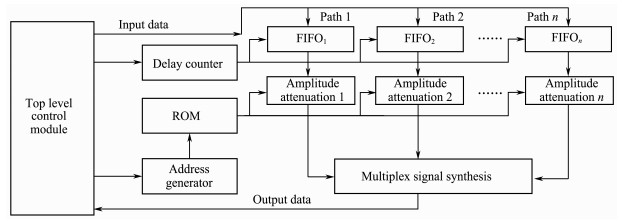
According to the mathematical model of the FIR multipath channel, FPGA is adopted to design the system hardware with n parallel data transmission paths to simulate the multipath phenomenon existing in the seawater channel. The schematic of the FPGA hardware simulator is shown in Fig. 2. The top-level control module controls the input signals to be synchronously stored in n (first input first output, FIFO) (FIFO1, FIFO2, …, and FIFOn) memories. According to the delay amount and amplitude attenuation of each path in Table 1, the counter value and amplitude attenuation data stored in the read only memory (ROM) is set. When the counter of each path reaches the predesigned value, an enabling signal is generated to control the FIFO memory to read data and output the stored data. The address generator is used to generate the address to read the amplitude attenuation value of the corresponding path from the ROM. The attenuation signal is obtained after multiplication, and finally, the simulator outputs the multichannel signal.
|
Fig. 2 Schematic of the FPGA hardware simulator for simulating the seawater multipath effect. |
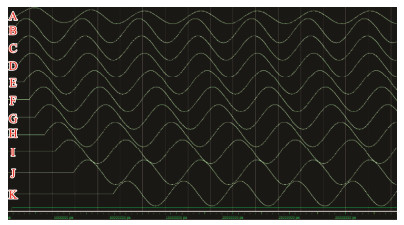
According to the introduction of the multipath-channel hardware simulator and results in Table 1, the 10-channel FPGA hardware simulator is designed. Altera's Cyclone IV E series EP4CE6F18 platform is selected. Each module uses Verilog programming language for the implementation, and ModelSim software is used to analyze the signals with frequencies of 100 kHz, 200 kHz, 500 kHz, 1 MHz, and 24 MHz. The simulation results of each delay waveform with a transmission frequency of 200 kHz are shown in Fig. 3. The FPGA simulation output waveforms denoted by B–K represent the 10 channels of different delays, and A is the output result after stacking. The two key parameters, i.e., amplitude and frequency, of the 10-path superimposed output signals are compared with the results of MATLAB to verify the performance of the multipath simulator. The amplitude and frequency errors of the FPGA hardware simulator's output are controlled within 0.1%, which proves that the multipath FPGA hardware simulator can meet the requirements. As for the output of the hardware simulator, the aliasing signal A is different from the original signal B. If the original signal B is set to 1 V, the mixed signal A is different in various frequencies, and outputs are 0.764, 0.541, 0.096, 0.02, and less than 0.01 V at 100 kHz, 200 kHz, 500 kHz, 1 MHz and 24 MHz, respectively. The results show that the signal-to-noise ratio (SNR) of the transmitted signal will decrease with the increasing transmission frequency because of the multipath time delay, and it will seriously influence the reliability of signal transmission. Therefore, it is essential to realize a communication algorithm that can resist the interference of the multipath channel and improve the transmission characteristics.
|
Fig. 3 Simulation results of each path of the FPGA-based hardware simulator. A, data output after the 10-channel hybrid superposition; B–K are signals with delays of 0, 13, 26, 54, 78, 104, 146, 194, 274, and 450 clock cycles, respectively. |
To effectively resist the multipath interference of the seawater channel and improve the anti-interference ability of the signal, we use the OFDM technology to transform the single-carrier and high-rate metadata into several parallel low-rate carrier data and minimize the impact of intersymbol interference. To minimize the effect of this interference, an interval of time Tg that is longer than the protection interval of the maximum delay time must be inserted between every two OFDM symbols. In this protection interval, the null insertion of invalid information, such as 0, can be inserted. However, owing to the delay extension of the channel data caused by the multipath effect, the period number of each subcarrier is no longer different in terms of integer periods within the fast Fourier transform (FFT) cycle, which means that each subcarrier is no longer orthogonal to the other, resulting in an intercarrier interference (ICI). To effectively solve the ICI problem, the cyclic prefix (CP) is inserted in the protection interval that is in front of the OFDM symbol. The CP is used to insert the data behind each OFDM symbol using the Tg period into the protection interval and keeping the protection interval data maintained for complete cycles. Thus, each subcarrier is different in terms of the integer number of cycles and remains orthogonal. Moreover, each subcarrier will not be affected by the IC at the receiver, and the value of the CP is
| $ {L_g} \ge \left[ {\frac{{{\tau _{\max }}M}}{{{T_g}}}} \right], $ | (2) |
where Lg is the number of CP value filled in the guard interval, τmax is the maximum delay time, M is the number of divided subcarriers, and Tg is the length of the time inserted between OFDM symbols.
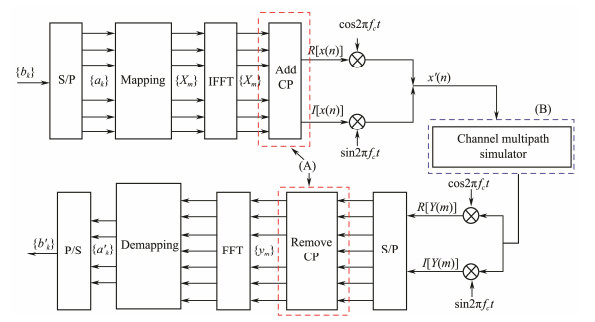
In the data transmission process, the intersymbol crosstalk caused by the multipath effect only interferes with the CP. Therefore, the CP can be removed to eliminate the influence on the receiver. The implementation process of the OFDM algorithm is shown in Fig. 4. The entire OFDM algorithm includes the modulation and demodulation parts. The serial input signal bk is first converted by a series union (S/P), 16 QAM mapping, and inverse FFT transformation. Then, the data are used to form the OFDM symbolic data value xm, and CP is added. After the orthogonal modulation module, I/Q is mixed and sent to the multipath simulator of the induction coupling chain. In the demodulation process, the I/Q demodulation and concatenation operations are first performed on the received data, and then the CP compensation value is removed. The ym signal passes the FFT transformation, and output result is obtained through demodulation. In addition, a comparative analysis is conducted between the original output signal and output data to evaluate the interference resistance effect of the OFDM algorithm on the seawater multipath effect.
|
Fig. 4 Flow chart of the OFDM algorithm. (A) compensation process of CP and (B) feasibility of verifying the multipath simulator using the OFDM algorithm. |
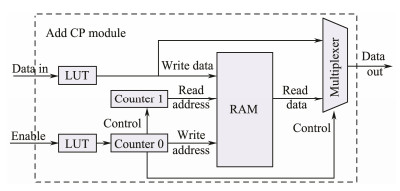
In the OFDM algorithm, the CP is added mainly to resist the interference caused by the multipath effect on the transmitted data. The FPGA hardware implementation process is shown in Fig. 5. The added CP module mainly implements the addition of the CP function by controlling the writing and reading of data using a dual-port random access memory (RAM) with a width of 16 bits, a storage depth of 64, and two counters to produce the RAM read and write addresses. The first 48 input data are stored in the RAM, and after the 48-th input data, the data are directly output and stored in the RAM, simultaneously. After the output of the last 16 data, the 64 data stored in the RAM are output to form the 80 output OFDM symbol values. To reduce resource usage, the input data are written into the RAM as 16-bit data combining 8-bit imaginary and 8-bit real data. The 'Enable' signal is input as a condition of Counter plus 1. Counter 0 is used to record the number of input data, and its value is used as the write address of the RAM. When counting to 48, the data are stored in the RAM and are directly output. After the Counter 0 count is complete, a control signal is generated to start Counter 1, and a value is generated as the read address of the RAM. The data are read from the RAM, and finally, the OFDM symbol is formed after the CP is compensated.
|
Fig. 5 Structure diagram of adding a cyclic prefix hardware. |
The OFDM algorithm parameters (Table 2) are selected according to the IEEE 802.11 technical standard. The simulation results show that the effect of high-frequency multipath aliasing is obvious. Therefore, the highest rate of data transmission of 24 Mb s−1 is selected in the actual test.
|
|
Table 2 OFDM algorithm parameter values based on the induction coupling transport channels |
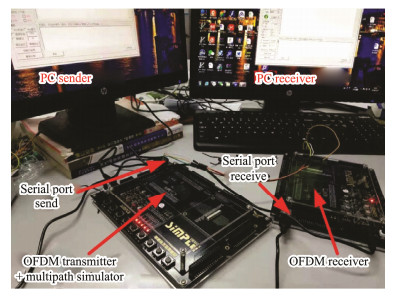
To analyze the signal interference effect of the OFDM technology against the multipath delay, we develop a hardware test platform composed of an OFDM transmission system, a receiving system, and a multipath-channel simulator, among which the OFDM transmission system and multipath-channel simulator are implemented in a FPGA board. The OFDM receiving system is implemented in another FPGA board. The selected board is the Cyclone IV E series EP4CE6F18. The PC is connected to the OFDM transmission and receiving systems through the serial port, and serial port assistant software is used to transmit the data to the OFDM transmission system from the PC. The transmission system performs OFDM modulation on the data, passes the data through the multipath simulator, and then transmits the data to the OFDM receiving system using a short transmission line. The receiving system demodulates the received data to obtain the original data and then transmits the demodulated data to the PC for processing. The hardware platform system is shown in Fig. 6.
|
Fig. 6 Hardware platform system. |
The CP is a key part of the OFDM system to resist the multipath interference. The CP length seriously affects the performance of the communication system. This study continuously inputs multiple sets of data frames through the serial port of the PC. Each frame of the data packet is 192 1-bit wide. The data are received by the receiver and obtained by demodulation mapping, and then the error rate is analyzed for the received data as follows:
1) Analysis of the relationship between the CP length and channel delay
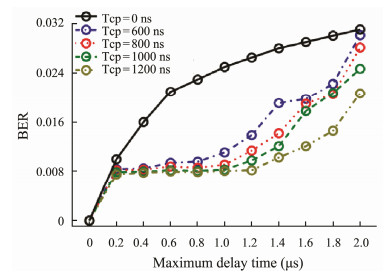
We change the CP length of the OFDM symbol and perform a communication test under the maximum delay of different multipath channels. The error rate of the OFDM symbol under the same maximum delay of different CP lengths is analyzed, and effect of the CP length on the multipath delay is discussed, as shown in Fig. 7. When the CP length of the OFDM symbol is 0, the BER gradually increases with the increase in the maximum delay time, and it quickly appears to be saturated. When the CP length of the OFDM symbol is constant, the BER gradually increases with an increase in the maximum delay time. When the delay time is less than the CP length, the BER tends to be stable. However, when the delay time is greater than the CP length, the BER significantly increases with the increase in the maximum delay time of the channel. For example, when the CP length is 800 ns and channel maximum delay time is less than 800 ns, the BER is stable at approximately 0.0085. However, when the maximum delay time of the channel is greater than 800 ns, the BER gradually increases and becomes 0.0281 when the maximum delay time of the channel reaches 2000 ns. Next, the maximum delay time of the channel is constant, and the length of the CP is changed. Fig. 7 shows that the error rates of different CP lengths are basically the same with and maintained at 0.0080 when the maximum delay time of the channel is less than 600 ns. However, when the maximum delay time exceeds 600 ns, the longer the CP length, the lower the BER.
|
Fig. 7 Relationship between different CP lengths and maximum delay error rate. |
2) Optimal CP length analysis
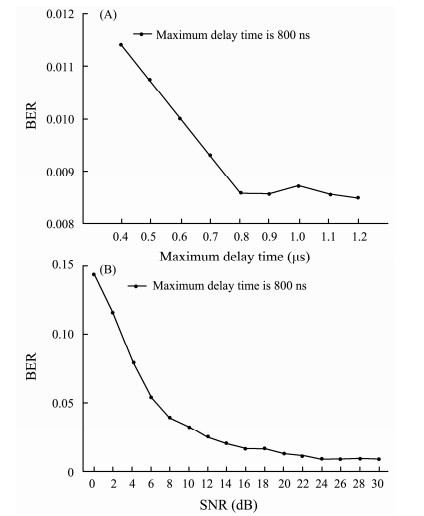
The longer the CP length, the better the effect of resisting the channel delay. However, as the CP length increases, the redundancy of the signal also increases, which significantly reduces the transmission efficiency. Therefore, determining the appropriate CP length according to the characteristics of the transmission channel is essential. Multiple tests demonstrate that the maximum delay time of the induction coupling chain channel is on an average 800 ns. Therefore, the delay parameter of the multipath-channel simulator is adjusted to 800 ns, keeping other parameters unchanged. Then, the CP time length of the OFDM symbols is varied, and the BER under different CP lengths is tested. The specific results are shown in Fig. 8A. When the channel multipath delay is constant, the BER decreases with the increase in the length of the OFDM symbol CP. When the CP lengths are 400, 800, 900, 1100, and 1200 ns, the BERs are 0.01140, 0.00860, 0.00857, 0.00852, and 0.00850, respectively. The value at 1000 ns may be caused by the FPGA calculation process error and is ignored. After the CP length exceeds 800 ns, the BER does not change much. Considering the BER and transmission efficiency, the CP length in the OFDM symbol is determined to be 800 ns.
|
Fig. 8 (A) BER at different CP lengths and (B) BER at different SNRs. |
3) Analysis of the relationship between the SNR and BER
According to the above analysis, the maximum delay parameter in the multipath-channel delay simulator is 800 ns. In other words, 40 clock cycles are delayed in the case of the 50-MHz system clock, and the CP length of the OFDM symbol is determined to be 800 ns. The transceiver system is redesigned, and relationship between the SNR and BER is analyzed by changing the SNR of the transmitted signal, as shown in Fig. 8B. When the SNR is 0 dB, BER is 0.1439. As the SNR increases, BER fleetly decreases. When the SNR is 20 dB, BER is 0.0145. The BER decreases to 0.0095 when the SNR is 24 dB. Then, the BER remains stable at approximately 0.01 despite the increase in the SNR. In the OFDM receiving system, the increase in the SNR can effectively reduce the BER and improve the communication quality.
5 ConclusionsIn this study, an ocean induction coupling chain communication method is proposed, and a system is designed based on the proposed method to resist the seawater multipath effect. The communication system simulates the multipath delay effects present in the ocean induction coupling chain channel. Through the addition of the OFDM hardware transceiver system, the entire system's data transmission and testing are realized, which not only verifies the feasibility of the system but also reduces the difficulty of testing related to the induction coupling anchor chain channel. The related test of the coupled anchorage chain channel solves the problem in testing the long-distance induction coupling anchorage chain channel and provides a laboratory test platform for studying the multipath delay effect of the induction coupling chain. However, it is difficult to test the actual seawater multipath effect. Future work needs to further investigate other issues including obtaining more accurate channel parameter indicators, designing a new channel estimation method, and designing the OFDM system parameters and frame structure highly in line with the ocean induction coupling chain communication system.
AcknowledgementsThis work was supported by the National Key Research and Development Program of China (Nos. 2017YFC140 3403, 2017YFC1403304).
Al-Rubaye, G. A., Tsimenidis, C. C. and Johnston, M., 2017. Lowdensity parity check coded orthogonal frequency division multiplexing for PLC in non-Gaussian noise using LLRs derived from effective noise probability density functions. IET Communications, 11(16): 2425-2432. DOI:10.1049/iet-com.2017.0265 (  0) 0) |
Ashri, R., Shaban, H. and El-Nasr, M. A., 2017. A Novel fractional fourier transform-based ASK-OFDM system for underwater acoustic communications. Applied Sciences, 7(12): 1286. DOI:10.3390/app7121286 ( 0) |
Che, X. H., Wells, I., Dickers, G., Kear, P. and Gong, X. C., 2010. Re-evaluation of RF electromagnetic communication in underwater sensor networks. IEEE Communications Magazine, 48(12): 143-151. DOI:10.1109/MCOM.2010.5673085 ( 0) |
Gama, F., Silveira, L. and Salazar, A. O., 2017. Adaptive wavelet coding applied in a wireless control system. Sensors, 17(12): 2901. DOI:10.3390/s17122901 ( 0) |
Goh, J. H., Shaw, A. and Al-Shammaa, A. I., 2009. Underwater wireless communication system. Journal of Physics: Conference Series, 178: 012029. DOI:10.1088/1742-6596/178/1/012029 ( 0) |
Ha, D. V., Chien, T. V. and Nguyen, V. D., 2016. Proposals of multipath time-variant channel and additive coloured noise modelling for underwater acoustic OFDM-based systems. International Journal of Wireless & Mobile Computing, 11(4): 329. DOI:10.1504/IJWMC.2016.082286 ( 0) |
Hanson, F. and Radic, S., 2008. High bandwidth underwater optical communication. Applied Optics, 47(2): 277. DOI:10.1364/AO.47.000277 ( 0) |
Harris, D. W. and Duennebier, F. K., 2002. Powering cabled ocean-bottom observatories. IEEE Journal of Oceanic Engineering, 27(2): 202-211. DOI:10.1109/JOE.2002.1002474 ( 0) |
Kojiya, T., Sato, F., Matsuki, H. and Sato, T., 2005. Construction of non-contacting power feeding system to underwater vehicle utilizing electromagnetic induction. Europe Oceans, 1: 709-712. ( 0) |
Kong, J., Cui, J., Wu, D., and Gerla, M., 2005. Building under
( 0) |
water ad-hoc networks and sensor networks for large scale real-time aquatic applications. MILCOM 2005–2005 IEEE Military Communications Conference, 3: 1535-1541.
( 0) |
Ku, M. L., Han, Y., Wang, B. and Liu, K. J. R., 2017. Joint power waveforming and beamforming for wireless power transfer. IEEE Transactions on Signal Processing, 65(24): 6409-6422. DOI:10.1109/TSP.2017.2755582 ( 0) |
Li, H., Zhang, S., Qin, X., Zhang, X. and Zheng, Y., 2019. Enhanced data transmission rate of XCTD profiler based on OFDM. Journal of Ocean University of China, 18(3): 1079-1085. DOI:10.1007/s11802-019-3919-1 ( 0) |
Li, J. and Kavehrad, M., 1999. Effects of time selective multipath fading on OFDM systems for broadband mobile applications. IEEE Communications Letters, 3(12): 332-334. DOI:10.1109/4234.809526 ( 0) |
Lloret, J., Sendra, S., Ardid, M. and Rodrigues, J. J. P. C., 2012. Underwater wireless sensor communications in the 2.4 GHz ISM frequency band. Sensors, 12(4): 4237-4264. DOI:10.3390/s120404237 ( 0) |
Magableh, A. M. and Jafreh, N., 2017. Exact expressions for the bit error rate and channel capacity of a dual-hop cooperative communication systems over nakagami-m fading channels. Journal of the Franklin Institute, 355(1): 565-573. ( 0) |
Momma, H., and Tsuchiya, T., 1976. Underwater communication by electric current. OCEANS '76. Washington, D. C., 631-636.
( 0) |
Preisig, J., 2007. Acoustic propagation considerations for underwater acoustic communications network development. ACM Sigmobile Mobile Computing & Communications Review, 11(4): 2-10. DOI:10.1145/1347364.1347370 ( 0) |
Sellschopp, J., 1997. A towed CTD chain for two-dimensional high resolution hydrography. Deep-Sea Research, 44(1): 147-165. DOI:10.1016/S0967-0637(96)00087-8 ( 0) |
Stojanovic, M. and Preisig, J., 2009. Underwater acoustic communication channels: Propagation models and statistical characterization. IEEE Communications Magazine, 47(1): 84-89. DOI:10.1109/MCOM.2009.4752682 ( 0) |
Tippmann, J. D., Sarkar, J., Verlinden, C. M. A., Hodgkiss, W. S. and Kuperman, W. A., 2016. Toward ocean attenuation tomography: Determining acoustic volume attenuation coefficients in seawater using eigenray amplitudes. Journal of the Acoustical Society of America, 140(3): 247. DOI:10.1121/1.4962348 ( 0) |
Wang, J. and Zhang, K., 2017. Low cost positioning with rotating antenna in constrained environment for global navigation satellite systems. Electronics Letters, 54(1): 45-47. ( 0) |
Wu, S., Zhang, W. X., Li, Z. H., Deng, Y., Liang, J. J., Li, F. C. and Lan, H., 2016. Study on the contactless data transmission for ocean underwater vertical sensor structure. Journal of Marine Engineering & Technology, 15(3): 107-114. ( 0) |
Yoshioka, D., Sakamoto, H., Ishihara, Y., Matsumoto, T. and Timischl, F., 2007. Power feeding and data-transmission system using magnetic coupling for an ocean observation mooring buoy. IEEE Transactions on Magnetics, 43(6): 2663-2665. DOI:10.1109/TMAG.2007.893775 ( 0) |
Zheng, Y., Guo, X. X., Li, H. Z., Wang, X. R. and Zhang, X. Y., 2019. Design of algorithm for multicarrier modulation to improve transmission performance of inductive coupling temperature-salinity-depth chain. IEEE Communications Letters, 23(6): 995-998. DOI:10.1109/LCOMM.2019.2911676 ( 0) |
Zheng, Y., Wang, X. R., Zhang, X. W., Li, H. Z. and Jin, X. Y., 2018. Improving transmission reliability of inductive coupling temperature-salinity-depth mooring cable system. Ocean Engineering, 147: 488-495. DOI:10.1016/j.oceaneng.2017.11.003 ( 0) |
Zhou, Y., Wang, W., Deng, H., Wang, C., Fan, R., Luo, W., and Xie, G., 2016. Communication distance correlates positively with emitter current in underwater electric current communication. 35th Chinese Control Conference. Chengdu, 6397-6402.
( 0) |