 2022, Vol. 21


2) Key Laboratory of Submarine Geosciences and Prospecting Techniques, MOE, Ocean University of China, Qingdao 266100, China;
3) College of Oceanic and Atmospheric Sciences, Ocean University of China, Qingdao 266100, China
The coastal zone is a transitional area between land and sea, where the atmosphere, hydrosphere, lithosphere, and biosphere converge and interact. It is also sensitive to natural or anthropogenic disturbances (Scherner et al., 2013; Lorenzo et al., 2018). The coastal environment has a wide range of impacts on the biosphere and society, including biodiversity conservation, flood control, water purification, coastline stabilization, storm protection, recreation, and tourism (Cao and Fox, 2009). However, in recent years, erosion in coastal areas has increased due to reduced sediment supply, human activities, hydrodynamic changes, and regional tectonic activity (Yin et al., 2012; Webb et al., 2013; Ma et al., 2014; Fan et al., 2018). The coastline is important for protecting the environment and maintaining the ecological balance of the coastal zone (Liu et al., 2018). The spatiotemporal evolution of the location, direction, shape, and utilization of coastlines is not only an intuitive manifestation of landscape changes in a coastal zone but also an external embodiment of the interactions among regional ecological function, environmental protection, economic development, and policy orientation (Liu and Jezek, 2004). With the improvement of remote sensing techniques, multiple satellite image resources in conjunction with geographic information systems (GIS) have been used successfully for analyzing and extracting surface water boundaries (Feyisa et al., 2014; Cao et al., 2020).
At present, coastline change research has become the most common and effective method for characterizing coastal environmental changes. Scholars from various countries have focused on two main aspects of coastline change: extracting coastline change information and characterizing the spatiotemporal variability of coastlines through the combination of remote sensing images and GIS (Hou et al., 2016; Li et al., 2018b; Ai et al., 2019). These studies have explored the impacts of climate, geology, human activities, and economy on coastlines by analyzing spatiotemporal changes in the coastlines (Li et al., 2018b; Zhu et al., 2018; Thoai et al., 2019; Sun et al., 2020). Many methods have been proposed and applied to extract the coastlines, including visual interpretation (Li et al., 2018a), multispectral classification (Maglione et al., 2014; Hsiao et al., 2016), and image segmentation (Zhang et al., 2013).
Over the past 40 years, China has experienced continuous and rapid economic growth, with coastal areas becoming the most economically developed and densely populated areas. As a result, there have been extensive exploitations of coastlines for aquaculture, port construction, and tourism purposes (Özdemir Işık and Demir, 2017). However, the intensive coastal development has changed the balance of the marine environment in the country's bays, causing the shrinking of the wetlands and coastlines (Li et al., 2014). In recent years, China's coastal provinces and cities have generally shown an overall declining trend in resource and environmental carrying capacity levels. In particular, the resource and environmental carrying capacities of most areas in Liaoning and the near-shore waters of Yantai are already at their maximum, while those of the near-shore waters of Tianjin, Hebei, Dongying, Binzhou, and Huludao are overloaded (Ding, 2019). Moreover, the ecological risk to the Bohai Bay-Yellow River Estuary zone has been increasing for the past 40 years (Wang et al., 2021).
In the past, studies on the Bohai coastal zone have explored the drivers of coastline change and coastal reclamation for the Yellow River Delta, individual bays, or the entire region (Xu et al., 2016b; Xu et al., 2019). However, research on coastal changes based on provincial and municipal administrative units is lacking. To date, no studies have combined the urban economic development levels and coastline utilization status to explore the factors driving coastline utilization in different types of cities. Therefore, the current study aims to explore 1) the degree of spatiotemporal changes and utilization status of the coastlines of cities surrounding the Bohai Sea from 1986 to 2016 by obtaining relevant data through the visual interpretation of remote sensing images; 2) the factors driving coastline utilization in the Bohai coastal cities using indicators of socioeconomic categories; and 3) the potential pathways for sustainable development of these cities. The results of this study can help in introducing scientific decision-making for sustainable socioeconomic development, maintaining ecological balance, and developing further resources in the bay areas.
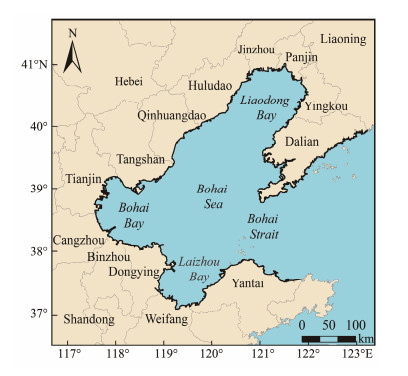
2 Data and Methodology 2.1 Study AreaThe study area is located within the economic circle of the Bohai Sea, including the coastal distribution within the Bohai Sea areas in Liaoning Province (Dalian, Yingkou, Panjin, Jinzhou, and Huludao), Hebei Province (Qinhuangdao, Tangshan, and Cangzhou), Shandong Province (Binzhou, Dongying, Weifang, and Yantai) and Tianjin City, which play a critical role in promoting global economic cooperation and the coordinated development of northern and southern China. The studied coasts include Liaodong Bay, Bohai Bay, and Laizhou Bay, which are located in 37˚1΄ – 40˚57΄N and 117˚32΄ – 123˚30΄E (Fig.1). Changes in the coastal zone around the Bohai Sea have been significantly influenced by human activities. At different times, the original characteristics of the coastal zone have changed due to human activities, such as sea-farming, transport-related construction, and port construction (Zhu et al., 2014; Feng et al., 2018). There are 13 cities of various sizes, all of which are economically active. The acceleration of economic development, heavy chemical industry development, coastal distribution of the industrial layout, clustering of urban development, and increased urban population density have all dramatically changed the coastline of the Bohai Sea, resulting in substantial pressure on the resources, environment, and ecology of the Bohai Sea area (Xu et al., 2016b).
|
Fig. 1 Geographical location and administrative divisions of the study area. |
In this study, a series of Landsat images from multiple sources, including Landsat TM and Landsat OLI, were used to monitor coastal reclamation and coastline changes from 1986 to 2016. A total of 40 cloud-free images covering the study area were acquired from the USGS (https://glovis.usgs.gov/) and were preprocessed using atmospheric correction, geo-rectification, image repair, and image enhancement (Xu et al., 2016a). The processed images were used in GIS software for the visual human-computer interpretation of the coastline.
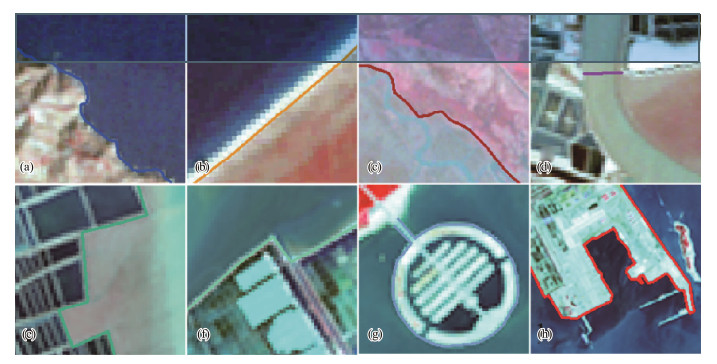
2.3 Coastline Analysis 2.3.1 Coastline classification and interpretationMulti-year sea and land boundary data corresponding to high tide levels were adopted for defining the coastline (First Institute of Oceanography, 2017). Linear dams with widths of less than 50 m and protruding to the sea, thus deviating significantly from the general coastal direction, were excluded from the total length of the coastline but were used for auxiliary coastline measurement (Zhang, 2009). The coastline was divided into natural and artificial coast lines according to the change in their natural states (Zhang et al., 2014; Xu et al., 2016a). The details of each type of coastline interpretation are shown in Fig.2.
|
Fig. 2 Schematic diagram of coastline interpretation. (a), bedrock; (b), sandy; (c), silty-clayey; (d), estuarine; (e), aquaculture embankment; (f), salt field embankment; (g), construction embankment; (h), port wharf coastline. |
The linear regression rate (LRR) method (Mahapatra et al., 2014; Himmelstoss et al., 2018) was used to quantify coastline changes in each city along the Bohai Sea from 1986 to 2016. The LRR of coastline change is a leastsquares linear regression fit to a dataset of intersection distances between the coastline and the profile during the study period. The slope of the fitted line is the LRR (m yr−1).
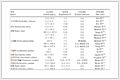
2.3.3 Analysis of coastline utilization degreeThe degree of utilization was first applied to land, ecological landscape, and other related fields (Sui et al., 2020). Wu et al. (2014) applied the same to study the degree of coastline utilization and obtained relatively good results. The current study used different human action intensity indicators for each coastal section based on the characteristics of different coastal types and the intensity of the human influence on the Bohai Sea (Table 1).The index of coastline utilization degree (ICUD) is the comprehensive utilization index. The greater the value of ICUD, the greater the interference of human factors, and the more difficult it is to revert to the natural coastline. ICUD is computed as:
| $ ICUD = \sum\nolimits_{i = 1}^n {(Ai * Ci) * 100}, $ | (1) |
|
Table 1 Human activity intensity index in different sections of the Bohai Sea |
where n is the number of coastline types, and Ai and Ci represent the intensity of human interference and the percentage of the length of coastline type I, respectively. In this study, ICUD was used to analyze the impacts of socioeconomic activities on the coastline around the Bohai Sea and as a dependent variable to analyze the factors driving changes in the Bohai Sea coastline.
2.4 Analysis of Factors Based on the PLSR ModelPartial least-squares regression (PLSR) is a new type of multivariate statistical data analysis method (Wold et al., 1983). Owing to the further refinement of its theory and methodology, it is widely used in different fields, such as economics, sociology, environment, ecology, and remote sensing. This method can effectively overcome the limitations of general regression modeling methods and is particularly suitable for analyzing data with multicollinearity and several independent variables (Wold et al., 2001; Palermo et al., 2009; Abdi, 2010; Zhang et al., 2015). The PLSR method specifies a linear relationship between a set of dependent variables (Y-variables, ICUD in our case) and a set of driving variables (X-variables, the potential driving factors). The validity of the PLSR model can be assessed based on the goodness of fit (R2Y) and variable importance of projection (VIP). In general, the dependent variable can be significantly explained by an independent variable, which has a VIP greater than 1.0 and cannot be significantly explained if the value is less than 0.5. The interval between 0.5 and 1 is termed a 'gray zone'.
The relationship between socioeconomic factors and coastline change was analyzed by quantifying various factors related to the existing data on the potential driving factors of coastline changes (Zhang et al., 2015; Meng et al., 2017). Indicators with the different units cannot be combined directly unless they are standardized (Wei et al., 2014). In this case, due to the differences in the units of various indicators, the original data need to be standardized. Then, SPSS was used to test the indicators for multicollinearity and stepwise regression to screen out variables with significant effects and no multicollinearity. A total of 14 socioeconomic variables were selected (Table 2). The economy is the foundation of urban development. The gross domestic product (GDP) of the coastal regions, gross output value of industrial (GOVI) areas, and the gross output value of agriculture (GOVA) were used to reflect each city's current economic development level. Disbursement of foreign capital (DFC) reflects the external attractiveness and international competitiveness of a city. Per capita retail sales of consumer goods (PCRSCG) reflect changes in the urban retail market and the level of economic prosperity. Per capita quantity of aquatic products (PCQAP) and port handling capacity (PHC) reflect the current development of a city's marine industry. The goal of urban development is the overall development of society. Thus, population density (PD) and natural growth rate of the population (NGRP) were selected to reflect the size and demographic situation of the city, respectively. Moreover, the proportion of the urban population (PUP), area of the built district (ABD), and the average wage of employed staff and workers (AWESW) reflect the level of urbanization. Coastline retention rate is CRR; Per capita coastline length is PCCL. Historical economic and social data from coastal areas between 1986 and 2016 were collected from the Statistical Yearbooks of the State Oceanic Administration (SOA).
|
|
Table 2 Selected socioeconomic indicators used in this case as explanatory variables in the PLSR models |
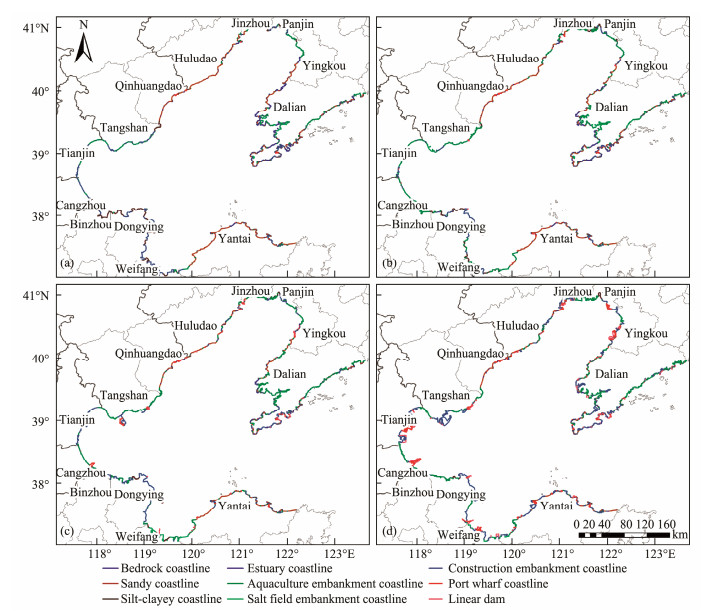
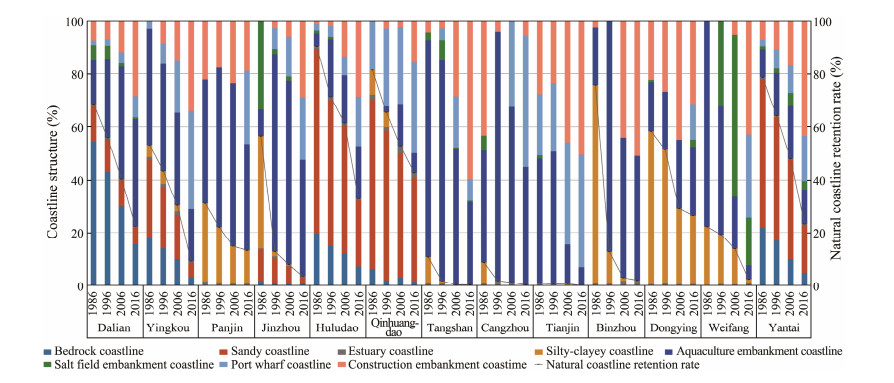
The coastline structure refers to the length ratio of various coastlines in a certain area. The impact of human activities on the coastline can be reflected in the changes in various natural and artificial coastlines in different periods. The interpretations of coastline types from remote sensing satellite images from 1986, 1996, 2006, and 2016 are shown in Fig.3. As can be seen, from 1986 to 2016, the tortuosity and length of the Bohai Sea coastline continued to increase (Fig.3). The total length of the coastline in 1986 was 3161.85 km, which increased by 1304.04 km or 41.24% in 30 years. Meanwhile, the proportion of natural coastline in the Bohai Sea has been decreasing, from 58.96% in 1986 to 17.92% in 2016. Over time, the coastline structures of the Bohai Sea cities have changed significantly (Fig.4), with the proportions and types of natural coastlines showing an overall decreasing trend. In 2016, Tangshan, Tianjin, and Cangzhou, located in Bohai Bay, had less than a 1% shoreline retention rate. Bohai Bay is a semi-enclosed, gently sloping silty bay, and the silty-clayey coastline was massively developed during 1986 – 1996 (Fig.4). High-intensity polder makes the average flow velocity of high and low tide in Bohai Bay decrease, which in turn aggravates the degradation of the Bohai Bay area's environmental quality (Hou et al., 2017).
|
Fig. 3 Distribution of the coastline around the Bohai Sea in1986 (a), 1996 (b), 2006 (c), and 2016 (d). |
|
Fig. 4 Schematic map of coastline structure changes in cities surrounding the Bohai Sea. |
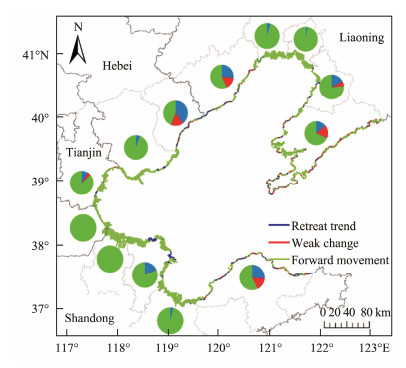
The valid sections (i.e., the sections where the four points do not intersect, excluding the null and false values) were graded and defined according to the LRR values (Fig.5). In the last 30 years, 72.80% of the coastline in the Bohai Sea has advanced seaward, especially the coastlines of the Liao River Estuary, the southern coast of the Bohai Sea, the Yellow River Estuary, and the southern coast of Laizhou Bay have pushed toward the sea massively. The mudflats in these areas were once more developed, and by 2016, the silty mud coastline had greatly reduced. Approximately 16.57% of the coastline has eroded landward, with the areas that have receded being further concentrated landward near the Yellow River Estuary, mainly due to extensive erosion of the mudflats. Furthermore, the areas where the coastline is retreating but not changing dramatically are concentrated in the southern end of Liaodong Bay, the eastern coast of Laizhou Bay, and the eastern end of the Shandong Peninsula, all of which have predominantly sandy coastal substrates. The weak coastline changes in the Bohai Sea account for only 10.63% of the total coastline and are concentrated mainly in the eastern part of the Liaodong Peninsula and Zhifu Island in the Shandong Peninsula, where the coastline types are dominated by bedrock and sandy coastlines.
|
Fig. 5 Changes in linear regression rates (LRR) along the Bohai Sea coastline. Using the LRR method, the longterm trends of the coastline around the Bohai Sea from 1986 to 2016 can be analyzed. The coastlines with rate values less than −0.5 m yr−1 and greater than 0.5 m yr−1 are defined as the retreat trend and the forward movement coastlines, respectively, while the shoreline with a rate value ranging between −0.5 and 0.5 m yr−1 corresponds to the weak change coastline. |
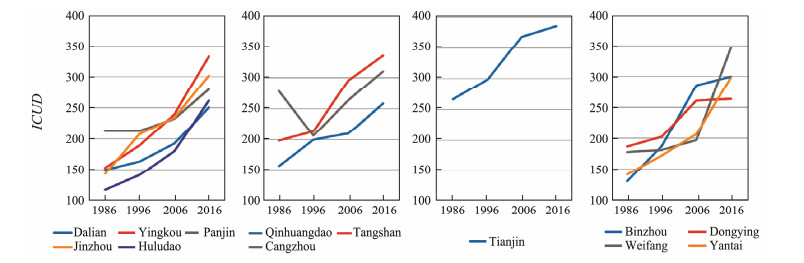
Since the 21st century, the increased degree of coastal development in Bohai Bay has accelerated the development of the entire Bohai Sea. Currently, the three provinces and one city around the Bohai Sea have surpassed the Yangtze River Delta and Pearl River Delta regions in terms of coastline utilization (Wu et al., 2014). The overall coastline utilization degree in the Bohai Sea continued to increase from 181.94 in 1986 to 287.75 in 2016, with substantial changes observed in Yingkou, Jinzhou, Huludao, and Yantai (Fig.6).
|
Fig. 6 Index of coastline utilization degree (ICUD) in prefecture-level city administrative region. ICUD values ranged from 1 to 400 (unitless), with higher ICUD values reflecting the increased difficulty in restoring the coastline to its natural state and decreased coastline structures. |
In 1986, the coastline in the Bohai Sea had a high proportion of natural coastline, with the construction of artificial coastlines dominated by aquiculture areas (Fig.4) and a low level of overall coastline utilization (Fig.6). Since then, the rapid development of the farming and salt industries has led to the rapid growth of the aquaculture embankment and salt field embankment coastlines in the Bohai Sea region. Moreover, the ICUD increased slightly in 1996, although the subsequent decline in the coastal farming and salt industries has reduced the coastline as well. Urban development has led to an increase in demand for land, as manifested in the expansion of cities and the construction of integrated coastal functional areas, resulting in the rapid growth of the ICUD after 1996. ICUD increased in all cities during 2006 – 2016, with the top three values corresponding to Weifang, Yingkou, and Yantai.
3.3 Overview of Urban Coastline Changes in the Bohai SeaCoastline changes are closely linked to the original coastal type and the municipalities' plans for the coastal zone (Fig.4). Silt mud and sandy coastlines are easier to use and develop, whereas bedrock coastlines are relatively difficult to develop. Cangzhou and Binzhou are located on the western and southern coasts of Bohai Bay, respectively, both with fully seaward advancing coastlines. The rich silty mud coastlines of the two cities are conducive to farming and the construction of salt pans surrounding the sea. The average rate of coastline advancement in Binzhou City is 524.00 m yr−1. Panjin, Jinzhou, Tangshan, and Weifang all have more than 90% of their coastlines advancing toward the sea. Dongying and Tianjin have over 80% of their coastlines advancing seaward. For many years, Tianjin has been reclaiming land, and its coastline structure is uneven and heavily artificial. Dongying is rich in mudflats and wetlands. From 2006 to 2016, part of the coastline advanced seaward due to the diversion of the Yellow River Estuary, the formation of a delta lobe at the new estuary, the completion of the Dongying Port, and the expansion of the farming area.
The coasts of Dalian, Yingkou, Huludao, and Yantai are dominated by bedrock and sandy shores, while the weak change coastlines of the four cities account for 72.78% of the weak change coastlines in the Bohai Sea. The average rate of seaward advancing coastline is approximately 25 – 50 m yr−1, and the erosion of bedrock and sandy coastline retreats the coastline. Qinhuangdao is located on a sandy shore with abundant sandy coastal resources. In this area, the average rate of forwarding movement of the coastline over the last 30 years has been 11.95 m yr−1, but the overall percentage of retreat in the coastline is nearly 40%.
Through their own resource advantages and geographical location, the cities in the Bohai Sea first developed resource-based industries. Tianjin, Tangshan, and Cangzhou in Bohai Bay and Weifang in Laizhou Bay had more farming areas and salt pans in 1986 because of their rich silty mud coastlines, while the remaining cities' coastlines were less exploited and had high retention rates of natural coastlines. From 1986 to 1996, the cities in the Bohai Sea entered the sea-farming stage. Along with the process of opening up to the global economy, Tianjin took the lead in developing a port economy, which led to the construction of the Binhai New Area. Between 1996 and 2006, several ports of varying sizes were built in various cities, and the ports of Dalian, Qinhuangdao, and Tianjin were all established as large international ports. During this time, Tangshan and Tianjin entered the land reclamation stage. From 2006 to 2016, the increase in reclamation projects and the increasing construction of ports led to larger increases in ICUD.
3.4 Major Socioeconomic Indicators of Coastline Utilization ChangeThe large differences between the variables may also have an impact on the reliability of the model results, as the cities have a wide range of economic strengths due to their natural environment and resource conditions. Therefore, the current study used hierarchical cluster analysis to reduce the impact of regional differences on the model results (Reger et al., 2007). To identify patterns of coastline utilization for each city, we collected information on GDP and calculated ICUD and coastline retention rate for 2016. The coastline retention rate and ICUD reflect the development intensities and utilization rates of the coastlines around the Bohai cities. GDP can reflect the economic strength of each coastal city and the economic benefits gained by developing the coastline. The results of the classification indicated the existence of different coastline utilizations considering the three variables.
The types of coastline utilization patterns and attributes (TCUPA) for each group are summarized in Table 3. Tianjin is a TCUPA I city and far exceeds the other cities in terms of economic strength and coastline utilization, with only 0.09% of its natural coastline remaining. The TCUPA Ⅱ cities of Dalian, Dongying, and Yantai have medium levels of GDP and high proportions of natural coastline. The TCUPA Ⅲ cities of Qinhuangdao and Huludao have low levels of coastline utilization and a natural coastline proportion of over 30%. The TCUPA Ⅳ cities of Tangshan and Weifang are second only to Tianjin in terms of GDP and the comprehensive use of coastline, with the proportions of the natural coastline just above that of Tianjin. The GDP of the TCUPA Ⅴ cities of Yingkou, Panjin, Jinzhou, Cangzhou, and Binzhou is lower than the average Bohai Sea GDP. The degree of coastline utilization in Panjin is lower than the Bohai Sea average, while the ICUD of other cities is higher than 300.
|
|
Table 3 Statistical analysis of the variables used to characterize the types of coastline utilization patterns and attributes (TCUPAs) |
For each TCUPA category, the mean value and standard deviation (Std.) are calculated by the indicator values for each group of cities.
Owing to the differences in the dimensions and magnitudes of various indicators, the original data were first standardized, and the indicators were then tested for multicollinearity. Correlation and variance expansion factor tests showed multicollinearity between the variables. Therefore, the PLSR model was used to analyze the factors driving the comprehensive utilization of the coastline. The results (Table 4) revealed that GDP, GOVI, GOVA, PCRSCG, and AWESW served as the main drivers of the degree of integrated coastline use in the five TCUPA groups (VIP > 1). DFC, PCQAP, PD, NGRP, and PUP were considered significant drivers only once in each of the five groups. The selected socioeconomic variables explained 68.48% of the variation in ICUD in Tianjin. The increased coastline utilization was driven by increases in GOVI, GOVA, PCAQP, PHC, PUP, ABD, and AWESW (VIP = 1.006 – 1.187). For the TCUPA Ⅱ cities, the model explained 62.72% of the variation in ICUD, with the highest VIP value for CRR (VIP = 1.554), followed by the AWESW (VIP = 1.421). Socioeconomic factors explained 80.89% and 85.75% of the differences in ICUD for TCUPA category Ⅲ and Ⅳ cities, respectively. GDP, GOVI, PCRSCG, AWESW, and CRR were the significant drivers common to both groups. Changes in socioeconomic factors explained 76.17% of the variation in the comprehensive utilization of the coastline in the TCUPA Ⅴ cities. Furthermore, seven variables had VIP values greater than 1, of which GDP, GOVA, PCRSCG, PHC, ABD, and AWESW had positive impacts on ICUD, while CRR had a negative impact.
|
|
Table 4 Summary of the PLSR models that evaluated the relationships between ICUD and driving factors in different TCUPAs |
Siltation and erosion are the main natural factors causing coastline changes. Sediment deposition is a determinant of coastal variability at longer time scales. The sediments carried by large rivers are deposited around the mouth of the sea, exceeding the erosion and transport effects of the ocean on land sediment and leading to the formation of a wide estuarine delta due to the natural silt (George et al., 2019; Twilley et al., 2019). In turn, this forms silty mud coastlines or sandy coastlines, which eventually change the estuarine coastline. Since the diversion of the Yellow River to the Qingshuigou flow path in 1976, the Yellow River Delta as a whole has been in a continuous process of dynamic changes in flushing and siltation, and the evolution of coastal flushing and siltation has varied significantly in different periods (Huang and Fan, 2004; Liu, 2017). The spatiotemporal variation of this flushing and siltation state is influenced by a combination of the amount of incoming marine sand from the Yellow River, the topography of the estuarine waters, and the ocean dynamics conditions (Li et al., 2020).
Furthermore, the natural erosion is heavily influenced by the sea tide, and the eroded coastline mainly consists of silty mud, sandy, and estuarine coastlines (Fig.3). Considered on a longer time scale, global warming-induced sea level rise is a common factor leading to shoreline retreat, and its cumulative effect is obvious even though the process is slow (Nicholls and Cazenave, 2010). In the future, sea levels will continue to rise in low-lying deltaic coastlines, and flat sandy coastlines are most affected by such a rise (Nicholls and Cazenave, 2010; Reguero et al., 2019). According to the China Sea Level Bulletin (State Oceanic Administration, 2021), since 1980, the sea level along the Bohai Sea has risen at a rate of 3.6 mm yr−1. The relative sea level of the Bohai Sea coast was predicted to rise by over 60 – 180 mm in the next 30 years, placing coastal communities at greater risk. Provinces and cities along the Bohai Sea have experienced frequent storms and typhoons and will be increasingly exposed to climate change impacts in the decades ahead (Wang et al., 2018; Zhang et al., 2021).
4.2 Socioeconomic Driving ForceBased on the relationship between socioeconomic factors and coastline change in multiple TCUPAs, GDP, GOVI, GOVA, PCRSCG, ABD, and AWESW have been found to have significant positive impacts on the artificiality and degree of utilization of the coastlines in cities surrounding the Bohai Sea. Furthermore, the drivers of the comprehensive utilization degree of the urban coastline around the Bohai Sea are both internal and external to the cities. In terms of internal factors, the basic conditions of most cities near the Bohai Sea are relatively weak, indicating that the urban system must go through the stage of urban-scale expansion to achieve further development (Yang, 2013; Qu et al., 2021). Land reclamation is a common practice globally (Suzuki, 2003; Wang et al., 2014; Meng et al., 2017) and is generally higher in the coastal areas of China's three major economic regions (Bohai Sea Rim, Yangtze River Delta, and Pearl River Delta). Approximately 35% of reclamation projects occur in the Bohai Sea (Tian et al., 2016). Anthropogenic activities, such as land reclamation and coastal engineering, are the main factors contributing to coastline changes (Mishra et al., 2019). With the refinement of resource allocation, marine fisheries, ship manufacturing, and marine transportation industries are clustered in the coastal zone along the Bohai Sea, which can inevitably lead to high degrees of coastline utilization in these areas in the future.
Along with the rise and development of related industries, such as finance, insurance, restaurants, and services, the construction of airports, ports, and residential and recreational facilities along the waterfront have also contributed to the growth of the cities' GDP and various production values (Qu et al., 2021). For municipalities, provincial capitals, sub-provincial cities, and general cities of different sizes, there are large differences in urban system functions, infrastructure, and urbanization levels, in which the more urbanized a city is, the higher the intensity of the coastline exploitation, as particularly observed in Tianjin during the study period. Tianjin has a natural location and resource advantage, which is reflected in the fact that Tianjin's employment environment and living conditions attract foreign citizens. This has led to a rapid expansion of its population size and stronger demand for land expansion. Tianjin's urban built-up area increased from 283 km2 in 1986 to 1008 km2 in 2016, with a PD of 1311 persons per km2.
In terms of external influences, the central government can effectively intervene by using macro policy adjustments to promote urban development and ensure balanced urban development among regions. Since 1986, when the 'Bohai Economic Circle' was first introduced into regional economic development plans, the Bohai Sea region has been an area of intense regional policy-level changes (Zhao, 2006). In recent years, the central government has implemented long-term control strategies to alleviate the dependence of urban development on land expansion by creating an institutional environment and introducing financial subsidies (Qu et al., 2021). Such rapid development and large-scale economic activities have further stimulated the demand for labor, capital, and other factors of production, thus attracting foreign populations that led to large amounts of technology and capital from foreign investors, joint ventures, and multinational enterprises. The economic strength and market scale have also grown further, indirectly promoting the high-intensity utilization of the coastlines around the Bohai Sea.
4.3 Development SuggestionsThere are large differences in the levels of economic development, infrastructure, industrial carrying capacity, population quality, and natural resources of cities around the Bohai Sea. These are related to both the differences in the original coastal resources and the current positioning of the city. Tianjin, a TCUPA I city with a high level of urbanization and limited resources, should adjust and improve its coastal zone development intensity and marine environmental quality in the future, thus playing the role of a core city. Meanwhile, TCUPA Ⅴ cities, such as Yingkou, Panjin, Jinzhou, Cangzhou, and Binzhou, whose market consumption rates and economic levels need further development, should strengthen industrial support, increase external exchanges, and effectively introduce and utilize foreign investments to ensure their future development.
At the same time, the economic levels of the TCUPA Ⅱ and Ⅲ cities are similar. Dalian and Yantai have long sandy coastlines, while Dongying has abundant mudflat resources, which should be carefully exploited in the future, with a focus on sustainable, healthy, and environmentally friendly development. As there are several reclamation projects in Tangshan and Weifang, the existing development model should be sustained to optimize and improve the monitoring technology and the utilization efficiency of coastlines. Furthermore, as the TCUPA Ⅲ cities of Huludao and Qinhuangdao are rich in sandy coastal resources, they may consider tourism revenue as an important source of GDP. During the study period, approximately 40% of the coastline of Qinhuangdao had eroded at an erosion rate of 4.18 m yr−1. Given that the sandy coastline of Huludao was reduced by 3 km, more attention should be paid to the protection and restoration of its coastline resources in the future. After that, it can focus on the improvement of tourism industry efficiency and the optimization of tourism factor inputs to enhance its overall development level.
The rapid development of China's marine economy is overly dependent on the use of resources, which has led to various problems with resources and the environment, to the detriment of China's overall economic development (Yu and Di, 2020). The restoration of the natural coastline retention rate, the efficient use of the coastline, and the harmonious development of the coastal zone environment are prerequisites for the long-term sustainable economic development of coastal cities. The Bohai Sea region is densely populated; thus, multiple ports share a common hinterland, and the space for fishery economic development has decreased (Fig.3). The convergence of industrial structure, overlapping of port function positioning, and increased competition are a few problems that persist (Wang et al., 2016; Lu et al., 2018). In the future, the zoning control system and policy framework should be scientifically improved, and special breeding, tourism, and leisure breeding should be developed according to local conditions. More attention should also be given to the construction of an industrial chain that connects large and medium-sized enterprises in an orderly manner, thus improving cooperation in the Bohai Sea region.
Furthermore, the development of the regional collaborative construction of the Bohai Sea city cluster and the establishment of shared and common construction of urban municipal facilities and transportation facilities can lead to positive interactions between urbanization and agriculture modernization. Thus, the government's supporting role in the sci-tech innovation of the marine industry should be promoted. In particular, various kinds of policy support from local governments are essential for the marine industry to conduct sci-tech innovation activities and improve its innovation efficiency (Xu et al., 2021). Moreover, regulations concerning coastal development should be strengthened, along with processes for the approval of reclamation planning and environmental impact assessment (Meng et al., 2017). In addition, the traditional reclamation methods must be changed to foster more comprehensive environments and promote the ecological restoration of China's coastal areas (Mao et al., 2019; Wang et al., 2020).
5 ConclusionsFor more than 30 years, the Bohai Economic Circle has accounted for an increasing proportion of the national economy. At the same time, the degree of human-induced transformation of the Bohai Sea coastal zone has become increasingly intense. In this study, remote sensing technology was used to analyze the spatiotemporal changes in the urban coastlines of the Bohai Sea from 1986 to 2016. By analyzing the changes in the ICUD of the Bohai Sea cities, the GDP and coastline retention rate data of each city in 2016 were used for cluster analysis, and the cities were classified into five categories based on their characteristics. Using coastline and socioeconomic data from 1986 to 2016, a PLSR model was developed to analyze factors affecting the extent of coastline use in each city.
The results showed that from 1986 to 2016, the length of the coastline in the Bohai Sea increased, the proportion of artificial coastline increased annually, and the overall coastline experienced a dominantly seaward expansion. Coastline change is closely linked to the original coastal type and the municipal planning of the coastal zone. Furthermore, the impact of human activities on coastline change is prominent in the silty and sandy shores, and the driving force of the comprehensive utilization of the urban coastline is embodied in both internal and external aspects. Internal factors, including the urban economic foundation, population growth, and urbanization level, are the direct driving forces. Meanwhile, the external factors mainly include national macro policies and the external market environment, which indirectly drive the high-intensity utilization of coastlines through the adjustment and intervention of internal factors.
Due to historical accumulation, there are large differences observed in the scale of cities surrounding the Bohai Sea, and full consideration should be given to the differences in the original coastal resources and the current positioning of these cities. In the future, the efficiency of coastline use should be improved, and marine resources should be developed rationally. Furthermore, cities in the Bohai Sea should focus on collaborative development, in which industrial chains that connect large, medium, and small enterprises are built in an orderly manner to further promote cooperation.
AcknowledgementsThe study is supported by the Key Intergovernmental Special Project of the National Key R & D Program (No. 2017YFE0133500), the Special Project for the Construction of Taishan Scholars, the National Natural Science Foundation of China (No. 41806072), and the Fundamental Research Funds for the Central Universities, China (No. 2019 13020).
Abdi, H., 2010. Partial least squares regression and projection on latent structure regression (PLS regression). Wiley Interdisciplinary Reviews: Computational Statistics, 2(1): 97-106. DOI:10.1002/wics.51 (  0) 0) |
Ai, B., Zhang, R., Zhang, H., Ma, C., and Gu, F., 2019. Dynamic process and artificial mechanism of coastline change in the Pearl River Estuary. Regional Studies in Marine Science, 30: 100715. DOI:10.1016/j.rsma.2019.100715 ( 0) |
Cao, L., and Fox, A. D., 2009. Birds and people both depend on China's wetlands. Nature, 460(7252): 173. DOI:10.1038/460173b ( 0) |
Cao, W., Zhou, Y., Li, R., and Li, X., 2020. Mapping changes in coastlines and tidal flats in developing islands using the full time series of Landsat images. Remote Sensing of Environment, 239(15): 111665. DOI:10.1016/j.rse.2020.111665 ( 0) |
Ding, D. D., 2019. Study on the regional resource and environmental carrying capacity of land and sea planning – A case of Bohai Rim region. Master thesis. Nanjing University.
( 0) |
Fan, J., Wang, Q., Wang, Y., and Zhou, K., 2018. Assessment of coastal development policy based on simulating sustainable land-use scenario for liaoning coastal zone in China. Land Degradation & Development, 29(8): 2390-2402. DOI:10.1002/ldr.3013 ( 0) |
Feng, J., Li, D., Wang, H., Liu, Q., Zhang, J., Li, Y., et al., 2018. Analysis on the extreme sea levels changes along the coastline of Bohai Sea, China. Atmosphere, 9(8): 324. DOI:10.3390/atmos9080324 ( 0) |
Feyisa, G. L., Meilby, H., Fensholt, R., and Proud, S. R., 2014. Automated water extraction index: A new technique for surface water mapping using Landsat imagery. Remote Sensing of Environment, 140: 23-35. DOI:10.1016/j.rse.2013.08.029 ( 0) |
First Institute of Oceanography, 2017. Oceanological Terminology – Marine Geology. China Standards Press, Beijing, 44pp.
( 0) |
George, C. F., Macdonald, D. I. M., and Spagnolo, M., 2019. Deltaic sedimentary environments in the Niger Delta, Nigeria. Journal of African Earth Sciences, 160(2): 103592. DOI:10.1016/j.jafrearsci.2019.103592 ( 0) |
Himmelstoss, E. A., Henderson, R. E., Kratzmann, M. G., and Farris, A. S., 2018. Digital Shoreline Analysis System (DSAS) version 5.0 user guide (2018 – 1179). DOI: 10.3133/ofr20181179.
( 0) |
Hou, Q. Z., Lu, Z. J., and Wang, Z. L., 2017. Cumulative impacts of high intensity reclamation in Bohai Bay on tidal wave system and its mechanism. Bulletin of Science and Technology, 62(30): 77-87. DOI:10.1360/N972017-00468 ( 0) |
Hou, X., Wu, T., Hou, W., Chen, Q., Wang, Y., and Yu, L., 2016. Characteristics of coastline changes in China's mainland since the early 1940s. Science China: Earth Sciences, 59(9): 1791-1802. DOI:10.1007/s11430-016-5317-5 ( 0) |
Hsiao, Y. S., Hwang, C., Cheng, Y. S., Chen, L. C., Hsu, H. J., Tsai, J. H., et al., 2016. High-resolution depth and coastline over major atolls of South China Sea from satellite altimetry and imagery. Remote Sensing of Environment, 176: 69-83. DOI:10.1016/j.rse.2016.01.016 ( 0) |
Huang, H. J., and Fan, H., 2004. Monitoring changes of nearshore zones in the Huanghe (Yellow River) Delta since 1976. Oceanologia et Limnologia Sinica, 35(4): 306-314. DOI:10.3321/j.issn:0029-814X.2004.04.003 ( 0) |
Li, C., Zhang, C., Chen, L., Wang, Z., and Ma, M., 2014. Integrated analysis of marine ecological environmental conditions in China. Ocean Development and Management, 31(3): 87-95. ( 0) |
Li, H., Huang, C., Zhang, C. C., Liu, Q. S., and Liu, G. H., 2020. Coastal erosion and sediment dynamics of the Yellow River Delta and their responses to the runoff-sediment flux since 1976. Resources Science, 42(3): 486-498. ( 0) |
Li, J., Cheng, H., Guo, H. L., and Qiu, S. B., 2018a. Survey on artificial intelligence for vehicles. Automotive Innovation, 1(1): 2-14. DOI:10.1007/s42154-018-0009-9 ( 0) |
Li, J., Ye, M., Pu, R., Liu, Y., Guo, Q., Feng, B., et al., 2018b. Spatiotemporal change patterns of coastlines in Zhejiang Province, China, over the last twenty-five years. Sustainability, 10(2): 477. DOI:10.3390/su10020477 ( 0) |
Liu, H., and Jezek, K. C., 2004. Automated extraction of coastline from satellite imagery by integrating Canny edge detection and locally adaptive thresholding methods. International Journal of Remote Sensing, 25(5): 937-958. DOI:10.1080/0143116031000139890 ( 0) |
Liu, L., Xu, W., Yue, Q., Teng, X., and Hu, H., 2018. Problems and countermeasures of coastline protection and utilization in China. Ocean & Coastal Management, 153(1): 124-130. DOI:10.1016/j.ocecoaman.2017.12.016 ( 0) |
Liu, Y. B., 2017. Diversion of the Yellow River and its influence on delta wetland evolution research. Master thesis. Shandong Normal University.
( 0) |
Lorenzo, M., Vousdoukas, M. I., Jean-Francois, P., Evangelos, V., and Luc, F., 2018. Global long-term observations of coastal erosion and accretion. Scientific Reports, 8(1): 12876. DOI:10.1038/s41598-018-30904-w ( 0) |
Lu, W., Park, S. H., Liu, S., Nam, T. H., and Yeo, G. T., 2018. Connection analysis of container ports of the Bohai Rim Economic Circle (BREC). The Asian Journal of Shipping and Logistics, 34(2): 145-150. DOI:10.1016/j.ajsl.2018.06.011 ( 0) |
Ma, Z., Melville, D., Liu, J., Chen, Y., Yang, H., Ren, W., et al., 2014. Rethinking China's new great wall. Science, 346(6212): 912-914. DOI:10.1126/science.1257258 ( 0) |
Maglione, P., Parente, C., and Vallario, A., 2014. Coastline extraction using high resolution WorldView-2 satellite imagery. European Journal of Remote Sensing, 47(1): 685-699. DOI:10.5721/EuJRS20144739 ( 0) |
Mahapatra, M., Ratheesh, R., and Rajawat, A. S., 2014. Shoreline change analysis along the coast of South Gujarat, India, using digital shoreline analysis system. Journal of the Indian Society of Remote Sensing, 42(4): 869-876. DOI:10.1007/s12524-013-0334-8 ( 0) |
Mao, Z., Xue, X., Tian, H., and Michael, A. U., 2019. How will China realize SDG 14 by 2030? – A case study of an institutional approach to achieve proper control of coastal water pollution. Journal of Environmental Management, 230(15): 53-62. DOI:10.1016/j.jenvman.2018.09.028 ( 0) |
Meng, W., Hu, B., He, M., Liu, B., Mo, X., Li, H., et al., 2017. Temporal-spatial variations and driving factors analysis of coastal reclamation in China. Estuarine, Coastal and Shelf Science, 191(15): 39-49. DOI:10.1016/j.ecss.2017.04.008 ( 0) |
Mishra, M., Chand, P., Pattnaik, N., Katter, D. B., Panda, G. K., Mohanti, M., et al., 2019. Response of longto short-term changes of the Puri coastline of Odisha (India) to natural and anthropogenic factors: A remote sensing and statistical assessment. Environmental Geology, 78(11): 338. DOI:10.1007/s12665-019-8336-7 ( 0) |
Nicholls, R. J., and Cazenave, A., 2010. Sea-level rise and its impact on coastal zones. Science, 328(5985): 1517-1520. DOI:10.1126/science.1185782 ( 0) |
Özdemir Işık, B., and Demir, S., 2017. Integrated multi-criteria decision-making methods for the sustainability of historicalcultural structures on the Trabzon coastline. Sustainability, 9(11): 2114. DOI:10.3390/su9112114 ( 0) |
Palermo, G., Piraino, P., and Zucht, H. D., 2009. Performance of PLS regression coefficients in selecting variables for each response of a multivariate PLS for omics-type data. Advances and Applications in Bioinformatics and Chemistry: AABC, 2009(2): 57-70. DOI:10.2147/aabc.s3619 ( 0) |
Qu, Y. B., Wang, X., Wang, S. L., Zhu, W. Y., Ping, Z. L., and Wang, S., 2021. Spatio-temporal evolution and coupling characteristics of urban scale expansion and quality growth in Bohai Rim. Geographical Research, 40(3): 762-778. DOI:10.11821/dlyj020200126 ( 0) |
Reger, B., Otte, A., and Waldhardt, R., 2007. Identifying patterns of land-cover change and their physical attributes in a marginal European landscape. Landscape & Urban Planning, 81(1-2): 104-113. DOI:10.1016/j.landurbplan.2006.10.018 ( 0) |
Reguero, B. G., Losada, I. J., and Méndez, F. J., 2019. A recent increase in global wave power as a consequence of oceanic warming. Nature Communications, 10(C10): 205-218. DOI:10.1038/s41467-018-08066-0 ( 0) |
Scherner, F., Horta, P. A., de Oliveira, E. C., Simonassi, J. C., HallSpencer, J. M., Chow, F., et al., 2013. Coastal urbanization leads to remarkable seaweed species loss and community shifts along the SW Atlantic. Marine Pollution Bulletin, 76(1): 106-115. DOI:10.1016/j.marpolbul.2013.09.019 ( 0) |
State Oceanic Administration, 2021. China Sea Level Bulletin 2020. http://www.mnr.gov.cn/sj/sjfw/hy/gbgg/zghpmgb.
( 0) |
Sui, L., Jun, W., Yang, X., and Wang, Z., 2020. Spatial-temporal characteristics of coastline changes in Indonesia from 1990 to 2018. Sustainability, 12(8): 1-28. DOI:10.3390/su12083242 ( 0) |
Sun, X., Zhang, L., Lu, S. Y., Tan, X. Y., Chen, K. L., Zhao, S. Q., et al., 2020. A new model for evaluating sustainable utilization of coastline integrating economic output and ecological impact: A case study of coastal areas in Beibu Gulf, China. Journal of Cleaner Production, 271: 122423. DOI:10.1016/j.jclepro.2020.122423 ( 0) |
Suzuki, T., 2003. Economic and geographic backgrounds of land reclamation in Japanese ports. Marine Pollution Bulletin, 47(1): 226-229. DOI:10.1016/S0025-326X(02)00405-8 ( 0) |
Thoai, D. T., Dang, A. N., and Kim Oanh, N. T., 2019. Analysis of coastline change in relation to meteorological conditions and human activities in Ca Mau Cape, Viet Nam. Ocean & Coastal Management, 171(1): 56-65. DOI:10.1016/j.ocecoaman.2019.01.007 ( 0) |
Tian, B., Wu, W., Yang, Z., and Zhou, Y., 2016. Drivers, trends, and potential impacts of long-term coastal reclamation in China from 1985 to 2010. Estuarine, Coastal and Shelf Science, 170(5): 83-90. DOI:10.1016/j.ecss.2016.01.006 ( 0) |
Twilley, R. R., Day, J. W., Bevington, A. E., Castañeda-Moya, E., Christensen, A., Holm, G., et al., 2019. Ecogeomorphology of coastal deltaic floodplains and estuaries in an active delta: Insights from the Atchafalaya Coastal Basin. Estuarine, Coastal and Shelf Science, 227(31): 106341. DOI:10.1016/j.ecss.2019.106341 ( 0) |
Wang, G. W. Y., Zeng, Q., Li, K., and Yang, J., 2016. Port connectivity in a logistic network: The case of Bohai Bay, China. Transportation Research Part E: Logistics and Transportation Review, 95: 341-354. DOI:10.1016/j.tre.2016.04.009 ( 0) |
Wang, M., Wang, X. H., Zhou, R., and Zhang, Z., 2020. An indicator framework to evaluate the Blue Bay Remediation Project in China. Regional Studies in Marine Science, 38: 101349. DOI:10.1016/j.rsma.2020.101349 ( 0) |
Wang, W., Liu, H., Li, Y., and Su, J., 2014. Development and management of land reclamation in China. Ocean & Coastal Management, 102: 415-425. DOI:10.1016/j.ocecoaman.2014.03.009 ( 0) |
Wang, X., Yan, F., and Su, F., 2021. Changes in coastline and coastal reclamation in the three most developed areas of China, 1980 – 2018. Ocean & Coastal Management, 204: 105542. DOI:10.1016/j.ocecoaman.2021.105542 ( 0) |
Wang, Y., Mao, X., and Jiang, W., 2018. Long-term hazard analysis of destructive storm surges using the ADCIRC-SWAN model: A case study of Bohai Sea, China. International Journal of Applied Earth Observation and Geoinformation, 73: 52-62. DOI:10.1016/j.jag.2018.03.013 ( 0) |
Webb, E. L., Friess, D. A., Krauss, K. W., Cahoon, D. R., Guntenspergen, G. R., and Phelps, J., 2013. A global standard for monitoring coastal wetland vulnerability to accelerated sea-level rise. Nature Climate Change, 3(5): 458-465. DOI:10.1038/NCLIMATE1756 ( 0) |
Wei, C., Guo, Z., Wu, J., and Ye, S., 2014. Constructing an assessment indices system to analyze integrated regional carrying capacity in the coastal zones – A case in Nantong. Ocean & Coastal Management, 93: 51-59. DOI:10.1016/j.ocecoaman.2014.02.009 ( 0) |
Wold, S., Albano, C., Dunn, M., Esbensen, K., Hellberg, S., Johansson, E., et al., 1983. Pattern Regression Finding and Using Regularities in Multivariate Data. Analysis Applied Science Publication, London.
( 0) |
Wold, S., Sjöström, M., and Eriksson, L., 2001. PLS-regression: A basic tool of chemometrics. Chemometrics and Intelligent Laboratory Systems, 58(2): 109-130. DOI:10.1016/S0169-7439(01)00155-1 ( 0) |
Wu, T., Hou, X., and Xu, X., 2014. Spatio-temporal characteristics of the mainland coastline utilization degree over the last 70 years in China. Ocean & Coastal Management, 98: 150-157. DOI:10.1016/j.ocecoaman.2014.06.016 ( 0) |
Xu, J., Li, F., Suo, A., Zhao, J., and Su, X., 2019. Spatio-temporal change and carrying capacity evaluation of human coastal utilization in Liaodong Bay, China from 1993 to 2015. Chinese Geographical Science, 29(3): 463-473. DOI:10.1007/s11769-019-1044-0 ( 0) |
Xu, N., Gao, Z. Q., and Ning, J. C., 2016a. Analysis of the characteristics and causes of coastline variation in the Bohai Rim (1980 – 2010). Environmental Earth Sciences, 75(8): 719. DOI:10.1007/s12665-016-5452-5 ( 0) |
Xu, N., Gao, Z. Q., and Ning, J. C., 2016b. Spatial-temporal variations of coastlines in Bohai Rim based on fractal dimension and their causes analysis. Journal of Geographical Sciences, 34(1): 45-51. ( 0) |
Xu, S., Lu, B., and Yue, Q., 2021. Impact of sci-tech finance on the innovation efficiency of China's marine industry. Marine Policy, 133: 104708. DOI:10.1016/j.marpol.2021.104708 ( 0) |
Yang, X. J., 2013. China's rapid urbanization. Science, 342(6156): 310. DOI:10.1126/science.342.6156.310-a ( 0) |
Yin, J., Yin, Z., Wang, J., and Xu, S., 2012. National assessment of coastal vulnerability to sea-level rise for the Chinese coast. Journal of Coastal Conservation, 16(1): 123-133. DOI:10.1007/s11852-012-0180-9 ( 0) |
Yu, Z., and Di, Q., 2020. The coordination between maritime economies and marine carrying capacity and their spatiotemporal evolution in the cities of the Bohai Rim in China. Ecological Modelling, 438: 109192. DOI:10.1016/j.ecolmodel.2020.109192 ( 0) |
Zhang, T., Yang, X., Hu, S., and Su, F., 2013. Extraction of coastline in aquaculture coast from multispectral remote sensing images: Object-based region growing integrating edge detection. Remote Sensing, 5(9): 4470-4487. DOI:10.3390/rs5094470 ( 0) |
Zhang, X., Pan, D., Chen, J., Zhao, J., Zhu, Q., and Huang, H., 2014. Evaluation of coastline changes under human intervention using multi-temporal high-resolution images: A case study of the Zhoushan Islands, China. Remote Sensing, 6(10): 9930-9950. DOI:10.3390/rs6109930 ( 0) |
Zhang, Y., Li, C., Wang, T., Cai, C., and Bao, Y., 2015. Countylevel patterns of cropland and their relationships with socioeconomic factors in northwestern China. Agriculture Ecosystems & Environment, 203(1): 11-18. DOI:10.1016/j.agee.2014.11.016 ( 0) |
Zhang, Y., Wu, T., Arkema, K. K., Han, B., Lu, F., Ruckelshaus, M., et al., 2021. Coastal vulnerability to climate change in China's Bohai Economic Rim. Environment International, 147: 106359. DOI:10.1016/j.envint.2020.106359 ( 0) |
Zhang, Z. H., 2009. Utilization status and assessment of coastal zone in Jiaozhou Bay. PhD thesis. Ocean University of China.
( 0) |
Zhao, Q. Y., 2006. A debate on the conception of the Bohai Sea surrounding area. Social Science of Beijing, 2: 19-24. ( 0) |
Zhu, L., Wu, J., Xu, Z., Xu, Y., Lin, J., and Hu, R., 2014. Coastline movement and change along the Bohai Sea from 1987 to 2012. Journal of Applied Remote Sensing, 8(1): 083585. DOI:10.1117/1.JRS.8.083585 ( 0) |
Zhu, Z. T., Cai, F., Chen, S. L., Gu, D. Q., Feng, A. P., Cao, C., et al., 2018. Coastal vulnerability to erosion using a multi-criteria index: A case study of the Xiamen Coast. Sustainability, 11(1): 93. DOI:10.3390/su11010093 ( 0) |