 2022, Vol. 21


2) Merchant Marine College, Shanghai Maritime University, Shanghai 201306, China;
3) College of Information Engineering, Shanghai Maritime University, Shanghai 201306, China;
4) Institute of Atmospheric Sciences & Department of Atmospheric and Oceanic Sciences, Fudan University, Shanghai 200438, China
In recent years, marine environmental pollution and marine disasters have gradually increased with the in-depth exploitation and utilization of marine resources. This situation results in substantial economic losses and destructive social effects. Therefore, real-time monitoring and protection of the marine environment and biological resources are urgently needed (Fu et al., 2018; Lu et al., 2019). Wireless sensor networks (WSNs), one of the leading technical means for marine monitoring, have been widely used in marine water quality monitoring, marine oil spill boundary detection, marine target tracking, maritime search and rescue (MSR), and other scenarios (Shahid and Kumar, 2015; Wu et al., 2019a; Mei et al., 2020a; Xian et al., 2020). Marine WSNs (MWSNs) comprise numerous low-power, lowcost marine sensor nodes in a self-organizing and multihop manner to form a distributed network that can realize data collection, preprocessing, and transmission (Wu et al., 2018a; Mei et al., 2019). We emphasize that the MWSN studied in this work is a sea surface WSN, and the communication technology used between nodes is radio signal propagation. A routing protocol is key to ensuring the performance of MWSNs. It determines whether marine data can be successfully delivered from the source node (monitoring node) to the sink node through the optimal path.
Many scholars have presented various routing protocols for static WSNs catering to different application requirements (Joshi et al., 2018; Sharma and Bhondekar, 2018; Yang et al., 2018; Li et al., 2019; Singh and Nagaraju, 2020). For example, Yang et al. (2018) proposed the routing protocol GLRR based on the reliability of nodes. GLRR selects nodes with great betweenness centrality as the backtracking node to form a backtracking path to achieve reliable data transmission. In addition, GLRR utilizes retransmission technology and calculates retransmission numbers to ensure the local reliability of nodes and reduce the network overhead. Singh and Nagaraju (2020) first used the particle swarm algorithm to complete the deployment of the sink node and then utilized the minimum wiener spanning tree combined with the artificial bee colony algorithm to perform routing construction. Finally, opportunistic coding technology was used to reduce the number of packet transmissions.
Many researchers have also proposed a large number of routing protocols for mobile WSNs and underwater acoustic sensor networks (UASNs) that integrate node mobility (Hayes and Ali, 2016; Saleh et al., 2017; Vithiya et al., 2018; Guan et al., 2019; Jin et al., 2019; Lin et al., 2019; Su et al., 2019). For example, Saleh et al. (2017) presented a multiaware query-driven routing protocol based on neuro-fuzzy inference. On the basis of the type of awareness selected, the protocol can use a fuzzy inference system to select the best delivery path for the perceived data. Lin et al. (2019) first designed a distributed architecture supporting softwaredefined networks for UASNs. Then, the spatiotemporal routing scheme DSR-SDN, which is based on the spatiotemporal characteristics of nodes and time-expanded network technology, was proposed for UASNs. Simulation experiments verified that DSR-SDN could precisely estimate the spatiotemporal characteristics of sensor nodes and enable efficient delay-sensitive data routing and scheduling. Jin et al. (2019) proposed RCAP, a reinforcement learningbased congestion-avoided routing protocol. RCAP utilizes a dynamic virtual routing pipe with a variable radius to accelerate algorithm convergence. Simulation experiments showed that RCAP effectively reduces the routing delay and network energy consumption of UASNs.
However, for the MWSNs considered in this study, the above routing protocols have at least one of the following shortcomings: 1) High computational complexity, especially the maintenance cost of routing. 2) Lack of scenarios wherein all nodes are movable. 3) Routing design in the absence of the reliability of the network communication link. Therefore, none of the above routing protocols are applicable for data delivery in MWSNs in highly dynamic and harsh marine communication environments. The design of the routing protocol for MWSNs faces four key challenges (Stojanovic and Preisig, 2009; Wu et al., 2018b, 2018c, 2019b): 1) The sensor nodes move in real time under the action of wind, waves, and ocean currents; that is, the network topology is highly dynamic; 2) The adverse shadowing effect of ocean waves on signal transmission leads to low reliability, high interruption probability, and the strong time-variation of marine communication links; 3) The marine nodes deployed on the sea have limited energy and usually cannot be charged and replaced; 4) The reliability and real-time performance of data transmission cannot be guaranteed under established conditions. Furthermore, the time-varying nature of the network topology leads to incomplete and random network coverage in time and space. The above challenges directly or indirectly affect the robustness of the routing protocol, thus leading to the low efficiency of data transmission in MWSNs.
As an alternative to the above protocols, the opportunistic routing protocol can take full advantage of the characteristics of wireless media broadcasting to select multiple potential next-hop forwarding nodes as the candidate node set among its neighbor nodes (Boukerche and Darehshoorzadeh, 2014). Opportunistic routing mainly includes three steps (Chakchouk, 2015): 1) the selection of candidate forwarding nodes; 2) the priority ranking and filtering of candidate forwarding nodes; and 3) the forwarding of data packets. Multiple forwarding nodes coordinate packet delivery to form spatial diversity, which considerably improves network throughput and diminishes the number of data packet retransmissions caused by communication link failure. Zhao et al. (2014) proposed a context-aware opportunistic routing (COR) protocol that integrated node mobility. COR is based on multiobjective decision-making theory and uses three indicators (link quality, packet geographic progress, and node remaining energy) to determine the set of candidate relay nodes. Simulation results showed that COR could effectively increase the packet delivery rate. Xu et al. (2018) presented the cross-layer opportunistic routing scheme COOR to ameliorate communication link quality and reduce time delay. COOR raises the transmission power of most nodes on the basis of fully considering the remaining energy of the sensor nodes, thereby providing increased communication reliability. Considering that traditional opportunistic routing ignores the time-varying characteristics and wake-up sequence of candidate nodes, Zhang et al. (2020) first acquired the initial candidate node-set on the basis of relatively stable network topology and dutycycle length data and then used real-time link quality and the local duty-cycle data to obtain the optimized candidate node node-set further. Simulation results proved that opportunistic routing with the shortest delay had significantly reduced end-to-end delay. In recent years, some scholars have also conducted specific research on the opportunistic routing protocol of ocean sensor networks (Coutinho et al., 2016; Kanthimathi and Dejey, 2017; Ahmed et al., 2018; Wu et al., 2018c; Celik et al., 2019; Guan et al., 2019; Ismail et al., 2020). Coutinho et al. (2016) discussed candidate set selection and candidate coordination procedures and provided detailed guidance for the design of opportunistic routing in UASNs. Ismail et al. (2020) proposed the reliable path selection and opportunistic routing protocol RPSOR for UASNs. RPSOR guarantees reliability by appending the information of the next-hop forwarding area to the priority function, thereby reducing void holes and reducing the packet loss rate.
Nevertheless, considerable energy will be consumed if node-aware data are sent directly to the sink node through opportunity routing. Compressed sensing technology uses random sampling to obtain discrete samples of signals at a relatively smaller sample rate than Nyquist by developing the sparse characteristics of the signal. It then correctly reconstructs the signal with a nonlinear reconstruction algorithm (Candès and Wakin, 2008; Lv et al., 2019). If marine data can be sparsely represented in a particular transform domain and the measurement matrix is unrelated to the transform domain, then the reconstruction algorithm can be utilized to recover the original data accurately on the basis of the measured value of the signal at the sink node (Wu et al., 2017). Usually, the original data can be reconstructed by solving the l1-norm convex optimization problem. In compressed sensing, the sampling rate depends on the sparsity and noncorrelation of the information in the signal rather than the signal bandwidth (Wang et al., 2019). Therefore, to reduce the amount of data packet transmission and extend the network lifespan, we utilize compressed sensing technology to spread the measured values and reconstruct the original data at the sink node. The power control mechanism has been frequently utilized to increase the packet delivery rate and the network lifetime in energy-limited WSNs (Akbas et al., 2016; Mahapatra et al., 2016; Coutinho et al., 2018, 2020). Coutinho et al. (2020) proposed power control-based opportunistic (PCR), an opportunistic routing protocol based on power control, for underwater IoT. PCR selects the appropriate transmission power and candidate node-set on the basis of the density of neighbor nodes, the geographic progress of the data packet, the link quality of underwater acoustic communication, and the consumption of energy, thereby enhancing the link quality between nodes and increasing the packet delivery rate. However, this study did not consider the movement of sensor nodes and directly forwarded the sensed data to sea surface sonobuoys. Coutinho and Boukerche (2021) presented a stochastic model for the design of opportunistic routing in multimodal underwater WSNs (UWSNs). Furthermore, two heuristics algorithms were established for candidate node-set selection to increase data delivery rate and reduce energy consumption in multimodal UWSNs. Jin et al. (2021) presented a Q-learning-based opportunistic routing (QBOR) protocol for an on-site architecture to realize the efficient and reliable transmission of the data collected by the source node to the data center. QBOR utilized a Q-value-based wait competition mechanism to reduce data packet conflicts and redundant transmissions effectively. Zhang et al. (2021) proposed a reinforcement learning-based opportunistic routing protocol (RLOR) for UASNs. RLOR used dynamic timing forwarding to decrease the end-to-end time delay to a certain extent. Given the difference between the underwater channel and the sea surface channel, RLOR is not applicable for the MWSNs studied in this work.
In this context, this study proposes a novel energy-efficient opportunistic routing (NEOR) protocol based on compressed sensing combined with power control to achieve low latency and energy-efficient reliable data transmission in MWSNs. The major innovations and contributions of the present work are summarized below:
1) We consider the case wherein all sensor nodes are continuously moving. This case is in line with the real situation of marine ecological environment monitoring and MSR using MWSNs.
2) To minimize the number of location information that is exchanged among a node and its neighbor nodes, the NEOR protocol employs a lightweight prediction method, i.e., the weighted moving average method (WMA), to predict packet advancement.
3) For the selection of the optimal transmitting power and candidate node-set for data packet delivery, we integrate the power control mechanism with the NEOR protocol based on node mobility, data packet advancement, communication link quality, and remaining node energy.
4) We use compressed sensing technology to make each node perform projections on sensed data and then send the projection data to the ship terminal (gateway node) through multihop transmission. The utilization of compressed sensing could dramatically reduce the amount of data transmission in the MWSNs, thereby decreasing network energy consumption and saving network bandwidth to a certain extent.
5) The reliability and robustness of MWSNs are enhanced. The packet loss rate is reduced to a certain extent because the compressed sensing technology effectively decreases the length of the marine data packet. Moreover, the use of power control technology effectively improves the link connectivity of MWSNs.
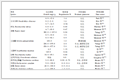
Furthermore, we perform extensive marine scene simulation experiments to validate the performance of the proposed opportunistic routing protocol by using four metrics: 1) packet delivery rate; 2) average candidate node number at each forwarding; 3) average energy consumption; and 4) average end-end delay. Table 1 provides the mathematical notations that are used frequently in this study.
|
Table 1 Frequently used notations |
Below, we take the MSR as an example to discuss in detail the practical relevance of the proposed opportunistic routing algorithm. Given that traditional MSR methods can not locate and track falling water mobile targets in real time, the falling water mobile targets can only passively wait for search and rescue. After a shipwreck occurs, we deploy a large number of marine sensor nodes to the accident sea area, and the nodes and the various marine sensor nodes that are preinstalled on life-saving equipment, such as ships, lifeboats (rafts), life jackets, life rings, and life-saving buoys, are self-organized into an MWSN through the ZigBee protocol (Wu et al., 2013). The MWSNs can aggregate the GPS/Beidou position coordinates, environmental status, and even vital signs perceived by each node and send the perceived information to the MSR terminal through the proposed opportunistic routing protocol. Therefore, the status of the target that is passively waiting for rescue could be converted into active positioning indications. This approach will increase the success rate of MSR to a certain extent.
The proposed opportunistic routing protocol has positive guiding importance for promoting the application of WSNs in marine environment monitoring and MSR. At the same time, they have scientific and academic value in related theories, such as the dynamic acquisition and intelligent processing of marine big data.
The rest of this article is organized as follows. Section 2 presents the problem formulation and system model. The proposed opportunistic routing protocol is introduced in Section 3. Section 4 provides a discussion of our numerical and simulation experiments. The conclusion is given in Section 5.
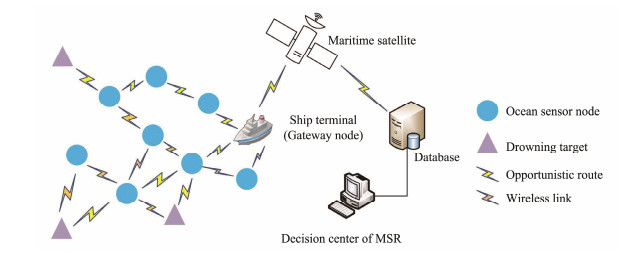
2 Problem Formulation and System Model 2.1 Overview of Opportunistic Routing for MWSNsOpportunistic routing is appropriate for MSR and marine monitoring scenarios because it can effectively increase the data delivery rate in the case of a highly dynamic environment and poor communication channel quality. When a sea disaster occurs, we quickly dispatch drones to deploy numerous marine sensor nodes in the accident sea area to perform search-and-rescue missions for drowning targets. A typical case of opportunistic routing using MWSNs for search and rescue is shown in Fig.1. We use a European graph G = (S, ξ) that satisfies the following characteristics to represent the MWSN topology: 1) S is a limited set of marine nodes; 2) ξ represents the set of links among nodes, and the existence of an edge ξij ∈ξ means that the distance between nodes i and j is less than the communication radius r; 3) Each link (i, j) has an associated cost representing the packet delivery error between nodes i and j.
|
Fig. 1 Opportunistic routing case using MWSNs for search and rescue. |
Sparse representation refers to finding a suitable orthogonal basis for a signal f ∈RN such that the signal is sparse in the transform domain Ѱ. The mathematical definition of sparsity is as follows: After the signal f undergoes orthogonal basis transformation, the coefficient vector becomes x = Ѱ Tf. When 0 < p < 2 and R > 0, the coefficient vector satisfies (Donoho, 2006):
| $ {\left\| x \right\|_p} = {\left({\sum\limits_i {{{\left| {{x_i}} \right|}^p}} } \right)^{1/p}} \leqslant R, $ | (1) |
when condition (1) is satisfied, the coefficient vector Θ is sparse. Follow-up research pointed out that for the precise reconstruction of the original signal, the number of measured values, that is, the dimension of the measurement vector, should satisfy the following formula (Candes and Tao, 2006):
| $ M > C \cdot K \cdot \log N \cdot {\mu ^2}\left({\mathit{\boldsymbol{ \boldsymbol{\varPhi}, \boldsymbol{\varPsi} }} } \right), $ | (2) |
where M is the number of marine nodes that need to be measured to recover the signal accurately, C is a small real constant (C > 1), K represents the sparsity of the signal, and μ (Φ, Ѱ) represents the correlation between the measurement matrix Φ and the transform domain Ѱ.
2.2.2 Measurement matrixThe measurement matrix Φ needs to satisfy the restricted isometry property (RIP) to recover the original data accurately. That is, for any signal x, if a parameter δk (0 < δk < 1) that satisfies the following inequality (Wang et al., 2019) exists
| $ \left({1 - {\delta _k}} \right)\frac{M}{N}\left\| {\mathit{\boldsymbol{x}}} \right\|_2^2 \leqslant \left\| {\mathit{\boldsymbol{ \boldsymbol{\varPhi} x}}} \right\|_2^2 \leqslant \left({1 + {\delta _k}} \right)\frac{M}{N}\left\| {\mathit{\boldsymbol{x}}} \right\|_2^2, $ | (3) |
then the measurements matrix Φ satisfies the RIP.
2.2.3 Signal reconstructionIf the signal x is sparsely representable, the source signal x can be precisely recovered by resolving the l0-norm optimization problem. However, solving the l0-norm problem is NP-hard. Donobo pointed out that when the measurement matrix satisfies the RIP, the l1-norm can be used to approximate the l0-norm. Hence, the recovery of the original data x can be transformed into the following l1-norm convex optimization problem (Wang et al., 2019):
| $ \overset{\lower0.5em\hbox{$\smash{\scriptscriptstyle\frown}$}}{\mathit{\boldsymbol{x}}} = \arg \min {\left\| {\mathit{\boldsymbol{x}}} \right\|_1}, y = {\mathit{\boldsymbol{ \boldsymbol{\varPhi} x}}} . $ | (4) |
Marine nodes are assumed to be capable of adapting their transmitting power in accordance with the network state and their residual energy. We further suppose that the transmitting power is selected among a set P = {p1 t, p2 t, ···, pL t} of discrete values. When the node i selects the transmitting power pk t∈P for data transmission, we define the neighbor node-set of the node i as
Traditional opportunistic routing protocols need to maintain a routing table at each node, wherein the default path is the shortest path from the source node to the destination node. In the MWSNs with time-varying topology, the routing table of the nodes is also continually changing. However, maintaining a real-time, dynamically changing routing table is unacceptable in terms of energy consumption. The objectives of our proposed lightweight NEOR protocol are to 1) use the link diversity in space and time to improve resilience to the dynamic changes of wireless links and 2) reduce network energy consumption and end-to-end latency while improving the packet delivery rate in highly dynamic MWSNs. This work first utilizes compressed sensing technology to reduce the amount of data perception and transmission of marine nodes and then explores the adaptive adjustment mechanism of node transmitting power to select the most appropriate power level for each forwarding. The main modules and processes of NEOR are introduced in detail below.
3.1 Theoretical Path Loss ModelIn accordance with the theoretical path loss model (shadowing model), the received power PR (d) could be expressed as (Wu et al., 2019b):
| $ {P_R}(d) = p_t^k - PL({d_0}) - 10\alpha {\log _{10}}\left({\frac{d}{{{d_0}}}} \right) - {X_\sigma }, $ | (5) |
where pk t is the transmitting power of the node; PL(d0) indicates the signal strength loss value when the reference distance is d0 = 1 m; α is the path-loss attenuation exponent; and Xσ is the wave shadow factor on the sea surface propagation path, which follows Gaussian distribution with zero mean and variance σ2. Eventually, the signal-to-noise ratio (SNR) at the receiving node is calculated as follows:
| $ \gamma _d^{p_t^k}\left[ {{\text{dB}}} \right] = {P_R}(d) - {P_N} = p_t^k - PL({d_0}) \\ \ \ \ \ \ \ - 10\alpha {\log _{10}}\left({\frac{d}{{{d_0}}}} \right) - {X_\sigma } - {P_N}, $ | (6) |
where PN is the marine noise power.
3.2 Successful Reception Probability of the Data PacketThe wireless communication micromodem of the sea surface is assumed to use noncoherent frequency shift keying modulation. Correspondingly, the calculation formula for the successful packet reception probability of a data packet with the size of m bytes over the marine link
| $ p_{{L_{_{{i_j}}}}}^s\left({\gamma _d^{p_t^k}} \right) = {\left({1 - \frac{1}{2}\left({\frac{{ - \gamma _d^{p_t^k}}}{2}\frac{1}{{0.64}}} \right)} \right)^{8m}}, $ | (7) |
and the probability of transmission failure is
| $ p_{{L_{_{{i_j}}}}}^f\left({m, d} \right) = 1 - p_{{L_{_{{i_j}}}}}^s\left({\gamma _d^{p_t^k}} \right) . $ | (8) |
We define
| $ {d_{{i_j}}} = d(i, {\text{Sink}}) - d({i_j}, {\text{Sink)}}, $ | (9) |
where d (i, Sink) is the Euclidean distance between i and the sink node, and d (ij, Sink) is the Euclidean distance between ij and the sink node. In the marine environment, the location of each node moves in real time. Hence,
| $ \mathord{\buildrel{\lower3pt\hbox{$\scriptscriptstyle\frown$}} \over d} _{{i_j}}^t = {\omega _1}\mathord{\buildrel{\lower3pt\hbox{$\scriptscriptstyle\frown$}} \over d} _{{i_j}}^{t - 1} + {\omega _2}\mathord{\buildrel{\lower3pt\hbox{$\scriptscriptstyle\frown$}} \over d} _{{i_j}}^{t - 2} + \cdots + {\omega _n}\mathord{\buildrel{\lower3pt\hbox{$\scriptscriptstyle\frown$}} \over d} _{{i_j}}^{t - n}, $ | (10) |
where ω1 + ω2 + ··· + ωn = 1, ω1 ≥ ω2 ≥ ···≥ ωn.
Given that the spatiotemporal characteristics of marine node motion are considered, that is, the node location in a sea area does not change considerably within a small time interval, WMA can accurately estimate the packet advancement value. Furthermore, WMA has low computational complexity and thus reduces network energy consumption to a certain extent.
3.4 Candidate Node-Set SelectionA sending node must know its neighbor node information to select the next-hop candidate node. The NEOR protocol uses a beaconing process to perform neighbor discovery. Beacon information contains the following four fields: node ID, remaining node energy, node location, and node transmitting power. Some nodes can know their location in real time via an installed GPS module, and the location of other nodes can be solved by using the distributed and cooperative localization algorithm NMTLAT in accordance with Xian et al. (2020). The location information between marine nodes is utilized to calculate the data packet advancement toward the sink node. The transmitting power level is utilized to determine the communication radius of the node, that is, the area wherein the neighbor node is located. When a potential neighbor node receives the beacon information, each marine node executes a neighbor table to store the neighbor node information. When a marine node receives a beacon packet, it obtains the beacon information of the sending node. Subsequently, the communication link quality between the sending node and its neighbor nodes can be estimated by using Eq. (7).
Table 2 shows the detailed steps of the candidate node selection of the proposed NEOR protocol. For a sending node i, the candidate node-set selection module determines the next-hop forwarding node-set
| $ {P_{{i_j}}} = \ln \left({1 + {d_{{i_j}}} \times p_{{L_{_{{i_j}}}}}^s\left({\gamma _d^{p_t^k}} \right) \times \frac{{{{\text{e}}_{{\text{Residual}}}}}}{{{{\text{e}}_{\text{0}}}}}} \right), $ | (11) |
|
|
Table 2 Candidate node-set selection algorithm |
where eResidual and e0 are the remaining energy and initial energy of a marine node, respectively.
Similar to those in the Coutinho et al. (2020), the following steps are performed in this study to calculate the energy consumption of the candidate set
| $ g_{{F_i}}^{p_t^k} = \prod\limits_{\forall {i_j} \in F_i^{p_t^k}} {\left({1 - p_{{L_{_{{i_j}}}}}^s\left({\gamma _d^{p_t^k}} \right)} \right)}, $ | (12) |
where
| $ {\lambda _{{\text{etc}}}} = \frac{1}{{1 - g_{{F_i}}^{p_t^k}}} . $ | (13) |
In summary, the energy consumption of unsuccessful transmission times when sending data packets to the nexthop candidate nodes set
| $ {E_{{\text{cost}}}} = \left({{\lambda _u} - 1} \right)\left({p_t^k\frac{m}{h} + \left| {N_i^{p_t^k}} \right|{P_R}\left(d \right)\frac{m}{h}} \right), $ | (14) |
where h is the channel rate, PR (d) is the received power level, and λu = min{λmax, λetc}.
3.5 Priority Scheduling of Candidate NodesWe integrate the proposed NEOR protocol with a timerbased candidate node-set coordination procedure to perform data packet forwarding to avoid packet conflict problems and reduce redundant transmission. First, the candidate nodes are arranged in descending order in accordance with the priority value
2)
| $ {T_{{i_j}\_{\text{wait}}}} = {T_{{\text{delay}}}} + (y - 1) \times {T_p} \\ \ \ \ \ \ \ \ \ \ = 0.002048{\text{ s}} + (y - 1) \times 0.002{\text{ s}} . $ | (15) |
The main problem of the timer-based scheduling solution is that if the distance between the candidate nodes is far, the low-priority node cannot receive the control message sent by the high-priority node, thus leading to high duplicate transmissions. The amount of data transmission during duplicate packet transmission is significantly reduced because of the use of compressed sensing technology. In the worst-case scenario, the sink node is responsible for discarding all duplicate packets.
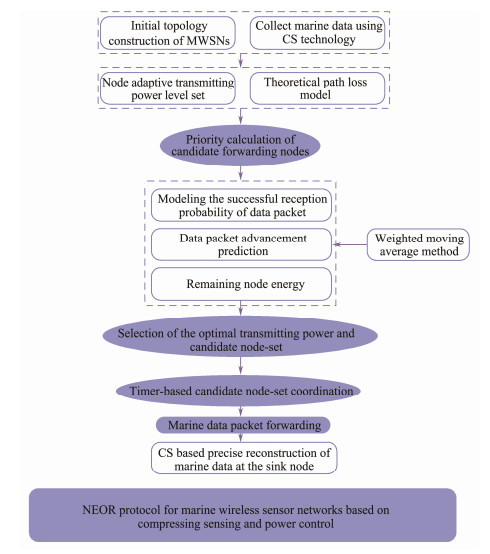
The flow chart of the proposed NEOR protocol is shown in Fig.2.
|
Fig. 2 Flow chart of the proposed NEOR protocol. |
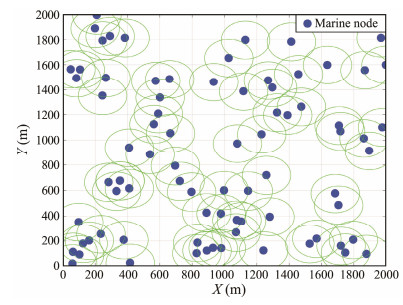
As discussed in this section, we use MATLAB 2016b to evaluate the performance of the proposed NEOR protocol. After the occurrence of a shipwreck, 80 nodes are evenly distributed in a square monitoring sea area with a side length of 2 km at the initial moment. The maximum and minimum speeds of the random waypoint mobility model adopted by the sensor node are 30 and 10 m s−1, respectively. Fig.3 is the initial topology of the MWSNs (80 marine nodes). Three routing algorithms, namely, adaptive deep Q-network-based energyand latency-aware routing (DQELR) (Su et al., 2019), prediction-based opportunistic routing (POR) (Wu et al., 2018c), and PCR routing (Coutinho et al., 2020), are selected as the benchmark algorithms. A marine node that is far from the ship terminal (gateway node) is chosen as a sink node to verify the proposed opportunistic routing protocol properly. The energy of the sink node is assumed to be sufficient. The marine data reconstruction task of the proposed NEOR protocol is completed in the sink node by using the CAMP algorithm (Wu et al., 2017). Other fixed simulation parameter settings are displayed in Table 3.
|
Fig. 3 Initial topology of the MWSNs (80 marine nodes). |
|
|
Table 3 Fixed simulation parameters |
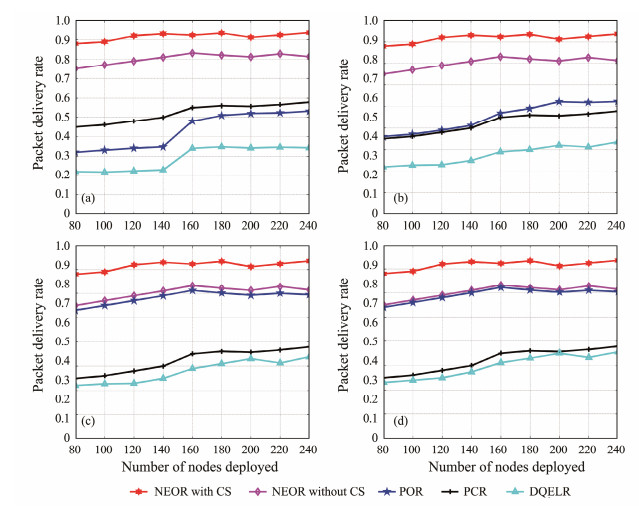
Fig.4 portrays the functional relationship between the packet delivery rate and the number of deployment nodes. It shows that compared with the NEOR protocol without CS and benchmark algorithms, NEOR with CS achieves the best performance. In particular, POR and DQELA utilize a fixed transmitting power level. Given that the NEOR and PCR protocols can adjust the transmitting power adaptively, theoretically, they can select the most appropriate transmitting power value from the discrete set Pt = {6, 12, 24, 48} W. The NEOR protocol can identify the most suitable candidate set for forwarding the packet to the sink node because the most suitable transmitting power level is selected. Hence, the data packet delivery rate increases, given that the power control mechanism improves the link connectivity among marine nodes and reduces the possible coverage holes. Moreover, the NEOR protocol with CS can significantly reduce the amount of data collected by the marine node to increase the packet delivery rate to a certain extent. As can be seen from Figs.4b – 4d, when Pt = {12, 24, 48} W, PCR has worse performance than NEOR and POR because it does not consider the mobility of sensor nodes. Simultaneously, with the increase in transmitting power, the packet delivery rates of POR and DQ- ELA increase by varying degrees. DQELA needs to rebuild a new transmission path after the link is damaged because it considers a network topology that is relatively static for a short period and transmits perceptive data via a single path. Therefore, DQELA has the worst performance. Fig.4d shows that the packet delivery rates of the NEOR protocol with CS are 12.4%, 39.4%, and 41.9% higher than those of POR (Pt = 48 W), PCR, and DQELR (Pt = 48 W), respectively.
|
Fig. 4 Packet delivery rate with a variable number of nodes. (a), Pt = 6 W; (b), Pt = 12 W; (c), Pt = 24 W; (d), Pt = 48 W. |
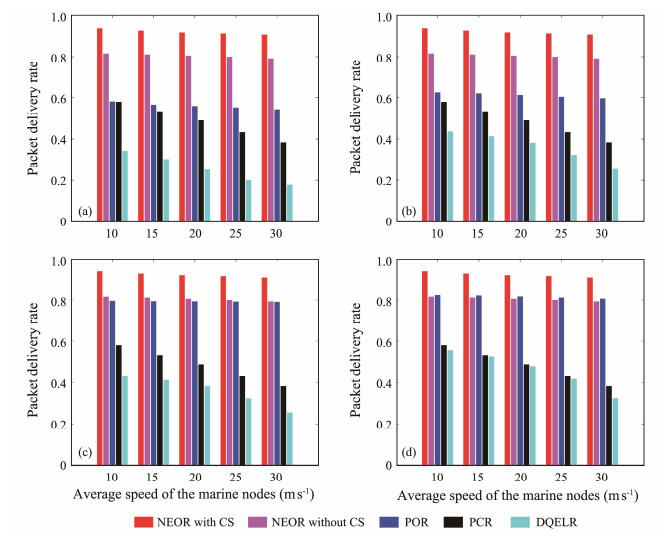
Fig.5 reveals the functional relationship between the packet delivery rate and the average speed of marine nodes. In the marine environment, sensor nodes move in real time. The speed of the marine nodes is a very critical factor that affects the performance of the routing protocol. As shown in Fig.5, the performances of NEOR and POR are better than those of PCR and DQELA because of the use of opportunistic routing technology and the consideration of node dynamics. With the increase in the average speed of nodes, the packet delivery rates of the NEOR and POR protocols decreased slightly and remained stable. In DQELA, the transmission path formed is unstable when the marine nodes move in real time. After the existing communication link is broken, a new route path must be established. This requirement prolongs the time delay and reduces the packet delivery rate. However, in opportunistic routing, marine nodes broadcast the message and, at all times, attempt to search for a superior transmission path. This situation increases the packet delivery rate. Given that the PCR and DQELA protocols do not take into account the mobility of nodes, their performance gradually deteriorates with the increase in the node's moving speed.
|
Fig. 5 Packet delivery rates with variable average marine node speeds. (a), Pt = 6 W; (b), Pt = 12 W; (c), Pt = 24 W; (d), Pt = 48 W. |
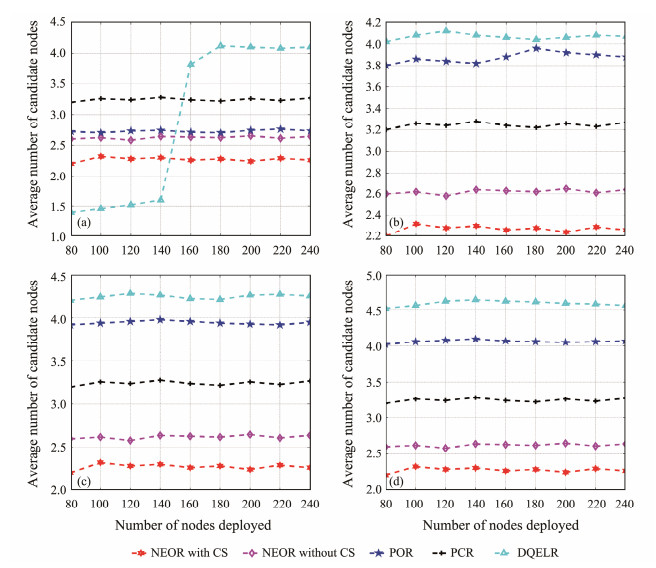
Fig.6 depicts the functional relationship between the number of nodes deployed and the average number of candidate nodes required for each forwarding. The simulation results show that, on average, the NEOR with CS, NEOR without CS, and PCR protocols using the power control mechanism require only 2.27, 2.62, and 3.25 marine nodes for each hop forwarding, respectively, because each marine node selects the most appropriate transmitting power (corresponding to the best node communication transmission radius), thereby determining the optimal sea area wherein the candidate node is located. When the transmitting power is increased, the average number of the candidate nodes of the POR and DQELA protocols increases at each forwarding because the increase in transmitting power increases the number of neighbor nodes, thus increasing the number of the potential candidate nodes. This situation increases the number of neighbor nodes as candidate nodes that prefer to continue forwarding data packets.
|
Fig. 6 Average number of candidate nodes at each forwarding. (a), Pt = 6 W; (b), Pt = 12 W; (c), Pt = 24 W; (d), Pt = 48 W. |
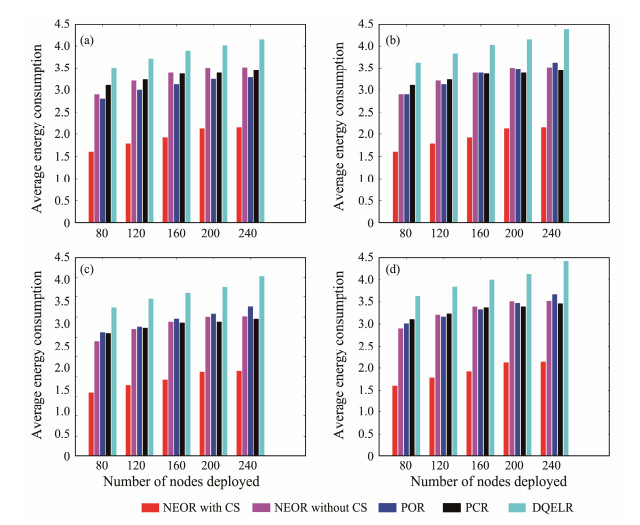
The results of average energy consumption against a variable number of nodes are presented in Fig.7. As expected, the average energy consumption of marine nodes increases as the network size increases. DQELA exhibits the poorest performance because in a highly dynamic marine environment, the routing path generated by DQELA is frequently destroyed, and reforming the new routing path requires high energy. When the transmitting power of the nodes is large, the communication radius of the nodes is large. The farther a node can communicate, the fewer hops required to send data packets to the sink node. Therefore, as Pt grows, the average energy consumption of POR and DQELA first increases gradually and then decreases. Fig.7a shows that when the network size is not less than 160, NEOR without CS consumes more energy than POR and PCR. Although the energy consumption of NEOR without CS and that of POR are analogous, power control enhances the communication link quality, as confirmed by the increase in packet delivery rate displayed in Fig.4. NEOR with CS has the lowest energy consumption as a result of the compressed sensing and power control technology. Meanwhile, NEOR, which has a relatively low network energy consumption, can effectively prolong the lifespan of the MWSNs.
|
Fig. 7 Average energy consumption with a variable number of nodes. (a), Pt = 6 W; (b), Pt = 12 W; (c), Pt = 24 W; (d), Pt = 48 W. |
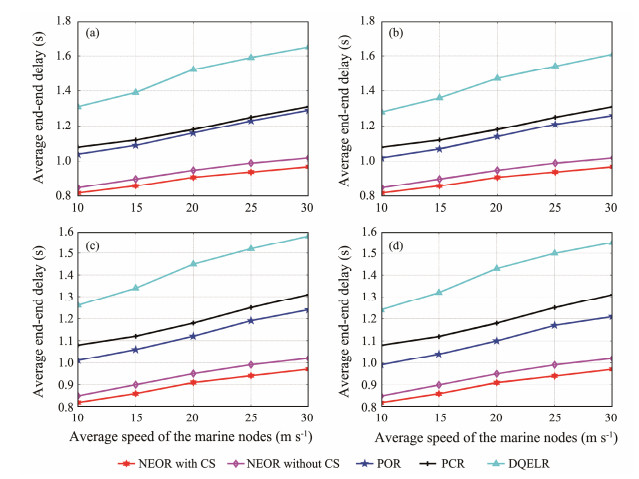
Fig.8 displays the average end-end delay (the average time from the source node generating the data packet to the sink node receiving the data packet) with a variable average speed of marine nodes. As expected, the average end-end delay increases with the increment in the average speed of marine nodes. DQELA has the poorest performance among the protocols because it detours to avoid data packet collisions and requires the frequent formation of new transmission links in MWSNs. This approach leads to high endend delay. With the increase in Pt, the communication radius of the nodes increases such that an enormous packet advancement can be obtained. As a result, the end-end latency of POR and DQELA decreases as Pt increases. Fig.8 shows that our proposed opportunistic routing protocol achieves the best performance because of the use of power control technology to obtain the best set of candidate nodes. The performance of the NEOR protocol with CS is slightly better than that of the NEOR protocol without CS. This result implies that although the compressed sensing technology greatly reduces the amount of marine data transmission, it does not significantly reduce the time delay. Fig.8d shows that the end-end delays of the NEOR protocol with CS are 18.3%, 23.7%, and 36.1% lower than those of POR, PCR, and DQELR (Pt = 48 W), respectively. The above results validate that the NEOR protocol can realize the lowlatency transmission of MSR data.
|
Fig. 8 Average end-end delay with variable average marine node speeds. (a), Pt = 6 W; (b), Pt = 12 W; (c), Pt = 24 W; (d), Pt = 48 W. |
We propose NEOR, a novel energy-efficient opportunistic routing protocol for MWSNs based on compressed sensing and power control, to realize the efficient delivery of marine data from source nodes (monitoring nodes) to sink nodes. First, to reduce the frequency of location information exchange, we utilize the space-time relationship of the network topology incorporated with the WMA method to predict packet advancement. Subsequently, the optimal transmitting power and candidate node-set are determined on the basis of the four metrics elaborated in the abstract. Finally, our proposed NEOR protocol adopts a timer-based candidate node-set scheduling algorithm to coordinate the forwarding of data packets to avoid packet conflict. Moreover, the use of compressed sensing technology greatly reduces the amount of data collection and transmission in MWSNs. Our numerical simulation results demonstrate the superiority of the NEOR protocol, which is due to the utilization of compressed sensing and the adaptive adjustment of the transmitting power of the marine sensor nodes. Compared with the selected benchmark algorithms, the NEOR protocol increases the packet delivery rate while reducing energy consumption and routing delay. We recommend the following as future research directions:
1) Improving the opportunity routing protocol in combination with different dynamic topology control algorithms to further enhance the performance of the NEOR protocol.
2) Using game theory and machine learning methods (Chakchouk, 2015) to optimize the NEOR protocol further.
3) Establishing a secure and efficient opportunistic route in the case of malicious attacks.
4) Improving the existing location algorithm (Mei et al., 2020b, 2021) to assist the design of routing protocols.
5) Performing real marine monitoring (ship type recognition and ship detection (Chen et al., 2020, 2021)) and marine MSR experiments with MWSNs to evaluate the engineering performance of the NEOR protocol comprehensively.
AcknowledgementsThe study is supported by the National Natural Science Foundation of China (Nos. 52201403, 52201401, 520712 00, 52102397, 61701299, 51709167), the National Key Research and Development Program (No. 2021YFC2801002), the China Postdoctoral Science Foundation (Nos. 2021M 700790, 2022M712027), the Fund of National Engineering Research Center for Water Transport Safety (No. A2 022003), the Foundation for Jiangsu Key Laboratory of Traffic and Transportation Security (No. TTS2021-05), the Fund of Hubei Key Laboratory of Inland Shipping Technology (No. NHHY2021002), and the Top-Notch Innovative Program for Postgraduates of Shanghai Maritime University (Nos. 2019YBR006, 2019YBR002).
Ahmed, F., Wadud, Z., Javaid, N., Alrajeh, N., Alabed, M. S., and Qasim, U., 2018. Mobile sinks assisted geographic and opportunistic routing based interference avoidance for underwater wireless sensor network. Sensors, 18(4): 1062. DOI:10.3390/s18041062 (  0) 0) |
Akbas, A., Yildiz, H. U., Tavli, B., and Uludag, S., 2016. Joint optimization of transmission power level and packet size for WSN lifetime maximization. IEEE Sensors Journal, 16(12): 5084-5094. DOI:10.1109/JSEN.2016.2548661 ( 0) |
Boukerche, A., and Darehshoorzadeh, A., 2014. Opportunistic routing in wireless networks: Models, algorithms, and classifications. ACM Computing Surveys, 47(2): 1-36. ( 0) |
Candès, E. J., and Tao, T., 2006. Near-optimal signal recovery from random projections: Universal encoding strategies?. IEEE Transactions on Information Theory, 52(12): 5406-5425. DOI:10.1109/TIT.2006.885507 ( 0) |
Candès, E. J., and Wakin, M. B., 2008. An introduction to compressive sampling: A sensing/sampling paradigm that goes against the common knowledge in data acquisition. IEEE Signal Processing Magazine, 25(2): 21-30. DOI:10.1109/MSP.2007.914731 ( 0) |
Celik, A., Saeed, N., Shihada, B., Al-Naffouri, T. Y., and Alouini, M. S., 2019. SectOR: Sector-based opportunistic routing protocol for underwater optical wireless networks. 2019 IEEE Wireless Communications and Networking Conference (WCNC). Marrakesh, Morocco, 1-6.
( 0) |
Chakchouk, N., 2015. A survey on opportunistic routing in wireless communication networks. IEEE Communications Surveys and Tutorials, 17(4): 2214-2241. DOI:10.1109/COMST.2015.2411335 ( 0) |
Chen, X., Ling, J., Wang, S., Yang, Y., Luo, L., and Yan, Y., 2021. Ship detection from coastal surveillance videos via an ensemble Canny-Gaussian-morphology framework. The Journal of Navigation, 74(6): 1252-1266. DOI:10.1017/S0373463321000540 ( 0) |
Chen, X., Qi, L., Yang, Y., Luo, Q., Postolache, O., Tang, J., et al., 2020. Video-based detection infrastructure enhancement for automated ship recognition and behavior analysis. Journal of Advanced Transportation, 2020: 7194342. ( 0) |
Coutinho, R. W. L., and Boukerche, A., 2021. OMUS: Efficient opportunistic routing in multi-modal underwater sensor networks. IEEE Transactions on Wireless Communications, 20(9): 5642-5655. DOI:10.1109/TWC.2021.3069117 ( 0) |
Coutinho, R. W. L., Boukerche, A., and Loureiro, A. A. F., 2020. A novel opportunistic power controlled routing protocol for internet of underwater things. Computer Communications, 150: 72-82. DOI:10.1016/j.comcom.2019.10.020 ( 0) |
Coutinho, R. W. L., Boukerche, A., Vieira, L. F. M., and Loureiro, A. A. F., 2016. Design guidelines for opportunisticrouting in underwater networks. IEEE Communications Magazine, 54(2): 40-48. DOI:10.1109/MCOM.2016.7402259 ( 0) |
Coutinho, R. W. L., Boukerche, A., Vieira, L. F. M., and Loureiro, A. A. F., 2018. Underwater wireless sensor networks: A new challenge for topology control-based systems. ACM Computing Surveys, 51(1): 1-36. ( 0) |
Donoho, D. L., 2006. Compressed sensing. IEEE Transactions on Information Theory, 52(4): 1289-1306. DOI:10.1109/TIT.2006.871582 ( 0) |
Fu, X. M., Zhang, M. Q., Liu, Y., Shao, C. L., Hu, Y., Wang, X. Y., et al., 2018. Protective exploitation of marine bioresources in China. Ocean & Coastal Management, 163: 192-204. ( 0) |
Guan, Q., Ji, F., Liu, Y., Yu, H., and Chen, W., 2019. Distancevector-based opportunistic routing for underwater acoustic sensor networks. IEEE Internet of Things Journal, 6(2): 3831-3839. DOI:10.1109/JIOT.2019.2891910 ( 0) |
Hayes, T., and Ali, F. H., 2016. Location aware sensor routing protocol for mobile wireless sensor networks. IET Wireless Sensor Systems, 6(2): 49-57. DOI:10.1049/iet-wss.2015.0027 ( 0) |
Ismail, M., Islam, M., Ahmad, I., Khan, F. A., Qazi, A. B., Khan, Z. H., et al., 2020. Reliable path selection and opportunistic routing protocol for underwater wireless sensor networks. IEEE Access, 8: 100346-100364. DOI:10.1109/ACCESS.2020.2992759 ( 0) |
Jin, Z., Duan, C., Yang, Q., and Su, Y., 2021. Q-learning-based opportunistic routing with an on-site architecture in UASNs. Ad Hoc Networks, 119: 102553. DOI:10.1016/j.adhoc.2021.102553 ( 0) |
Jin, Z., Zhao, Q., and Su, Y., 2019. RCAR: A reinforcementlearning-based routing protocol for congestion-avoided underwater acoustic sensor networks. IEEE Sensors Journal, 19(22): 10881-10891. DOI:10.1109/JSEN.2019.2932126 ( 0) |
Joshi, A., Dhongdi, S., Ankit, and Anupama, K. R., 2018. Joint clustering and routing protocol for static 3D wireless sensor networks. 2018 International Conference on Information Networking (ICOIN). Chiang Mai, Thailand, 368-373.
( 0) |
Kanthimathi, N., and Dejey, 2017. Void handling using GeoOpportunistic Routing in underwater wireless sensor networks. Computers and Electrical Engineering, 64: 365-379. DOI:10.1016/j.compeleceng.2017.07.016 ( 0) |
Li, X., Keegan, B., Mtenzi, F., Weise, T., and Tan, M., 2019. Energy-efficient load balancing ant based routing algorithm for wireless sensor networks. IEEE Access, 7: 113182-113196. DOI:10.1109/ACCESS.2019.2934889 ( 0) |
Lin, C., Han, G., Guizani, M., Bi, Y., and Du, J., 2019. A scheme for delay-sensitive spatiotemporal routing in SDN-enabled underwater acoustic sensor networks. IEEE Transactions on Vehicular Technology, 68(9): 9280-9292. DOI:10.1109/TVT.2019.2931312 ( 0) |
Lu, W. H., Caroline, C., Maria, B., Wang, T., Chen, M. B., Kelli, P., et al., 2019. Successful blue economy examples with an emphasis on international perspectives. Frontiers in Marine Science, 6: 261. DOI:10.3389/fmars.2019.00261 ( 0) |
Lv, C., Wang, Q., Yan, W., and Li, J., 2019. Compressive sensingbased sequential data gathering in WSNs. Computer Networks, 154: 47-59. DOI:10.1016/j.comnet.2019.03.004 ( 0) |
Mahapatra, C., Sheng, Z., Kamalinejad, P., Leung, V. C., and Mirabbasi, S., 2016. Optimal power control in green wireless sensor networks with wireless energy harvesting, wake-up radio and transmission control. IEEE Access, 5: 501-518. ( 0) |
Mei, X., Wu, H., and Xian, J., 2020a. Matrix factorization-based target localization via range measurements with uncertainty in transmit power. IEEE Wireless Communications Letters, 9(10): 1611-1615. DOI:10.1109/LWC.2020.2998609 ( 0) |
Mei, X., Wu, H., Saeed, N., Ma, T., Xian, J., and Chen, Y., 2020b. An absorption mitigation technique for received signal strengthbased target localization in underwater wireless sensor networks. Sensors, 20(17): 4698. DOI:10.3390/s20174698 ( 0) |
Mei, X., Wu, H., Xian, J., and Chen, B., 2021. RSS-based byzantine fault-tolerant localization algorithm under NLOS environment. IEEE Communications Letters, 25(2): 474-478. DOI:10.1109/LCOMM.2020.3027904 ( 0) |
Mei, X., Wu, H., Xian, J., Chen, B., Zhang, H., and Liu, X., 2019. A robust, non-cooperative localization algorithm in the presence of outlier measurements in ocean sensor networks. Sensors, 19(12): 2708. DOI:10.3390/s19122708 ( 0) |
Saleh, A. I., Abo-Al-Ez, K. M., and Abdullah, A. A., 2017. A Multi-Aware Query Driven (MAQD) routing protocol for mobile wireless sensor networks based on neuro-fuzzy inference. Journal of Network and Computer Applications, 88: 72-98. DOI:10.1016/j.jnca.2017.02.016 ( 0) |
Shahid, S. P., and Kumar, S. S., 2015. Sea Water quality monitoring using smart sensor network. 2015 International Conference on Control, Instrumentation, Communication and Computational Technologies (ICCICCT). Kumaracoil, India, 804-812.
( 0) |
Sharma, D., and Bhondekar, A. P., 2018. Traffic and energy aware routing for heterogeneous wireless sensor networks. IEEE Communications Letters, 22(8): 1608-1611. DOI:10.1109/LCOMM.2018.2841911 ( 0) |
Singh, A., and Nagaraju, A., 2020. Low latency and energy efficient routing-aware network coding-based data transmission in multi-hop and multi-sink WSN. Ad Hoc Networks, 107: 102182. DOI:10.1016/j.adhoc.2020.102182 ( 0) |
Stojanovic, M., and Preisig, J., 2009. Underwater acoustic communication channels: Propagation models and statistical characterization. IEEE Communications Magazine, 47(1): 84-89. DOI:10.1109/MCOM.2009.4752682 ( 0) |
Su, Y., Fan, R., Fu, X., and Jin, Z., 2019. DQELR: An adaptive Deep Q-Network-based energyand Latency-aware Routing protocol design for underwater acoustic sensor networks. IEEE Access, 4: 9091-9104. ( 0) |
Vithiya, R., Sharmila, G., and Karthika, S., 2018. Enhancing the performance of routing protocol in underwater acoustic sensor networks. 2018 IEEE International Conference on System, Computation, Automation and Networking (ICSCA). Pondicherry, India, 1-5.
( 0) |
Wang, Q., Lin, D., Yang, P., and Zhang, Z., 2019. An energyefficient compressive sensing-based clustering routing protocol for WSNs. IEEE Sensors Journal, 19(10): 3950-3960. DOI:10.1109/JSEN.2019.2893912 ( 0) |
Wu, H., Mei, X., Chen, X., Li, J., Wang, J., and Mohapatra, P., 2018a. A novel cooperative localization algorithm using enhanced particle filter technique in maritime search and rescue wireless sensor network. ISA Transactions, 78: 39-46. DOI:10.1016/j.isatra.2017.09.013 ( 0) |
Wu, H., Meng, Q., Xian, J., Mei, X., Claramunt, C., and Cao, J., 2019a. An information entropy based event boundary detection algorithm inwireless sensor networks. Symmetry, 11(4): 537. DOI:10.3390/sym11040537 ( 0) |
Wu, H., Suo, M., Wang, J., Mohapatra, P., and Cao, J., 2017. A holistic approach to reconstruct data in ocean sensor network using compression sensing. IEEE Access, 6: 280-286. ( 0) |
Wu, H., Wang, J., Ananta, R. R., Kommareddy, V. R., Wang, R., and Mohapatra, P., 2018b. Prediction based opportunistic routing for maritime search and rescue wireless sensor network. Journal of Parallel and Distributed Computing, 111: 56-64. DOI:10.1016/j.jpdc.2017.06.021 ( 0) |
Wu, H., Xian, J., Mei, X., Zhang, Y., Wang, J., Cao, J., et al., 2019b. Efficient target detection in maritime search and rescue wireless sensor network using data fusion. Computer Communications, 136: 53-62. DOI:10.1016/j.comcom.2019.01.002 ( 0) |
Wu, H., Xian, J., Wang, J., Khandge, S., and Mohapatra, P., 2018c. Missing data recovery using reconstruction in ocean wireless sensor networks. Computer Communications, 132: 1-9. DOI:10.1016/j.comcom.2018.09.007 ( 0) |
Wu, H., Zhang, Q., Nie, S., Sun, W., and Guan, X., 2013. An energy distribution and optimization algorithm in wireless sensor networks for maritime search and rescue. International Journal of Distributed Sensor Networks, 9(2): 725869. DOI:10.1155/2013/725869 ( 0) |
Xian, J., Wu, H., Mei, X., Zhang, Y., Chen, H., and Wang, J., 2020. NMTLAT: A new robust mobile multi-target localization and tracking scheme in marine search and rescue wireless sensor networks under Byzantine attack. Computer Communications, 160: 623-635. DOI:10.1016/j.comcom.2020.06.034 ( 0) |
Xu, X., Yuan, M., Liu, X., Liu, A., Xiong, N. N., Cai, Z., et al., 2018. A cross-layer optimized opportunistic routing scheme for loss-and-delay sensitive WSNs. Sensors, 18(5): 1422. DOI:10.3390/s18051422 ( 0) |
Yang, G., Liang, T., He, X., and Xiong, N., 2018. Global and local reliability-based routing protocol for wireless sensor networks. IEEE Internet of Things Journal, 6(2): 3620-3632. ( 0) |
Zhang, X., Tao, L., Yan, F., and Sung, D. K., 2020. Shortestlatency opportunistic routing in asynchronous wireless sensor networks with independent duty-cycling. IEEE Transactions on Mobile Computing, 19(3): 711-723. DOI:10.1109/TMC.2019.2897998 ( 0) |
Zhang, Y., Zhang, Z., Chen, L., and Wang, X., 2021. Reinforcement learning-based opportunistic routing protocol for underwater acoustic sensor networks. IEEE Transactions on Vehicular Technology, 70(3): 2756-2770. DOI:10.1109/TVT.2021.3058282 ( 0) |
Zhao, Z. L., Rosário, D., Braun, T., and Cerqueira, E., 2014. Context-aware opportunistic routing in mobile ad-hoc networks incorporating node mobility. 2014 IEEE Wireless Communications and Networking Conference (WCNC). Istanbul, Turkey, 2138-2143.
( 0) |