 2021, Vol. 20

(Porphyra yezoensis) During One Harvest Cycle


2) Laboratory for Marine Drugs and Bioproducts of Qingdao National Laboratory for Marine Science and Technology, Qingdao 266237, China;
3) College of Food Science and Technology, Ocean University of China, Qingdao 266003, China
Due to the increasing awareness of dietary nutrition and health, consumers are becoming more and more interested in eating seaweeds (Jiménez-Escrig, 2011). Laver is one of the most important economic algae in the world. It belongs to the Rhodophyta phylum, Protoflorideophyceae class, Bangiales order, Bangiaceae family, and Porphyra genus. Laver products are popular for their high nutritional value and unique flavor, especially umami (Nakamura, 2011). So far, more than 130 kinds of laver have been reported worldwide, among which Porphyra yezoensis and Porphyra haitnensis are the two main aquaculture species. Laver can be harvested 5-6 times during an aquaculture cycle. Both consumers and producers concern about quality differences between the different crops.
Now, consumers no longer only care about whether the product is nutritious, but also have higher requirements for its flavor. The flavor of aquatic products consists mainly of odor and taste. The researchers have studied the volatile odor components of various aquatic products (Varlet et al., 2006; François et al., 2012; Li et al., 2013) and made ideal progress in analytical methods, such as headspace solid-phase microextraction (HS-SPME) (Cheong et al., 2010), two-dimensional gas chromatography coupled to time-of-flight mass spectrometry (GC×GC-ToF MS) (Cheong, 2011), electronic nose (Alasalvar et al., 2015) and gas chromatography-ion mobility spectrometer (GC-IMS) (Criado-García et al., 2016).
Taste substances are mainly non-volatile and water-soluble, such as inorganic ions, organic acids, free amino acids, peptides, nucleotide and related compounds. At pre-sent, research on the taste of aquatic products is mainly focused on aquatic animals such as fish (Fujimaki et al., 2014), shellfish (Cho and Sang, 2014), shrimp (Cheung and Li-Chan, 2014) and crabs (Hayashi et al., 2010). Few studies focus on the taste of economic algae such as laver.
Previous studies have confirmed that there are significant differences in the nutrient composition of different laver crops (Zhao et al., 2018). However, little information is available about the flavor characteristics of different laver crops. In this paper, as the typical species in northern China, P. yezoensis was collected as an experimental object. To identify the flavor characteristics of P. yezoensis, the odor and taste of different crops harvested during one aquaculture cycle were analyzed using an electronic nose and an electronic tongue respectively. The taste substances such as free amino acids and flavored nucleotides were also determined. This is the first report on the odor and taste analysis of lavers collected at different dates.
2 Materials and Methods 2.1 MaterialsP. yezoensis used in this study was collected from Jing Bay, which is in Shandong Province, China. The harvest date was 1/02/2018 for the first crop, 1/14/2018 for the second crop, 2/10/2018 for the fourth crop and 3/15/2018 for the sixth crop. The reagents and chemicals used in this study were of analytical grade and purchased from Sigma Corp.
2.2 Taste Profile AnalysisThe taste characteristic of laver was analyzed by using TS-5000Z taste sensing system (INSENT Technology Co., Ltd., Japan). Dried laver powder 5.0 g was mixed with 100 mL boiling distilled water. After soaking in a flask for 5 min, the mixture was centrifuged (3000 g, 5 min). The supernatant was taken and cooled to room temperature. Then, the electronic tongue which loaded different sensor electrodes was used to examine umami, bitterness, astringency, saltiness, sourness and their aftertastes. Each sample was examined for 3 times. All the test data were analyzed by using the system's build-in software. The reference solution used in this study was a mixed solution of potassium chloride and tartaric acid, which was an artificial simulation to human saliva. The cleaning solution for anode was a mixture of distilled water, potassium chloride, ethanol and potassium hydroxide. The cleaning solution for cathode was a mixture of distilled water, ethanol and hydrochloric acid.
2.3 Taste Related Compounds DeterminationSulfosalicylic acid method was used for the detection and quantification of free amino acids. High performance liquid chromatography method was used for measuring nucleotides. 5.0 g laver powder was immersed in hydrochloric acid solution (0.01 mol L−1) for 30 min, then filtrated and mixed with sulphosalicylic acid solution (8%, m/v) in a ratio of 1:1 (v/v). The mixture was centrifuged and filtered through a 0.45 μm filter membrane, then determined by L-8800 amino acid automatic analyzer (Hitachi Technology Co., Ltd., Japan).
5.0 g dried laver powder was added into 25.0 mL peracetic acid solution (10%, m/v). After homogenization and centrifugation, the supernatant was collected and neutralized to pH 6.5. The supernatant was filtered through a 0.45 μm filter membrane. The leachate was collected and examined by 1260 HPLC (Agilent Technology Co., Ltd., USA). The contents of adenosine monophosphate (AMP), inosine monophosphate (IMP) and guanosine monophosphate (GMP) were determined by comparing the retention time and peak area of the sample with the standard compounds.
Taste active value (TAV) was calculated according to the following formula (Gong et al., 2014):
| $TAV = \frac{{{\rm{Absolute \;concentration \;of\; the \;substance}}}}{{{\rm{Taste \;threshold \;of\; the \;substance}}}}.$ | (1) |
Equivalent umami concentration (EUC) was calculated according to the following formula (Gong et al., 2014).
| $EUC({\rm{g }}MSG/100{\rm{ g}}) = \sum {{a_i}{b_i}} + 1218(\sum {{a_i}{b_i}})(\sum {{a_j}{b_j}}).$ | (2) |
MSG represents monosodium glutamate. 1218 is a sy-nergistic constant. ai represents the quantity of umami amino acid (g/100 g). bi represents umami coefficient of amino acid to MSG (Glu 1.0, Asp 0.077). aj represents the quantity of umami nucleotides (g/100 g). bj represents umami coefficient of nucleotides to IMP (IMP 1.0, AMP 0.18, GMP 2.3).
2.4 Odor Profile AnalysisPEN-3 electronic nose (Airsense Technology Co., Ltd., Germany) was used for the odor characteristic analysis. The E-nose is equipped with 10 metal oxide sensors. Each sensor is sensitive to a specific class of volatile compounds. 1.0 g dried laver powder was placed in a 50 mL head space bottle and kept at 60℃ for 10 min for stabilization. The test project was set as following: 120 s for washing, 5 s for sample injection, 90 s for measurement. The gas flow rate was 200 mL min−1. Data acquisition interval was set at 1 s. Data of a 10-s interval before the end of the test was collected and processed by using built-in software (WinMuster, Version 1.6.2) for principal component analysis (PCA).
2.5 Volatile Compounds DetectionDried laver powder of 0.5 g was placed in a 20 mL head space bottle and kept at 60℃ for 10 min. Then, Flavorspec® gas chromatography-ion mobility spectrometer (GC-IMS) (G.A.S. Technology Co., Ltd., Germany) was used for the analysis of volatile compounds. According to the NIST database and IMS database, the volatile substances were determined and plotted in a diagram by using the Gallery-Plot function of the built-in Laboratory Analytical Viewer (LAV) software.
2.6 Statistical AnalysisSPSS 17.0 was used for the experimental data analysis. The results were represented by the mean ± standard deviation. The significance of difference was analyzed by Duncan multiple comparison method. P < 0.05 indicates a significant difference.
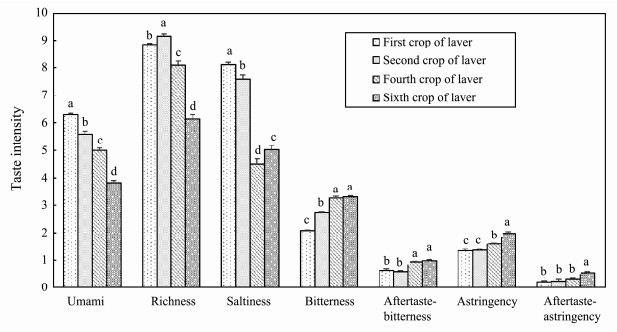
3 Results and Discussion 3.1 Taste Characteristic of Different Crops of LaverThe response of the electronic tongue to different laver crops is shown in Fig.1. All data are absolute output values and the reference solutions (simulated artificial saliva) is the baseline. According to the Weber-Fechner's law, when the intensity of a flavored substance changes by 20%, the human tongue can recognize this difference (Shigemoto, 2003). Therefore, the 20% intensity variation range is defined as the taste unit.
|
Fig. 1 Taste characteristics of different Porphyra yezoensis crops. The different letters in the same category indicates significant difference (P < 0.05). |
In terms of umami, the first laver crop has the highest intensity, while the sixth crop has the lowest, showing a gradual decline. Umami taste was first proposed as a basic taste by Kikunae Ikeda in 1909 when he founded that brown seaweeds contain large amount of free glutamic acid (Mouritsen et al., 2019). Umami is associated with deliciousness and contributes a lot to the overall taste of laver. The richness that can be considered as the aftertaste and durability of umami varies in a similar manner. The second laver crop has the highest richness value, not the first crop. This is because the richness is not only related to the absolute content of the taste-related compounds, but also to the type of these chemicals. The second laver crop richness is more intense, suggesting that the content and variety of umami compounds may be different from the content and type of other crops.
The salty taste of lavers is due to their seawater living environment and absorption properties. The saltiness of the first and second crop was close, significantly higher than the fourth and sixth crops (P < 0.05). Salty taste is mainly produced by Na+, K+ and other inorganic cations. These cations can enhance other tastes (Nakata et al., 1995), such as the stronger umami of the first crop and the second crop.
Bitterness and astringency are the negative tastes of laver. The bitterness and astringency of the early laver crops are relatively weak, which is contrary to the chan-ges in umami and richness. The intensity values of aftertaste-bitterness and aftertaste-astringency are lower than 1.0, which means the contribution to the taste is very little.
Electronic tongues are able to detect single chemicals as well as mixtures by means of electrochemical techniques and particular sensor membranes (Vlasov et al., 2002). Over the past 20 years, many types of electronic tongues have been reported (Ciosek and Wróblewski, 2007; Kobayashi et al., 2010). However, most are experimental laboratory setups. The INSENT taste sensing system used in this study is one of the few devices commercially available. This system is a potentiometric multichannel taste sensor and equipped with up to eight lipid membrane sensors, each representing a gustatory stimulus or mouth feeling (Kobayashi et al., 2010). As an instrument to reduce the number of human taste tests, electronic tongue has been widely used in the area of food industry, such as comparison of different products, quality assessment, and quality control (Escuder-Gilabert and Peris, 2010). This study confirmed that the taste profile of different laver crops can be analyzed by the INSENT taste sensing system conveniently and accurately. However, electronic tongue will never be able to integrate all sensory, physiological and psychological aspects of human taste sensation into a single analytical procedure. Therefore, there is still a long way to go to develop a 'real artificial tongue' (Woertz et al., 2011).
3.2 Contents of Taste-Related Compounds in Different Crops of LaverFree amino acids and flavored nucleotides are the major taste related substances for aquatic products (Chen and Zhang, 2007). In terms of laver, free amino acids play an important role in the presentation of overall taste. The total amount of free amino acids in the first laver crop was 4237.62 mg/100 g. The species of high content are alanine (Ala), glutamic acid (Glu), aspartic acid (Asp) and valine (Val). This is consistent with previous studies on brown algae, which concluded that the contents of Glu and Ala are significantly higher than other free amino acids in konbu, bull kelp, wakame, macro kelp and sea palm (Mouritsen et al., 2019). The total amount of free amino acids in the second crop was 3485.29 mg/100 g, which was significantly lower than the first crop (P < 0.05), but the species and proportions were similar. The total amount of free amino acids in the fourth crop was 2801.94 mg/100 g, and the high content of species were Ala, Glu, Val, Asp and threonine (Thr). No threonine was detected in the first and second crop. This amino acid may be closely related to the physiological activity of late-harvested laver. Changes in the ecological environment such as temperature, salinity and illumination intensity will also affect the physiological components of laver. The total amount of free amino acids in the sixth crop was as low as 1181.18 mg/100 g. Except for tyrosine (Tyr) and histidine (His), the content of various amino acid is lower than that of the early harvested crops (Table 1).
|
Table 1 Free amino acid composition in different Porphyra yezoensis crops and their TAVs |
Human perception of taste depends on the content of the flavored substances and its taste threshold. Taste active value (TAV) is widely used to evaluate the taste intensity of foods. When a compound has a TAV of less than 1.0, the corresponding substance contributes little to the overall taste. When the TAV is greater than 1.0, the corresponding substance has a positive contribution to the taste (Gong et al., 2014). A higher value means greater contribution. The amino acids that contribute greatly to the taste of laver are Glu (umami) and Ala (sweet), which is consistent with a very pleasant overall taste. The TAVs of Glu and Ala in the sixth laver crop were significantly lower than that of the early crops (P < 0.05). This may be one of the reasons for the relatively mild taste of the later harvested lavers.
Adenosine monophosphate (AMP), inosine monophosphate (IMP) and guanosine monophosphate (GMP) are typical tasty nucleotides (Fuke and Ueda, 1996). The contents of umami-related nucleotides in different laver crops and their TAVs are shown in Table 2. In all laver samples, the AMP content was at a low level and contributed little to the taste. GMP has a limited contribution to the taste and the TAVs are in the range of 0.96 to 2.19. Of the three nucleotides, IMP is the most contributing substance to taste. It is known that only few seaweeds contain appreciable amounts of inosinate and laver is one of them (Mouritsen et al., 2019). The first crop had a TAV of 5.06, the second crop was 5.49, the fourth crop was 2.33, and the sixth crop was 2.22. The second laver crop has the highest TAV, which may be related to higher richness values, as shown in Fig.1.
|
|
Table 2 Contents of umami-related nucleotides in different Porphyra yezoensis crops and their TAVs |
Flavored nucleotides and umami amino acids can produce a synergistic effect, which has a considerable contribution to umami, usually measured by EUC. There have been some research reports on EUC of fish and shrimp, such as Pseudosciaena crocea (Zhou and Wang, 2019), Euphausia superba and Exopalaemon carinicauda (Cao et al., 2018). However, little literature about EUC of algae is available. The EUC of first, second, fourth and sixth laver crop was 318.43 g MSG/100 g, 259.20 g MSG/ 100 g, 97.70 g MSG/100 g and 46.86 g MSG/100 g, respectively. This continuous reduction in EUC is consistent with the conclusions reached by the electronic tongue. In addition to free amino acids and flavored nucleotides, peptides, inorganic ions, organic acids and some other substances can also have an effect on the taste (Maehashi et al., 1999). Therefore, more in-depth research is needed.
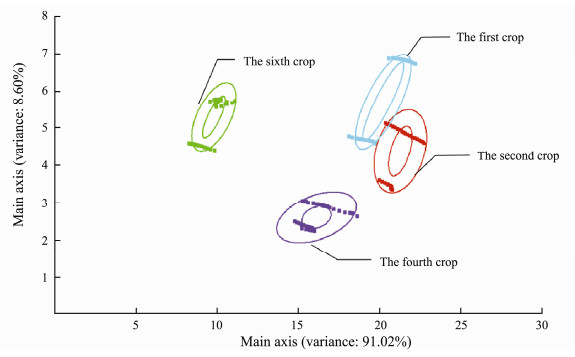
3.3 The Overall Odor Differences Among Different Laver CropsElectronic nose is mainly composed of an odor sampler, a gas sensor array and a signal processing system (Peris and Escuder-Gilabert, 2009). The PEN-3 electronic nose used in this study is equipped with 10 sensors, corresponding to different types of volatile compounds, such as aromatic ingredients, nitrogen oxygen compounds, alkanes, sulfide, etc. Principal component analysis (PCA) is used to process the raw data collected by the electronic nose. Longitudinal and transverse axis were denoted as y and x axis, respectively (Fig.2). The percentages of data variability explained by PC1 and PC2 were 91.02% and 8.60% respectively, which means that PC1 and PC2 cover the sample information. For the four laver samples, there is a clear distinction between the electronic nose signal regions. The first crop and the second crop having similar odors tended to closely distribute the distance on the two-dimensional graph, while the signal regions corresponding to the fourth crop and the sixth crop are distant. At present, electronic nose technology has been widely used in aquatic species identification (Zhang et al., 2012), freshness assessment (Han et al., 2013) and quality evaluation (Wilson et al., 2013). The experimental data of this study show that the electronic nose can distinguish different laver crops.
|
Fig. 2 Results of principal component analysis of different Porphyra yezoensis crops by E-nose. |
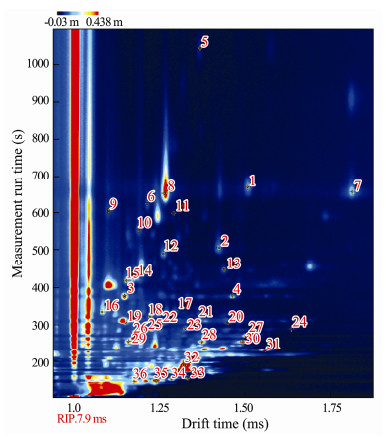
Volatile substances play an important role in the overall flavor of food, and affect consumers acceptance of the products greatly (Werkhoff et al., 1998). Previous studies have confirmed that there is a significant correlation between nori (dried laver) quality and volatile compounds, using a gas chromatography-mass spectrometer (GC-MS) (Miyasaki et al., 2014). GC-MS has been widely used and demonstrated as a powerful analytical method for the determination of volatile compounds in complex samples. However, GC-MS has some disadvantages, such as high requirements for the pretreatment of samples, long detection time, expensive equipment and high maintenance cost. Gas chromatography-ion migration spectrometer (GC-IMS) provides a convenient alternative for the detection of volatile compounds, due to its excellent selectivity and sensitivity, high speed of analysis, small size, and low power consumption as demonstrated by a series of publications (Snyder et al., 1993; Kanu and Hill, 2008; Gerhardt et al., 2018). Furthermore, because IMS separates ions based on mobilities rather than mass, selective detection among compounds of the same mass but different structures are possible (Gerhardt et al., 2018). In this study, GC-IMS was used to analyze the volatile compounds of lavers. GC-IMS separated and identified 36 volatile components (Fig.3.) from laver, mainly including aldehydes, ketones, alcohols, esters, acids and aromatic substances.
|
Fig. 3 Gas chromatography-ion migration spectrum graph of P. yezoensis. Each point represents a volatile compound, the color depth and area indicate concentration. |
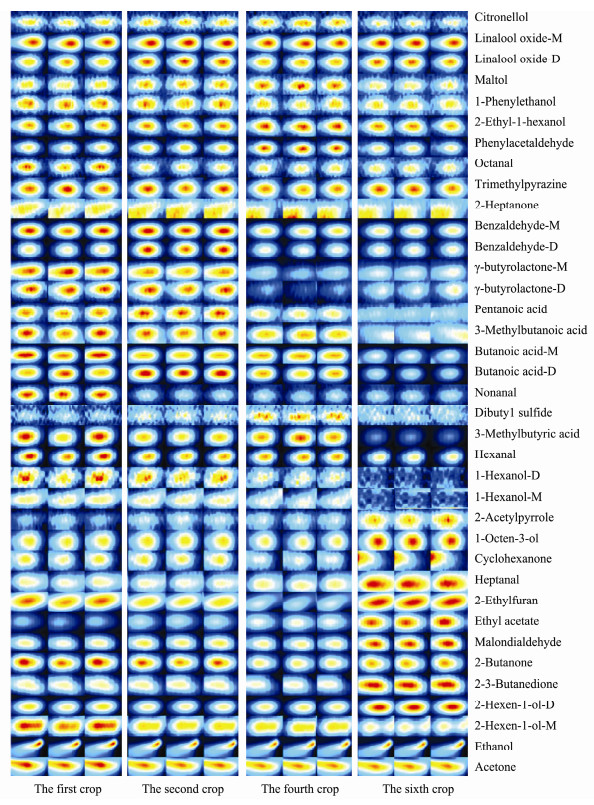
The differences in volatile substances of different laver crops are shown in Fig.4. The concentrations of some compounds (mainly alcohols) were relatively stable in all four samples, such as citronellol, linalool oxide, 2-ethyl-1-hexanol, 1-phenylethanol, trimethylpyrazine, ethanol and acetone. However, due to the higher threshold value (Anupam et al., 2010), these substances contributed little to odor. As the harvest period increases, the concentration of most volatile acid substances in the laver declines, such as pentanoic acid, butanoic acid and 3-methylbutyric acid. The concentration of butyrolactone and hexanol also showed a significant decrease. The concentrations of non-anal (grassy smell), octanal (grease smell), hexanal (fishy smell) and benzaldehyde (almond smell) in the first and second crops are higher, and the threshold value (Fratini et al., 2012) of these aldehydes is at a very low level. Therefore, these aldehydes are important for the odor of laver. These findings are consistent with those of Miyasaki et al. (2014), who pointed out that excellent-grade laver products were characterized by higher content of octanal. The concentration of some ketones in the late harvested laver samples tends to increase, such as cyclohexanone and 2-3-butanedione. In the sixth crop, 1-Octen-3-ol (mushroom smell), malondialdehyde (cocoa smell), heptanal (sweet smell) compounds which have significant contribution to odor (Na and Hong, 2012) also have a relative high content. The concentration of other compounds fluctuated with the harvest period, such as maltol, 2-butanone, 2-ethylfuran and phenylacetaldehyde. Phenylacetaldehyde has a grassy and flower smell (Frank et al., 2009), which contributes a lot to the pleasant odor of laver.
|
Fig. 4 The major volatile compounds of different P. yezoensis crops. The color depth represents concentration of the volatile compound; M means monomer; D means dimer. |
In this study, the flavor characteristics of different laver crops during a harvest cycle were determined by electronic tongue, electronic nose and gas chromatography-ion mobility spectrometer. According to the experimental data, early laver crops have a stronger intense umami taste, a more pleasant odor and higher free amino acids and flavored nucleotides content, making them more suitable for producing seasonings and recreational seaweed products. The results of this study can provide references for the high-valued and efficient utilization of lavers.
AcknowledgementsThis work was supported by the National Key R & D Program of China (No. 2018YFD0901004), the Special Fun-ds for the Technology System of Modern Agricultural Industry (No. CARS-50), and the Central Public-interest Scientific Institution Basal Research Fund, YSFRI, CAFS (No. 20603022020013).
Alasalvar, C., Pelvan, E., Bahar, B., Korel, F. and Ölmez, H., 2015. Flavour of natural and roasted turkish hazelnut varieties (Corylus avellana L.) by descriptive sensory analysis, electronic nose and chemometrics. International Journal of Food Science & Technology, 47(1): 122-131. (  0) 0) |
Anupam, G., Kazufumi, O. and Toshiaki, O., 2010. Identification and characterization of headspace volatiles of fish miso, a Japanese fish meat based fermented paste, with special emphasis on effect of fish species and meat washing. Food Chemistry, 120(2): 621-631. DOI:10.1016/j.foodchem.2009.10.036 ( 0) |
Cao, R., Zhao, L., Sun, H. and Liu, Q., 2018. Nutritional characteristics and umami assessment of Euphausia superba and Exopalaemon carinicauda. Food Science, 7(5): 149-153. ( 0) |
Chen, D. W. and Zhang, M., 2007. Non-volatile taste active compounds in the meat of Chinese mitten crab (Eriocheir sinensis). Food Chemistry, 104(3): 1200-1205. DOI:10.1016/j.foodchem.2007.01.042 ( 0) |
Cheong, K. W., Tan, C. P., Mirhosseini, H., Hamid, N. S. A., Osman, A. and Basri, M., 2010. Equilibrium headspace analysis of volatile flavor compounds extracted from soursop (annona muricata) using solid-phase microextraction. Food Research International, 43(5): 1270-1276. ( 0) |
Cheong, K. W., Tan, C. P., Mirhosseini, H., Chin, S. T., Man, Y. B. C. and Hamid, N. S. A., 2011. Optimization of equilibrium headspace analysis of volatile flavor compounds of malaysian soursop (Annona muricata): Comprehensive two-dimensional gas chromatography time-of-flight mass spectrometry (GC×GC-TOFMS). Food Chemistry, 125(4): 1481-1489. DOI:10.1016/j.foodchem.2010.10.067 ( 0) |
Cheung, I. W. Y. and Li-Chan, E. C. Y., 2014. Application of taste sensing system for characterization of enzymatic hydrolysates from shrimp processing by-products. Food Chemistry, 145(7): 1076-1085. ( 0) |
Cho, W. I. and Sang, M. K., 2014. Taste compounds and biofunctional activities of the sandy beach clam hydrolysate for the shellfish flavoring condiment. Journal of Aquatic Food Product Technology, 25(1): 24-34. ( 0) |
Ciosek, P. and Wróblewski, W., 2007. Sensor arrays for liquid sensing-electronic tongue systems. Analyst, 132(10): 963. DOI:10.1039/b705107g ( 0) |
Criado-García, L., Arce, L. and Valcárcel, M., 2016. Solid phase extraction to enhance sensitivity when headspace-gas chromatography-ion mobility spectrometer is used: Determination of phenol in environmental samples. Analytical Methods, 8(27): 5388-5397. DOI:10.1039/C6AY01492E ( 0) |
Escuder-Gilabert, L. and Peris, M., 2010. Review: Highlights in recent applications of electronic tongues in food analysis. Analytica Chimica Acta, 665(1): 15-25. DOI:10.1016/j.aca.2010.03.017 ( 0) |
Fuke, S. and Ueda, Y., 1996. Interactions between umami and other flavor characteristics. Trends in Food Science & Technology, 7(12): 407-411. ( 0) |
François, L., Pascal, T., Nathalie, K., Frédéric, N., Pierre, M., Ossarat, K., Jean, L. B. and Guillaume, D., 2012. Evolution of volatile odorous compounds during the storage of European seabass (Dicentrarchus labrax). Food Chemistry, 131(4): 1304-1311. DOI:10.1016/j.foodchem.2011.09.123 ( 0) |
Frank, D., Poole, S. and Kirchhoff, S., 2009. Investigation of sensory and volatile characteristics of farmed and wild barramundi (Lates calcarifer) using gas chromatography-olfactometry mass spectrometry and descriptive sensory analysis. Journal of Agricultural and Food Chemistry, 57(21): 10302-10312. DOI:10.1021/jf902030y ( 0) |
Fratini, G., Lois, S. and Pazos, M., 2012. Volatile profile of Atlantic shellfish species by HS-SPME GC/MS. Food Research International, 48(2): 856-865. DOI:10.1016/j.foodres.2012.06.033 ( 0) |
Fujimaki, M., Arai, S., Yamashita, M., Kato, H. and Noguchi, M., 2014. Taste peptide fractionation from a fish protein hydrolysate. Journal of the Agricultural Chemical Society of Japan, 37(12): 8. ( 0) |
Gerhardt, N., Birkenmeier, M., Schwolow, S., Rohn, S. and Weller, P., 2018. Volatile-compound fingerprinting by headspace-gas-chromatography ion-mobility spectrometry (HSGC-IMS) as a benchtop alternative to 1H NMR profiling for assessment of the authenticity of honey. Analytical Chemistry, 90(3): 1777-1785. DOI:10.1021/acs.analchem.7b03748 ( 0) |
Gong, J., Tao, N. P. and Gu, S. Q., 2014. Overview of umami substance in food and its detection methods. China Condiment, 39(1): 129-135. ( 0) |
Han, F., Huang, X. and Teye, E., 2013. Nondestructive detection of fish freshness during its preservation by combining electronic nose and electronic tongue techniques in conjunction with chemometric analysis. Analytical Methods, 6(2): 529-536. ( 0) |
Hayashi, T., Yamaguchi, K. and Konosu, S., 2010. Sensory analysis of taste-active components in the extract of boiled snow crab meat. Journal of Food Science, 46(2): 479-483. ( 0) |
Jiménez-Escrig, A., Gómez-Ordóñez, E. and Rupérez, P., 2011. Seaweed as a source of novel nutraceuticals: Sulfated polysaccharides and peptides. Advances in Food and Nutrition Research, 64: 325-337. ( 0) |
Kanu, A. B. and Hill, H. H., 2008. Ion mobility spectrometry detection for gas chromatography. Journal of Chromatography A, 1177(1): 12-27. DOI:10.1016/j.chroma.2007.10.110 ( 0) |
Kobayashi, Y., Habara, M., Ikezazki, H., Chen, R., Naito, Y. and Toko, K., 2010. Advanced taste sensors based on artificial lipids with global selectivity to basic taste qualities and high correlation to sensory scores. Sensor, 10(4): 3411-3443. DOI:10.3390/s100403411 ( 0) |
Li, C. P., Wu, J. J. and Li, Y., 2013. Identification of the aroma compounds in stinky mandarin fish (Siniperca chuatsi) and comparison of volatiles during fermentation and storage. International Journal of Food Science & Technology, 48(11): 2429-2437. ( 0) |
Maehashi, K., Matsuzaki, M. and Yamamoto, Y., 1999. Isolation of peptides from an enzymatic hydrolysate of food proteins and characterization of their taste properties. Journal of the Agricultural Chemical Society of Japan, 63(3): 555-559. ( 0) |
Miyasaki, T., Ozawa, H., Banya, H., Tanaka, H., Usui, M. and Hanaoka, K., 2014. Discrimination of excellent-grade 'nori', the dried Laverporphyra spp. with analytical methods for volatile compounds. Fisheries Science, 80(4): 827-838. DOI:10.1007/s12562-014-0749-3 ( 0) |
Mouritsen, O. G., Duelund, L., Petersen, M. A., Hartmann, A. L. and Frøst, M. B., 2019. Umami taste, free amino acid composition, and volatile compounds of brown seaweeds. Journal of Applied Phycology, 31: 1213-1232. DOI:10.1007/s10811-018-1632-x ( 0) |
Na, S. and Hong, S., 2012. Identification of odour-active compounds in dried and roasted nori (Porphyra yezoensis) using a simplified gas chromatography–SNIF technique. Flavour and Fragrance Journal, 27(2): 157-164. DOI:10.1002/ffj.2096 ( 0) |
Nakamura, E., 2011. One hundred years since the discovery of the 'umami' taste from seaweed broth by Kikunae Ikeda, who transcended his time. Chemistry – An Asian Journal, 6(7): 1659-1663. DOI:10.1002/asia.201000899 ( 0) |
Nakata, T., Takahasi, M., Nakatani, M., Kuramitsu, R., Tamura, M. and Okai, H., 1995. Role of basic and acidic fragments in delicious peptides (Lys-Gly-Asp-Glu-Glu-Ser-Leu-Ala) and the taste behavior of sodium and potassium salts in acidic oligopeptides. Bioscience Biotechnology and Biochemistry, 59(4): 689-693. DOI:10.1271/bbb.59.689 ( 0) |
Peris, M. and Escuder-Gilabert, L., 2009. A 21st century technique for food control: Electronic noses. Analytica Chimica Acta, 638(1): 1-15. DOI:10.1016/j.aca.2009.02.009 ( 0) |
Shigemoto, K., 2003. Weber-Fechner's law and demand function. Microeconomics, 9: 41-46. ( 0) |
Snyder, A. P., Harden, C. S., Brittain, A. H., Man, G. K., Arnold, N. S. and Meuzelaar, H. L. C., 1993. Portable hand-held gas chromatography/ion mobility spectrometry device. Journal of Analytical Chemistry, 65(3): 299-306. DOI:10.1021/ac00051a019 ( 0) |
Varlet, V., Knockaert, C., Prost, C. and Serot, T., 2006. Comparison of odor-active volatile compounds of fresh and smoked salmon. Journal of Agricultural and Food Chemistry, 54(9): 3391-3401. DOI:10.1021/jf053001p ( 0) |
Vlasov, Y., Legin, A. and Rudnitskaya, A., 2002. Electronic tongues and their analytical application. Analytical and Bioanalytical Chemistry, 373(3): 136-146. DOI:10.1007/s00216-002-1310-2 ( 0) |
Werkhoff, P., Güntert, M., Krammer, G., Sommer, H. and Kaulen, J., 1998. Vacuum headspace method in aroma research: Flavor chemistry of yellow passion fruits. Journal of Agricultural and Food Chemistry, 46(3): 1076-1093. DOI:10.1021/jf970655s ( 0) |
Wilson, A. D., Oberle, C. S. and Oberle, D. F., 2013. Detection of off-flavor in catfish using a conducting polymer electronic-nose technology. Sensors, 13(12): 15968-15984. DOI:10.3390/s131215968 ( 0) |
Woertz, K., Tissen, C., Kleinebudde, P. and Breitkreutz, J., 2011. Taste sensing systems (electronic tongues) for pharmaceutical applications. International Journal of Pharmaceutics, 417: 256-271. DOI:10.1016/j.ijpharm.2010.11.028 ( 0) |
Zhang, M., Wang, X. and Liu, Y., 2012. Species discrimination among three kinds of puffer fish using an electronic nose combined with olfactory sensory evaluation. Sensors, 12(9): 12562-12571. DOI:10.3390/s120912562 ( 0) |
Zhao, L., Cao, R., Wang, L. Z. and Liu, Q., 2018. Nutritional analysis and umami assessment of Pyropia yezoensis from Jing Bay. Progress in Fishery Science, 39(6): 134-140. ( 0) |
Zhou, F. and Wang, X., 2019. Effect of heat extraction on water-soluble taste substances in processing products of chilled large yellow croaker (Pseudosciaena crocea). Food Science & Nutrition, 7(12): 3863-3872. ( 0) |