 2024, Vol. 23


The oysters Crassostrea gigas are widely distributed in estuaries of China, which can adapt rapid and dramatic temperature fluctuations from − 3℃ to 30℃. The species is well suited for aquaculture because of its rapid growth, low production cost, high nutritional properties and good adaptation to artificial culture conditions. C. gigas is mainly produced in estuary system, which is among the most productive and valuable ecosystems in the world and are characterized by constant fluctuations in the mixture of freshwater and seawater (Zacchi et al., 2017). Estuary system is fragile and vulnerable to heavy metal pollution due to the leak from industrial and municipal wastewater discharges.
Cadmium is a non-essential element and may be highly toxic to humans, animals, and plants, even at low doses (Benavides et al., 2005). The toxicity of Cd has been studied in marine bivalve shellfish. Wang et al. (2021) reported Cd might induce apoptosis in M. meretrix via the mitochondrial caspase-dependent pathway. Waterborne Cd2+ may hamper the immune responses of Tegillarca granosa through influencing Ca2+ signaling and Ca2+- related apoptosis pathways (Shi et al., 2018). In C. gigas, the acute embryotoxicity and chronic toxicity such as histopathological changes of Cd have been investigated (Xie et al., 2017).
In estuary environments, temperature is one of the most controlling factors governing metal bioaccumulation and toxicity potential. The temperature fluctuates with the daily tidal cycle and the seasonal variation. For instance, there may be an acute rise due to the summer low tides. Bioaccumulation and toxicity are often reported to increase with temperature, which has influences on both the solution chemistry of metals, and physiological attributes of organisms (Cairns et al., 1975; Cossins and Bowler, 1987; Schmidt-Nielsen, 1993). In our previous study, the cadmium concentration at 10℃ was significantly lower than that at 25℃ and 30℃ in the digestive gland, gill, and mantle (Sun et al., 2022).
Several studies have reported the responses of detoxification genes after Cd exposure. P-glycoprotein plays an important role in the biological system for detoxifying Cd. Its molecular weight is more than 200 kDa in oysters (Ivanina et al., 2008). It can eliminate multiple toxicants from the cell through ATP-dependent processes and pump the heavy metal toxicants directly out of the body. Heat shock protein (hsp) expression is also used as an indicator of cellular stress in animals and intracellular signaling is used for the induction of hsp70 (Sherman and Goldberg, 2001). Heat shock proteins are involved in maintaining protein integrity in the presence of environmental stressors such as chemicals (Mukhopadhyay et al., 2003) and correcting protein folding in the cell. They exist in a variety of organisms from bacteria to humans. In organisms, hsp70 is a suitable biomarker of exposure. Previous studies have reported hsp70 expression in mollusks exposed to heavy metals (Boutet et al., 2003; Taylor et al., 2013; Ivanina et al., 2015). These studies have only identified P-gp and hsp70 expression after Cd exposure in oysters C. gigas. However, the effect of temperature on these molecular responses under a chemical exposure has not yet been reported. Accordingly, the expression levels of detoxification genes (P-gp and hsp70) in tissues of C. gigas under different water temperature (10, 15, 20, 25, and 30℃) were studied in the present study. Five temperatures were considered to mimic a natural estuarine environment influenced by tidal actions and seasonal changes, and were selected considering C. gigas natural habitat temperatures for warmer months (between 14 and 29℃) (Carrasco and Barón, 2009).
2 Materials and Methods 2.1 Ethics StatementThe experiments were conducted under the guidelines and approval of the respective Animal Research and Ethics Committees of China.
2.2 Oyster Rearing ConditionsPacific oysters (average 31.26 ± 3.01 mm in shell height, 90.33 ± 7.68 mm in shell length, 40.72 ± 3.84 mm in shell width, 90.78 ± 10.49 g in body weight) were then obtained from Rizhao, Shandong province, China (November 2017). Prior to the experiment, the oysters were acclimated to the laboratory conditions for 24 d in fully aerated water tanks (70 oysters per 150 L tank). The size of the tank is (800 mm × 500 mm × 375 mm). They were divided in five groups according to the exposure temperatures 10, 15, 20, 25, and 30℃. The oysters acclimation was achieved gradually starting from 8℃ over a 10-day period, respectively in 3 tanks. Then the oysters were kept at the final temperature for 14 d. The temperature grade was achieved by increasing 2℃ every 1 day. Oysters were fed with algae containing 2.5*106 cells mL−1 Nitzschia closterium f. minutissima once a day and the water was totally changed every day.
2.3 Cadmium Exposure and Sample CollectionCadmium CdCl2 (cadmium chloride anhydrous, CAS: 7790-78-5) were used for conducting the heavy metal exposure experiment. After 2 weeks of acclimation, the contaminant cadmium (Cd) was introduced at 10 µg L−1.
The experiments were conducted in triplicate using 200 L PVC tanks containing 150 L of exposure sea water and 70 individuals per test unit. The accumulation phase lasted for 21 days. In the Cd exposure and temperature experiments, the animals were randomly assigned to experimental groups. The salinity of the water was 32, the pH was approximately 7.9, and the oxygen concentration was > 7 mg L−1 due to the aerator pump. The temperature of the exposure media was kept at 10, 15, 20, 25, and 30℃. Total water was updated daily under the same conditions to keep the Cd concentration constant during the exposure phase. Control conditions corresponded to 3 non-contaminated tanks, and the conditions of the oysters were the same as those of the exposed groups. The oysters were fed once a day with N. closterium f. minutissima.
Tissues, including mantle, digestive gland, and gill were carefully collected from three healthy oysters as parallel samples. Animal samples were taken 0.083, 7, 14, and 21 d after the start of contamination. For each harvested animal, 0.1 g was sampled from each tissue, subsequently frozen in the liquid nitrogen and then stored at − 80℃. Dead animals were removed daily from the tanks. Mortality was checked daily, and was below 10% at the end of the experiment.
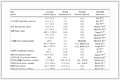
2.4 mRNA QuantificationQuantitative real-time PCR was performed using a MiQ Cycler (BioRad, America), and the primer sequences used (Table 1) were designed based on cDNA sequences available from GenBank using the Primer 5 software. All primer pairs were tested to ensure the amplification of single discrete bands with the absence of primer dimers. PCR efficiency (E) was determined for each primer pair by generating standard curves based on serial dilutions to ensure that E ranged from 95% to 120% (R2 > 99%). Total RNA extraction was performed using the TRIZOL® Reagent (Life Technologies) according to the manufacturer's instructions. RNA quantification was conducted using the Nanodrop® ND-1000 spectrophotometer (NanoDrop Technologies, Inc., Wilmington, USA). Gene expression levels were analyzed using quantitative real-time PCR analysis. Expression of the actin gene was used as a reference. All data were analyzed using the 2−ΔΔCt method (Livak and Schmittgen, 2001), and the values were transformed using the following equation: gene relative expression level = log (2−ΔΔCt, 2) (Tian et al., 2019). The gene relative expression level represented the n-fold difference relative to the control (untreated samples). The data have been presented as the relative expression levels (mean ± standard deviation, n = 3), and all experimental data were subjected to Duncan's test between the treated and control groups. The sequences of the primers were presented in Table 1.
|
Table 1 Primer sequences for qRT-PCR |
Through three-way analysis of variance, with time (experimental days) and tissue as independent variables, the variability of gene content in different tissues with the duration of the experiment was tested. Duncan's test was used to determine significant differences between variables. All statistical analyses use a significance level of 0.05 (that is, the probability of P ≤ 0.05 is considered to be significant). All analyses were run in the software packages SPSS 16.0 for Windows.
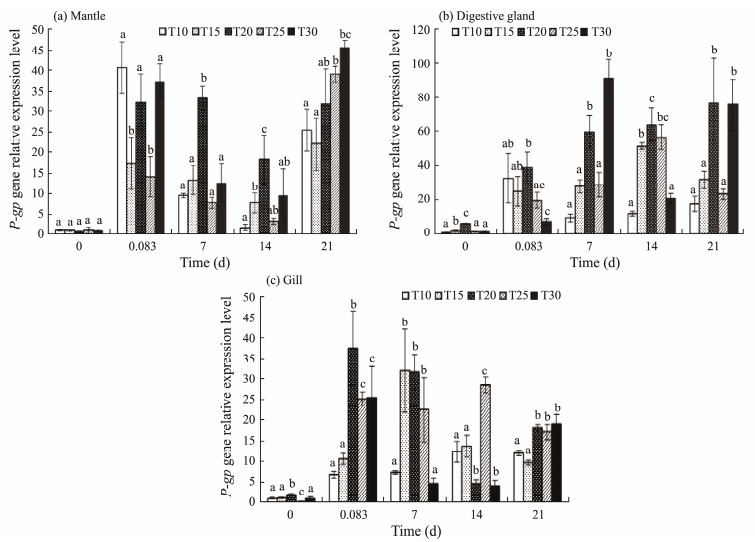
3 Results 3.1 P-gp Expression Files in Oyster After Cd Exposure at Different TemperaturesAs shown in Fig.1, the P-gp gene expression changed significantly after treatment at different temperatures and different treatment times. Compared with the control group, the P-gp gene expression in cadmium treatment groups at all the different temperatures were significantly higher than the control group at 0.083, 7, 14, and 21 d.
|
Fig. 1 P-gp expression in C. gigas under conditions of different temperatures and exposure to Cd. The expression levels of P-gp in tissues ((a), mantle; (b), digestive gland; (c), gill) were determined by performing quantitative real time PCR. Actin gene expression was used as an internal control. The samples acclimated at 10℃ (T10) without Cd exposure have been considered as the reference samples. The samples at 0 d were not subjected to Cd exposure. Vertical bars represent mean ± S.E. (n = 3). |
In mantle (Fig.1a), the P-gp gene expression at the temperature of 10, 15, 25 and 30℃ increased first at day 0.083, then decreased at day 7, continually deceased at day 14 and then increased at day 21, with the lowest P-gp gene expression at 14 d. However, at day 7, the P-gp gene expression at the temperature of 20℃ significantly increased, and the changes in the other temperatures were not significantly compared with the control group (p < 0.05).
In digestive gland (Fig.1b), the P-gp gene expression at the temperature of 15℃ and 25℃ showed a trend of increasing first and then decreasing, with the highest P-gp expression at day 14; the P-gp gene expression at the temperature of 20℃ showed an increasing trend, with the highest P-gp gene expression at day 21; the P-gp gene expression at the temperature of 10℃ showed an overall decreasing trend, with the highest P-gp gene expression at day 0.083. The P-gp gene expression at the temperature of 30℃ increased first, then decreased, and then increased, with the highest P-gp gene expression at day 7.
In gills (Fig.1c), the P-gp gene expression at the temperature of 10℃ showed an overall increasing trend; the P-gp gene expression at the temperature of 15℃ increased first, and then decreased, with the highest P-gp gene expression at day 7; the P-gp gene expression at the temperature of 20℃ and 30℃ increased first, then decreased, and then increased, with the highest P-gp gene expression at day 0.083; the P-gp gene expression at the temperature of 25℃ showed a fluctuation trend, with the highest P-gp gene expression at day 14. In general, the relative high induction of P-gp gene expression occurred at the temperature of 20℃ and 30℃.
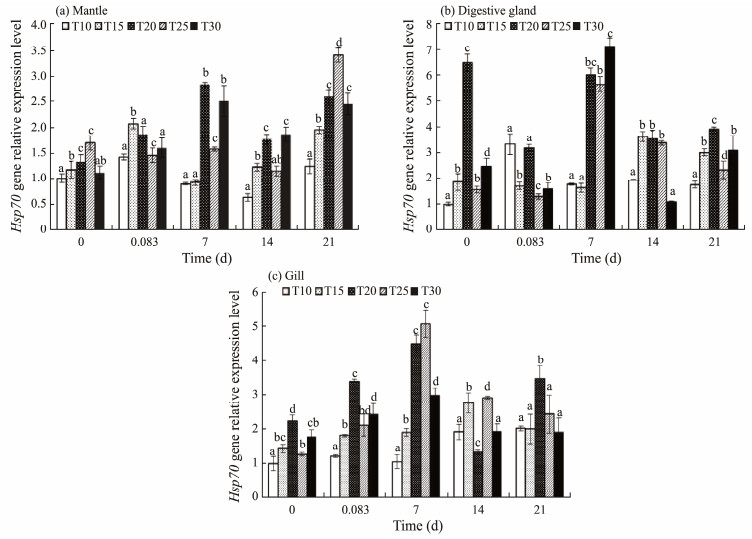
3.2 Hsp70 Gene Expression Files in Oyster After Cd Exposure at Different TemperaturesIn mantle (Fig.2a), the hsp70 gene expression at the temperature of 10℃ increased in 0 – 0.083 days and 14 – 21 d and decreased in 0.083 – 14 days; the hsp70 gene expression at the temperature of 15℃ increased in 0 – 0.083 days and 7 – 21days and decreased in 0.083-7 days; the hsp70 gene expression at the temperature of 20℃ and 30℃ increased in 0 – 7 days and 14 – 21 days and decreased in 7 – 14 days; the hsp70 gene expression at the temperature of 20℃ showed an increasing trend with the time went on. At the temperature of 25℃, the hsp70 gene expression at day 21 was significantly higher than the other four sampling points. Comprehensive results showed that the hsp70 gene expression at different temperatures in mantle increased significantly 7 – 21 days after treatment compared with the control group.
|
Fig. 2 Hsp70 expression in C. gigas under conditions of different temperatures and exposure to Cd. The expression levels of P-gp in tissues ((a), mantle; (b), digestive gland; (c), gill) were determined by performing quantitative real time PCR. Actin gene expression was used as an internal control. The samples acclimated at 10℃ (T10) without Cd exposure have been considered as the reference samples. The samples at 0 d were not subjected to Cd exposure. Vertical bars represent mean ± S.E. (n = 3). |
In the digestive gland (Fig.2b), the hsp70 gene expression at the temperature of 10℃ first increased, then decreased, and did not change in 7 – 21 d; the hsp70 gene expression at the temperature of 15℃ sharply increased at day 14, then slightly decreased at day 21; the hsp70 gene expression at the temperature of 20℃ and 25℃ increased first, then decreased, with the highest hsp70 gene expression at day 7; the hsp70 gene expression at the temperature of 30℃ decreased in 0 – 0.083 days and 7 – 14 days, and increased in 0.083 – 7 days and 14 – 21 days, with the highest hsp70 gene expression at day 7.
In gills (Fig.2c), compared with the control group, the hsp70 gene expression at the temperature of 10℃ did not change at day 0.083 and 7, but increased significantly at days 14 and 21; the hsp70 gene expression at the temperature of 15℃ increased in 0 – 14 days, and then decreased; the hsp70 gene expression at the temperature of 20℃ increased in 0 – 7 days and 14 – 21 days, and decreased in 7 – 14 days; the hsp70 gene expression at the temperature of 25℃ and 30℃ increased in 0 – 7 days, and then decreased. The highest hsp70 gene expression occurred at day 7 at the temperature of 20, 25 and 30℃.
4 DiscussionWe investigated the combined effects of temperature and cadmium on the expression of P-gp and hsp70 expression in C. gigas. The qualitative RT-PCR analysis showed an increased expression of P-gp and hsp70 in C. gigas at different temperatures exposed to cadmium.
The hsp70 family protein is different from other types of heat shock proteins. It is one of the most highly conserved proteins. It has more than 50% homology between humans, fruit flies, mice, yeast, and bacteria. It can be first induced under stress conditions. It is one of the most widely studied and well defined classes of HSPs (Lindquist, 1986; Gupta et al., 2010). Nowadays, hsp70 has been widely used as environmentally responsive genes. Generally, heat shock protein expression is induced when organisms are exposed to acute stressors. In the present study, the control oysters (kept at 10℃ during the whole experiment without cadmium) expressed low levels of hsp70, but the groups treated with cadmium displayed somewhat higher levels. The results are consistent with other study showing the low levels of hsp70 expression at low temperature. Further, the hsp70 were induced greater at the temperature range from 20 − 30℃ than that at 10℃ exposed to cadmium.
Induction of hsp70 was also found in other mollusks. For instance, when mussels Mytilus edulis exposed to metal stress, followed by heat shock, it showed greater hsp70 induction (Tedengren et al., 2000); Exposure for 18 − 0.020 mg L−1 of cadmium also caused an increase in hsp70 expression in M. edulis (Tedengren et al., 2000). Oysters Ostrea edulis exposed to a range of 0.1 − 0.5 mg L−1 for 7 days of cadmium showed a dose-dependent enhancement of the hsp70 expression (Piano et al., 2004). Taylor et al. (2013) reported that hsp70 expression in bivalve mollusks was up-regulated by exposure of mollusks to low concentrations of metals. In the present study, a slightly induction occurred at 0.083 day, and the significant induction of hsp70 was found after 7 days of exposure to cadmium. Our data is agreement with the study of Piano et al. (2004) with the O. edulis. The hsp70 levels in gills and digestive gland of O. edulis after 7 days of exposure to cadmium. Radlowska and Pempkowiak (2002) found elevated hsp70 concentrations occurred after 2 days following exposure of M. edulis to cadmium. The high expression of hsp70 in tissues of mollusks showed its important role in response to cadmium exposure. However, in some cases, the hsp70 was down-regulated in contaminated field sites compared to controls, such as Cd, Pb and Zn, which was due to the highly contaminated environment (Thompson et al., 2011).
P-gp acted as an important mechanism for protection from natural toxins. As a molecular pump, it is responsible for extruding xenobiotics. The expression of P-gp in Crassostrea virginica Gmelin significantly increase after Cd exposure (Ivanina and Sokolova, 2008). P-gp showed a protective role against Cd in Mytilus galloprovincialis and in Mediterranean mussel exposed to Hg and CH3Hg (Franzellitti and Fabbri, 2006; Della Torre et al., 2013). In our previous study, expression levels of P-gp in the mantle of oysters exposed to Cd at different salinities were all increased (Sun et al., 2018). The protective role of P-gp against CdCl2 has been already pointed out in M. galloprovincialis (Della Torre et al., 2013). In the present study, P-gp was induced in the digestive gland, mantle and gills, and the P-gp expression was the highest in the digestive gland. Different physiological roles of various tissues maybe the reasons of such differences. It is inferred that the digestive gland is the main detoxification metabolism organ. The induction of P-gp in gills and mantles can be explained that it is benefit to form an active physiological barrier between the interface of tissue and environment in order to prevent organism from the damage of xenobiotic (Luckenbach and Epel, 2008). In most cases in the present study, the P-gp expression level at 10℃ was low, while a significant increase was induced at 20 − 30℃, showed a similar trend with hsp70 expression. The results showed P-gp had an important role in the CdCl2 defense response in C. gigas. Our earlier studies also demonstrated salinity can affect the P-gp expression in C. gigas. For example, the P-gp expression in mantle were higher than other salinities at salinity of 13 from 7 to 35 d; while the P-gp expression in digestive gland at salinity of 34 was first increased at day 7, and then were all decreased during both the accumulation and depuration periods (Sun et al., 2018).
5 ConclusionsOur results showed that the combined effect of temperature and cadmium induced an increase of P-gp and hsp70 in tissues of oysters, and these data showed P-gp and hsp70 played an important role in the Cd detoxification. The impact of temperature on the toxicity of heavy metals should be fully considered to evaluate their environmental risks in the estuary system.
AcknowledgementThis project was supported by the earmarked fund for the Modern Agroindustry Technology Research System in Shandong Province (No. SDAIT-14).
Benavides, M. P., Gallego, S. M., and Tomaro, M. L., 2005. Cadmium toxicity in plants. Brazilian Journal of Plant Physiology, 17: 21-34. DOI:10.1007/978-94-007-5179-8_13 (  0) 0) |
Boutet, I., Tanguy, A., Rousseau, S., Auffret, M., and Moraga, D., 2003. Molecular identification and expression of heat shock cognate 70 (hsc70) and heat shock protein 70 (hsp70) genes in the Pacific oyster Crassostrea gigas. Cell Stress & Chaperon, 8(1): 76-85. DOI:10.2307/1601854 ( 0) |
Cairns, J. J., Heath, A. G., and Parker, B. C., 1975. The effects of temperature upon the toxicity of chemicals to aquatic organisms. Hydrobiologia, 47: 135-171. DOI:10.1007/BF00036747 ( 0) |
Cossins A. R., Bowler K.. 1987. Temperature Biology of Animals. Chapman & Hall, London, 1-23.
( 0) |
2009. Analysis of the potential geographic range of the Pacific oyster Crassostrea gigas (Thunberg, 1793) based on surface seawater temperature satellite data and climate charts: The coast of South America as a study case. Biological Invasions, 12: 2597-2607. DOI:10.1007/s10530-009-9668-0 ( 0) |
2013. Differential expression and efflux activity of ABCB and ABCC transport proteins in gills and hemocytes of Mytilus galloprovincialis and their involvement in cadmium response. Marine Environmental Research, 93: 56-63. ( 0) |
1989. Uptake and elimination of waterborne cadmium by the fish Noemacheilus barbatulus L. (Stone Loach). Archives of Environmental Contamination and Toxicology, 18: 576-586. DOI:10.1007/BF01055025 ( 0) |
2006. Cytoprotective responses in the Mediterranean mussel exposed to Hg2+ and CH3Hg+. Biochemical and Biophysical Research Communications, 351: 719-725. DOI:10.1016/j.bbrc.2006.10.089 ( 0) |
2010. Heat shock proteins in toxicology: How close and how far?. Life Sciences, 86: 377-384. DOI:10.1016/j.lfs.2009.12.015 ( 0) |
2008. Effects of cadmium exposure on expression and activity of P-glycoprotein in eastern oysters, Crassostrea virginica Gmelin. Aquatic Toxicology, 88: 19-28. DOI:10.1016/j.aquatox.2008.02.014 ( 0) |
2015. Effects of environmental hypercapnia and metal (Cd and Cu) exposure on acid-base and metal homeostasis of marine bivalves. Comparative Biochemistry and Physiology Part C: Toxicology & Pharmacology, 174-175(1): 1-12. DOI:10.1016/j.cbpc.2015.05.001 ( 0) |
1986. The heat shock response. Annual Review of Biochemistry, 55: 1151-1191. DOI:10.1146/annurev.bi.55.070186.005443 ( 0) |
2001. Analysis of relative gene expression data using real-time quantitative PCR and the 2 (-Delta Delta C (T)) method. Methods, 25: 402-408. DOI:10.1006/meth.2001.1262 ( 0) |
2008. ABCB- and ABCC-type transporters confer multixenobiotic resistance and form an environment-tissue barrier in bivalve gills. American Journal of Physiology Regulatory Integrative and Comparative Physiology, 294(6): R1919-R1929. DOI:10.1152/ajpregu.00563.2007 ( 0) |
2003. Heat shock response: Hsp70 in environmental monitoring. Journal of Biochemical and Molecular Toxicology, 17(5): 249-254. DOI:10.1002/jbt.10086 ( 0) |
2004. Expression of cytoprotective proteins, heat shock protein 70 and metallothioneins, in tissues of Ostrea edulis exposed to heat and heavy metals. Cell Stress Chaperones, 9: 134-142. DOI:10.1379/483.1 ( 0) |
2002. Stress-70 as indicator of heavy metals accumulation in blue mussel Mytilus edulis. Environment International, 27: 605-608. DOI:10.1016/S0160-4120(01)00117-9 ( 0) |
Schmidt-Nielsen K.. 1993. Animal Physiology: Adaptation and Environment. Cambridge University Press, Cambridge, 1-33.
( 0) |
2001. Cellular defenses against unfolded proteins: A cell biologist thinks about neurodegenerative diseases. Neuron, 29: 15-32. DOI:10.1016/S0896-6273(01)00177-5 ( 0) |
2018. Waterborne Cd2+ weakens the immune responses of blood clam through impacting Ca2+ signaling and Ca2+ related apoptosis pathways. Fish & Shellfish Immunology, 77: 208-213. DOI:10.1016/j.fsi.2018.03.055 ( 0) |
2022. Effect of temperature on the toxicokinetics and gene expression of the Pacific cupped oyster Crassostrea gigas exposed to cadmium. Comparative Biochemistry and Physiology Part C, 253: 109252. DOI:10.1016/j.cbpc.2021.109252 ( 0) |
2018. Effect of salinity on the bioaccumulation and depuration of cadmium in the Pacific cupped oyster, Crassostrea gigas. Environmantal Toxicology and Pharmacology, 62: 88-97. DOI:10.1016/j.etap.2018.05.018 ( 0) |
2013. Differential effects of metal contamination on the transcript expression of immune and stress-response genes in the Sydney rock oyster, Saccostrea glomerata. Environmental Pollution, 178: 65-71. DOI:10.1016/j.envpol.2013.02.027 ( 0) |
2000. Heat pretreatment increases cadmium resistance and hsp70 levels in Baltic Sea mussels. Aquatic Toxicology, 48: 1-12. DOI:10.1016/S0166-445X(99)00030-2 ( 0) |
2011. A proteomic analysis of the effects of metal contamination on Sydney rock oyster (Saccostrea glomerata) haemolymph. Aquatic Toxicology, 103: 241-249. DOI:10.1016/j.aquatox.2011.03.004 ( 0) |
2019. Analysis of apolipoprotein multigene family in spotted sea bass (Lateolabrax maculatus) and their expression profiles in response to Vibrio harveyi infection. Fish and Shellfish Immunology, 92: 111-118. DOI:10.1016/j.fsi.2019.06.005 ( 0) |
2021. Cadmium-induced oxidative stress in Meretrix meretrix gills leads to mitochondria-mediated apoptosis. Ecotoxicology, 30(10): 2011-2023. DOI:10.1007/s10646-021-02465-8 ( 0) |
2017. Combined toxicity of cadmium and lead on early life stages of the Pacific oyster, Crassostrea gigas. Invertebrate Survival Journal, 14: 210-220. ( 0) |
2017. Transcriptional changes in oysters Crassostrea brasiliana exposed to phenanthrene at different salinities. Aquatic Toxicology, 183: 94-103. DOI:10.1016/j.aquatox.2016.03.007 ( 0) |