 2019, Vol. 18


2) Key Laboratory of Submarine Geosciences and Prospecting Techniques, MOE, Qingdao 266100, China;
3) Key Laboratory of Marine Sedimentology and Environmental Geology, First Institute of Oceanography, MNR, Qingdao 266100, China;
4) Laboratory for Marine Geology, Qingdao National Laboratory for Marine Science and Technology, Qingdao 266100, China
The South China Sea is an important part of the Western Pacific Ocean, and is also the third largest marginal sea in the world. It is characterized by high material fluxes to the ocean around the world (Milliman and Meade, 1983). The sediments in the South China Sea included the terrestrial sediments from the Pearl River, the Hong River and rivers in Taiwan islands (Liu et al., 2008), mainland dust and volcanic mineral debris (Wang and Chen, 2011) and a large number of biogenic debris and marine authigenic minerals (Chen et al., 2003). These massive sediments provide a good record of the uplift of the Tibetan Plateau, the formation and evolving history of the East Asian monsoon, and the climate change associated with the Earth's orbital parameters and solar activity (Wan et al., 2007; Liu et al., 2016). Therefore, the South China Sea is an ideal place to study the sedimentary response to regional tectonic activity as well as the globalclimatic and environmental changes.
Sediment grain size parameters are important indicators to identify sedimentary environment, and they are controlled by the sediment sources, hydrodynamic conditions and biological activities (Peng and Chen, 2010). Changes in the climate and environment have a significant impact on the migration of geochemical elements in the sediments. The distribution characteristics of different elements and their association (ratio) reflect different environmental conditions and changes, so they are the good recorders of climate and geological events (Zhao et al., 2008).
Over the past 20 years, about 20 international cruises have been carried out in the South China Sea and more than 200 high-quality sediment cores have been obtained, including continuous sequences of deep-sea sediments over 33 Myr. Based on these materials, notable advances have been achieved in scientific research on deep sea processes, paleoceanography, and East Asian paleomonsoonal evolution (Clift et al., 2014; Wang et al., 2016; Zhao et al., 2017). However, these studies in the South China Sea mostly focus on the northern continental slope and the Sunda Shelf and little attention is given to the Yingqiong continental slope. Although there are a small number of studies on the Yingqiong continental slope, these studies are constrained to a short span of geological time, which limits our understanding on the paleoenvironment and paleoclimate of the whole South China Sea to some certain extent. In this paper, we use sediments in core YQ1 from the Yingqiong continental slope in the South China Sea as the research materials. The chronological framework of core YQ1 is established by dating data of AMS 14C, the oxygen isotope data of planktonic foraminifera. On base of the constructed chronological framework, we aim to illustrate the vertical changes of the grain size and major elemental composition features of core YQ1 sediments and propose their provenance and paleoenvironmental significance.
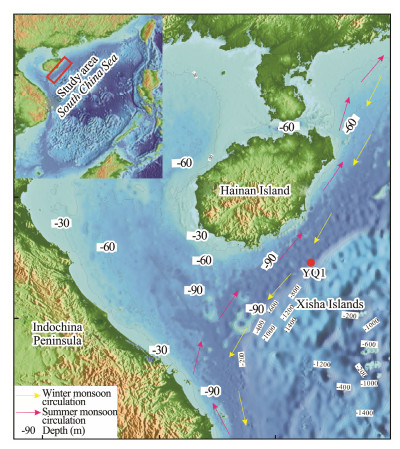
2 Study AreaThe study area is located in the Yingqiong continental slope area in the northwestern South China Sea, neighboring Hainan Island to the north, Indochina Peninsula to the southwest and Xisha Islands to the southeast (Fig.1). The upper part of the continental slope is narrow and steep, with a width of 20 km and a slope of about 23˚, and the water depth increases steeply from 100 m to over 1000 m. The lower part of this continental slope is gentle with a slope of about 1˚ (Wang et al., 2008) and submarine canyons develop (Zhuo et al., 2014; Li et al., 2015). The climate in this area is mainly dominated by the East Asian monsoon and is characterized by a typical tropical monsoon climate.
|
Fig. 1 Bathymetric and geographical location Map of core YQ1 (currents based from Wang and Li, 2009). |
The materials studied in this paper are sediments in the deep-sea core YQ1 drilled from the Yingqiong continental slope of the South China Sea at the water depth of 300 m (Fig.1). The core length is 120 m. The core is mainly composed of dark brown silt, with no obvious sedimentary discontinuities and turbidity sedimentary layers.
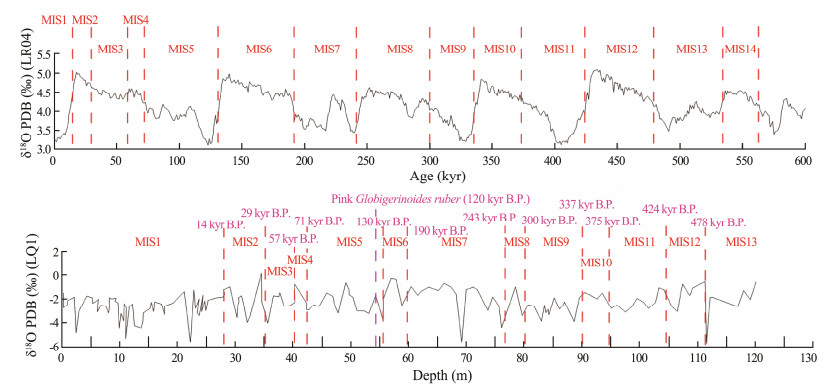
3.2 DatingA combination of AMS14C dating, foraminifera oxygen isotope compositions, pink red Globigerinoides ruber abundance (a symbolic foraminifera) was used to establish the chronological framework of sedimentary deposits and to calculate the sedimentation rate. The sediments at typical layers of core YQ1 were sampled, and an appropriate amount of each sample was put into a small beaker. Water and 30% H2O2 were added to soak it, and after fully dispersed, it was flushed with the 0.063 mm sieve. The samples < 0.063 mm were dried, and the mixed species of planktonic foraminiferal shell and rooting between 0.025 mm and 0.035 mm were picked up for AMS14C dating. Oxygen isotope tests were also performed on samples in this core, and the sample pre-treatment procedure was the same as AMS14C dating. In particular, the layers with pink Globigerinoides ruber were identified. The AMS 14C dating was completed at the Beta Dating Laboratory in Miami, USA.
3.3 Grain Size MeasurementA total of 120 sediment samples for grain size analysis were sampled at an average interval of 100 cm. First, 1–2 g of each sediment sample was taken to put into a beaker, and excessive hydrogen peroxide (30%) was added for soaking 24 h to remove the organic matter in the sample. Second, 0.25 mol L−1 hydrochloric acid solutions were added into the beaker to remove the carbonate in the sample until no bubbling. Third, a large amount of distilled water was used for repeated centrifugation until the sample solution was neutral. Finally, 5 mL of sodium hexametaphosphate solution (0.5 mol L−1) were added into the beaker. After dispersion, the laser particle size analyzer was used for testing, and the Folk method was used for classification and nomenclature (Folk et al., 1970). Grain size test was performed by the Mastersizer 2000 laser particle size analyzer from Malvern Instruments at the Marine Science and Exploration Laboratory of Ocean University of China.
3.4 Major Elemental AnalysisMajor element test was conducted for core sediment samples with an interval of 100 cm, and the layers with abundant biological debris were avoided. A total of 120 samples were taken. The sediment samples were ground to less than 0.075 mm after being dried at 60℃ and then were tested by desktop energy dispersive polarization X-ray fluorescence spectrometer at the Marine Science and Exploration Laboratory of Ocean University of China. The concentrations of oxides of Fe, Al, Ca, Mg, K, Na, Mn, Ti and P were determined.
4 Results 4.1 Age and Sedimentary RateThe ages of sediments from the depth of 0–21 m in core YQ1 were determined by the AMS14C dating and the age of the sediments at 21 m is about 9 kyr B.P. The sedimentation was continuous as a whole, with no obvious sedimentary discontinuity. No age reversal was found in the core at depths of 0 to 13.52 m. This indicates that there has been no sedimentary discontinuity since 5.85 kyr B.P. Indicated by the dating results, the layer at depths from 15.00 to 15.02 m is characterized by the inversed stratigraphic sequence, and the strata slump event causing the stratigraphic inversion occurred between 5.85 and 7.06 kyr B.P. The layer at depths from 20.04 to 20.06 m is also characterized by the inversed ages, but there was little difference of age for sediments from the 19.00–19.02 m layer and the 20.04–20.06 m layer. So they were not identified as the stratigraphic inversion and can be recognized as the sedimentary strata with the same age.
Combined with pink Globigerinoides ruber extinction boundary line (120 kyr) at about 54 m deep, the careful comparison between the foraminifera δ18O data in core YQ1 and the LR04 standard δ18O curve was performed. The result indicates that the age of the bottom layer of core YQ1 is 533 kyr B.P., consistent with the MIS13. In the core YQ1, the strata at depths of 0 to 27 m formed during the Holocene, and the deposition of the 27 to 120 m of the core started in the Pleistocene (Fig.2). Overall, the average time resolution of the core is approximately 4.5 kyr m−1.
|
Fig. 2 Comparison between the δ18O curve of core YQ1 and the LR04 standard δ18O curve. |
However, constrained by the sparse sampling, the ages obtained by the comparison between the foraminifera δ18O data of core YQ1 and the LR04 standard δ18O curve were not very accurate and secondary stages cannot be divided. Especially for MIS5 we cannot recognize its precise boundaries. Higher resolution researches in this area will be needed to carry out in the further study to confirm the division in this paper.
4.2 Grain Size FeaturesIn this section, the sediment types, grain size compositions, median size, mean size, sorting coefficient, skewness and kurtosis were discussed. The core has been divided into 13 layers in accordance with the sedimentation chronological framework constructed in Section 4.1.
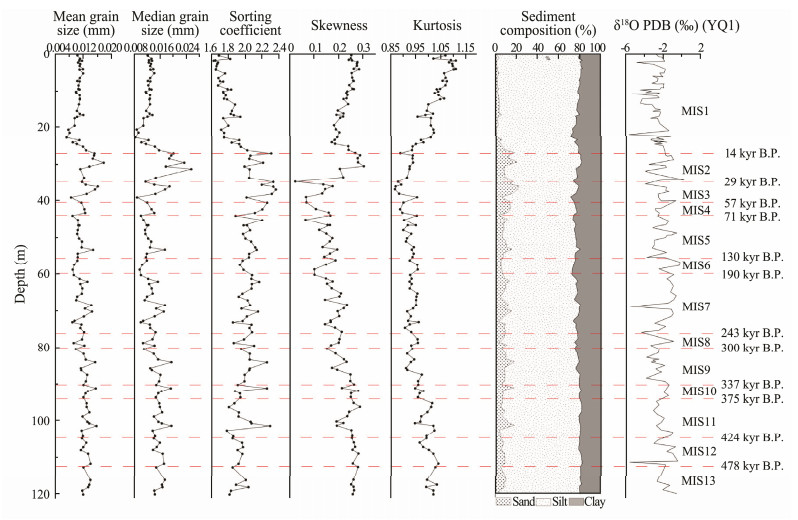
According to Folk nomenclature, the sediment types in the core YQ1 are silt and sandy silt. The sediments were mainly composed of sand, silt and clay (Fig.3). Among them, the silt is the main component, with the content varying from 56.6% to 80.7%. The layer at the depth of 37 m exhibits the lowest content of silt, while the content of silt in the layer at the depth of 2 m is the highest. The content of sand varied in the range of 1.0%–21.6%, and the layer at the depth of 29 m is characterized by the highest content of sand. The content of clay varied in the range of 17.4%–29.2%. Especially, the layers at depths of 4 m and 39 m exhibit the lowest and highest content of clay, respectively. The mean grain size of sediments is between 0.007 and 0.018 mm, and the median grain size changes from 0.008 to 0.025 mm. The sediments in the core are well sorted and the sorting coefficient fluctuates between 1.63 and 2.36. The skewness changing from 0.02 to 0.30 is positive and nearly symmetrical. The kurtosis varies from 0.87 to 1.11 and is flat and medium as a whole.
|
Fig. 3 Grain size variation of core YQ1 in the vertical. |
During MIS1 (0–27 m), the sediments were the finest and the sediment type was silt, showing good sorting. During MIS2 (27–35 m), the grain size parameters of the sediment changed significantly. The grain size of sediments increased obviously and the sediments were poorly sorted. The sediment type was mainly sandy silt. During MIS3 (35–40 m), the grain size of sediments increased and then decreased, with poor sorting. The sediment type was sandy silt. During MIS4 (40–42 m), the grain size of sediments became finer and the sediments showed good sorting. During MIS5 (42–57 m), the sediment type was mainly silt with sandy silt interlayers. During MIS6 (57– 61 m), the layer was characterized by a small thickness. The median size of sediments decreased obviously and the sorting became better. During MIS7 (61–76 m), the fluctuation frequency of sediment grain size parameters increased significantly. The sediment type was mainly silt with a small amount of sandy silt. During MIS8 (76–80 m), the sediments were mainly composed of silt. During MIS9 (80–90 m), the grain size of sediments obviously became coarser, and the silt was still the dominant component of the sediment type. During MIS10 (90–94 m), the sediment type continued to be silt. During MIS11 (94– 104 m), the grain size of sediments became coarser and the sediments were poorly sorted. The sandy silt became the main component of the sediment type. During MIS12 (104–112 m), the grain size of sediments was finer. The fluctuation range of sediment grain size parameters was less and the silt took dominant position in the sediment type. During MIS13 (112–120 m), the grain size of sediments became coarser again, and the silt remained the main component of the sediment type.
In summary, the particle size parameters in core YQ1 fluctuate with depth, and there exists an obvious corresponding relationship among the variation trends of each parameter. From MIS1 to MIS2, every grain size parameter and the sediment composition of core YQ1 exhibited significant variations. In contrast, from MIS3 to MIS13, the periodical cyclic changes occurred in the sediment grain size parameters and composition. Meanwhile, the periodical cyclic changes maintained within a narrow range and the coarser sediments present at odd oxygen isotope stages while finer sediments at even oxygen isotope stages (Fig.3).
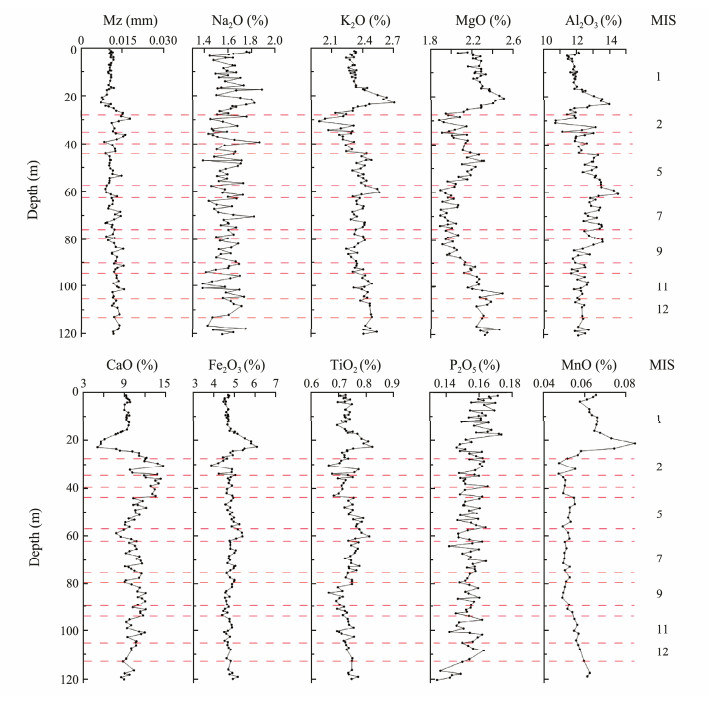
4.3 Major Element Composition CharacteristicsThe median size and major element composition of sediment samples in core YQ1 were shown in Fig.4. Among them, the contents of Na2O and P2O5 are characterized by slight fluctuation and the change trends are not obvious. The content of MnO exhibits a significant change only before MIS3. While the contents of other major elements changed significantly with depth, presenting an obviously glacial-interglacial cyclic change.
|
Fig. 4 Vertical changes of mean size (Mz) and major element content in core YQ1. |
It could be seen from the whole sequence that, except for CaO, the contents of other five major elements are consistent in the change trend with depth: at the later stage of MIS1, the content of each major element at depths of 20 to 25 m suddenly increased, almost reaching the peak value. However, during MIS2, the content of each major element at the depth of 30 m decreased significantly and exhibited the lowest value. During MIS3–MIS13, the content of each major element presented periodic fluctuations, but the range of variations was small. Except for MgO, the contents of other four major elements increased gradually from MIS3 to MIS5, reaching the high values during MIS6. During MIS7–MIS13, the changes of major elements contents were not significant, with a small range.
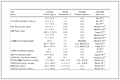
In terms of the relationship between the major elements contents and the mean size, the change regularity between them in core YQ1 could be divided into three types. There is a significantly positive correlation between the mean size and contents of CaO and P2O5. The contents of K2O, TiO2, Al2O3 and Fe2O3 show a negative correlation with the mean size. In contrast, the correlation between contents of MnO, Na2O, MgO and the mean size is not obviously presented. The correlation coefficients for these elements and contents of sand, silt and clay are shown in Table 1, and it could be seen that there are high correlation coefficients between the content of each element and the three grain size parameters. Among them, the contents of Al2O3, Fe2O3 and TiO2 are positively correlated with the content of clay. The coefficients between them are relatively high, which are 0.71, 0.59 and 0.44, respectively. This indicates that these three elements are concentrated in the fine clay. The content of CaO is positively correlated with the sand content, and the correlation coefficient is 0.72, indicating that CaO is mainly concentrated in the sand. Therefore, the grain size of sediments plays a key role in the contents of Al2O3, Fe2O3, TiO2 and CaO.
|
Table 1 Correlation coefficients of major elements and grain size components for sediments in core YQ1 |
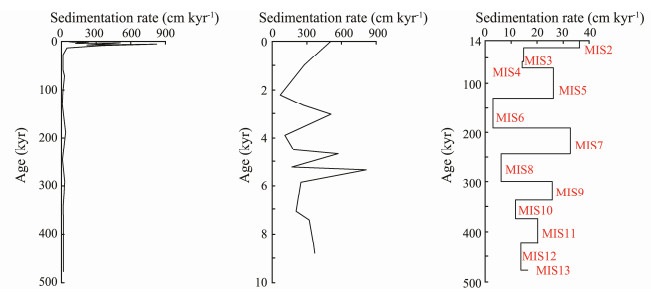
The sedimentation rates of core YQ1 were calculated by linear interpolation based on the age of each sampling layer as shown in Fig.5. The sedimentary rates in this core varied from lower than 2.9 to higher than 800 cm kyr−1. During MIS1 (0–14 kyr), the average sedimentation rate was 252 cm kyr−1 and reached about 800 cm kyr−1 at approximately 5.5 kyr B.P. The sedimentation rate declined dramatically before MIS1, and the average sedimentation rate exhibited the lowest value during MIS6 (130 kyr B.P. –191 kyr B.P.), which was lower than 3 cm kyr−1. During MIS2–MIS13, the sedimentation rate was characterized by the obvious glacial-interglacial periodical cyclic change. Namely, the sedimentary rate was large in the interglacial period while it was small in the glacial period. This is because the sediment supply increased significantly in the warm and humid interglacial period, with the increased rainfall and accelerated weathering and erosion rate. In contrast, the climate was cold and dry in the glacial period, which caused the decrease in the sediment supply.
|
Fig. 5 Sedimentation rate in core YQ1. |
It is worth noting that the sedimentation rate during MIS1 near core YQ1 in previous studies is only one third of the sedimentation rate in this paper (Tian et al., 2015a, 2015b). This is partly because the location of core YQ1, with the offshore distance of less than 300 m, is much closer to the land and material supply is sufficient. And it is partly because the study area is located in the middle unstable part of the continental slope, and sediments at the top slumped and accumulated within a short time, especially since 5.5 kyr B.P. However, it cannot be ruled out that there is some uncertainty about the sedimentation rate because of the sparse sampling interval.
5.2 Sediment Provenance Based on R-mode AnalysisIn order to identify the provenance of sediments in core YQ1, the SPSS19.0 software was used to perform R-mode analysis on nine major element concentrations of 120 samples. According to the geochemical characteristics of the major elements, the geological significance was assigned to each factor identified by R-mode, and then the element associations representing different provenances were determined.
In case of 83% cumulative variance contribution, three factors representing different element associations were obtained by R-mode analysis as shown in Table 2. The variance contribution of factor F1 presents the largest value and reaches 48.39%, which indicates that it makes the greatest contribution to the elemental composition of the sediments. F1 is the association of Al2O3, Fe2O3, TiO2 and K2O, all of which are positive loading. TiO2 is generally considered to be entirely from terrestrial detritus (Schmitz, 1987; Wei et al., 2004; Yang et al., 2004) and Al2O3, Fe2O3 and K2O are closely related to the terrestrial component (Wei et al., 2004, 2006). Therefore elements in F1 can be recognized as the terrestrial elemental association.
|
|
Table 2 Factor loadings of R-mode analysis on major element data of sediments in core YQ1 |
Previous studies show that the terrestrial sources are diversity and complexity and include Hainan Island, Pearl River catchment, Mekong River catchment, Taiwan Island, Luzon Island, and Yangzi River catchment (Liu et al., 2003; Wan et al., 2007; Liu et al., 2008, 2009; Xu et al., 2009). In this case, the terrestrial sources of the sediment from the Yingqiong continental slope and their percentages need to be determined by the rare earth element compositions, clay mineral compositions and other sediment parameters in the further research.
The variance contribution of F2 is 21.29%, and the elemental association in this factor is MgO and MnO, with positive loading. The previous studies show that the content of MgO in coral, loess and deep-sea sediments is related to paleoclimate changes. The high content of MgO indicates a warm and humid climate and conversely the low values means a dry and cold climate (Shen et al., 1991; Delaney et al., 1993). The MnO is a representative element of the early diagenesis in seafloor sediments (Wei et al., 2005; Meng et al., 2011). It can be seen that F2 is indicative of the paleoclimate changes and early diagenesis.
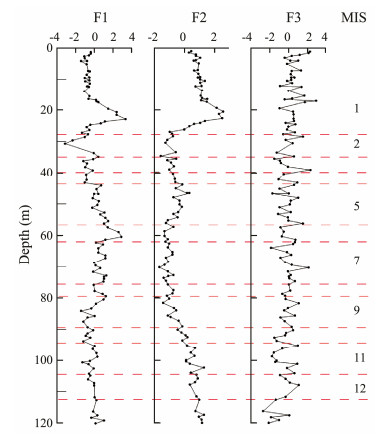
The variance contribution of F3 is 13.62%, and F3 is the element association of Na2O and P2O5, both of which have positive loading. Previous studies show that the content of Na2O is closely correlated with the volcanic activity and the content of P2O5 is generally related to biological activities (Shu et al., 2009; Xu et al., 2010). Therefore F3 probably represented the impact of volcanic activities and biological activities nearby. The factor scores are shown in Fig.6, and the larger factor scores exhibit the greater percentages of corresponding factor.
|
Fig. 6 Factor Scores for major elemental data in sediments from core YQ1. |
According to Section 5.2, the terrestrial indicative major elements included in F1 are Al2O3, Fe2O3, TiO2 and K2O. Because of the close relationship between the continental crust chemical weathering intensity and the climate, these major elements could reflect the climate change. The climate in the glacial period is cold and dry and the rocks on the lands are characterized by the weak chemical weathering effect. In the warm and humid interglacial period, there is more rainfall and the chemical weathering in the lands is intensified.
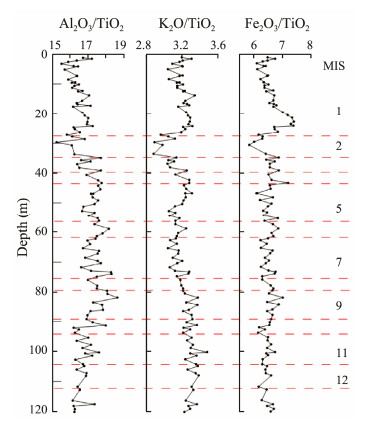
The oxide concentrations of these indicative major elements are generally affected by the sediment grain size compositions (as discussed in Section 4.3), so elemental ratios are used to eliminate this effect. Al2O3 is a commonly used reference element for eliminating grain size effect in marine sediments. However, the authigenic Al2O3 is involved in deep-water sediments of the South China Sea and TiO2 is often used to replace Al2O3 as reference element (Asahara et al., 1999; Wei et al., 2004, 2006). Therefore, Al2O3/TiO2, Fe2O3/TiO2 and K2O/TiO2 were selected to reflect the changes of the chemical weathering intensity in the source areas and then further to indicate the climate changes. Indicated by previous studies (Zhang et al., 2013), the increase or decrease of the chemical weathering intensity would result in the corresponding increase or decrease of Al2O3/TiO2, Fe2O3/TiO2 and K2O/ TiO2 in weathering products. As shown in Fig.7, with the temperature rising in the interglacial period of MIS1, the intensity of chemical weathering exhibited the largest value, and the supply of terrestrial clastic materials was the most sufficient. During the last glacial period of MIS2, the chemical weathering intensity decreased significantly. During MIS3–MIS13, the elemental ratio presented the glacial-interglacial periodic cyclic change as a whole.
|
Fig. 7 Typical elemental ratios in core YQ1. |
As the climate in the study area is mainly controlled by the East Asian monsoon, the glacial-interglacial cyclic change presented by Al2O3/TiO2, Fe2O3/TiO2 and K2O/ TiO2 reflects the restriction of glacial-interglacial cycle on the evolution of the East Asian monsoon, which implies that the major element ratios are significant indicators of climate changes.
6 ConclusionsBased on the comprehensive analysis of age, grain size and major element composition of sediments in core YQ1 from the Yingqiong continental slope in the northwestern South China Sea, coupled with the R-mode factor analysis on major elemental ratios, the provenance and paleoenvironment changes during last 500 kyr in the South China Sea were discussed. The conclusions are listed as follows:
1) Since the material supply in the interglacial period is more abundant than that in the glacial period, the sedimentary rate in the Yingqiong continental slope in the northwestern South China Sea presents the glacial-interglacial periodical cyclic change. The interglacial period is characterized by a high sedimentary rate, while the sedimentary rate in the glacial period shows an obvious low value. The rate could reach 800 cm kyr−1 during MIS1, while it exhibited the lowest value (< 3 cm kyr−1) during MIS6.
2) The results of R-mode factor analysis show that the two main factors F1 (Al2O3, Fe2O3, TiO2 and K2O) and F2 (MgO and MnO) reflect the impacts of terrestrial detritus, early diagenesis and climate changes on the major element composition in sediments, and the other factor F3 (Na2O and P2O5) indicates the less impact from the volcanic activity and biological activity.
3) The changes of the ratios of major elements included in F1 present obvious glacial-interglacial cyclic features, which reflects the impact of East Asian monsoon on the environment in the study area and further shows the restriction of glacial-interglacial climatic cycles on the evolution of the East Asian monsoon. This indicates that the ratios of some major elements are significant indicators of climate changes.
AcknowledgementsThis study was financially supported by the National Key Research and Development Program of China (No. 2017 YFC0306703), and the National Natural Science Foundation of China (No. 41706065).
Asahara, Y., Tanaka, T., Kamioka, H., Nishimura, A. and Yamazaki, T., 1999. Provenance of the north Pacific sediments and process of source material transport as derived from Rb-Sr isotopic systematics. Chemical Geology, 158: 271-291. DOI:10.1016/S0009-2541(99)00056-X (  0) 0) |
Chen, R. H., Wang, D. J., Xu, J., Meng, Y., Liu, C. L., Zhao, Q. Y. and Zhang, F. Y., 2003. Calcium and siliceous microfossil in the surface sediments of the northeastern South China Sea and their relationship with the sedimentary environment. Marine Geology & Quaternary Geology, 23(4): 15-21 (in Chinese with English abstract). ( 0) |
Clift, P. D., Wan, S. and Blusztajn, J., 2014. Reconstructing chemical weathering, physical erosion and monsoon intensity since 25 Ma in the northern South China Sea: A review of competing proxies. Earth-Science Reviews, 130: 86-102. DOI:10.1016/j.earscirev.2014.01.002 ( 0) |
Delaney, M. L., Linn, L. J. and Druffel, E. R. M., 1993. Seasonal cycles of manganese and cadrnium in coral from the Galapagos Islands. Geochimica et Cosmochimica Acta, 57(2): 347-354. DOI:10.1016/0016-7037(93)90436-Z ( 0) |
Folk, R. L., Andrews, P. B. and Lewis, D. W., 1970. Detrital sedimentary rock classification and nomenclature for use in New Zealand. New Zealand Journal of Geology and Geophysics, 13(4): 937-968. DOI:10.1080/00288306.1970.10418211 ( 0) |
Li, D., Xu, Q. and Wang, Y. F., 2015. Provenance analysis of the Pliocene central canyon in Qiongdongnan Basin and its implications. Acta Sedimentologica Sinica, 33(4): 659-664 (in Chinese with English abstract). ( 0) |
Liu, J., Xiang, R., Kao, S. J., Fu, S. and Zhou, L., 2016. Sedimentary responses to sea-level rise and Kuroshio Current intrusion since the Last Glacial Maximum: Grain size and clay mineral evidence from the northern South China Sea slope. Palaeogeography, Palaeoclimatology, Palaeoecology, 450: 111-121. DOI:10.1016/j.palaeo.2016.03.002 ( 0) |
Liu, Z. F., Trentesaux, A., Clemens, S. C., Colin, C., Wang, P., Huang, B. and Boulay, S., 2003. Clay mineral assemblages in the northern South China Sea: Implications for East Asian monsoon evolution over the past 2 million years. Marine Geology, 201(1): 133-146. ( 0) |
Liu, Z. F., Tuo, S. T., Colin, C., Liu, T. J., Hung, C. Y., Selvaraj, K., Chen, C. T. A., Zhao, Y., Siringan, F. P., Boulay, S. and Chen, Z., 2008. Detrital fine-grained sediment contribution from Taiwan to the northern South China Sea and its relation to regional ocean circulation. Marine Geology, 255(3-4): 149-155. DOI:10.1016/j.margeo.2008.08.003 ( 0) |
Liu, Z. F., Zhao, Y. L., Colin, C., Siringan, F. P. and Wu, Q., 2009. Chemical weathering in Luzon, Philippines from clay mineralogy and major-element geochemistry of river sediments. Applied Geochemistry, 24(11): 2195-2205. DOI:10.1016/j.apgeochem.2009.09.025 ( 0) |
Meng, X. W., Xia, P., Zhang, J. and Wang, X. Q., 2011. Evolution of the East Asian monsoon and its response to uplift of the Tibetan Plateau since 1.8 Ma recorded by major elements in sediments of the South China Sea. Chinese Science Bulletin, 56(6): 547-551. DOI:10.1007/s11434-010-4258-1 ( 0) |
Milliman, J. and Meade, R. H., 1983. World wide delivery of river sediments to the oceans. Journal of Geology, 91(1): 1-21. ( 0) |
Peng, J. L. and Chen, S. L., 2010. Analysis on sedimentary characteristics and environments in nearshore of Lianyungang. Advances in Marine Science, 28(4): 445-454 (in Chinese with English abstract). ( 0) |
Schmitz, B., 1987. The TiO2/Al2O3 ratio in the Cenozoic Bengal abyssal fan sediments and its use as a paleostream energy indicator. Marine Geology, 78(3): 195-206. ( 0) |
Shen, G. T., Campbell, T. M., Dunbar, R. B., Wellington, G. M., Colgan, M. W. and Glynn, P. W., 1991. Paleochemistry of manganese in corals from the Galapagos Islands. Coral Reefs, 10(2): 91-100. DOI:10.1007/BF00571827 ( 0) |
Shu, Z. H., Yang, S. Y., Dou, Y. G., Liu, Z. X., Yu, H. and Serge, B., 2009. Geochemical compositions and paleoenvironmental implication of the residual fractions of core DGkS9604 sediments in the middle Okinawa Trough. Tropical Geography, 29(3): 236-240, 273 (in Chinese with English abstract). ( 0) |
Tian, X., Xu, F. J., Wu, S. Z., Zhang, J., Guo, C. and Dong, J., 2015a. Clay mineral characteristics and provenance of continental shelf sediments in eastern Hainan Island since middle Holocene. Earth Science - Journal of China University of Geosciences, 40(9): 1497-1504 (in Chinese with English abstract). DOI:10.3799/dqkx.2015.134 ( 0) |
Tian, X., Xu, F. J., Xu, W. and Liu, X. L., 2015b. 4400 a East Asian monsoon record from sediments in the continental shelf of the northern South China Sea. Marine Sciences, 39(9): 62-68 (in Chinese with English abstract). ( 0) |
Wan, S., Li, A., Clift, P. D. and Stuutc, J. B. W., 2007. Development of the East Asian monsoon: Mineralogical and sedimentologic records in the northern South China Sea since 20 Ma. Palaeogeography, Palaeoclimatolog, Palaeocology, 254(3-4): 561-582. DOI:10.1016/j.palaeo.2007.07.009 ( 0) |
Wang, H. R., Wang, Y. M., Qiu, Y., Peng, X. C. and Liu, Y. Y., 2008. Geomorphology and its control of deep-water slope of the margin of the South China Sea. Acta Oceanologica Sinica, 30(2): 70-79 (in Chinese with English abstract). ( 0) |
Wang, P., and Li, Q., 2009. The South China Sea: Paleoceanography and Sedimentology. Springer, Berlin, 1-576.
( 0) |
Wang, P., Li, Q., Tian, J., He, J., Jian, Z., Ma, W. and Dang, H., 2016. Monsoon influence on planktic δ18O records from the South China Sea. Quaternary Science Reviews, 142: 26-39. DOI:10.1016/j.quascirev.2016.04.009 ( 0) |
Wang, W. G. and Chen, J., 2011. Distribution characters of major elemental composition contents and the influence factors in sediments of the late Pleistocene in central South China Sea. Journal of Oceanography in Taiwan Strait, 30(4): 449-457 (in Chinese with English abstract). ( 0) |
Wei, G. J., Li, X. H., Liu, Y. and Liang, X., 2006. Geochenmical record of chemical weathering and monsoon climate change since the early Miocene in the South China Sea. Paleoceanography, 21(4): 271-292. ( 0) |
Wei, G. J., Li, X. H., Liu, Y., Shao, L. and Liang, X. R., 2005. Transfer patterns of Mn, Cd and Mo in sediments during early diagenesis evidences from sediment cores at ODP site 1148. Geochimca, 34(2): 129-135 (in Chinese with English abstract). ( 0) |
Wei, G. J., Liu, Y., Li, X. H., Lei, S. and Dian, Y. F., 2004. Major and trace element variations of the sediments at ODP site 1144, South China Sea, during the last 230 ka and their paleoclimate implications. Palaeogeography, Palaeoclimatology, Palaeoecology, 212(3-4): 331-342. DOI:10.1016/S0031-0182(04)00329-3 ( 0) |
Xu, K. H., Milliman, J. D., Li, A., Liu, J. P., Kao, S. J. and Wan, S., 2009. Yangtze- and Taiwan-derived sediments on the inner shelf of East China Sea. Continental Shelf Research, 29(18): 2240-2256. DOI:10.1016/j.csr.2009.08.017 ( 0) |
Xu, Z. K., Li, A. C., Li, T. G. and Nan, Q. Y., 2010. Major element compositions of surface sediments in the east Philippine Sea and its geological implication. Marine Geology & Quaternary Geology, 30(6): 43-48 (in Chinese with English abstract). ( 0) |
Yang, S. Y., Lim, D. I., Jung, H. S. and Oh, B. C., 2004. Geochemical composition and provenance discrimination of coastal sediments around Cheju Island in the southeastern Yellow Sea. Marine Geology, 26: 41-53. ( 0) |
Zhang, J., Meng, X. W. and Wang, X. Q., 2013. The record of major element ratios in late Quaternary at northern slope of the South China Sea and its indicative significance on the cooling events. Acta Oceanologica Sinica, 35(4): 106-111 (in Chinese with English abstract). ( 0) |
Zhao, H. Q., Han, X. B., Chen, R. H., Chu, F. Y. and Gao, S. T., 2008. Charicteristics of main elements and their palaeoenvironment significance of core 191 in the northern South China Sea. Acta Oceanologica Sinica, 30(6): 85-93 (in Chinese with English abstract). ( 0) |
Zhao, S. H., Liu, Z. F., Chen, Q., Wang, X. X., Shi, J. N., Jin, H. Y., Liu, J. J. and Jian, Z. M., 2017. Spatiotemporal variations of deep-sea sediment components and their fluxes since the last glaciation in the northern South China Sea. Science China Earth Sciences, 60: 1368-1381. DOI:10.1007/s11430-016-9058-6 ( 0) |
Zhuo, H. T., Wang, Y. M., Xu, Q., Li, D., Wang, Y., Wang, Y. F., Li, H. and Tang, W., 2014. Classification and genesis of continental slopes on the northern South China Sea. Acta Geologica Sinica, 88(3): 327-336 (in Chinese with English abstract). ( 0) |