 2024, Vol. 23


2) Laboratory of Marine Ecology and Environment Science, Qingdao National Laboratory for Marine Science and Technology, Qingdao 266071, China
Long-chain alkenones (LCAs) are the lipids produced by haptophytes, consisting of methyl ketone (Me) or ethyl ketone (Et) with 35 – 42 carbon atoms and 2 – 3 carbon-carbon double bonds. Haptophytes can be classified into three groups based on the DNA and 18rRNA profiles of each haptophytes species (Theroux et al., 2010). Group I is freshwater algal species living in middle and high latitudes, mainly including haptophytes that have not yet been isolated and purified (Theroux et al., 2010; Longo et al., 2018); Group II includes coastal algal species and algal species in salt lakes, such as the Isochrysis galbana and Chrysotila lamellosa (Versteegh et al., 2001; Rontani et al., 2004); Group III is marine haptophytes, including Emiliania huxleyi (E. huxleyi) and Gephyrocapsa oceanica (G. oceanica) (Volkman et al., 1980, 1995). LCAs found in most of modern marine sediments were mainly produced by E. huxleyi (Marlowe et al., 2007).
Proxies based on LCAs have been widely used to reconstruct the past change in marine environment. Particularly, as well known paleotemperature proxy, UK 37 (Eq. (1)) (Brassell et al., 1986) and UK' 37 (Eq. (2)) (Prahl and Wakeham, 1987) based on the unsaturation of C37 alkenones have been applied to reconstruct the quaternary variations of sea water temperature in the oceans. In addition to C37 alkenones, studies of LCAs in the eastern North Atlantic surface waters have shown that UK 38Me (Eq. (3)) and UK 38Et (Eq. (4)) proxies calculated with C38 alkenone unsaturation can also indicate environmental temperature (Conte and Eglinton, 1993). It has been found that the percentage of C37:4Me in total C37 alkenones (%C37:4Me) can reflect sea surface salinity (SSS) in high-latitude regions (Rosell-Melé, 1998; Liu et al., 2008), while the content of C36:2 alkenone has the potential to indicate SSS in mid-latitude areas (Fujine et al., 2006). Alkenone proxies can also be used to indicate the parent algae of alkenones. For instance, Group I haptophytes can be distinguished with Ratios of Isomeric Ketones (RIK)37 and RIK38E proxies established with tautomers of C37:3Me and C38:3Et, respectively (Longo et al., 2018). Additionally, the ratio of total C37 alkenones to total C38 alkenones (K37/K38) was found to indicate the presence of Group II haptophytes in algal mixture (Rontani et al., 2004). The correlations of UK 38Me-UK 38Et and UK' 37-UK 38Et can be used to distinguish LCAs produced by E. huxleyi and G. oceanica in open oceans and marginal seas (Conte et al., 1998; Yamamoto et al., 2000; Conte et al., 2001). The algal productivity can also be estimated with LCAs content. The content of C37 alkenones correlates significantly with siliceous debris abundance (R = 0.83) in cores spanning Late Pliocene from the eastern equatorial Pacific and Atlantic Oceans, suggesting the changes in coccolithophore productivity (Bolton et al., 2010). The analysis of C37 alkenones in ocean surface sediments on a global scale has shown that C37 alkenones content correlated with ocean surface chlorophyll-a concentration, and can be used to quantitatively estimate the past changes in ocean primary productivity or phytoplankton productivity (Raja and Rosell-Melé, 2021).
| $ {\text{U}}_{{\text{37}}}^{\text{K}} = \frac{{\left[ {{{\text{C}}_{{\text{37:2}}}}{\text{Me}}} \right] - \left[ {{{\text{C}}_{{\text{37:4}}}}{\text{Me}}} \right]}}{{\left[ {{{\text{C}}_{{\text{37:2}}}}{\text{Me}}} \right] + \left[ {{{\text{C}}_{{\text{37:3}}}}{\text{Me}}} \right] + \left[ {{{\text{C}}_{{\text{37:4}}}}{\text{Me}}} \right]}}, $ | (1) |
| $ {\text{U}}_{{\text{37}}}^{{{\text{K}}^{\text{'}}}} = \frac{{\left[ {{{\text{C}}_{{\text{37:2}}}}{\text{Me}}} \right]}}{{\left[ {{{\text{C}}_{{\text{37:2}}}}{\text{Me}}} \right] + \left[ {{{\text{C}}_{{\text{37:3}}}}{\text{Me}}} \right]}}, $ | (2) |
| $ {\text{U}}_{{\text{38:Me}}}^{{{\text{K}}^{\text{'}}}} = \frac{{\left[ {{{\text{C}}_{{\text{37:2}}}}{\text{Me}}} \right]}}{{\left[ {{{\text{C}}_{{\text{38:2}}}}{\text{Me}}} \right] + \left[ {{{\text{C}}_{{\text{38:3}}}}{\text{Me}}} \right]}}, $ | (3) |
| $ {\text{U}}_{{\text{38:Et}}}^{{{\text{K}}^{\text{'}}}} = \frac{{\left[ {{{\text{C}}_{{\text{38:2}}}}{\text{Et}}} \right]}}{{\left[ {{{\text{C}}_{{\text{38:2}}}}{\text{Et}}} \right] + \left[ {{{\text{C}}_{{\text{38:3}}}}{\text{Et}}} \right]}} . $ | (4) |
In the eastern marginal seas of China, the studies on LCAs proxies focus on seawater temperature reconstruction using UK' 37 proxy and coccolithophore or phytoplankton productivity indicated with C37 alkenones content. A regional calibration of UK' 37 and sea surface temperature (SST) has been proposed and applied in the southern Yellow Sea (SYS) (Tao et al., 2011; Xing et al., 2013; Nan et al., 2017). The analysis of UK' 37 in suspended particulate matters (SPM) in the northern East China Sea (ECS) reveals that SST derived from UK' 37 corresponds to the summer-to-fall averaged SST in the nearshore region, but reflects the annual mean SST in the offshore region (Lee et al., 2014). This is attributed to seasonal fluctuation in C37 alkenone content (Lee et al., 2014; Ko et al., 2018). UK' 37-SST records indicate that centennial SST variations are mainly influenced by solar activity (Zhao et al., 2014; Nan et al., 2017; Bae et al., 2022), East Asian Winter Monsoon (EAWM) and North Atlantic ice-rafted debris (Wang et al., 2011; Nan et al., 2017), while the millennial SST variations are related to the EAWM, the Kuroshio Current (KC) and the Yellow Sea Warm Current (YSWC) during the middle and late Holocene in the SYS (Ge et al., 2014; Jia et al., 2019). In addition, C37 alkenones have been proved to be a reliable proxy to reflect phytoplankton productivity and community structure in the SYS and ECS (Xing et al., 2011; Wu et al., 2016). The contents of C37 alkenones in the SYS surface sediments have low values near the coasts and high values seaward, caused by higher phytoplankton primary productivity and low sedimentation rates in the central SYS (Xing et al., 2011). The analysis of C37 alkenones in SPM from surface water in the SYS and ECS indicates that the C37 alkenones concentration is higher in summer than that in spring (Wu et al., 2016). C37 alkenones records suggest that centennial or millennial changes in phytoplankton productivity and community structure are associated with the influences of the KC, YSWC, EAWM, El Niño-Southern Oscillation and human activities in the ECS (Duan et al., 2014; Xing et al., 2016; Wang et al., 2019).
Nevertheless, with exception of C37 alkenones, it is little known about the distributions of the other LCAs and their environmental indications in the YS. In this study, 32 surface sediments from the SYS and a sediment core (A02-C) from the muddy zone in the central part of the SYS were collected to analyze the LCAs with different chain lengths and evaluate environmental indications of these compounds. The results would be helpful to provide available alkenone proxies and reconstruct the past changes in the YS environment.
2 Materials and Methods 2.1 Study AreaThe SYS is located between the east coast of China and the Korean Peninsula (Fig.1). Under the influences of the Siberian High and the Aleutian Low, north wind prevails in the SYS in winter (Wang et al., 2013), while south wind dominates in summer due to the Pacific Subtropical High (Cai et al., 2011). The circulation of the SYS includes the YSWC and coastal currents, which is strong in winter and weak in summer (Xu et al., 2009). The YSWC is a branch of the KC, carrying high temperature and salinity water into the YS. The Yellow Sea Coastal Current (YSCC) is a mixture of freshwater from inland rivers and coastal seawater, including the Shandong Peninsula Coastal Current, the North Jiangsu Coastal Current, the West Coast Korean Peninsula Coastal Current and the Liao-dong Peninsula Coastal Current. Under the influence of winter wind, the YSWC and the YSCC are strengthened in winter, but weakened in summer (Tang et al., 2000; Yu et al., 2006; Gao et al., 2016).

|
Fig. 1 Map illustrating sampling stations and main currents in the YS and ECS (modified after Xing et al., 2013 and Gao et al., 2016). The sampling sites of surface sediments are indicated by black solid circles and Core A02-C is indicated by blue square. Records in Core 10694 (Yuan et al., 2016), Core HS2 (Lyu et al., 2021), Core B-3GC (Jian et al., 2000) and ODP Hole 1202B (Su and Wei, 2005) are used to compare with those in Core A02-C. E1A-G1A is the sampling site of E. huxleyi and G. oceanica (Yamamoto et al., 2000). KC, Kuroshio Current; TWWC, Taiwan Warm Current; YSWC, Yellow Sea Warm Current; CWC, Cheju Warm Current; TSWC, Tsushima Warm Current; KCC, Korea Coastal Current; SPCC, Shan-dong Peninsula Coastal Current; YSCC, Yellow Sea Coastal Current; CDW, Changjiang Diluted Water. |
A total of 32 surface sediments (0 – 5 cm) from the SYS were collected using a grab sampler during the autumn and winter cruises by the First Institute of Oceanography, Ministry of Natural Resources in 2019. Core A02-C was collected using a gravity corer on the R/V Dong Fang Hong 2 in March 2011. The dating model of Core A02-C has been reported (Wu et al., 2019). 84 samples at the top of Core A02-C were collected for LCAs measurement, spanning the last 0.58 – 5.5 kyr with an average time resolution of 59 yrs. Sedimentary samples were stored frozen at − 20℃ prior to analysis.
2.2 Biomarkers AnalysisThe freeze-dried samples (about 10 g) were grounded and ultrasonically extracted nine times with a mixture of dichloromethane and methanol (3:1, v/v). The total extracts were dried under N2 stream and hydrolyzed using 6% KOH-MeOH for 12 h. The saponified extracts were separated into nonpolar fraction (n-alkanes) and LCAs using 5% deactivated silica gel chromatography (Xing et al., 2015). The nonpolar fraction was eluted with n-hexane, and LCAs were eluted with a mixture of n-hexane and dichloromethane (1:1, v/v; 6 mL) and dried under N2 stream.
Biomarker identification was performed on a Gas Chromatography-Mass Spectrometry/Mass Spectrometry (GC-MS/MS, Agilent 7890A-7000 GC/MS Triple Quad) with a flame-ionization detector (FID), using a HP-1 capillary column (50 m × 0.32 mm × 0.17 μm) and He as the carrier gas at a flow rate of 1.2 mL min−1. The MS ion source was electron ionization (EI, 70 eV), and the mass scanning ranged between m/z 50 and 800 amu. The injection was performed with non-split mode. Oven temperature programming was holding at 80℃ for 1 min, 80℃– 200℃ at 25℃ min−1, 200℃ – 250℃ at 4℃ min−1, 250℃– 300℃ at 1.6℃ min−1, holding at 300℃ for 10 min, 300℃ – 315℃ at 5℃ min−1, and holding at 315℃ for 13 min.
Biomarker quantification was performed on a Gas Chromatograph (GC, Agilent 6890N) with a FID, using HP-1 capillary column (50 m × 0.32 mm, 0.17 μm) and He as the carrier gas at 1.2 mL min−1. The injection was performed in spitless mode. The oven temperature was programmed to be maintained at 80℃ for 1 min, increased to 200℃ at 25℃ min−1, 200℃ – 250℃ at 4℃ min, 250℃ – 300℃ at 1.6℃ min−1, held at 300℃ for 10 min, 300℃ – 315℃ at 5℃ min−1, and held at 315℃ for 13 min (Xing et al., 2011). The relative content of individual LCAs was obtained by comparing each respective peak area with that of the total LCAs. Sample blanks were measured and no target compounds were detected. The relative standard deviation was less than 3.4% (n = 6).
2.3 Data of Sea Surface TemperatureSST data in February during the period of 2003 – 2021 were obtained from National Oceanic and Atmospheric Administration Southwest Fisheries Science Center (https://coastwatch.pfeg.noaa.gov/data.html). The data were interpolated to determine the distributions of SST isotherms in the SYS using Data Interpolating Variational Analysis (DIVA) software integrated into Ocean Data View software (Torniainen et al., 2017).
2.4 Statistical AnalysisBoth correlation analysis and analysis of variance (ANOVA) were performed using the program SPSS 24.0 for Windows (SPSS Inc., Chicago, Illinois).
3 Results 3.1 LCAs in Surface SedimentsEight LCAs were detected in surface sediments from the stations in the SYS (Figs.2 and 3), except for YS-3 and YS-11 stations (Fig.1).

|
Fig. 2 Gas chromatogram of detected LCAs at Station A4. |

|
Fig. 3 The Mass spectrums of detected LCAs at Station A4. |
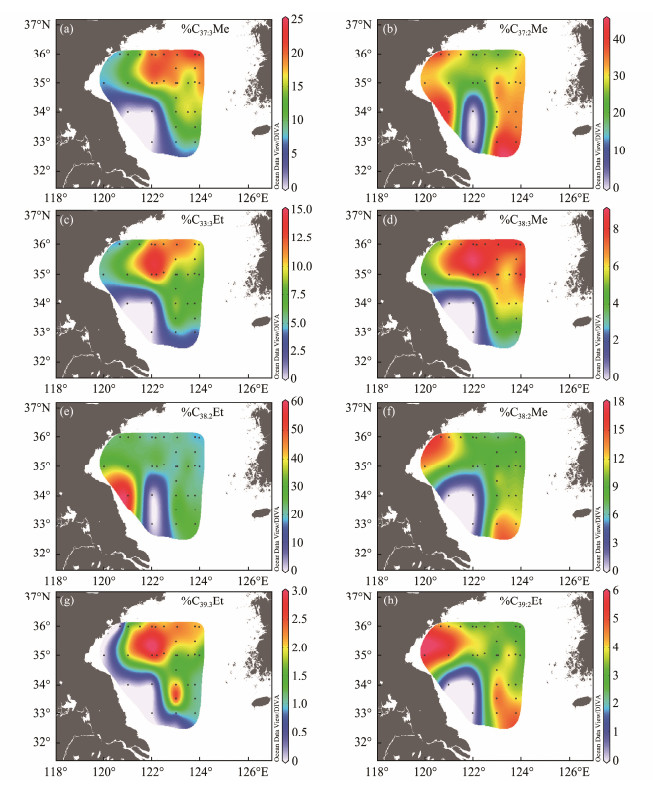
The relative contents of the C38:2Et, C37:2Me, C37:3Me, C38:2Me, C38:3Et, C38:3Me, C39:2Et and C39:3Et were 18.3% – 59.8%, 22.6% – 41.2%, 7.4% – 23.0%, 6.6% – 15.4%, 3.8% – 13.3%, 3.6% – 8.7%, 2.8% – 6.0% and 0.7% – 3.0%, respectively. The relative contents of C37:3Me, C38:3Et, C38:3Me and C39:3Et showed similarly increasing trends from the southwest to the northeast of the SYS (Figs.4a, c, d and g), which is likely linked to higher abundance of tri-unsaturated alkenones in lower temperature condition (Conte et al., 1998) from the northeast of the SYS. The relative content of C37:2Me had high values in western and eastern regions, and with low values in middle region of the study area (Figs.4b). The relative content of C38:2Et had the maximum in the southwestern region and the minimum in the central-southern region of the SYS, respectively (Figs.4e). C38:2Me and C39:2Et relative contents had similar distribution pattern with high values in the northwest and southeast and low values in southwest of the SYS (Figs.4f and h). C37:4Me was not detected in surface sediments of the SYS, consistent with the previous study (Tao et al., 2011). C35 – C36 alkenones and C40 – C42 alkenones were not found in surface sediments of the SYS.
|
Fig. 4 Spatial distributions of the relative contents of LCAs (%) in surface sediments from the SYS. |
Eight LCAs were detected in Core A02-C. The relative contents of C37:2Me, C38:2Et, C37:3Me, C38:3Me, C38:3Et, C38:2Me, C39:2Et and C39:3Et were 23.2% – 31.1%, 17.6% – 21.4%, 14.4% – 21.0%, 8.6% – 19.0%, 7.6% – 10.5%, 6.9% – 9.1%, 2.7% – 3.9% and 2.0% – 3.4%, respectively (Fig.5). During the period of 5.5 – 3 kyr, the relative contents of C37:2Me and C38:2Me showed similarly decreasing trends, in contrast to the increasing trend of C38:3Et relative content. The relative contents of C38:2Et, C37:3Me, C39:2Et and C39:3Et had no clear trends. The relative content of C38:3Me oscillated with relatively low values (average 11.6%). During the period of 3 – 0.58 kyr, the relative contents of C37:2Me, C38:2Et, C38:2Me and C39:2Et had increasing trends, while the relative contents of C37:3Me, C38:3Et and C39:3Et had decreasing trends. The relative content of C38:3Me fluctuated significantly with relatively high values (average 13.4%).

|
Fig. 5 Relative contents (%) of LCAs in Core A02-C. |
The analyses of alkenones in algal cultures reveal that the relationships of UK 38Me-UK 38Et and UK' 37-UK 38Et can distinguish LCAs produced by E. huxleyi and G. oceanica (Conte et al., 1998; Yamamoto et al., 2000). Fig.6a shows the correlations between UK 38Me and UK 38Et in various samples including surface sediments of this study, SPM samples collected from the Bermuda, G. oceanica collected from the southwestern Pacific Ocean and Jervis Bay (eastern Australia) and E. huxleyi collected from the northeastern Pacific Ocean, Indian Ocean, Atlantic Ocean and Norwegian fjord (Conte et al., 1998, 2001). The correlations between UK' 37 and UK 38Et for surface sediments of this study, SPM samples collected from the Bermuda, G. oceanica and E. huxleyi collected from the northwestern Pacific Ocean are shown in Fig.6b (Yamamoto et al., 2000; Conte et al., 2001). The analysis of alkenones in SPM samples indicates that E. huxleyi is the main LCAs producer in the Bermuda (Conte et al., 2001). Both UK 38Me-UK 38Et and UK' 37-UK 38Et reveal that LCAs in surface sediments of this study and SPM samples from the Bermuda fall in the range of E. huxleyi, suggesting that these LCAs are mainly originated from E. huxleyi. This is consistent with the results of coccolithophores nannofossil in surface sediments and living coccolithophores investigation in seawater of the SYS, which also indicate that E. huxleyi are the dominant coccolithophores species in the SYS (Rui et al., 2011; Luan et al., 2013).

|
Fig. 6 UK 38Et vs. UK 38Me (a) and UK 38Et vs. UK' 37 (b) for LCAs in surface sediments (black triangles) from the SYS, SPM samples (shaded triangles) from the Bermuda and those in E. huxleyi (white circles) and G. oceanica (white squares) cultures. |
The ratios of K37/K38 have different values in Chrysotila lamellosa HAP 17 strain (1.4 – 3.3) (Rontani et al., 2004), Isochrysis galbana (5.4 – 15.1) (Marlowe et al., 2007), E. huxleyi (0.86 – 2.16) (Conte et al., 1994) and G. oceanica (0.59 – 0.81) (Volkman et al., 1995). Consequently, it can be used to identify LCAs producers (Chu et al., 2005; Furota et al., 2016). The ratios of K37/K38 in surface sediments from the SYS range from 0.6 to 1.2, with low values (0.7 – 0.9) in the nearshore zone of the SYS and high values (1 – 1.2) in the offshore area of the SYS (Fig.7). The evidence of coccolithophores nannofossil in the SYS sediments has revealed low relative abundance of E. huxleyi in the nearshore region and high relative abundance of E. huxleyi in the offshore region from the SYS, opposite with G. oceanica (Rui et al., 2011). Furthermore, the analyses of living coccolithophores in seawater also found similar distribution pattern of E. huxleyi in the SYS (Luan et al., 2013; Sun et al., 2014). Therefore, high K37/K38 ratios correspond to high abundance of E. huxleyi; while low K37/K38 ratios reflect high abundance of G. oceanica. Similarly, K37/K38 ratios were found to reflect the change of haptophyte species in Gulf of Cadiz (Furota et al., 2016). Moreover, K37/K38 ratios have been used to distinguish the relative contributions of coastal and open marine haptophyte species in the continental slope off French Guiana during Heinrich and Dansgaard-Oeschger stadials (Zhang et al., 2017). The spatial distribution of K37/K38 ratio in the SYS is linked with the YS current system. The YSWC, a branch of the KC (Fig.1), brings high temperature and salinity water into the SYS. Spatial distributions of SST and SSS in winter showed similarly decreasing trends from the southeast to the northwest of the SYS (Wei et al., 2016), in accord with K37/K38 ratios distribution. The YSWC brings high abundance of E. huxleyi originated from the west Pacific Ocean into the YS (Wang and Samtleben, 1983; Zhang and Siesser, 1986), resulting in high K37/K38 ratios in the offshore area.

|
Fig. 7 Spatial distribution of K37/K38 ratio in surface sediments from the SYS. Contours indicate SST and the red arrow indicates the YSWC. |
SST isolines in Fig.7 indicate the YSWC pathway (Cao and Zhu, 2021). As shown in Fig.7, the YSWC flows from the southeast to the northwest of the SYS. Similarly, K37/K38 ratios show a decreasing trend from the southeast to the northwest of the SYS, in accord with SST distribution (R = 0.5, P < 0.01) and the YSWC pathway. As a result, K37/K38 index can trace the YSWC pathway in the SYS.
To evaluate temporal variation in the YSWC, a core (A02-C) collected from the central YS under the influence of the YSWC was analyzed. ANOVA indicates that all indicators in different sedimentary cores show significant differences (P < 0.05) between the two period intervals. From the last 5.5 kyr to 3 kyr, K37/K38 ratios in Core A02-C show a decreasing trend (Fig.8a), consistent with the decrease in the relative abundance of E. huxleyi nannofossil in the southern Okinawa Trough (ODP Hole 1202B) (Fig.8e) (Su and Wei, 2005). At this period, the reduced KC intensity (Fig.8b) (Jian et al., 2000) and the weakened EAWM (Fig.8d) (Lyu et al., 2021) are found. Similarly, UK' 37-SST in Core A02-C shows a decreasing trend overall (Fig.8c) (Jiang, 2014). These records reveal a reduction of the YSWC intensity during this period.

|
Fig. 8 Comparison of the record of K37/K38 ratio in Core A02-C (a), the record of the relative abundance (%) of P. obliquiloculata (indicating the strength of the KC) in Core B-3GC from the northern Okinawa Trough (Jian et al., 2000) (b), the record of UK' 37-SST in Core A02-C (Jiang, 2014) (c), the EAWM record in Core HS2 from the central SYS (Lyu et al., 2021) (d), the records of the relative abundances of E. huxleyi nannofossil (e) and G. oceanica nannofossil (f) in ODP Hole 1202B from the southern Okinawa Trough (Su and Wei, 2005). |
Therefore, the decrease in K37/K38 ratios is attributed to the declined E. huxleyi input into the SYS caused by the weakened YSWC during this period. During the period of 3 – 0.58 kyr, the K37/K38 ratios keep persistent decrease (Fig.8a), corresponding to the decrease in the relative abundance of E. huxleyi nannofossil (3 – 0.58 kyr) (Fig.8e) and the increase in the relative abundance of G. oceanica nannofossil (3 – 1.4 kyr) (Fig.8f) (Su and Wei, 2005). However, the KC (Fig.8b), UK' 37-SST (Fig.8c), and the EAWM (Fig.8d) show increasing trends during this period. The enhanced EAWM would strengthen the vertical mixing of the water column and transport more bottom nutrients to the upper layer, which favors G. oceanica growth rather than E. huxleyi (Guo et al., 2020). Additionally, a previous study indicates that the increase in G. oceanica nannofossil is in accord with the intensified EAWM at 1880 – 1900 and 1925 – 1945, opposite with the change in E. huxleyi nannofossil in Core 10694 (Fig.1) from the central SYS (Yuan et al., 2016). Therefore, low K37/K38 ratios are attributed to the increased intensity of the EAWM during this period. In summary, K37/K38 index reflects the variation in the YSWC, and it is also influenced by the EAWM intensity.
5 ConclusionsThe relationships of UK 38Me-UK 38Et and UK' 37-UK 38Et indicate that C37 and C38 alkenones in surface sediments of the SYS are mainly derived from E. huxleyi. K37/K38 ratios in surface sediments of the SYS reflect the spatial distribution of coccolithophores species in the SYS. The YSWC brings high abundance of E. huxleyi into the YS, resulting in high K37/K38 ratios in the offshore area of the SYS. Whereas low K37/K38 ratios are related to high abundance of G. oceanica in the nearshore area of the SYS, where the YSWC influence is negligible.
Temporal variations in K37/K38 ratios reveal that during the period of 5.5 – 3 kyr, the decrease in K37/K38 ratios is controlled by the YSWC intensity. However, at the period of 3 – 0.58 kyr, K37/K38 ratios keep persistent decrease despite the intensified YSWC. This is attributed to the enhanced EAWM-induced vertical mixing, which favors the growth of G. oceanica and leads to the reduction of K37/K38 ratios.
AcknowledgementsThis study is funded by the National Natural Science Foundation of China (Nos. 41876073, 92058207) and the National Basic Research Program of China (973 Program No. 2010CB428901).
Bae, S. W., Lee, K. E., Ko, T. W., Kim, R. A., and Park, Y. G., 2022. Holocene centennial variability in sea surface temperature and linkage with solar irradiance. Scientific Reports, 12(1): 15046. DOI:10.1038/s41598-022-19050-6 (  0) 0) |
Bolton, C. T., Lawrence, K. T., Gibbs, S. J., Wilson, P. A., Cleaveland, L. C., and Herbert, T. D., 2010. Glacial-interglacial productivity changes recorded by alkenones and microfossils in late Pliocene eastern equatorial Pacific and Atlantic up-welling zones. Earth and Planetary Science Letters, 295(3-4): 401-411. DOI:10.1016/j.epsl.2010.04.014 ( 0) |
Brassell, S. C., Eglinton, G., Marlowe, I. T., Pflaumann, U., and Sarnthein, M., 1986. Molecular stratigraphy: A new tool for climatic assessment. Nature, 320: 129-133. DOI:10.1038/320129a0 ( 0) |
Cai, R., Chen, J., and Tan, H., 2011. Variations of the sea surface temperature in the offshore area of China and their relationship with the East Asian Monsoon under the global warming. Climate and Environmental Research, 16(1): 94-104 (in Chinese with English abstract). DOI:10.3878/j.issn.1006-9585.2011.01.09 ( 0) |
Cao, Y., and Zhu, Q., 2021. Study on the intensity and temporal and spatial variation of Yellow Sea Warm Current based on Aqua/MODIS data. Marine Forecasts, 38(6): 93-102 (in Chinese with English abstract). DOI:10.11737/j.issn.1003-0239.2021.06.010 ( 0) |
Chu, G., Sun, Q., Li, S., Zheng, M., Jia, X., Lu, C., et al., 2005. Long-chain alkenone distributions and temperature dependence in lacustrine surface sediments from China. Geochimica et Cosmochimica Acta, 69(21): 4985-5003. DOI:10.1016/j.gca.2005.04.008 ( 0) |
Conte, M. H., and Eglinton, G., 1993. Alkenone and alkenoate distributions within the euphotic zone of the eastern North Atlantic: Correlation with production temperature. Deep Sea Research Part I: Oceanographic Research Papers, 40(10): 1935-1961. DOI:10.1016/0967-0637(93)90040-A ( 0) |
Conte, M. H., Thompson, A., Lesley, D., and Harris, R. P., 1998. Genetic and physiological influences on the alkenone/alkenoate versus growth temperature relationship in Emiliania huxleyi and Gephyrocapsa Oceanica. Geochimica et Cosmochimica Acta, 62(1): 51-68. DOI:10.1016/s0016-7037(97)00327-x ( 0) |
Conte, M. H., Volkman, J. K., and Eglinton, G., 1994. Lipid biomarkers of the Haptophyta. The Haptophyte Algae, 51: 351-377. DOI:10.1093/oso/9780198577720.003.0019 ( 0) |
Conte, M. H., Weber, J. C., King, L. L., and Wakeham, S. G., 2001. The alkenone temperature signal in western North Atlantic surface waters. Geochimica et Cosmochimica Acta, 65(23): 4275-4287. DOI:10.1016/S0016-7037(01)00718-9 ( 0) |
Duan, S., Xing, L., Zhang, H., Feng, X., Yang, H., and Zhao, M., 2014. Upwelling and anthropogenic forcing on phytoplankton productivity and community structure changes in the Zhe-jiang coastal area over the last 100 years. Acta Oceanologica Sinica, 33(10): 1-9. DOI:10.1007/s13131-014-0535-1 ( 0) |
Fujine, K., Yamamoto, M., Tada, R., and Kido, Y., 2006. A salinity-related occurrence of a novel alkenone and alkenoate in late Pleistocene sediments from the Japan Sea. Organic Geochemistry, 37(9): 1074-1084. DOI:10.1016/j.orggeochem.2006.05.004 ( 0) |
Furota, S., Nakamura, H., and Sawada, K., 2016. Long-chain alkenones and related distinctive compounds in the late Miocene and Pliocene sediments from the Gulf of Cadiz, eastern North Atlantic. Organic Geochemistry, 101: 166-175. DOI:10.1016/j.orggeochem.2016.08.014 ( 0) |
Gao, F., Qiao, L., and Li, G., 2016. Modelling the dispersal and depositional processes of the suspended sediment in the central South Yellow Sea during the winter. Geological Journal, 51(S1): 35-48. DOI:10.1002/gj.2827 ( 0) |
Ge, H., Zhang, C. L., Li, J., Versteegh, G. J. M., Hu, B., Zhao, J., et al., 2014. Tetraether lipids from the southern Yellow Sea of China: Implications for the variability of East Asia Winter Monsoon in the Holocene. Organic Geochemistry, 70: 10-19. DOI:10.1016/j.orggeochem.2014.02.011 ( 0) |
Gong, G., Wen, Y., Wang, B., and Liu, G., 2003. Seasonal variation of chlorophyll a concentration, primary production and environmental conditions in the subtropical East China Sea. Deep Sea Research Part II: Topical Studies in Oceanography, 50(6-7): 1219-1236. DOI:10.1016/s0967-0645(03)00019-5 ( 0) |
Guo, C., Zhang, G., Sun, J., Leng, X., Xu, W., Wu, C., et al., 2020. Seasonal responses of nutrient to hydrology and biology in the southern Yellow Sea. Continental Shelf Research, 206: 104207. DOI:10.1016/j.csr.2020.104207 ( 0) |
Jia, Y., Li, D., Yu, M., Zhao, X., Xiang, R., Li, G., et al., 2019. High- and low-latitude forcing on the south Yellow Sea surface water temperature variations during the Holocene. Global and Planetary Change, 182: 103025. DOI:10.1016/j.gloplacha.2019.103025 ( 0) |
Jian, Z., Wang, P., Saito, Y., Wang, J., Pflaumann, U., Oba, T., et al., 2000. Holocene variability of the Kuroshio Current in the Okinawa Trough, northwestern Pacific Ocean. Earth and Planetary Science Letters, 184(1): 305-319. DOI:10.1016/s0012-821x(00)00321-6 ( 0) |
Jiang, Y., 2014. Biomarker records of Holocene hydrological condition and ecosystem structure variations in the 36°N section of the central Yellow Sea mud area. Master thesis. Ocean University of China (in Chinese with English abstract).
( 0) |
Ko, T. W., Lee, K. E., Bae, S. W., and Lee, S., 2018. Spatial and temporal distribution of C37 alkenones in suspended materials in the northern East China Sea. Palaeogeography, Palaeoclimatology, Palaeoecology, 493: 102-110. DOI:10.1016/j.palaeo.2018.01.004 ( 0) |
Lee, K. E., Lee, S., Park, Y., Lee, H. J., and Harada, N., 2014. Alkenone production in the East Sea/Japan Sea. Continental Shelf Research, 74: 1-10. DOI:10.1016/j.csr.2013.12.003 ( 0) |
Liu, K., Chao, S., Lee, H., Gong, G., and Teng, Y., 2010. Seasonal variation of primary productivity in the East China Sea: A numerical study based on coupled physical-biogeo-chemical model. Deep Sea Research Part II: Topical Studies in Oceanography, 57(19-20): 1762-1782. DOI:10.1016/j.dsr2.2010.04.003 ( 0) |
Liu, W., Liu, Z., Fu, M., and An, Z., 2008. Distribution of the C37 tetra-unsaturated alkenone in Lake Qinghai, China: A potential lake salinity indicator. Geochimica et Cosmochimica Acta, 72(3): 988-997. DOI:10.1016/j.gca.2007.11.016 ( 0) |
Longo, W. M., Huang, Y., Yao, Y., Zhao, J., Giblin, A. E., Wang, X., et al., 2018. Widespread occurrence of distinct alkenones from Group I haptophytes in freshwater lakes: Implications for paleotemperature and paleoenvironmental reconstructions. Earth and Planetary Science Letters, 492: 239-250. DOI:10.1016/j.epsl.2018.04.002 ( 0) |
Luan, Q., Sun, J., Niu, M., and Wang, J., 2013. Warm currents affecting the spring and winter distributions of living coccolithophores in the Yellow Sea, China. Oceanological and Hydrobiological Studies, 42(4): 431-441. DOI:10.2478/s13545-013-0099-2 ( 0) |
Lyu, W., Fu, T., Hu, Z., Tang, Y. Z., Chen, G., Xu, X., et al., 2021. Sedimentary dynamics of the central South Yellow Sea revealing the relation between East Asian Summer and Winter Monsoon over the past 6000 years. Frontiers in Earth Science, 9: 689508. DOI:10.3389/feart.2021.689508 ( 0) |
Marlowe, I. T., Green, J. C., Neal, A. C., Brassell, S. C., Eglin0 ton, G., and Course, P. A., 2007. Long chain (n-C37-C39) alkenones in the Prymnesiophyceae. Distribution of alkenones and other lipids and their taxonomic significance. British Phycological Journal, 19(3): 203-216. DOI:10.1080/00071618400650221 ( 0) |
Nan, Q., Li, T., Chen, J., Chang, F., Yu, X., Xu, Z., et al., 2017. Holocene paleoenvironment changes in the northern Yellow Sea: Evidence from alkenone-derived sea surface temperature. Palaeogeography, Palaeoclimatology, Palaeoecology, 483: 83-93. DOI:10.1016/j.palaeo.2017.01.031 ( 0) |
Prahl, F. G., and Wakeham, S. G., 1987. Calibration of unsaturation patterns in long-chain ketone compositions for palaeotemperature assessment. Nature, 330(6146): 367-369. DOI:10.1038/330367a0 ( 0) |
Raja, M., and Rosell-Melé, A., 2021. Appraisal of sedimentary alkenones for the quantitative reconstruction of phyto-plankton biomass. Proceedings of the National Academy of Sciences, 118(2): e2014787118. DOI:10.1073/pnas.2014787118 ( 0) |
Rontani, J. F., Beker, B., and Volkman, J. K., 2004. Long-chain alkenones and related compounds in the benthic haptophyte Chrysotila lamellosa Anand HAP 17. Phytochemistry, 65(1): 117-126. DOI:10.1016/j.phytochem.2003.09.021 ( 0) |
Rosell-Melé, A., 1998. Interhemispheric appraisal of the value of alkenone indices as temperature and salinity proxies in high-latitude locations. Paleoceanography, 13(6): 694-703. DOI:10.1029/98pa02355 ( 0) |
Rui, X., Liu, C., Liang, D., and Zhao, M., 2011. Distribution of calcareous nannofossils in the surface sediments of the southern Yellow Sea. Marine Geology & Quarternary Geology, 31(5): 89-94 (in Chinese with English abstract). DOI:10.3724/SP.J.1140.2011.05089 ( 0) |
Su, X., and Wei, K., 2005. Calcareous nannofossils and variation of the Kuroshio Current in the Okinawa Trough during the last 14000 years. Terrestrial, Atmospheric and Oceanic Sciences, 16(1): 95-111. DOI:10.3319/TAO.2005.16.1.95(OT) ( 0) |
Sun, J., Gu, X. Y., Feng, Y. Y., Jin, S. F., Jiang, W. S., Jin, H. Y., et al., 2014. Summer and winter living coccolithophores in the Yellow Sea and the East China Sea. Biogeosciences, 11(3): 779-806. DOI:10.5194/bg-11-779-2014 ( 0) |
Tang, Y., Zou, E., Li, X., and Li, Z., 2000. Some features of circulation in the southern Huanghai Sea. Acta Oceanologica Sinica, 22(1): 1-16 (in Chinese with English abstract). DOI:10.3321/j.issn:0253-4193.2000.01.001 ( 0) |
Tao, S., Xing, L., Luo, X., Wei, H., Liu, Y., and Zhao, M., 2011. Alkenone distribution in surface sediments of the southern Yellow Sea and implications for the UK′ 37 thermometer. Geo-Marine Letters, 32(1): 61-71. DOI:10.1007/s00367-011-0251-1 ( 0) |
Theroux, S., D'Andrea, W. J., Toney, J., Amaral-Zettler, L., and Huang, Y., 2010. Phylogenetic diversity and evolutionary relatedness of alkenone-producing haptophyte algae in lakes: Implications for continental paleotemperature reconstructions. Earth and Planetary Science Letters, 300(3-4): 311-320. DOI:10.1016/j.epsl.2010.10.009 ( 0) |
Torniainen, J., Lensu, A., Vuorinen, P. J., Sonninen, E., Keinanen, M., Jones, R. I., et al., 2017. Oxygen and carbon isoscapes for the Baltic Sea: Testing their applicability in fish migration studies. Ecology and Evolution, 7(7): 2255-2267. DOI:10.1002/ece3.2841 ( 0) |
Versteegh, G. J. M., Riegman, R., de Leeuw, J. W., and Jansen, J. H. F., 2001. UK′ 37 values for Isochrysis galbana as a function of culture temperature, light intensity and nutrient concen-trations. Organic Geochemistry, 32(6): 785-794. DOI:10.1016/s0146-6380(01)00041-9 ( 0) |
Volkman, J. K., Barrerr, S. M., Blackburn, S. I., and Sikes, E. L., 1995. Alkenones in Gephyrocapsa oceanica: Implications for studies of paleoclimate. Geochimica et Cosmochimica Acta, 59(3): 513-520. DOI:10.1016/0016-7037(95)00325-t ( 0) |
Volkman, J. K., Eglinton, G., Corner, E. D. S., and Forsberg, T. E. V., 1980. Long-chain alkenes and alkenones in the marine coccolithophorid Emiliania huxleyi. Phytochemistry, 19(12): 2619-2622. DOI:10.1016/s0031-9422(00)83930-8 ( 0) |
Wang, L., Yang, Z., Zhang, R., Fan, D., Zhao, M., and Hu, B., 2011. Sea surface temperature records of core ZY2 from the central mud area in the South Yellow Sea during last 6200 years and related effect of the Yellow Sea Warm Current. Chinese Science Bulletin, 56(15): 1588-1595. DOI:10.1007/s11434-011-4442-y ( 0) |
Wang, P., and Samtleben, C., 1983. Calcareous nannoplankton in surface sediments of the East China Sea. Marine Micropaleontology, 8(3): 249-259. DOI:10.1016/0377-8398(83)90027-0 ( 0) |
Wang, S., Wen, X., and Huang, J., 2013. East Asian winter monsoon. Advances in Climate Change Research, 9(2): 154-156 (in Chinese with English abstract). DOI:10.3969/j.issn.1673-1719.2013.02.012 ( 0) |
Wang, Z., Xiao, X., Yuan, Z., Wang, F., Xing, L., Gong, X., et al., 2019. Air-sea interactive forcing on phytoplankton productivity and community structure changes in the East China Sea during the Holocene. Global and Planetary Change, 179: 80-91. DOI:10.1016/j.gloplacha.2019.05.008 ( 0) |
Wei, Q., Yu, Z., Wang, B., Fu, M., Xia, C., Liu, L., et al., 2016. Coupling of the spatial-temporal distributions of nutrients and physical conditions in the southern Yellow Sea. Journal of Marine Systems, 156: 30-45. DOI:10.1016/j.jma-rsys.2015.12.001 ( 0) |
Wu, P., Bi, R., Duan, S., Jin, H., Chen, J., Hao, Q., et al., 2016. Spatiotemporal variations of phytoplankton in the East China Sea and the Yellow Sea revealed by lipid biomarkers. Journal of Geophysical Research: Biogeosciences, 121(1): 109-125. DOI:10.1002/2015jg003167 ( 0) |
Wu, X., Xing, L., Jiang, Y., Zhang, X., Xiang, R., and Zhou, L., 2019. High-resolution reconstruction of sedimentary organic matter variability during the Holocene in the mud area of the Yellow Sea using multiple organic geochemical proxies. Quaternary International, 503: 178-188. DOI:10.1016/j.quaint.2018.10.012 ( 0) |
Xing, L., Jiang, Y., Yuan, Z., Zhang, H., Li, L., Zhou, L., et al., 2013. Holocene temperature records from the East China Sea mud area southwest of the Cheju Island reconstructed by the UK′ 37 and TEX86 paleothermometers. Journal of Ocean University of China, 12(4): 599-604. DOI:10.1007/s11802-013-2202-0 ( 0) |
Xing, L., Sachs, J. P., Zhang, H., Li, L., Ji, Z., and Zhao, M., 2015. Hydrogen isotopes in palmitic and stearic acids in suspended particles from the Changjiang River Estuary. Science China Earth Sciences, 59(5): 981-988. DOI:10.1007/s11430-015-5228-x ( 0) |
Xing, L., Tao, S., Zhang, H., Liu, Y., Yu, Z., and Zhao, M., 2011. Distributions and origins of lipid biomarkers in surface sediments from the southern Yellow Sea. Applied Geochemistry, 26(8): 1584-1593. DOI:10.1016/j.apgeochem.2011.06.024 ( 0) |
Xing, L., Zhao, M., Zhang, T., Yu, M., Duan, S., Zhang, R., et al., 2016. Ecosystem responses to anthropogenic and natural forcing over the last 100 years in the coastal areas of the East China Sea. The Holocene, 26(5): 669-677. DOI:10.1177/0959683615618248 ( 0) |
Xu, L., Wu, D., Lin, X., and Ma, C., 2009. The study of the Yellow Sea Warm Current and its seasonal variability. Journal of Hydrodynamics, 21(2): 159-165. DOI:10.1016/s1001-6058(08)60133-x ( 0) |
Yamamoto, M., Shiraiwa, Y., and Inouye, I., 2000. Physiological responses of lipids in Emiliania huxleyi and Gephyrocapsa oceanica (Haptophyceae) to growth status and their implications for alkenone paleothermometry. Organic Geochemistry, 31(9): 799-811. DOI:10.1016/s0146-6380(00)00080-2 ( 0) |
Yu, F., Zhang, Z., Diao, X., Guo, J., and Tang, Y., 2006. Analysis of evolution of the Huanghai Sea Cold Water Mass and its relationship with adjacent water masses. Acta Oceanologica Sinica, 28(5): 26-34 (in Chinese with English abstract). DOI:10.3321/j.issn:0253-4193.2006.05.003 ( 0) |
Yuan, M., Huang, J., Sun, J., and Sun, Y., 2016. Coccolith assemblages and their response to climate and surface hydrography in the Yellow Sea, Northwest Pacific, AD 1780-2011. Acta Oceanologica Sinica, 35(10): 56-62. DOI:10.1007/s13131-016-0895-9 ( 0) |
Zhang, J., and Siesser, W. G., 1986. Calcareous nannoplankton in continental-shelf sediments, East China Sea. Micropaleontology, 32(3): 271-281. DOI:10.2307/1485621 ( 0) |
Zhao, M., Ding, L., Xing, L., Qiao, S., and Yang, Z., 2014. Major mid-late Holocene cooling in the East China Sea revealed by an alkenone sea surface temperature record. Journal of Ocean University of China, 13(6): 935-940. DOI:10.1007/s11802-014-2641-2 ( 0) |
Zhang, Y., Chiessi, C. M., Mulitza, S., Sawakuchi, A. O., Häggi, C., Zabel, M., et al., 2017. Different precipitation patterns across tropical South America during Heinrich and Dansgaard-Oeschger stadials. Quaternary Science Reviews, 177: 1-9. DOI:10.1016/j.quascirev.2017.10.012 ( 0) |