 2025, Vol. 24


2) Shandong Provincial Key Laboratory of Computer Networks, Shandong Fundamental Research Center for Computer Science, Jinan 250000, China
In maritime navigation, accurately acquiring and analyzing offshore wind speed data are vital for ensuring safety and optimizing ship navigation efficiency (Probowo et al., 2021). Offshore wind speed data is typically obtained through regular marine observations. However, the complexity and variability of the maritime environment pose challenges, such as the impact of wind on vessel movement. Sudden changes in wind speed and direction can threaten ship safety and affect navigation efficiency and fuel consumption; thus, correcting these data is crucial for more accurate readings.
Over the past few decades, scientists and engineers have continuously explored various maritime technologies and systems to improve navigation safety and efficiency. Traditional methods often use physical laws or statistical methods to correct wind speed data, relying on models that link sensor data with ship movements. Physical methods use simulated environmental parameters, whereas statistical methods depend on historical data. These methods struggle with the inherent properties of shipborne wind speed data because they rely on linear models and assumptions about data correlations.
To overcome these challenges, modern approaches use data-driven techniques, including machine learning and deep learning (Song et al., 2020). Unlike traditional physical and mathematical models, these techniques learn complex relationships from large datasets without predefined physical laws. By using machine learning algorithms, especially deep learning, these methods can synthesize shipmovement data, sensor readings, and advanced models to simulate the complexity of maritime environments. They autonomously identify sensor error patterns and continuously improve over time, providing accurate and reliable wind speed predictions.
Despite the impressive performance of existing wind speed prediction and correction methods, inherent flaws still need to be addressed. For example, deep neural networks may struggle to adapt to temporal variations in timeseries data, whereas recurrent neural networks often face the issue of vanishing gradients. To address the limitations of individual models, researchers have begun exploring hybrid models as a potential solution. However, these hybrid models require selecting appropriate sub-model combinations to adapt to complex and dynamic environments, which increases the complexity of the training and tuning processes. Additionally, certain models may excel at single-step predictions but exhibit a noticeable decrease in multistep prediction accuracy.
Ultrasonic wind speed measurements use ultrasonic technology to measure atmospheric wind speed with high precision (Jiang et al., 2020). Common techniques include Doppler ultrasonic anemometry and phase-shift ultrasonic anemometry. Building on this background, this study introduces a novel shipboard wind speed prediction method that employs contrastive learning. This approach aims to reduce deviations between the port and starboard wind speeds (left side and right side) and their actual values (ultrasonic wind).
1) By using the Pearson correlation coefficient (PCC), this study extracted key elements and applied sine-cosine decomposition to smooth wind direction data.
2) A contrastive learning algorithm based on time-frequency fusion leverages the time and frequency domains of ocean observation data to predict and correct shipborne wind measurements. This innovation represents the first use of contrastive learning for intelligent analysis of ocean observation data.
3) The model effectiveness was evaluated through single-step and multistep predictions based on shipborne wind speed data provided by the Institute of Oceanographic Instrumentation, Shandong Academy of Science.
The remainder of this article is structured as follows: Section 2 reviews prior research on wind speed forecasting and correction. Section 3 introduces the proposed methods, and Section 4 discusses the experimental setup, results, and in-depth analysis. Finally, Section 5 summarizes the main content.
2 Related Work 2.1 Statistical MethodsCommon statistical methods for wind speed data correction include regression analysis, filtering techniques, and Kalman filtering. These methods establish mathematical models to understand the error sources in wind speed data, ensuring a high level of interpretability. Dong et al. (2013) introduced a wavelet-based linear correction method that uses wavelet multi-resolution analysis to adjust low-frequency steady-state numerical weather forecast wind speeds. Jiang et al. (2017) proposed a hybrid method that combines the Boosting algorithm and multistep forecasting to enhance wind speed prediction in the traditional ARMA model. Auligné et al. (2007) developed a variational bias correction scheme to separate observational biases from systematic errors, ensuring that the analysis was aligned with the inherent climate.
However, note that these methods may be sensitive to assumptions about data distribution and may not perform well in the presence of complex nonlinear relationships or significant noise.
2.2 Physical MethodsNumerical weather prediction (NWP) models, like those developed by Al-Yahyai et al. (2010), are physical models that use atmospheric equations and meteorological principles to simulate future weather conditions. These models, including the high-resolution limited-area model, fifthgeneration mesoscale model (MM5), and weather research and forecasting (WRF) model, are widely used to predict meteorological parameters such as wind speed and direction. Xu et al. (2021) introduced a multistep wind speed prediction model that integrates WRF simulation and an error correction strategy. This model uses variational mode decomposition and principal component analysis to extract the main components, followed by long short-term memory (LSTM) for error correction. In a wind assessment using the medium-scale model MM5 in the German Bight, Jimenez et al. (2007) found that the modeled wind speeds were consistently underestimated by approximately 4% compared to the actual measurements. Similarly, Mortensen et al. (2006) found an average wind speed prediction error of 4.8% for wind speeds using NWP models for Tokyo.
These studies highlight the frequent discrepancies between NWP model-simulated and actual wind speeds, which can be attributed to uncertainties in the model inputs, physical schemes, and structures. Additionally, real-time correction of shipboard wind speeds requires rapid execution, which is challenging because physical model computations require the support of supercomputers, making real-time execution difficult.
2.3 Artificial Intelligence MethodsWith advances in computational power, numerous machine learning approaches are now widely used to correct prediction biases. As a data-driven method, machine learning can automatically discern the relationships between observations and predictions in extensive historical datasets, ensuring robustness. Yakoub et al. (2020) introduced a model based on support vector regression (SVR) that leverages historical observations and NWP data to improve the accuracy of predicting wind speed and direction at specific locations, outperforming traditional NWP methods, particularly in predicting wind speed. The FOCUSED algorithm proposed by Kunić et al. (2021) presented a correction algorithm for short-term wind speed prediction, using continuous past predictions as input features for an artificial neural network to produce correction values. This approach enhances the accuracy of immediate and shortterm wind speed forecasts. For mid-term wind speed corrections, Tang et al. (2022) proposed a lightweight random forest-based method that captures local spatial information at the site by merging observational and model data. Additionally, Zhang et al. (2020) introduced a Seq-2Seq model for predicting wind power output, which demonstrated significant improvements in predictive performance by integrating clustering methods.
Despite the current success of machine learning methods in improving wind speed prediction accuracy, their reliance on feature engineering can limit performance, particularly when dealing with complex, large-scale, and high-dimensional datasets. The surge in deep learning has greatly advanced wind speed prediction methods. The wind speed, which is characterized by multiple-frequency superposition, has a multiscale nature. Convolutional neural networks (CNNs) have proven particularly effective in this domain. By using convolutional kernels of varying sizes, CNNs can extract features at different scales, allowing them to better capture and understand multiscale information in wind speed data. Zhao et al. (2020) demonstrated significant improvements in prediction accuracy by incorporating CNNs, indicating the feasibility and effectiveness of this method. Additionally, Qin et al. (2023) proposed a CNN model based on the 'grid-to-point' (G2N) approach, which maps gridded forecasts from high-resolution weather models to ground weather observations to correct forecast errors in temperature, humidity, and wind speed. However, these methods have only achieved satisfactory results for single-step predictions.
The significant variability in wind speeds makes it challenging for a single model to meet prediction requirements, prompting researchers to propose composite models that enhance wind speed prediction accuracy and robustness. Han et al. (2022) utilized a combination of CNNs and bidirectional LSTM (BLSTM), incorporating an attention mechanism and grid search optimization to refine wind speed predictions and corrections. Liu et al. (2020) introduced a hybrid model that integrates three different network structures, making weighted decisions based on wind speed fluctuations to better adapt to varying wind speeds. Patel and Deb (2022) introduced two composite models, namely, ARIMA-WT-ML and KF-WT-ML, which demonstrated higher predictive accuracy on land-based datasets than advanced techniques such as SVR and RF. These models also improved the offshore wind power data predictions to a certain extent. Sun (2022) proposed an ensemble-boosted combination prediction model that considers error correction. This model establishes five independent base learners and selects the optimal one to correct initial prediction errors, thereby proving to be effective. These approaches, which involve multiple models and optimization strategies, have significantly improved the overall prediction accuracy and robustness. However, designing and combining hybrid models poses challenges due to their high complexity, which makes training and tuning difficult.
2.4 Contrastive Learning MethodsContrastive learning, a technique that learns feature representations by comparing diverse samples (Le-Khac et al., 2020), has gained prominence across different domains, such as computer vision, speech, and time-series analysis (Chen et al., 2020). In time-series analysis, Eldele et al. (2021) introduced time and context contrast modules, which outperformed supervised models by maximizing similarity within a sample across different contexts and minimizing similarity between different samples. Similarly, Wickstrøm et al. (2022) employed data augmentation through a mixture of data instances and an innovative contrastive loss function for predicting univariate and multivariate time series. Tonekaboni et al. (2021) proposed an unsupervised framework for analyzing complex multivariate time series. This framework encodes the underlying states of nonstationary time series and differentiates between signal distributions in adjacent time intervals and the original signal distribution. This approach provides a universal representation for classification and anomaly detection.
Despite the success of contrasting learning in time-series forecasting, its application in analyzing marine observational data remains unexplored.
Against this backdrop, this paper aims to investigate an innovative self-supervised contrastive learning model designed for wind speed correction, aiming to extract features from ocean time-series observations in the time and frequency domains. By autonomously learning the intrinsic structures and patterns in data, the model seeks to enhance sensitivity to errors in shipboard wind speed data and improve correction accuracy.
3 MethodologyThis section begins with a comprehensive overview of the overall model workflow, followed by a detailed explanation of each module and its algorithms.
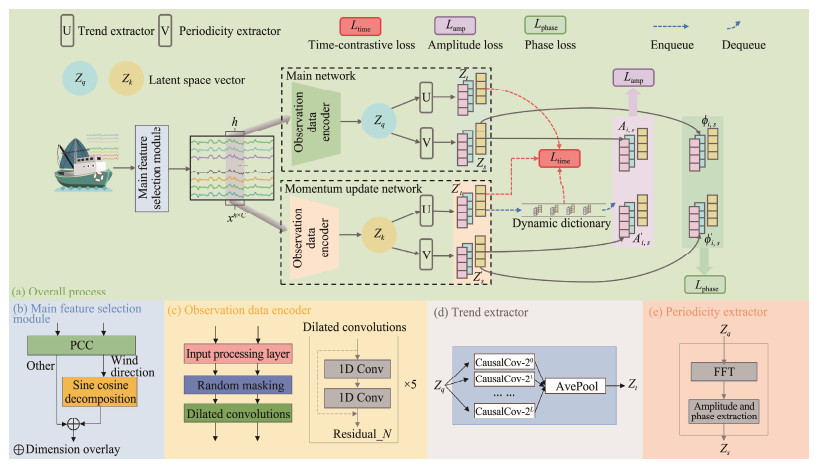
Fig.1(a) shows the entire process flow of the proposed model. For multi-factor ocean observational data, relevant features closely associated with ultrasonic wind intensity are initially extracted using the main feature selection module. Subsequently, a dual network comprising a main network and momentum update network performs contrastive learning to extract specific representations. Ultimately, the learned representations are applied as inputs for downstream linear regression tasks to predict future outcomes.
|
Fig. 1 Model architecture diagram. (a), provides an overview of the entire workflow, whereas (b), (c), (d), and (e) offer detailed representations of individual sub-modules. |
To enhance the predictive precision with a parsimonious feature set while reducing the interference from redundant factors, we adopted the PCC methodology. As delineated in Fig.1(b) we meticulously curated pivotal maritime data elements to serve as the model's input sequence.
The PCC assesses the linear relationship between two variables and extracts key information from multivariate data, simplifying subsequent calculations. It is calculated by dividing the covariance of two variables by the product of their standard deviations, expressed by the following formula:
| $ \gamma = \frac{{\sum\limits_{i = 1}^n {\left({{v_i} - \bar v} \right)\left({{u_i} - \bar u} \right)} }}{{\sqrt {\sum\limits_{i = 1}^n {{{\left({{v_i} - \bar v} \right)}^2}{{\left({{u_i} - \bar u} \right)}^2}} } }}, $ | (1) |
where γ represents the Pearson correlation coefficient, −1 < γ < 1. vi and ui denote two specific samples from v and u, respectively, and
Furthermore, owing to the combined impact of ship heading and meteorological factors, wind direction readings from shipboard measurements often fluctuate sharply between 360˚ and 0˚. To address these instantaneous and drastic changes while preserving the periodic trends in the wind direction data, we decompose the wind direction into left and right shipside components, resulting in four orthogonal components. The expressions are expressed as follows:
| $ \text { component}_{{\sin }} = \sin \left({\frac{{\theta \mathtt{π} }}{{18{0^ \circ }}}} \right), $ | (2) |
| $ \text { component}_{{\cos }} = \cos \left({\frac{{\theta \mathtt{π} }}{{18{0^ \circ }}}} \right), $ | (3) |
where θ represents the wind direction range, which extends from 0˚ to 360˚.
3.2 Main NetworkThe main network comprises an observational data encoder and two feature extractors: the trend and periodicity extractors. As shown in Fig.1(a), we assume that the time series obtained after the main feature selection module is denoted as xT = {x1, x2, ···, xt}, where
The momentum update network f (·) mirrors the architecture of the main network g(·) but does not undergo gradient backward updates. Instead, it iteratively updates its parameters using momentum from the main network, ensuring alignment between both networks. Additionally, in self-supervised learning, a dynamic dictionary is commonly used to store feature representations learned by the model in previous iterations (Wu et al., 2018). The momentum update network generates new temporal representations Zt' and adds them to the queue while removing old representations, ensuring that the sample representations in the queue remain updated.
1) Observation data encoder
Fig.1(c) illustrates the observation data encoder, which comprises three components: an input processing layer, a random masking module, and a dilated convolutional neural network module.
The input processing layer maps the input ocean time series data
Next, random masking is applied to the high-dimensional feature representation k = {kt} at specific time steps to generate an enhanced view. Using a binary encoding vector q∈{0, 1}T, with positions determined by a Bernoulli distribution p = 0.5, this operation introduces additional randomness. This randomness prevents the model from focusing too much on particular timestamps, thus enabling it to leverage the remaining data for inference. This approach enhances the overall performance of the model and its ability to generalize to unknown timestamps.
The dilated convolutional neural network module generates representations for each timestamp. This procedure involves five residual blocks, each containing two one-dimensional convolutional layers. The dilation factors increase exponentially (2l) for each block l. Dilated convolution enlarges the receptive field of each convolutional kernel by introducing holes in the kernel, which improves the capture of long-range dependencies on the input.
2) Temporal contrastive learning
Autoregressive filtering is a commonly used signal-processing method for analyzing time-series data because it effectively captures temporal lagged causal relationships among observed values. However, selecting an appropriate window size is crucial; a small window can lead to underfitting, whereas a large window can cause overfitting and over-parameterization. To address this issue, we employ a hybrid approach known as autoregressive expert mixing. The proposed method combines autoregressive modeling with expert systems, and it features an adaptive selection of retrospective windows that intelligently adjusts window sizes based on data characteristics.
The trend extractor, illustrated in Fig.1(d), is a hybrid model comprising L + 1 autoregressive experts. Each expert performs a one-dimensional causal convolution featuring d input channels and dt output channels. The adaptive window size, determined by L = ⌊log2(b /2)⌋, ensures a dynamic selection of retrospective window sizes based on parameter b. The convolution kernel size for each expert j is defined as 2j. Output generation involves producing a matrix Zj for each expert using the causal convolution operation Zj = CausalConv(Zq; 2j). Ultimately, the temporal trend is represented by applying average pooling to the outputs of these experts.
| $ {Z_t} = \text {AvePool}\left({{Z_0}, {Z_1}, \cdot \cdot \cdot, {Z_L}} \right) . $ | (4) |
To capture temporal trends in marine observational data, we identify features from both the main network and momentum update network (or dynamic dictionary) for the same sample i as positive samples. Negative samples are then defined as features Zi, t from the main network and features Zj, t from the dynamic dictionary for different samples j (where i ≠ j). The loss function is delineated by the following specifications:
| $ {L_{\text {time}}} = \sum\limits_{i = 1}^N {\log \left({\frac{{\exp \left({\frac{{{Z_{i, t}} \cdot {{Z'}_{i, t}}}}{T}} \right)}}{{\exp \left({\frac{{{Z_{i, t}} \cdot {{Z'}_{i, t}}}}{T}} \right) + \sum\limits_{j = 1}^u {\exp \left({\frac{{{Z_{i, t}} \cdot {{Z'}_{j, t}}}}{T}} \right)} }}} \right)}, $ | (5) |
where T is a temperature hyperparameter, N represents the number of samples, and u represents the size of the dynamic dictionary.
3) Frequency domain contrastive learning
Frequency domain analysis is a common method for examining time-series data, particularly when dealing with periodic or cyclic patterns. By converting signals into the frequency domain, frequency domain analysis captures periodic structures in the data, such as the regular turns of ships or seasonal changes in wind direction.
The periodicity extractor, as illustrated in Fig.1(e), primarily comprises two steps. First, the potential space Zq is transformed from the time domain to the frequency domain using Fourier transformation, resulting in the corresponding frequency domain representation r. From this representation, the amplitude and phase information are extracted for use in subsequent contrastive learning tasks. The formulas for calculating the amplitude and phase are as follows:
| $ \mathrm{amp}=\sqrt{(\text { real }+\varepsilon)^2+(\mathrm{imag}+\varepsilon)^2}, $ | (6) |
| $ \text { phase }=\mathrm{a} \tan 2(\text { imag, real }+\varepsilon), $ | (7) |
where 'real' represents the real part of r, 'imag' denotes the imaginary part of r, ε is a small constant 1 × 10⁻⁶, 'amp' indicates the calculated amplitude, and 'phase' signifies the calculated phase.
To generate distinct periodic representations when the frequency is not explicitly known, we introduce a novel frequency domain contrastive loss. To simplify the loss function, we opt for the representation of the amplitude A and phase ϕ, thereby avoiding the use of complex values in constructing the loss function.
Amplitude representations Ai, s from the main network and A'i, s momentum update network for the same sample i in a batch are considered positive pairs. Simultaneously, Ai, s from the main network for sample i is paired with representations Aj, s from different samples j as negative pairs. The loss function for amplitudes is provided as follows:
| $ {L_{\mathrm{amp}}} = \frac{{\exp \left({{A_{i, s}} \cdot {{A'}_{i, s}}} \right)}}{{\sum\limits_{j = 1}^B {\left({\exp \left({{A_{i, s}} \cdot {{A'}_{i, s}}} \right) + {\Gamma _{[i \ne j]}}\exp \left({{A_{i, s}} \cdot {A_{j, s}}} \right)} \right)} }}, $ | (8) |
where B represents the batch size and j denotes the j-th representation in the same batch. The symbol Γ serves as an indicator, taking the value of 1 when i ≠ j and 0 when i = j.
Similarly, the loss function of the phase representations is expressed as follows:
| $ {L_{\text {phase }}} = \frac{{\exp \left({{\phi _{i, s}} \cdot {{\phi '}_{i, s}}} \right)}}{{\sum\limits_{j = 1}^B {\left({\exp \left({{\phi _{i, s}} \cdot {{\phi '}_{i, s}}} \right) + {\Gamma _{[i \ne j]}}\exp \left({{\phi _{i, s}} \cdot {\phi _{j, s}}} \right)} \right)} }}. $ | (9) |
4) Total contrastive loss
The synergistic action of the three aforementioned losses enables the model to simultaneously capture both timeand frequency-domain information in time-series data. To accomplish this, we formulate the total contrastive loss as follows:
| $ L_{\text {total }}=L_{\text {time }}+\frac{\alpha}{2}\left(L_{\mathrm{amp}}+L_{\text {phase }}\right), $ | (10) |
where α represents a hyperparameter that balances the timeand frequency-domain representations. In the concluding step, the outputs from the trend extractor and the periodicity extractor are combined to form the final output representation.
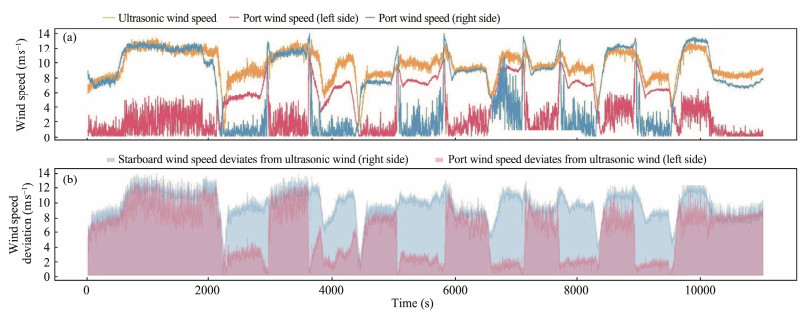
4 Experiments and Results 4.1 DatasetThis study used shipborne sensor data collected by the Qingdao Marine Research Institute between March 26, 2023, and April 18, 2023, in a specific marine area. The data were recorded at a temporal resolution of 1 s. Fig.2(a) shows the raw wind speed data for both the port and starboard.
|
Fig. 2 Wind speed performance before correction. This diagram illustrates the wind speeds on both sides of the boat, as well as the ultrasonic wind speed (a), along with the corresponding deviation (b). The time granularity on the x-axis is 1 s. |
The experiment employed the A100 GPU for model training with a consistent batch size of 64. The Adam optimizer, with a learning rate of 0.001, was employed throughout the experiment. The training phase spanned 40 epochs and featured an encoder with a hidden dimension of 128 and an output representation of 320. For handling temporal contrastive loss, we set the dictionary queue size to 256, maintained a momentum of 0.999, and maintained the temperature at 0.07℃.
To assess the accuracy of the corrected wind speed, we relied on key metrics, such as the mean absolute error (MAE), mean squared error (MSE), mean absolute percentage error (MAPE), and root mean squared error (RMSE). These metrics collectively provide a comprehensive view of model performance. Lower values in these metrics indicate more precise predictions, further confirming the effectiveness of the proposed method.
MAE calculates the average of the absolute errors between the actual and predicted values. The formula is expressed as follows:
| $ MAE = \frac{1}{n}\sum\limits_{i = 1}^n {\left| {{y_i} - {{\hat y}_i}} \right|} . $ | (11) |
MSE quantifies the disparity between actual and predicted wind speed values. The formula is expressed as follows:
| $ MSE = \frac{1}{n}\sum\limits_{i = 1}^n {{{\left({{y_i} - {{\hat y}_i}} \right)}^2}} . $ | (12) |
MAPE reflects the absolute percentage error between the actual and predicted values. The formula is expressed as follows:
| $ MAPE = \frac{1}{n}\sum\limits_{i = 1}^n {\left| {\frac{{{y_i} - {{\hat y}_i}}}{{{y_i}}}} \right|} . $ | (13) |
RMSE reflects the average difference between the actual observed and model predicted values. The formula is expressed as follows:
| $ RMSE = \sqrt {\frac{1}{n}\sum\limits_{i = 1}^n {{{\left({{y_i} - {{\hat y}_i}} \right)}^2}} } . $ | (14) |
In Eqs. (11) to (14), n represents the number of samples, yi represents the actual value of the i-th sample, and
Experiment 1: We initially compared the port and starboard wind speeds with the true wind speed, as shown in Fig.2(a). Here, the left side wind speed is represented in sky blue, the right side in pink, and the ultrasonic wind speed in yellow. Despite this, Fig.2(b) shows some disparities between the ship's side wind speed and the ultrasonic wind speed, with maximum errors of about 15.4 m s−1 for the left side and 15.5 m s−1 for the right side. Therefore, correcting these shipborne wind speed measurements is crucial.
Experiment 2: To assess the main feature selection module's effectiveness, we employed the PCC method. Our primary goal was to improve prediction accuracy while simultaneously reducing training complexity. In this experimental phase, we opted for the top 4 variables most correlated with actual wind speed. Additionally, to mitigate wind direction fluctuations, we applied sine and cosine decomposition. Table 1 shows that after the principal feature selection, the wind speed accuracy was significantly improved, confirming the efficacy of the main feature selection module.

|
Table 1 PCC values used for main feature selection and wind direction decomposition |
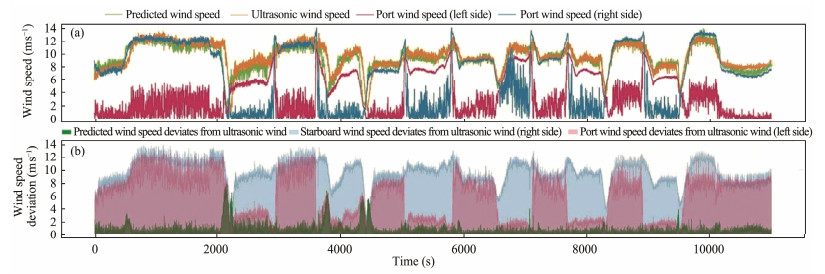
Experiment 3: We employed the architecture depicted in Fig.1 to predict and compare the corrected wind speeds with the original port and starboard wind speeds. Fig.3(a) provides clear evidence that the corrected wind speed closely aligns with the actual wind speed. Additionally, Fig.3(b) shows that our model's predicted deviations were significantly reduced compared with the initial port and starboard wind speeds and ultrasonic wind, resulting in a more stable error curve. This stability is evident as the wind strength varies, indicating greater resilience. The performance metrics presented in Table 2 highlight a distinct improvement in wind speed prediction accuracy after correction compared with the uncorrected scenario. This outcome clearly indicates that the correction step of the model effectively enhances the wind speed forecasting accuracy.
|
Fig. 3 Predicted wind speed performance. (a), wind speed prediction results of the proposed model; (b), deviation magnitude between the predicted results and the original port and starboard wind speeds. |
|
|
Table 2 Comparison of port and starboard wind speeds before and after correction, where the wind speeds on the port and starboard sides represent the measurements taken before correction |
Experiment 4: To assess the predictive capabilities of the proposed model, we compared it with existing models for both single-step and multistep predictions. All networks used the input variables selected by the main feature selection module.
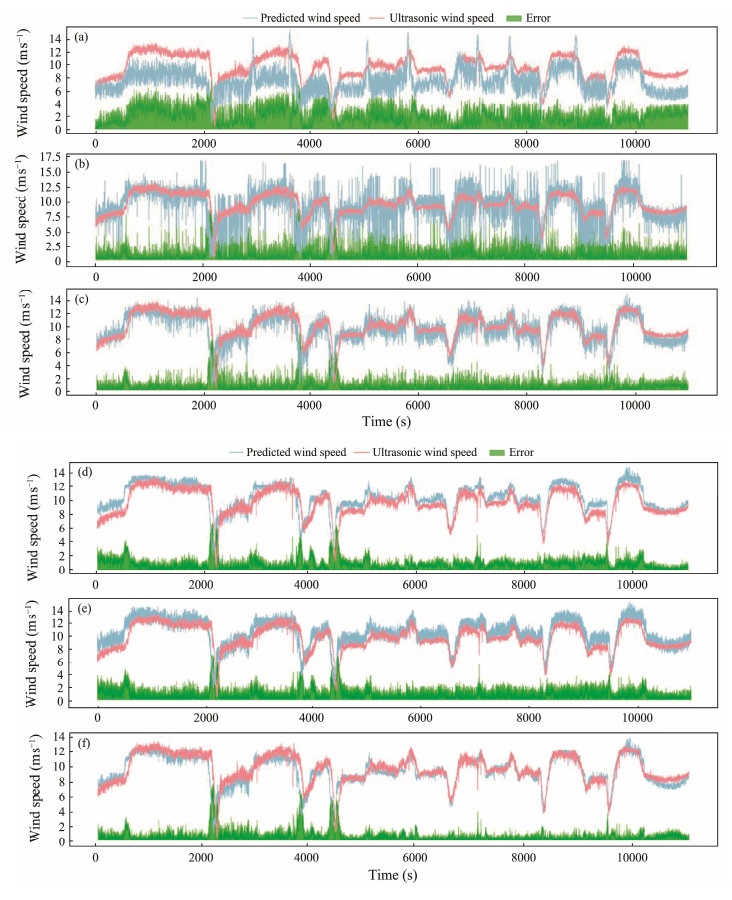
1) Comparison of single-step predictions among different models: Fig.4 highlights the outstanding predictive performance of the proposed approach. Compared with other highly cited wind speed correction methods, our model significantly reduced the prediction errors, achieving superior results in the evaluation metrics presented in Table 3.
|
Fig. 4 (a) – (c) Comparison chart of different models, (a) – (c) depict the prediction results of existing approaches. (d) – (f) Comparison chart of different models, where (d) – (e) depict the prediction results of existing approaches, and (f) illustrates the prediction results of our proposed model. |
|
|
Table 3 Single-step prediction performance comparison |
2) Comparison of multistep predictions among different models: To validate our model performance in multistep predictions, specifically for forecasting 10 and 30 s ahead, we compared its predictive accuracy with other models, as shown in Table 4. The results clearly highlight the model's superior prediction accuracy. Notably, as the prediction horizon increases, most models tend to exhibit a higher number of errors. However, the proposed model outperformed comparable models, consistently maintaining lower MAE, RMSE, and MAPE values.
|
|
Table 4 Multistep prediction performance comparison |
This study presents a framework for correcting and predicting shipborne wind speed using self-supervised contrastive learning. The proposed framework excels at extracting timeand frequency-domain features by harnessing the combined strengths of a main network and momentum update network, leading to effective correction of shipborne wind data. Validated through practical cases by the Institute of Oceanographic Instrumentation, Shandong Academy of Science, the proposed framework demonstrates superior accuracy in wind speed prediction when compared to existing models in both single-step and multistep forecasts. Future research could further validate the proposed method's effectiveness by applying it to a wider range of real-world maritime scenarios.
AcknowledgementsThis work was supported by the Major Innovation Project for the Integration of Science, Education, and Industry of Qilu University of Technology (Shandong Academy of Sciences) (Nos. 2023HYZX01, 2023JBZ02), the Open Project of Key Laboratory of Computing Power Network and Information Security, Ministry of Education, Qilu University of Technology (Shandong Academy of Sciences) (No. 2023ZD007), the Talent Research Projects of Qilu University of Technology (Shandong Academy of Sciences) (No. 2023RCKY136), the Technology and Innovation Major Project of the Ministry of Science and Technology of China (No. 2022ZD0118600), and the Jinan '20 New Colleges and Universities' Funded Project (No. 202333043).
Author Contributions
All authors contributed to the study conception and design. Material preparation, data collection and analysis were performed by Xiang Li. The draft of the manuscript was written by Jian Song and Meng Huang. Zhenqiang Zhang, Chunxiao Wang, and Zhigang Zhao were responsible for the review and editing of the manuscript. All authors read and approved the final manuscript.
Data Availability
The data and references presented in this study are available from the corresponding author upon reasonable request.
Declarations
Ethics Approval and Consent to Participate
This article does not contain any studies with human participants or animals performed by any of the authors.
Consent for Publication
Informed consent for publication was obtained from all participants.
Conflict of Interests
The authors declare that they have no conflict of interests.
Al-Yahyai, S., Charabi, Y., and Gastli, A., 2010. Review of the use of numerical weather prediction (NWP) models for wind energy assessment. Renewable and Sustainable Energy Reviews, 14(9): 3192-3198. (  0) 0) |
Auligné, T., McNally, A. P., and Dee, D. P., 2007. Adaptive bias correction for satellite data in a numerical weather prediction system. Quarterly Journal of the Royal Meteorological Society, 133(624): 631-642. ( 0) |
Chen, T., Kornblith, S., Norouzi, M., and Hinton, G., 2020. A simple framework for contrastive learning of visual representations. International Conference on Machine Learning. PMLR, 1597-1607.
( 0) |
Dong, L., Ren, L., Gao, S., Gao, Y., and Liao, X., 2013. Studies on wind farms ultra-short term NWP wind speed correction methods. 2013 25th Chinese Control and Decision Conference (CCDC). Guiyang, 1576-1579.
( 0) |
Eldele, E., Ragab, M., Chen, Z., Wu, M., Kwoh, C. K., Li, X., et al., 2021. Time-series representation learning via temporal and contextual contrasting. International Joint Conferences on Artificial Intelligence (IJCAI-21). Montreal, 1-8.
( 0) |
Han, Y., Mi, L., Shen, L., Cai, C. S., Liu, Y., Li, K., et al., 2022. A short-term wind speed prediction method utilizing novel hybrid deep learning algorithms to correct numerical weather forecasting. Applied Energy, 312: 118777. ( 0) |
Jiang, J. J., Dang, W. J., Duan, F. J., Wang, X. Q., Fu, X., and Li, C. Y., 2020. An accurate ultrasonic wind speed and direction measuring method by combining time-difference and phasedifference measurement using coded pulses combination. Applied Acoustics, 159: 107093. ( 0) |
Jiang, Y., Chen, X., Yu, K., and Liao, Y., 2017. Short-term wind power forecasting using hybrid method based on enhanced boosting algorithm. Journal of Modern Power Systems and Clean Energy, 5(1): 126-133. ( 0) |
Jimenez, B., Durante, F., Lange, B., Kreutzer, T., and Tambke, J., 2007. Offshore wind resource assessment with WAsP and MM5: Comparative study for the German Bight. Wind Energy, 10(2): 121-134. ( 0) |
Kunić, Z., Ženko, B., and Boshkoska, B. M., 2021. FOCUSED – short-term wind speed forecast correction algorithm based on successive NWP forecasts for use in traffic control decision support systems. Sensors, 21(10): 3405. ( 0) |
Le-Khac, P. H., Healy, G., and Smeaton, A. F., 2020. Contrastive representation learning: A framework and review. IEEE Access, 8: 193907-193934. ( 0) |
Liu, H., Yu, C., Wu, H., Duan, Z., and Yan, G., 2020. A new hybrid ensemble deep reinforcement learning model for wind speed short term forecasting. Energy, 202: 117794. ( 0) |
Mortensen, N. G., Hansen, J. C., Badger, J., Jørgensen, B. H., Hasager, C. B., Paulsen, U. S., et al., 2006. Wind atlas for Egypt: Measurements, microand mesoscale modelling. 2006 European Wind Energy Conference and Exhibition. European Wind Energy Association (EWEA), 136-145.
( 0) |
Patel, Y., and Deb, D., 2022. Machine intelligent hybrid methods based on Kalman filter and wavelet transform for shortterm wind speed prediction. Wind, 2(1): 37-50. ( 0) |
Prabowo, A. R., Tuswan, T., Ridwan, R., 2021. Advanced development of sensors' roles in maritime-based industry and research: From field monitoring to high-risk phenomenon measurement. Applied Science – Basel, 11: 3954. ( 0) |
Qin, Y., Liu, Y., Jiang, X., Yang, L., Xu, H., Shi, Y., et al., 2023. Grid-to-point deep-learning error correction for the surface weather forecasts of a fine-scale numerical weather prediction system. Atmosphere, 14(1): 145. ( 0) |
Rannik, Ü., and Vesala, T., 1999. Autoregressive filtering versus linear detrending in estimation of fluxes by the eddy covariance method. Boundary-Layer Meteorology, 91: 259-280. DOI:10.1023/A:1001840416858 ( 0) |
Song, J., Li, X., Zhang, Z., Zhao, Z., Wang, C., Wu, S., et al., 2024. A predictive framework for shipborne wind speed measurement correction based on self-supervised contrastive learning. 2024 27th International Conference on Computer Supported Cooperative Work in Design (CSCWD 24). Tianjin, 2319-2324.
( 0) |
Sun, C. Y., 2022. Q-stacking prediction model considering wind speed error correction. Wind Engineering, 46: 886-895. DOI:10.1177/0309524x211060235 ( 0) |
Tang, R., Ning, Y., Li, C., Feng, W., Chen, Y., and Xie, X., 2021. Numerical forecast correction of temperature and wind using a single-station single-time spatial LightGBM method. Sensors, 22(1): 193. ( 0) |
Tonekaboni, S., Eytan, D., and Goldenberg, A., 2021. Unsupervised representation learning for time series with temporal neighborhood coding. ArXiv preprint arXiv: 2106.00750.
( 0) |
Wickstrøm, K., Kampffmeyer, M., Mikalsen, K., and Jenssen, R., 2022. Mixing up contrastive learning: Self-supervised representation learning for time series. Pattern Recognition Letters, 155: 54-61. DOI:10.1016/j.patrec.2022.02.007 ( 0) |
Wu, Z., Xiong, Y., Yu, S. X., and Lin, D., 2018. Unsupervised feature learning via non-parametric instance discrimination. 2018 IEEE/CVF Conference on Computer Vision and Pattern Recognition. Salt Lake City, 3733-3742.
( 0) |
Xu, W., Liu, P., Cheng, L., Zhou, Y., Xia, Q., Gong, Y., et al., 2021. Multi-step wind speed prediction by combining a WRF simulation and an error correction strategy. Renewable Energy, 163: 772-782. ( 0) |
Yakoub, G., Mathew, S., and Leal, J., 2020. Downscaling and improving the wind forecasts from NWP for wind energy applications using support vector regression. Journal of Physics: Conference Series, 1618: 062034. ( 0) |
Zhang, Y., Li, Y., and Zhang, G., 2020. Short-term wind power forecasting approach based on Seq2Seq model using NWP data. Energy, 213: 118371. ( 0) |
Zhao, X., Jiang, N., Liu, J., Yu, D., and Chang, J., 2020. Shortterm average wind speed and turbulent standard deviation forecasts based on one-dimensional convolutional neural network and the integrate method for probabilistic framework. Energy Conversion and Management, 203: 112239. ( 0) |