 2025, Vol. 24


2) Key Laboratory of Marine Mineral Resources, Ministry of Natural Resources, Guangzhou Marine Geological Survey, Guangzhou 511458, China;
3) College of Marine Geosciences, Ocean University of China, Qingdao 266100, China;
4) Center for Biomedical Materials and Interfaces, Shenzhen Institutes of Advanced Technology, Chinese Academy of Sciences, Shenzhen 518055, China
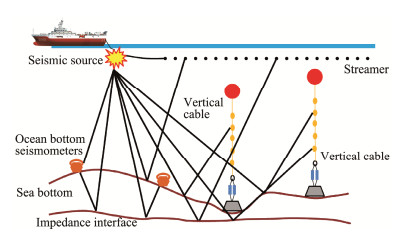
High resolution seismic exploration plays an important role in exploring marine sedimentary layers, exploring submarine landslides and geological hazards, and investigating natural gas hydrates (Brothers et al., 2013; Hao et al., 2017; Luo et al., 2017). Spark is the most commonly used high-resolution seismic exploration source. Compared to other seismic sources, spark has the characteristics of high main frequency, a slightly wider frequency band, fast charging and discharging, and easy deployment. Compared to high-resolution seismic exploration sources such as sonar and parameter arrays, the spark source can penetrate deeper (Watkins et al., 1993; Muller et al., 2002; Pei et al., 2019). In the 1970s, spark sources generally replaced small capacity air guns as popular high-resolution seismic exploration sources (Duchesne et al., 2007). The early spark source used the principle of arc discharge, which was triggered by a high voltage to discharge copper rods, breaking through the medium and generating an acoustic pulse signal. As the electrode loss becomes increasingly severe, the consistency of source wavelets becomes poor. In practical exploration surveys, spark sources have gradually exposed their own shortcomings (Pei et al., 2017). Unlike arc discharge, the corona discharge process in high conductivity liquids can compensate for the aforementioned shortcomings. Corona discharge has no current breakdown channel and no current leakage. By using the cathode as the discharge electrode, the loss effect of the discharge electrode is solved, and the consistency of the source wavelet is improved (Winands et al., 2005; Pei et al., 2007; Yan et al., 2012). The discharge process of a plasma spark source is influenced by parameters such as charge discharge voltage and capacitance (Huang et al., 2016), electrode diameter (Pei et al., 2017), relative position of electrodes (Zhu et al., 2017), water temperature, conductivity, and sinking depth (Huang et al., 2015). Based on experimental data, the bubble motion equation is used to simulate and calculate the acoustic pulse signal after a single electrode discharge of 5 – 30 joules (Huang et al., 2014). However, the plasma spark source excites pulses in the form of a combination of multiple electrodes. Combining the approximate multi-bubble motion equation with single electrode discharge test data, with synchronous excitation of multiple electrodes at equal intervals as the initial condition, Wei et al. (2021) simulated the acoustic pulse signal of the plasma electric spark source and established a wavelet simulation method for the plasma electric spark source. The ocean three-dimensional observation method is a new type of multidimensional seismic exploration method that integrates some advanced measurement methods such as horizontal streamers, vertical cables, and seabed seismometers. The ocean stereo observation method can obtain richer wave field information, thereby improving observation accuracy (Asakawa et al., 2010) (Fig. 1). Using the plasma spark source wavelet simulation method, combined with seismic data obtained from three-dimensional ocean observations, we aim to analyze the generation of plasma spark source wavelet and its propagation characteristics, describe the spatial characteristics of plasma electric spark source wavelet more clearly, and propose an evaluation method for plasma spark source wavelet.
|
Fig. 1 Schematic diagram of the ocean stereo observation. |
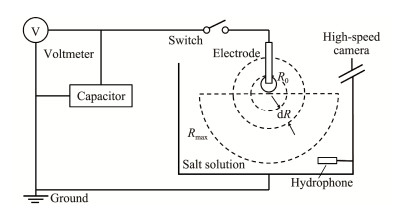
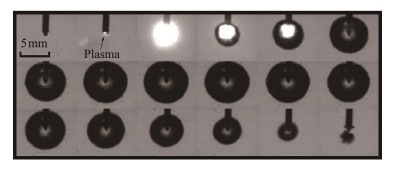
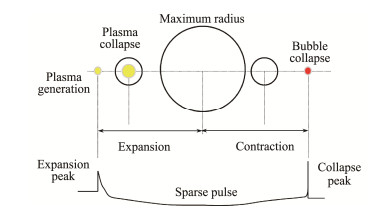
Electrical energy is converted into internal energy, light energy, and mechanical energy in the process of plasma discharge in water. Huang et al. (2014) conducted the experiment using the device shown in Fig.2. When the air switch is closed and the capacitor begins to discharge, the electrode tip accumulates a strong current density over time. As the voltage at the electrode tip increases and the water near the electrode is rapidly vaporized, a hot high-pressure plasma bubble is formed at the tip (Fig.3). During the process of plasma formation, the pressure inside the bubble rapidly increases and is accompanied by the ionization and hydrolysis of water molecules. As the bubble rapidly increases, the internal pressure of the bubble reaches its maximum. Then, the internal pressure decreases, and when it is less than the external pressure, the bubble begins to contract. Due to limited capacitance energy, the plasma will undergo neutralization, collapse, and elimination (Liu and Sun, 2006; Zhang et al., 2016). In the early stage of bubble formation, the expansion of plasma bubble is accompanied by the emission of light, heat, and acoustic wave. The first positive pulse generated by bubble oscillation is the main pulse signal of the plasma spark, also known as the peak of the expansion pulse. Due to the high temperature around the plasma, the radius of bubble filled with vapor will continue to increase. As the plasma energy is converted into other forms of energy and released, the plasma gradually disappears and the bubbles begin to contract. The prerequisite for bubble expansion is that the internal pressure of the bubble is greater than the external fluid pressure. As the bubble radius increases, the pressure difference between the inside and outside gradually decreases. When the bubble expands to an internal pressure equal to the fluid pressure, the bubble radius reaches its maximum. Due to the inertia of the expansion of the bubble wall, the internal pressure begins to decrease and the bubble begins to contract. When the pressure difference reaches its maximum, the bubble collapses and generates a peak pulse, which is the peak of the contraction pulse (Yan et al., 2012). After a cycle of oscillation, the bubbles at the end of the electrode break and disappear (Fig.4).
|
Fig. 2 Schematic diagram of discharge system experiment (modified after Huang et al. (2014)). |
|
Fig. 3 One single bubble oscillation period with excitation energy of 10 J (modified after Huang et al. (2014)). |
|
Fig. 4 Schematic diagram of the generation process of single electrode plasma acoustic pulse signal (modified after Wei et al. (2021)). |
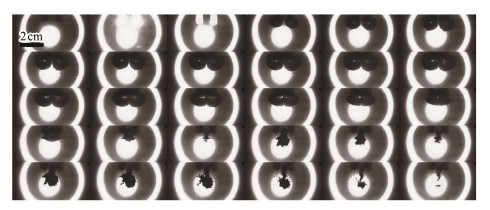
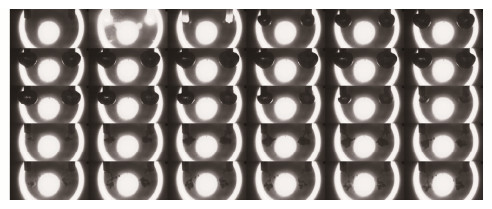
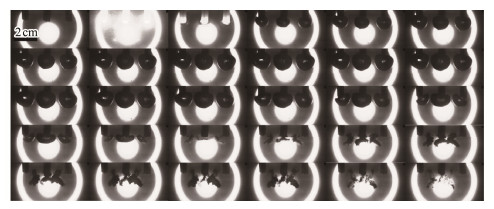
Due to the limited excitation energy of a single electrode, it cannot meet the actual exploration needs. According to the different exploration depths of geological targets, plasma source is usually applied in the form of combinations (Pei et al., 2019). The combination of multiple electrodes can not only increase the excitation energy of the source to improve the initial peak of the main pulse, but also suppress the source bubble effect caused by the excitation method. The characteristics of pulsed sound wave are influenced by the number of electrodes, but the more important parameter is the electrode spacing. The different electrode spacing mainly affects the dynamic process of bubble pulsation. Yan et al. (2011) conducted high-speed photography experiments on bubble dynamics under different spacing conditions, with a time interval of 0.1 ms between each frame.
It was focused on analyzing the effect of electrode spacing on bubble vibration while Single electrode excitation energy was 10 J. Firstly, the distance between the two electrodes was set at 1 cm, leading to interaction between the two bubbles. Squeezing occurred on the inner side of double bubbles at 0.6 ms. The two bubbles began to merge at 1.1 ms and collapsed into one bubble after 1.8 ms, resulting in the generation of secondary pulsation oscillations in the form of one bubble with irregular shapes (Fig.5). When the electrode spacing was increased to 4 cm, the interaction between bubbles weakened, and the expansion and contraction process of bubbles was relatively complete during a period, without the occurrence of collapsing into a single bubble (Fig.6).
|
Fig. 5 Bubble pulsation process at a 1 cm spacing between two electrodes (20 J per pulse) (modified after Yan et al. (2011)). |
|
Fig. 6 Bubble pulsation process at a 4 cm spacing between two electrodes (20 J per pulse) (modified after Yan et al. (2011)). |
Set three electrodes with a spacing of about 2 cm. Initially, the development of the three bubbles is relatively even, but the period of the middle bubble is significantly longer than the other two bubbles by about 0.2 ms. The closer the distance between electrodes is, the more irregular the shape of the secondary pulsation of bubbles is. Especially when the middle bubble is broken by the action of bubbles on both sides, only the secondary pulsation of bubbles on both sides is more obvious, and the middle bubble has almost no secondary pulsation, that is, the secondary pulse sound wave of the middle bubble is suppressed (Fig.7).
|
Fig. 7 Bubble pulsation process at a 2 cm spacing between three electrodes (30 J per pulse) (modified after Yan et al. (2011)). |
The formation of plasma spark source wavelet is a complex process. A plasma spark source requires several hundred electrode combinations. The formation of source wavelets can usually be divided into near field wavelets and far field wavelets. This section analyzes the numerical relationship between far-field and near-field wavelets by explaining the boundaries between them.
3.1 Near Field Wavelet SimulationThe acoustic wave pulse propagates in a spherical manner after being excited by the seismic source. The acoustic pulse changes with spatial position within a certain spherical range, resulting in different wavelet waveforms and pressure values at different points. The near field is the range where wavelet changes with position due to the source spatial scale. Beyond this range and extending to infinity, the wavelet shapes at each point tend to stabilize without any changes, with only the pressure value decreasing according to the law of spherical diffusion. This region is called the far field.
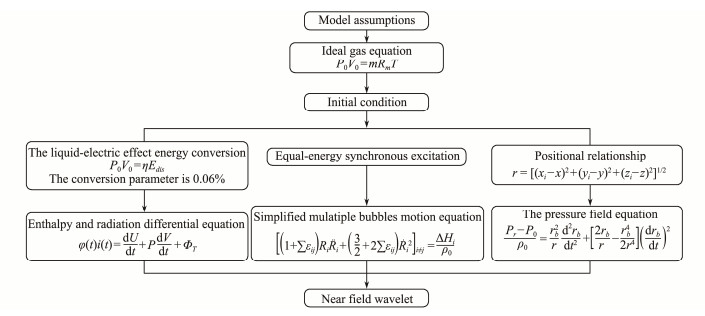
By studying the energy conversion in plasma discharge systems, the efficiency of electrical and acoustic energy conversion can be determined. Based on the ideal gas state equation and certain assumptions, we obtain the initial parameters of the bubble, including initial pressure, initial bubble radius, initial bubble wall velocity, etc. Under the premise of knowing the number of electrodes and the distance between electrodes, a multi-bubble motion equation is derived based on the equal energy synchronous excitation of multi bubbles in a linear arrangement (Wei et al., 2021). By using the multi bubble motion equation, energy conversion equation, and ideal gas equation, the acoustic pulse function of the corresponding electrode is obtained. Assuming that the source is a point, the total acoustic pulse pressure at the center of the source can be considered as the near-field wavelet of the source (Fig.8). Due to the presence of the water vapor interface, near-field wavelet is coupled with its virtual reflection.
|
Fig. 8 Flow chart of plasma spark source wavelet simulation method (modified after Wei et al. (2021)). |
Empirical Eq. (1) is usually used to calculate the farfield distance d (Krail, 2010).
| $ d > \frac{{{D^2}}}{{{\lambda _{\min }}}} = {f_{\min }}\frac{{{D^2}}}{c}, $ | (1) |
where fmin is the minimum frequency of the excitation wavelet; λmin is the minimum wavelength of the excitation wavelet; D is the maximum size of the source array space; c is the acoustic velocity in water.
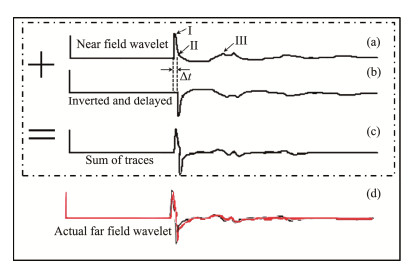
When the receiving distance is greater than d, the source wavelet is the far-field wavelet. The wavelet mentioned in the seismic survey is usually the far-field wavelet. The relevant method patents have outlined the numerical calculation relationship between near-field and far-field wavelets (Dragoset and Cumro, 1987). The near-field wavelet is a function of position. Dragoset and Cumro (1987) mainly focused on the vertical downward propagation of the seismic source, and chose to measure the near-field wavelet at a certain depth below the center of the seismic source. The near-field wavelet measured was affected by the actual situation at that depth, which included the primary peak, bubble peak, and their virtual reflections (Fig.9a). After calculating the delay and polarity reversal of the actual A-field wavelet, the corresponding sea surface virtual reflection of the near-field wavelet was obtained (Fig.9b), and the far-field wavelet was obtained by combining the two (Fig.9c). Compared with the actual far-field wavelets, it could be observed that the difference between them was relatively small (Fig.9d). Through the above method, it is believed that whether through on-site measurements or indoor simulation calculations, as long as the near-field wavelet is obtained, the far-field wavelet would be determined.
|
Fig. 9 Far-field wavelet calculation method (modified after Dragoset and Cumro (1987)). (a), near field wavelet (Ⅰ is primary peak, Ⅱ is ghost, Ⅲ is bubble peak); (b), inverted and delay; (c), sum of (a) and (b); (d), comparison between calculated result (black line) and measured far-field wavelet (red line). |
Ocean three-dimensional observation technology is an exploration method that utilizes different reception methods at different positions to obtain seismic signals from different azimuths, providing comprehensive data for subsequent processing and interpretation work. The propagation characteristics of source wavelet directly affect the quality of the original data (Zhang et al., 2021). The relative position changes between excitation and reception result in changes in seismic wavelet characteristics. This section uses the wavelet model calculation method of a plasma spark source, establishes three-dimensional observation systems, analyzes the propagation characteristics of seismic wavelet in both horizontal and vertical directions, and finally obtains the wavelet facial spectrum that describes the propagation characteristics of spatial plasma spark wavelets. A plasma spark source is used with a brush like shape and 100 electrodes. The electrode spacing is about 2 cm, and the total energy is 5 kJ.
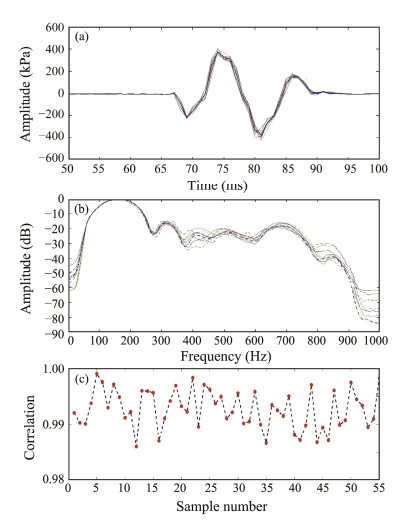
4.1 Consistency of Plasma Spark Source WaveletThe consistency of source wavelet is a prerequisite for applying wavelet simulation methods. The traditional spark source has poor wavelet consistency. The reason is that during the excitation process, electrode loss can affect the excitation pulse of the spark source. The plasma spark source is based on high-power semiconductor switching devices and multi electrode emission array technology, which solves the shortcomings of traditional spark source in engineering applications, mainly in terms of short service life of switches and discharge electrodes and poor repeatability of radiated sound waves (Huang et al., 2016). Based on the first arrival waveform received by the horizontal streamer, eleven out of thousands of excitation wavelets were selected randomly. The comparison results show that the difference between waveforms is small, while the corresponding frequency spectrum has a high degree of agreement between 50 and 400 Hz, with a correlation coefficient range of 0.98 – 1 (Fig.10). Therefore, the consistency of plasma source wavelet is good, and wavelet numerical simulation is meaningful.
|
Fig. 10 Consistency of far-field wavelets. (a), comparison of waveform consistency; (b), comparison of spectrum consistency; (c), cross correlation of wavelets. |
By describing the changes in the spatial propagation properties of wavelets, we analyze the propagation characteristics of wavelets and provide technical support for actual data collection and processing works. The attribute description of the spatial propagation characteristics of wavelets includes wavelet waveform, wavelet spectrum, wavelet energy, and wavelet directionality. They are called facial features.
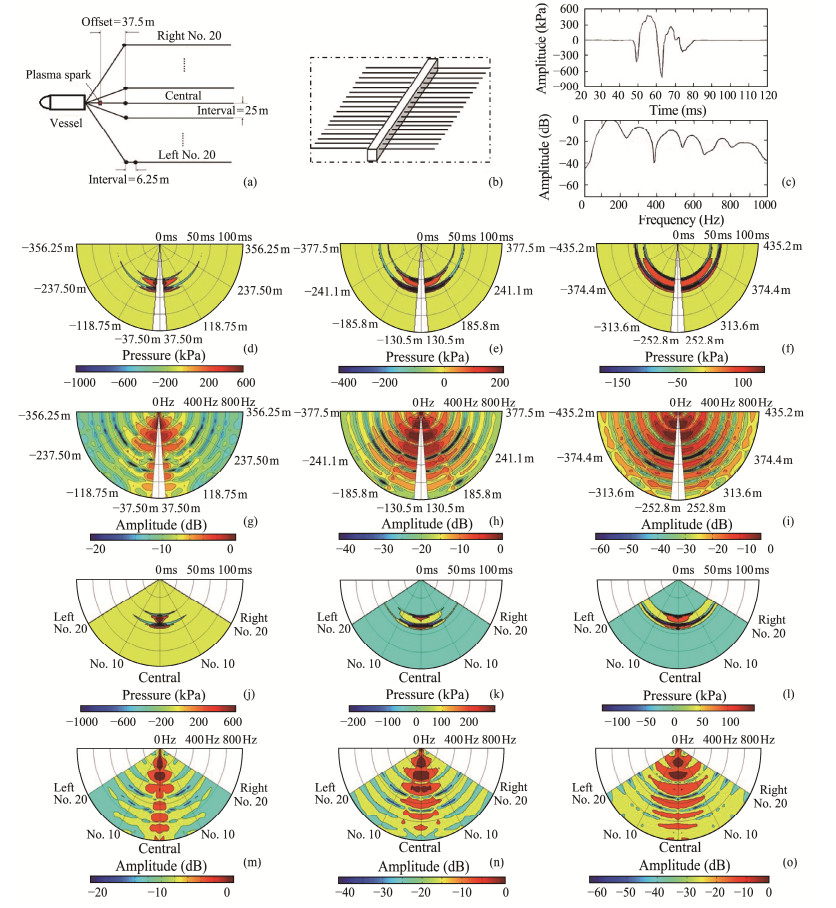
The established observation system parameters include a source sinking of 3 m, a horizontal streamer on the same straight line and at the same sinking depth as the source, a minimum offset of 37.5 m, and a channel spacing of 6.25 m, totaling 48 channels. Take the horizontal streamer as the centerline and increase the number of streamers equally spaced on both sides at intervals of 25 m. The outermost streamer is 500 m away from the centerline (Fig.11a). The plasma spark is in a brush-like shape (Fig.11b). The farfield wavelet of the plasma spark source is calculated by using simulation methods and its spectrum is obtained (Fig.11c). The waveforms and spectra from the central cable to the external cable are analyzed. The wavelet energy is mainly concentrated in the front of the cable, and as the lateral offset increases, the wavelet waveform energy decreases significantly. Unlike an air gun pulse, the bubble pulse of the plasma spark source is obvious and accounts for a large proportion (Figs.11d, e, and f). The frequency of the wavelet is concentrated in the range of 200 – 600 Hz, with small changes in bandwidth but significant changes in spectral energy. As the lateral offset increases, the bubble pulse portion in the sub-wave shape becomes prominent, and the corresponding spectral amplitude decreases (Figs.11g, h, and i).
|
Fig. 11 Simulated wavelet facial features of horizontal propagation. (a), horizontal observation system; (b), plasma spark shape; (c), simulated wavelet form and its spectrum; (d), central streamer simulated wavelet waveform facial feature; (e), No. 5 streamer simulated wavelet waveform facial feature; (f), No. 10 streamer simulated wavelet waveform facial feature; (g), central streamer simulated wavelet spectrum facial feature; (h), No. 5 streamer simulated wavelet spectrum facial feature; (i), No. 10 streamer simulated wavelet spectrum facial feature; (j), the wavelet waveform facial feature on the first channel of all streamers; (k), the wavelet waveform facial feature on the 12th channel of all streamers; (l), the wavelet waveform facial feature on the 24th channel of all streamers; (m), the wavelet spectrum facial feature on the first channel of all streamers; (n), the wavelet spectrum facial feature on the 12th channel of all streamers; (o), the wavelet spectrum facial feature on the 24th channel of all streamers. |
We analyzed the waveforms and spectrums of the 1st, 12th, and 24th channels of all cables. The variation of wavelets from the middle to both sides is relatively slow. The time width of the first positive polarity pulse decreases as the lateral distance increases. The absolute value of the peak value of the wavelet waveform also decreases as the lateral distance increases, and the rate of decrease is faster. The data on both sides of the central drag cable show symmetry (Figs.11j, k, and l). We analyzed the corresponding spectrum of wavelet, and found that the spectral energy changes significantly. As the number of channels increases, the corresponding high-frequency components decrease significantly and the spectral energy weakens.
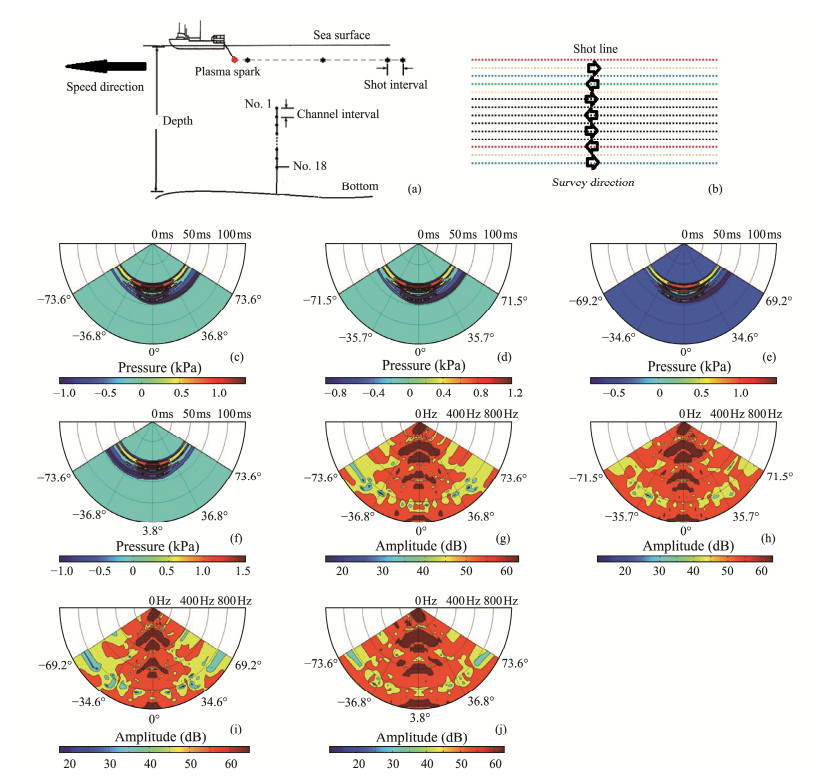
4.3 Vertical Propagation CharacteristicsThe depth of the seismic source is maintained at 3 m, and the vertical cable is located at 2000 m on the seabed. There are a total of 18 channels with a spacing of 25 m, and the bottom channel is 100 m away from the seabed. The shot point spacing is 25 m, and the cruise lines are parallel, with a round-trip interval of 100 m in sequence (Figs.12a, 2b). The wavelet waveform spectra of the first, ninth, and 18th channels were analyzed (Figs.12c – e). Along the survey direction, the wavelet waveform changes significantly, and the trend of the wavelet waveform changes symmetrically along the centerline. But the second pulse of the wavelet on the far-right side has significantly widened. The peak value of the wave decreases with increasing vertical distance, but the waveform does not change much and the source has directionality. We further analyze the variation pattern of wavelet waveforms with offset. According to the spatial geometric relationship, it can be determined that the angle change caused by the offset distance is very small. Except for the peak change, the waveform width decreases and the proportion of positive polarity peak energy increases. The symmetry of the spatial wavelet variation trend caused by different velocity directions precisely indicates the directionality of the source (Fig.12f).
|
Fig. 12 Simulated wavelet facial features of vertical propagation. (a), vertical observation system; (b), shoot line and direction; (c), waveform facial feature of the first channel simulated wavelet without offset; (d), waveform facial feature of the 9th channel simulated wavelet without offset; (e), waveform facial feature of the 18th channel simulated wavelet without offset; (f), waveform facial feature of the first channel simulated wavelet with an offset of 100 m; (g), spectrum facial feature of the first channel simulated wavelet without offset; (h), spectrum facial feature of the 9th channel simulated wavelet without offset; (i), spectrum facial feature of the 18th channel simulated wavelet without offset; (j), spectrum facial feature of the first channel simulated wavelet with an offset of 100 m. |
The frequency spectrum changes significantly along the survey direction and also exhibits asymmetry by analyzing the corresponding frequency spectrum. As the offset increases, the main peak value of the spectrum begins to increase and the spectrum changes significantly from the middle to both sides. When there is an offset between the vertical cable and the shoot line, the wavelet frequency spectrum also changes with the increase of the offset. The frequency spectrum of the first signal with an offset of 100 m varies little with distance in the range of 200 – 600 Hz, which is different from zero offset (Figs.12g–j).
4.4 Influence of Source DepthWe analyzed the variation of wavelet in different receiving directions previously when the spark source was at a fixed depth. We also analyzed the patterns of wavelet changes with the receiving depth constant and the source at different depths. The experimental measurements showed the depth changes of the spark source at 1 m, 3 m, 5 m, and 10 m, respectively. The receiving point is 18 m horizontally from the seismic source, and the depth of the seismic source is 1 m. The change in source depth caused a significant change in the peak value of the first arrival pulse of the wavelet (Fig.13a), while its waveform remained relatively consistent (Fig.13b). But as the depth increased, the virtual reflection path on one side of the source extended, and the virtual reflection part of the received wavelet signal increased in travel time. Ultimately, the virtual reflection diverged from the wavelet first arrival pulse signal. It could be seen that the polarity of the first arrival pulse part of the wavelet signal was opposite to its virtual reflection part, and the peak amplitude of the first arrival pulse with short travel time was greater than the virtual reflection peak.
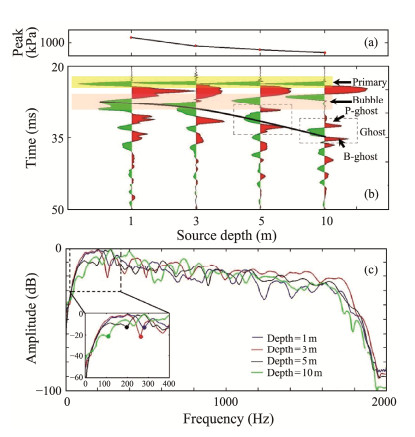
|
Fig. 13 Wavelets at the different source depth. (a), peak values of wavelet; (b), waveforms of wavelet; (c), spectrums of wavelet. |
The wavelet spectra corresponding to different source depths were analyzed, and the change in depth led to the shift of the first notch point (Fig.13c). From the enlarged image, it could be seen that the frequency of the first notch decreased from 300 to 110 Hz as the depth of the source increases. Therefore, the frequency spectrum of the wavelet corresponding to the small depth of the seismic source had a significant advantage in the low-frequency range. In the high-frequency range, especially in the 600 – 2000 Hz range, it could be seen that the wavelet frequency band width was larger when the source is at the depth of 3 m.
5 Discussion 5.1 Facial Feature MethodWe use the wavelet model calculation method for plasma spark source to comprehensively analyze the wavelet propagation characteristics of ocean three-dimensional space observation systems, and ultimately obtain the wavelet facial feature that describes the propagation characteristics of space electric spark wavelet. The facial feature method describes the propagation characteristics of wavelets within a certain spatial range based on their various properties. Attribute descriptions including wavelet waveform, wavelet spectrum, wavelet energy, wavelet directionality, wavelet bubble ratio, and wavelet peak to peak, can be selected as needed (Figs.11 and 12). Through wavelet facial description, the spatial propagation characteristics of wavelet can be described as a whole, and wavelet attributes can be fully analyzed to improve the efficiency of wavelet analysis.
5.2 Sensitivity of High-Frequency Source WaveletsThe plasma spark source effectively reduces the influence of factors such as electrode consumption and output power fluctuations in hardware design, ensuring wavelet consistency under steady-state conditions. However, the plasma spark source may experience differences in the received signal in actual conditions, due to the fluctuations of sea waves, environmental noise, and changes in the attitude of the receiving cable. When the source depth is close to the sea surface for high-resolution detection, the virtual reflection path is reduced and convolved with the main pulse to form a complex output waveform (Fig.13b). The fluctuation of the sea surface and the breaking of sea wave bubbles can change the source position and increase high-frequency components in environmental noise. Both can affect the output waveform of the source wavelet. The scattering effect caused by poor sea conditions can lead to lower amplitude and reduced frequency of the source wavelet. When configuring the parameters of the observation system, special care needs to be taken for plasma spark sources, as small changes in parameter settings can cause significant changes in waveform and spectrum, ultimately leading to unsatisfactory resolution of the profile.
6 ConclusionsOn the basis of indoor test data, the single electrode excitation process and multi electrode bubble interaction of corona discharge plasma were discussed. The electrode spacing has a direct impact on the movement of bubbles. A calculation process for the near-field wavelet model of a plasma electric spark source under the condition of linear arrangement and equal energy synchronous excitation has been established. The characteristic attributes of spatial wavelet propagation were analyzed by using spatial wavelet facial representation. The depth of the source and the virtual reflection path are the main factors affecting the wavelet. The high-frequency properties of plasma electric spark source wavelets lead to their sensitivity to factors such as wave fluctuations, position changes, and environmental noise. Minor changes in collection parameters may result in significant changes in the recorded waveforms and final data resolution. Therefore, when applying plasma spark source, caution should be taken in selecting the observation system parameters for high-resolution marine seismic exploration and ensuring the stability of spatial parameters.
AcknowledgementsThis work was supported by the Key Laboratory of Marine Mineral Resources, Ministry of Natural and Resources, Guangzhou (No. KLMMR-20220K02), and the Marine Geological Survey Program of China Geological Survey (No. DD20191003).
Author Contributions
All authors contributed to the study conception and design. Material preparation, data collection and analysis were performed by Rui Yang and Jia Wei. The draft of the manuscript was written by Jia Wei and all authors commented on previous versions of the manuscript. All authors read and approved the final manuscript.
Data Availability
The data and references presented in this study are available from the corresponding author upon reasonable request.
Declarations
Ethics Approval and Consent to Participate
This article does not contain any studies with human participants or animals performed by any of the authors.
Consent for Publication
Informed consent for publication was obtained from all participants.
Conflict of Interests
The authors declare that they have no conflict of interests.
Asakawa, E., Sekino, Y., and Okamoto, T., 2010. Development of vertical cable seismic system for hydrothermal deposit survey. EGU General Assembly, 64(4): 1993-1999. DOI:10.3997/2214-4609.20148328 (  0) 0) |
Brothers, D. S., ten Brink, U. S., Andrews, B. D., and Chaytor, J. D., 2013. Geomorphic characterization of the U. S. Atlantic continental margin. Marine Geology, 338: 46-63. DOI:10.1016/j.margeo.2012.12.008 ( 0) |
Dragoset, W. H., and Cumro, D. L., 1987. Method for determining the far-field signature of an air gun array, US, US0465 8384A. DOI: US4658384A.
( 0) |
Duchesne, M. J., Bellefleur, G., Galbraith, M., Kolesar, R., and Kuzmiski, R., 2007. Strategies for waveform processing in sparker data. Marine Geophysical Researches, 28(2): 153-164. DOI:10.1007/s11001-007-9023-8 ( 0) |
Hao, X. Z., Zhao, Q. X., and Pei, Y. L., 2017. Large-energy plasma seismic source for gas hydrate exploration. Journal of Tropical Oceanography, 36(1): 35-40 (in Chinese with English abstract). ( 0) |
Huang, Y. F., Yan, H., Wang, B. Z., Zhang, X. M., Liu, Z., and Yan, K. P., 2014. The electro-acoustic transition process of pulsed corona discharge in conductive water. Journal of Physics D: Applied Physics, 47(25): 255204. DOI:10.1088/0022-3727/47/25/255204 ( 0) |
Huang, Y. F., Zhang, L. C., Yan, H., Wang, B. Z., Zhang, X. M., Liu, Z., et al., 2015. The influence of water characteristics on plasma-containing bubble dynamics. IEEE Transactions on Plasma Science, 43(9): 3256-3259. DOI:10.1109/tps.2015.2458979 ( 0) |
Huang, Y. F., Zhang, L. C., Yan, H., Zhu, X. L., Liu, Z., and Yan, K. P., 2016. Experimental study of the electric pulse-width effect on the acoustic pulse of a plasma sparker. IEEE Journal of Oceanic Engineering, 41(3): 724-730. DOI:10.1109/joe.2015.2471635 ( 0) |
Krail, P. M., 2010. Airguns: Theory and operation of the marine seismic source. Course notes for GEO-391: Principles of seismic data acquisition. University of Texas at Austin, 1-44.
( 0) |
Liu, Q., and Sun, Y. H., 2006. Plasma characteristics of pulsed corona discharge in water and moving process of the bubble. High Voltage Engineering, 32(2): 54-56 (in Chinese with English abstract). ( 0) |
Luo, D., Cai, F., and Wu, Z., 2017. Numerical simulation for accuracy of velocity analysis in small-scale high-resolution marine multichannel seismic technology. Journal of Ocean University of China, 16(3): 370-382. DOI:10.1007/s11802-017-3145-7 ( 0) |
Muller, C., Milkereit, B., Bohlen, T., and Theilen, F., 2002. Towards high-resolution 3D marine seismic surveying using boomer sources. Geophysical Prospecting, 50(5): 517-526. DOI:10.1046/j.1365-2478.2002.00335.x ( 0) |
Pei, Y. L., Kan, G. M., Zhang, L. C., Huang, Y. F., Liu, Z., Liu, B. H., et al., 2019. Characteristics of source wavelets generated by two sparkers. Journal of Applied Geophysics, 170: 103819. DOI:10.1016/j.jappgeo.2019.103819 ( 0) |
Pei, Y. L., Liu, B. H., Zhao, Y. X., Wang, R. H., and Yan, K. P., 2007. Research on pulsed plasma source and its application in the marine seismic prospecting. Science and Technology Review, 25(19): 48-52 (in Chinese with English abstract). ( 0) |
Pei, Y. L., Zhang, L. C., Huang, Y. F., Yan, H., Zhu, X. L., Liu, Z., et al., 2017. Discharge electrode configuration effects on the performance of a plasma sparker. Plasma Science and Technology, 19(9): 48-55. DOI:10.1088/2058-6272/aa7332 ( 0) |
Watkins, W. A., Daher, M. A., Fristrup, K. M., Howald, T. J., and di Sciara, G. N., 1993. Sperm whales tagged with transponders and tracked underwater by sonar. Marine Mammal Science, 9(1): 55-67. DOI:10.1111/j.1748-7692.1993.tb00426.x ( 0) |
Wei, J., Yang, H. L., Feng, J., and Li, Y., 2021. Simulation of spark source wavelet under multibubble motion. Journal of Ocean University of China, 20(1): 67-74. DOI:10.1007/s11802-021-4303-5 ( 0) |
Winands, H. G. J. J., Yan, K., Nair, S. A., Pemen, G. A. J. M., and van Heesch, B. E. J. M., 2005. Evaluation of corona plasma techniques for industrial applications: HPPS and DC/AC systems. Plasma Processes and Polymers, 2(3): 232-237. DOI:10.1002/ppap.200400046 ( 0) |
Yan, H., Huang, Y. F., Liu, Z., and Yan, K., 2011. Plasma-generated multibubbles in water and their dynamics. IEEE Transactions on Plasma Science, 39(11): 2656-2657. DOI:10.1109/tps.2011.2158668 ( 0) |
Yan, H., Huang, Y. F., Pei, Y. L., Liu, Z., Wang, K. Y., Liu, B. H., et al., 2012. Plasma seismic source and its application in oceanic seismic exploration. High Voltage Engineering, 38(7): 1711-1718 (in Chinese with English abstract). ( 0) |
Zhang, D., Liu, H. S., Xing, L, Wei, J., Wang, J. H., Zhou, H., et al., 2021. Facial features of an air gun array wavelet in the time-frequency domain based on marine vertical cables. Journal of Ocean University of China, 20(6): 1-12. DOI:10.1007/s11802-021-4527-4 ( 0) |
Zhang, L. C., Zhu, X. L., Huang, Y. F., Liu, Z., and Yan, K., 2016. Development of a simple model for predicting the spark-induced bubble behavior under different ambient pressures. Journal of Applied Physics, 120(4): 043302. DOI:10.1063/1.4959082 ( 0) |
Zhu, X. L., Zhang, L. C., Huang, Y. F., Wang, J., Liu, Z., and Yan, K. P., 2017. The effect of the configuration of a single electrode corona discharge on its acoustic characteristics. Plasma Science and Technology, 19(7): 57-62. DOI:10.1088/2058-6272/aa6716 ( 0) |