 2024, Vol. 23

New offshore platforms and construction operation modes are emerging with the continuous progress and development of ocean technologies, such as the joint operation of deep-water semisubmersible platforms and foreign oil tankers. A mutual interference exists between the floating bodies when the distance between them is relatively small due to the swaying motion and wave generation. Han et al. (2011) and Kuang et al. (2020) pointed out that in the case of incident waves, mutual interference of diffracted waves can be observed between multiple floating bodies that are prone to collision and other serious consequences.
The hydrodynamic research of floating bodies is relatively mature; Chen et al. (2006), Zhu and Gao (2016), Jiao et al. (2018), and Gong et al. (2020) conducted extensive research mostly based on the potential flow theory to obtain the response operator, restoring force coefficient, and linear radiation damping of floating bodies. Qin et al. (2022) highlighted the research and technical challenges of float-over installations and pointed out the shortages within the emerging numerical and experimental research. Qin et al. (2021a, b) conducted hydrodynamic numerical analysis and model test research on float-over operations at different water depths and explored the influence of various water depth conditions on hydrodynamic parameters and time-domain analysis research. Kuang et al. (2015) investigated the hydrodynamic interference characteristics of two vessels during replenishment. Wang et al. (2008) analyzed the second-order drift force between two vessels using a three-dimensional method. Xie and Gao (1999) and Chan (2019) investigated the hydrodynamic interaction between two floating bodies in waves. Bai et al. (2020, 2021a) experimentally investigated a T-shaped barge and twin-barge float-over installation in various wave directions and observed that the relatively long wave threatened the mating operation as the stabbing pin motions exceeded the capture radius. Bai et al. (2021b) further conducted model tests to analyze the dynamic response of the float-over load transfer from the T-shaped barge onto the twin barge, indicating considerable lateral loads on mating units. Wu et al. (2003) studied the influence of the distance between the floating bodies on the hydrodynamic coefficient of a multi-floating body system. Xu et al. (2013) and Zhu et al. (2008) studied the hydrodynamic resonance phenomenon of multi-floating body systems with small gaps. Kuang et al. (2005) used the three-dimensional potential flow theory to predict the motion of two vessels leaning against the side in waves. Gong et al. (2020) explored the added resistance of trimarans and seakeeping for high-speed hybrid vessels with different scale ratios. Zhao et al. (2021a, 2021b) performed a numerical analysis on the model of offshore structures and verified the validity of the numerical model via the corresponding physical model test.
Liu et al. (2021) investigated the coupled dynamic characteristics of the mooring system with double-floating bodies, considering hydrodynamic coupling, and calculated the movement of the floating body and force characteristics of the fender and mooring system. Han et al. (2017) employed numerical calculation and model test methods to study the installation of transport vessels close to the spar platform and verified the accuracy of the calculation using the time delay function method. He et al. (2019) numerically analyzed the group shading effect among multiple floating bodies via viscous flow theory. Li et al. (2021) conducted an experimental study on the float-over installation of large-scale upper-block double vessels subjected to cross waves. The research results revealed that the roll of vessels on the seaward side was constantly greater than that on the back seaside under the cross sea.
The above-mentioned investigations explored the hydrodynamic steady-state solution of single or multi-floating body couplings in the frequency domain. However, the calculation efficiency of computational fluid dynamics was low and did not meet the engineering requirements. The correlation coefficient was calculated in a limited frequency range, and the frequency-domain damping coefficient was transformed using the retardation function method of the three-dimensional frequency-domain potential flow theory to obtain the impulse response function of the multi-floating body. Furthermore, time-domain analysis and the first semisubmersible platform float-over test research were carried out.
In this paper, coupled hydrodynamic and float-over time-domain analyses of an HYSY 229 barge and a semisubmersible platform were carried out, and the obtained results were compared with the test findings. The distance between the floating bodies was 0.1 m during floating over, and it was considerably affected by fluid viscosity. Herein, viscous damping, hydrodynamic coupling between the floating bodies, and the nonlinear effect of the sway fender system were considered to establish a multi-floating body coupling model. The motion equation in the time domain was used to study the motion response for the float-over operation of the HYSY 229 barge, the dynamic response of the fender system, the dynamic force of the mooring line and the influence of different wave periods. Finally, relative results were compared and analyzed to verify the accuracy of the analysis.
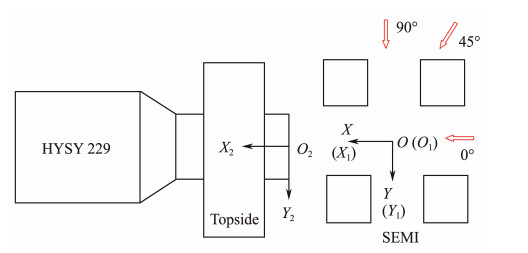
2 Theoretical ModelsIn this paper, a barge docking into a semisubmersible platform using the float-over method was considered the research object. When the float-over operation was started, the semisubmersible platform was first moored with no heel and trim. Then, the HYSY 229 transportation barge with the topside entered the platform through cross and longitudinal cables. Finally, the platform was seated via the longitudinal cables. Hydrodynamic coupling between the semisubmersible platform and the HYSY 229 barge was considered, and the hydrodynamic model of the system was established using the boundary element method. Fig. 1 shows the coordinate distribution.
|
图 1 Coordinate system. |
To study the motion response between the semisubmersible platform and the construction vessel HYSY 229, the overall semisubmersible platform and HYSY 229 barge coordinate systems were established. The established coordinate systems conformed to the right-hand rule, and the overall coordinate system OXYZ was the fixed coordinate. The origin O was located on the water surface. The positive direction of the X axis was the initial motion direction of the vessel, and the positive direction of the Z axis was the vertically upward direction. The semisubmersible platform coordinate system, O1X1Y1Z1, coincided with the overall coordinate system, and the coordinate direction of X1Y1Z1 was consistent with the X, Y, and Z directions of the overall coordinate system. The HYSY 229 barge coordinate system, O2X2Y2Z2, was at the stern of the HYSY 229 barge; O2 was on the water surface; X2 pointed from the stern to the yaw; Y2 pointed to the port side; and Z2 was perpendicular to the water surface.
3 Theoretical BackgroundAccording to potential flow theory, an ideal flow field is assumed to be irrotational, inviscid, and incompressible. A velocity potential that satisfies the Laplace equation, the object surface condition, the boundary condition of the free surface, the bottom condition, and the distant radiation condition can be found. The velocity potential on the surface of the HYSY 229 barge was the sum of the velocity potentials of the flow field disturbance caused by the movement of the semisubmersible platform and the HYSY 229 barge.
The velocity potential on the semisubmersible platform can be expressed as follows:
| $ \text{Re} \left\{ {{\phi ^s}{{\text{e}}^{{\text{i}}\omega t}}} \right\} = \text{Re} \left\{ {\left[ {\varphi _I^s + \sum\limits_{l = 1}^N {\varphi _D^{bs}} + \sum\limits_{l = 1}^N {\sum\limits_{j = 1}^6 {\varphi _j^{bs}v_j^b} } } \right]{{\text{e}}^{{\text{i}}\omega t}}} \right\}, $ | (1) |
where
the semisubmersible platform to itself),
Laplace's equation can be expressed as follows:
| $ {\nabla ^2}{\varphi ^s} = 0. $ | (2) |
The surface boundary conditions of the diffraction potential for the semisubmersible platform were expressed as follows:
| $ \left\{ {\begin{array}{*{20}{l}} {{{\left. {\frac{{\partial \varphi _D^{bs}}}{{\partial {\boldsymbol{n}}}}} \right|}_s} = {{\left. { - \frac{{\partial {\varphi _I}}}{{\partial {\boldsymbol{n}}}}} \right|}_s}, {\text{ }}(b = s)} \\ {{{\left. {\frac{{\partial \varphi _D^{bs}}}{{\partial {\boldsymbol{n}}}}} \right|}_s} = 0, {\text{ }}(b \ne s)} \end{array}} \right., $ | (3) |
where φI is the incident wave velocity potential, n is the unit normal vector on the object's surface, b is the first floating body, and s represents the second floating body (HYSY 229).
The radiation potential is solved as follows:
Condition 1: The semisubmersible platform moves freely, the HYSY 229 barge is fixed, and the radiation potential boundary conditions of the semisubmersible platform are as follows:
| $ {\left. {\frac{{\partial \varphi _j^{ss}}}{{\partial {\boldsymbol{n}}}}} \right|_s} = - {\text{i}}\omega {n_j}. $ | (4) |
Condition 2: The HYSY 229 barge moves freely, the semisubmersible platform is stationary, and the radiation potential generated by the HYSY 229 barge has the following boundary conditions on the semisubmersible plat-form:
| $ {\left. {\frac{{\partial \varphi _j^{bs}}}{{\partial {\boldsymbol{n}}}}} \right|_s} = 0. $ | (5) |
The impulse response function is expressed as follows:
| $ K(t) = \frac{1}{{2{\text{π }}}}\int_{ - \infty }^\infty {H({\text{i}}\omega){{\text{e}}^{ - {\text{i}}\omega t}}{\text{d}}\omega }, $ | (6) |
where H(iω) is the characteristic system frequency.
The impulse response function accurately describes the memory effect of the floating body moving in waves. Using the Kramer-Kronig relation, the frequency-domain hydrodynamic coefficient and radiation hydrodynamic time-domain impulse response function of the floating-to-multifloating body system were processed using the Fourier transform. Then, the following expression can be obtained:
| $ K_{kj}^{lm}(\tau) = \frac{2}{{\text{π }}}\int_{\text{0}}^\infty {B_{kj}^{lm}(\omega)\cos \omega \tau {\text{d}}\omega } . $ | (7) |
The retardation function method of three-dimensional frequency-domain potential flow theory was used to solve for
For the double buoyant composed of semisubmersible platforms subjected to wave, flow, wind, and other environmental load forces and the fender and mooring forces of mutual coupling when moving in waves, the time-domain coupled motion equation is as follows:
| $ \left[ {\begin{array}{*{20}{c}} {{M_{11}} + {a_{11}}}&{{a_{12}}} \\ {{m_{21}}}&{{M_{22}} + {a_{22}}} \end{array}} \right]\left[ {\begin{array}{*{20}{l}} {{{\ddot x}_1}(t)} \\ {{{\ddot x}_2}(t)} \end{array}} \right] + \left[ {\begin{array}{*{20}{c}} {\int_0^t {{K_{11}}(t - \tau){\text{d}}\tau } }&{\int_0^t {{K_{12}}(t - \tau){\text{d}}\tau } } \\ {\int_0^t {{K_{21}}(t - \tau){\text{d}}\tau } }&{\int_0^t {{K_{22}}(t - \tau){\text{d}}\tau } } \end{array}} \right]\\ \left[ {\begin{array}{*{20}{l}} {{{\dot x}_1}(t)} \\ {{{\dot x}_2}(t)} \end{array}} \right] + \left[ {\begin{array}{*{20}{c}} {{B_1}}&0 \\ 0&{{B_2}} \end{array}} \right]\left[ {\begin{array}{*{20}{l}} {{{\dot x}_1}(t)} \\ {{{\dot x}_2}(t)} \end{array}} \right] + \left[ {\begin{array}{*{20}{c}} {{C_1}}&0 \\ 0&{{C_2}} \end{array}} \right]\left[ {\begin{array}{*{20}{l}} {{x_1}(t)} \\ {{x_2}(t)} \end{array}} \right] = \left[ {\begin{array}{*{20}{l}} {{F_1}(t)} \\ {{F_2}(t)} \end{array}} \right], $ | (8) |
where F1(t) and F2(t) are the sums of external forces, including environmental, mooring, and fender forces, on the semisubmersible platform and the vessel, respectively. B1 and B2 are the viscous damping of the semisubmersible platform and the vessel, respectively. Sway, surge, and yaw damping parameters were based on the experience formula, and the roll, heave, and pitch damping coefficients were obtained based on the test data. Finally, coefficients C1 and C2 represent the hydrostatic restoring forces of the semisubmersible platform and the vessel, respectively. m is the mass and inertia of the floating objects. Subscripts 1 and 2 stand for the semisubmersible platform and the vessel (HYSY 229), respectively.
4 Numerical Analysis and Test Results 4.1 Numerical ModelSoftware AQWA and the quadratic transfer function method were used to calculate the hydrodynamic parameters in the frequency domain, including the motion response and wave force transfer function. Furthermore, the entire system was simulated in the time domain, including two floating bodies, a semisubmersible hull, an HYSY 229 barge, an inter-platform connection cable, and a finite element mooring positioning system.
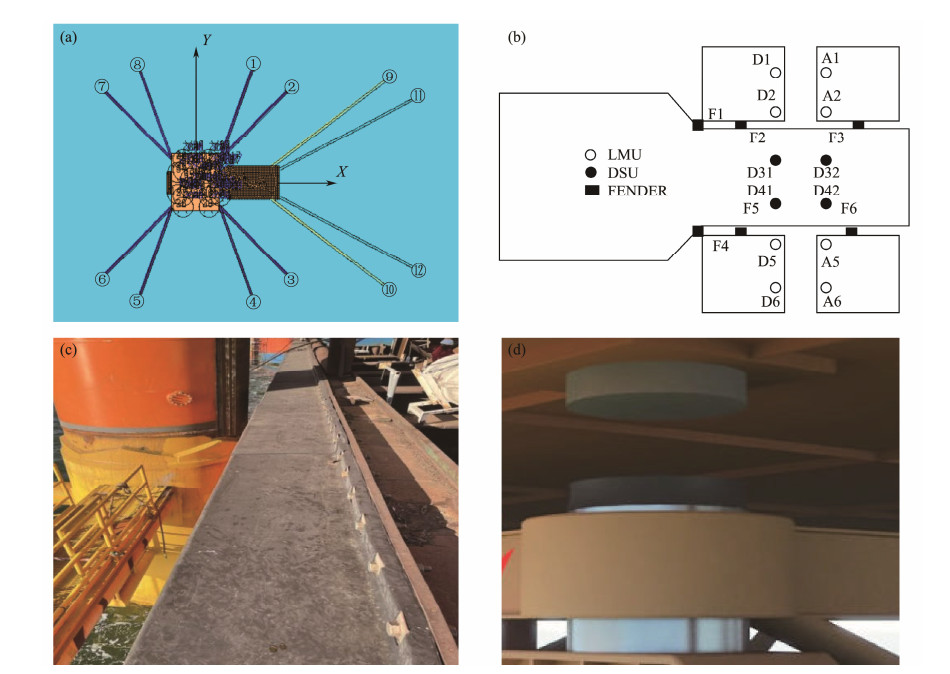
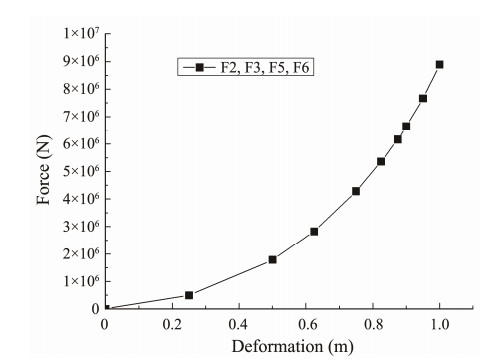
First, the semisubmersible platform and the HYSY 229 barge were considered examples. Hydrodynamic analysis software was used to analyze the frequency domain of the semisubmersible and HYSY 229 barges, and the comparison and analyses verified the feasibility and accuracy of the calculation method. During the float-over operation, in addition to the mooring system, the semisubmersible platform, HYSY 229 barge, and the upper block interacted with different types of fender systems and with each other according to different stages. The system had six fender systems (F1 – F6), eight leg mating units (LMUs; A1 – A2, A5 – A6, D1 – D2, and D5 – D6), and four deck separation units (DSUs; D31, D32, D41, and D42). A semisubmersible platform and the HYSY 229 barge passed the fender system (F1 – F6) during the docking operation (Figs. 2a and 2b). Fig. 3 shows the stiffness curve of the fender system, which was characterized by a strong nonlinearity during operation.
|
图 2 HYSY229 and SEMI platform reaction. (a), numerical analysis model; (b), fender system distribution, (c), LMU; and (d), DSU. |
|
图 3 Stiffness of the absorber device. |
The mooring of the semisubmersible platform and barge adopted 8 × 76 and 4 × 76 mm2 anchor chains, the axial stiffness was 5.8338 × 1e8 N m−1, the maximum break load was 4.622 × 1e6 N, the anchor was a 15 t Stevpr MK, the unit weight of the water was 118.185 kg m−1, the equivalent area was 1.628E-02 m2, and the pretension was 1.9612 × 1e4 N. The length of each segment was 292 m for the semisubmersible platform and 311 m for the HYSY229 barge.
Table 1 presents the dimensions of the HYSY 229 barge, Table 2 shows the main dimensions of the semisubmersible platform, and Table 3 displays the main dimensions of the upper block. Herein, the wave heights of the transverse and yaw waves were 0.75 and 1.5 m, respectively, and the height of the oblique wave was 1.0 m. The Joint North Sea Wave Project spectrum was used; the wind speed was 10 m s−1, the flow velocity was 0.5 m s−1, and the wave direction was constant.
|
表 1 Principal particulars of the HYSY229 barge |
|
|
表 2 Principal particulars of the SEMI platform |
|
|
表 3 Principal particulars of the topside platform |
The main dimensions of the HYSY 229 barge and the semisubmersible platform are shown in Tables 1 and 2, respectively.
The principal particulars of the topside platform and the location of mooring points are shown in Tables 3 and 4, respectively.
|
|
表 4 Location of the mooring points |
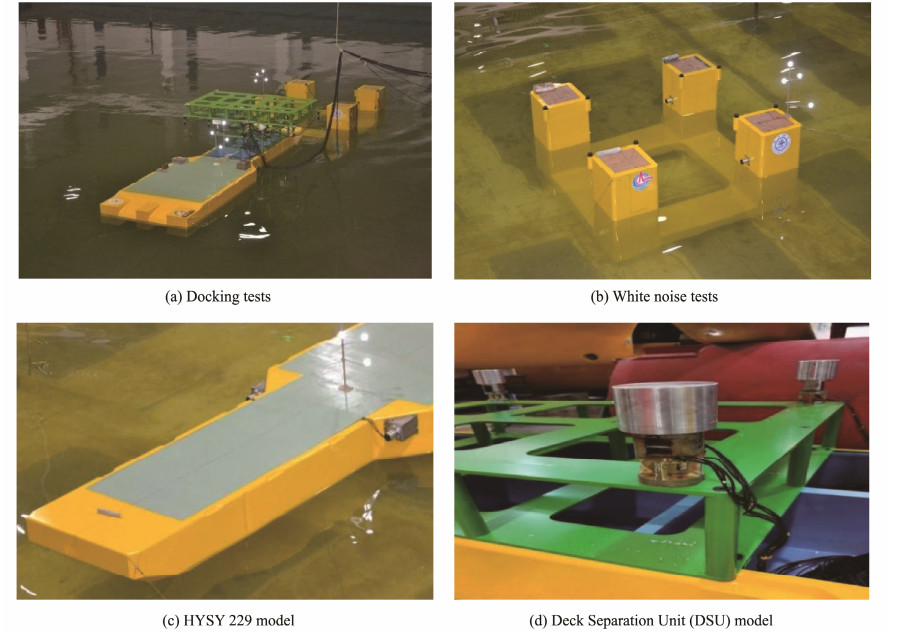
The scale ratio of the model was selected as 1:50, and the float-over installation test of the upper module of the semisubmersible platform was performed to verify the accuracy of the numerical analysis. Horizontal stiffness test of the mooring system, white noise wave test, and irregular wave test were conducted at water depths of 42 and 200 m. The wind tunnel test was carried out in the wind tunnel laboratory to obtain the wind and flow coefficients of the semisubmersible platform. Consequently, wind and flow coefficients were obtained for a series of working conditions, such as different drafts, as shown in Fig. 4.
|
图 4 Snapshots of the model tests. |
This test was conducted in the pool laboratory at Shanghai Jiao Tong University. All scales and parameters were based on the Lingshui 17-2 project. Relevant physical quantities, including the 6-DOF motion, motion acceleration, and mooring line load at the center of gravity of the platform and the barge, were measured in the model test. The computer-controlled time-history data acquisition system was used for time-history data acquisition and recording, and each physical quantity was stored based on the data channel. Table 5 shows the description of the relevant channels. The data sampling frequency in the wave simulation was 25 Hz. The interval from the point when the instruction was sent to generate waves to the start of the sampling record was set to 1.5 min to ensure that the model was in a stable motion state during the formal test sampling.
|
|
表 5 Data acquisition channels in the test |
1) A noncontact optical 6-DOF motion measurement system was used to measure the motion of the 6-DOF model under the action of wind, wave, and current, i.e., surge, sway, heave, pitch, roll, and yaw. The measurement accuracy of the surge, roll, and heave and the pitch, roll, and yaw was 1 mm and 0.1˚, respectively.
2) The acceleration sensor measured the linear or angular acceleration in all directions when the model moved in waves.
3) A three-component force sensor was used to measure the vertical load on the DSU on the barge deck and the horizontal and vertical loads on the LMU of the topside.
4) A tension sensor was used to measure the mooring system of the transportation barge, the mooring line load between the barge and semisubmersible platform, and the flow load on the barge in hydrostatic and wave tests.
5) A wave height meter was mainly used to measure the wave height and period during marine environment simulation and measure the relative wave surface elevation of the barge during transportation.
6) Digital and digital high-definition cameras were used to photograph all test conditions and processes.
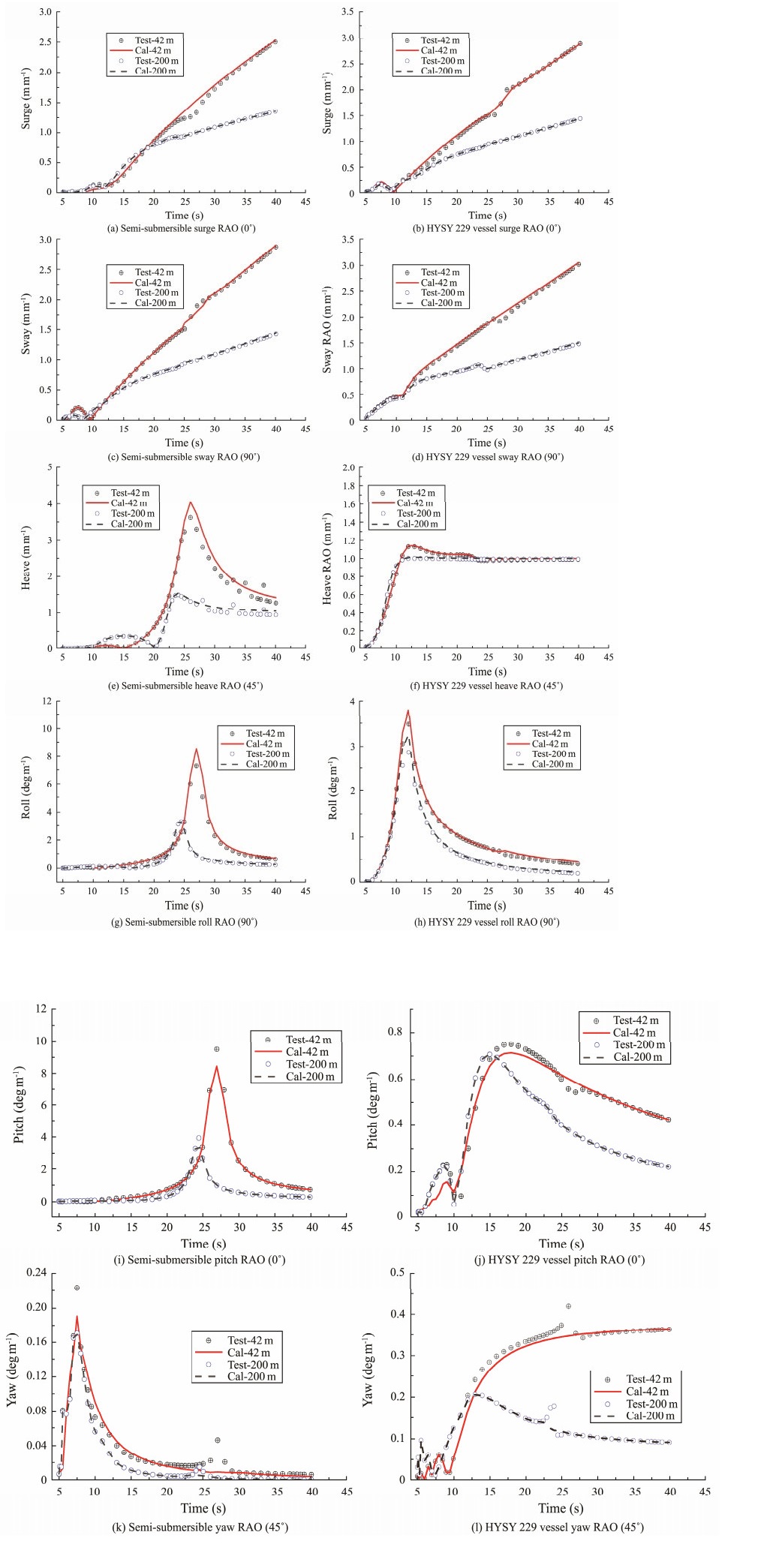
4.3 Frequency-Domain Motion RAO ResultsA system comprising a semisubmersible platform and an HYSY 229 barge was selected to investigate the response amplitude operator (RAO) at water depths of 42 and 200 m. The wave angles of 0˚, 45˚, and 90˚ were selected for the float-over operation, and the 6-DOF motion response operator RAO and the test results of the semisubmersible and HYSY 229 barge were calculated, 0˚ for the surge and pitch, 90˚ for sway and roll, and 45˚ for heave and yaw, as shown in Fig. 5. The RAO calculation results of the semisubmersible platform and the HYSY 229 barge agreed with the experimental data. The surge and sway, as well as the pitch and roll responses of the semisubmersible platform, were consistent and determined by the symmetry of the semisubmersible structure. The pitch and roll peak of the semisubmersible platform appeared at about 28 s, and the heaving peak appeared at about 27 s. With the increase in the incident wave period, particularly when the period was greater than 15 s, the surge and sway response values of the semisubmersible platform with a depth of 42 m were greater than those observed at a depth of 200 m, indicating that the shallow water effect had a greater impact. Furthermore, the wave period corresponding to the extreme value of the pitch and roll response of the semisubmersible platform differed due to the increase in additional mass at 42-m water depth, resulting in a larger period. The first-order low-frequency wave force increased, which resulted in a larger extreme value. Similarly, the peak roll of HYSY229 appeared at about 13 s, and the peak pitch appeared at about 19 s. The water depth had a considerable influence on the pitch and roll, and the response to the pitch and roll was inevident. The main reason behind this was the relatively larger water depth of HYSY229 and the minimal effect of shallow water.
|
图 5 Semisubmersible and HYSY 229 RAO |
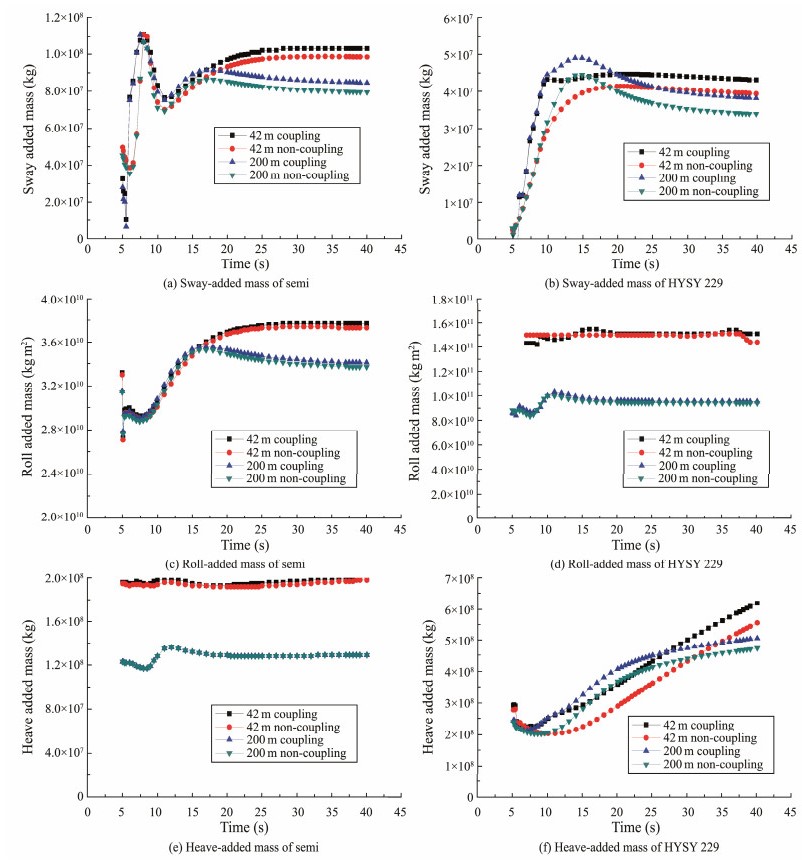
According to the selected added mass change curve (Figs. 6a and 6c), the sway- and roll-added mass of the semisubmersible platform changed greatly at 5 – 18 s, and the added mass changed more smoothly after 18 s.
|
图 6 Added mass of the floating body. |
The added mass of the semisubmersible platform in sway was different when considering the coupling and uncoupling conditions of the floating body. However, almost no difference was observed between the added mass of the roll and heave. When the period of sway-added mass was > 25 s, the coupled condition of added mass at a water depth of 42 m and 200 m was greater than the uncoupled condition. The added mass of the heave at 42-m water depth condition was greater than that at 200 m, and the added mass of the roll met the above rules when the period exceeded 18 s. Figs. 6b, 6d, and 6f show the added mass of the sway, heave, and roll of the HYSY229 barge, exhibiting good regularity on the whole. The added mass of the roll at 42 m water depth was greater than at 200 m, and the added mass of sway at 42 m water depth was greater than at 200 m when the wave period was greater than 25 s. The added mass of the heave increased with the increase in the wave period.
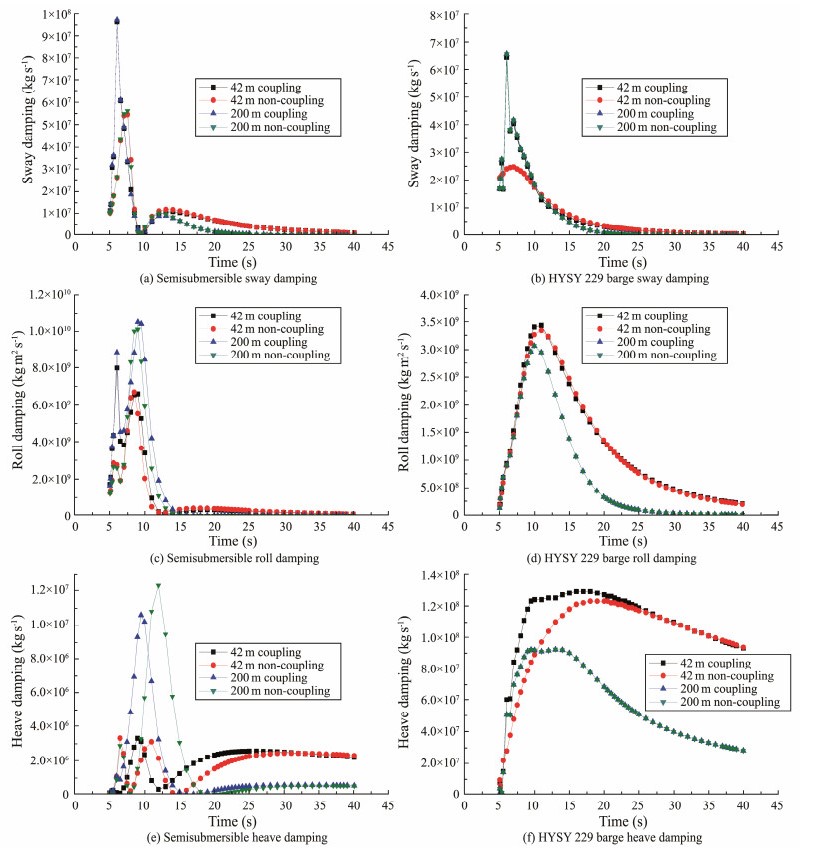
Fig. 7 shows that the radiation damping of the 3-DOF of sway, heave, and roll mainly acted in the wave frequency range, and its value tended to be zero with the increase in the wave period, indicating that radiation damping in this area accounts for a small proportion of the total damping. Viscous damping must be provided for the platform through an appropriate means to correctly simulate the motion response of floating, particularly the low-frequency motion. As shown in Figs. 7a, 7c, and 7e, when the wave period was < 15 s, the sway, heave, and roll damping of the semisubmersible platform changed sharply, respectively. When the period was > 15 s, the damping at 42-m water depth was greater than that at 200 m, and the hydrodynamic coupling effect of the two water depths had minimal effect on additional damping. The roll additional damping value was the largest and several orders of magnitude greater than the other additional dampings. The above reasons were mainly attributed to the structure of the semisubmersible hull distribution of pontoons and column, the spacing between columns is also relatively quite far. Figs. 7b, 7d, and 7f show the additional damping of the sway, heave, and roll of the HYSY229 barge, respectively, revealing good regularity on the whole. When the period was > 13 s, the damping at 42-m water depth was greater than that at 200 m, and the coupling and uncoupling values were almost identical.
|
图 7 Floating body damping. |
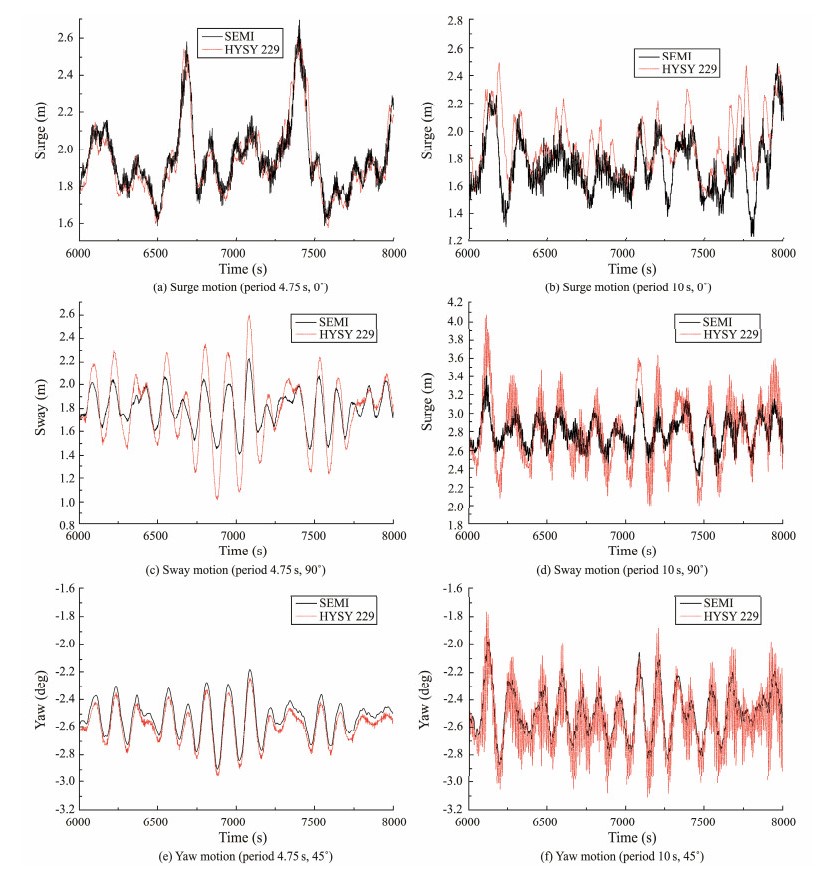
For motion analysis, the HYSY229 barge slowly entered the semisubmerged slot until it was finally in place, and the final position was selected. The semisubmersible platform and HYSY 229 barge were connected using longitudinal cables, fender systems, and mooring lines. We selected surge, sway, and yaw motion analysis results. The time-history motion curve of the 4.75 s period (Figs. 8a, 8c, and 8e) and the maximum displacement appeared simultaneously, mainly because the semisubmersible platform and HYSY 229 barge were connected using cables during motion. However, the maximum motion displacement of the HYSY 229 barge was greater than that of the semisubmersible platform during sway, with a maximum difference of about 0.5 m. This result was mainly due to the weak mooring stiffness of the HYSY 229 barge and the fender systems between the two floating bodies. When the semisubmersible platform reached a balance, the HYSY 229 barge further compressed the fender systems under the action of the sea state and finally balanced, resulting in greater movement of the HYSY 229 barge compared to the semisubmersible platform. As shown in Figs. 8b, 8d, and 8f, when the wave period was 10 s, the maximum displacement of the two floating bodies appeared simultaneously, but they showed severe shock. The further increase in the movement difference indicated that the wave period had a considerable influence on the motion of the floating body. Therefore, corresponding measuring equipment should be used to prevent the motion from exceeding the capture radius of the LMU and causing a floating accident when the float-over operation is carried out in the long-peak-wave sea area.
|
图 8 Motion analysis. |
The fender system played an energy-absorbing role when the barge entered the notch of the semisubmersible platform. Thus, a direct steel-steel collision was avoided, and the safety of the floating body increased.
The two sides of the HYSY 229 barge in contact with the fender system were regarded as point-to-surface contact, and the fender force was evaluated based on the normal distance to the contact surface.
| $ {F_{{\text{fender}}}} = \left\{ {\begin{array}{*{20}{l}} \begin{gathered} - {K_F} \cdot ({X_F} - {X_S}) \cdot {n_S} + {D_F} \cdot ({{\dot X}_F} - {{\dot X}_S}) \cdot {n_S}, \hfill \\ {\text{ }}({X_F} - {X_S}) \cdot {n_S} < 0 \hfill \\ \end{gathered} \\ {0, {\text{ }}({X_F} - {X_S}) \cdot {n_S} \geqslant 0} \end{array}} \right. . $ | (9) |
This tangential friction force can be expressed as follows:
| $ {F_f} = - {\mu _F}\left| {{F_{{\text{fender}}}}} \right|\frac{{({{\dot X}_F} - {{\dot X}_S}) \times {n_S}}}{{\left| {({{\dot X}_F} - {{\dot X}_S}) \times {n_S}} \right|}}, $ | (10) |
where
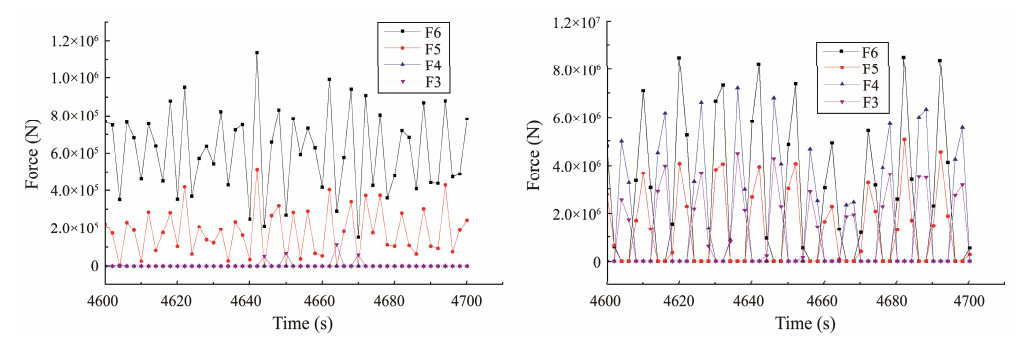
Figs. 9a and 9b show the time-history curve of the fender system. The trends of F5 and F6 were the same and simultaneously reached their maximum values. Moreover, the force value was mainly affected by the wave frequency, and the maximum values were 1121 and 9846 kN for the wave periods of 4.75 and 10 s, respectively. Thus, the wave period was sensitive to the influence of the fender system. When the wave period was 4.75 s, the maximum forces of F5 and F6 and F3 and F4 appeared alternately, with a difference in a single phase.
|
图 9 Time-history curve of force on the fender system (wave direction 90˚). (a), period 4.75 s; (b), period 10 s. |
The numerical analysis and model test of the semisubmersible platform and the HYSY 229 barge at a water depth of 42 m and sea conditions of 0˚, 45˚, and 90˚ showed good agreement. According to Table 6, the statistical errors between the calculated and experimental surge, sway, and yaw motions of the HYSY 229 barge and the semisubmersible platform were all within 5%. The maximum and minimum statistic values of the surge of the two floating bodies were similar, mainly because the two floating bodies added a surge cable in the longitudinal direction, limiting the relative movement between the floating bodies. In the sway direction, the maximum movement of the HYSY 229 barge reached 2.61 m, while the semisubmersible platform reached 2.11 m. These results can be attributed to the HYSY 229 barge squeezing the fender system during movement, increasing its motion.
|
|
表 6 Statistical comparison of floating body movement |
The yaw motion was the same as the sway motion, and the motion amplitude of the HYSY 229 barge was larger than that of the semisubmersible platform, which also increased after squeezing the fender system. Table 7 presents the comparative statistical analysis of the mooring force. The results for a 90˚ sea condition were selected, and the overall error was within 5%. The maximum test force of No. 5 on the semisubmersible platform was 85.15 t, and the maximum test force of No. 10 on the HYSY229 barge was 82.49 t, and both met the design requirements.
|
|
表 7 Statistical comparison of mooring line forces |
In this paper, the multibody coupled dynamic characteristics of the semisubmersible platform and HYSY229 vessel were studied. First, coupled hydrodynamic analysis of the HYSY 229 barge and semisubmersible platform was carried out. Relevant hydrodynamic parameters were obtained using the retardation function method of the three-dimensional frequency-domain potential flow theory. Then, combined with viscous damping, fender system, and mooring system, the motion equations of the semisubmersible platform and barge were established. Furthermore, hydrodynamics, floating body motion, and dynamic response of the fender system were analyzed, and the following conclusions can be drawn:
1) Hydrodynamic analysis results were highly consistent with the test findings, verifying the accuracy of the multifloating hydrodynamic coupling analysis. The key hydrodynamic parameters were solved for different water depths with and without consideration of the coupling effect, and the results revealed that the hydrodynamic influence was larger for shallow water conditions and considering the coupling.
2) Motion analysis revealed that the surge, sway, and yaw motions of the two floating bodies were in good agreement. However, when the wave period reached 10 s, the motion of the two floating bodies showed severe shock, and a relative motion was observed. Therefore, excessive constraints should be added between the two floating bodies during construction to ensure construction safety.
3) According to the time-history curve of the fender system, the changing trend of the load-time history curve was the same at the low-wave period and reached the maximum value at the same time. This value was mainly affected by the wave frequency. The maximum values were 1121 and 9846 kN when the wave periods were 4.75 and 10 s, respectively. Therefore, the fender system effect was sensitive to the wave period, and the maximum forces appeared alternately and differed by a single phase.
4) The numerical analysis and model test results of the semisubmersible platform and the HYSY 229 barge at a water depth of 42 m and sea conditions of 0˚, 45˚, and 90˚ were in good agreement, and the error was < 5%. In the sway direction, the maximum movement of the HYSY 229 barge reached 2.61 m, whereas that of the semisubmersible platform reached 2.11 m. This result can be attributed to the HYSY 229 barge squeezing the fender system during movement, increasing its motion. Hence, constraints should be added between the two floating bodies during the construction process to limit their relative movement.
AcknowledgementsVery special thanks are to Drs. Lei Wang, Xin Li, Xinliang Tian from Shanghai Jiao Tong University, and the National Natural Science Foundation of China (No. U20A20328).
Bai, X. D., Luo, H. B., and Xie, P., 2020. Experimental investigation on motions behavior and loads characteristic of float-over installation with T-shaped barge. Ocean Engineering, 195: 116761. (  0) 0) |
Bai, X. D., Luo, H. B., and Xie, P., 2021a. Experimental analysis of hydrodynamic response of the twin-barge float-over installation for mega topsides. Ocean Engineering, 219: 108302. DOI:10.1016/j.oceaneng.2020.108302 ( 0) |
Bai, X. D., Luo, H. B., and Xie, P., 2021b. Experimental investigation on hydrodynamic performance of side-by-side three barges in topsides float-over installation in beam seas. Ocean Engineering, 236: 109516. DOI:10.1016/j.oceaneng.2021.109516 ( 0) |
Chan, S. Z., 2019. Research on the hydrodynamic characteristics of two ships side by side in waves. Master thesis. Wuhan University of Technology.
( 0) |
Chen, J. P., Zhu, D. X., and He, S. L., 2006. Research on numerical prediction method for wave making resistance of catamaran/trimaran. Journal of Ship Mechanics, 10(2): 23-29. DOI:10.3969/j.issn.1007-7294.2006.02.004 ( 0) |
Gong, J. Y., Yan, S. Q., Ma, Q. W., and Li, Y., 2020. Added resistance and seakeeping performance of trimarans in oblique waves. Ocean Engineering, 216: 107721. DOI:10.1016/j.oceaneng.2020.107721 ( 0) |
Han, X. L., Duan, W. Y., and Ma, S., 2011. Time domain analysis of multiple floating bodies interaction for offshore nearby operation. Academic Symposium on Ocean Engineering in Commemoration of Academician Gu Maoxiang. Wuxi, 128-138 (in Chinese with English abstract).
( 0) |
Han, X., Xie, B., Wang, S. S., Yu, X. C., and Li, Y., 2017. Numerical simulation and model test of motion response of multi-body floating operation system at sea. Ocean Engineering Equipment and Technology, 4(5): 287-292. DOI:10.3969/j.issn.2095-7297.2017.05.008 ( 0) |
He, G. H., Wang, Z. K., and Zhang, Z. G., 2019. CFD simulation and analysis of multi-floating body group shading effect. Journal of Harbin Engineering University, 40(5): 906-912. ( 0) |
Jiao, J. L., Sun, S. Z., Li, J. D., Adenya, C. A., Ren, H. L., Chen, C. H., et al., 2018. A comprehensive study on the seakeeping performance of high speed hybrid ships by 2.5D theoretical calculation and different scaled model experiments. Ocean Engineering, 160: 197-223. ( 0) |
Kuang, X. F., Miao, Q. M., and Xiang, X., 2005. Theoretical prediction of ship leaning motion in waves. Shipbuilding of China, 46: 7-14. ( 0) |
Kuang, X. F., Zhang, F. W., Fan, Y. L., and Zhao, Z. H., 2015. Hydrodynamic interaction of ship to ship in wave during underway replenishment. Proceedings of the 2015 Hydrodynamic Academic Conference. Nanjing, 361-373 (in Chinese with English abstract).
( 0) |
Kuang, Y., Li, Q. B., Qin, L. C., Wang, Y., Zhang, B. W., and Li, P., 2020. Hydrodynamic analysis of HYSY201 close to the spar. Shanxi Architecture, 46(9): 190-192. DOI:10.3969/j.issn.1009-6825.2020.09.086 ( 0) |
Li, H. L., Yu, W. T., Li, X. C., Bai, X. D., Huang, J. H., and Luo, H. B., 2021. Experimental investigation on dynamic response characteristics of the twin-barge float-over installation of mega topsides in beam waves. China Offshore Oil & Gas, 33(4): 172-179. ( 0) |
Liu, L. Q., Meng, C. L., Shen, W. J., Liu, Y. L., and Bian, H. D., 2021. Dynamic characteristics of side-by-side moored system coupled with hydrodynamic interaction. Shipbuilding of China, 62(4): 190-206. DOI:10.3969/j.issn.1000-4882.2021.04.015 ( 0) |
Qin, L. C., Bai, X. D., Luo, H. B., Li, H. L., and Ding, H. Y., 2022. Review on recent research and technical challenges of float-over installation operation. Ocean Engineering, 253: 111378. DOI:10.1016/j.oceaneng.2022.111378 ( 0) |
Qin, L. C., Ding, H. Y., and Zhang, P. Y., 2021a. Model tests research on a float-over barge in shallow water under the undocking conditions. China Ocean Engineering, 35(6): 933-942. DOI:10.1007/s13344-021-0082-4 ( 0) |
Qin, L. C., Li, H. L., Yu, W. T., Ding, H. Y., and Zhang, P. Y., 2021b. Hydrodynamic study of undocking operation during float-over installation in shallow water. Proceedings of the 31st International Offshore and Polar Engineering Conference. Rhodes, Greece, 18-23.
( 0) |
Wang, J. F., Li, H. H., and Xu, Z. Q., 2008. Three-dimensional method research on the second-order drift force of two floating bodies in waves. Ship & Boat, 2: 18-22. ( 0) |
Wu, G. H., Shen, Q., Chen, X., and Wu, P. D., 2003. Influence of the distance between floating bodies on hydrodynamic coefficients of floating multi-body system. Ocean Engineering, 21(4): 29-34. ( 0) |
Xie, N., and Gao, H. Q., 1999. Numerical calculation of hydrodynamic interaction of two floating bodies in waves. Ship Mechanics, 3(2): 7-15. ( 0) |
Xu, L. Y., Yang, J. M., and Li, X., 2013. Research on hydrodynamic interference of small-spaced multi-floating bodies based on viscous fluids. Proceedings of the 16th China Ocean (Shore) Engineering Symposium. Dalian, 53 (2): 217-226 (in Chinese with English abstract).
( 0) |
Zhao, S. X., Bi, C. W., and Sun, Z. Z., 2021a. Engineering analysis of the dynamic characteristics of an electrical jacket platform of an offshore wind farm under seismic loads. Applied Ocean Research, 112: 102692. ( 0) |
Zhao, S. X., Bi, C. W., Zhang, D. L., and Yu, H., 2021b. Hydrodynamic response analysis of a 10000-ton offshore electrical platform in waves using a modified finite element model. Ocean Engineering, 233: 109194. ( 0) |
Zhu, H., and Gao, X. P., 2016. Numerical prediction of seakeeping based on 3D potential flow theory. Ship Science and Technology, 38(13): 16-20. ( 0) |
Zhu, R. C., Zhu, H. R., and Miao, G. P., 2008. Hydrodynamic resonance phenomenon of multi-floating body systems with small gaps. Journal of Shanghai Jiaotong University, 42(8): 1238-1242. ( 0) |


2. Offshore Oil Engineering Co., Ltd., Tianjin 300461, China