 2025, Vol. 24


2) Laboratory for Marine Ecology and Environmental Science, Qingdao Marine Science and Technology Center, Qingdao 266061, China;
3) First Institute of Oceanography, Ministry of Natural Resources, Qingdao 266061, China;
4) National Engineering Laboratory for Integrated Aero-Space-Ground-Ocean Big Data Application Technology, Xi'an 710129, China
Harmful macroalgal blooms are becoming a global concern, due to their increasing occurrence and severe social and economic impacts (Smetacek and Zingone, 2013). In the Yellow Sea and East China Sea (YS-ECS), green tide caused by Ulva prolifera has occurred for at least 17 years since 2007. Meanwhile, golden tide caused by Sargassum horneri has become another regular and trans-regional marine ecological disaster (Xiao et al., 2021a; Qi et al., 2022; Wang et al., 2023b). The bi-macroalgal bloom in early spring has also been frequently reported (Xiao et al., 2020a, 2020b; Liu et al., 2021). Despite their possible ecological functions in offshore waters (Komatsu et al., 2007), massive stranding of biomass along the coastline poses serious threats to coastal marine ecosystems, marine aquaculture, tourism etc. (Wang et al., 2015; Xing et al., 2017).
Understanding the onset and evolution of macroalgal blooms is important to elucidate their underlying mechanisms and to formulate effective countermeasures. However, our understanding of macroalgal blooms in the YS-ECS prior to 2008 is mixed and unclear. Previous studies usually recognized U. prolifera as the only species causing macroalgal blooms before 2008. For example, using MODIS and Landsat imagery, Hu et al. (2010) reported that macroalgal patches appeared almost every year between April and July from 2000 to 2009, inferring that Subei Shoal was the origin of green tide in the YS. Xing and Hu (2016) traced the history of Ulva bloom in the YS back to 1999. Sargassum blooms here were first reported by Komatsu et al. (2007), who found that these rafts were mainly distributed along the front between the Kuroshio Current and coastal waters. Their recent massive strandings along the Chinese and Korean coasts have attracted much attention (Hwang et al., 2016; Qi et al., 2017; Xing et al., 2017). Meanwhile, the spectral difference between floating Sargassum and Ulva rafts has also been documented and used to distinguish them (Xiao et al., 2021b; Qi et al., 2022; Yuan et al., 2022). By revisiting the Sargassum bloom footprints, Qi et al. (2022) found clear signals of Sargassum blooms in 2001 and 2002 before 2008. Their results also indicated a northward drift from the ECS to the YS in spring, suggesting that floating macroalgal signals around the Changjiang Estuary (CE) were most likely from Sargassum rafts (Yuan et al., 2022; Qi et al., 2023; Wang et al., 2023b). To the best of our knowledge, there are no reports on the annual bloom patterns of Sargassum before 2008. Therefore, it is necessary to clarify our interpretation of macroalgal signals and uncover their bloom patterns before the large-scale outbreaks.
The finer the spatial resolution of the satellite image, the easier it is to obtain more detailed information and reveal the early development of macroalgal blooms. For example, the early developmental pattern of Sargassum blooms from winter to spring could hardly be detected in coarser MODIS imagery (Xing et al., 2017; Yuan et al., 2022; Wang et al., 2023b). In this study, we used time-series Landsat images with 30 m spatial resolution to retrieve the spatiotemporal distribution patterns of both Ulva and Sargassum blooms in the YS-ECS before 2008.
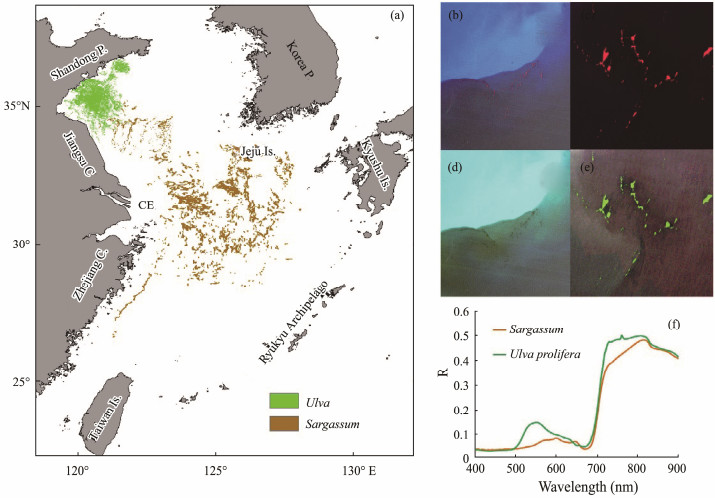
2 Data and MethodsThe study area covers the whole YS-ECS (Fig.1a), where harmful macroalgal blooms of Ulva and Sargassum have increased in recent years (Qi et al., 2022; Wang et al., 2023b). Surface reflectance (Level 2) images with few clouds cover from Landsat 5 TM and Landsat 7 ETM+ sensors were downloaded from USGS EarthExplorer website from 1984 to 2008. Landsat 5 and Landsat 7 were launched in 1984 and 1999, respectively. A combination of these two satellites achieves a regular 8-day revisit interval. Landsat images have higher spatial resolution of 30 m and wider swath width of 185 km during the earlier years, offering precious datasets to retrieve and analyze the early development of macroalgal blooms in the study area.
A two-step process was used to detect macroalgal bloom signals (Figs.1b – f) (Xiao et al., 2021b; Hu et al., 2023; Pan et al., 2024). First, floating macroalgal mats have higher reflectance in near infrared band (RNIR), similar to land vegetation. A pseudo-color image composite of near-infrared, red, and green bands was used to identify any red stripes. By calculating the Difference Vegetation Index (DVI), defined as the difference between RNIR and red band (Rred), these red stripes should have higher DVI values and look brighter in the images. Second, we differentiated pixels of Ulva from Sargassum bloom by its increasing reflectance in green band (wavelength ca. 550 nm). Visually, floating Ulva mats appeared greenish, while Sargassum mats look in brown or dark brown in the natural color image. Referring to previous studies (Hu et al., 2010; Xing and Hu, 2016; Qi et al., 2022; Wang et al., 2023a), Sargassum blooms were primarily distributed in the ECS from March to early May and some patches could move into the south YS in late May and June. On the other hand, the distribution area of Ulva bloom was mostly confined in the south YS from May to August. We checked out previous reports and determined the existence of floating Ulva or Sargassum rafts, then looked backward and forward for at least one month until no detectable macroalgal signals. The distribution envelope of macroalgal blooms were outlined by a simplification method (Ding et al., 2024).
|
Fig. 1 (a) Study area of Yellow Sea and East China Sea, where the green and brown dots indicate the footprints of Ulva and Sargassum bloom from 1999 to 2008, respectively. CE, Changjiang Estuary; P., Peninsula; C., Coast; Is., Island; (b) – (f) show the two-step process to detect macroalgal bloom signals, both floating Ulva (b) and Sargassum rafts (c) show in red in NIR-RED-GREEN pseudo-color images, but Sargassum in dark brown (d) and Ulva show in green (e) in natural color images, the spectral difference (f) between were mainly found in green band of ca. 550 nm (Xiao et al., 2021). |
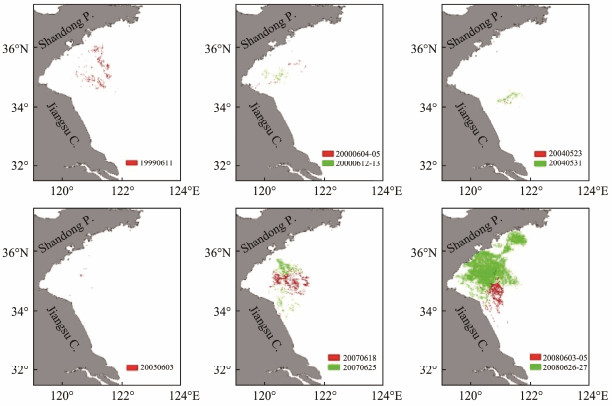
Before 1999, no obvious signal of macroalgal bloom could be observed from Landsat images in the YS-ECS. Generally, Ulva blooms or green tides were mainly detected from late May to late July and was confined in a small geographic distribution of the western south YS (Figs.2 and 3). The first sign of Ulva patches was recorded in the south Yellow Sea in June 11, 1999. Few patches could also be detected in the north of Subei Shoal in early June, 2000. However, no obvious signals were found in the subsequent three years. In 2004, small Ulva patches were first found in the Subei Shoal on May 23, then moved northwards and expanded in the north of Subei Shoal on May 31. Unfortunately, the bloom could not be tracked in June due to lack of valid observations. Only a few patches were found in the Subei Shoal in early June, but no further increase was observed in 2005.
|
Fig. 2 Time series development of Ulva bloom in the YS-ECS from 2000 to 2008, the dates are formatted as YYYYMMDD. |
|
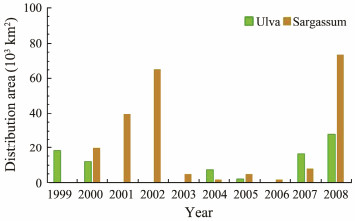
Fig. 3 Annual maximum distribution area of Ulva (green) and Sargassum (brown) blooms before 2008 observed by Landsat images. |
In 2007, a few green patches were observed on June 9 along the boundary between Subei Shoal turbid water and northern clear water. By June 17, the main distribution area moved to north of Subei Shoal. A long tail could be seen along Jiangsu coast, with the southmost bound near Sheyang River mouth. In the following days, green macroalgal signals could be observed, but with strong cloud cover. Ulva bloom moved furth northward and continued to expand on June 25, reaching the south coastline of Shandong Peninsula on July 11.
The Ulva bloom in 2008 was unprecedent (Figs.2 and 3). On June 3 – 4, the floating Ulva mats were mainly distributed in the northeastern waters of Jiangsu coast. The distribution area was multiplied several times on June 26 – 27. Meanwhile, the coastline of Shandong Peninsula experienced massive stranding of Ulva biomass, which lasted for more than one month. The bloom size significantly reduced on July 28 – 29, when the floating Ulva mats were mostly concentrated in the western south YS. In August, several stripes could still be found around the coastal waters of Qingdao.
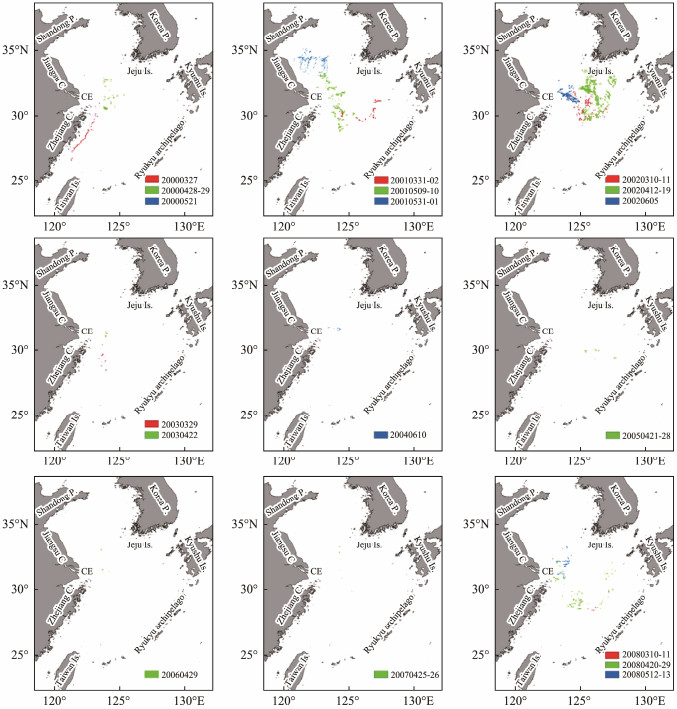
3.2 Sargassum BloomSargassum blooms were first observed in the ECS in 2000, and occurred almost every year since then, with varying bloom size (Figs.3 and 4). Larger bloom sizes were recorded in 2000, 2001, 2002 and 2008. However, the signals were much weaker in other years. Typically, Sargassum blooms were first detected in the ECS in March, then gradually moved northward, reaching south YS in May or June. They reached the maximum distribution in April, followed by a rapid decline. No floating Sargassum rafts has been recorded in July.
|
Fig. 4 Time series development of Sargassum bloom in the YS and ECS from 2000 – 2008. The dates are formatted as YYYYMMDD. |
In 2000, long stripes of floating Sargassum mats were first recorded along Zhejiang coast from north to south in late March. One month later, they formed a dense distribution area in offshore CE. By May, only a few patches could be observed on eastern waters of Subei Shoal. In 2001, Sargassum rafts exhibited an east-west distribution pattern in the offshore CE in late March. They then moved coastward and northward in April, with the northern boundary reaching the east of Subei Shoal. In May, the Sargassum mats were mainly found in the northern Subei Shoal. In 2002, Sargassum mats were distributed more offshore and concentrated in the ECS in March. They moved northwest in April and some patches even reached the coast of Jeju. In May, the distribution area sharply decreased and Sargassum rafts were mainly observed in waters between Jeju and CE.
From 2003 to 2007, Sargassum bloom size was relatively small (Figs.3 and 4). In 2003, floating Sargassum mats were mainly found offshore Zhejiang in late March and only few patches could be observed in April near the CE. In 2004, it was not until early June could small patches be observed in the northern waters of CE. Sargassum bloom could only be detected in late April in the following three years (2005, 2006 and 2007). However, the distribution area varied among year, with an east-west long stripe far offshore CE in 2005, few patches near CE in 2006 and a north-south long stripe between the CE and Jeju islands in 2007.
A rebound of Sargassum bloom was recorded in 2008. Floating Sargassum rafts were first found concentrating around Kuroshio Current near 28˚N in late March. A v-shape distribution pattern has formed in late April. the west branch was distributed north-westly to CE, while the east one extended along Kuroshio Current to waters near Korea Strait. The bloom size rapidly shrank in May, with only small amount observed between the CE and Jeju.
4 Discussion 4.1 Uncertainties from Remote SensingField validation plays a vital role for detection of macroalgal bloom from remote sensing. Conservatively speaking, we could only report that these historical events were from some floating greenish (brownish) photosynthetic organisms due to lack of observations. However, based on our current knowledge, U. prolifera (S. horneri) is the only known green (brown) algae species that can form large floating rats in the YS-ECS. In early 2000s, Japanese researches have conducted several cruises in the eastern ECS on floating Sargassum mats (Komatsu et al., 2007, 2008). It was not until 2007 could we be sure of the formation of macroalgal bloom from U. prolifera (Jiang et al., 2008).
Floating macroalgal rats tend to be scattered separately and mostly submerged below seawater at the early stage. They could only be detected by optical sensors when gathered into large patches by strong winds or surface currents (Komatsu et al., 2007; Qiao et al., 2009). Compared with previous results from MODIS, our Landsat (30 m) observation also found clear bloom occurrences in 2000 and 2008, besides in 2001 and 2002 (Qi et al., 2022). However, we could not observe Sargassum bloom in 2004 reported by Komatsu et al. (2008), possible due to the relative coarser spatial resolution of Landsat images.
4.2 Ulva Bloom from Occasional to CommonOur result suggested two important stages of Ulva bloom in the YS: stage one is from 1999 to 2006 when few green patches could be occasionally observed, stage two is from 2007 to now when green tide by U. prolifera became a recurrent marine ecological problem. The finding in stage one agreed with Xing and Hu (2016) and Qi et al. (2022). The bloom mechanism of Yellow Sea green tide has been well studied and is consistent among these years (Liu et al., 2013; Wang et al., 2015). The offshore expansion of Pyropia aquacultural industry in Subei Shoal has been identified as the primary cause of this world's largest green tide (Liu et al., 2010). During harvest season, the attached green macroalgal populations on Pyropia aquacultural rafts in Subei Shoal is discarded. Because U. prolifera has high growth rate, strong positive buoyancy in seawater and diverse reproductive strategy, it becomes the only dominant species in floating mats (Liu et al., 2013; Wang et al., 2015; Fu et al., 2019; Liu et al., 2020). The favorable conditions, including abundant nutrients and suitable temperature, fuel its explosive growth, while sea winds and surface currents are responsible for the northward drift (Gao et al., 2014). In late June, million tons of green macroalgal biomass reaches the southern coastline of Shandong Peninsula. It is noteworthy that Subei Shoal has long been identified as eutrophic waters before 2000 (Wang et al., 2003). Therefore, a condition of abundant nutrients is a prerequisite but not the sole determining factor for its outbreak (Zhang et al., 2020). In this study, the first appearance of Ulva bloom coincided with the beginning of offshore expansion of Pyropia aquaculture in early 2000's (Xing et al., 2019). Since 2007, Ulva bloom has transitioned from an occasional event to an uncontrollable ecological disaster.
4.3 Sargassum Bloom on the Rise: The Changed and UnchangedOur results suggested that Sargassum bloom in the YS-ECS could be dated back to at least 2000, which was consistent with previous field studies. Unlike the holopelagic Sargassum in the tropical Atlantic (Wang et al., 2019), detached fragments or thalli from hard substrates are considered as the primary source of macroalgal blooms in the YS-ECS (Sun et al., 2008). Based on Buoys with GPS, Komatsu et al. (2007) reported float S. horneri released from off Zhejiang Province could be transported to the fringe area between continental shelf and Kuroshio Current. We also observed Sargassum blooms in March consistently extended from offshore Zhejiang coast despite of the various distribution patterns. Recently, the possible northern contributions from northern Yellow Sea and Korean western coastlines have also been highlighted, which might explain the obvious increase biomass and winter stranding in the Subei Shoal (Xing et al., 2017; Huang et al., 2018; Liu et al., 2018; Byeon et al., 2019; Yuan et al., 2022; Qi et al., 2023; Wang et al., 2023b). However, our knowledge on the distribution and life history of S. horneri populations in these regions is very limited and deserves further investigations.
Sargassum bloom size displayed significant interannual variation before 2008. However, a general northward movement was revealed from March to May in those years of larger bloom size, congruent with the findings in recent years (Wang et al., 2023b). The transport from Kuroshio Current has also been revealed, such as the v-shaped distribution pattern on the east side in late April of 2001 and 2008. Our results also indicated that the macroalgal signals in the ECS in winter and early spring most likely originated from floating S. horneri because the brown color or no increasing reflectance in green band, such as the macroalgal slicks identified near CE every year from 2000 to 2005 (Hu et al., 2010) and the brown color macroalgal rafts in the ECS in 2012 (Xing and Hu, 2016).
In summary, we revisited the macroalgal bloom events in the eastern China seas by Landsat images from 1984 to 2008. The findings indicated that Ulva bloom has evolved from an occasional event to a recurring ecological disaster in the western South Yellow Sea from May to July since 2007. Sargassum bloom has occurred at fluctuating bloom size since 2000, with a significantly broader geographic range. The bloom mechanism of Yellow Sea green tide has been extensively documented. Various measures have been proposed and implemented to control and prevent it. the causes of the recent massive Sargassum bloom remain a topic of debate. Further in-depth studies and refined monitoring are recommended to minimize the potential threats to the coastal environment while maximizing the ecological benefits in the pelagic waters.
AcknowledgementsThis research is funded by the National Key R&D Program of China (No. 2022YFC3106005), the Shandong Provincial Natural Science Foundation (No. ZR2021MD 122), the MNR Key Laboratory of Eco-Environmental Science and Technology, China (No. MEEST-2023-04), the Taishan Scholars Program (No. tstp20230642), and the Shandong Provincial Key Laboratory of Marine Ecological Environment and Disaster Prevention and Mitigation (Nos. 201708, 202209, 202314).
Author Contributions
Chao Yuan: conceptualization, methodology, data analysis, raw material preparation, writing-original draft, data curation, writing-review and editing. Juan Huang and Lingjuan Wu: methodology, data analysis, software and surveys. Jie Xiao and Xuelei Zhang: methodology, writing-review and editing. Song Gao: writing-review and editing, funding acquisition, supervision, project administration. Yifei Li and Jiangling Xu: writing-original draft, data curation. Zongling Wang: conceptualization, funding acquisition, supervision, project administration.
Data Availability
The data and references presented in this study are available from the corresponding author upon reasonable request.
Declarations
Ethics Approval and Consent to Participate
This article does not contain any studies with human participants or animals performed by any of the authors.
Consent for Publication
Informed consent for publication was obtained from all participants.
Conflict of Interests
The authors declare that they have no conflict of interests. Zongling Wang is one of the Editorial Board Members, but he was not involved in the journal's review of, or decision related to, this manuscript.
Byeon, S. Y., Oh, H. J., Kim, S., Yun, S. H., Kang, J. H., Park, S. R., et al., 2019. The origin and population genetic structure of the 'golden tide' seaweeds, Sargassum horneri, in Korean waters. Scientific Reports, 9: 7757. DOI:10.1038/s41598-019-44170-x (  0) 0) |
Ding, Y., Gao, S., Huang, G., Wu, L., Wang, Z., Yuan, C., et al., 2024. A novel method for simplifying the distribution envelope of green tide for fast drift prediction in the Yellow Sea, China. Remote Sensing, 16: 3520. DOI:10.3390/rs16183520 ( 0) |
Fu, M., Fan, S., Wang, Z., Song, W., Sun, K., Han, H., et al., 2019. Buoyancy potential of dominant green macroalgal species in the Yellow Sea's green tides, China. Marine Pollution Bulletin, 140: 301-307. DOI:10.1016/j.marpolbul.2019.01.056 ( 0) |
Gao, S., Huang, J., Bai, T., Cao, Y., Wu, L., and Zhong, S., 2014. Analysis on drifting path of green tides in the Yellow Sea in 2008 and 2009. Marine Science, 38: 86-90. DOI:10.11759/hykx20131021001 ( 0) |
Hu, C., Li, D., Chen, C., Ge, J., Muller-Karger, F. E., Liu, J., et al., 2010. On the recurrent Ulva prolifera blooms in the Yellow Sea and East China Sea. Journal of Geophysical Research: Oceans, 115: C05017. ( 0) |
Hu, C., Qi, L., Hu, L., Cui, T., Xing, Q., He, M., et al., 2023. Mapping Ulva prolifera green tides from space: A revisit on algorithm design and data products. International Journal of Applied Earth Observation and Geoinformation, 116: 103173. ( 0) |
Huang, B., Ding, L., Qin, S., Fu, W., Lu, Q., Liu, Z., et al., 2018. The taxonomical status and biogeographical distribution of Sargassum horneri with the origin analysis of its drifting population in the end 2016 at the western Yellow Sea. Oceanologia et Limnologia Sinica, 49: 214-223. ( 0) |
Hwang, E. K., Lee, S. J., Ha, D. S., and Park, C. S., 2016. Sargassum golden tides in the Shinan-gun and Jeju Island, Korea. Korean Journal of Fisheries, 49: 689-693. ( 0) |
Jiang, P., Wang, J., Cui, Y., Li, Y., Lin, H., and Qin, S., 2008. Molecular phylogenetic analysis of attached Ulvaceae species and free-floating Enteromorpha from Qingdao coasts in 2007. Chinese Journal of Oceanology and Limnology, 26: 276-279. DOI:10.1007/s00343-008-0276-0 ( 0) |
Komatsu, T., Matsunaga, D., Mikami, A., Sagawa, T., Boisnier, E., Tatsukawa, K., et al., 2008. Abundance of drifting seaweeds in eastern East China Sea. Journal of Applied Phycology, 20: 801-809. DOI:10.1007/s10811-007-9302-4 ( 0) |
Komatsu, T., Tatsukawa, K., Filippi, J. B., Sagawa, T., Matsunaga, D., Mikami, A., et al., 2007. Distribution of drifting seaweeds in eastern East China Sea. Journal of Marine Systems, 67: 245-252. DOI:10.1016/j.jmarsys.2006.05.018 ( 0) |
Liu, D., Keesing, J. K., Dong, Z., Zhen, Y., Di, B., Shi, Y., et al., 2010. Recurrence of the world's largest green-tide in 2009 in Yellow Sea, China: Porphyra yezoensis aquaculture rafts confirmed as nursery for macroalgal blooms. Marine Pollution Bulletin, 60: 1423-1432. DOI:10.1016/j.marpolbul.2010.05.015 ( 0) |
Liu, D., Keesing, J. K., He, P., Wang, Z., Shi, Y., and Wang, Y., 2013. The world's largest macroalgal bloom in the Yellow Sea, China: Formation and implications. Estuarine, Coastal and Shelf Science, 129: 2-10. DOI:10.1016/j.ecss.2013.05.021 ( 0) |
Liu, D., Ma, Q., Valiela, I., Anderson, D. M., Keesing, J. K., Gao, K., et al., 2020. Role of C4 carbon fixation in Ulva prolifera, the macroalga responsible for the world's largest green tides. Communications Biology, 3: 494. DOI:10.1038/s42003-020-01225-4 ( 0) |
Liu, F., Liu, X., Wang, Y., Jin, Z., Moejes, F. W., and Sun, S., 2018. Insights on the Sargassum horneri golden tides in the Yellow Sea inferred from morphological and molecular data. Limnology and Oceanography, 63: 1762-1773. ( 0) |
Liu, J., Xia, J., Zhuang, M., He, P. M., Sun, Y., Tong, Y., et al., 2021. Golden seaweed tides accumulated in Pyropia aquaculture areas are becoming a normal phenomenon in the Yellow Sea of China. Science of the Total Environment, 774: 145726. DOI:10.1016/j.scitotenv.2021.145726 ( 0) |
Pan, X., Cao, M., Zheng, L., Xiao, Y., Qi, L., Xing, Q., et al., 2024. Remote sensing of Ulva prolifera green tide in the Yellow Sea using multisource satellite data: Progress and prospects. IEEE Geoscience and Remote Sensing Magazine: 2-23. ( 0) |
Qi, L., Cheng, P., Wang, M., Hu, C., Xie, Y., and Mao, K., 2023. Where does floating Sargassum in the East China Sea come from. Harmful Algae, 129: 102523. ( 0) |
Qi, L., Hu, C., Barnes, B. B., Lapointe, B. E., Chen, Y., Xie, Y., et al., 2022. Climate and anthropogenic controls of seaweed expansions in the East China Sea and Yellow Sea. Geophysical Research Letters, 49: e2022GL098185. ( 0) |
Qi, L., Hu, C., Wang, M., Shang, S., and Wilson, C., 2017. Floating algae blooms in the East China Sea. Geophysical Research Letters, 44: 11501-11509. ( 0) |
Qiao, F., Dai, D., Simpson, J., and Svendsen, H., 2009. Banded structure of drifting macroalgae. Marine Pollution Bulletin, 58: 1792-1795. DOI:10.1016/j.marpolbul.2009.08.006 ( 0) |
Smetacek, V., and Zingone, A., 2013. Green and golden seaweed tides on the rise. Nature, 504: 84-88. DOI:10.1038/nature12860 ( 0) |
Sun, J., Chen, W., Zhuang, D., Zheng, H., Lin, L., and Pang, S., 2008. In situ ecological studies of the subtidal brown alga Sargasssum horneri at Nanji Island of China. South China Fishery Science, 4: 58-63. ( 0) |
Wang, B. D., Wang, X. L., and Zhan, R., 2003. Nutrient conditions in the Yellow Sea and the East China Sea. Estuarine, Coastal and Shelf Science, 58: 127-136. ( 0) |
Wang, M., Hu, C., Barnes, B. B., Mitchum, G., Lapointe, B., and Montoya, J. P., 2019. The great Atlantic Sargassum belt. Science, 365: 83-87. ( 0) |
Wang, Z., Fan, B., Yu, D., Fan, Y., An, D., and Pan, S., 2023a. Monitoring the spatio-temporal distribution of Ulva prolifera in the Yellow Sea (2020–2022) based on satellite remote sensing. Remote Sensing, 15: 157. ( 0) |
Wang, Z., Xiao, J., Fan, S., Li, Y., Liu, X., and Liu, D., 2015. Who made the world's largest green tide in China? – An integrated study on the initiation and early development of the green tide in Yellow Sea. Limnology and Oceanography, 60: 1105-1117. ( 0) |
Wang, Z., Yuan, C., Zhang, X., Liu, Y., Fu, M., and Xiao, J., 2023b. Interannual variations of Sargassum blooms in the Yellow Sea and East China Sea during 2017–2021. Harmful Algae, 126: 102451. ( 0) |
Xiao, J., Fan, S., Wang, Z., Fu, M., Song, H., Wang, X., et al., 2020a. Decadal characteristics of the floating Ulva and Sargassum in the Subei Shoal, Yellow Sea. Acta Oceanologica Sinica, 39: 1-10. ( 0) |
Xiao, J., Wang, Z., Liu, D., Fu, M., Yuan, C., and Yan, T., 2021a. Harmful macroalgal blooms (HMBs) in China's coastal water: Green and golden tides. Harmful Algae, 107: 102061. ( 0) |
Xiao, J., Wang, Z., Song, H., Fan, S., Yuan, C., Fu, M., et al., 2020b. An anomalous bi-macroalgal bloom caused by Ulva and Sargassum seaweeds during spring to summer of 2017 in the western Yellow Sea, China. Harmful Algae, 93: 101760. ( 0) |
Xiao, Y., Liu, R., Kim, K., Zhang, J., and Cui, T., 2021b. A random forest-based algorithm to distinguish Ulva prolifera and Sargassum from multispectral satellite images. IEEE Transactions on Geoscience and Remote Sensing, 60: 1-15. ( 0) |
Xing, Q., An, D., Zheng, X., Wei, Z., and Chen, J. J., 2019. Monitoring seaweed aquaculture in the Yellow Sea with multiple sensors for managing the disaster of macroalgal blooms. Remote Sensing of Environment, 231: 111279. ( 0) |
Xing, Q., and Hu, C., 2016. Mapping macroalgal blooms in the Yellow Sea and East China Sea using HJ-1 and Landsat data: Application of a virtual baseline reflectance height technique. Remote Sensing of Environment, 178: 113-126. ( 0) |
Xing, Q., Guo, R., Wu, L., An, D., Cong, M., Qin, S., et al., 2017. High-resolution satellite observations of a new hazard of golden tides caused by floating Sargassum in winter in the Yellow Sea. IEEE Geoscience and Remote Sensing Letters, 14: 1815-1819. ( 0) |
Yuan, C., Xiao, J., Zhang, X., Fu, M., and Wang, Z., 2022. Two drifting paths of Sargassum bloom in the Yellow Sea and East China Sea during 2019 – 2020. Acta Oceanologica Sinica, 41: 78-87. ( 0) |
Zhang, H., Su, R., Shi, X., Zhang, C., Yin, H., Zhou, Y., et al., 2020. Role of nutrients in the development of floating green tides in the Southern Yellow Sea, China, in 2017. Marine Pollution Bulletin, 156: 111197. ( 0) |