 2020, Vol. 19


2) Function Laboratory for Marine Fisheries Science and Food Production Processes, Qingdao National Laboratory for Marine Science and Technology, Qingdao 266237, China
Adenosine triphosphate-binding cassette (ABC) transporter breast cancer resistance protein (BCRP), also known as 'ABCG2', is an efflux transporter with the specificity for a broad range of substrates. BCRP locates in various types of tumour cells, normal tissues (e.g., brain, placenta, small intestine, liver, testis, ovary, prostate gland) and the apical membranes of breast ducts/lobules (Maliepaard et al., 2001; Jonker et al., 2005). In mammals, BCRP plays a key role in the modulation of pharmacokinetics and bioavailability of agents (Sooud, 2003; Daood et al., 2008; Hua et al., 2012). Drug disposition can be altered by changing BCRP activity (Kruijtzer et al., 2002; Eriksson et al., 2006). BCRP activity can be down-regulated and induced by dietary compounds, hormones and xenobiotics (Bertilsson et al., 1998; Staudinger et al., 2001).
BCRP content in the organs of aquatic animals has been documented (Zhou et al., 2009; Chang et al., 2012; Zhai et al., 2017). Some drugs used commonly in aquaculture and animal husbandry, for example, nitrofurantoin, erythromycin and fluoroquinolones, are substrates of BCRP in mammals (Ando et al., 2007; Wright et al., 2011; Ballent et al., 2012). However, whether the change in BCRP expression affects drug disposition in aquatic animals, especially in prawns, is not known. The role of BCRP transporters in drug disposition in aquatic animals needs to be investigated.
Ridgetail white prawn (Exopalaemon carinicauda) inhabits on the coasts of Yellow Sea and Bohai Sea, China. It contributes to one-third of the gross output of polyculture ponds in eastern China (Duan et al., 2013). E. carinicauda can reproduce in large numbers, grows rapidly, adapts to a wide range of environments, and is of moderate size suitable for experimental operation and laboratory culture, making it a good crustacean for experimentation (Li et al., 2012; Wang et al., 2013; Duan et al., 2014). The BCRP transporter exists widely in various tissues and organs of E. carinicauda, and its gene expresses highly in hepatopancreas and intestine (Zhai et al., 2017).
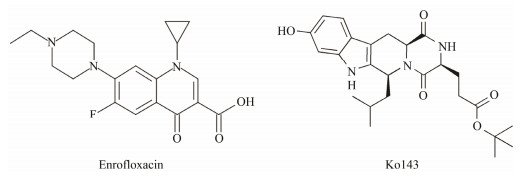
The synthetic antibacterial agent enrofloxacin (ENRO) (Fig. 1) is a fluoroquinolone employed as veterinary and aquatic medicine. It is also a substrate of BCRP (Real et al., 2011). The compound Ko143 [(3S, 6S, 12αS)-1, 2, 3, 4, 6, 7, 12, 12α-octahydro-9-methoxy-6-(2-methylpropyl)-1, 4-dioxopyrazino [1', 2':1, 6] pyrido [3, 4-b] indole-3propanoic acid 1, 1-dimethylethyl ester] is a potent ABCG2 inhibitor and a candidate for PET imaging studies along with a suitable radiotracer. Derived from fumitremorgin C (FTC) as a nontoxic analog, Ko143 (Fig. 1) has been used over the past decade to examine the interaction between ABCG2 and pharmaceutical drugs in vitro and in vivo (Allen et al., 2002; Matsson et al., 2009). Here in this study, we determined the effect of Ko143 on the expression of BCRP in the tissues of E. carinicauda. The effect of Ko143 on ENRO pharmacokinetics in different tissues was also determined to better understand the function of BCRP transporter in fluoroquinolone disposition in E. carinicauda.
|
Fig. 1 The chemical structure of ENRO and Ko143. |
The ENRO (purity > 98%) used in preparation of the medicated feed was purchased from Solarbio (Beijing, China). Ko143 (purity > 99%) was obtained from Sigma- Aldrich (Saint Louis, MO, USA). The medicated feed was administered at 2% of total body weight (BW), and was made by top-coating the drug powder uniformly on the pellet feed using egg white. The ENRO-medicated feeds were made with 10, 20 and 40 mg ENRO per kg BW, respectively. The Ko143 and ENRO-medicated feeds were made with 5 mg Ko143 per kg BW and 10, 20 and 40 mg ENRO per kg BW, respectively.
2.2 Shrimp and Culture ConditionE. carinicauda (length: 4.59 cm ± 0.45 cm; weight: 1.32 g ± 0.21 g) were purchased from a commercial farm (Qingdao, China) and cultured in sea water (salinity 30, pH 8.0 ± 0.2) at 23℃ ± 1℃ for 7 days before processing. Two-thirds of the water in each shrimp group was renewed once a day. The collection and handling of the animals in this study was approved by the Animal Care and Use Committee of Chinese Academy of Fishery Sciences, and all experimental animal protocols were written and used following the guidelines for the care and use of laboratory animals of Chinese Academy of Fishery Sciences.
2.3 Reverse Transcription-Polymerase Chain Reaction (RT-PCR)Thirty-six healthy adult E. carinicauda were divided into a control group (n = 18) and a Ko143-treated group (single oral administration of 5 mg kg−1 BW each E. carinicauda) (n = 18). Two hours after Ko143 treatment, the gills, haemocytes, heart, muscles, hepatopancreas, eyestalks, intestines, stomach and ovaries were sampled. Three shrimps were randomly selected as one sample from each group, and there were six biological replicates for each tissue in each group.
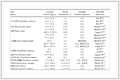
Total RNA was isolated from tissues using TRIzol™ Reagent (Invitrogen, Carlsbad, CA, USA). After digestion of genomic DNA (Promega, Fitchburg, WI, USA), the mRNAs were reversely transcribed with M-MLV reverse transcriptase (Promega). Then, quantitative PCR (q-PCR) was undertaken on an ABI PRISM 7500 Sequence Detection System (Applied Biosystems, Foster City, CA, USA) using SYBR® Premix Ex Taq™ II (TaKaRa Bio, Dalian, China) and primers listed in Table 1. PCR condition was 95℃ for 30 s first, then 40 cycles of 95℃ for 5 s and 60℃ for 34 s, followed by one additional cycle of 95℃ for 15 s, 60℃ for 1 min and 95℃ for 15 s. The 18S rRNA (GenBank accession number: GQ369794) of E. carinicauda was used as the internal control. Fold-change in relative gene expression to control was determined with standard 2−ΔΔCt method as we did early (Zhai et al., 2017).
|
Table 1 Primers used in this study |
Healthy adult E. carinicauda (n = 1620) were divided into six treatment groups, 270 individuals in a tank each group. The first three groups received medicated feed at a single oral dose of 10, 20 and 40 mg ENRO per kg BW, respectively. The remaining three groups were given medicated feed at a single oral dose of 5 mg Ko143 per kg BW and 10, 20 and 40 mg ENRO per kg BW, respectively. Blood, hepatopancreas, intestines and muscles were collected at 0.083, 0.25, 0.5, 1, 2, 4, 6, 8, 12, 24, 48, 72, 96, 120 and 144 h after drug administration. Then 200 μL of hemolymph each individual was drawn directly from the cardiocoelom using sterile syringes containing 200 μL of anticoagulant solution (1.588 g of sodium citrate, 3.92 g of sodium chloride, 4.56 g of glucose, 0.66 g of EDTA-2Na, 200 mL of ddH2O). Shrimps from six groups were dissected carefully and the hepatopancreas, intestines and muscles were collected immediately. Eighteen shrimps were selected randomly at each time point each group. Three shrimps were combined to use as one sample to be analyzed. Thus, there were six biological replicates each tissue each group each time point. The ENRO level in blood and tissues was analysed using high-performance liquid chromatography as was described by Liang et al. (2014) with a modification (0.017 mol L−1 phosphate-triethylamine buffer: acetonitrile, 85:15, v/v as the mobile phase). Calculations of pharmacokinetic parameters were undertaken with Drug and Statistics v2.0 (Center for Clinical Drug Evaluation, Wannan Medical College, Wuhu, China) using the compartmental model.
2.5 Data AnalysisAll data were presented as mean ± SD. Statistical analysis was performed using SPSS v17.0 (IBM, Armonk, NY, USA). The mRNA abundance data in different tissues and pharmacokinetic parameters of enrofloxacin in plasma, hepatopancreas, intestines and muscles were analyzed with one-way ANOVA followed by the Student's ttest to find any significant difference between ENRO and Ko143 + ENRO treatments.
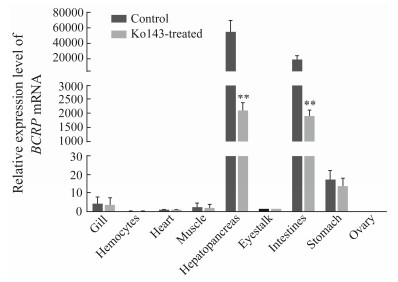
3 Results 3.1 Effect of Ko143 on Abundance of BCRP Gene mRNA in E. carinicaudaBefore treatments, the highest expression level of BCRP gene was in hepatopancreas, followed by that in intestine (Fig. 2). The mRNA abundance in stomach, gills, muscles, eyestalks and heart were low, and virtually no expression of the gene was found in haemocytes and ovaries. BCRP gene expression was also recorded in different tissues after Ko143 treatment. Compared with the control, the expressions of BCRP was downregulated significantly in hepatopancreas and intestines (P < 0.01) after Ko143 treatment. The mRNA level in other tissues did not show significant differences (P > 0.05).
|
Fig. 2 Expression of BCRP gene in E. carinicauda with and without Ko143. Expression of BCRP gene was detected by real-time RT PCR. 18S rRNA was used as the reference for normalization (n = 6). ∗∗ (P < 0.01) and ∗ (P < 0.05) show the significant difference between control and Ko143-treated E. carinicauda. |
The limit of quantitation (LOQ) and limit of detection (LOD) of ENRO were 0.05 and 0.02 μg mL−1, respectively. After detection of ENRO at 3 concentrations (0.05, 1, and 10 μg mL−1. The recovery rate of ENRO at 3 concentrations was all higher than 85%. The stability test revealed that the precision of ENRO was less than 12% under four conditions: short-term placement (4 h) at room temperature 25℃; freezing and thawing three times; long-term (2 weeks) freezing (−20℃); and placement for 13 h at room temperature 25℃ before injection, which complied with the test requirement for biologic samples. The correlation coefficient for the calibration curves was 0.9996.
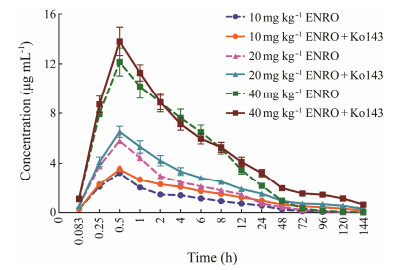
3.3 Effect of Ko143 on ENRO PharmacokineticsThe mean plasma concentration-time profile of ENRO (10, 20, 40 mg kg−1 BW, p.o.) administered alone and coadministered with Ko143 (5 mg kg−1 BW, p.o.) is displayed in Fig. 3. The pharmacokinetic parameters are shown in Table 2. It was shown that orally taken both ENRO and Ko143 can significantly change ENRO pharmacokinetics in E. carinicauda (P < 0.05) (Table 6). Compared with Ko143 + ENRO groups, the concentration of ENRO in plasma was lower in ENRO-alone groups over the entire experimental period. Compared with ENRO-alone groups, a significant increase by 2.69-, 2.68-, and 2.72-folds in elimination half-life (t1/2β) for ENRO at concentrations of 10, 20 and 40 mg kg−1 BW were observed in Ko143 groups, respectively. In parallel, the area under the curve up to the last measurable concentration (AUC0-t) of ENRO increased significantly after concomitant administration of Ko143 (2.28-, 2.11and 1.85-fold at ENRO doses of 10, 20 and 40 mg kg−1 BW, respectively, P < 0.01). The differences in distribution half-life (t1/2α), peak concentration (Cmax) and clearance (CL/F) between two groups were also significant (P < 0.05).
|
Fig. 3 The concentration-time profile of ENRO in plasma. The different curves are the plasma concentration-time profile of ENRO after single oral administration at 10, 20, 40 mg kg−1 BW alone or together with Ko143. Data are shown as mean ± SD (n = 6). |
|
|
Table 2 Pharmacokinetic parameters of enrofloxacin in plasma after oral administration at different doses alone or together with Ko143 in E. carinicauda (mean ± SD, n = 6) |
|
|
Table 3 Pharmacokinetic parameters of enrofloxacin in hepatopancreas after oral administration at different doses alone or together with Ko143 in E. carinicauda (mean ± SD, n = 6) |
|
|
Table 4 Pharmacokinetic parameters of enrofloxacin in intestines after oral administration at different doses alone or together with Ko143 in E. carinicauda (mean ± SD, n = 6) |
|
|
Table 5 Pharmacokinetic parameters of enrofloxacin in muscles after oral administration at different doses alone or together with Ko143 in E. carinicauda (mean ± SD, n = 6) |
|
|
Table 6 One-way ANOVA analysis of some pharma cokinetic parameters in plasma, hepatopancreas, intestine and muscle after oral administration at different doses alone or together with Ko143 in E. carinicauda |
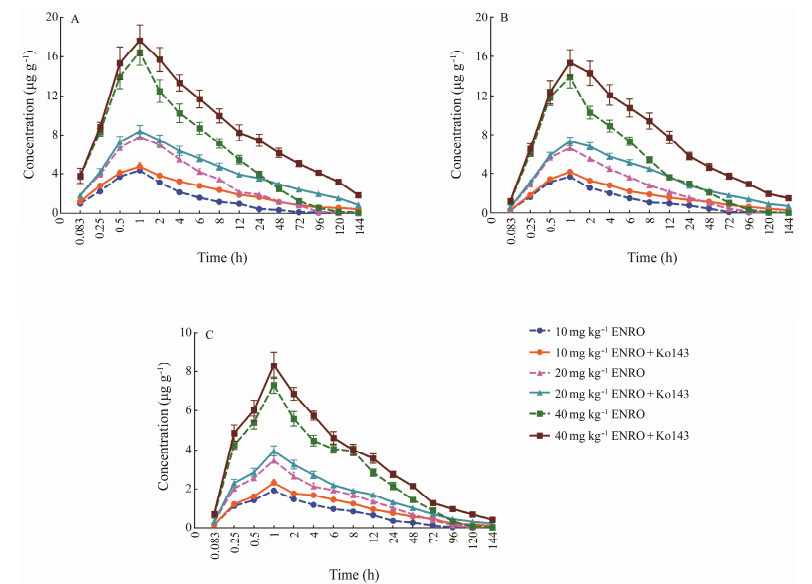
The mean concentration-time profile of ENRO (10, 20, 40 mg kg−1 BW, p.o.) in different tissues after administered alone or co-administered with Ko143 (5 mg kg−1 BW, p.o.) are displayed in Fig. 4, and pharmacokinetic parameters are shown in Tables 3 – 5. The combination of ENRO and Ko143 caused also significant changes in the pharmacokinetic behaviour of ENRO in hepatopancreas, intestine and muscle via oral administration (P < 0.05) (Table 6). High ENRO concentrations over the whole drug-detection period were observed, and a significant increase by 2.70 – 2.75, 2.68 – 2.70, 1.87 – 1.91 folds in the t1/2β (P < 0.05) were displayed in hepatopancreas, intestine and muscle respectively at the dose of 10, 20 and 40 mg kg−1 in Ko143treated groups compared with ENRO alone groups. In parallel, the AUC0-t of ENRO significantly increased following concomitant administration of Ko143 (3.08-, 2.63-, 2.47-fold in hepatopancreas, 2.56-, 2.45-, 2.71-fold in intestine, and 2.23-, 1.86-, 1.71-fold in muscle at the dose of 10, 20 and 40 mg kg−1, respectively, P < 0.05). The difference in CL/F between the ENRO group and Ko143 + ENRO group also achieved statistical significance in hepatopancreas, intestine and muscle (P < 0.05). Although the differences in t1/2α and Cmax between the ENRO group and Ko143 + ENRO group did not show statistical significance, they tended to be higher in the presence of Ko143.
|
Fig. 4 The concentration-time profile of ENRO in different tissues. The concentration-time profiles of ENRO in the hepatopancreas (A), intestines (B) and muscles (C) after single oral administration at 10, 20, 40 mg kg−1 BW alone or together with Ko143. Data are shown as mean ± SD (n = 6). |
Drug-metabolizing enzymes and transporters belong to the crucial 'detoxification system' in the liver and small intestine, which can control the absorption of xenobiotic compounds (including drugs) into the circulation (Wacher et al., 2001; Ding and Kaminsky, 2003; Murakami and Takano, 2008). For drug candidates, low oral availability and high elimination rate can be ascribed to metabolism and/ or active efflux. Even for marketed drugs, oral availability and elimination rate can cause non-linearity and inter-person variations due to drug-drug interactions and genetic factors. Discovery of the effect of the metabolism enzymes and efflux transporters can help to select drug candidates and increase the safety and validity of drug treatment.
ABC transporters constitute one of the largest families of membrane transporter proteins, which couple the energy stored in ATP to the movement of molecules across the membrane. ABC transporters have numerous functions and transport diverse substrates from simple ions, polar, amphipathic and hydrophobic organic molecules, to peptides, complex lipids and even small proteins. They are also involved in the absorption, accumulation and excretion of various toxic substances and play an important role in defence (Theodoulou and Kerr, 2015). To date, the ABC transporter superfamily has been divided into eight subtypes (A-H), of which P-gp (ABCB1), MRP (ABCC1) and BCRP (ABCG2) are most involved in the metabolism and transport of exogenous chemicals (Xiong et al., 2010). BCRP is a multiple-specific ABC transporter synthesized at apical membranes in the intestines, liver, kidneys and placenta (Kusuhara and Sugiyama, 2007; Vlaming et al., 2009; Alexander et al., 2011). As an important efflux transporter, BCRP can transport food toxicants, nutrients and drugs, and thereby regulates the intestinal absorption and hepatic metabolism of these substances (Aspenström-Fagerlund et al., 2015). Considering the broad substrate specificity of BCRP, its effect on drug disposition, including pharmacokinetics and oral bioavailability of drugs/drug candidates are important factors for consideration.
Studies on mammals have demonstrated that BCRP can promote the elimination of drugs into bile and urine, and limit the penetration into tissues, which affects the pharmacokinetics of drugs (Enokizono et al., 2007; Vlaming et al., 2009). For example, BCRP is involved in the biliary excretion of quinolone antibiotics in mice. After administration of ciprofloxacin to BCRP-knockout mice, the concentration of ciprofloxacin in renal tissue and blood in BCRP-knockout mice increased significantly (Ando et al., 2007). Ivermectin and danofloxacin can bind competitively to the BCRP transporter in sheep. Compared with single administration of danofloxacin, the concentration of danofloxacin in sheep increased significantly. Meanwhile, the area under the curve of the drug in plasma increased by 32% – 35%, and the half-life extended by 4% – 52% when the two drugs were used in combination (Ballent et al., 2012). Moreover, when mice were treated (p.o.) with Ko143, a significant increase (greater than 2 folds; P < 0.05) of the specific BCRP substrate mitoxantrone (MXR) was found in liver. MXR level in blood (P = 0.17) and plasma (P = 0.13) also tended to increase in Ko143-treated mice though the difference was not significant (Aspenström-Fagerlund et al., 2015). In engineered HeLa1A1 cells, Ko143 (5 and 20 μmol L−1) administration led to a significant reduction in excretion of BCRP substrate cycloicaritin-3-O-glucuronide (15.6% – 51.7%), efflux CLapp value (32.3% – 51.7%) and metabolized fraction (36.5% – 44.1%), and a marked increase in intracellular level of glucuronide (35.2% – 79.7%) (Li et al., 2018). The above findings also proved that drug disposition in mammals can be altered by changing the activity of BCRP.
It has been shown that BCRP is also present in shrimps, and its gene highly expressed in hepatopancreas and intestines (Zhou et al., 2009; Zhai et al., 2017). Additionally, ENRO is the most widely used fluoroquinolone in aquaculture (including shrimp culture) and a substrate for BCRP in mammals (Real et al., 2011; Liang et al., 2014). In consequence, we investigated the effects of Ko143 on BCRP activities and the influence of BCRP activity on ENRO pharmacokinetics in E. carinicauda, which is helpful to clarify the role of BCRP in drug disposition in shrimps. The findings of our study are in accordance with the previously reported about the role of BCRP in drug disposition in mammals (Ando et al., 2007; Ballent et al., 2012; Aspenström-Fagerlund et al., 2015; Li et al., 2018). The present study also demonstrated BCRP is a key factor that affects ENRO (which was given via the oral route) pharmacokinetics in E. carinicauda. Under the experimental conditions, it was found that Ko143 down-regulated the mRNA abundance of BCRP gene transcripts in E. ca- rinicauda. Then, the ENRO concentrations in plasma, hepatopancreas, intestines and muscles after ENRO (10, 20 and 40 mg kg−1 BW, p.o.) administration to E. carinicauda was measured. We found that concurrent administration of Ko143 altered the pharmacokinetic parameters of ENRO, t1/2β, AUC0-t and CL/F significantly. Alteration of these pharmacokinetic parameters may be due to the enhancement of intestinal absorption, as well as the inhibition of hepatopancreas elimination of ENRO by inhibition of BCRP gene expression using Ko143 (Vlaming et al., 2009; Gu et al., 2012; Aspenström-Fagerlund et al., 2015). Pharmacokinetic parameters such as t1/2β, AUC0-t and CL/ F of ENRO in the edible tissue (muscle) were also increased significantly by co-administration with Ko143. This may be due to prolonged elimination of ENRO in the hepatopancreas and increased absorption of ENRO in the intestines, which caused a slow elimination of ENRO in blood. Therefore, drug-drug interactions caused by change of BCRP activity should be concerned if ENRO is used in combination with other drugs and food ingredients; BCRP plays an important role in ENRO disposition in shrimps.
Presently, the effect of Ko143 on the mRNA abundance of BCRP gene transcripts in E. carinicauda was studied in this research. The effect on the protein level will be studied once the antibody for the detection of BCRP is available.
5 ConclusionsKo143 inhibited the expression of BCRP gene significantly in E. carinicauda. Co-administration of Ko143 increased the ENRO concentration significantly in E. carinicauda and changed the pharmacokinetic parameters of ENRO administered via the oral route, causing higher t1/2α, t1/2β, AUC0-t and Cmax values, as well as lower CL/F value in comparison with those of control. Concomitant application of Ko143 with ENRO resulted in major interactions via BCRP in E. carinicauda. Thus, if ENRO is used in combination with other substances that can affect BCRP in shrimps, the change in ENRO pharmacokinetics should be considered.
AcknowledgementsThis work was supported by the Natural Science Foundation of Shandong Province, P. R. China (No. ZR2019 QC015), the National Key R&D Program of China (No. 2019YFD0900403), the Central Public-Interest Scientific Institution Basal Research Fund, CAFS (Nos. 2019ZD09 03 and 2020TD46), the Marine S&T Fund of Shandong Province for Pilot National Laboratory for Marine Science and Technology (Qingdao) (No. 2018SDKJ0502-2), the Earmarked Fund for Modern Agro-industry Technology Research System (No. CARS-48), and the National Natural Science Foundation of China (No. 31873039).
Alexander, S. P., Mathie, A. and Peters, J. A., 2011. Guide to receptors and channels (GRAC), 5th edition. British Journal of Pharmacology, 164: S1-324. DOI:10.1111/j.1476-5381.2011.01649_1.x (  0) 0) |
Allen, J. D., van Loevezijn, A., Lakhai, J. M., van der Valk, M., van Tellingen, O., Reid, G., Schellens, J. H., Koomen, G. J. and Schinkel, A. H., 2002. Potent and specific inhibition of the breast cancer resistance protein multidrug transporter in vitro and in mouse intestine by a novel analogue of fumitremorgin C. Molecular Cancer Therapeutics, 1: 417-425. ( 0) |
Ando, T., Kusuhara, H., Merino, G., Alvarez, A. I., Schinkel, A. H. and Sugiyama, Y., 2007. Involvement of breast cancer resistance protein (ABCG2) in the biliary excretion mechanism of fluoroquinolones. Drug Metabolism and Disposition, 35: 1873-1879. DOI:10.1124/dmd.107.014969 ( 0) |
Aspenström-Fagerlund, B., Tallkvist, J., Ilbäck, N. G. and Glynn, A. W., 2015. Oleic acid increases intestinal absorption of the BCRP/ABCG2 substrate, mitoxantrone, in mice. Toxicology Letters, 237: 133-139. DOI:10.1016/j.toxlet.2015.06.009 ( 0) |
Ballent, M., Lifschitz, A., Virkel, G., Sallovitz, J., Maté, L. and Lanusse, C., 2012. In vivo and ex vivo assessment of the interaction between ivermectin and danofloxacin in sheep. The Veterinary Journal, 192: 422-427. DOI:10.1016/j.tvjl.2011.09.006 ( 0) |
Bertilsson, G., Heidrich, J., Svensson, K., Asman, M., Jendeberg, L., Sydow-Bäckman, M., Ohlsson, R., Postlind, H., Blomquist, P. and Berkenstam, A., 1998. Identification of a human nuclear receptor defines a new signaling pathway for CYP3A induction. Proceedings of the National Academy of Science of the United States of America, 95: 12208-12213. DOI:10.1073/pnas.95.21.12208 ( 0) |
Chang, Z. Q., Li, J., Liu, P., Kuo, M. M. C., He, Y. Y., Chen, P. and Li, J. T., 2012. cDNA cloning and expression profile analysis of an ATP-binding cassette transporter in the hepatopancreas and intestine of shrimp Fenneropenaeus chinensis. Aquaculture, 365-367: 250-255. ( 0) |
Daood, M., Tsai, C., Ahdab-Barmada, M. and Watchko, J. F., 2008. ABC transporter (P-gP/ABCB1, MRP1/ABCC1, BCRP/ABCG2) expression in the developing human CNS. Neuropediatrics, 39: 211-218. DOI:10.1055/s-0028-1103272 ( 0) |
Ding, X. and Kaminsky, L. S., 2003. Human extrahepatic cytochromes P450: Function in xenobiotic metabolism and tissueselective chemical toxicity in the respiratory and gastrointestinal tracts. Annual Review of Pharmacology and Toxicology, 43: 149-173. DOI:10.1146/annurev.pharmtox.43.100901.140251 ( 0) |
Duan, Y. F., Liu, P., Li, J. T., Li, J. and Chen, P., 2013. Expression profiles of selenium dependent glutathione peroxidase and glutathione S-transferase from Exopalaemon carinicauda in response to Vibrio anguillarum and WSSV challenge. Fish and Shellfish Immunology, 35: 661-670. DOI:10.1016/j.fsi.2013.05.016 ( 0) |
Duan, Y. F., Liu, P., Li, J. T., Wang, Y., Li, J. and Chen, P., 2014. A farnesoic acid O-methyltransferase (FAMeT) from Exopalaemon carinicauda is responsive to Vibrio anguillarum and WSSV challenge. Cell Stress and Chaperones, 19: 367-377. DOI:10.1007/s12192-013-0464-5 ( 0) |
Enokizono, J., Kusuhara, H. and Sugiyama, Y., 2007. Effect of breast cancer resistance protein (Bcrp/Abcg2) on the disposition of phytoestrogens. Molecular Pharmacology, 72: 967-975. DOI:10.1124/mol.107.034751 ( 0) |
Eriksson, U. G., Dorani, H., Karlsson, J., Fritsch, H., Hoffmann, K. J., Olsson, L., Sarich, T. C., Wall, U. and Schützer, K. M., 2006. Influence of erythromycin on the pharmacokinetics of ximelagatran may involve inhibition of P-glycoprotein-mediated excretion. Drug Metabolism and Disposition, 34: 775-782. DOI:10.1124/dmd.105.008607 ( 0) |
Gu, L. L., Chen, Z. X. and Lu, W. G., 2012. Advance on efflux inhibititors inhibiting ABC transporters to improve drug intestinal absorption. World Clinical Drugs, 33: 176-182 (in Chinese with English abstract). ( 0) |
Hua, W. J., Hua, W. X. and Fang, H. J., 2012. The role of OATP1B1 and BCRP in pharmacokinetics and DDI of novel statins. Cardiovascular Therapeutics, 30: e234-241. DOI:10.1111/j.1755-5922.2011.00290.x ( 0) |
Jonker, J. W., Merino, G., Musters, S., van Herwaarden, A. E., Bolscher, E., Wagenaar, E., Mesman, E., Dale, T. C. and Schinkel, A. H., 2005. The breast cancer resistance protein BCRP (ABCG2) concentrates drug and carcinogenic xenotoxins into milk. Nature Medicine, 11: 127-129. DOI:10.1038/nm1186 ( 0) |
Kruijtzer, C. M., Beijnen, J. H., Rosing, H., ten Bokkel Huinink, W. W., Schot, M., Jewell, R. C., Paul, E. M. and Schellens, J. H., 2002. Increased oral bioavailability of topotecan in combination with the breast cancer resistance protein and P-glycoprotein inhibitor GF120918. Journal of Clinical Oncology, 20: 2943-2950. DOI:10.1200/JCO.2002.12.116 ( 0) |
Kusuhara, H. and Sugiyama, Y., 2007. ATP-binding cassette, subfamily G (ABCG family). Pflugers Archiv: European Journal of Physiology, 453: 735-744. DOI:10.1007/s00424-006-0134-x ( 0) |
Li, J. T, Han, J. Y., Chen, P., Chang, Z. Q., He, Y. Y., Liu, P., Wang, Q. Y. and Li, J., 2012. Cloning of a heat shock protein 90 (HSP90) gene and expression analysis in the ridgetail white prawn Exopalaemon carinicauda. Fish and Shellfish Immunology, 32: 1191-1197. DOI:10.1016/j.fsi.2012.03.008 ( 0) |
Li, S., Xu, J., Yao, Z., Hu, L., Qin, Z., Gao, H., Krausz, K. W., Gonzalez, F. J. and Yao, X., 2018. The roles of breast cancer resistance protein (BCRP/ABCG2) and multidrug resistanceassociated proteins (MRPs/ABCCs) in the excretion of cycloicaritin-3-O-glucoronide in UGT1A1-overexpressing HeLa cells. Chemico-Biological Interactions, 296: 45-56. DOI:10.1016/j.cbi.2018.09.001 ( 0) |
Liang, J. P., Li, J., Li, J. T., Liu, P., Chang, Z. Q. and Nie, G. X., 2014. Accumulation and elimination of enrofloxacin and its metabolite ciprofloxacin in the ridgetail white prawn Exopalaemon carinicauda following medicated feed and bath administration. Journal of Veterinary Pharmacology and Therapeutics, 37: 508-514. DOI:10.1111/jvp.12115 ( 0) |
Maliepaard, M., Scheffer, G. L., Faneyte, I. F., van Gastelen, M. A., Pijnenborg, A. C., Schinkel, A. H., van De Vijver, M. J., Scheper, R. J. and Schellens, J. H., 2001. Subcellular localization and distribution of the breast cancer resistance protein transporter in normal human tissues. Cancer Research, 61: 3458-3464. ( 0) |
Matsson, P., Pedersen, J. M., Norinder, U., Bergstrom, C. A. and Artursson, P., 2009. Identification of novel specific and general inhibitors of the three major human ATP-binding cassette transporters P-gp, BCRP and MRP2 among registered drugs. Pharmaceutical Research, 26: 1816-1831. DOI:10.1007/s11095-009-9896-0 ( 0) |
Murakami, T. and Takano, M., 2008. Intestinal efflux transporters and drug absorption. Expert Opinion on Drug Metabolism and Toxicology, 4: 923-939. DOI:10.1517/17425255.4.7.923 ( 0) |
Real, R., González-Lobato, L., Baro, M. F., Valbuena, S., de la Fuente, A., Prieto, J. G., Alvarez, A. I., Marques, M. M. and Merino, G., 2011. Analysis of the effect of the bovine adenosine triphosphate-binding cassette transporter G2 single nucleotide polymorphism Y581S on transcellular transport of veterinary drugs using new cell culture models. Journal of Animal Science, 89: 4325-4338. DOI:10.2527/jas.2011-3841 ( 0) |
Sooud, K. A., 2003. Influence of albendazole on the disposition kinetics and milk antimicrobial equivalent activity of enrofloxacin in lactating goats. Pharmacological Research, 48: 389-395. DOI:10.1016/S1043-6618(03)00179-8 ( 0) |
Staudinger, J. L., Goodwin, B., Jones, S. A., Hawkins-Brown, D., MacKenzie, K. I., LaTour, A., Liu, Y., Klaassen, C. D., Brown, K. K., Reinhard, J., Willson, T. M., Koller, B. H. and Kliewer, S. A., 2001. The nuclear receptor PXR is a lithocholic acid sensor that protects against liver toxicity. Proceedings of the National Academy of Sciences of the United States of America, 98: 3369-3374. DOI:10.1073/pnas.051551698 ( 0) |
Theodoulou, F. L. and Kerr, I. D., 2015. ABC transporter research: Going strong 40 years on. Biochemical Society Transactions, 43: 1033-1040. DOI:10.1042/BST20150139 ( 0) |
Vlaming, M. L., Lagas, J. S. and Schinkel, A. H., 2009. Physiological and pharmacological roles of ABCG2 (BCRP): Recent findings in Abcg2 knockout mice. Advanced Drug Delivery Reviews, 61: 14-25. DOI:10.1016/j.addr.2008.08.007 ( 0) |
Wacher, V. J., Salphati, L. and Benet, L. Z., 2001. Active secretion and enterocytic drug metabolism barriers to drug absorption. Advanced Drug Delivery Reviews, 46: 89-102. DOI:10.1016/S0169-409X(00)00126-5 ( 0) |
Wang, L. Y., Li, F. H., Wang, B. and Xiang, J. H., 2013. A new shrimp peritrophin-like gene from Exopalaemon carinicauda involved in white spot syndrome virus (WSSV) infection. Fish and Shellfish Immunology, 35: 840-846. DOI:10.1016/j.fsi.2013.06.018 ( 0) |
Wright, J. A., Haslam, I. S., Coleman, T. and Simmons, N. L., 2011. Breast cancer resistance protein BCRP (ABCG2)-mediated transepithelial nitrofurantoin secretion and its regulation in human intestinal epithelial (Caco-2) layers. European Journal of Pharmacology, 672: 70-76. DOI:10.1016/j.ejphar.2011.10.004 ( 0) |
Xiong, J., Feng, L., Yuan, D., Fu, C. and Miao, W., 2010. Genome-wide identification and evolution of ATP-binding cassette transporters in the ciliate Tetrahymena thermophila: A case of functional divergence in a multigene family. BMC Evolutionary Biology, 10: 330. ( 0) |
Zhai, Q. Q., Li, J. and Chang, Z. Q., 2017. cDNA cloning, characterization and expression analysis of ATP-binding cassette (ABC) transmembrane transporter in Exopalaemon carinicau- da. Aquaculture Research, 48: 4143-4154. ( 0) |
Zhou, J., He, W. Y., Wang, W. N., Yang, C. W., Wang, L., Xin, Y., Wu, J., Cai, D. X., Liu, Y. and Wang, A. L., 2009. Molecular cloning and characterization of an ATP-binding cassette (ABC) transmembrane transporter from the white shrimp Litope- naeus vannamei. Comparative Biochemistry and Physiology Part C: Toxicology and Pharmacology, 150: 450-458. ( 0) |