 2017, Vol. 33


PM2.5为粒径<2.5 μm的细颗粒物,可通过呼吸途径直接进入肺部,致人罹患呼吸系统或循环系统疾病,有研究表明,空气中PM2.5浓度的上升将导致人群死亡率的上升[1-3]。目前中国多个城市存在PM2.5空气质量未达标的情况,部分雾霾现象已十分严重。为探讨PM2.5日平均浓度与死亡率的“剂量-反应”关系,为评估严重雾霾天气对居民健康造成的影响提供科学依据,本研究通过收集相关文献,对PM2.5日平均浓度与死亡率的关系进行meta分析。结果报告如下。
1 资料与方法 1.1 文献检索策略在中国期刊全文数据库(CNKI)、PubMed数据库和Elsevier Science Direct数据库中检索1990年1月1日—2015年6月30日发表的相关中、英文文献,末次检索日期为2015年6月30日。中文和英文检索主题词分别为:“PM2.5”、“颗粒物”、“大气污染物”、“死亡率”、“剂量-反应”、“短期健康效应”、“particulate matter”、“ambient air pollution”、“mortality”、“dose-response”、“short-term health effect”。同时辅以文献追溯法及人工检索法收集更多相关文献。
1.2 纳入与排除标准纳入标准:(1) 国内或国外期刊上公开发表的在国内城市开展的PM2.5日平均浓度与死亡率的流行病学研究;(2)文献类型为流行病学原始研究;(3) 研究设计为时间序列或病例交叉研究;(4)时间尺度为日;(5)健康终点为人群总死亡率(全因死亡率);(6)暴露人群为城市全体居民;(7)环境暴露指标为PM2.5浓度值;(8)采样时间>1年;(9)样本量应足够大。排除标准:(1) 政策应用类、综述类和meta分析类文献;(2)采用生态比较方法分析的文献;(3)以年或月为时间尺度对PM2.5长期致死效应进行研究的文献;(4)以air pollutant index(API)或air quality index(AQI)指数建模的文献。
1.3 数据提取对纳入文献进行信息提取,内容包括、第一作者、发表年份、研究地区、样本量、居民死亡率、PM2.5浓度值、模型形态、“剂量-反应”关系系数(β值)、标准差。多数流行病学研究使用对数线性模型ln(Y)=a+βX+γ,式中,Y为死亡率,X为污染物浓度值(μg/m3),γ为其他因素对死亡率的影响,β值为“剂量-反应”关系系数。在对数线性模型中,污染物浓度从X0上升△x到X1时,居民基期死亡率Y0也将上升到Y1的水平,ln(Y1/Y0)=β(X1-X0),式中,Y1/Y0为相对危险度(relative risk,RR),代表PM2.5浓度上升情况下的死亡率对基期死亡率的比值,借助于“剂量-反应”关系系数β值,可计算暴露人群的相对危险度水平。对所提取数据进行整理和进行质量分析,部分文献未直接给出β值,需全部换算为β值。
1.4 统计分析应用Stata 12.0软件对纳入的文献进行meta分析。本研究拟采用倒方差法为原始研究分配权重,对原始研究结果进行异质性分析,给出异质性检验Q统计量值及相应的P值。如果纳入研究无异质性(P>0.10,I2<50%),则采用固定效应模型;如果纳入研究存在异质性(P≤0.10,I2≥50%),则采用随机效应模型。采用亚组分析对异质性来源因素进行分析,并采用Begg秩相关法和Egger直线回归法评价文献的发表偏倚。
2 结 果 2.1 文献一般特征(表 1)共检索出相关文献45篇(中文文献30篇,英文文献15篇),根据纳入和排除标准进行剔除,最终纳入11篇文献(中文文献1篇,英文文献10篇),共包括上海、西安、北京、沈阳、广州、重庆6个城市13个分析样本的数据。

|
表 1 纳入meta分析文献一般特征 |
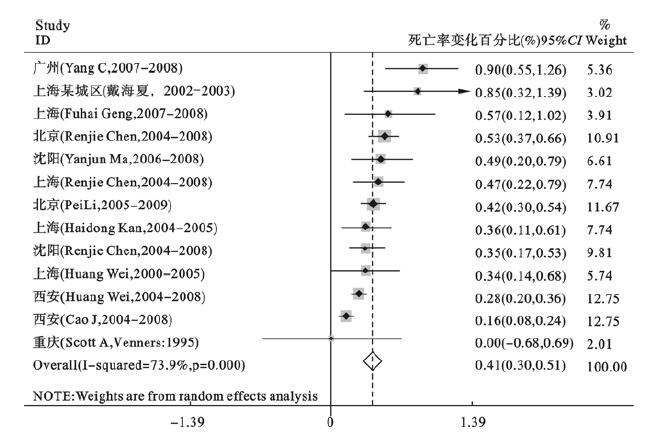
2.2 PM2.5日平均浓度与死亡率的“剂量-反应”关系的meta分析(图 1)
对纳入的11篇文献进行异质性检验,文献间存在显著的异质性(Q=45.97,P<0.001,I2=73.9%),采用随机效应模型。meta分析结果显示,在PM2.5日平均浓度上升10 μg/m3的情况下,人群死亡率较基期水平上升了0.37% [95%CI=0.26%~0.48%]。
|
图 1 PM2.5日平均浓度与死亡率“剂量-反应”关系meta分析森林图 |
2.3 亚组分析
经异质性检验,PM2.5浓度值和气温是本研究meta分析中最主要的异质性来源,2个因素合计可以解释原始研究93.78%的异质性。亚组分析结果显示,PM2.5日平均浓度较高地区(PM2.5≥75 μg/m3)PM2.5日平均浓度上升10 μg/m3,人群死亡率较基期水平上升0.33%[95% confidence interval(95%CI)=0.20%~0.46%],PM2.5日平均浓度较低地区(PM2.5<75 μg/m3)PM2.5日平均浓度上升10 μg/m3,人群死亡率较基期水平上升0.50%(95%CI=0.36%~0.63%);在气温较高地区(南方城市)PM2.5日平均浓度上升10 μg/m3,人群死亡率较基期水平上升0.51%(95%CI=0.32%~0.69%),在气温较低地区(北方城市)PM2.5日平均浓度上升10 μg/m3,人群死亡率较基期水平上升0.35%(95%CI=0.23%~0.47%)。
2.4 发表偏倚对纳入meta分析的11篇PM2.5日平均浓度与死亡率“剂量-反应”关系相关文献进行发表偏倚评价,结果显示,漏斗图两侧基本对称,Begg秩相关检验和Egger′s检验均P>0.05,发表偏倚较小。
3 讨 论本研究在全面收集中国PM2.5流行病学研究的基础上,对文献进行筛选、整理和meta分析,结果显示,在PM2.5日平均浓度上升10 μg/m3的情况下,人群死亡率较基期水平上升了0.37%(95%CI=0.26%~0.48%)。提示,PM2.5日平均浓度的上升将导致居民死亡率的上升。
亚组分析结果显示,PM2.5日平均浓度较高地区(PM2.5≥75 μg/m3)PM2.5日平均浓度上升10 μg/m3,人群死亡率较基期水平上升0.33%(95%CI=0.20%~0.46%),PM2.5日平均浓度较低地区(PM2.5<75 μg/m3)PM2.5日平均浓度上升10 μg/m3,人群死亡率较基期水平上升0.50%(95%CI=0.36%~0.63%);在气温较高地区(南方城市)PM2.5日平均浓度上升10 μg/m3,人群死亡率较基期水平上升0.51%(95%CI=0.32%~0.69%),在气温较低地区(北方城市)PM2.5日平均浓度上升10 μg/m3,人群死亡率较基期水平上升0.35%(95%CI=0.23%~0.47%)。提示,PM2.5日平均浓度的上升对浓度较高地区(PM2.5≥75 μg/m3)和气温较高地区(南方城市)居民危害更大。
欧洲和美国等发达国家也开展了大量关于PM2.5短期致死效应的流行病学研究。其中,WHO欧洲区域办公室发起“欧洲空气污染健康风险项目”,收集和整理了在欧洲地区开展的相关研究[15]。Bart等[16]和Franklin 等[17]也分别在美国9个和27个城市进行了同类研究。与国外研究结果比较,国内研究所得到的“剂量-反应”关系参数略小,这可能与人种差异、居民生活习惯的不同以及中国城市PM2.5浓度值较高等有关,具体原因尚有待进一步研究。
| [1] | Arden PC, Burnett RT, Thun MJ, et al. Lung cancer,cardiopulmonary mortality,and long-term exposure to fine particulate air pollution[J]. JAMA, 2002, 287(9) : 1132–1141. DOI:10.1001/jama.287.9.1132 |
| [2] | Laden F, Schwartz J, Speizer FE, et al. Reduction in fine particulate air pollution and mortality:extended follow-up of the Harvard Six Cities study[J]. American Journal of Respiratory and Critical Care Medicine, 2006, 173(6) : 667–672. DOI:10.1164/rccm.200503-443OC |
| [3] | Krewski D,Jerrett MR,Burnett RT,et al.Extended follow-up and spatial analysis of the American Cancer Society study linking particulate air pollution and mortality[R].Boston:Health Effects Institute,2009. |
| [4] | 戴海夏, 宋伟民, 高翔. 上海市A城区大气PM10、PM2.5污染与居民日死亡数的相关分析[J]. 卫生研究, 2004, 33(3) : 293–297. |
| [5] | Kan H, London SJ, Chen G, et al. Differentiating the effects of fine and coarse particles on daily mortality in Shanghai,China[J]. Environment International, 2007, 33(3) : 376–384. DOI:10.1016/j.envint.2006.12.001 |
| [6] | Huang W, Cao J, Tao Y, et al. Seasonal variation of chemical species associated with short-term mortality effects of PM2.5 in Xi'an,a central city in China[J]. American Journal of Epidemiology, 2012, 175(6) : 556–566. DOI:10.1093/aje/kwr342 |
| [7] | Cao J, Xu H, Xu Q, et al. Fine particulate matter constituents and cardiopulmonary mortality in a heavily polluted Chinese city[J]. Environmental Health Perspectives, 2012, 120(3) : 373–378. DOI:10.1289/ehp.1103671 |
| [8] | Chen R, Li Y, Ma Y, et al. Coarse particles and mortality in three Chinese cities:the China Air Pollution and Health Effects Study (CAPES)[J]. Science of the Total Environment, 2011, 409(23) : 4934–4938. DOI:10.1016/j.scitotenv.2011.08.058 |
| [9] | Ma Y, Chen R, Pan G, et al. Fine particulate air pollution and daily mortality in Shenyang,China[J]. Science of the Total Environment, 2011, 409(13) : 2473–2477. DOI:10.1016/j.scitotenv.2011.03.017 |
| [10] | Yang C, Peng X, Huang W, et al. A time-stratified case-crossover study of fine particulate matter air pollution and mortality in Guangzhou,China[J]. International Archives of Occupational and Environmental Health, 2012, 85(5) : 579–585. DOI:10.1007/s00420-011-0707-7 |
| [11] | Huang W, Tan J, Kan H, et al. Visibility,air quality and daily mortality in Shanghai,China[J]. Science of the Total Environment, 2009, 407(10) : 3295–3300. DOI:10.1016/j.scitotenv.2009.02.019 |
| [12] | Venners SA, Wang B, Xu Z, et al. Particulate matter,sulfur dioxide,and daily mortality in Chongqing,China[J]. Environmental Health Perspectives, 2003, 111(4) : 562–567. |
| [13] | Li P, Xin J, Wang Y, et al. Association between particulate matter and its chemical constituents of urban air pollution and daily mortality or morbidity in Beijing city[J]. Environmental Science and Pollution Research, 2014, 22(1) : 1–11. |
| [14] | Geng F, Hua J, Mu Z, et al. Differentiating the associations of black carbon and fine particle with daily mortality in a Chinese city[J]. Environmental Research, 2013, 120 : 27–32. DOI:10.1016/j.envres.2012.08.007 |
| [15] | World Health Organization.Health risks of air pollution in Europe-HRAPIE project recommendations for concentration-response functions for cost-benefit analysis of particulate matter,ozone and nitrogen dioxide[R].Gevana:World Health Organization,2013. |
| [16] | Bart O, Rachel B, Shelley G, et al. Fine particulate air pollution and mortality in nine California counties:results from CALFINE[J]. Environmental Health Perspectives, 2006, 114(1) : 29–33. DOI:10.1289/ehp.8335 |
| [17] | Franklin M, Zeka A, Schwartz J. Association between PM2.5 and all-cause and specific-cause mortality in 27 US communities[J]. Journal of Exposure Science and Environmental Epidemiology, 2006, 17(3) : 279–287. |