 2012, Vol. 28


番茄红素是一种脂溶性的类胡萝卜素,广泛存在于番茄、胡萝卜、西瓜和番石榴等蔬菜和瓜果中,具有抗氧化、抗肿瘤和降胆固醇等多种生物活性[1]。有研究表明,血浆中番茄红素水平与一些慢性疾病如心血管疾病和癌症的发生率呈负相关[2, 3, 4];炎症反应与一些慢性疾病如动脉粥样硬化、癌症的发生发展密切相关[5, 6],但番茄红素对炎症反应的调节作用目前尚不十分清楚。本研究拟通过建立脂多糖 (lipopolysaccharide,LPS )诱导的 RAW264. 7巨噬细胞炎症模型,探讨番茄红素对巨噬细胞炎症反应的影响,以了解番茄红素的抗炎作用。
1 材料与方法 1.1 材料RAW264.7细胞株(武汉大学中国细胞典藏中心);番茄红素、LPS、一氧化氮(nitric oxide,NO)检测试剂(美国 Sigma公司); ReverTra Ace-a-TM试剂盒 (日本 Toyobo公司); DNA链合成试剂盒(日本 Takara公司);诱导型一氧化氮合酶 (inducible nitric oxide synthase,iNOS)抗体(美国 Santa Cruz公司);酶联免疫吸附测定 (enzyme-linked immunosorbent assay,ELISA)试剂盒(比利时 Biosourse公司)。
1.2 方法 1.2.1 细胞培养及分组将 RAW264.7细胞接种入 25 cm2细胞培养瓶,加入含 10%胎牛血清的达尔伯克改良伊格尔培养基 (Dulbecco's modified eagle medium,DMEM)培养基(青霉素 100 U /mL,链霉素 100 μg /mL)4~5 mL,置于 37 ℃细胞培养箱中,5% CO2、饱和湿度条件下培养。每 2~3 d换液 1次。用 0.25%胰蛋白酶和 0.1%乙二胺四乙酸(ethylene diamine tetraacetic acid,EDTA)混合消化液(1: 1)消化传代培养。实验时,更换新鲜培养基并分别加入终浓度为 1、5、10 μmol /L的番茄红素孵育细胞 1 h,再加入终浓度为 1 μg /mL的 LPS处理细胞 24 h作为高、中、低剂量组,0.1%二甲基亚砜 (dimethyl sulfoxide,DMSO)处理 25 h作为空白对照组,而 0.1% DMSO处理 1 h后,再用 1 μg /mL LPS处理细胞 24 h作为阳性对照组,每组设定 3个平行孔,结果取均值。
1.2.2 细胞内 iNOS、白介素-6(interleukin-6,IL-6)mRNA表达cDNA第一链的合成参照 ReverTraAcea-TM试剂盒说明书进行。iNOS、IL-6和 GAPDH的 PCR扩增引物由上海生工生物工程公司合成,其序列为: iNOS(F: 5'-TCACTGGGACAGCACAGAAT-3',R: 5'-TGTGTCTGCAGATGTGCTGA-3'); IL-6 (F: 5'-CTGGTGACAACCACGGCCTTCCCTA-3',R: 5'-TTGGATCACGCAATACGCATCGTA-3'); GAPDH (F: 5'-ATGACAACAGCCTCAAGATCATCAG-3',R: 5'-CTGGTGGTCCAGGGGTCTTACTCCT-3')。PCR反应条件为: 94 ℃ 2 min,94 ℃ 30 s [58 ℃ 30 s(iNOS); 60 ℃ 30 s (IL-6); 60 ℃ 30 s (GADPH)],72 ℃ 1 min,循环 30次,72 ℃ 10 min。取 PCR产物于 1.2%琼脂糖凝胶中电泳后凝胶成像系统上观察、拍照。
1.2.3 细胞内iNOS蛋白表达采用聚丙烯酰胺凝胶电泳和免疫印迹(Western blot)法[7]。
1.2.4 细胞中NO及IL-6表达水平采用常规Griess法[8]检测 RAW264.7巨噬细胞培养基中 NO的含量;参照说明书采用 ELISA法检测 RAW264.7巨噬细胞培养基中 IL-6的含量。
1.3 统计分析采用 SPSS 13.0软件进行统计分析。多组均数比较采用方差齐性检验和单因素方差分析,各组间均数两两比较采用 Bonferroni法。检验水准为 P < 0.05。
2 结果 2.1 各组细胞 NO和 IL-6生成情况(表 1) | 表 1 各组细胞培养基上清液中 NO、IL- 6 含量 |
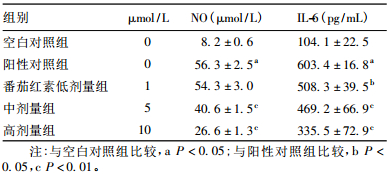
与空白对照组比较,阳性对照组 NO和 IL-6分泌量明显增加(F = 26.4,P < 0.001);番茄红素低剂量组 NO分泌量与阳性对照组比较,差异无统计学意义,番茄红素中、高剂量组 NO分泌量均明显低于阳性对照组(F = 18.3,P < 0.01);番茄红素低、中、高剂量组 IL-6分泌量均明显低于阳性对照组(F = 92.6,P < 0.05或 P < 0.01)。
2.2 各组细胞 iNOS mRNA和蛋白表达情况(图 1)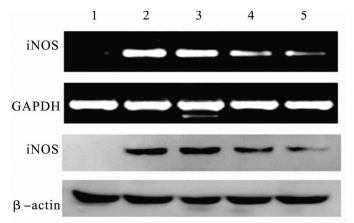 | 注: 1: 空白对照组; 2: 阳性对照组; 3 ~ 5: 番茄红素低、 中、 高剂量组。 图 1 各组细胞 iNOS mRNA 和蛋白表达情况 |
1、5、10 μmol /L番茄红素均能降低 LPS诱导 iNOS mRNA和蛋白表达,且该作用具有浓度依赖性,表明番茄红素能够通过抑制 iNOS表达而有效地降低炎症介质 NO生成。
2.3 各组细胞 IL-6 mRNA表达情况(图 2)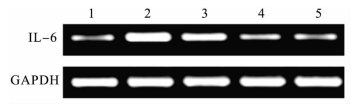 | 注: 1: 空白对照组; 2: 阳性对照组; 3 ~ 5: 番茄红素低、 中、 高剂量组。 图 2 各组细胞 IL- 6 mRNA 表达情况 |
1、5、10 μmol /L番茄红素均能明显抑制 LPS诱导的 IL-6 mRNA表达,表明番茄红素对 LPS诱导 IL-6分泌的抑制作用是通过下调 IL-6的基因表达而发挥的。
3 讨论由 iNOS合成的大量 NO广泛参与了体内炎症反应和许多急性或慢性炎症性疾病的发生发展[9]。因此,阻断 iNOS源性的 NO产生,成为预防各种炎症紊乱性疾病的一个重要的手段,同时干扰 iNOS源性 NO的产生也成为众多天然或合成抗炎药物的作用靶点[10, 11, 12]。本研究结果表明,1~10 μmol /L番茄红素均可明显抑制 LPS诱导 RAW264.7巨噬细胞 iNOS基因和蛋白表达,有效地降低 NO的生成。IL-6不仅为动脉粥样硬化重要临床生物标志物,且由巨噬细胞生成的过量的 IL-6参与了一些自主性免疫疾病如类风湿性关节炎和代谢性疾病如肥胖及糖尿病的发生发展,相应的关于阻断 IL-6生成的药物已应用于临床治疗中,并取得了良好的疗效[13]。本研究发现,番茄红素还能够明显降低 IL-6这个关键促炎因子的分泌,且其抑制作用是发生在对 IL-6基因转录水平上的调控。综上所述,番茄红素具有良好的抗炎作用,其中抑制巨噬细胞 iNOS表达和 IL-6分泌可能是其发挥抗炎效应和防治某些慢性炎性疾病的重要作用靶点。
| [1] | Kong KW,Khoo HE,Prasad KN,et al.Revealing the power of the natural red pigment lycopene[J].Molecules,2010,15(2):959-987. |
| [2] | Riccioni G.Carotenoids and cardiovascular disease[J].Curr Atheroscler Rep,2009,11(6):434-439. |
| [3] | Rissanen T,Voutilainen S,Nyyssonen K,et al.Low plasma lycopene concentration is associated with increased intima-media thickness of the carotid artery wall[J].Arterioscler Thromb Vasc Biol,2000,20(12):2677-2681. |
| [4] | Nkondjock A,Ghadirian P,Johnson KC,et al.Dietary intake of lycopene is associated with reduced pancreatic cancer risk[J].J Nutr,2005,135(3):592-597. |
| [5] | Montecucco F,Mach F.Atherosclerosis is an inflammatory disease[J].Semin Immunopathol,2009,31(1):1-3. |
| [6] | Kundu JK,Surh YJ.Inflammation:gearing the journey to cancer[J].Mutat Res,2008,659(1-2):15-30. |
| [7] | Green LC,Wagner DA,Glogowski J,et al.Analysis of nitrate,nitrite,and |
| [8] | 郭红辉,胡艳,刘驰,等.黑米花色苷对果糖喂养大鼠胰岛素敏感性影响[J].中国公共卫生,2008,24(10):1200-1202. |
| [9] | Aktan F.iNOS-mediated nitric oxide production and its regulation[J].Life Sci,2004,75(6):639-653. |
| [10] | 王庆,刘驰,郭红辉,等.花色苷抗炎抗肿瘤相关信号通路研究[J].中国公共卫生,2009,25(7):800-801. |
| [11] | Pergola C,Rossi A,Dugo PC,et al.Inhibition of nitric oxide biosynthesis by anthocyanin fraction of blackberry extract[J].Nitric Oxide,2006,15(1):30-39. |
| [12] | Tsai SH,Lin-Shiau SY,Lin JK.Suppression of nitric oxide synthase and the down-regulation of the activation of NF-kappaB in macrophages by resveratrol[J].Br J Pharmacol,1999,126(3): 673-680. |
| [13] | Ding C,Cicuttini F,Li J,et al.Targeting IL-6 in the treatment of inflammatory and autoimmune diseases[J].Expert Opin Investig Drugs,2009,18(10):1457-1466. |