 2009, Vol. 25


 , 赵仲堂
, 赵仲堂 研究表明, 妇女围孕期增补叶酸可有效预防胎儿神经管缺陷(neural tube defects, NTDs), 其预防率可达50%~70%。许多国家育龄妇女围孕期叶酸服用率 < 50%〔1-5〕, 中国北方某NTDs高发地区妇女叶酸服用率 < 15%, 且仅1/3的妇女为末次月经之前服用〔6〕。为了解高校女生这一潜在生育群体对叶酸知识的认知水平及其影响因素, 为推进叶酸干预措施提供理论依据, 于2008年3月对山东省济南市高校女生进行调查。结果报告如下。
1 对象与方法 1.1 对象采用分层抽样方法, 将济南市高校分为医科、理工和文科3类, 随机抽取3所高校不同学院(或专业)学生, 以女生宿舍为单位随机抽样, 共抽取高校女生523人。其中, 医科生190人, 工科生161人, 文科生171人; 本、专科学生(大学生) 294人, 占56.2%, 研究生229人, 占43.8%。年龄为18~31岁, 平均年龄(23.2±2.1)岁。
1.2 方法采用横断面流行病学调查方法。自行设计调查问卷; 调查内容包括学生的一般情况、叶酸相关知识及健康相关行为等。调查表经研究对象知情同意后匿名填写。
1.3 统计分析采用EPIDATA 3.1软件建立数据库, 应用SPSS 13.0软件进行χ2检验及Logistic回归分析。
2 结果 2.1 叶酸相关知识知晓情况 2.1.1 叶酸相关知识总体知晓情况叶酸总体知晓率为50.9%, NTDs知晓率为30.0%;知晓叶酸有预防NTDs作用的总体知晓率为25.8%, 其中, 31.9%(n=73)的女研究生知晓叶酸有预防NTDs作用, 女大学生知晓率为21.1% (n=62), 2者差异有统计学意义(χ2=7.825, P < 0.005, 95% CI=0.385~0.847)。15.1%的女生知晓育龄妇女叶酸的推荐服用时间(孕前3个月~孕后3个月); 6.3%知晓叶酸的推荐服用剂量(0.4 mg/d); 41.1%的女生知晓食物中含有叶酸。
2.1.2 不同专业女生叶酸相关知识知晓情况(表 1)
|
表 1 不同专业学生叶酸相关知识知晓情况 |
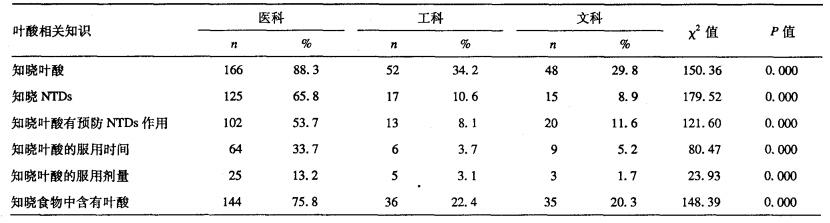
医科、工科和文科不同专业女生叶酸相关知识知晓率差异有统计学意义(P < 0.001), 医科类女生知晓率较高。
2.2 接受叶酸预防NTDs知识的来源35.8%的女生接受过健康教育, 仅1.0%进行过遗传优生咨询。知晓叶酸有预防NTDs作用; 女生知识来源主要是教科书, 其次为大众媒体; 不同女生获取该知识的来源不同, 除教课书以外, 医科大学生知晓叶酸作用的来源主要通过医务工作者和大众媒体的宣传, 工科学生主要通过亲朋好友获得, 文科类学生主要通过网络了解这一知识。
2.3 叶酸预防NTDs作用知晓现况影响因素分析 2.3.1 单因素分析学科专业、文化水平、是否接受过健康教育和年龄等4个因素对研究对象知晓叶酸预防NTDs作用有影响。医科生、研究生、接受过健康教育、年龄> 22岁女生知晓叶酸有预防NTDs作用知识的比例较高。
2.3.2 多因素分析(表 2)|
|
表 2 叶酸预防NTDs作用知晓现况多因素Logistic回归分析 |
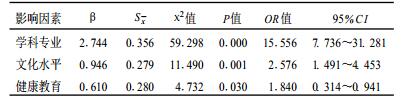
多因素Logistic回归分析结果显示, 不同专业、不同文化水平和是否接受过健康教育与研究对象知晓叶酸预防NTDs作用之间差异有统计学意义(P < 0.005);在调整专业、文化水平和是否接受健康教育因素后, 年龄因素未进入模型中, 年龄可能与文化水平存在共线性。
3 讨论调查结果表明, 高校女生中50.9%听说过叶酸, 仅有25.8%知晓叶酸预防NTDs作用, 与有关报道结果一致〔6〕, 低于其他国家报道结果〔7-10〕。仅15.1%的女生知晓服用叶酸的推荐时间, 6.3%知晓围孕期服用叶酸的推荐剂量, 表明高校女生关于叶酸相关知识知晓水平较低, 低于Lynch SM〔11〕调查结果。医科比文科和工科女生更多了解叶酸相关知识, 表明医学生叶酸预防NTDs相关知识了解较多。结果表明, 接受健康教育与高校女生知晓叶酸预防作用存在统计学关联, 应采用多种形式对高校女生叶酸相关知识进行教育, 减少NTDs发生。
结果表明, 研究生具有较多的叶酸预防NTDs作用相关知识, 提示随着教育程度增加(包含接受教育时间增加), 叶酸预防NTDs作用相关知识相对增多。
| [1] | Ray JG, Singh G, Burrows RF. Evidence for suboptimal use of periconceptional folic acid supplements globally[J]. BJOG, 2004, 111 : 399–408. DOI:10.1111/bjo.2004.111.issue-5 |
| [2] | Centers for Disease Control and Prevention (CDC). Use of supplements containing folic acid among women of childbearing age-United States, 2007[J]. MMWR Morb Mortal Wkly Rep, 2008, 57(1) : 5–8. |
| [3] | Conlin ML, MacLennan AH, Broadbent JL. Inadequate compliance with periconceptional folic acid supplementation in South Australia[J]. Aust N Z J Obstet Gynaecol, 2006, 46(6) : 528–533. DOI:10.1111/ajo.2006.46.issue-6 |
| [4] | Daltveit AK, Vollset SE, Lande B, et al. Changes in knowledge and attitudes of folate, and use of dietary supplements among women of reproductive age in Norway 1998-2000[J]. Scand J Public Health, 2004, 32(4) : 264–271. DOI:10.1080/14034940310019515 |
| [5] | Centers for Disease Control and Prevention (CDC). Prevalence of neural tube defects and folic acid knowledge and consumption-Puerto Rico, 1996-2006[J]. MMWR Morb Mortal Wkly Rep, 2008, 57(1) : 10–13. |
| [6] | Ren A, Zhang L, Li Z, et al. Awareness and use of folic acid, and blood folate concentrations among pregnant women in northern China-an area with a high prevalence of neural tube defects[J]. Reprod Toxicol, 2006, 22(3) : 431–436. DOI:10.1016/j.reprotox.2006.02.003 |
| [7] | Amitai Y, Fisher N, Haringman M, et al. Increased awareness, knowledge and utilization of preconceptional folic acid in Israel following a national campaign[J]. Prev Med, 2004, 39(4) : 731–737. DOI:10.1016/j.ypmed.2004.02.042 |
| [8] | Morin P, De Wals P, St-Cyr-Tribble D, et al. Pregnancy planning: a determinant of folic acid supplements use for the primary prevention of neural tube defects[J]. Can J Public Health, 2002, 93(4) : 259–263. |
| [9] | Bener A, Al Maadid MG, Al-Bast DA, et al. Maternal knowledge, attitude and practice on folic acid intake among Arabian Qatari women[J]. Reprod Toxicol, 2006, 21(1) : 21–25. DOI:10.1016/j.reprotox.2005.07.004 |
| [10] | Nawapun K, Phupong V. Awareness of the benefits of folic acid and prevalence of the use of folic acid supplements to prevent neural tube defects among Thai women[J]. Arch Gynecol Obstet, 2007, 276(1) : 53–57. DOI:10.1007/s00404-006-0305-1 |
| [11] | Lynch SM. Assessment of student pharmacists' knowledge concerning folic acid and prevention of birth defects demonstrates a need for further education[J]. J Nutr, 2002, 132(3) : 439–442. |