 2009, Vol. 25


2. 苏州大学医学部放射医学与公共卫生学院流行病学教研室;
3. 内蒙古通辽市医院;
4. 内蒙古通辽市科左后旗医院;
5. 内蒙古通辽市科尔沁区医院
研究表明, 高血压是脑卒中重要的危险因素〔1-2〕。然而, 高血压与急性脑卒中临床结局(残疾或死亡)的关系尚不清楚, 尤其是短期结局〔3-4〕。一些观察性的研究显示, 血压升高与急性脑卒中的不良结局相关联〔5-7〕。也有研究报道, 血压与脑卒中结局之间呈现一种U-型的关系〔8〕。但有些研究并未发现血压水平与脑卒中不良结局的关系〔9-10〕。因此, 有关血压水平与脑卒中临床结局的关系目前尚未定论。本研究探讨急性缺血性和出血性脑卒中患者入院血压水平与临床结局的关系, 为急性脑卒中的血压控制和治疗提供科学依据。
1 对象与方法 1.1 对象将内蒙古通辽市6家医院2003年1月-2005年12月期间入院治疗的急性脑卒中患者作为调查对象。所有病例都经过计算机断层(CT)或磁共振(MRI)扫描确诊为缺血性和出血性脑卒中。
1.2 方法采用统一设计的病例调查表进行人口统计学信息、病前生活方式、病史资料的问卷调查; 进行入院血压的测量、血糖和血脂的检测以及出院时肢体功能状态和死亡资料的收集。
1.3 统计分析应用Epidata数据库建立数据库, 采用SPSS 13.0软件进行分析。分别按缺血性和出血性脑卒中, 对入院血压与出院结局的关系进行分析。采用χ2检验对不同血压水平的残疾和病死率的差异进行检验。所有检验均为双侧检验, 显著性水平定义为0.05。
2 结果 2.1 一般情况收集18~95岁的急性脑卒中患者3 938例, 其中, 住院期间残疾人数为1506例, 致残率38.2%。在1 506例残疾病例中, 缺血性脑卒中残疾900例, 出血性脑卒中残疾606例。缺血性脑卒中的残疾发生率41.3%, 高于出血性脑卒中34.3%, 差异有统计学意义(P < 0.05)。住院期间发生死亡的人数为142例, 总病死率为3.6%。其中缺血性脑卒中死亡39例, 病死率为1.8%;出血性脑卒中死亡103例, 病死率5.9%。出血性脑卒的病死率高于缺血性脑卒中, 2者差异有统计学意义(P < 0.05)。
2.2 血压水平与残疾率和病死率的关系(表 1)
|
表 1 不同血压水平下缺血性和出血性脑卒中残疾率及病死率(%) |
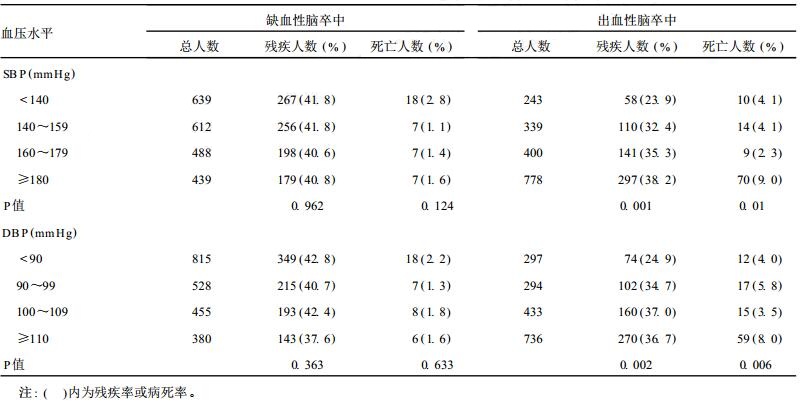
缺血性脑卒中在不同收缩压和舒张压水平下, 其残疾率差异均无统计学意义(P > 0.05)。而出血性脑卒中的残疾率则随着收缩压水平的升高而增高, 差异有统计学意义(P < 0.01)。缺血性脑卒中在收缩压 < 140 mmHg和舒张压 < 90 mmHg的情况下, 病死率高于其他血压水平, 但总体差异无统计学意义(P > 0.05)。而出血性脑卒中的病死率在不同血压水平下差异有统计学意义(P < 0.01)。在收缩压160~179 mmHg和舒张压100~109 mmHg时病死率最低, 而在收缩压≥180 mmHg和舒张压≥110 mmHg时病死率最高。
3 讨论血压升高与急性脑卒中的病死率升高相关联〔11-12〕。Dandapani研究〔5〕显示, 平均动脉压>145 mmHg的急性出血性脑卒中患者的病死率显著高于≤145 mmHg的患者。有研究报道, 血压与脑卒中结局之间呈现一种U-型的关系, 即血压处于极端低水平笮于极端高水平时可增加脑卒中患者不良结局的危险性〔8〕.Fogelholm研究〔11〕显示, 在282例急性出血性脑卒中患者中, 28 h内的高病死率与高入院平均动脉压相关联。本研究结果显示, 急性出血性脑卒中患者入院血压水平与住院期间的残疾和死亡相关联, 入院血压越高残疾或死亡的发生率越高。未发现急性缺性脑卒中患者入院血压与住院期间残疾或死亡相关联。国内有研究显示, 缺血性脑卒中患者入院血压与病死率无关联〔12〕。国外研究显示, 入院血压与急性缺血性脑卒中病死率间无显著关系〔9-10〕。本研究为观察性的研究, 只有随机对照研究才能最终确定急性脑卒中患者发病或入院血压水平与残疾或死亡的因果关系, 今后应进一步加以验证。
| [1] | Zhang LF, Yang J, Hong Z, et al. Proportion of different subtypes of stroke in China[J]. Stroke, 2003, 34 : 2091–2096. DOI:10.1161/01.STR.0000087149.42294.8C |
| [2] | 赵景波, 张文彦, 方庆伟, 等. 脑出血危险因素的病例对照研究[J]. 中国公共卫生, 2000, 16(2) : 99–100. |
| [3] | Bath P, Chalmers J, Powers W, et al. International Society of Hypertension Writing Group (ISH):Statement on the management of blood pressure in acute strokde[J]. J Hypertens, 2003, 21 : 665–672. DOI:10.1097/00004872-200304000-00003 |
| [4] | Chalmers J. Blood pressure in acute stroke[J]. J Hypertens, 2005, 23 : 277–278. DOI:10.1097/00004872-200502000-00008 |
| [5] | Dandapani BK, Suzuki S, Kelley RE, et al. Relation between blood pressure and outcome in intracerebral haemorrhage[J]. Stroke, 1995, 26 : 21–24. DOI:10.1161/01.STR.26.1.21 |
| [6] | Robinson TG, Dawson SL, Ahmed U, et al. Twenty-four hour systolic blood pressure predicts long-term mortality following acute stroke[J]. J Hypertens, 2001, 19 : 2127–2134. DOI:10.1097/00004872-200112000-00003 |
| [7] | Vemmos KN, Tsivgoulis G, Spengos K, et al. U-shaped relationship between mortality and admission blood pressure in parients with acute stroke[J]. J Intern Med, 2004, 255 : 257–265. DOI:10.1046/j.1365-2796.2003.01291.x |
| [8] | Castillo J, Leira R, Garcia M, et al. Blood pressure decrease during the acute phase of ischemic stroke is associated with brain injury stroke outcome[J]. stroke, 2004, 35 : 510–527. |
| [9] | Aslanyan S, Fazekas F, Weir CJ, et al. Blood pressure decrease during the acute phase of ischemic stroke on stroke outcome:a teriary analysis of the GAIN International Trial[J]. Stroke, 2003, 34 : 2420–2425. DOI:10.1161/01.STR.0000091233.04524.0C |
| [10] | Fogelholm R, Avikainen S, Murros K. Prognostic value and determinants of first-day mean arterial pressure in spontaneous supratentorial intracerebral hemorrhage[J]. Stroke, 1997, 28 : 1396–1400. DOI:10.1161/01.STR.28.7.1396 |
| [11] | Willmot M, Leonardi-Bee J, Bath PM. High blood pressure in acute stroke and subsequent outcome:a systematic review[J]. Hypertension, 2004, 43 : 18–24. DOI:10.1161/01.HYP.0000105052.65787.35 |
| [12] | Liu X, LA Y, Wang B, et al. Prediction of functional outcome of ischemic stroke patients in northwest China[J]. Clin Neurol Neurosurg, 2007, 109 : 571–577. DOI:10.1016/j.clineuro.2007.05.008 |