引用本文

杨莉, 李海, 李春灵, 冯启明. 广西农村地区儿童意外中毒病例—对照研究[J]. 中国公共卫生, 2007, 23(11): 1293-1295.

YANG Li, LI Hai, LI Chun-ling, et al. Case-control study on childhood accident poisoning in rural area of Guangxi province[J]. Chinese Journal of Public Health, 2007, 23(11): 1293-1295.
广西农村地区儿童意外中毒病例—对照研究
广西医科大学公共卫生学院劳动卫生学教研室, 南宁 530021
收稿日期: 2007-04-11
基金项目: 广西自然基金资助 (桂科自0447046)
作者简介: 杨莉 (1960-), 女, 山西屯留县人, 教授, 硕士, 主要从事职业伤害流行病学研究。
摘要:
目的
探讨农村地区儿童意外中毒的危险因素, 为儿童中毒预防和干预提供科学依据。
方法
采用1:1匹配的病例-对照研究, 对广西贵港市2所县级医院和18个乡镇卫生院2002年~2004年因意外中毒而住院或急诊的216例1~14岁农村儿童中毒病例和居住于同一地区的匹配对照儿童, 以问卷方式进行调查。调查的危险因素重点是环境因素、对有害有毒物质的管理和家长的行为。采用单因素和多因素条件Logistic回归模型分析儿童中毒发生的危险因素。
结果
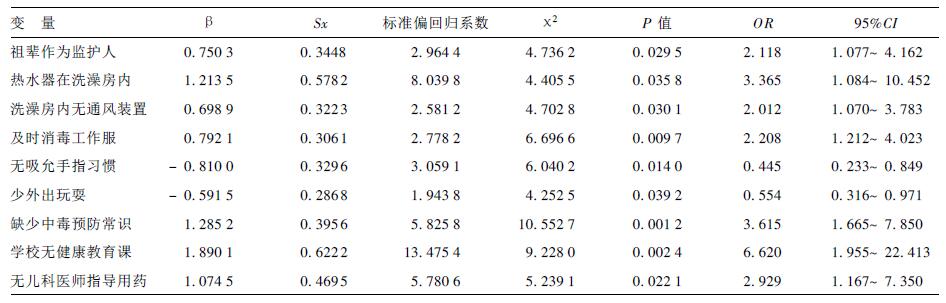
通过多因素条件Logistic分析, 筛选出9个与儿童中毒发生有关的因素。
结果
表明, 共有7个因素可增加儿童中毒发生的危险性, 2个因素可减少危险性。影响儿童中毒事件发生的危险因素为学校无健康教育课程 (OR=6.620)、父母或监护人缺少中毒知识 (OR=3.615)、热水器安装在洗澡房内 (OR=3.365)、没有儿科医生指导用药 (OR=2.929)、喷农药后不消毒工作服 (OR=2.208)、祖辈作为监护人 (OR=2.118)、洗澡房内无通风装置 (OR=2.012)。而少外出玩耍 (OR=0.554), 无吸吮手指的习惯 (OR=0.445) 是减少儿童中毒事件发生的保护因素。
结论
广西农村地区儿童意外中毒的发生与家庭因素、环境因素、儿童自身行为、医疗卫生服务状况等因素有关。应对这些危险因素制定出行之有效的综合预防干预措施。
关键词:
儿童
中毒
危险因素
病例-对照研究
Logistic回归分析
Case-control study on childhood accident poisoning in rural area of Guangxi province
YANG Li, LI Hai, LI Chun-ling, et al
Department of Occupational Health, School of Public Health, Guangxi Medical University, Nanning 530021, China
Abstract:
Objective
To study the potential risk factors of childhood po isoning, and provide science evidence for its prevention and intervention.
Methods
1:1 matched case-control study was conducted, 216 rural children who hospitalized or visited the out-patient clinic (OPD) because of the accident poisoning during Jan 1, 2002 to Dec 31, 2004 in two county hospitals and 18 town hospitals of Guigang city were included in the case group, and the children who dwelt in the same village were recruited as matched controls.There were 216 controls in total.Both cases and controls received questionnaire investigation including environment factors, the management of hazards oods and parents.behavior.Conditional Logistic regression was employed to analyze matching data.
Results
According to the results of multivariate analysis, there were 9 factors which were related with the unintentional childhood poisoning.They were no health education lessons in children's school, parents or guardians'lack of poisoning knowledge, the inside installation of bathroom water-heater, no medicine guide from the pediatricians, without sterilizing working cloth after sprinkling pesticide, grandparents as children's main guardian, noregister inside bathr oom (OR values were 6.620, 3.615, 3.365, 2.929, 2.208, 2.118, 2.012 respectively).Two factors were the protective factors, which were children seldom to play outside and children not to absorb fingers regularly (OR were 0.554 and 0.445 respectively), which can reduce the possibility of childhood poisoning.
Conclusion
The childhood poisoning accident happening of Guangxi rural area is related with the family factors, environment factors, children's behavior factors and condition of health service.So effective and comprehensive prevention and inter vention measures should be instituted according to these risk factors.
Key words:
childhood
poisoning
risk factor
cas-econtrol study
Logistic regression
儿童是一个特殊的社会群体, 由于缺乏自我保护及安全防范意识, 成为伤害发生的高危人群。中毒是儿童期意外伤害的一种常见类型[2]。相关研究[2, 3]表明, 中毒是我国全人群的前5位死因, 是1~4岁儿童的首位死亡原因。儿童期长期接触环境中的各种污染物对神经和免疫系统造成损伤, 对生殖功能和发育造成影响, 而这些损伤将在成年期显现[4]。为探讨农村地区儿童意外中毒的危险因素, 为儿童中毒的预防和干预提供科学依据, 对广西贵港市农村地区部分儿童意外中毒病例进行危险因素的病例-对照研究。
1 对象与方法
1.1 对象 抽取贵港市2所县级医院和18个乡镇卫生院2002年〜2004年部分经确诊为意外中毒的住院或急诊儿童共216例。同时,选择与病例儿童居住在同一村民小组的同性别、年龄相近 (相差3岁内),同期未发生意外中毒儿童为对照。
1.2 方法 采用1:1匹配的病例-对照研宄方法,用统一问卷对中毒儿童与对照儿童的家长或监护人由调查员进行入户问卷调查。
1.3 统计分析 用Excel录入数据。采用SAS9.0软件进行分析。采用单因素和多因素条件Logistic回归分析进行危险因素分析。
2 结果
2.1 —般情况 共调查216对儿童,其中男性儿童136对,占6296%, 女性儿童80对,占37.04%。男女比例为1.7:1。病例组1~14岁,平均年龄(5.44±3.56) 岁;对照组1~14岁,平均年 (5.30±3.73) 岁。
2.2 中毒情况 (1) 中毒类型构成:本次调查中216例儿童意外中毒病例,中毒类型以毒鼠强意外中毒最多共83例,占38.43%;其次是有机磷农药中毒53例,占2454%;各种药物中毒33例,占15.28%;余下依次是有毒气体中毒22例,占10.29%;其他有毒固体液体物质中毒18例, 占8.33%;动物、植物类中毒7例, 占3.24%。(2) 中毒地点:儿童意外中毒病例中78.24%发生在家中, 19.91%发生在其他地点, 只有1185%发生在学校。(3) 时间分布:儿童意外中毒发生人数最多分布在10月份 (32例), 其次是3月 (21例)、1月份 (20例) 和6月份 (20例)、12月份 (20例)。季节分布分别为春季 (3~5月)52例, 夏季 (6~8月)50例, 秋季 (9~11月)62例, 冬季 (12月~1月)51例。男性儿童与女性儿童时间分布趋势基本一致。
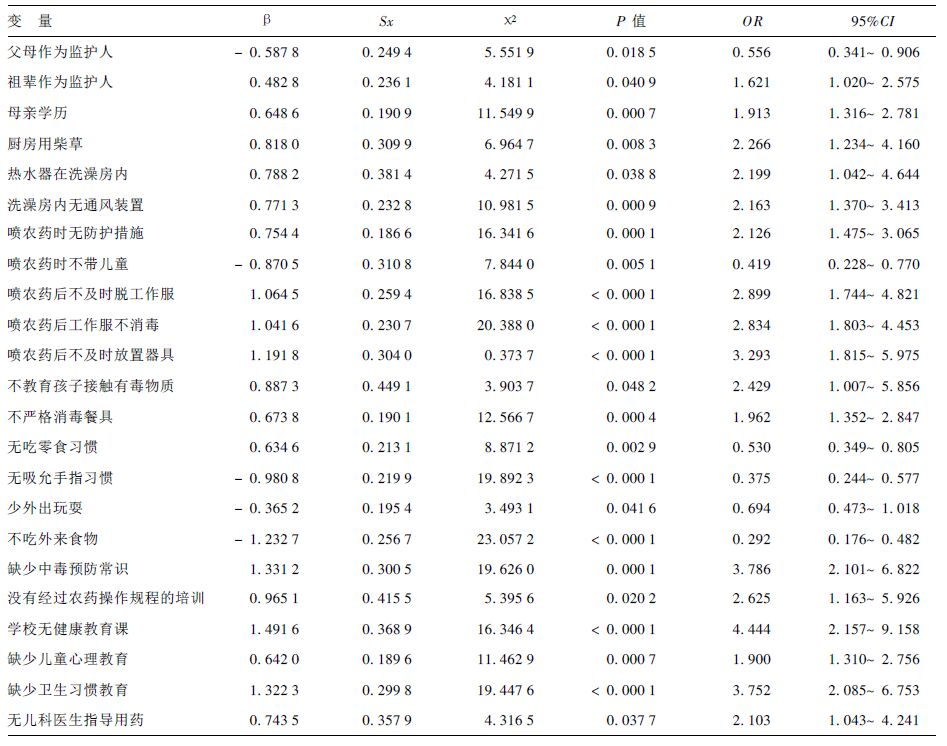
2.3 单因素分析 将所有研究因素进行单因素条件Logistic回归分析, 在α=0.05的水准下筛选出23个有意义的因素, 见表 1。
表 1

|
表 1 单因素条件Logistic回归分析结果
|
2.4 多因素分析 将上述23个单因素分析中有意义的变量 (P<0.10) 进行多因素Logistic回归分析。变量的选择采用逐步法, 变量的移出概率设定为0.05, 最终筛选出9个与儿童中毒发生有关的因素, 见表 2。
表 2
|
|
表 2 多因素Logistic回归分析结果
|
3 讨论 有关研究显示, 儿童意外伤害与家庭因素如父母亲文化程度、年龄、家庭关系有密切关系[5-7]。IanRobert等人报道[8], 儿童意外伤害与贫穷、缺少对儿童的监护、整个社会的支持密切相关。本次研究结果显示, 祖辈作为监护人为儿童意外中毒的危险因素。祖辈 (祖父母或外祖父母等) 对儿童中毒防范意识较差, 因身体条件所限导致对儿童监护力度有限, 易导致儿童意外中毒的发生, 与国外的研究相一致[9]。
儿童意外中毒的发生还与儿童的生理状况、心理因素及其危险行为有关[10]。本次研究结果表明, 无吸允手指习惯是儿童中毒事件发生的保护因素, 与上述研究结果一致。研究还发现, 喷洒农药后不严格消毒工作服有增加中毒事件发生率的可能, 说明中毒还与家长行为密切相关。热水器安装在洗澡房内、没有通风装置均为引起中毒事件的危险因素。因此, 改善洗澡房的通风状况, 将热水器安装在洗澡房外, 是减少、杜绝儿童发生有害气体中毒的有效措施。结果提示, 在学校中开设包括预防中毒的健康教育课程, 有助于防止儿童意外中毒的发生。结果还显示, 没有儿科医生指导用药能增加意外中毒发生的可能性, 提示儿童意外中毒发生与农村地区医疗服务状况有密切关系。
建议提高对农村基层卫生保健设施的投入与建设, 提高中毒的急救水平, 加强培训基层医务工作者, 进一步完善医疗急救措施, 降低儿童中毒死亡人数, 避免或减低残疾的程度进而控制和减少意外中毒事件的发生, 提高儿童的生存质量。
参考文献
| [1] |
World Health Organization.The world health report 2003-shaping the future[R].Geneva:WHO, 2003.
|
| [2] |
杨功焕, 周脉耕, 黄正京, 等.
中国人群1991~2000伤害死亡的流行趋势和疾病负担[J]. 中华流行病学杂志, 2004, 25(3) : 193–198.
|
| [3] |
林良明, 刘玉琳, 米杰, 等.
1991~1993年中国0~4岁儿童意外死亡监测结果[J]. 中华儿科杂志, 1995, 33(4) : 202–205.
|
| [4] |
Yáea L.
Overview of human health and chemical mixtures:problems facing developing countries[J]. Environmental Health Perspectives, 2002, 110(6) : 901–909.
|
| [5] |
时颖, 焦淑芳, 谢谨, 等.
北京市城市和农村地区儿童意外伤害现况及影响因素比较[J]. 疾病控制杂志, 2004, 8(6) : 588–590.
|
| [6] |
郭书芹, 孙业恒, 范亚平, 等.
家庭因素对儿童伤害相关行为的影响[J]. 中华流行病学杂志, 2004, 25(3) : 218–220.
|
| [7] |
王声湧.
伤害流行病学[M]. 北京: 人民卫生出版社, 2002: 360.
|
| [8] |
Ian Roberts I, Pless B.
Social policy as a cause of childhood accidents:the children of lone mothers[J]. BMJ, 1995, 311(7010) : 925–928.
DOI:10.1136/bmj.311.7010.925 |
| [9] |
Petridou E.
Risk factors for childhood poisoning:a case-control study in Greece[J]. Injury Prevention, 1996, 2(3) : 208–211.
DOI:10.1136/ip.2.3.208 |
| [10] |
Paritsis N, et al.
An epidemiological study of the factors influencing poisoning in children aged 0-5 years[J]. Paediatr Perinat Epidemiol, 1994, 38(1) : 79–89.
|
 2007, Vol. 23