Prenylated acylphloroglucinols from the fruits of Hypericum patulum

Abstract
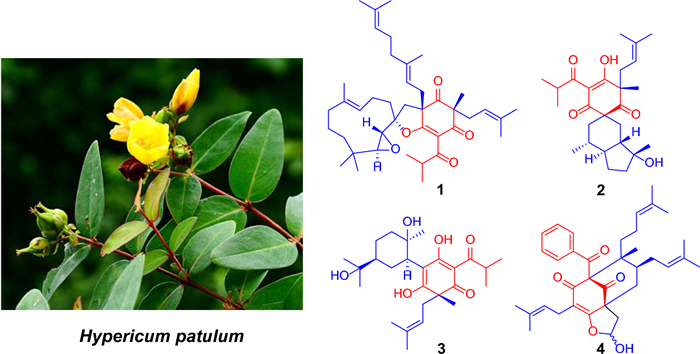
Twenty-eight prenylated acylphloroglucinols, including the new hypulatones C–F (1–4), have been isolated from the fruits of Hypericum patulum and structurally characterized. Compound 1 represents a rare meroterpenoid formed through the addition of a prenylated acylphloroglucinol unit and a sesquiterpenoid moiety. Spirocyclic polycyclic polyprenylated acylphloroglucinol 2 contains six chiral centers, and its relative configuration was established based on 1H–1H coupling constants, conformational analysis, and NOE correlations. The cytotoxic activities of all isolates against two human carcinoma cell lines (Huh-7 and Panc-1) were evaluated using the CCK-8 assay. Bioassay results indicated that compounds 6, 8, and 15 exhibited moderate antiproliferative activity.Graphical Abstract
Keywords
Prenylated acylphloroglucinols Hypericum patulum Structural determination Cytotoxicity1 Introduction
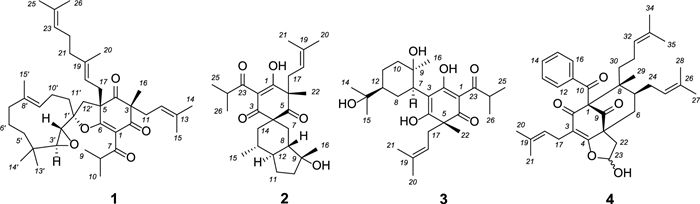
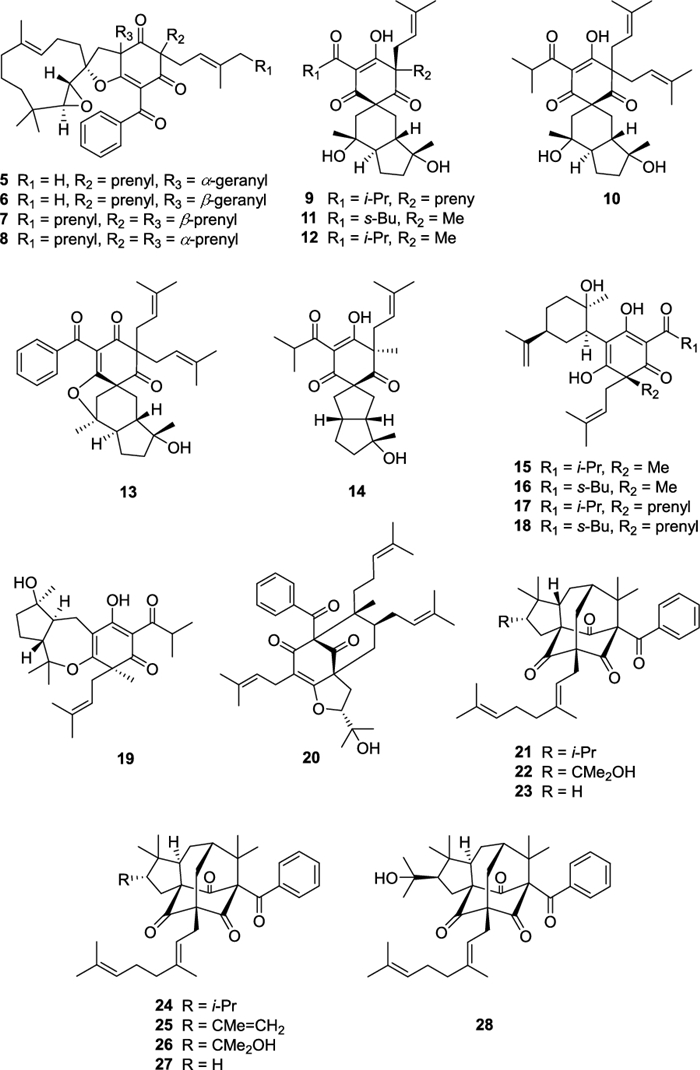
Polyprenylated acylphloroglucinols (PAPs) are a class of structurally fascinating hybrid natural products that exhibit diverse bioactivities, such as tumor inhibitive, antimicrobial, HIV preventative, antioxidant, and antidepressant [1, 2]. Plants of the genus Hypericum (Hypericaceae) are known to be a rich source of PAPs. Hypericum patulum, commonly known as "Jinsimei", is a Hypericum species primarily distributed in southwestern China, notably in Yunnan, Guizhou, and Sichuan provinces [3]. It is a traditional Chinese medicine commonly used for the treatment of hepatitis, bacterial diseases, and epistaxis [4]. Due to the structural diversity of its chemical constituents and their potential pharmacological effects, this plant has attracted widespread scientific interest [5–17]. As we have a longstanding interest in the investigation of structures and bioactivities of PAPs [1, 18–30], we selected the fruit of H. patulum for further investigation. Four undescribed PAPs, hypulatones C–F (1–4), were isolated together with twenty-four known analogues (5–28, Figs. 1 and 2). Compound 1 represents a rare meroterpenoid formed through the addition of a prenylated acylphloroglucinol unit and a sesquiterpenoid moiety. To date, only eight enantiomeric pairs of this type of meroterpenoids have been reported [14, 31]. Herein are described the isolation, structure determination, and inhibitory activities against two human carcinoma cells (Huh-7 and Panc-1) of all the compounds isolated. This study provides an effective method for configurational assignments of spirocyclic polycyclic polyprenylated acylphloroglucinols (PPAPs) that bear six chiral centers.
The structures of compounds 1–4
The structures of compounds 5–28
2 Results and discussion
Hypulatone C (1) was obtained as yellow gum. Its molecular formula C41H60O5 with 12 degrees of unsaturation was established by analysis of 13C NMR (Table 1) and HRESIMS data (m/z 671.4082, [M + K]+, cacld for 671.4072). The FTIR spectrum displayed absorption bands due to carbonyl (1719 and 1699 cm−1) functionalities. The 1H NMR spectrum (Table 1) exhibited the signals of an isopropyl (δH 3.07, sept; 1.16, d; 1.09, d; J = 6.9 Hz), four olefinic protons (δH 4.51–5.01), and nine singlet methyls (δH 0.64–1.67). Analysis of its 13C and DEPT-NMR data revealed a total of 41 carbon resonances, including a shielded sp2 carbon at δC 115.3 (C-1) and three deshielded carbons at δC 178.7 (C-6), 199.3 (C-2), and 203.2 (C-7), which were indicative of the presence of an enol-β-triketo system. The above signals, in combination with a nonconjugated ketone at δC 207.4 (C-4) and two quaternary carbons at δC 57.4 (C-3) and 62.6 (C-5), suggested that compound 1 should possess a dearomatized acylphloroglucinol core. This assumption was further confirmed by the HMBC correlations from a singlet methyl at δH 1.31 (Me-16) to C-2, C-3, and C-4, and from δH 3.29 and 2.28 (H2-17) to C-4, and C-5, and C-6. An isoprenyl group (δC 39.5, C-11; 118.6, C-12; 135.3, C-13; 26.0, C-14; 17.4, C-15) linked to C-3 was deduced by the correlation of δH 4.82 (H-12)/δH 2.67 and 2.31 (H2-11) in the 1H–1H COSY spectrum, together with the correlations of both δH 1.58 (Me-14) and 1.53 (Me-15) with C-11 and C-12, of H2-11 with C-2, C-3, and C-4 in the HMBC spectrum. Moreover, C-17 was proved to be the head of a geranyl group (δC 40.3, C-17; 116.6, C-18; 141.4, C-19; 17.6, C-20; 39.9, C-21; 26.3, C-22; 123.9, C-23; 131.5, C-24; 25.7, C-25; 17.7, C-26) by the HMBC correlations from δH 1.62 (Me-20) to C-18, C-19, and C-21, from both δH 1.67 (Me-25) and 1.59 (Me-26) to C-23 and C-24, coupled with the proton spin systems of H2-17/δH 4.74 (H-18) and δH 1.97 (H2-21)/δH 2.03 (H2-22)/δH 5.02 (H-23) in the 1H–1H COSY spectrum. The HMBC correlations of both doublet methyls at δH 1.16 and 1.09 with C-7 assigned the location of the isopropyl group (δC 39.8, C-8; 18.5, C-9; 18.1, C-10) (Fig. 3).
13C (150 MHz) and 1H NMR (600 MHz) data of compound 1 in CDCl3
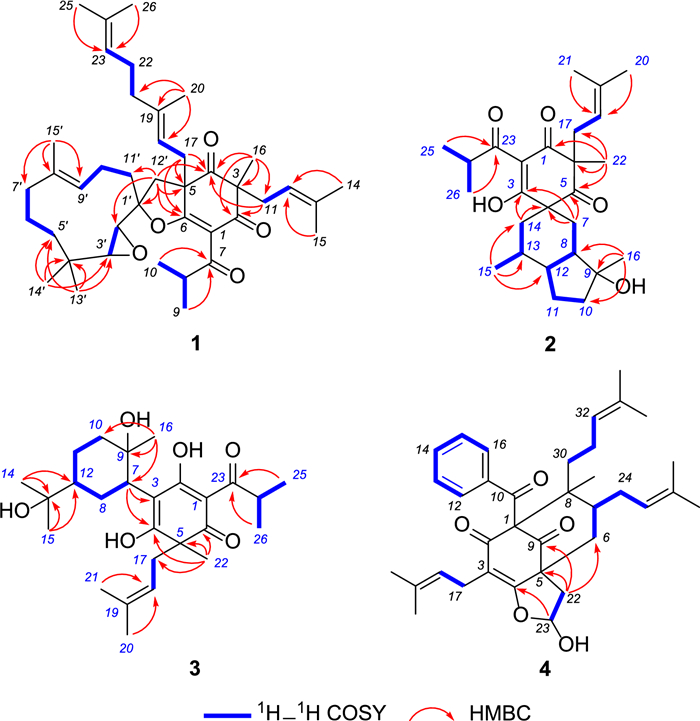
1H–1H COSY and HMBC correlations of 1–4
Besides the aforementioned 26 carbon signals in the 13C and DEPT NMR spectra of 1, the remaining 15 resonances assignable to three nonprotonated carbons (δC 135.5, C-8′; 92.4, C-1′; and 33.8, C-4′), three methines (δC 123.6, C-9′; 64.2, C-3′; and 59.4, C-2′), six methylenes, and three methyls indicated a humulane-type sesquiterpenoid moiety. This deduction was further confirmed by the correlations of 2.63 (H-2′)/δH 2.85 (H-3′), and δH 1.24 (H-5′)/δH 1.41 (H-6′)/δH 1.76 (H-7′), and δH 5.13 (H-9′)/δH 2.41 (H-10′)/δH 1.71 (H-11′) in the 1H–1H COSY spectrum, along with the HMBC correlations from δH 2.31 (H-12′) to δC 92.4 (C-1′), 59.4 (C-2′), and 40.3 (C-11′), from both singlet methyls at δH 0.64 (Me-14′) and 1.00 (Me-13′) to δC 64.2 (C-3′), 33.8 (C-4′), and 39.3 (C-5′), and from singlet methyl at δH 1.64 (H-15′) to δC 39.5 (C-7′), 135.5 (C-8′), and 123.6 (C-9′) (Fig. 3).
The linkage of C-5/C-12′ was deduced by the HMBC correlations from H2-12′ to C-4, C-5, and C-6, which combined the acylphloroglucinol and sesquiterpenoid moieties. The formation of the 2′,3′-epoxide and deduced furan ring were indicated by the indices of hydrogen deficiency along with the special chemical shifts of C-1′ (δC 92.4), C-2′ (δC 59.4), C-3′ (δC 64.2), and C-6 (δC 178.7). So far, the planar structure of 1 was elucidated as shown (Fig. 1).
Comparison of the structure of 1 with that of hyperkouytin C (6) [31] indicated that the benzoyl and prenyl groups in 6 were replaced by an isobutyryl and a methyl in 1, respectively. The 13C chemical shifts of carbons around C-1′, C-2′ C-3′, and C-5 chiral centers are very close to those of 6, which suggests that the relative configurations of C-1′, C-2′ C-3′, and C-5 are identical to those of 6. Furthermore, the chemical shift of H-17a (δH 3.29) was 1.01 ppm downfield of H-17b (δH 2.28), indicating that compound 1 had a close O2′/H-17a contact and the geranyl group was located at the same side of C-2′. This deduction was confirmed by a computationally optimized model (Fig. 4) and the crystallographic data of hypulatone B and hyperkouytins A and B [14, 31]. These evidences further confirmed the relative configurations four chiral carbons mentioned above. Finally, the NOESY correlation between Me-16 and H-18 established the configuration of C-3, thus assigning the relative configuration of 1 as 3S*, 5S*, 1'R*, 2'R*, 3'S* (Fig. 4). Considering that all the meroterpenoids of this type were reported in enantiomeric pairs [14, 31], the optical rotation of 1 ([α]D = + 19) suggested it might be scalemic mixtures. Nevertheless, the lack of sufficient sample quantities precluded the further chiral separation.
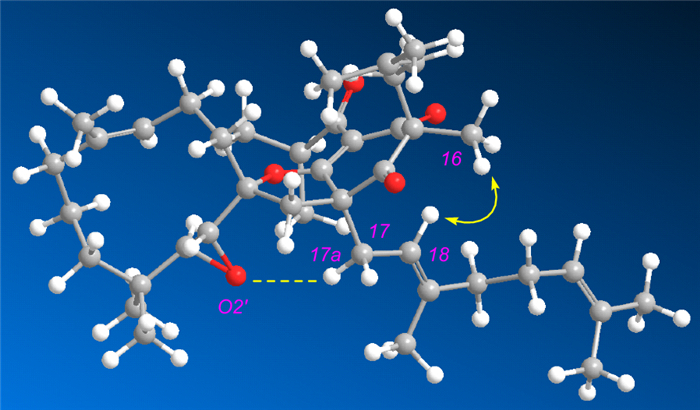
Configuration optimized molecular model of 1. yellow arrows, key NOE correlation; yellow dashed line, close O2′/H-17a contact
Hypulatone D (2) was assigned the molecular formula C26H38O5 by analysis of its 13C NMR (Table 2) and HREIMS data (m/z 429.2643 [M − H]−). Comparing the 1H and 13C NMR data of 2 to those of hyperpatulone E [15] indicates that they are structurally similar. The sec-butyl group in hyperpatulone E is replaced by an isopropyl (δH 1.21, d; 1.13, d; 3.51, sept.; J = 6.8 Hz) in 2, as evidenced by the HMBC correlations from Me-25 (δH 1.21) and Me-26 (δH 1.13) to δC 206.7 (C-23). It is worth noting that one could barely determine the relative configuration of spirocyclic PPAPs characterized by six chiral centers, like 2, unless one used a combination of 1H–1H coupling constants, conformational analysis, and NOE correlations. Firstly, in the 1H spectrum of 2 measured in CDCl3 (Table S1), the 3J coupling constant of H-14b (δH 1.23, t, J = 13.0 Hz) was 13.0 Hz. So, the corresponding six-membered ring adopted chair conformations (Fig. 5), and H-14a (δH 2.00, brd, J = 13.0 Hz) and Me-15 were equatorial while H-14b and H-13 (δH 1.25) were axial. Secondly, the NOE contacts of Me-15 with H-11eq (δH 1.86) and of H-11ax (δH 1.11) with H-8 (δH 1.57) indicated the trans configuration of the octahydro-indene moiety, as well as the relationship between H-12 and H-13. Thirdly, due to the constraints of the spirocyclic framework, the phloroglucinol ring is perpendicular to the octahydro-indene moiety, which itself lies nearly coplanar with the plane formed by the two C-6 substituents. The NOE correlations of H-14a/Me-22 (δH 1.43), H-18 (δH 4.70)/H-7b (δH 1.79), and H-7b/Me-16 (δH 1.28) measured in CD3OD defined the relative configurations of C-6 and C-9. Thus, the structure of 2 was determined as shown and named as hypulatone D (Fig. 1).
13C (150 MHz) and 1H NMR (600 MHz) data of compounds 2–4
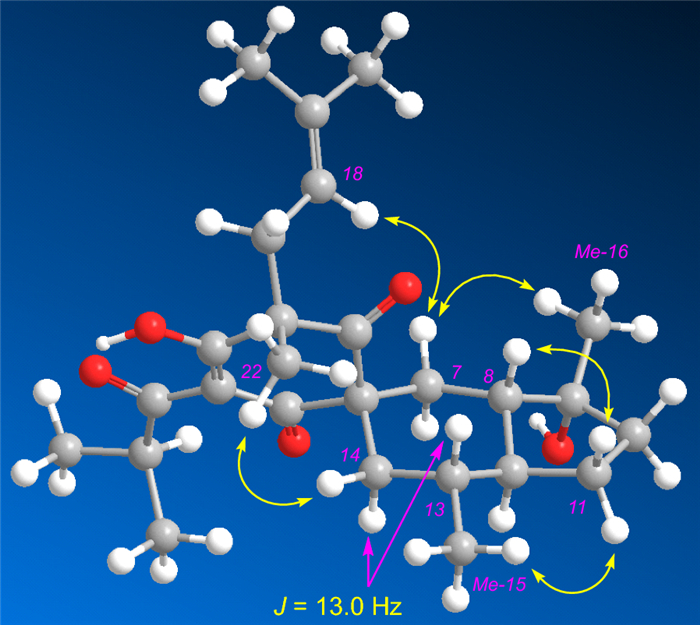
Configuration optimized molecular model of 2. Pink arrows, coupling constants; yellow arrows, NOE correlations
The molecular formula of hypulatone E (3) was determined as C26H40O6 by analysis of its 13C NMR (Table 2) and HRESIMS data (m/z 447.2745 [M–H]−). The 1H and 13C NMR data of 3 resembled those of hyperhenone E (15) [32]. Instead of two olefinic carbons in hyperhenone E, an oxygen-bearing quaternary carbon at δC 73.2 (C-13) and a methyl at δC 27.2 (Me-14) appeared in 3, suggesting that 3 could be derived from hyperhenone E by adding water across the Δ13,14 double bond of the latter. This suggestion was further supported by the correlations of both Me-14 (δH 1.15) and Me-15 (δH 1.14) with C-13 and C-12 (δC 50.8). The NOE contacts of H-7 (3.18) with H-12 (1.48) and Me-16 (1.16) indicated that the relative configurations of C-7, C-9, and C-12 were identical to those of hyperhenone E. Furthermore, the well matched ECD curves of 3 and hyperhenone E (15) suggested that their absolute configuration of C-5 was identical [32–34]. Considering that compounds 3 and 15 were co-isolated and the absolute configuration of 15 was determined by X-ray diffraction data [33], the absolute configuration of 3 could be defined as 5R, 7R, 9R, 12S (Fig. 1).
The molecular formula of hypulatone F (4) was determined to be C35H44O5 from its HRESIMS and 13C NMR data (Table 2). On the basis of analysis of its 1D and 2D NMR data, compound 4 was assigned to possess the same backbone as hypseudohenrin F [35]. The structural novelty of 4 involved the presence of a hemiacetal hydroxyl (δH 3.62, OH-23) rather than a methoxy group, which was confirmed by the 1H–1H COSY correlations of H-22a (δH 2.59) with H-23 (δH 6.05), in combination with the HMBC correlations from H-22a to C-5 (δC 58.4) and C-6 (δC 40.2) and C-9 (δC 204.7), and from H-23 to C-4 (δC 171.8) (Fig. 3). The 2D NMR data showed that the other structural features of 4 were identical to those of hypseudohenrin F.
Twenty-four known compounds were identified as hypulatone A (5) [14], (+)-hyperkouytin C (6) [31], hypulatone B (7) [14], (−)-hyperkouytin D (8) [31], tomoeone A (9) [36], tomoeone B (10) [36], chipericumin D (11) [37], chipericumin E (12) [38], hypercohone G (13) [39], spirohypatone A (14) [13], hyperhenone E (15) [32], bellumone I (16) [40], hyphenrone J (17) [23], hyphenrone K (18) [23], hyphenol J (19) [34], uralione E (20) [41], hookerione K (21) [42], attenuatumione D (22) [43], sampsonione H (23) [44], hypersampsone D (24) [45], sampsonione D (25) [44], sampsonione C (26) [44], hypersampsone I (27) [46], and hypersampsonone G (28) [47], by comparison of their spectroscopic and physical data with those of related literature (Fig. 2).
All the isolates (compounds 1–28) were tested for their cytotoxic activities on Huh-7 and Panc-1 cell lines by CCK-8 assay. Sorafenib and paclitaxel were used as the positive control. As shown in Table 3, compounds 6, 8, and 15 showed moderate inhibitory activity against two human cancer cell lines with IC50 values in the range of 9.7–19.2 µM.
Cytotoxicity of compounds 1–28 on two cancer cell lines with IC50 values (μM)
In summary, four previously undescribed PAPs, hypulatones C–F (1–4), together with twenty-four known analogues, were isolated from the fruit of Hypericum patulum and structurally characterized. Compounds 6, 8, and 15 showed moderate inhibitory activity against two human cancer cell lines with IC50 values in the range of 9.7–19.2 µM. Our findings enriched the structural diversity of natural PAPs, and also provided a useful method for configurational assignments of spirocyclic PPAPs that bear six chiral centers.
3 Experimental procedures
3.1 General experimental procedures
Optical rotations were measured on a Jasco P-1020 polarimeter. UV spectra were recorded on a Shimadzu UV-2401PC spectrometer. IR spectra were recorded on a Bruker FT-IR Tensor-27 infrared spectrophotometer with KBr disks. 1D and 2D NMR spectra were recorded on a Bruker DRX-600 spectrometer using TMS as an internal standard. Unless otherwise specified, chemical shifts (δ) are expressed in ppm with reference to the solvent signals. ESIMS and HREIMS data were acquired on Waters Xevo TQS and Waters AutoSpec Premier P776 mass spectrometers, respectively. Semi-preparative HPLC was performed on an Agilent 1100 HPLC with a Zorbarx SB-C18 (9.4 × 250 mm) column. Silica gel (200–300 mesh, Qingdao Marine Chemical Co., Ltd., Qingdao, People's Republic of China) were used for column chromatography. Fractions were monitored by TLC (GF 254, Qingdao Marine Chemical Co., Ltd.), and spots were visualized by heating silica gel plates immersed in H2SO4 in EtOH.
3.2 Plant materials
The fruits of Hypericum patulum were collected in Xishan of Kunming County, Yunan Province, People's Republic of China, in July 2020. The plant was identified by Dr. L. Zhang, and a voucher specimen (KIB 20200701) has been deposited at the Kunming Institute of Botany.
3.3 Extraction and isolation
The dried fruits of Hypericum patulum (3.12 kg) were powdered and percolated with MeOH (3 × 10 L) at room temperature for 24 h to yield an extract (680 g) after evaporation in vacuo. The residue was suspended in H2O and partitioned with EtOAc and H2O to yield the EtOAc fraction (350 g). This fraction was subjected to column chromatography over silica gel eluted with a petroleum ether–EtOAc in gradient (19:1, 9:1, 8:2, 7:3, 1:1, and 0:1) to obtain 10 fractions (Fr. A–J).
Fr. A (18.6 g) was fractionated by MCI gel column chromatography (MeOH–H2O, 70:30–100:0) to provide five subfractions (Fr. A1–A5). Fr. A3 (3.1 g) was fractionated by silica column chromatography using petroleum ether–EtOAc (100:1–0:1) as eluents to provide four subfractions (Fr. A3.1–A3.4). Fr. A3.2 (715 mg) was then purified by semipreparative HPLC (MeOH–H2O, 92:8) to produce compounds 23 (9.1 mg) and 27 (30.8 mg). Fr. A4 (1.9 g) was then fractionated by silica gel column chromatography using petroleum ether–EtOAc (50:1–0:1) as eluents to provide four subfractions (Fr. A4.1–A4.4). Fr. A4.2 (540 mg) was then purified by semipreparative HPLC eluting with MeOH–H2O (95:5), in combination with preparative TLC, to afford compounds 1 (2.6 mg), 7 (4 mg), 21 (7 mg), 24 (9.9 mg) and 25 (6 mg). Fr. A4.3 (175 mg) was then fractionated by semipreparative HPLC (MeOH–H2O, 94:6) to produce compounds 5 (8 mg), 6 (1.3 mg), and 8 (15.7 mg). A portion of Fr. B (6.8 g) was fractionated by MCI gel column chromatography (MeOH–H2O, 60:40–100:0) to provide five subfractions (Fr. B1–B5). Fr. B5 (3.5 g) was chromatographed on a silica gel column, eluting with petroleum ether–EtOAc (20:1–0:1), to gather Fr. B5.1–B5.3. Compounds 16 (3.9 mg), 17 (6 mg), and 18 (4.1 mg) were obtained from Fr. B5.2 by semipreparative HPLC (MeOH–H2O, 95:5). Using semipreparative HPLC (MeCN–H2O, 85:15 and 70:30, respectively), Fr. B4 (639 mg) afforded compounds 10 (4.8 mg) and 15 (89.4 mg). Fr. C (38.5 g) was fractionated by using MCI gel column chromatography (MeOH–H2O, 40:60–100:0) to gather Fr. C1–C5. Fr. C5 was chromatographed on a silica gel column (petroleum ether–EtOAc, 20:1–0:1) to provide five subfractions (Fr. C5.1–C5.5). Using semipreparative HPLC (MeCN–H2O, 85:15) and preparative TLC (petroleum ether–EtOAc), compounds 11 (33 mg), 20 (5 mg), 28 (28.1 mg) from Fr. C5.4 (889.5 mg), and compounds 4 (12.3 mg), 9 (3.2 mg), 22 (18.3 mg), and 26 (28.3 mg) from Fr. C5.5 (48.9 mg) were isolated. Similarly, compounds 2 (3.1 mg), 3 (4.5 mg), 12 (13.2 mg), 13 (3.1 mg), 14 (6.3 mg), and 19 (3.9 mg) were obtained from Fr. E (60 g) by using silica gel column, semipreparative HPLC (MeCN − H2O, 70:30), and preparative TLC.
Hypulatone C (1): Yellow gum; [α]D25 + 19 (c 0.1, MeOH); UV (MeOH) λmax (log ε) 210 (4.28), 230 (4.31), 275 (4.28) nm; IR (KBr) νmax 2964, 2930, 2872, 2857, 1719, 1699, 1625, 1456, 1383, 1250, 1184, 1095, 1030, 908, 803 cm−1; 1H and 13C NMR data, see Table 1. ESIMS m/z 671 [M + K]+; HRESIMS m/z 671.4082 (calcd for C41H60O5K, 671.4072).
Hypulatone D (2): Yellow gum; [α]D25 − 12 (c 0.1, MeOH); UV (MeOH) λmax (log ε) 240 (2.89), 283 (3.02) nm; CD (c 3 × 10⁻⁴, MeOH) λmax nm (Δε) 201 (− 5.23), 221 (+ 10.95), 244 (+ 9.96), 272 (+ 9.50), 295 (− 1.82), 305 (+ 1.13), 334 (− 2.83); IR (KBr) νmax 3317, 2945, 2831, 1668, 1533, 1448, 1279, 1022 cm−1; 1H and 13C NMR data, see Table 2. ESIMS m/z 429 [M − H]−; HRESIMS m/z 429.2643 (calcd for C26H37O5, 429.2641).
Hypulatone E (3): Light yellow gum; [α]D25 + 112 (c 0.1, MeOH); UV (MeOH) λmax (log ε) 228 (3.07), 238 (3.02), 279 (2.90), 327 (2.97) nm; CD (c 3 × 10⁻⁴, MeOH) λmax nm (Δε) 199 (− 18.6), 228 (+ 4.52), 248 (+ 0.29), 270 (+ 7.74), 317 (+ 10.39), 350 (+ 5.35); IR (KBr) νmax 3334, 3084, 1637, 1502, 1022 cm−1; 1H and 13C NMR data, see Table 2. ESIMS m/z 447 [M − H]−; HRESIMS m/z 447.2745 (calcd for C26H39O6, 447.2747).
Hypulatone F (4): Light yellow gum; [α]D25 − 23 (c 0.1, MeOH); UV (MeOH) λmax (log ε) 210 (4.25), 248 (4.30), 275 (4.18) nm; IR (KBr) νmax 3437, 2967, 2925, 2859, 1728, 1695, 1627, 1448, 1340, 1317, 1227, 1190,1142, 1057,869, 799, 768, 689 cm−1; 1H and 13C NMR data, see Table 2. HRESIMS m/z 583.2826 (calcd for C35H44O5K, 583.2820).
3.4 Cytotoxicity assay
Cells (Huh-7 and Panc-1) were seeded in 96-well plates at a density of 1 × 10⁴ cells per well, incubated for 24 h, and treated with the different concentrations of all isolated compounds (3.125, 6.25, 12.5, 25, and 50 μM) at 37 ℃ in 5% CO2 for another 24 h. A 10 μL amount of the Cell Counting Kit-8 (Biosharp, Shanghai, China) was added to the medium and incubated for 2 − 4 h; then the absorbance was read at a wavelength of 450 nm using a microplate reader (Shenzhen Sanli Technology Co. Ltd, Shenzhen, China). Sorafenib (G-CLONE, Beijing, China) and paclitaxel (G-CLONE, Beijing, China) were used as positive control [27]. The half-maximal inhibitory concentration (IC50) value was measured and calculated by GraphPad Prism 8 software.
Notes
Acknowledgements
The authors would like to thank the Natural Sciences Foundation of Guangdong Province (No. 2025A1515010551) and the Shenzhen Medical Research Funds (A2303041). The project was also funded by Shanghai Pujiang Program (No. 2021PJD091) and Shenzhen High-level Hospital Construction Fund (GSP-ZDSYS-009, GSP-QNPY-A2025004).
Author contributions
Xing-Wei Yang and Juan Huang conceived and designed the study. Yu-Feng Qiu and Yi-Zhou performed the isolation and purification of the compounds. Yu-Feng Qiu and Cheng Chen performed the pharmacological experiments and analysis of the data. The manuscript has been drafted by Yu-Feng Qiu and revised by Xing-Wei Yang. All authors have read and agreed to the published version.
Data availability
All data generated or analyzed during this study are included in this published article and its supplementary information files.
Declarations
Competing interests
The authors declare no competing financial interest.
References
-
1.Yang XW, Grossman RB, Xu G. Research progress of polycyclic polyprenylated acylphloroglucinols. Chem Rev. 2018;118(7): 3508-58. CrossRef PubMed Google Scholar
-
2.Ciochina R, Grossman RB. Polycyclic polyprenylated acylphloroglucinols. Chem Rev. 2006;106(9): 3963-86. CrossRef PubMed Google Scholar
-
3.Li XW, Li J, Stevens P. Flora of China. Beijing: Science Press; 1990. p. 25. PubMed Google Scholar
-
4.State Administration of Traditional Chinese Medicine of the People’s Republic of China, Chinese Materia Medica, Shanghai Scientific and Technical Publishers, Shanghai. 1999;9:594–608. PubMed Google Scholar
-
5.Ishiguro K, Nagareya N, Suitani A, Fukumoto H. A prenylated xanthone from cell suspension cultures of Hypericum patulum. Phytochemistry. 1997;44(6): 1065-6. CrossRef PubMed Google Scholar
-
6.Tanaka N, Yano Y, Tatano Y, Kashiwada Y. Hypatulins A and B, meroterpenes from Hypericum patulum. Org Lett. 2016;18: 5360-3. CrossRef PubMed Google Scholar
-
7.Liu YY, Ao Z, Xue GM, Wang XB, Luo JG, Kong LY. Hypatulone A, a homoadamantane-type acylphloroglucinol with an intricately caged core from Hypericum patulum. Org Lett. 2018;20: 7953-6. CrossRef PubMed Google Scholar
-
8.Liu YY, Ao Z, Xu QQ, Zhu DR, Chen C, Wang XB, et al. Hyperpatulols A–I, spirocyclic acylphloroglucinol derivatives with anti-migration activities from the flowers of Hypericum patulum. Bioorg Chem. 2019;87: 409-16. CrossRef PubMed Google Scholar
-
9.Wu ZN, Niu QW, Zhang YB, Luo D, Li QG, Li YY, et al. Hyperpatulones A–F, polycyclic polyprenylated acylphloroglucinols from Hypericum patulum and their cytotoxic activities. RSC Adv. 2019;9: 7961-6. CrossRef PubMed Google Scholar
-
10.Tanaka N, Niwal K, Yano Y, Kashiwada Y. Prenylated benzophenone derivatives from Hypericum patulum. J Nat Med. 2020;74: 264-8. CrossRef PubMed Google Scholar
-
11.Ao Z, Liu YY, Lin YL, Chen XL, Chen K, Kong LY, et al. Hyperpatulones A and B, two new peroxide polyprenylated acylphloroglucinols from the leaves of Hypericum patulum. Tetrahedron Lett. 2020;61: 151385. CrossRef PubMed Google Scholar
-
12.Jia XY, Wu YM, Lei C, Yu YY, Li JQ, Li JY, et al. Hyperinoids A and B, two polycyclic meroterpenoids from Hypericum patulum. Chin Chem Lett. 2020;31: 1263-6. CrossRef PubMed Google Scholar
-
13.Ye YS, Jiang NN, Yang XW, Xu G. Polycyclic polyprenylated acylphloroglucinol with an unprecedented spirocyclic core from Hypericum patulum. Chin Chem Lett. 2020;31: 2433-6. CrossRef PubMed Google Scholar
-
14.Ye YS, Du SZ, Jiang NN, Xu HX, Yang J, Fu WW, et al. Novel meroterpenoids from Hypericum patulum: highly potent late Nav1.5 sodium current inhibitors. Org Lett. 2020;22: 6339-43. CrossRef PubMed Google Scholar
-
15.Zhang YX, Ao Z, He YW, Lu JY, Chen XL, Kong LY, et al. Hyperpatulones C-G, new spirocyclic polycyclic polyprenylated acylphloroglucinols from the leaves of Hypericum patulum. Fitoterapia. 2021;155: 105063. CrossRef PubMed Google Scholar
-
16.Duan YL, Deng YF, Bu PF, Xie SS, Guo Y, Shi ZY, et al. Discovery of nor-bicyclic polyprenylated acylphloroglucinols possessing diverse architectures with anti-hepatoma activities from Hypericum patulum. Bioorg Chem. 2021;111: 104902. CrossRef PubMed Google Scholar
-
17.Zhang F, Yang J, Yi P, Li YN, Hao XJ, Yuan CM. Hyperpatone A, a polycyclic polyprenylated acylphloroglucinol with a rare 8/6/5/6/5 pentacyclic skeleton from Hypericum patulum. Org Biomol Chem. 2023;21: 140-6. CrossRef PubMed Google Scholar
-
18.Yang XW, Deng X, Liu X, Wu CY, Li XN, Wu B, et al. Hypercohin A, a new polycyclic polyprenylated acylphloroglucinol possessing an unusual bicyclo[5.3.1]hendecane core from Hypericum cohaerens. Chem Commun. 2012;48(48): 5998-6000. CrossRef PubMed Google Scholar
-
19.Luo Y, Grossman RB, Nie XB, Yang XW. Total synthesis and structural reassignment of garcinielliptone FC, a polycyclic polyprenylated acylphloroglucinol with diverse bioactivity. Chem Commun. 2023;59(41): 6215-8. CrossRef PubMed Google Scholar
-
20.Yang XW, Ding Y, Zhang JJ, Liu X, Yang LX, Li XN, et al. New acylphloroglucinol derivatives with diverse architectures from Hypericum henryi. Org Lett. 2014;16(9): 2434-7. CrossRef PubMed Google Scholar
-
21.Hu YL, Hu K, Kong LM, Xia F, Yang XW, Xu G. Norascyronones A and B, 2,3,4- nor-polycyclic polyprenylated acylphloroglucinols from Hypericum ascyron. Org Lett. 2019;21(4): 1007-10. CrossRef PubMed Google Scholar
-
22.Yang XW, Grossman RB. Revision of the structure of hypatulone A by NMR, computations, and biosynthetic considerations. Org Lett. 2020;22(2): 760-3. CrossRef PubMed Google Scholar
-
23.Yang XW, Li MM, Liu X, Ferreira D, Ding Y, Zhang JJ, et al. Polycyclic polyprenylated acylphloroglucinol congeners possessing diverse structures from Hypericum henryi. J Nat Prod. 2015;78(4): 885-95. CrossRef PubMed Google Scholar
-
24.Yang XW, Yang J, Xu G. Skeleton reassignment of type C polycyclic polyprenylated acylphloroglucinols. J Nat Prod. 2017;80(1): 108-13. CrossRef PubMed Google Scholar
-
25.Grossman RB, Yang XW. Structural revision of garcinielliptin oxide and garcinielliptone E. J Nat Prod. 2020;83(6): 2041-4. CrossRef PubMed Google Scholar
-
26.Wang X, Nie XB, Grossman RB, Ji TF, Yang XW. Structural revision of hyperibrin B and hyperscabrones H and I by biosynthetic considerations, NMR analysis, and chemical synthesis. J Nat Prod. 2021;84(7): 2059-64. CrossRef PubMed Google Scholar
-
27.Xu ZH, Grossman RB, Qiu YF, Luo Y, Lan T, Yang XW. Polycyclic polyprenylated acylphloroglucinols bearing a lavandulyl-derived substituent from Garcinia xanthochymus fruits. J Nat Prod. 2022;85(12): 2845-55. CrossRef PubMed Google Scholar
-
28.Qiu YF, Grossman RB, Yang XW. Structure revision of type B polycyclic polyprenylated acylphloroglucinols fused to a partly reduced furan ring. J Nat Prod. 2023;86(10): 2391-7. CrossRef PubMed Google Scholar
-
29.Xu ZH, Luo Y, Qiu YF, Yang XW, Lan T. Prenylated acylphloroglucinols from the fruits of Garcinia xanthochymus. Fitoterapia. 2023;165: 105427. CrossRef PubMed Google Scholar
-
30.Fu Y, Huang YQ, Xu Z, Liu X, Yang XW. Polyprenylated acylphloroglucinols from Garcinia species and structural revision of seven analogues. Nat Prod Bioprospect. 2025;15: 34. CrossRef PubMed Google Scholar
-
31.Huang JC, Sheng L, Zong JF, Zhou YB, Li J, Hou AJ. Enantiomeric pairs of meroterpenoids with 11/5/6 spiro-heterocyclic systems from Hypericum kouytchense. Org Chem Front. 2022;9(23): 6475-83. CrossRef PubMed Google Scholar
-
32.Zhang JJ, Yang XW, Ma JZ, Ye Y, Shen XL, Xu G. Cytotoxic polyprenylated acylphloroglucinol derivatives from Hypericum henryi. Tetrahedron. 2015;71: 8315-9. CrossRef PubMed Google Scholar
-
33.Ye YS, Wu M, Jiang NN, Lao YZ, Fu WW, Liu X, et al. Dearomatized isoprenylated acylphloroglucinol derivatives with potential antitumor activities from Hypericum henryi. Nat Prod Bioprospect. 2020;10: 1-11. CrossRef PubMed Google Scholar
-
34.Jiang NN, Yue GGL, Li P, Ye YS, Gomes AJ, Kwok FHF, et al. Discovery of dearomatized isoprenylated acylphloroglucinols with colon tumor suppressive activities in mice via inhibiting NFκB-FAT1-PDCD4 signaling activation. Eur J Med Chem. 2022;239: 114532. CrossRef PubMed Google Scholar
-
35.Sun H, Wang J, Zhen B, Wang X, Suo X, Lin M, et al. Polycyclic polyprenylated acylphloroglucinol derivatives from Hypericum pseudohenryi. Phytochemistry. 2021;187: 112761. CrossRef PubMed Google Scholar
-
36.Hashida W, Tanaka N, Kashiwada Y, Sekiya M, Ikeshiro Y, Takaishi Y. Tomoeones A−H, cytotoxic phloroglucinol derivatives from Hypericum ascyron. Phytochemistry. 2008;69: 2225-30. CrossRef PubMed Google Scholar
-
37.Abe S, Tanaka N, Kobayashi J. Prenylated acylphloroglucinols, chipericumins A-D, from Hypericum chinense. J Nat Prod. 2012;75(3): 484-8. CrossRef PubMed Google Scholar
-
38.Tala MF, Talontsi FM, Zeng GZ, Wabo HK, Tan NH, Spiteller M, et al. Antimicrobial and cytotoxic constituents from native Cameroonian medicinal plant Hypericum riparium. Fitoterapia. 2015;102: 149-55. CrossRef PubMed Google Scholar
-
39.Zhang JJ, Yang XW, Ma JZ, Liu X, Yang LX, Yang SC, et al. Hypercohones D–G, new polycyclic polyprenylated acylphloroglucinol type natural products from Hypericum cohaerens. Nat Prod Bioprospect. 2014;4: 73-9. CrossRef PubMed Google Scholar
-
40.Zhou X, Xu WJ, Li YR, Zhang MH, Tang PF, Lu WJ, et al. Anti-inflammatory, antioxidant, and anti-nonalcoholic steatohepatitis acylphloroglucinol meroterpenoids from Hypericum bellum flowers. J Agric Food Chem. 2021;69: 646-54. CrossRef PubMed Google Scholar
-
41.Zhou ZB, Li ZR, Wang XB, Luo JG, Kong LY. Polycyclic polyprenylated derivatives from Hypericum uralum: neuroprotective effects and antidepressant-like activity of uralodin A. J Nat Prod. 2016;79: 1231-40. CrossRef PubMed Google Scholar
-
42.Ye Y, Yang XW, Zhou Y, Xu G. Homo-adamantane type polycyclic polyprenylated acylphloroglucinols from Hypericum hookerianum. Fitoterapia. 2019;133: 43-50. CrossRef PubMed Google Scholar
-
43.Zhou ZB, Zhang YM, Pan K, Luo JG, Kong LY. Cytotoxic polycyclic polyprenylated acylphloroglucinols from Hypericum attenuatum. Fitoterapia. 2014;95: 1-7. CrossRef PubMed Google Scholar
-
44.Hu LH, Sim KY. Sampsoniones C–H, a unique family of polyprenylated benzophenone derivatives with the novel tetracyclo[7.3.1.13,11.03,7]tetradecane-2,12,14-trione skeleton, from Hypericum sampsonii (Guttiferae). Tetrahedron Lett. 1999;40: 759-62. CrossRef PubMed Google Scholar
-
45.Lin YL, Wu YS. Polyprenylated phloroglucinol derivatives from Hypericum sampsonii. Helv Chim Acta. 2003;86: 2156-63. CrossRef PubMed Google Scholar
-
46.Zeng YH, Osman K, Xiao ZY, Gibbons S, Mu Q. Four geranyl-bearing polyisoprenylated benzoylphloroglucinol derivatives from Hypericum sampsonii. Phytochem Lett. 2012;5: 200-5. CrossRef PubMed Google Scholar
-
47.Zhang JS, Zou YH, Guo YQ, Li ZZ, Tang GH, Yin S. Polycyclic polyprenylated acylphloroglucinols: natural phosphodiesterase-4 inhibitors from Hypericum sampsonii. RSC Adv. 2016;6: 53469-76. CrossRef PubMed Google Scholar
Copyright information
© The Author(s) 2026.
Open Access This article is licensed under a Creative Commons Attribution 4.0 International License, which permits use, sharing, adaptation, distribution and reproduction in any medium or format, as long as you give appropriate credit to the original author(s) and the source, provide a link to the Creative Commons licence, and indicate if changes were made. The images or other third party material in this article are included in the article’s Creative Commons licence, unless indicated otherwise in a credit line to the material. If material is not included in the article’s Creative Commons licence and your intended use is not permitted by statutory regulation or exceeds the permitted use, you will need to obtain permission directly from the copyright holder. To view a copy of this licence, visit http://creativecommons.org/licenses/by/4.0/.