Sophflarines F–K: matrine-based alkaloids with a rare aromatic system from Sophora flavescens and their anti-inflammatory and synergistic antibacterial effects

Abstract
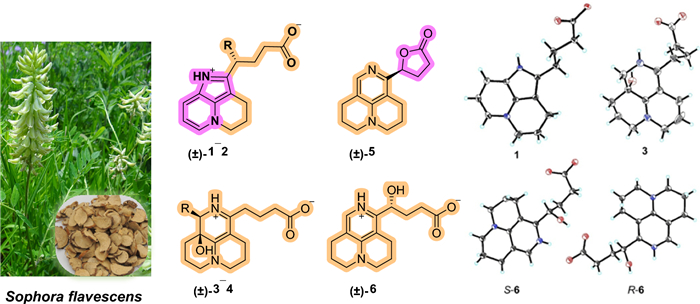
Six new matrine-based alkaloids, sophflarines F–K (1–6), featuring a rare aromatic system, were obtained from the water-soluble alkaloid fractions of Sophora flavescens by UV-guided separation. Their structures were elucidated by the interpretation of spectroscopic analyses, quantum chemical calculation, and X-ray diffraction data. Compounds 1 and 2 represent highly modified 15,16-seco-17-nor-matrine derivatives incorporating a rare 4,5-dihydro-3H-pyrrolo[2,3,4-ij]quinolizine moiety, while compound 5 possesses an unusual 6/6/6–5 tetracyclic skeleton. A copper sulfate-induced zebrafish assay revealed that compounds 1, 4, and 5 exhibited moderate anti-inflammatory activity at non-toxic concentrations. Checkerboard assays demonstrated that compounds 5 and 6 potentiated colistin activity against Escherichia coli ATCC25922 and BW25113-mcr-1, reducing colistin MIC values by 16- and 32-fold, respectively. These findings expand the structural diversity of aromatic matrine-type alkaloids and highlight their potential as anti-inflammatory agents and antibacterial adjuvants.Graphical Abstract
Keywords
Matrine type alkaloids Sophora flavescens X-Ray diffraction Anti inflammatory Antibacterial synergy1 Introduction
Sophora flavescens Ait., a medicinal plant widely distributed throughout East Asia, has been extensively employed in traditional medicine for the treatment of inflammatory conditions, gastrointestinal disorders, and parasitic infections [1–4]. Phytochemical investigations have revealed that this species is abundant in quinolizidine alkaloids, particularly those of the matrine-type [5–7]. These compounds display considerable structural diversity, resulting from various biochemical modifications such as oxidation [8], rearrangement [9, 10], ring-opening [11], and dimerization [12–14]. Such structural variations underpin a broad range of pharmacological properties, including anti-inflammatory [15, 16], antiviral [17], antibacterial [3, 18, 19], anti-fibrotic [20], and immunomodulatory activities [21]. Despite this diversity, most matrine-type alkaloids are fully saturated and sp3-rich, showing only terminal UV absorption; by contrast, aromatic and highly modified matrine derivatives are rare, with only a few structural types reported, yet they have attracted increasing interest due to their distinctive scaffolds and promising bioactivities [7, 11].
Inflammation and bacterial drug resistance remain serious global health concerns [22, 23]. Excessive inflammatory responses contribute to the progression of many infectious and chronic diseases, while antimicrobial resistance limits the effectiveness of existing antibiotics [24, 25]. As a result, combination therapy has become an important approach to enhance antibacterial efficacy. As part of our ongoing investigation of bioactive alkaloids from S. flavescens [7, 26], we isolated six rare aromatic matrine-based alkaloids, designated sophflarines F–K (Fig. 1). Compounds 1 and 2 represent the first nor-matrine derivatives featuring a 4,5-dihydro-3H-pyrrolo[2,3,4-ij]quinolizine moiety and an aromatic A/C ring, which is clearly distinct from previously reported seco- or nor-matrine scaffolds that mainly involve simple ring cleavage without extensive skeletal reorganization. This paper details the isolation, structural elucidation, plausible biosynthetic pathway, anti-inflammatory and synergistic antibacterial activities of these alkaloids.
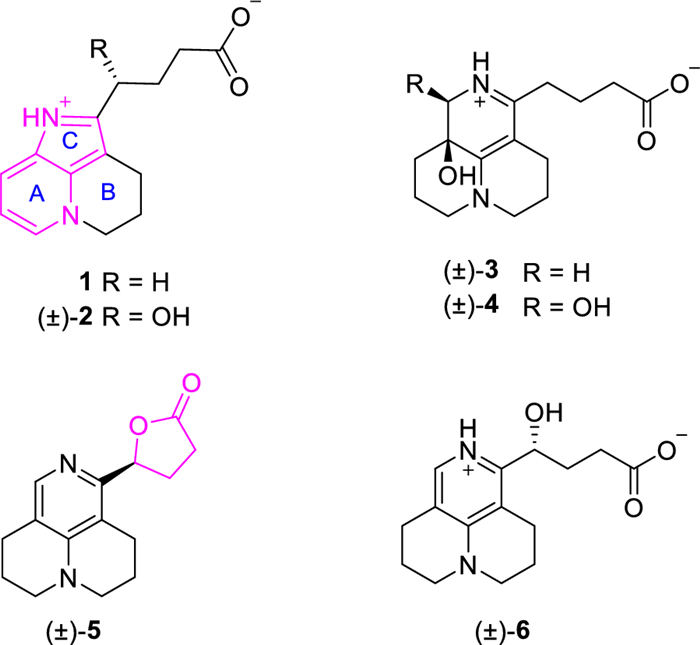
Chemical structures of compounds 1−6
2 Results and discussion
2.1 Isolation and structural identification
The total alkaloids were prepared from S. flavescens roots via a standard acid–base extraction. During preliminary profiling of the alkaloid extract, several constituents displayed a UV absorption band near 350 nm, indicative of an extended conjugated system rarely encountered in matrine-type alkaloids [27]. This diagnostic spectral feature enabled the UV-guided isolation of compounds 1–6.
Compound 1 was isolated as pale yellow crystals with negligible optical rotation value. The UV spectra exhibited an unusual conjugated chromophore absorption maxima at λmax 223, 237, 291, and 352 nm. The HRESIMS ion peak gave a molecular formula of C14H16N2O2 ([M + H]+ at 245.1282, calcd for C14H17N2O2, 245.1285), requiring 8 indices of hydrogen deficiency (IHDs). The 1H NMR spectrum showed the signals for 1,2-disubstituted pyridine ring [δH 8.38 dd (6.5, 2.6), 8.24 dd (8.0, 2.6), 7.49 dd (8.0, 6.5)] and several sp3 methylene emerging at δH [4.68 m, 3.00 m, 3.97 m, 2.38 m, 2.24 td (7.3, 2.5), and 2.08 m], respectively. The 13C NMR and DEPT data showed a C14 backbone assignable to a carboxy carbon (δC 180.0), seven aromatic carbons (δC 148.3, 137.0, 133.6, 131.2, 124.1, 115.6, 104.4), and six methylene (δC 51.6, 36.8, 26.3, 25.4, 22.1, 17.5) (Table 1). These mentioned spectroscopic data together with biosynthetic reasoning revealed a nor-matrine incorporating terminal carboxyl side chain and unusual aromatic system, similar to flavesine G, which also displayed a ring D-seco and aromatic C ring [11]. The body ring structural unit that fused via C-5 − C-6 − C-7 was established by 1H-1H COSY spin system of H-2/H-3/H-4 and H2-8/H2-9/H2-10, and multiple HMBC correlations from H-2 to C-3/C-4/C-6/C-10, from H2-8 to C-9/C-10/C-11, and from H2-10 to C-2/C-6/C-8/C-9 (Fig. 2). The side chain attached at C-11 was deduced from key HMBC correlations from H2-12 to C-7/C-11. The 2D structure of 1 was verified by X-ray crystallographic data with unique C2/c space group (Fig. 3). Ultimately, the chemical structure of 1 was identified to be an unprecedented matrine-based skeleton involving 15,16-seco, ring-aromatization and 17-nor structural modification, named sophflarine F.
1H and 13C NMR data of 1–2 (CD3OD, δ in ppm, J in Hz)a, b
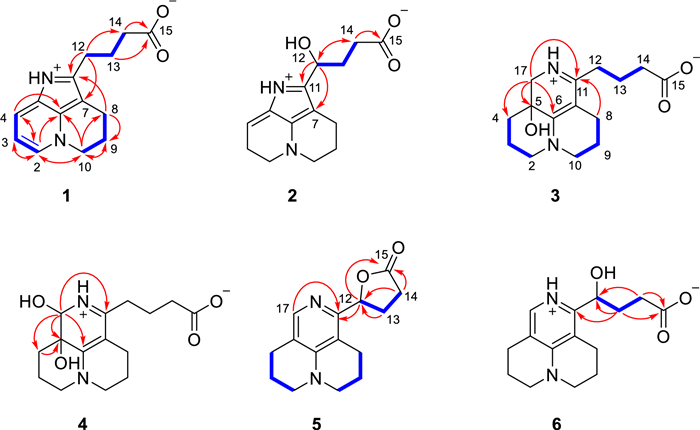
Key 1H-1H COSY, HMBC, and NOESY correlations of compounds 1−6
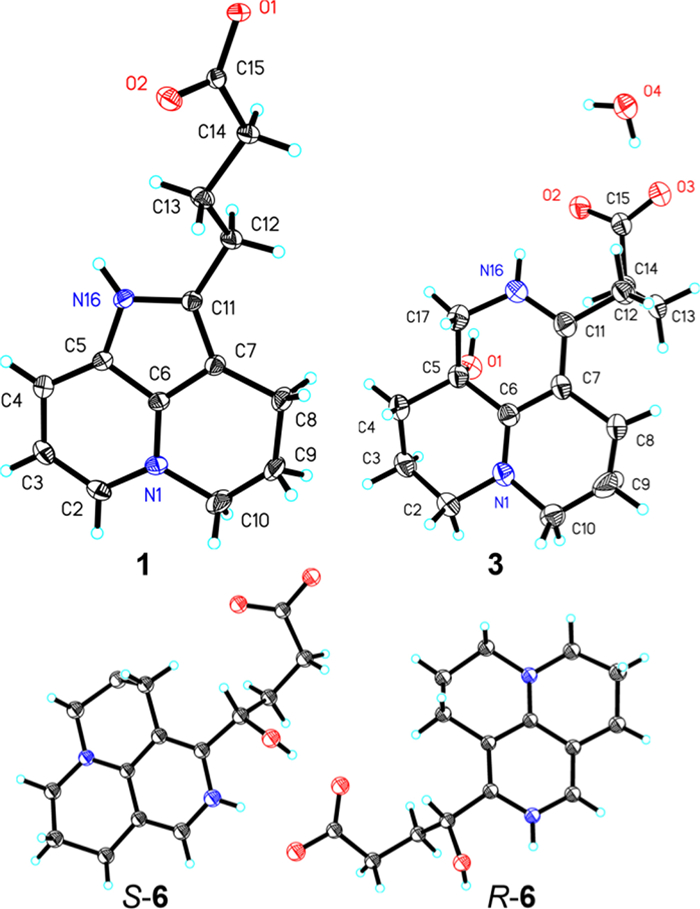
X-ray crystal structures of compounds 1, 3, and (±)-6 (ORTEP drawings at 30% probability ellipsoids)
The only difference between 2 and 1 was the substitution of C-12 methylene [(δC 25.4, δH 2.08 (2H, overlaped)] in 1 by a hydroxylated methine (δC 71.6, δH 4.95) in 2, as supported by the HMBC correlations from H-12 → C-7/C-11/C-14 and H2-14 → C-12/C-15 (Fig. 2). Its smooth ECD curve and specific rotation near 0 indicated the racemic nature (Fig. S12). The chiral resolution of 2 was unsuccessful because of the rapid rotation of its flexible side chain. Since 2 has only one chiral center at C-12, the 12R or 12S configuration correspond to positive or negative value of the optical rotation, respectively. Therefore, the relationship between the positive/negative theoretical optical rotation values and the 12R/12S absolute configuration was established by optical rotation calculation on three different basis sets (Table 2). The enantiomers of 2 was finally designated as (+)-12R-sophflarine G and (−)-12S-sophflarine G, respectively.
Calculated optical rotation values of compounds 2, 5, and 6 (in deg [dmg/cm3]−1)
Compound 3 was obtained as colorless crystals and had a molecular formula of C15H22N2O3 [m/z: 279.1694 [M + H]+ (calcd for C15H23N2O3, 279.1703)], requiring six IHDs. The NMR data of 3 exhibited similar chemical shifts to those of flavesine Ⅰ [28], indicating the presence of a rare 15,16-seco-matrine skeleton (Table 3). The key difference was that 3 has an additional hydroxy group at C-5 than flavesine Ⅰ, based on its missing COSY correlations of H2-4/H-5 and H2-17/H-5, together with HMBC correlations from H2-17 to C-4/C-5/C-6/C-11 and from H2-4 to C-2/C-5/C-17 (Fig. 2). Furthermore, the gross structure of 3 was definitively identified by X-ray crystallographic data (Fig. 3). The crystal of 3 has the space group P21/n and near 0 optical rotation indicating it existed in racemic form. Subsequent chiral HPLC separation of 3 was performed to afford a pair of enantiomers with 1:1 ratio (Fig. S22). The positive optical rotation value of (+)-3, [α]D25 130.7 (c 0.01, CH3OH), with experimental ECD curve dominated positive Cotton effects 355 nm and negative ellipticity around 220 nm consistent with 5S-3 conformer (Fig. 4). Thus, the absolute configurations of both enantiomers were determined as (+)-5S-sophflarine H and (−)-5R-sophflarine H.
1H and 13C NMR data of 3–6 (CD3OD, δ in ppm, J in Hz)a,b
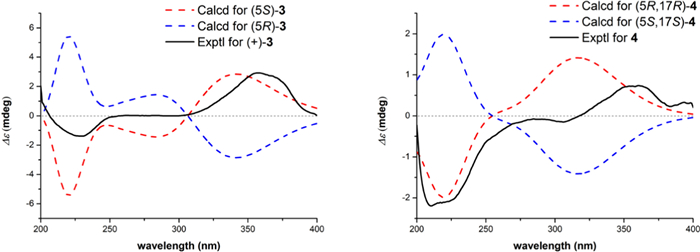
Calculated or experimental ECD spectra of compounds 3–4
HRESI(+)MS measurements on 4 revealed a molecular formula C15H22N2O4 suggestive of an oxidized (+ O) homologue of 3. Comparison of the NMR data for 4 with 3 revealed the principal differences as transformation of the C-17 methylene in 3 into a hydroxy substituent methine in 4 (Table 3). Confirming evidence was obtained from the downfield chemical shifts of C-17 (δC 51.9 → 80.4) and the HMBC correlations of protons from H-17 (δH 4.44) to C-4/C-5/C-6/C-11 (Fig. 2). Inspired by the conformation provided by the X-ray crystal structure of 3, the ring A of 4 was thought to adopt a chair conformation and H-4a was subsequently identified as being on the axial bond (δHeq > δHaq). Therefore, the observed NOE between H-4a and H-17 indicates that OH-5 and OH-17 are on the same face of the molecule, as shown in computer generated 3D drawing (Fig. S44). The CD spectrum of 4 was weak (non-racemic mixture in 1:1), but its overall shape matched best with the calculated spectrum of the (5R,17R)-configuration, indicating that the sample of 4 was enriched in (5R,17R)-4 (Fig. 4). Finally, the absolute configurations of 4 were tentatively assigned as (+)-(5R,17R)-sophflarine Ⅰ and (−)-(5S,17S)-sophflarine Ⅰ.
HRESIMS established the molecular formulas of 5 and 6 as C15H18N2O3 and C15H20N2O3, respectively. For compound 6, comparison with flavesine G showed that the sole structural modification was the replacement of the C-12 methylene by a hydroxylated methane [11], supported by the HMBC cross-peaks H-12 → C-7/C-11/C-14 and H2-14 → C-12/C-15 (Fig. 2). Single-crystal X-ray diffraction further confirmed the planar structure of 6 and revealed a P1 space group containing both (R)- and (S)-6 within the asymmetric unit (Fig. 3). Compound 5 displayed NMR data highly similar to those of 6, yet detailed MS/NMR comparison revealed that 5 possesses one additional degree of unsaturation. The characteristic shifts at C-12 (δC 68.9 → 71.6) and C-14 (δC 181.7 → 175.4) are diagnostic for intramolecular lactonization [29], as ester formation typically shields the carbonyl carbon and deshields the oxygenated methine. This transformation was corroborated by the COSY sequence H-12 ↔ H2-13 ↔ H2-14, indicating a transition from a flexible side chain to a constrained ring system, and by the key HMBC correlation H-12 → C-11/C-13/C-15, confirming a five-membered γ-lactone in 5. Finally, because both compounds displayed poor resolution on chiral HPLC columns, chiral separation was not attempted. Analogous to compound 2, optical rotation values were calculated using single-point B3LYP calculations with different basis sets (6-31 G(d), cc-pVDZ, and 6–311 + + G(2d, p)). Based on these results, the configurations of the enantiomers were assigned as (+)-(12S)-5 and (−)-(12R)-5, and (+)-(12R)-6 and (−)-(12S)-6, respectively (Table 2).
Plausible biogenetic pathways for compounds 1–2 and 5 were proposed based on the co-isolated analogues, as illustrated in Scheme 1. All of these metabolites can be hypothetically traced back to sophoridine or matrine, two major quinolizidine alkaloids that together account for more than 50% of the crude alkaloid fraction [30]. On the upper pathway, the co-isolated compound 3 may first undergo an acid-promoted pinacol-like 1,2-shift, affording the rearranged intermediate A1 [31]. Subsequent oxidation followed by decarboxylation would furnish intermediate A2, which can be further converted into A3 via hydroxylation [32]. A dehydration step from A3 then establishes the characteristic aromatic C-ring system observed in 1. Additional hydroxylation at C-12 of 1 gives rise to compound 2. On the lower pathway, oxidation of flavesine G generates the corresponding carboxyl intermediate, which upon dehydration affords the γ-lactone scaffold [33], thereby yielding compound 5.
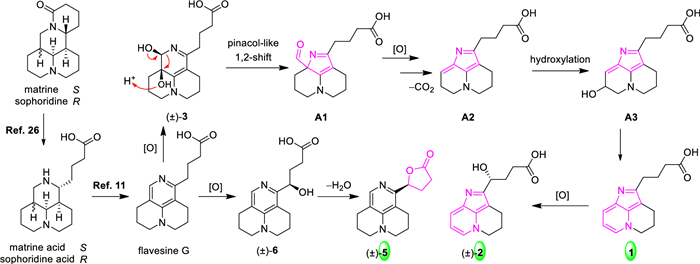
Plausible biosynthetic proposal for compounds 1−2, and 5
2.2 In vivo anti-inflammatory assay
Inspired by the results from previous assays [34, 35], the in vivo anti-inflammatory activity of compounds 1–6 was evaluated in the Copper sulfate-induced zebrafish inflammation model (Fig. 5). Compounds 1, 4, and 5 displayed moderate anti-inflammatory effects at their non-toxic concentration (50 μM), as reflected by the decreased fluorescence intensity around the neuromasts.
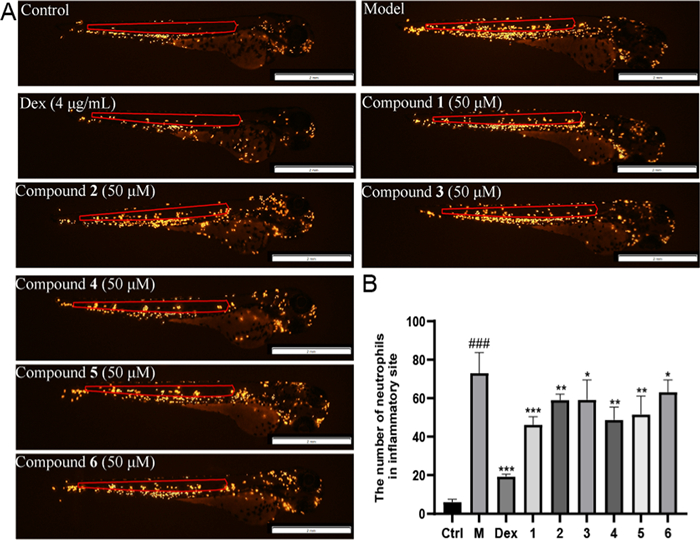
Anti-inflammatory effects of compounds 1−6 in zebrafish inflammatory models. A Representative images of zebrafish treated with different isolates in zebrafish inflammatory models induced by CuSO4. B Neutrophils in the red region were quantitatively analyzed. Data were represented as mean ± SEM from three independent experiments. Statistical analysis was performed using Student's t-test. *P < 0.05, **P < 0.01, ***P < 0.001 vs. the model group. ###P < 0.001 vs. the control group. Ctrl control group, M Model, Dex dexamethasone group
2.3 Synergistic antibacterial activity with colistin
Plasmid-mediated colistin resistance, particularly driven by mcr genes, has become a major challenge in the treatment of multidrug-resistant Gram-negative infections, and combination therapy is considered an effective strategy for restoring colistin susceptibility [23, 36, 37]. The synergistic effects of colistin in combination with compounds 1–6 were evaluated using checkerboard assays against E. coli ATCC25922 and BW25113-mcr-1 (Table 4). In E. coli ATCC25922, compounds 1, 2, 5, and 6 markedly enhanced colistin susceptibility, lowering its MIC from 4 μg·mL−1 to 1 and 0.125 μg·mL−1 (a 4- to 32-fold reduction). Importantly, compounds 2, 5, and 6 also restored colistin activity against the mcr-1–positive strain BW25113, reducing its MIC by 4–32 fold and yielding synergistic FICI values.
MIC and FIC values of colistin alone or in combination with compounds 1–6 against E. colia
3 Experimental
3.1 General experimental procedures
The melting points of crystalline samples were determined on an X-5 digital micro-melting point apparatus and are presented without correction. UV spectra were obtained using a JASCO V-550 UV/VIS spectrophotometer, and optical rotations were measured on an Autopol JASCO P-1020 digital polarimeter. IR spectra were recorded on a JASCO FT/IR-480 Plus spectrometer using KBr pellets. NMR measurements, including 1D and 2D experiments, were performed on a Bruker Avance 600 spectrometer (600 MHz for 1H and 150 MHz for 13C) equipped with standard Bruker pulse programs. Chemical shifts (δ) were expressed in ppm with reference to residual solvent peaks. High-resolution electrospray ionization mass spectra (HR-ESI–MS) were acquired using a Waters Synapt G2 mass spectrometer. Single-crystal X-ray diffraction data were collected on an Agilent Gemini Ultra diffractometer fitted with a Cu-Kα radiation source (λ = 1.54178 Å) and a CCD area detector (Agilent Technologies, USA). HPLC analyses were conducted on a Shimadzu system (Shimadzu Corporation, Tokyo, Japan) equipped with a PDA detector, using analytical or preparative Waters XBridge RP18 columns (MeCN/H2O or MeOH/H2O as eluents). TLC analysis employed aluminium oxide 60 F2₅4 basic plates (Merck, China). The chromatographic materials used in this study included D-101 macroporous resin (Diaion, Shanghai, China), neutral alumina N (200–300 mesh; Aldrich, China), Sephadex LH-20 (25–100 μm; Fluka, Switzerland), MCI CHP20P gel (75–150 μm; Sigma-Aldrich, China), and ODS silica gel (50 μm; YMC, Japan). All solvents and reagents were of analytical grade and purchased from commercial suppliers in China.
3.2 Plant material
The roots of S. flavescens Ait. were collected in September 2019 from Xi'an, Shaanxi Province, China (34°46′–34°55′ N, 109°08′–109°16′ E). The botanical identity of the material was verified by Mr. Zhengqiu Mai, a senior herbal specialist at the Chinese Medicinal Material Co. (Guangzhou, China). A voucher specimen (No. SF-201909) is deposited at the Guangdong Provincial Key Laboratory of Veterinary Pharmaceutics Development and Safety Evaluation, College of Veterinary Medicine, South China Agricultural University, Guangzhou, China.
3.3 Extraction and isolation
The powdered roots of S. flavescens (25 kg) were extracted three times with 95% EtOH (48 h each), and the combined extracts were concentrated to yield a crude ethanol extract (~ 3.5 kg). Suspension of the crude extract in water followed by acidification to pH 3–4 with dilute HCl enabled the removal of neutral constituents through extraction with CHCl3. Basification of the remaining aqueous phase to pH 9–10 with saturated NH4OH, followed by extraction with CHCl3, afforded the crude alkaloid extract (926 g, extraction coefficient: 3.7%). The alkaloid extract was chromatographed on a D-101 macroporous resin column eluted with graded EtOH–H2O mixtures (10%–95%), yielding five fractions designated Fr.1–Fr.5. Fraction Fr.1 was dissolved in water and partitioned twice with EtOAc to remove lipophilic materials, and the aqueous-enriched portion was collected as Fr.1A (60.0 g). Chromatography of Fr.1A on neutral Al2O3 using CH2Cl2–MeOH (100:0 → 0:100, v/v, with 1% Et2NH) yielded seven subfractions, Fr.1Aa–Fr.1Ag. Among these, Fr.1Ag was further purified on an MCI CHP20P column eluted with MeOH–H2O–NH4OH to obtain sixteen fractions (Fr.1Ag.1–Fr.1Ag.16). Fractions Fr.1Ag.1–Fr.1Ag.5 were successively subjected to Sephadex LH-20 chromatography (MeOH–H2O, 1:1) to enrich minor alkaloids. The combined eluates were chromatographed on an ODS column with increasing proportions of MeOH–H2O (5%–50%) to obtain Fr.1Ag.1–5. Final purification was carried out by semipreparative HPLC on a Waters XBridge™ Phenyl column with MeOH/H2O or CH3CN/H2O (each containing 0.1% Et2NH; isocratic or shallow gradients as appropriate), affording compounds 1 (88.8 mg, tR = 9.7 min), 2 (0.9 mg, tR = 6.4 min), 3 (54.2 mg, tR = 16.1 min), and 4 (33.9 mg, tR = 21.5 min). Compounds 5 (7.0 mg, tR = 31.0 min) and 6 (69.9 mg, tR = 19.0 min) were purified by preparative RP-HPLC using CH3CN/H2O/Et2NH (15:85:0.01, v/v/v).
3.4 Spectroscopic data of the isolates
Sophflarine F (1): pale yellow crystals in CH3OH; m.p. 128–129 ℃; [α]D25 ± 0 (c 0.01, CH3OH); UV (CH3OH) λmax (log ε) 223 (3.17), 237 (3.02), 291 (2.66), and 352 (2.61) nm; IR (KBr) νmax 3412, 3080, 2937, 2859, 1561, 1447, 1389, 1041 cm−1; 1H NMR (600 MHz, CD3OD) and 13C NMR (150 MHz, CD3OD), see Table 1; HRESIMS m/z 245.1282 [M + H]+ (calcd for C14H17N2O2, 245.1285).
Sophflarine G (2): pale yellow oil; [α]D25 ± 0 (c 0.01, CH3OH); UV (CH3OH) λmax (log ε) 200 (3.17), 223 (2.92), 290 (2.71) and 351 (2.61) nm; IR (KBr) νmax 3390, 2931, 2859, 1593, 1511, 1415, 1036 cm−1; 1H NMR (600 MHz, CD3OD) and 13C NMR (150 MHz, CD3OD), see Table 1; HR-ESI–MS m/z: 261.1235 [M + H]+ (calcd for C14H17N2O3, 261.1234).
Sophflarine H (3): colorless crystals in CH3OH; mp 135–136 ℃; [α]D25 ± 0 (c 0.01, CH3OH); UV (CH3OH) λmax (log ε) 201 (3.33) and 359 (2.91) nm; IR (KBr) νmax 3423, 2929, 2857, 1632, 1451, 1415, 1331, 1162 cm−1 1H NMR (600 MHz, CD3OD) and 13C NMR (150 MHz, CD3OD), see Table 3; HR-ESI–MS m/z: 279.1694 [M + H]+ (calcd for C15H23N2O3, 279.1703); ( +)-Sophflarine H: white amorphous powder; [α]D25 130.7 (c 0.01, CH3OH); ECD (CH3OH) λmax (Δε) 233 (− 1.4), 357 (+ 2.9) nm; (−)-Sophflarine H: white amorphous powder; [α]D25 − 135.5 (c 0.01, CH3OH); ECD (CH3OH) λmax (Δε) 233 (− 13.2), 357 (+ 28.5) nm.
Sophflarine I (4): brown oil; [α]D25 3.3 (c 0.01, CH3OH); UV (CH3OH) λmax (log ε) 200 (3.18) and 359 (3.01) nm; ECD (CH3OH) λmax (Δε) 233 (− 1.4), 357 (+ 2.9) nm. IR (KBr) νmax 3443, 3287, 2922, 2854, 1629, 1470, 1411, 1330 cm−1; 1H NMR (600 MHz, CD3OD) and 13C NMR (150 MHz, CD3OD), see Table 3; HR-ESI–MS m/z: 295.1642 [M + H]+ (calcd for C15H23N2O4, 295.1652).
Sophflarine J (5): pale yellow oil; [α]D25 6.3 (c 0.01, CH3OH); UV (CH3OH) λmax 200 (3.13), 308 (2.68) nm; ECD (CH3OH) λmax (Δε) 213 (+ 0.3), 297 (− 3.7), 340 (+ 1.7) nm. IR (KBr) νmax 2933, 2866, 1625, 1603, 1444, 1332 cm−1; 1H NMR (600 MHz, CD3OD) and 13C NMR (150 MHz, CD3OD), see Table 3; HR-ESI–MS m/z: 259.1439 [M + H]+ (calcd for C15H19N2O2, 259.1441).
Sophflarine K (6): brown oil; [α]D25 ± 0 (c 0.01, CH3OH); UV (CH3OH) λmax 205, 228, and 296 nm; IR (KBr) νmax 3443, 3287, 2922, 2854, 1629, 1470, 1451 cm−1; 1H NMR (600 MHz, CD3OD) and 13C NMR (150 MHz, CD3OD), see Table 3; HR-ESI–MS m/z: 277.1520 [M + H]+ (calcd for C15H21N2O3, 277.1547).
3.5 X-ray crystallographic analyses of compounds 1, 3, and 6
Single-crystal X-ray diffraction analyses of compounds 1, 3, and 6 were performed using an Agilent Gemini Ultra diffractometer equipped with a CCD area detector and employing Cu Kα radiation (λ = 1.54184 Å). Structural determination was conducted using direct methods via the SHELXT program, followed by full-matrix least-squares refinement on F2 using SHELXL or SHELXS within the Olex2 platform. The crystallographic information files (CIFs) for compounds 1, 3, and 6 have been deposited in the Cambridge Crystallographic Data Centre (CCDC, https://www.ccdc.cam.ac.uk/) under deposition numbers 2085308, 2,358,218, and 2,358,219, respectively. ORTEP representations of the crystal structures were generated using SHELXP. A summary of crystallographic data and refinement parameters is provided below:
Crystal data for sophflarine F (1): C14H20N2O4 (M = 280.32 g/mol), monoclinic, space group C2/c (no. 15), a = 50.0093(10) Å, b = 11.3394(2) Å, c = 14.5656(3) Å, β = 90.749(2)°, V = 8259.1(3) Å3, Z = 24, T = 149.99(10) K, μ(CuKα) = 0.823 mm−1, Dcalc = 1.353 g/cm3, 16,655 reflections measured (7.072° ≤ 2Θ ≤ 147.84°), 8107 unique (Rint = 0.0247, Rsigma = 0.0310) which were used in all calculations. The final R1 was 0.0754 (I > 2σ(I)) and wR2 was 0.1958 (all data). The goodness of fit on F2 was 1.080. CCDC number: 2085308.
Crystal data for sophflarine H (3): C15H22N2O4 (M = 258.30 g/mol): monoclinic, space group P21/n (no. 14), a = 8.340(2) Å, b = 14.179(4) Å, c = 12.361(3) Å, β = 98.75(3)°, V = 1444.8(7) Å3, Z = 4, T = 293(2) K, μ(CuKα) = 0.611 mm−1, Dcalc = 1.187 g/cm3, 5060 reflections measured (9.556° ≤ 2Θ ≤ 151.168°), 2839 unique (Rint = 0.0519, Rsigma = 0.0601) which were used in all calculations. The final R1 was 0.1255 (I > 2σ(I)) and wR2 was 0.3621 (all data). The goodness of fit on F2 was 0.865. CCDC number: 2358218.
Crystal data for sophflarine K (6): C15H23N2O4.5 (M = 303.35 g/mol): triclinic, space group P-1 (no. 2), a = 8.7462(8) Å, b = 11.2707(8) Å, c = 16.4281(11) Å, α = 81.481(6)°, β = 78.275(7)°, γ = 68.629(8)°, V = 1471.7(2) Å3, Z = 4, T = 293(2) K, μ(CuKα) = 0.836 mm−1, Dcalc = 1.369 g/cm3, 10,848 reflections measured (5.512° ≤ 2Θ ≤ 147.798°), 5777 unique (Rint = 0.0433, Rsigma = 0.0562) which were used in all calculations. The final R1 was 0.0958 (I > 2σ(I)) and wR2 was 0.2977 (all data). The goodness of fit on F2 was 1.076. CCDC number: 2358219.
3.6 Quantum chemical ECD and ORD calculations
Theoretical ECD calculations of compounds 3–4 and optical rotation calculations of compounds 2 5, and 6 were performed using the Gaussian 09 software package. Conformational analysis was initially conducted using the Sybyl-X 2.1.1 program with an energy cutoff of 10 kcal/mol relative to the global minimum. These conformers were further optimized at the DFT/B3LYP/6-31G(d, p) level. For ORD calculations, single-point optical rotation calculations were performed at the B3LYP level using different basis sets, including 6-31G(d), cc-pVDZ, and 6–311 + + G(2d, p), based on the optimized conformers. The final optical rotation values reported in Table 3 represent Boltzmann-weighted averages derived from the corresponding conformer populations. ECD spectra were simulated from the first 50 singlet electronic transitions using Gaussian band shapes with a standard deviation of 0.33 eV [38]. Additional experimental details can be found in our previous report [6]. Optimized Cartesian coordinates, thermodynamic data, and conformer populations for compounds 2–6 are provided in the Supporting Information.
3.7 CuSO4-induced inflammation and drug treatments
CuSO4-induced inflammation assay was performed based on our previous report. Briefly, 3 days post fertilization (dpf), healthy larvae were immersed in 20 μM CuSO4 solution containing sophflarines F− K (50 μM). The behavior of fluorescent neutrophils and macrophages were observed after the treatment for 2 h. Photographs of the inflammatory neutrophil migration results were taken with a microscope (MVX10, Olympus, Japan). Dexamethasone (Dex) group was used for positive control.
3.8 Antibiotic susceptibility and checkerboard assays
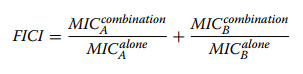
According to the Clinical and Laboratory Standards Institute (CLSI) guidelines, the minimum inhibitory concentrations (MICs) of the test compounds and colistin against E. coli ATCC 25922 (conventional QC strain) and E. coli BW25113-mcr-1 (plasmid-mediated colistin-resistant strain) were determined using the broth microdilution method. MIC was defined as the lowest drug concentration that completely inhibited visible bacterial growth. To evaluate compound-colistin interactions, fractional inhibitory concentration (FIC) indices were measured via checkerboard assay. Colistin underwent twofold serial dilution along the x-axis while compounds were diluted along the y-axis, generating a matrix of wells containing combinatorial concentrations. Bacterial suspensions of target strains were inoculated into each well (final density: 5 × 10⁵ CFU mL−1). Following 18 h incubation at 37 ℃, optical density was measured at 600 nm. The FIC index (FICI) is calculated by dividing the MIC of the drug combination by the MIC of the individual drugs. FIC indices were calculated as: synergism (FICI ≤ 0.5); additive (0.5 < FICI ≤ 1); indifferent (1 < FICI ≤ 2); and antagonism (FICI > 4).
|
3.9 Statistical analysis
Experiments were conducted in triplicate. Data are represented as means ± SEMs or mean ± SD. The statistical significance was evaluated using either a Student's t-test or one-way ANOVA for multiple comparisons, conducted via GraphPad Pro software. A P-value < 0.05 was set as the threshold for statistical significance.
4 Conclusions
In summary, six novel matrine-type alkaloids (1–6) featuring previously unreported tricyclic scaffolds were isolated from S. flavescens under UV-guided purification. Compounds 1–2 possess a contracted 6/6/5 ring system, while 5 possessed a distinct 6/6/6–5 fused-ring system. A plausible biogenetic pathway was proposed based on a common intermediate. Moreover, several isolates exhibited anti-inflammatory activity, and enhanced the antibacterial potency of colistin against E. coli. These findings enrich the chemical diversity of matrine-type alkaloids and provide promising molecular scaffolds for further development of anti-inflammatory and antibacterial adjuvant agents.
Notes
Acknowledgements
This work was financially supported by the National Key Research and Development Program of China (Grant No. 2023YFD1800101), the National Natural Science Foundation of China (Nos. 82304320, 82273803), the Innovative Research Groups of the National Natural Science Foundation of China (Grant No. 32121004), and the Administration of Traditional Chinese Medicine of Guangdong Province (No. 20251086).
Author Contributions
Ding Luo performed the isolation and structural elucidation of new compounds, and drafted the manuscript. Le-Yan Wang conducted the biological assays. Xiang-Feng Zhao assisted in data collection and experimental support. Xiao-Lin Huang, Yang-Yi Hu, and Qiong-Yun Jing assisted in data collection, data analysis, and experimental support. Yan-Jun Chen and He Tian contributed to bioactivity evaluation and data validation. Si-Yan Chen and Yu-Yan Wang participated in methodology development. Xian-Hui Huang was responsible for project administration. Zhen-Ling Zeng and Xiao-Ping Liao conceived and supervised the project and revised the manuscript. All authors reviewed and approved the final manuscript.
Funding
The National Key Research and Development Program of China, 2023YFD1800101, Zhen-Ling Zeng, National Natural Science Foundation of China, 82304320, Ding Luo, 82273803, Ding Luo, the Innovative Research Groups of the National Natural Science Foundation of China, 32121004, Xiao-Ping Liao, the Administration of Traditional Chinese Medicine of Guangdong Province, 20251086, He Tian.
Data availability
The copies of original UV, IR, CD, HRESIMS, 1D and 2D NMR spectra of compounds 1–6; Computational ORD/ECD details for compounds 2–6. This material is available free of charge in the supplementary materials.
Declarations
Ethics approval and consent to participate
Zebrafish larvae (≤ 5 dpf) were used, which are not subject to animal ethics approval under current guidelines.
Competing interests
The authors declare that they have no competing interests.
References
-
1.Abd-Alla HI, Souguir D, Radwan MO. Genus Sophora: a comprehensive review on secondary chemical metabolites and their biological aspects from past achievements to future perspectives. Arch Pharm Res. 2021;44(11): 903-86. CrossRef PubMed Google Scholar
-
2.Sun P, Zhao W, Wang Q, Chen L, Sun K, Zhan Z, et al. Chemical diversity, biological activities and traditional uses of and important Chinese herb Sophora. Phytomedicine. 2022;100: 154054. CrossRef PubMed Google Scholar
-
3.Li JJ, Zhang X, Shen XC, Long QD, Xu CY, Tan CJ, et al. Phytochemistry and biological properties of isoprenoid flavonoids from Sophora flavescens Ait. Fitoterapia. 2020;143: 104556. CrossRef PubMed Google Scholar
-
4.Zhang L-H, Zhang W-Y, Xiong J-M, Duan X-M, Hai L-N, Zhang Y-L, et al. Mechanisms of compound kushen injection for the treatment of bladder cancer based on bioinformatics and network pharmacology with experimental validation. Chin J Nat Med. 2022;20(1): 43-53. CrossRef PubMed Google Scholar
-
5.Zhang P, Zhang J, An Q, Wang J, Yi P, Yuan CM, et al. Matrine-type alkaloids with anti-Tomato Spotted Wilt Virus activity from the root of Sophora tonkinensis Gagnep. J Agric Food Chem. 2023;71(10): 4394-407. CrossRef PubMed Google Scholar
-
6.Luo D, Zou JW, Wang JH, Tian H, Xie H-Y, Zhu T-X, et al. Undescribed matrine-type alkaloids from Sophora alopecuroides with anti-inflammatory activity. Phytochem. 2024;218: 113954. CrossRef PubMed Google Scholar
-
7.Luo D, Xie Q, Tian H, Zheng X-K, Zou J-W, Huang Y-H, et al. Sophflarines B−E, four distinctive matrine alkaloids from Sophora flavescens with potential neuroprotective activities. Phytochem. 2025;229: 114310. CrossRef PubMed Google Scholar
-
8.Luo D, Lin Q, Tan JL, Zhao HY, Feng X, Chen NH, et al. Water-soluble matrine-type alkaloids with potential anti-neuroinflammatory activities from the seeds of Sophora alopecuroides. Bioorg Chem. 2021;116: 105337. CrossRef PubMed Google Scholar
-
9.Luo D, Wu ZN, Zhang JH, Lin Q, Chen NH, Chen S, et al. Sophaloseedlines A-G: diverse matrine-based alkaloids from Sophora alopecuroides with potential anti-hepatitis B virus activities. Chin J Chem. 2021;39(9): 2555-62. CrossRef PubMed Google Scholar
-
10.Yuan X, Li ZY, Feng ZM, Jiang JS, Yang YN, Zhang PC. Alopecuroidines A−C, three matrine-derived alkaloids from the seeds of Sophora alopecuroides. Chin Chem Lett. 2021;32(12): 4058-62. CrossRef PubMed Google Scholar
-
11.Zhang YB, Luo D, Yang L, Cheng W, He LJ, Kuang GK, et al. Matrine-type alkaloids from the roots of Sophora flavescens and their antiviral activities against the hepatitis B Virus. J Nat Prod. 2018;81(10): 2259-65. CrossRef PubMed Google Scholar
-
12.Luo D, Chen NH, Wang WZ, Zhang JH, Li CJ, Zhuo XF, et al. Structurally diverse matrine-based alkaloids with anti-inflammatory effects from Sophora alopecuroides. Chin J Chem. 2021;39(12): 3339-46. CrossRef PubMed Google Scholar
-
13.Meng C, Wang Y, Chen S, Li M, Yuan C, Yin X. Discovery, Topo Ⅰ inhibitory activity and mechanism evaluation of two novel cytisine-type alkaloid dimers from the seeds of Sophora alopecuroides L. Bioorg Med Chem. 2022;61: 116723. CrossRef PubMed Google Scholar
-
14.Yuan X, Jiang JS, Yang YN, Zhang X, Feng ZM, Zhang PC. Three quinolizidine dimers from the seeds of Sophora alopecuroides and their hepatoprotective activities. Chin Chem Lett. 2022;33(6): 2923-7. CrossRef PubMed Google Scholar
-
15.Yao H, Shi Y, Yuan J, Sa R, Chen W, Wan X. Matrine protects against DSS-induced murine colitis by improving gut barrier integrity, inhibiting the PPAR-α signaling pathway, and modulating gut microbiota. Int Immunopharmacol. 2021;100: 108091. CrossRef PubMed Google Scholar
-
16.Subudhi RN, Poonia N, Singh D, Arora V. Natural approaches for the management of ulcerative colitis: evidence of preclinical and clinical investigations. Nat Prod Bioprospect. 2024. CrossRef PubMed Google Scholar
-
17.Faisal S, Badshah SL, Kubra B, Emwas A-H, Jaremko M. Alkaloids as potential antivirals. A comprehensive review. Nat Prod Bioprospect. 2023. CrossRef PubMed Google Scholar
-
18.Zou X, Liu W, Peng W, Sun L, Liu S, Cao X, et al. Antifungal activity and mechanistic insights of total alkaloids from Sophora flavescens against Candida albicans. Nat Prod Res. 2025. CrossRef PubMed Google Scholar
-
19.Wang Z, Li X, Zhao L, Liu S, Du J, Jia X, et al. Matrine restores colistin efficacy against mcr-1-carrying Escherichia coli. Molecules. 2025. CrossRef PubMed Google Scholar
-
20.Cely-Veloza W, Kato MJ, Coy-Barrera E. Quinolizidine-type alkaloids: chemodiversity, occurrence, and bioactivity. ACS Omega. 2023;8(31): 27862-93. CrossRef PubMed Google Scholar
-
21.Ren SH, Shao B, Wang HD, Zhang JY, Qin H, Sun CL, et al. Oxymatrine attenuates chronic allograft rejection by modulating immune responses and inhibiting fibrosis. Eur J Pharmacol. 2024;985: 177082. CrossRef PubMed Google Scholar
-
22.Salam MA, Al-Amin MY, Salam MT, Pawar JS, Akhter N, Rabaan AA, et al. Antimicrobial resistance: a growing serious threat for global public health. Healthcare. 2023. CrossRef PubMed Google Scholar
-
23.Li M, Feng X, Jian Q, Jing M, Wang X, Cui Z, et al. Plasmid pHXY0908 confers ciprofloxacin heteroresistance to Salmonella enterica serovar typhimurium ATCC 14028 by regulating efflux pump gene expression. BMC Microbiol. 2025. CrossRef PubMed Google Scholar
-
24.Zhang J, Yan J, Dong H, Zhang R, Chang J, Feng Y, et al. Dimeric sesquiterpenoids with anti-inflammatory activities from Inula britannica. Chin J Nat Med. 2025;23(8): 961-71. CrossRef PubMed Google Scholar
-
25.Zhong Z-x, Zhou S, Liang Y-j, Wei Y-y, Li Y, Long T-f, et al. Natural flavonoids disrupt bacterial iron homeostasis to potentiate colistin efficacy. Sci Adv. 2023. CrossRef PubMed Google Scholar
-
26.Luo D, Dai X, Tian H, Fan C, Xie H, Chen N, et al. Sophflarine A, a novel matrine-derived alkaloid from Sophora flavescens with therapeutic potential for non-small cell lung cancer through ROS-mediated pyroptosis and autophagy. Phytomedicine. 2023;116: 154909. CrossRef PubMed Google Scholar
-
27.Mancinotti D, Frick KM, Geu-Flores F. Biosynthesis of quinolizidine alkaloids in lupins: mechanistic considerations and prospects for pathway elucidation. Nat Prod Rep. 2022;39(7): 1423-37. CrossRef PubMed Google Scholar
-
28.Xie M-F, Liu T-T, Yang Q-Q, Li R-T, Zhang Z-J. Sophormodines D− K, matrine-type alkaloids with anti-HBV activity from the seeds of Tibetan medicine Sophora moorcroftiana. J Mol Struct. 2025;1340: 142498. CrossRef PubMed Google Scholar
-
29.Jing S-X, Li C-H, Liu Y-C, Zhou T-T, Fu R, Luo S-H, et al 2025 γ-Lactam and γ-lactone-containing sesterterpenoids from Colquhounia coccinea var. mollis with immunosuppressive activity. Phytochemistry 242 https://doi.org/10.1016/j.phytochem.2025.114706 PubMed Google Scholar
-
30.Liu TT, Xie MF, Yang QQ, Li RT, Zhang ZJ. Sophormodines A-C, three alkaloids with antiviral activities against the HBV from the seeds of the Tibetan medicine plant Sophora moorcroftiana. Phytochem. 2025;236: 114514. CrossRef PubMed Google Scholar
-
31.Song Z-L, Fan C-A, Tu Y-Q. Semipinacol rearrangement in natural product synthesis. Chem Rev. 2011;111(11): 7523-56. CrossRef PubMed Google Scholar
-
32.Nguyen NA, Forstater JH, McIntosh JA. Decarboxylation in natural products biosynthesis. JACS Au. 2024;4(8): 2715-45. CrossRef PubMed Google Scholar
-
33.Fei D-Q, Dong L-L, Qi F-M, Fan G-X, Li H-H, Li Z-Y, et al. Euphorikanin A, a diterpenoid lactone with a fused 5/6/7/3 ring system from Euphorbia kansui. Org Lett. 2016;18(12): 2844-7. CrossRef PubMed Google Scholar
-
34.Sun B, Li Z-W, Lin M, Liu G-Q, Gu J-L, Wang L, et al. Humulupones A-F, bitter acid derivatives from Humulus lupulus. Org Lett. 2025;27(40): 11188-92. CrossRef PubMed Google Scholar
-
35.Gu J-H, Li N-P, Lin H-T, Dai L-N, Cheng M-J, Hong J, et al. Oligomeric monoterpenoid indole alkaloids from the flowers of Gelsemium elegans with anti-inflammatory and anti-fibrotic activities. Org Chem Front. 2025;12(20): 5387-94. CrossRef PubMed Google Scholar
-
36.Wang J, Tao H, Fan Q, Wang Z, Han B, Wang X. Anti-bacterial and anti-inflammatory properties of sophoridine and its effect on diarrhea in mice. Int J Mol Sci. 2025. CrossRef PubMed Google Scholar
-
37.Liu YY, Wang Y, Walsh TR, Yi LX, Zhang R, Spencer J, et al. Emergence of plasmid-mediated colistin resistance mechanism MCR-1 in animals and human beings in China: a microbiological and molecular biological study. Lancet Infect Dis. 2016;16(2): 161-8. CrossRef PubMed Google Scholar
-
38.Wu Z, Zhang Y, Wang G, Tang Q, Li Y, Xie X, et al. Structurally novel tryptamine-derived alkaloids from the seeds of Peganum harmala and their antiviral activities against respiratory syncytial virus. Chin J Nat Med. 2025;23(8): 972-9. CrossRef PubMed Google Scholar
Copyright information
© The Author(s) 2026
Open Access This article is licensed under a Creative Commons Attribution 4.0 International License, which permits use, sharing, adaptation, distribution and reproduction in any medium or format, as long as you give appropriate credit to the original author(s) and the source, provide a link to the Creative Commons licence, and indicate if changes were made. The images or other third party material in this article are included in the article’s Creative Commons licence, unless indicated otherwise in a credit line to the material. If material is not included in the article’s Creative Commons licence and your intended use is not permitted by statutory regulation or exceeds the permitted use, you will need to obtain permission directly from the copyright holder. To view a copy of this licence, visit http://creativecommons.org/licenses/by/4.0/.