 2017, Vol. 52


2. 上海中医药大学 中药学院, 上海 201203
2. School of Pharmacy, Shanghai University of Traditional Chinese Medicine, Shanghai 201203, China
压缩特性指在物料受压下产生变形并形成一定机械强度的压实体的能力, 通常可采用硬度、抗张强度和压缩方程等表征, 对固体片剂成型具有重要的影响[1]。对物料压缩特性的研究方法主要有采用不同方法表征物料的压缩特性及不同技术改善物料的压缩特性等。研究比较不同的压缩方程如Heckel方程、Walker方程和Kawakita方程等对物料压缩行为的表征, 各种离线和在线的压缩方程均能较好地表征物料的压缩特性[2, 3]。也有研究采用共喷雾、共研磨等技术对物料进行共处理以改善物料的压缩特性[4, 5], 同时研究者们从不同角度如物料含水量、粒径等阐述物料压缩特性的差异[6, 7]。上述对物料压缩特性不同角度的研究无疑增进了对物料压缩特性的认识和对压缩机制的理解。
对物料压缩特性的研究较多采用宏观方法, 如上述不同压缩方程、物理属性等对压缩特性的影响, 但鲜有从微观表面自由能角度研究物料的压缩特性。表面自由能为单位面积表面具有的能量, 是物料表面微观性质的宏观体现, 对制剂过程具有重要的作用。如制粒过程粒子聚集、表面改性、粉碎程度、混合均匀性和物料稳定性研究等[8-12]。因物料压缩过程为粒子间的表面接触变形压实, 是粒子表面相互作用的结果, 而表面作用的初始推动力为表面自由能性质。因此, 作者提出物料压缩特性在一定程度受表面自由能的影响, 物料表面自由能越大, 粒子间的黏聚功越大, 压实粉体需要更多的能量, 表现为压缩特性较差, 不利于粉体压实。
填充性辅料占处方比例较大, 其压缩特性与处方的压缩行为息息相关; 黏合剂类辅料虽然占处方比重较小, 但其对处方压缩特性的改善仍不可忽视, 加入少量黏合剂的共处理辅料处方能显著改善物料的压缩特性[13, 14]; 作为中药制剂原料的植物提取物粉末往往在处方中占有较大比重, 其压缩特性也是影响处方成型的关键属性[15, 16]。因上述种类物料物理性质各异, 适合用于分析表面自由能性质对压缩特性的影响。因此, 本研究选取3类物料:填充性辅料、黏合剂辅料及植物提取物共11种物料, 测定其表面自由能参数及压缩特性参数, 建立基于表面自由能评价物料压缩特性的方法研究, 有助于从表面自由能角度深入理解物料的压缩行为, 并为制剂处方从压缩特性角度筛选辅料提供参考。
材料与方法试剂与仪器 乳糖70 (GranuLac 70, L1411)、乳糖200 (GranuLac 200, L1402) (Meggle Pharma公司); 糊精(160411)、淀粉(111206) (安徽山河药用辅料有限公司); 甘露醇(361602004, 青岛明月海藻集团有限公司); 五倍子提取物(20120501)、垂盆草提取物(20120201) (宁波丽华制药有限公司); 乙基纤维素EC T10 (Aqualon EC-T10 Pharm, 52416)、HPMC E5 (hydroxypropyl methylcellulose, BenecelTM E5 PHARM, 0501859067)、PVP K29/32 (Plasdone, 0001693619) (Ashland公司); HPMC E3 (Type 2910, 3E150124L1, Dow Chemical公司); 二碘甲烷(20151104)、硬脂酸镁(20140116) (国药集团化学试剂有限公司); Milli-Q纯水(Millipore公司); Korsch XP1感应压片机(Krosch AG公司); HT10硬度仪(Sotax公司); Accupyc Ⅱ 1340真密度仪(Micromeritics公司); SCA20视频接触角(Dataphysics公司); HE 53水分测定仪(Mettler Toledo公司); Mastersizer 2000激光粒度仪(Malvern公司)。
含水量测定 称取粉末约2.5 g, 置于水分测定仪中, 在105 ℃加热至恒重, 测定物料含水量(moisture content, MC)。
粒径分布测定 取待测粉体约5 g, 以空气为分散介质, 采用激光粒度仪干法Scirocco模块测定粒径分布。其中以d10、d50、d90和跨距Span表征物料的粒径分布。
真密度测定 采用真密度测定仪, 通过氦气置换法, 设定10次重复吹气循环测定物料的真密度(true density, ρt)。
抗张强度计算 采用感应压片机, 在压缩压力分别为88、176、264、353、406 MPa下压实物料。物料的填充质量为0.175 g, 平面冲的冲模直径为8.5 mm。压实体经硬度仪测定片厚(t, mm)、片径(d, mm)和硬度(F, N), 根据公式1, 计算物料在不同压缩压力下的抗张强度(TS, MPa)[17, 18]。采用压缩压力-抗张强度曲线积分, 用曲线下面积(area under tensile strength-compression pressure curve, AUTSC)表征物料的压缩特性[19]。为避免黏冲, 每压5片物料后压空白硬脂酸镁片。

|
(1) |
Heckel 方程拟合 采用Krosch XP1仪器Pharma research软件计算在线的Heckel方程(公式2和3)。

|
(2) |

|
(3) |
其中, ρ为在压力P时物料压实的密度, ρt为物料的真密度。物料真密度通过真密度测定仪测定。截距A表示物料压实键合前的重排的致密化[20], 线性方程的斜率k的倒数为屈服压力(pressure yield, Py), 方程斜率越大, 屈服压力Py越小, 表示物料塑性越大, 压缩特性越好[21, 22]。在本研究压缩曲线的Heckel方程拟合结果相关系数大于0.995。
接触角测定与表面自由能的计算 采用水与二碘甲烷为探测液体, 测定物料在353 MPa下压实后表面与探测液体形成的接触角。接触角测定时水和二碘甲烷的用量分别为2和6μL[23]。当液滴初始接触物料表面时形成的角为接触角, 即t = 0 s时形成的角。结合Young方程, 采用Owens、Wendt、Rebel和Kalble (OWRK法)方法计算物料的表面自由能(公式4), 并由表面自由能参数计算物料的黏聚功(cohesion work, Wco)及极性指数(polarity index, PI) (公式5和6)[11, 24]。探测液体与物料的接触角平行测定6次。水和二碘甲烷表面张力分别为72.8和50.8 mN·m-1, 其中水的非极性分量为21.8 mN·m-1, 极性分量为51.0 mN·m-1, 二碘甲烷的非极性分量为50.8 mN·m-1, 极性分量为0 mN·m-1[25]。

|
(4) |

|
(5) |

|
(6) |
其中, γl为探测液体的表面张力, γs为物料的表面自由能, γd为表面自由能非极性分量, γp为表面自由能极性分量, Wco为粒子间的黏聚功。γd也称Lifshitzwan der Waals作用力, 包括了London作用力和Keeson和Debye作用力, 而γp为除上述作用力外的极性作用力[26]。
相关分析 表面自由能相关参数与物料压缩特性的相关性及线性采用Pearson相关系数及P值表征, 当P<0.05, 认为具有显著性[27]。相关分析通过Minitab 17.0统计软件完成。
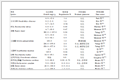
结果 1 物性参数表征粉体的粒径、水分和密度测定结果见表 1。由表 1可知, 物料粒径分布d10在4.5~24.0μm, d50在13.3~131.9 μm, d90在21.5~344.6μm, Span在1.0~3.1之间。其中糊精粒径分布最小且分布集中, 而EC T10粒径最大。含水量和真密度测定结果分别在0.1%~10.2%和1.1~1.5 g·mL-1。乳糖200具有较低的含水量和较大的真密度, 分别为0.13%和1.54 g·mL-1。
|
Table 1 Physical properties of different sample powders. MC: Moisture content; ρt: True density |

表面自由能的测定方法主要有接触角法、反相气相色谱法(Invers gas chromatography, IGC)等[28, 29]。反相气相色谱法测定高能位点表面自由能(无限稀释模型)和表面自由能分布(有限稀释模型)[26]。相比反相气相色谱法, 接触角法是根据热力学原理, 主要测定物料的平均表面自由能, 测定方法简单[30-32], 本研究采用OWRK法计算物料的表面自由能相关参数。
物料在不同压力压实后水和二碘甲烷形成的接触角见图 1。因为物料表面暴露的基团不同, 引起与探测液体的相互作用力不一样, 导致与探测液体形成的接触角差异, 物料与水的接触角有较为明显的差异, 在20°~110°之间(图 1a)。压缩压力对不同物料接触角的测定结果均有一定影响, 但其趋势不尽相同。其中糊精、乳糖70与水的接触角变化较大, 均呈先增大后减小的趋势, 其他物料接触角测定结果对压缩的变化不敏感。除乳糖200外, 其他物料在压缩压力高于353 MPa时接触角变化趋势较为缓和, 测定结果基本与353 MPa时持平。相比与水的接触角, 物料与二碘甲烷的接触角表现较为均匀, 接触角约在30°~70°之间(图 1b)。除PVP K29/32, 物料接触角基本表现在低压力(<264 MPa)下, 与二碘甲烷的接触角随压力的增大而增大, 在高压力(>264 MPa)下, 接触角变化基本不大。因在353 MPa压力下, 水和二碘甲烷测定接触角均维持相对恒定, 测定误差值较小, 故选用压缩压力为353 MPa时, 物料与探测液体形成的接触角计算物料表面自由能相关参数。

|
Figure 1 Contact angles (CA) of water (a) and diiodomethane (b) on the compacts surfaces |
基于接触角计算的表面自由能性质的非极性分量γd和极性分量γp相关计算结果见表 2。由表 2可知, 物料的表面自由能在27~70 mN·m-1之间, 其中乳糖与淀粉具有较大的表面自由能, 而HPMC的表面自由能相对较小。作为填充性质的物料如淀粉、甘露醇、乳糖与糊精表面自由能极性指数较大, 为35.3%~56.3%, 而作为黏合剂类辅料的极性指数较小, 在1.5%~15.0%之间; 五倍子和垂盆草提取物的极性指数分别为28.7%和21.9%。不同性质的辅料表面自由能极性成分含量差异较大, 填充剂的表面自由能极性成分明显高于黏合剂的极性成分。因此, 可由表面自由能相关性质区别不同类型的物料。
|
|
Table 2 Surface free energy (γ), surface free energy components, i.e., dispersive component (γd) and polar component (γp) calculated by OWRK approach. θW: Contact angle with water; θD: Contact angle with diiodomethane; PI: Polarity index; Wco: Cohesion work |

物料在不同压缩压力下的抗张强度分布见图 2。由图 2可知, 随着压缩压力的增大, 物料的抗张强度增大。抗张强度曲线可基本分为3类:随压缩压力的增大抗张强度增加缓慢, 如淀粉、糊精等; 随压缩压力的增大抗张强度开始增大, 后趋于平衡, 如HPMC E3、EC T10等; 随压缩压力的增大抗张强度维持较稳定的增长, 如乳糖200、五倍子提取物等。采用AUTSC定量表征辅料的压缩行为, AUTSC反映了物料在整个压缩压力段的压缩行为[19]。AUTSC计算结果见表 3。由表 3可知, 曲线下面积随着压力的增大而增大, 淀粉AUTSC最小, 为293.4 MPa2, 而HPMC E3最大, 为2 003.2 MPa2。

|
Figure 2 Effect of compression pressure on the tensile strength (TS) |
|
|
Table 3 Area under tensile strength-compression pressure curve (AUTSC) of the materials at different compression pressure |

在线的Heckel方程拟合结果见表 4, 越高的斜率即越低的屈服压力, 表明物料具有更好的压缩行为。在较低压力下粒子发生重排和较高压力下粒子破碎, Heckel方程会出现偏差[33], 因此, Heckel方程在中等偏低压力下拟合结果较好。由表 4可知, 在选定压力段范围内, 乳糖具有最大的屈服压力, 为119.1 MPa, 可压缩性较差, 而EC T10的屈服压力为40.0 MPa, 可压性较好。Heckel方程拟合结果和抗张强度曲线下面积结果并不完全一致, 由于Heckel拟合方程拟合曲线段压力较低, 主要体现物料在低压力段下粒子间的黏聚情况, 而抗张强度曲线拟合面积为整个压力曲线, 是不同压缩压力段整体的压缩特性, 包括低压力下粒子的黏聚, 也包括粒子在高压下的破碎等情况。
|
|
Table 4 Results of in-die Heckel analysis of the materials studied at different compression pressure. Py: Pressure yield |

分别由PI和Wco表征物料表面自由能参数, Py及AUTSC表征压缩特性参数。基于物料压缩特性的初始推动力为物料表面自由能的假设, 建立表面自由能相关参数评价物料压缩特性的方法。表面自由能参数与压缩特性的关系结果见图 3, 由图 3可知, Wco与Py成正相关(图 3a), 与不同压力段AUTSC成负相关(图 3b), 表现为Wco越大, Py越大, AUTSC越小, 物料的压缩特性越差。PI对压缩特性的影响与Wco类似, 表现为PI越大, Py越大, AUTSC越小, 物料的压缩特性越差(图 3c, d)。

|
Figure 3 Relationship between surface free energy related parameters and compression behaviour. a: Influence of Wco on Py; b: Influence of Wco on AUTSC; c: Influence of PI on Py; d: Influence of PI on AUTSC |
对表面自由能相关参数分别与表征物料压缩特性的AUTSC和Py进行Pearson相关分析, 结果见表 5。由表 5可知, PI和Wco均对压缩特性参数具有较强的相关性(P<0.05)。Pearson相关系数负值表明为负相关, 相比Wco, PI与相关系数的绝对值更大, 表明PI对物料压缩特性影响更大。
|
|
Table 5 Pearson correlation between the surface free energy related parameters and AUTSC |

目前对物料压缩特性的表征与评价多采用宏观观测方法, 如硬度、抗张强度等。本文在研究思路上进行了有益探索, 以物料表面自由能为研究对象, 尝试从微观的角度建立压缩特性的表征与评价方法, 并深入探讨微观与宏观表征结果的相关关系, 验证了微观表征方法的可行性, 实现了微观与宏观的统一。
研究初步建立基于物料微观表面性质评价压缩特性的方法研究, 结果证实表面自由能对物料的压缩特性具有重要的影响, 物料压缩特性随黏聚功、极性指数的增大而降低, 且具有显著的相关性(P<0.05)。物料的压缩特性与表面自由能极性指数成负相关, Pearson相关系数绝对值大于0.77, 表明物料的压缩特性主要由表面自由能非极性部分决定, 非极性成分越多, 则压缩特性越好。这与相关研究报道[34, 35]是一致的, 色散力成分在黏聚压缩过程具有主导性作用。表面自由能性质与物料的压缩特性具有显著的相关性, 但仍存在一定的偏差。可能原因是粒子压缩过程中存在粒子破碎和塑性变形聚集[2], 生成新的表面, 引起表面自由能的变化。
在对接触角测定方法的探索中, 本文针对物料的压缩压力进行了较为深入的分析。目前, 对物料压缩压力并没有统一的标准, 有研究者在68、70及200 MPa等压缩压力压实物料测定接触角[36-38]。有研究[39]表明在压实前后表面自由能发生变化, 但压实前后极性指数类似。随着压力的增大, 孔隙率降低、粒子破碎和形成新表面, 引起表面自由能的变化, 导致接触角变化。本文的研究结果表明, 在353 MPa压力下制备待测样品可获得相对较为稳定的接触角测量结果, 相对误差较小。
通过建立表面自由能性质评价压缩特性的方法, 有助于从微观角度深入理解物料的压缩行为, 深化对物料压缩特性的认识。在后续的研究中, 将进一步开展该方法的应用研究, 如基于表面自由能性质的压缩性辅料分类、制剂处方筛选和直压复合辅料的开发等。
| [1] | Patel S, Kaushal AM, Bansal AK. Mechanistic investigation on pressure dependency of Heckel parameter[J]. Int J Pharm, 2010, 389: 66–73. DOI:10.1016/j.ijpharm.2010.01.020 |
| [2] | Ilić I, Govedarica B, Šibanc R, et al. Deformation properties of pharmaceutical excipients determined using an in-die and out-die method[J]. Int J Pharm, 2013, 446: 6–15. DOI:10.1016/j.ijpharm.2013.02.001 |
| [3] | Si GN, Chen L, Li BG. Theoretical modeling and experimental research on direct compaction characteristics of multi-component pharmaceutical powders based on the Kawakita equation[J]. Acta Pharm Sin(药学学报), 2014, 49: 550–557. |
| [4] | Al-Zoubi N, Odeh F, Nikolakakis I. Co-spray drying of metformin hydrochloride with polymers to improve compaction behavior[J]. Powder Technol, 2016, 307: 163–174. |
| [5] | Yuan J, Shi L, Sun WJ, et al. Enabling direct compression of formulated Danshen powder by surface engineering[J]. Powder Technol, 2013, 241: 211–218. DOI:10.1016/j.powtec.2013.03.010 |
| [6] | Shi L, Feng Y, Sun CC. Initial moisture content in raw material can profoundly influence high shear wet granulation process[J]. Int J Pharm, 2011, 416: 43–48. DOI:10.1016/j.ijpharm.2011.05.080 |
| [7] | Koynov A, Romanski F, Cuitiño AM. Effects of particle size disparity on the compaction behavior of binary mixtures of pharmaceutical powders[J]. Powder Technol, 2013, 236: 5–11. DOI:10.1016/j.powtec.2012.07.046 |
| [8] | Liao ZG, Ming LS, Yun L, et al. Effect of process parameters on the powder aggregation of andrographis extract mixtures during high shear granulation process[J]. Chin Pharm J(中国药学杂志), 2014, 49: 572–577. |
| [9] | Das S, Larson I, Young P, et al. Understanding lactose behaviour during storage by monitoring surface energy change using inverse gas chromatography[J]. Dairy Sci Technol, 2010, 90: 271–285. DOI:10.1051/dst/2009051 |
| [10] | Shah UV, Wang Z, Olusanmi D, et al. Effect of milling temperatures on surface area, surface energy and cohesion of pharmaceutical powders[J]. Int J Pharm, 2015, 495: 234–240. DOI:10.1016/j.ijpharm.2015.08.061 |
| [11] | Mangal S, Meiser F, Tan G, et al. Applying surface energy derived cohesive-adhesive balance model in predicting the mixing, flow and compaction behaviour of interactive mixtures[J]. Eur J Pharm Biopharm, 2016, 104: 110–116. DOI:10.1016/j.ejpb.2016.04.021 |
| [12] | Das SC, Zhou Q, Morton DAV, et al. Use of surface energy distributions by inverse gas chromatography to understand mechanofusion processing and functionality of lactose coated with magnesium stearate[J]. Eur J Pharm Sci, 2011, 43: 325–333. DOI:10.1016/j.ejps.2011.05.012 |
| [13] | Wang ST, Li JZ, Lin X, et al. Novel coprocessed excipients composed of lactose, HPMC, and PVPP for tableting and its application[J]. Int J Pharm, 2015, 486: 370–379. DOI:10.1016/j.ijpharm.2015.03.069 |
| [14] | Li JZ, Wu F, Lin X, et al. Novel application of hydroxypropyl methylcellulose to improving direct compaction properties of tablet fillers by co-spray drying[J]. Rsc Adv, 2015, 5: 69289–69298. DOI:10.1039/C5RA10496C |
| [15] | Li SQ, Feng Y, Xu DS, et al. Effect of physical properties on direct compression of herbal extracts[J]. Chin Pharm J(中国药学杂志), 2010, 45: 608–611. |
| [16] | Cao HH, Du RF, Yang JN, et al. Effect of microcrystalline cellulose on compressibility and moldability of Galla chinensis extract[J]. Chin Tradit Herbal Drugs(中草药), 2014, 45: 1072–1077. |
| [17] | Wang J, Zhao GW, Jiang QY, et al. Multivariate analysis on micromeritic properties of Sarcandrae herba granule and its correlation with tablet compactibility[J]. Chin Tradit Herbal Drugs(中草药), 2014, 45: 1998–2004. |
| [18] | Zhang YL, Tian C, Hu DR, et al. Micromeritic evaluation of the direct compression excipient LubriTose AN[J]. Acta Pharm Sin(药学学报), 2012, 47: 640–645. |
| [19] | Kothari SH, Kumar V, Banker GS. Comparative evaluations of powder and mechanical properties of low crystallinity celluloses, microcrystalline celluloses, and powdered celluloses[J]. Int J Pharm, 2002, 232: 69–80. DOI:10.1016/S0378-5173(01)00909-7 |
| [20] | Rojas J, Kumar V. Comparative evaluation of silicified microcrystalline cellulose Ⅱ as a direct compression vehicle[J]. Int J Pharm, 2011, 416: 120–128. DOI:10.1016/j.ijpharm.2011.06.017 |
| [21] | Cao HH, Du RF, Yang JN, et al. Correlation analysis of physical properties and yield pressure of traditional Chinese medicine powder[J]. Chin J Exp Tradit Med Form(中国实验方剂学), 2014, 20: 14–17. |
| [22] | Li XH, Li MD, Du Y, et al. Application of factor analysis to evaluate deformation behaviors of frequently-used tablet excipients[J]. Acta Pharm Sin(药学学报), 2013, 48: 1475–1483. |
| [23] | Karde V, Ghoroi C. Influence of surface modification on wettability and surface energy characteristics of pharmaceutical excipient powders[J]. Int J Pharm, 2014, 475: 351–363. DOI:10.1016/j.ijpharm.2014.09.002 |
| [24] | Fernández V, Khayet M. Evaluation of the surface free energy of plant surfaces: toward standardizing the procedure[J]. Front Plant Sci, 2015, 6: 1–11. |
| [25] | Hwang G, Lee CH, Ahn IS, et al. Determination of reliable Lewis acid-base surface tension components of a solid in LW-AB approach[J]. J Ind Eng Chem, 2011, 17: 125–129. DOI:10.1016/j.jiec.2010.12.009 |
| [26] | Gamble JF, Leane M, Olusanmi D, et al. Surface energy analysis as a tool to probe the surface energy characteristics of micronized materials-a comparison with inverse gas chromatography[J]. Int J Pharm, 2012, 422: 238–244. DOI:10.1016/j.ijpharm.2011.11.002 |
| [27] | Li W, Quan P, Zhang Y, et al. Influence of drug physicochemical properties on absorption of water insoluble drug nanosuspensions[J]. Int J Pharm, 2014, 460: 13–23. DOI:10.1016/j.ijpharm.2013.10.038 |
| [28] | Saurí J, Suñénegre JM, Díazmarcos J, et al. Relationships between surface free energy, surface texture parameters and controlled drug release in hydrophilic matrices[J]. Int J Pharm, 2015, 478: 328–340. DOI:10.1016/j.ijpharm.2014.11.054 |
| [29] | Shah UV, Olusanmi D, Narang AS, et al. Decoupling the contribution of surface energy and surface area on the cohesion of pharmaceutical powders[J]. Pharm Res, 2015, 32: 248–259. DOI:10.1007/s11095-014-1459-3 |
| [30] | Chen M, Wu S, Tang W, et al. Caking and adhesion free energy of maltitol: studying of mechanism in adhesion process[J]. Powder Technol, 2015, 272: 235–240. DOI:10.1016/j.powtec.2014.12.012 |
| [31] | Borah R, Kumar A, Das MK, et al. Surface functionalization-induced enhancement in surface properties and biocompatibility of polyaniline nanofibers[J]. Rsc Adv, 2015, 5: 48971–48982. DOI:10.1039/C5RA01809A |
| [32] | Planinsek O, Trojak A, Srcic S. The dispersive component of the surface free energy of powders assessed using inverse gas chromatography and contact angle measurements[J]. Int J Pharm, 2001, 221: 211–217. DOI:10.1016/S0378-5173(01)00687-1 |
| [33] | Li XH, Zhao LJ, Li M, et al. Applications and characteristics of mathematical models to study compression process of pharmaceutical powder[J]. Chin J New Drug(中国新药杂志), 2012, 21: 1362–1366. |
| [34] | Modi SR, Khomane KS, Bansal AK. Impact of differential surface molecular environment on the interparticulate bonding strength of celecoxib crystal habits[J]. Int J Pharm, 2013, 460: 189–195. |
| [35] | Li NN, Li GL, Wang HD, et al. Research progress of surface free energy's computing methods and the influence on the properties of material surface[J]. Mater Rev(材料导报), 2015, 29: 30–35. |
| [36] | Tüske Z, Regdon G Jr, Erős I, et al. The role of the surface free energy in the selection of a suitable excipient in the course of a wet-granulation method[J]. Powder Technol, 2005, 155: 139–144. DOI:10.1016/j.powtec.2005.05.058 |
| [37] | Zhang D, Flory JH, Panmai S, et al. Wettability of pharmaceutical solids: its measurement and influence on wet granulation[J]. Colloid Surface A Physicochem Eng Asp, 2002, 206: 547–554. DOI:10.1016/S0927-7757(02)00091-2 |
| [38] | Prestidge CA, Tsatouhas G. Wettability studies of morphine sulfate powders[J]. Int J Pharm, 2000, 198: 201–212. DOI:10.1016/S0378-5173(00)00341-0 |
| [39] | Luangtana-Anan M, Fell JT. Surface energetics of powders before and after compaction[J]. Int J Pharm, 1988, 41: 237–240. DOI:10.1016/0378-5173(88)90199-8 |