 2017, Vol. 52


Aflatoxins (AFs) are a group of toxic secondary metabolites that are mainly produced by Aspergillusflavus and A. parasiticus[1]. The four most important are AFB1, AFB2, AFG1, and AFG2, all of which are highly toxic and carcinogenic[2]. Of these compounds, AFB1 and AFB2 are the most commonly occurring. They are often found in crops, fruits and meat, such as peanuts, wheat and so on. Recent studies have found that aflatoxin contamination in herbal teas has become increasingly prominent, which poses a public health threat. Due to the widespread occurrence of AF-producing fungi and the occurrence of the aflatoxins in a number of crops, robust efforts have been made for aflatoxin detection[3, 4].
Most of the traditional methods for detection of aflatoxins are based on chemical or biological analysis. They are generally accurate, but time-consuming[5, 6]. Presently, simple and rapid immunoassays are considered as suitable methods for detection of small molecules[7-9]. Fluorescence polarization immunoassay (FPIA) is one of most popular immunoassay methods due to its high throughput and automation[10, 11]. FPIA measures the polarized light of solution by monitoring the interaction between the tracers and the specific antibodies. In general, the polarization value is inversely proportional to free unlabelled antigen (i.e., mycotoxin) in solution that competes with the tracers[12]. The schematic diagram of FPIA are shown in Figure 1. In this study, we describe our preliminary efforts towards developing a rapid and sensitive FPIA for the detection of aflatoxins.

|
Figure 1 The schematic diagram of FPIA |
Reagents and chemicals Aflatoxins B1, carboxy methoxylamine (CMO), pyridine, benzene, 5-amino flurescein (5-AF), ethyl acetate, tetrahydrofuran (THF), anhydrous sodium sulfate (Na2SO4), EDCI, HOPT, and methylene chloride were purchased from Gaohua Weiye, Beijing, China. Aflatoxin total immunoaffinity columns and multifunctional enzyme standard instrumenst were purchased from Molecylar Devices (SUPLCO, Bellefonte, PA, USA). Fluorescent microporous plates were purchased from Shenzhen Industrial Ltd., Guang zhou, China.
Synthesis and detection of the oxime AFB1 (10 mg, 30 μmol), carboxymethoxylamine (CMO, 20 mg, 60 μmol), and 5 mL pyridine were combined in a round-bottom flask which was shaken for 24 h at room temperature. The pyridine was evaporated at 50 ℃, and the remaining 2 mL product was dissolved in 10 mL distilled deionized water. NaOH (0.1 mol·L-1, about 5 mL) was added drop-wise to adjust the solution to pH 8.0, completely dissolving the product. To this solution, 2×5 mL benzene was added to separate the organic and aqueous phases. The aqueous phase was acidified with 5 mol·L-1 HCl to pH 2, and a white-brown precipitate formed. The compound was then extracted with ethyl acetate (3×20 mL) and dried with 2 g anhydrous Na2SO4. The solvent was evaporated and 9.5 mg (20 μmol) oxime was obtained. A small portion (about 10 μL) was dissolved in 100 μL THF and detection by TLC using ethyl acetate/methanol/ ammonia = 32:17:5.
Synthesis and detection of the tracer 20 μL EDCI, HOPT of CH2Cl2 solution (10 mg·mL-1) was added to a small portion (about 20 μL) of the solution above. Dichloromethane (1 mL) was added and maintained for 5 minutes. This was followed by the addition of 20 μL of a solution of 5-amino fluorescein in THF (10 mg·mL-1) and shaking overnight. A small portion (about 10 μL) was purified by TLC using chloroform/methanol/acetic acid = 40:10:3. The main yellow band at Rf = 0.7 was collected, eluted with 0.5 mL methanol, centrifuged for 1 min and stored the supernatant at −20 ℃ in the dark. The synthesized tracer solution was detected by mass spectrometry.
Selection of working concentration of tracer and antibody The tracer solution was serially diluted to 1/100, 1/200, 1/400, 1/800, and 1/1 600 in borate buffer (BB) (50 mmol·L-1, pH 8.5), measured by fluorescence, and selected according to the total final fluorescence intensity, which was 10 times higher than the background of BB.
Determination of antibody concentration in the system: the anti-AF (A9555, Sigma) were serially diluted to 1/200, 1/400, 1/800, 1/1 600, 1/3 200, 1/6 400, 1/12 800. Diluted antibody (70 μL) was added to each 96-hole microplate well with 70 μL tracer (350 ng·mL−1) and 70 μL BB to make a total volume of 210 μL. The reaction mixture was incubated for 10 min at room temperature and then detected by FPIA. The FPIA was measured at λex = 485 nm and λem = 530 nm (emission cutoff = 515 nm, G factor = 1.0). The optimal antibody dilution (70% of the tracer binding to the antibody) for anti-AF was determined to be 1/1 600, 1/2 000 and 1/2 500; this dilution was then used in the FPIA calibration curve for AFs.
Standard curve of FPIA Curve fitting was performed using a four parameter logistic model as follows: Y= (A-D)/[1 + (X/C)B+D]; A, response at high asymptote; B, slope factor; C, concentration corresponding to 50% specific binding (IC50); D, response at low asymptote; X, alibration concentration.
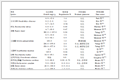
HPLC detection method Hexane (200 μL), fluoroacetic acid (100 μL) and aflatoxins standards (20 μL) were added to sample bottles oscillating for 30 s and allowed to derivatize for 20 min at 40 ℃. Samples were placed in a water bath to nearly dry followed by addition of 300 μL acetonitrile−water (2:8, v:v) and thorough mixing. The chromatographic conditions were: C18 Agilon column; fluorescence excitation wavelength: 360 nm; emission wavelength: 460 nm; column tem perature: 35 ℃; sample volume: 10 μL; mobile phase: A: water, B: acetonitrile; flow rate: 1.0 mL·min−1. Gradient elution as described in Table 1.
|
Table 1 HPLC conditions for detection of aflatoxins |
The expansion agent (chloroform/methanol/acetic acid = 40:10:3) was used in TLC and the 354 nm wavelength of the UV lamp was used for detection of tracers. As shown in Figure 2, Rf of aflatoxin tracer was about 0.8. The identity of the synthesized tracer was confirmed by mass spectrometry in negative ion mode; the molecular weight of the tracer was found to be 714 (Figure 2). These results indicate that the oxime was successfully conjugated with 5-AF.

|
Figure 2 Preparation and detection of tracer |
In general, the fluorescence intensity of the tracer solution should be 10 times higher than the BB solution. As a result, the optimized concentration of the tracer was determined to be 30 nmol·L-1. And dilution ratio of the antibody should generally be selected at the moderate level of fluorescence intensity, so the optimized dilution ratio of the antibody was determined to be 1/2 000 (Figure 3).

|
Figure 3 Dilution curve of aflatoxins antibody |
The FPIA calibration curve for AFB1 (Figure 4) indicated that the limit of detection (LOD) and IC50 were 20 and 371.80 ng·mL-1, respectively, and the detection range was 92.76−252.32 ng·mL-1.

|
Figure 4 Standard curve of FPIA for aflatoxins |
As shown in Figure 5, the chromatographic peaks of four aflatoxins were significantly separated by HPLC method. It indicates the HPLC method established in this study can be used for the qualitative analysis of aflatoxins. The standard curve of aflatoxins also showed that the linear correlation coefficient was higher than 0.99 and LOD of aflatoxins was about 5 ng·mL-1 (Figure 5). Results suggest the HPLC detection method can be used for determination of aflatoxin B1, B2, G1 and G2.

|
Figure 5 HPLC liquid phase diagram and standard curve of aflatoxin G1, B1, G2 and B2 |
Seventy-two samples of six important herbal teas including medlar (the fruit), honeysuckle (flower), American ginseng (roots), Gynostemma (whole plant), Ganoderma lucidum spores (bacteria) and velvet (animals) were collected from market for further detection of aflatoxins by HPLC and FPIA. As a consequence, FPIA detected traces of aflatoxins in two samples of Gynostemma. Comparative analyses of these herbal teas samples by both the FPIA and HPLC methods showed a good correlation (r = 0.964). These results indicate that, instead of traditional method of HPLC, FPIA we established may also be suitable for determi nation of aflatoxins in herbal teas.
DiscussionWe established a method for the detection of aflatoxins by FPIA in this study, making it possible for rapid quantitative and qualitative detection of aflatoxins in herbal teas. In FPIA, tracers can be easily synthe sized by chemical method and purified by chromatog raphy. Also, the whole detection process takes less than 15 min. In contrast, HPLC detection method is time-consuming and expensive. Thus, FPIA developed in this work has advantages of short analysis time, low cost and high sensitivity for detection of aflatoxins.
Moreover, there are some problems that need to be solved in further studies. First, the value of fluores cence polarization is larger than that reported in the other literatures. This phenomenon may be related to testing instruments, the access to converting and effect of background signal. In this work, the fluorescence polarization of tracer value showed sufficient differ ences after adding antibody, which indicates the final measurement value may have significant correlation with aflatoxin content. Therefore, the developed FPIA can be used for the qualitative and quantitative detec tion of aflatoxina. The next problem concerns the effect of methanol on the antibody. The fluorescence polarization values measured by the antibody in the experiment were lower than the real value, which may be affected by the methanol in the system according to other papers. In this study, there was methanol in the presence of storage fluid and aflatoxins standard. However, since the solution was diluted more than 50 times, the impact of methonal is small. The third problem concerns the activity of the antibody, which varied according to storage conditions, storage time and
reaction temperature. Therefore, it is recommended that close attention should be paid to the preservation of the antibody across experiments. The antibody solution should be saved at −20 ℃ and the working dilutions should be stored at 4 ℃. Freeze-thawing cycles for antibody should be avoided. It is recommended to reconstruct the standard curve to ensure the accuracy of measurement before the detection of different batches of samples at different time.
| [1] | Chen J, Zhang XH, Yang MH, et al. Detection of aflatoxin in Chinese herbal medicine[J]. Chin Tradit Herb Drugs (中草药), 2006, 3: 463–466. |
| [2] | Liu XD. Detection method of aflatoxin and overall solu-tion[J]. Food S Guide (食品安全导刊), 2015, 9: 95. |
| [3] | Liu Y, Hu JH, Liu CZ. The toxicological effects and detec-tion methods of aflatoxin[J]. Biolo Pro (生物加工), 2013, 3: 83–88. |
| [4] | Ma YS. Detection method and comparison of aflatoxin in grain and oil food[J]. Fri Sci (科学之友), 2012, 7: 18–19. |
| [5] | Wan LZ, Jun T, Lin C, et al. Hetero-enzyme-based two-round signal amplification strategy for trace detection of aflatoxin B1 using an electrochemical aptasensor[J]. Biosens Bioelectron, 2016, 80: 570–574. |
| [6] | Mécheri S, Peltre G, Weyer A, et al. Production of a monoclonal antibody against a major allergen of Dactylis glomerata pollen (Dg1)[J]. Ann Inst Pasteur Immunol, 1985, 136C2: 195–209. |
| [7] | Lippolis V, Pascale M, Valenzano S, et al. A rapid fluores-cence polarization immunoassay for the determination of T-2 and HT-2 toxins in wheat[J]. Anal Bioanal Chem, 2011, 401: 2561–2571. DOI:10.1007/s00216-011-5379-3 |
| [8] | Zezza F, Longobardi F, Pascale M, et al. Fluorescence polarization immunoassay for rapid screening of ochra-toxin A in red wine[J]. Anal Bioanal Chem, 2009, 395: 1317–1323. DOI:10.1007/s00216-009-2994-3 |
| [9] | Chun HS, Choi EH, Chang HJ, et al. A fluorescence polari-zation immunoassay for the detection of zearalenone in corn[J]. Anal Chim Acta, 2009, 639: 83–89. DOI:10.1016/j.aca.2009.02.048 |
| [10] | Ren LL, Meng M, Wang P, et al. Determination of sodium benzoate in food products by fluorescence polarization immunoassay[J]. Talanta, 2014, 121: 136–143. DOI:10.1016/j.talanta.2013.12.035 |
| [11] | Maragos CM, Kim EK. Detection of zearalenone and related metabolites by fluorescence polarization im-munoassay[J]. J Food Protect, 2004, 67: 1039–1043. DOI:10.4315/0362-028X-67.5.1039 |
| [12] | Lippolis V, Pascale M, Visconti A. Optimization of a fluo-rescence polarization immunoassay for rapid quantification of deoxynivalenol in durum wheat-based products[J]. J Food Protect, 2006, 69: 2712–2719. DOI:10.4315/0362-028X-69.11.2712 |