 2016, Vol. 7
引用本文 |

| Ti/Cr比对(VFe)50Ti26-xCr24+x(0≤x≤2.0)储氢合金吸放氢性能的影响 |  [PDF全文] [PDF全文] |


随着环境污染的日益严重以及传统能源危机的产生,世界上越来越多的国家开展了新型能源的研究开发工作,氢能以其储量丰富、能量密度高等突出优点,受到越来越多研究工作者的重视[1].在所有的储氢方式中,储氢材料储氢因其具有储氢体积密度较大以及安全高效等优点,成为目前研究最为活跃的储氢技术之一[2].具有BCC结构的钒基固溶体储氢合金,理论吸氢量达到3.9 %,且有良好的动力学性能,因而受到了广泛的关注[3-15],是目前具有较大潜力实用化的储氢材料之一.
由于不同Ti/Cr比的相同体系储氢合金其晶格常数不同,导致其吸放氢量的不同,合金的吸放氢量在合适的晶格常数范围内具有较理想的吸放氢性能. Sung-Wook Cho等[16-17]研究发现,Ti/Cr比对合金的结构和性能有显著的影响.本文主要通过研究不同Ti/Cr比(VFe)50Ti26-xCr24+x(0≤x≤2.0)储氢合金的组织结构,研究分析不同Ti/Cr比与吸放氢的内在规律,获得最佳吸放氢性能的Ti/Cr比.
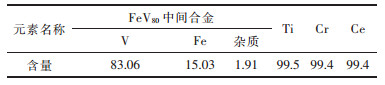
1 实验部分 1.1 实验原料FeV80中间合金,海绵Ti,Cr,稀土Ce,原料纯度如表 1所示.
| 表1 原材料纯度/(质量分数, %) Table 1 Purity of raw materials/(mass fraction, %) |
 |
| 点击放大 |
1.2 实验研究方法
为了提高(VFe)50Ti26-xCr24+x(0≤x≤2.0)合金的活化性能,在合金中加入了3 at%的稀土Ce.合金采用氩气作为保护气体(氩气纯度:99.999%)的ZDH-5000非自耗电弧炉熔炼制备.在熔炼过程中合金试样经过3次翻转以使合金成分尽量均匀化.合金的均匀化退火热处理在ZM-40-16型真空钼丝炉中进行,以使合金的成分更加均匀,热处理温度为1 673 K,时间30 min.合金在空气中机械破碎至1 mm左右后称取3.0 g用于吸放氢性能测试.
室温298 K下,采用Sieverts-type装置测试储氢合金的吸放氢性能,合金在常温下抽真空30 min后无需活化即可快速吸放氢.采用DX-2000型X射线衍射仪对放氢后的合金粉末进行物相检测,检测参数为管电压35 kV,管电流25 mA,Cu Kα(λ=0.154 05 nm)辐射,石墨单色器,测试过程中采用3 °/min连续扫描,扫描角度2θ范围为20~90°.采用上海蔡康光学仪器有限公司的4XCE型光学显微镜检测分析合金金相组织,块状样品经砂纸磨平和金相抛光后,进行表面侵蚀,腐蚀剂为:10%HF+20%HNO3+70%H2O(体积百分数).
2 实验结果与分析 2.1 微观组织结构图 1为(VFe)50Ti26-xCr24+x(x=0, 0.5, 1, 1.5, 2)合金的XRD衍射图谱.由图可知,所有的合金均由主相BCC及稀土氧化物CeO2相组成.如图 1中右上角BCC相衍射峰放大图可知,随着x的增加,即Ti/Cr比的降低,合金主相BCC的衍射峰向高角度偏移,由布拉格方程可知,主相BCC的晶格常数随着衍射峰2θ角的增大而减小.这与卫格定律[18]的规律相一致,在固溶体合金中增加小原子半径元素的含量时(Cr原子半径为1.28 ,Ti原子半径为1.47 ),合金的晶格常数减小. 图 2为不同Ti/Cr比合金晶格常数变化图谱,如图所示,随着x的增加,即Ti/Cr比的降低,合金的晶格常数逐渐降低,这与图 1测得合金的峰位角角度偏移规律一致.
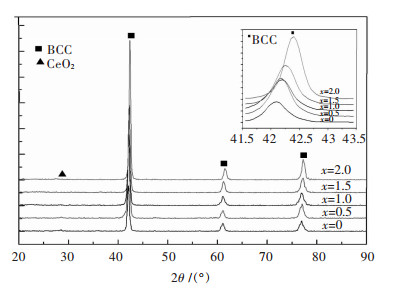 |
| 图 1 (VFe)50Ti26-xCr24+x (x=0, 0.5, 1.0, 1.5, 2.0)合金的XRD图谱 Fig. 1 XRD patterns of (VFe)50Ti26-xCr24+x (x=0, 0.5, 1.0, 1.5, 2.0) alloys |
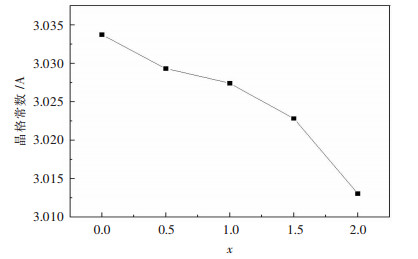 |
| 图 2 (VFe)50Ti26-xCr24+x (x=0, 0.5, 1.0, 1.5, 2.0)合金的晶格常数图谱 Fig. 2 Lattice parameter patterns of (VFe)50Ti26-xCr24+x(x=0, 0.5, 1.0, 1.5, 2.0) alloys |
图 3为(VFe)50Ti26-xCr24+x(x=0, 0.5, 1, 1.5, 2)合金的金相组织图谱.合金由黑色的稀土氧化物相和基体BCC相组成.从图 3中可以看出,黑色的稀土氧化物相呈颗粒状,随机弥散地分布在晶粒和晶界上,随着Ti/Cr比的降低,合金的组织没有明显的改变,合金的相分布也较均匀.综合XRD物相分析和金相组织可知,Ti/Cr比对(VFe)50Ti26-xCr24+x合金的组织和形貌均没有明显的影响.
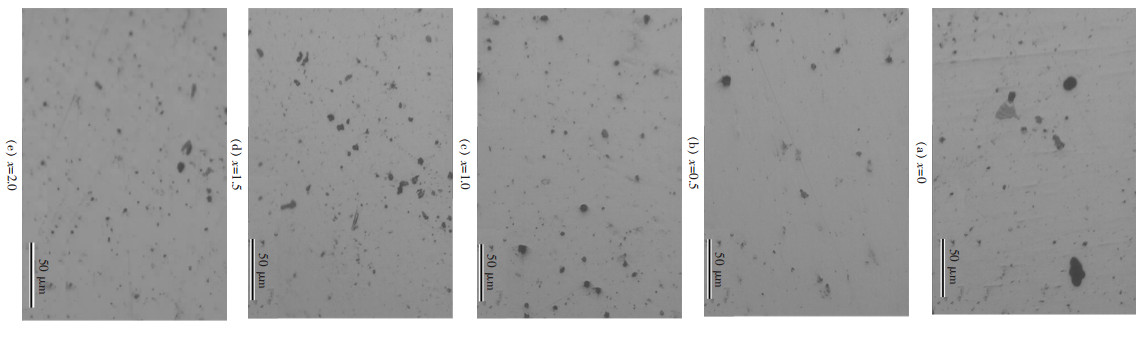 |
| 图 3 (VFe)50Ti26-xCr24+x合金的金相图谱 Fig. 3 Metallograph of(VFe)50Ti26-xCr24+x alloys |
2.2 吸放氢性能
图 4为(VFe)50Ti26-xCr24+x(x=0, 0.5, 1, 1.5, 2)合金放氢PCT曲线, 由图 4可知,随着x的增加,即Ti/Cr比的降低,合金的吸放氢量均随之减小,这主要是由于随着合金中Ti/Cr比的降低,合金主相BCC的晶格常数逐渐减小,从而使可容纳H原子的数量越来越少,使得合金的吸氢量随之减少.结合图 5可知,合金的吸放氢量由(VFe)50Ti26-xCr24+x(x=0)时的吸氢量3.51 wt%、放氢量2.13 wt%降至(VFe)50Ti26-xCr24+x(x=2.0)时的吸氢量2.82 wt%、放氢量1.63 wt%.
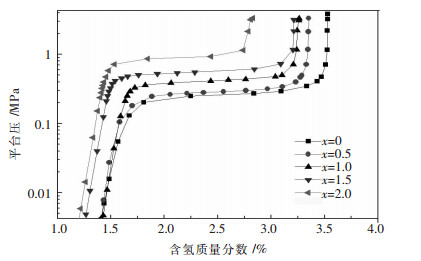 |
| 图 4 (VFe)50Ti26-xCr24+x合金的放氢PCT曲线 Fig. 4 PCT curves of (VFe)50Ti26-xCr24+x (x=0, 0.5, 1.0, 1.5, 2.0) alloys |
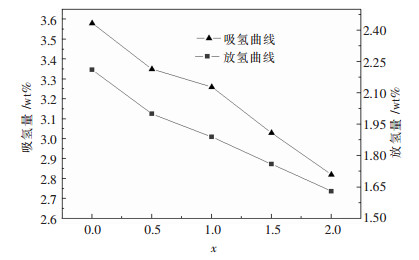 |
| 图 5 (VFe)50Ti26-xCr24+x (x=0, 0.5, 1.0, 1.5, 2.0)合金放量随Ti/Cr比变化曲线 Fig. 5 Changing curves of (VFe)50Ti26-xCr24+x (x=0, 0.5, 1, 1.5, 2.0) with variation of the Ti/Cr ratio |
图 6为(VFe)50Ti26-xCr24+x(x=0, 0.5, 1, 1.5, 2)合金放氢平台压的拟合曲线.拟合误差R2=0.99769,拟合函数关系如下:
| $ y = {A_1} \times {{\rm{e}}^{x/t1}} + {y_0}$ |
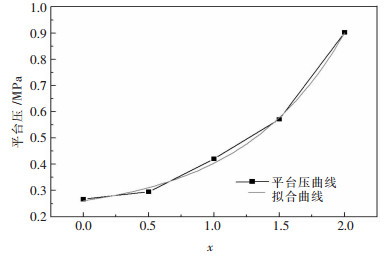 |
| 图 6 (VFe)50Ti26-xCr24+x (x=0, 0.5, 1.0, 1.5, 2.0)合金放氢平台拟合曲线 Fig. 6 Hydrogen desorption plateau pressure fitting curves of(VFe)50Ti26-xCr24+x(x=0, 0.5, 1.0, 1.5, 2.0) alloys |
y表示合金放氢平台压,x表示合金(VFe)50Ti26-xCr24+x(x=0, 0.5, 1, 1.5, 2)的x值.
| $ {A_1} = 0.05842;{y_0} = 0.20266;{t_1} = 0.80619 $ |
具体拟合函数如下:
| $ y = {\rm{0}}{\rm{.05842}} \times {{\rm{e}}^{x/0.80619}} + 0.20266 $ | (1) |
由式(1)可以估测不同Ti/Cr比时(VFe)50Ti26-xCr24+x贮氢合金的放氢平台压.
结合图 6可知,随着x的增加,即Ti/Cr比的降低,合金的放氢平台压成指数增长,由(VFe)50Ti26-xCr24+x(x=0)时的0.267 MPa升高至(VFe)50Ti26-xCr24+x(x=2.0)时的0.902 MPa.平台压越高,合金的氢化物稳定性越小.
3 结论1) 随着(VFe)50Ti26-xCr24+x(x=0, 0.5, 1.0, 1.5, 2)合金中Ti/Cr比的降低,即x的增加, 合金的组织结构没有明显的变化,均由BCC相和少量稀土氧化物CeO2相组成,但主相BCC的峰位角则是随着Ti/Cr比的降低而减小,即主相BCC的晶格常数随着Ti/Cr比的降低而减小.
2) 随着(VFe)50Ti26-xCr24+x(x=0, 0.5, 1.0, 1.5, 2)合金中Ti/Cr比的降低,合金的吸放氢量均随之降低,合金的吸放氢量在x=0时达到最大,分别是3.51 wt%和2.13 wt%.
3) 随着(VFe)50Ti26-xCr24+x(x=0, 0.5, 1.0, 1.5, 2)合金中Ti/Cr比的降低,合金的放氢平台压成指数性地增长,平台压越高,合金的氢化物稳定性越小.
| [1] | 毛宗强.氢能—我国未来的清洁能源[J]. 太阳能,2005 (3):6–8. |
| [2] | 毛宗强, 刘志华.中国氢能发展战略思考[J]. 电池,2002,32 (3):150–152. |
| [3] |
SUWARNO S, SOLBERG J K, MAEHLEN J P, et al. The effects of rapid solidification on microstructure and hydrogen sorption properties of binary BCC Ti-V alloys[J].
Journal of Alloys and Compounds, 2014,582 :540–546. DOI: 10.1016/j.jallcom.2013.08.077. |
| [4] |
SHEN C C, LI H C. Passivation and reactivation of Ti25V35Cr40 hydrides by cycling with impure hydrogen gas[J].
International Journal of Hydrogen Energy, 2015,40 :3277–3282. DOI: 10.1016/j.ijhydene.2015.01.047. |
| [5] |
HANG Z M, XIAO X Z, TAN D Z, et al. Microstructure and hydrogen storage properties of Ti10V84—xFe6Zrx(x=1-8) alloys[J].
International Journal of Hydrogen Energy, 2010,35 :3080–3086. DOI: 10.1016/j.ijhydene.2009.07.019. |
| [6] |
HANG Z M, CHEN L X, XIAO X Z, et al. The effect of Cr content on the structural and hydrogen storage characteristics of Ti10V80−xFe6Zr4Crx (x=0-14) alloys[J].
Journal of Alloys and Compounds, 2010,493 :396–400. DOI: 10.1016/j.jallcom.2009.12.110. |
| [7] |
LOTOTSKY M V, YARTYS V A, ZAVALIY I Y. Vanadium-based BCC alloys: phase-structural characteristicsand hydrogen sorption properties[J][J].
Journal of Alloys and Compounds, 2005,404/405/406 :421–426. |
| [8] |
YAN Y G, CHEN Y G, ZHOU Z Z, et al. Hydrogen storage properties of V-Ti-Cr-Fe alloys[J].
Journal of Alloys and Compounds, 2008,454 :427–431. DOI: 10.1016/j.jallcom.2006.12.093. |
| [9] |
HANG Z M, XIAO X Z, LI S Q, et al. Influence of heat treatment on the microstructure and hydrogen storage properties of Ti10V77Cr6Fe6Zr alloy[J].
Journal of Alloys and Compounds, 2012,529 :128–133. DOI: 10.1016/j.jallcom.2012.03.044. |
| [10] |
SHEN C C, CHOU J C, LI H C, et al. ffect of interstitial boron and carbon on the hydrogenation properties of Ti25V35Cr40 alloy[J].
International Journal of Hydrogen Energy, 2010,35 :11975–11980. DOI: 10.1016/j.ijhydene.2010.07.166. |
| [11] |
KURIIWA T, MARUYAMA T, KAMEGAWA A, et al. Effects of V content on hydrogen storage properties of V-Ti-Cr alloys with high desorption pressure[J].
International Journal of Hydrogen Energy, 2010,35 :9082–9087. DOI: 10.1016/j.ijhydene.2010.06.024. |
| [12] |
MATSUDA J, AKIBA A. Lattice defects in V-Ti BCC alloys before and after hydrogenation[J].
Journal of Alloys and Compounds, 2013,581 :369–372. DOI: 10.1016/j.jallcom.2013.07.073. |
| [13] |
DOLAN M D, McLennan K G, Song G, et al. The effect of Ti on hydrogen absorption and diffusivity in V-Ti-Al alloy membranes[J].
Journal of Membrane Science, 2013,446 :405–409. DOI: 10.1016/j.memsci.2013.07.003. |
| [14] |
ITOH H, Arashima H, Kubo K, et al. Improvement of cyclic durability of BCC structured Ti-Cr-V alloys[J].
Journal of Alloys and Compounds, 2005,404/405/406 :417–420. |
| [15] |
SHIRASAKI K, TAMURA T, KURIIWAT, et al. Cyclic properties of protium absorption-desorption inTi-CrValloys[J].
Mater Trans JIM, 2002,43 :1115–1119. DOI: 10.2320/matertrans.43.1115. |
| [16] |
CHO S W, HAN C S, PARK C N. The hydrogen storage characteristics of Ti-Cr-V alloys[J].
Journal of Alloys and Compounds, 1999,288 :294–298. DOI: 10.1016/S0925-8388(99)00096-1. |
| [17] |
CHO S W, PARK C N, YOO J H, et al. Hydrogen absorption-desorption characteristics of Ti (0.22+x)Cr(0.28+1.5x)V(0.5—2.5x)(0≤x≤0.12) alloys[J].
Journal of Alloys and Compounds, 2005,403 :262–266. DOI: 10.1016/j.jallcom.2005.06.083. |
| [18] | 张克立. 固体无机化学[M]. 北京: 北京化工出版社 , 2005 : 79 . |