 2018, Vol. 40

 [PDF全文]


2. 中国石油天然气销售西部公司, 新疆 乌鲁木齐 830012
2. PetroChina West Gas Marketing Company, Urumqi, Xinjiang 830012, China
对地下腔体的稳定性研究,目前国内外主流的技术是地表沉降监测和力学数值模拟[1-6],这两种技术都属于间接方式并且具有滞后性。国外曾经利用实时微地震提前3周预测了采卤盐腔的垮塌[7],这使得微地震技术在地下腔体监测方面名声鹊起。微地震技术起源于地热开发行业后,引入石油天然气行业进行地下原生裂缝、诱发裂缝几何特性分析及储层有效改造体积估算[8]。目前雪伏龙(亚太)公司在印尼的Duri、壳牌美国公司在华盛顿、德士古公司在哈萨克斯坦都进行了储气库微地震技术应用研究。新疆呼图壁废弃油气藏储气库利用深浅井结合的井中监测方式连续监测2年进行注采运行过程中断层活化状态研究。金坛储气库前期的微地震监测研究中把检波器放到中心管(直径114.33 mm)中,结果显示三层套管对微地震信号衰减严重,特别是套管之间环空液阻碍了横波传播。研究中检波器直接置于生产套管(直径244.50 mm)中间,从而避免了中间管、中心管、环空液对微地震信号的影响。微地震监测的目的是实时预警盐穴储气库生产过程中天然裂缝活动、腔壁垮塌、顶板破裂信号,进而采取有效措施控制和防范盐腔垮塌[9-15],以及对盐穴储气库的生产运行技术参数进行安全稳定性评价。
1 微地震监测采集与处理 1.1 微地震野外采集监测井A井为盐穴储气库新完钻井,完钻方式为二开裸眼完钻,盐顶埋深982.4 m,钻井生产套管下深998.4 m,为了防止盐层溶蚀,完钻后井筒灌满饱和卤水。目标井B1井为储气库造腔井,完钻采取二开裸眼完钻,盐顶埋深980.6 m,钻井生产套管下深996.8 m,造腔外管下深1 088.7 m,内管下深1 127.0 m,监测时腔顶位于1 087.7 m,腔体体积为2.1
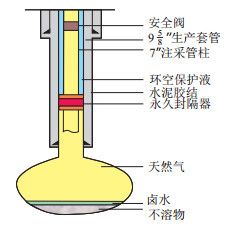 |
| 图1 盐穴储气库注采井C1结构示意图 Fig. 1 Production well C1 schematic diagram of salt cavern gas storage |
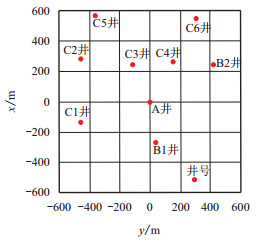 |
| 图2 实时微地震监测井位分布图 Fig. 2 Real-time microseismic monitoring location map |
微地震监测采集方式分为井中观测、地表观测和设备埋置观测3种方式。地表监测观测系统布置快,水平方向定位分辨率高,利于震源机制研究,缺点是纵向分辨率差,金坛库区600 m埋深附近存在稳定发育的玄武岩屏蔽层,不适合地表观测方式。设备埋置具有丛式井成本低和较高的精度,不足之处是单井成本高,纵向分辨率差。井中观测可以获得高信噪比的微地震有效信号并且具有较高的垂向定位精度,缺点是监测井选取困难和平面监测范围有限。
根据现场条件采取井中观测方式(图 3),选定12级Maxwave三分量检波器接收,级距10 m,检波器的位置尽量靠近观测目的层段深度,并且为了仪器安全考虑,检波器不能出生产套管进入裸眼段,所以,12级三分量检波器设计位置为870~980 m,仪器采样间隔0.5 ms,记录长度10 s,增益40 dB。
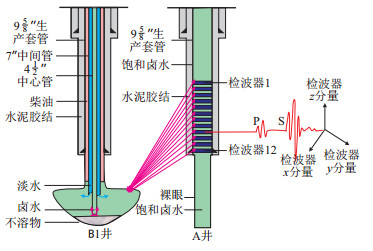 |
| 图3 盐穴储气库实时微地震监测示意图 Fig. 3 Real-time microseismic monitoring schematic diagram of salt cavern gas storage |
野外采集过程中利用28 t地面可控震源车确定井下三分量检波器的方向,接收地面8个不同位置的激发信号,采集到的可控震源信号波形清晰可见,初至起跳干脆,在震源位置已知的前提下运用地震波传播规律确定三分量检波器的方向。
1.2 微地震数据处理利用射线追踪和Geiger算法联合定位微地震事件震源位置,采用如下技术路线进行震源定位:(1)利用声波测井和地震层位建立初始速度模型,对地面定位震源信号和地下微地震信号进行联合定位,调整速度模型,获取最终的速度场以满足定位误差在10 m误差内;(2)微地震事件自动筛选、噪声压制、检波器三分量定位及人机交互自动初至拾取;(3)利用P波的极化信息,P波S波的时差联合确定微地震事件位置[16-20]。
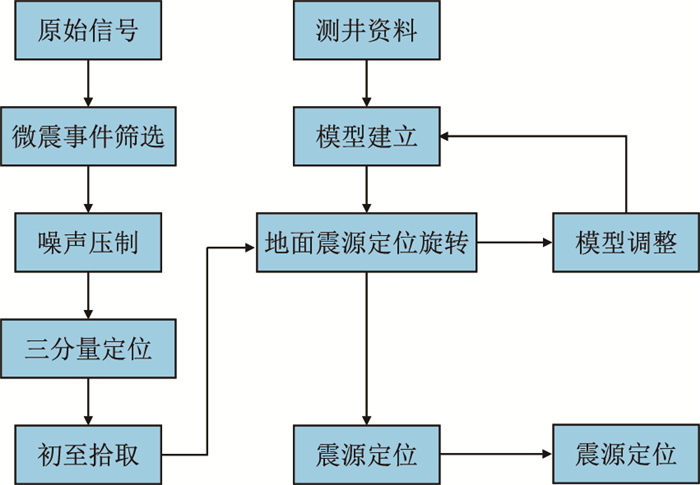 |
| 图4 微地震数据处理流程图 Fig. 4 Microseismic data processing flow chart |
为期23 d的监测过程中,共监测到419个微地震事件,震级范围为-2.64~-0.35。其中微地震事件主要集中C5、C6两井之间,造腔井B1、B2井也监测到少量微地震信号,6口注采井中没有监测到明显微地震信号。在造腔井B1和B2各监测到16个微地震事件,C5、C6两井之间监测到387个微地震事件,从时间上看微地震事件主要集中在2016年12月17~20日,在19日微地震事件产生最多。
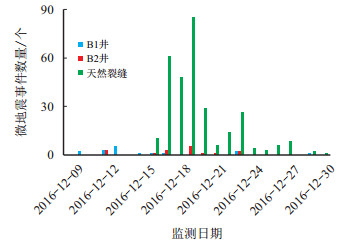 |
| 图5 盐穴储气库微地震事件数量随时间演变图 Fig. 5 The number of microseismic events evolves time of salt cavern gas storage |
造腔井B1井共监测到16个微地震信号(图 6),震级范围在-2.63~-2.10。微地震事件距离造腔井最远水平距离为40 m,深度在1 038~1 107 m。相关研究表明,微地震震源的辐射模式与横波和纵波振幅比值以及纵波和横波转角频率比值有关(图 7)。造腔井B1的活动产生的破裂大多是剪应力和张应力共同作用的裂缝,其中张应力占主要作用的裂缝较多,一般为张开缝。
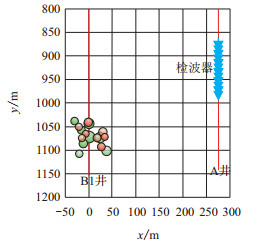 |
| 图6 造腔B1井微地震事件侧视图 Fig. 6 Side view of microseismic events of leaching cavern B1 |
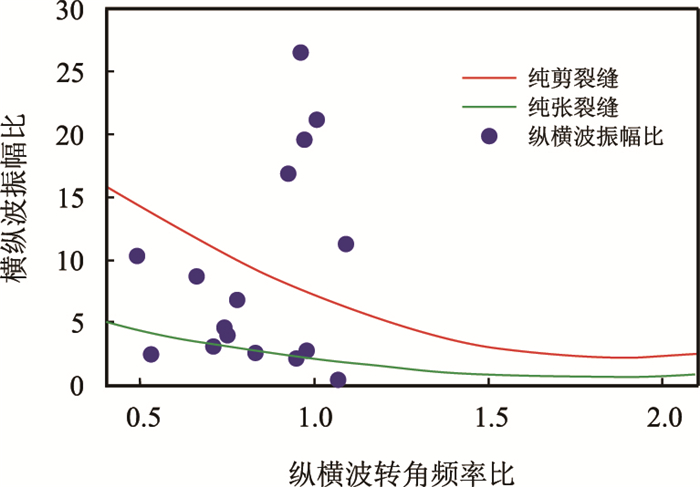 |
| 图7 造腔B1井微地震震源辐射模式 Fig. 7 Microseismic source radiation pattern of leaching cavern B1 |
微地震事件基本平均出现在各个施工阶段,在12、13日出现较集中,在造腔结束后也有少量微地震事件(图 8)。分析发现,生产工艺参数压力剧烈变化时,微地震事件数量明显增多。
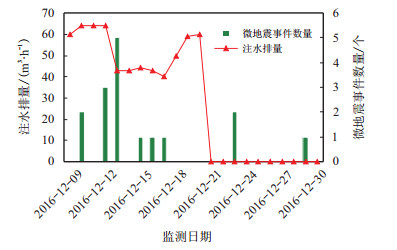 |
| 图8 造腔B1井微地震事件个数与注水排量统计图 Fig. 8 The statistical relationship between the number of microseismic events and the waterflood emission of leaching cavern B1 |
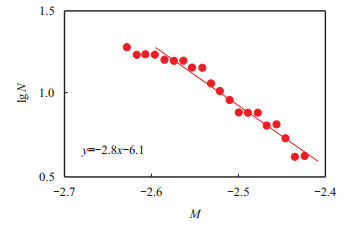
| $ \lg{{N}}=a-bM $ | (1) |
式中:
 |
|
图9
造腔B1井微地震事件 |
监测过程中在注采井C5井和注采C6井之间监测到大量微地震事件(图 10),共387个,震级范围在-2.500~-0.585。近天然裂缝区域的活动产生的破裂大多是剪应力和张应力共同作用的裂缝,其中张应力占主要作用的裂缝较多,盐穴注采井之间微地震震源辐射模式见图 11。
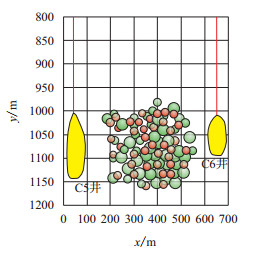 |
| 图10 盐穴注采井之间微地震事件侧视图 Fig. 10 Side view of microseismic events in the middle of production wells |
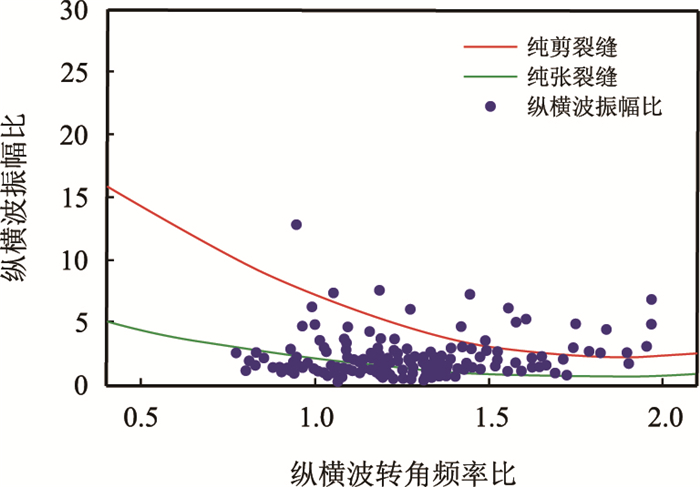 |
| 图11 盐穴注采井之间微地震震源辐射模式 Fig. 11 Microseismic source in the middle of production wells radiation pattern |
该区域微地震事件产生较集中,在16日之后开始出现,主要集中在17~20日(图 12),其中19日最多,达到83个。微地震事件在井口压力达到最大值时开始出现,并且当井口压力保持在一定数值之上时,微地震事件持续大量出现。盐穴注采井之间微地震事件
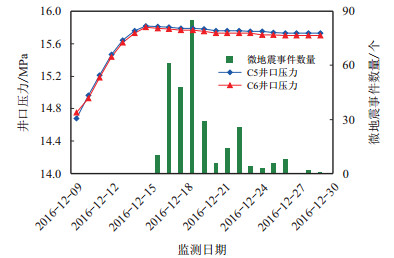 |
| 图12 盐穴注采井之间微地震事件个数与井口压力统计 Fig. 12 The statistical relationship between the number of microseismic events in the middle of production wells and wellhead pressure |
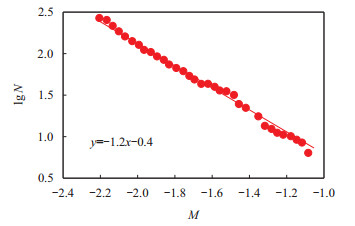 |
|
图13
盐穴注采井之间微地震事件 |
(1) 在造腔井B1、B2中监测到少量微地震信号,震级范围在-2.630~-2.100,微地震事件基本平均分布在整个监测过程中,在压力变化处和压力达到最大值之后产生较多,由于监测时间较短,造腔井附近接收到微地震事件较少,统计规律并不明显,通过
(2) 监测过程中注采井C5与C6井之间接收到大量微地震信号,震级范围在-2.500~-0.585,综合三维地震数据和
(3) 造腔井造腔层段围岩及注采井之间矿柱的岩体破裂大多是剪应力和张应力共同作用,其中张应力占主要作用的震源辐射较多。
(4) 盐穴储气库造腔井和注采井在监测期内微地震事件较少,说明目前的生产工艺参数满足腔体稳定性要求,建议后续研究中增加监测时间以提高生产参数与微地震事件数量的统计规律;对于注采井之间天然裂缝活动需加强认识,建议增加监测时间以研究天然裂缝活动规律以及其与周围气腔注采气生产活动是否存在内在联系。
| [1] |
李建君, 陈加松, 吴斌, 等. 盐穴储气库盐岩力学参数的校准方法[J]. 天然气工业, 2015, 35(7): 96-102. LI Jianjun, CHEN Jiasong, WU Bin, et al. A calibration method for salt rock mechanics parameters of salt-cavern gas storage[J]. Natural Gas Industry, 2015, 35(7): 96-102. doi: 10.3787/j.issn.1000-0976.2015.07.015 |
| [2] |
张新生, 常晓云, 蒋丽云, 等. 盐穴地下储气库稳定性评价系统及其应用[J]. 天然气工业, 2015, 35(11): 83-90. ZHANG Xinsheng, CHAN Xiaoyun, JIANG Liyun, et al. Salt cavern UGS stability evaluation system and its application[J]. Natural Gas Industry, 2015, 35(11): 83-90. doi: 10.3787/j.issn.1000-0976.2015.11.013 |
| [3] |
任松, 姜德义, 杨春和. 盐穴储气库破坏后地表沉陷规律数值模拟研究[J]. 岩土力学, 2009, 30(12): 3595-3606. REN Chunlei, JIANG Deyi, YANG Chunhe. Numerical stimulation research on ground subsidence after salt cavern gas storage collapsing[J]. Rock and Soil Mechanics, 2009, 30(12): 3595-3606. doi: 10.16285/j.rsm.2009.12.004 |
| [4] |
屈丹安, 杨春和, 任松. 金坛盐穴地下储气库地表沉降预测研究[J]. 岩石力学与工程学报, 2010, 29(增1): 2705-2707. QU Danan, YANG Chunhe, REN Song. Study and prediction of surface subsidence of salt rock caves used for gas storages in Jintan salt mine[J]. Chinese Journal of Rock Mechanics and Engineering, 2010, 29(S1): 2705-2707. doi: 10.16285/j.rsm.2009.12.004 |
| [5] |
完颜祺琪, 冉莉娜, 韩冰洁, 等. 盐穴地下储气库库址地质评价与建库区优选[J]. 西南石油大学学报(自然科学版), 2015, 37(1): 57-64. WANYAN Qiqi, RAN Lina, HAN Bingjie, et al. Study on site selection and evaluation of underground gas storage in salt cavern[J]. Journal of Southwest Petroleum University (Science & Technology Edition), 2015, 37(1): 57-64. doi: 10.11885/j.issn.1674-5086.2013.05.29.02 |
| [6] |
刘继芹, 焦雨佳, 李建君, 等. 盐穴储气库回溶造腔技术研究[J]. 西南石油大学学报(自然科学版), 2016, 38(5): 122-128. LIU Jiqin, JIAO Yujia, LI Jianjun, et al. Back-leaching technology in the construction of underground salt cavern gas storage[J]. Journal of Southwest Petroleum University (Science & Technology Edition), 2016, 38(5): 122-128. doi: 10.11885/j.issn.1674-5086.2015.02.24.02 |
| [7] |
EMMANUELLE N, ERIC B, GUILLAUME B. Real time microseismic monitoring dedicated to forecast collapse hazards by brine production[C]. Solution Mining Research Institute Fall Technical Meeting, 2007. doi:10.1007/s00024-015-1176-9
|
| [8] |
赵博雄, 王忠仁, 刘瑞, 等. 国内外微地震监测技术综述[J]. 地球物理学进展, 2014, 29(4): 1882-1888. ZHAO Boxiong, WANG Zhongren, LIU Rui, et al. Review of microseismic monitoring technology research[J]. Progress in Geophysics, 2014, 29(4): 1882-1888. doi: 10.6038/pg20140454 |
| [9] |
RAMEY M, DESCOUR J, HARDY M. Cavity shape characterization of a rubble-filled solution mined cavity[C]. Solution Mining Research Institute Spring Technical Meeting, 2005.
|
| [10] |
FORTIER E, VALETTE M, MAISONS C. Contribution to a better understanding of brine production using a long period of microseismic monitoring[C]. Solution Mining Research Institute Fall Technical Meeting, 2005.
|
| [11] |
LILIAN D, EMMANUELLE N, GIOVANNI G. Contribution to salt leaching and post-leaching monitoring issues feed-back form a long term microseismic survey[C]. Solution Mining Research Institute Spring Technical Meeting, 2006.
|
| [12] |
KLEIN E, CONTRUCCI X. Experimental monitoring of solution-mining cavern in salt:identifying and analyzing early warning signals prior to collapse[C]. Solution Mining Research Institute Fall Technical Meeting, 2008.
|
| [13] |
MERCERAT D, DRIAD L, BERNARD P, et al. Induced seismicity monitoring of an underground salt cavity under a transient pressure experiment[C]. Solution Mining Research Institute Spring Technical Meeting, 2007, 227-234.
|
| [14] |
HOSSEINI Z, COLLINS D, SHUMILA V, et al. Induced microseismic monitoring in salt caverns[C]. US Rock Mechanics Geomechanics Symposium, 2015. http://www.onepetro.org/conference-paper/ARMA-2015-394
|
| [15] |
TRIFU C, SHUMILA V. Microseismic monitoring of controlled collapse in field Ⅱ at Ocnele Mari, Romania[J]. Pure and Applied Geophysics, 2010, 167(2): 27-42. doi: 10.1007/s00024-009-0013-4 |
| [16] |
段银鹿, 李倩, 姚韦萍. 水力压裂微地震裂缝监测技术及其应用[J]. 断块油气田, 2013, 20(5): 644-648. DUAN Yinlu, LI Qian, YAO Weiping. Microseismic fracture monitoring technology of hydraulic fracturing and its application[J]. Fault-Block Oil & Gas Field, 2013, 20(5): 644-648. doi: 10.6056/dkyqt201305024 |
| [17] |
刘劲松, 王赟, 姚振兴. 微地震信号到时自动拾取方法[J]. 地球物理学报, 2013, 56(5): 1660-1666. LIU Jinsong, WANG Yun, YAO Zhenxing. On microseismic first arrival identification:A case study[J]. Chinese Journal of Geophysics, 2013, 56(5): 1660-1666. doi: 10.6038/cjg20130523 |
| [18] |
夏常亮, 李振勇, 代东. 马达海洋区块分段压制多次波方法[J]. 西南石油大学学报(自然科学版), 2015, 37(6): 64-71. XIA Changliang, LI Zhenyong, DAI Dong. Eliminating oceanic seismic data multiples in west Madagascar Sea[J]. Journal of Southwest Petroleum University (Science & Technology Edition), 2015, 37(6): 64-71. doi: 10.11885/j.issn.1674-5086.2013.11.06.04 |
| [19] |
鄢雪梅, 王欣, 张合文, 等. 页岩气藏压裂数值模拟敏感参数分析[J]. 西南石油大学学报(自然科学版), 2015, 37(6): 127-132. YAN Xuemei, WANG Xin, ZHANG Hewen, et al. Analysis of sensitive parameter in numerical simulation of shale gas reservoir with hydraulic fractures[J]. Journal of Southwest Petroleum University (Science & Technology Edition), 2015, 37(6): 127-132. doi: 10.11885/j.issn.1674-5086.2013.06.14.04 |
| [20] |
巫芙蓉, 闫媛媛, 尹陈. 页岩气微地震压裂实时监测技术——以四川盆地蜀南地区为例[J]. 天然气工业, 2016, 36(11): 46-50. WU Furong, YAN Yuanyuan, YIN Chen. Real-time microseismic monitoring technology for hydraulic fracturing in shale gas reservoirs:A case study from the Southern Sichuan Basin[J]. Natural Gas Industry, 2016, 36(11): 46-50. doi: 10.3787/j.issn.1000-0976.2016.11.006 |
| [21] |
薛靖楠, 李想, 张波, 等. 山东地区b值的统计分析[J]. 华北地震科学, 2011, 29(1): 1-5. XUE Jingnan, LI Xiang, ZHANG Bo, et al. Statistical analysis of b values in Shandong area[J]. North China Earthquake Sciences, 2011, 29(1): 1-5. doi: 10.3969/j.issn.1003-1375.2011.01.001 |
| [22] |
王彦辉, 司丽, 朴昌永, 等. 井震结合断层解释应注意的几个问题[J]. 西南石油大学学报(自然科学版), 2016, 38(5): 50-58. WANG Yanhui, SI Li, PIAO Changyong, et al. Discussion on several issues of integrated well-to-seismic fault interpretation[J]. Journal of Southwest Petroleum University (Science & Technology Edition), 2016, 38(5): 50-58. doi: 10.11885/j.issn.1674-5086.2015.05.14.02 |