 2016, Vol. 38

 [PDF全文]


2. 中国地质大学(北京)能源学院, 北京 海淀 100083
2. School of Energy Resources, China University of Geosciences, Haidian, Beijing 100083, China
聚合物驱是中国油田主要应用的三次采油技术之一,大庆、胜利、新疆及大港等油田都已成功开展大规模矿场应用,平均提高采收率12%左右[1],为各油田稳产增产发挥了重要作用。目前常用的聚合物驱开发效果预测方法主要包括数值模拟方法、流管法、类比法和经验公式法等。前两种方法基于渗流理论,需要建模且模拟技术涉及参数较多,结果相对精确,通常应用于矿场方案设计;后两种方法计算简单,通常以某一油田已实施聚合物驱的区块开发效果为基础,对未实施聚合物驱开发的区块进行类比评价或预测,以快速明确聚合物驱潜力,为油田规划计划提供参考,方法不具备普适性。
本文通过研究影响聚合物驱的因素,建立了影响因素分级评分和权重评分相结合的聚合物驱综合评分计算方法,并利用指数回归方法建立了新的聚合物驱潜力预测方法,可直观反映聚合物驱综合评分与提高采收率值的关系,方法具有普适性,可用于不同类型油藏聚合物驱潜力评价及可行性研究。
1 聚合物驱影响因素分析影响聚合物驱开发效果的因素主要分为两个方面,一是油藏因素,如油藏类型、岩石类型、储层物性参数、地层流体物性等;二是注入参数,包括聚合物分子量、注入浓度和注入量、注入速度等。油藏因素是客观制约因素,不可人为改变;注入参数可根据油藏条件进行优选和调整,因此本文主要分析油藏因素的影响。
每个影响因素对聚合物驱矿场应用效果都会产生作用,但影响程度不同[2]。本文按照各个影响因素对聚合物驱驱油效果的影响程度划分为关键参数和一般性参数,参数分类依据及其权重见表 1。
| 表1 聚合物驱开发效果影响因素及作用 Table 1 Main influence factors of polymer flooding |
 |
由表 1可知,文中参与评价的影响因素有9个,其中关键参数有5个,一般性参数有4个。根据其影响程度的大小,设定了不同的权重系数,以客观地反映各因素对聚合物驱开发效果的影响。
2 聚合物驱综合评分方法的建立对于不同的油藏区块,每个影响因素的参数值不同,对聚合物驱开发效果产生的影响也不同,如油藏温度低于50 ℃时,对聚合物溶液的增黏效果影响较小,随着温度的升高,会导致聚合物降解,到达某一温度时聚合物完全降解,不再具备增黏作用,按照油藏温度不同的取值,划分了五级评分参数界限,并用相同的分析方法确定了其他参数的五级评分界限[3],结果见表 2。
| 表2 聚合物驱五级筛选与评分标准 Table 2 Polymer flooding screening & grading criteria |
|
根据表 2中的筛选参数分级标准,可对待评价油藏区块进行不同参数的评分。每项参数评分与对应参数的权重系数相乘后求和,即得到待评价油田区块聚合物驱评分总值,其计算公式如下
| $ {W_{总}}=\sum\limits_{i=1}^n {{W_i}{X_i}} $ | (1) |
式中:W总-待评价油藏的聚合物驱评分总值,无因次;
Wi-第i个参数的评分权重值,0~1,无因次;
Xi-第i个参数的评分值,0~4,无因次;
i-参与评分的参数个数,无因次。
为评价不同油藏之间的聚合物驱适应性,对聚合物驱评分进行归一化处理,得到聚合物驱综合评分值
| $ {W_{归}}=\frac{{{W_{总}}-{W_{\min }}}}{{{W_{\max }}}}=\frac{{{W_{总}}}}{4} $ | (2) |
式中:
W归-油藏聚合物驱综合评分值,无因次;
Wmin-参数的评分最低值,无因次,聚合物驱分级筛选标准中为0;
Wmax-参数的评分最高值,无因次,聚合物驱分级筛选标准中为4。
3 聚合物驱开发效果预测方法的建立利用建立的聚合物驱综合评分方法,对中国13个实施聚合物驱矿场试验的油藏进行了评价,13个聚合物驱矿场应用实例的油藏参数见表 3,各油藏聚合物驱综合评分结果见表 4。
| 表3 聚合物驱矿场实例油藏参数表 Table 3 Reservoir parameters of fields developed by polymer flooding |
|
根据表 4的评分结果,本文将13个聚合物驱矿场应用油藏的综合评分值和对应的聚合物驱实际提高采收率值进行关联,见图 1。
| 表4 聚合物驱矿场实例油藏评分表 Table 4 Evaluation scores for fields developed by polymer flooding |
|
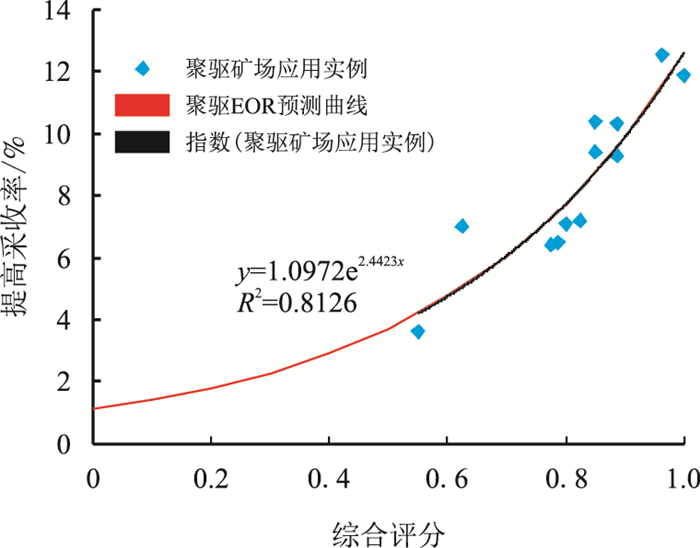 |
| 图1 聚合物驱综合评分与提高采收率的关系 Fig. 1 The relationship between comprehensive evaluation coefficient and EOR for polymer-flooding |
采用指数回归的方法,建立了聚合物驱综合评分与提高采收率的关系
| $ R=1.097{{\rm{e}}^{2.442{W_{归}}}} $ | (3) |
式中:
R-聚合物驱提高采收率值,%。
4 新方法的应用应用新的评价方法对河南油田古城泌124块和下二门H2II块聚合物驱进行了效果预测,结果见表 5。
| 表5 新预测方法在2个油田区块的应用及评价结果 Table 5 Application of the new method in two oilfields |
|
古城泌124块于2008年5月开始聚合物驱[17],2011年12月完成聚合物驱试验,提高采收率5.7%;下二门H2Ⅱ油藏于1996年8月实施聚合物驱[18],最终提高采收率11.05%。
采用新方法预测古城泌124块聚合物驱提高采收率5.63%,与实际效果的误差为3.8%,预测下二门H2Ⅱ油藏聚合物驱提高采收率9.83%,与实际效果的误差为12.7%,预测方法的误差在合理范围,接近数模误差要求10%,结果可用。
5 结论(1)通过分析影响聚合物驱开发效果的各种因素,确定了不同影响因素的作用权重。
(2)根据聚合物驱五级筛选评分技术界限,确定了各级界限的参数范围和评分标准。
(3)综合考虑影响因素评分及权重评分,建立了聚合物驱综合评分计算方法。
(4)采用指数回归方法,确定了聚合物驱综合评分与聚合物驱矿场提高采收率的关系。
(5)应用新建的聚合物驱潜力预测方法,评价了古城泌124块和下二门H2Ⅱ油藏聚合物驱效果,预测结果与矿场实际效果误差分别为3.8%和12.7%,结果可靠,可用于聚合物驱可行性研究及潜力评价。
| [1] | 胡博仲, 刘恒, 李林. 聚合物驱采油工程[M]. 北京: 石油工业出版社, 1997. |
| [2] |
张金国. 聚合物溶液粘度的主要影响因素分析[J].
断块油气田, 2005, 12(1): 57–59.
ZHANG Jinguo. Analysis of the main factors affecting the viscidity of the solution of polymer[J]. Fault-Block Oil & Gas Field, 2005, 12(1): 57–59. |
| [3] |
刘朝霞, 王强, 孙盈盈, 等. 聚合物驱矿场应用新技术界限研究与应用[J].
油气地质与采收率, 2014, 21(2): 22–24, 31.
LIU Zhaoxia, WANG Qiang, SUN Yingying, et al. Study and application of new technological limit for polymer flooding in field application[J]. Petroleum Geology and Recovery Efficiency, 2014, 21(2): 22–24, 31. DOI:10.3969/j.issn.1009-9603.2014.02.006 |
| [4] |
廖广志, 牛金刚, 邵振波, 等. 大庆油田工业化聚合物驱效果及主要做法[J].
大庆石油地质与开发, 2004, 23(1): 48–51.
LIAO Guangzhi, NIU Jin'gang, SHAO Zhenbo, et al. Application and experience of industrialized polymer flooding in Daqing Oilfield[J]. Petroleum Geology & Oilfield Development in Daqing, 2004, 23(1): 48–51. DOI:10.3969/j.issn.1000-3754.2004.01.018 |
| [5] | 巢华庆. 大庆油田提高采收率研究与实践[M]. 北京: 石油工业出版社, 2006. |
| [6] |
程宏杰, 顾鸿君, 楼仁贵, 等. 克拉玛依油田七区砾岩油藏聚合物驱方案设计[J].
新疆石油地质, 2009, 30(5): 609–612.
CHENG Hongjie, GU Hongjun, LOU Rengui, et al. The conceptual design of polymer flooding in conglomerate reservoir of district No.7 in Karamay Oilfield[J]. Xinjiang Petroleum Geolog, 2009, 30(5): 609–612. |
| [7] | 马立军, 闫建华, 李志勇. 聚合物驱油技术在大港油田港西三区的推广应用[J]. 油气地质与采收率, 2001, 8(6): 71–72. DOI:10.3969/j.issn.1009-9603.2001.06.021 |
| [8] | 张贤松, 郭兰磊, 屈智坚, 等. 孤岛油田中一区聚合物驱先导试验效果评价及驱油特征[J]. 石油勘探与开发, 1996, 23(6): 54–57. |
| [9] | 王翠丽. 孤东油田六区聚合物驱油效果分析[J]. 内江科技, 2006, 27(2): 139. DOI:10.3969/j.issn.1006-1436.2006.02.132 |
| [10] |
钟玉龙, 李洪生, 王建军, 等. 双河油田高温聚合物驱综合调整技术[J].
石油地质与工程, 2007, 21(1): 44–45, 48.
ZHONG Yulong, LI Hongsheng, WANG Jianjun, et al. Comprehensive adjustment technique of high temperature polymer flooding in Shuanghe oilfield[J]. Petroleum Geology and Engineering, 2007, 21(1): 44–45, 48. DOI:10.3969/j.issn.1673-8217.2007.01.015 |
| [11] |
刘建军, 冯丹, 马卫东, 等. 胜坨油田胜一区沙二段1-3砂层组聚合物驱先导试验研究[J].
油气田地面工程, 2002, 21(2): 45–47.
LIU Jianjun, FENG Dan, MA Weidong, et al. Polymer pilot test and research for sand layer 1-3 sand 2 section shengl district in Shengtuo oilfield[J]. Oil-Gasfield Surface Engineering, 2002, 21(2): 45–47. DOI:10.3969/j.issn.1006-6896.2002.02.026 |
| [12] |
王德, 张智春, 高小鹏, 等. 孤岛油田中一区馆3聚合物驱试验区转后续水驱开采特征[J].
大庆石油地质与开发, 2004, 23(4): 61–62.
WANG De, ZHANG Zhichun, GAO Xiaopeng, et al. Development characteristics of Guan 3 polymer flooding pilot test area of Zhong 1 area in Gudao Oilfield[J]. Petroleum Geology & Oilfield Development in Daqing, 2004, 23(4): 61–62. DOI:10.3969/j.issn.1000-3754.2004.04.024 |
| [13] |
张衍军, 毛卫荣, 郭学民, 等. 七点法井网聚合物驱数值模拟及矿场试验[J].
油气田地面工程, 2002, 21(2): 47–48.
ZHANG Yanjun, MAO Weirong, GUO Xuemin, et al. Digital analog and lease test on 7-spot pattern polymer flooding[J]. Oil-Gasfield Surface Engineering, 2002, 21(2): 47–48. DOI:10.3969/j.issn.1006-6896.2002.02.027 |
| [14] |
顾永强, 解保双, 魏志高, 等. 孤东油田聚合物驱工业化应用效果分析[J].
中外能源, 2008, 13(2): 52–55.
GU Yongqiang, XIE Baoshuang, WEI Zhigao, et al. Analysis on industrial application effect of polymer flooding in Gudong Oilfield[J]. Sino-Global Energy, 2008, 13(2): 52–55. DOI:10.3969/j.issn.1006-7981.2010.23.006 |
| [15] |
张贤松, 孙福街, 冯国智, 等. 渤海稠油油田聚合物驱影响因素研究及现场试验[J].
中国海上油气, 2007, 19(1): 30–34.
ZHANG Xiansong, SUN Fujie, FENG Guozhi, et al. A research on influence factors of polymer flooding and its field testing in Bohai heavy oil fields[J]. China Offshore Oil and Gas, 2007, 19(1): 30–34. DOI:10.3969/j.issn.1673-1506.2007.01.006 |
| [16] |
张新民, 郭拥军, 冯如森, 等. 适合渤海绥中361油田二元复合驱体系性能研究[J].
油田化学, 2012, 29(3): 322–325, 361.
ZHANG Xinmin, GUO Yongjun, FENG Rusen, et al. Performance of surfactant/polymer flooding system suitable for Suizhong 361 Oilfield[J]. Oilfield Chemistry, 2012, 29(3): 322–325, 361. |
| [17] |
李星, 费永涛, 关群丽, 等. 小断块普通稠油高效聚合物驱跟踪调整技术及应用--以河南古城油田泌124断块下层系为例[J].
油气藏评价与开发, 2013, 3(1): 40–43.
LI Xing, FEI Yongtao, GUAN Qunli, et al. Common heavy oil high efficiency polymer flooding tracking adjusting technique in small fault block and its applicationtaking Bi-124 fault lower series of Henan Gucheng oil field as an example[J]. Reservoir Evaluation and Development, 2013, 3(1): 40–43. DOI:10.3969/j.issn.2095-1426.2013.01.009 |
| [18] |
孙永, 魏秀芹. 下二门油田聚合物驱实践和认识[J].
石油地质与工程, 2010, 24(6): 79–81, 91.
SUN Yong, WEI Xiuqin. Polymer flooding practice and recognition in Xiaermen oilfield[J]. Petroleum Geology and Engineering, 2010, 24(6): 79–81, 91. DOI:10.3969/j.issn.1673-8217.2010.06.023 |