 2015, Vol. 37

 [PDF全文]


2. 中国石油吉林油田采油工艺研究院, 吉林 松原 138000
2. Production Technology Research Institute, Jilin Oilfield, PetroChina, Songyuan, Jilin 138000, China
随着低渗透油藏和稠油油藏的进一步开发,注气提高采收率技术得到了迅速发展[1-3]。CO2在原油中溶解度高,能够明显降低原油界面张力和黏度,与水驱相比平均可提高采收率16.38%[4],CO2驱已在美国阿拉斯加Kuparuk River油田、阿曼Safah油田、挪威的Ruth油田、加拿大Brazeau River Nisku油田等国外油田和国内的大庆、胜利、辽河等油田得到了应用[5, 6]。中国大多数油田纵向发育油层较多,各油层有效厚度、渗透率、原油黏度、原油密度差异大,合注CO2时层间干扰现象严重,生产测试表明中低渗透层基本得不到动用,开发效果较差。分层配注CO2是解决油田开发层间矛盾,实现高、中、低渗透地层都有效注CO2,保持地层能量,维持油田长期稳产高产,提高气驱动用储量和采收率的重要手段。本文旨在建立描述多个储层吸气动态-配水器嘴损-井筒压力的分层配注井模型,提出相应的数值求解方法,为分层注CO2提供了重要的理论依据。
1 数学模型图 1为分层注气示意图。CO2从井筒经配气嘴注入各油层,配气嘴控制流量实现分层注气。该过程中CO2经历了井筒流动、配气嘴限流和注入油层3个阶段,因此分层注气模型应包括描述上述3个过程压力的数学模型。
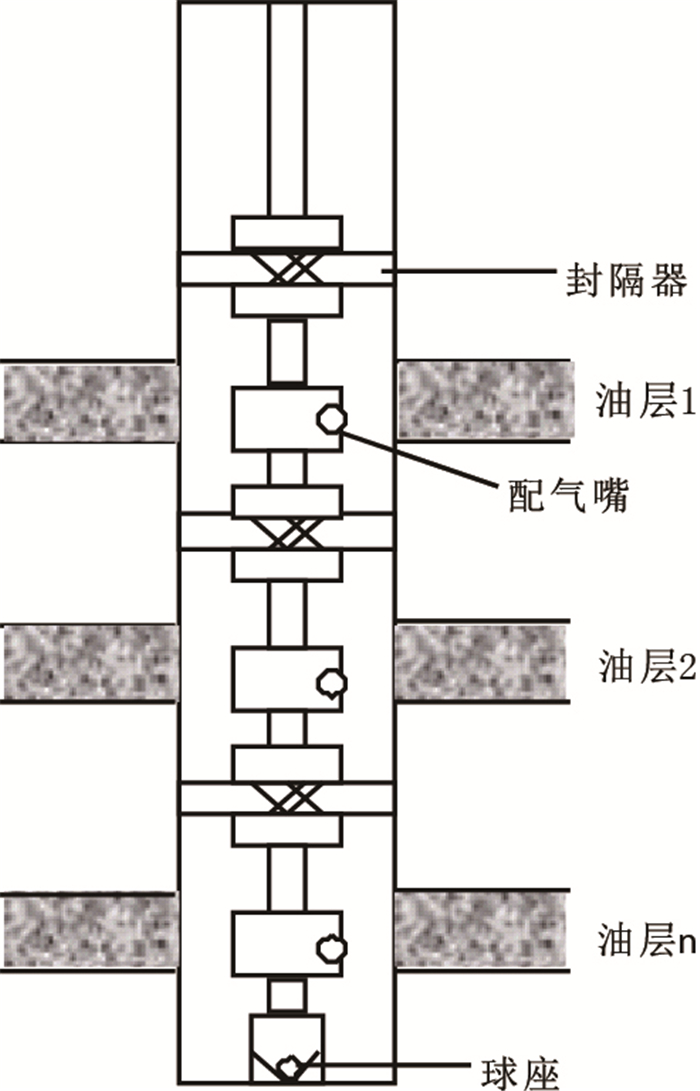 |
| 图1 分层注气示意图 Fig. 1 Sketch map showing separate layer gas injection |
CO2注入过程中常存在相态变化:一般情况下近井口为液态,随着井深增加,温度逐渐增大,CO2转变为超临界态。注CO2井筒必须考虑温度对压力的影响[7-9]。基于动量守恒、质量守恒、能量守恒,建立了注CO2井筒压力温度耦合数学模型[10, 11]
| $\left\{ \begin{array}{l} \dfrac{{{\rm{d}}{T_{\rm{f}}}}}{{{\rm{d}}Z}} = \dfrac{{2\pi {r_{{\rm{to}}}}{U_{{\rm{to}}}}{\lambda _{\rm{e}}}\left( {{T_{\rm{f}}} - {G_{{\rm{DC}}}}Z - {T_{{\rm{sur}}}}} \right)}}{{W{C_{{\rm{pm}}}}\left[{{\lambda _{\rm{e}}} + {r_{{\rm{to}}}}{U_{{\rm{to}}}}f({\tau _{\rm{D}}})} \right]}}\\ \dfrac{{{\rm{d}}p}}{{{\rm{d}}Z}} = \dfrac{{\rho {\rm{g}}\sin \theta {\rm{ - }}f\dfrac{{\rho {v^2}}}{{2{d_{{\rm{ti}}}}}}}}{{1 - \rho \dfrac{{{v^2}}}{p}}} \end{array} \right.$ | (1) |
式中:
Z——井深,m;
W——注入流量,kg/h;
p——压力,Pa;
g——重力加速度,g=9.8 m/s2;
f——摩阻系数,无因次;
v——流速,m/s;
式(1)可采用四阶龙格库塔法求解,求解时需要知道CO2的物性参数黏度、比热容和总传热系数。其中,(1) 黏度:由文献[12]中的方法计算;(2) 比热容:该参数在相变时变化较大,采用计算模型时误差较大,采用查表法得到其不同温度压力下的比热容值,然后进行插值;(3) 总传热系数
| ${U_{{\rm{to}}}}{\rm{ = }}{\left[{\dfrac{{{r_{{\rm{to}}}}}}{{{r_{{\rm{ti}}}}({h_{\rm{c}}} + {h_{\rm{r}}})}} + \dfrac{{{r_{{\rm{to}}}}}}{{{\lambda _{{\rm{cas}}}}}}\ln \dfrac{{{r_{{\rm{co}}}}}}{{{r_{{\rm{ci}}}}}} + \dfrac{{{r_{{\rm{to}}}}}}{{{\lambda _{{\rm{cem}}}}}}\ln \dfrac{{{r_{\rm{h}}}}}{{{r_{{\rm{co}}}}}}} \right]^{{\rm{ - }}1}}$ | (2) |
式中:
通过配气嘴实现流量控制是分层注气的关键。CO2通过配气嘴时所产生的压降一部分转化为速度损失,另一部为不可逆转的涡流损失。根据气体稳定流动及热力学相关理论,可导出嘴流方程
| ${q_{{\rm{sc}}}} = \dfrac{{{\rm{\pi }}d_2^2}}{4}\dfrac{{{C_{\rm{d}}}}}{{{\rho _{{\rm{sc}}}}}}\sqrt {2{p_1}{\rho _1}} \cdot \\{\kern 42pt} \sqrt {\left( {\dfrac{k}{{k - 1}}} \right)\left[{\dfrac{{{{\left( {\dfrac{{{p_2}}}{{{p_1}}}} \right)}^{\frac{2}{k}}}-{{\left( {\dfrac{{{p_2}}}{{{p_1}}}} \right)}^{\frac{{k + 1}}{k}}}}}{{1-{{\left( {\dfrac{{{d_2}}}{{{d_1}}}} \right)}^4} \cdot {{\left( {\dfrac{{{p_2}}}{{{p_1}}}} \right)}^{\frac{2}{k}}}}}} \right]}$ | (3) |
式中:
k——气体的绝热指数,无因次;
吸气方程是确定地层注气量的依据,但描述注气动态的文献却很少[14]。注气早期,注气量少,注入气在地层中形成压差很小,采用径向非达西模型来描述吸气能力
| ${\psi _{{\rm{wf}}}} - {\psi _{\rm{e}}} = \dfrac{{12.91{q_{{\rm{sc}}}}T}}{{K{K_{{\rm{rg}}}}h}}\left( {\ln \dfrac{{{r_{\rm{e}}}}}{{{r_{\rm{w}}}}} + S + D{q_{{\rm{sc}}}}} \right) $ | (4) |
式中:
T——地层温度,℃;
K——岩石绝对渗透率,
h——油层厚度,m;
S——表皮系数,无因次;
D——惯性(紊流)系数,d/m3。
注气中后期,注入气在地层已经形成相当体积的气体带,此时气体渗流规律已不能再忽略,采用文献[15]中的注气方程
| ${\psi _{{\rm{wf}}}} - {\psi _{\rm{e}}} = Aq_{{\rm{sc}}}^2 + B{q_{{\rm{sc}}}} $ | (5) |
式中:A,B——二项式注气系数。
2 模型求解假设注气温度为
| ${p_{{\rm{f, 1}}}} = {F_{{\rm{f, }}1}}({Z_{\rm{1}}}, \sum\limits_{i = 1}^n {{q_i}} ) $ | (6) |
第i层(
| ${p_{{\rm{f, }}i}} = {p_{{\rm{f, }}i{\rm{ - 1}}}} + {F_{{\rm{f, }}i}}({Z_i} - {Z_{i{\rm{ - 1}}}}, \sum\limits_{i = 1}^n {{q_i} - } \sum\limits_{j = 1}^{i - 1} {{q_j}} ) $ | (7) |
将节流气嘴安装在井底各油层,则各油层井底压力即为通过气嘴的嘴前压力,假设油层i的气嘴嘴径为
| ${d_i} = {F_{\rm{v}}}({p_{{\rm{f, }}i}}, {q_i}, {p_{{\rm{inj, }}i}}) $ | (8) |
各层的注入压力是关于各层注气量的函数,即
| ${p_{{\rm{inj, }}i}} = {F_{\rm{e}}}({q_i}) $ | (9) |
在方程组(6)
吉林油田某井地层平均压力为24.2 MPa,地层温度为98.9 ℃,地温梯度为3.97 ℃/(100 m),油管内径为62.0 mm,套管内径为161.7 mm,油套管导热系数为56.5 W/(m
| 表1 单井注气情况 Table 1 Gas injection in single well |
 |
固定总注气量3.5
| 表2 不同注气压力与注气量分配下嘴径 Table 2 The chosen choke diameter under different gas injection pressure and injection volume |
|
由表 2可见,当注气压力为8 MPa时,油层1与油层2注气量比大于3:4时不能实现有效配注。主要是由于油层1注气量增加,注气压差增大,导致配气嘴后压力增加,已大于该井口压力下配气嘴上游压力。因此要提高较差的注气能力油层的配注量,井口注气压力需要达到一临界值。同时,在相同的注气量下,增加井口注气压力气嘴直径减小,但减幅有限。
4 结语(1) 基于井筒温度压力耦合数学模型、嘴损动态模型和地层吸气模型,建立了分层配注CO2井模型,提出相应的数值求解方法,为实现分层注CO2提供了理论支持。
(2) 模拟计算表明,要提高较差的注气能力油层的配注量,井口注气压力需要达到一个临界值,因此合理选择井口注气压力以及气嘴直径是实现分层配注的关键。
| [1] | 李士伦, 张正卿, 冉新权, 等. 注气提高石油采收率技术[M]. 成都: 四川科学技术出版社, 2001 . |
| [2] |
罗二辉, 胡永乐, 李保柱, 等. 中国油气田注CO2提高采收率实践[J].
特种油气藏, 2013, 20 (2) : 1 –7.
Luo Erhui, Hu Yongle, Li Baozhu, et al. Practices of CO2 EOR in China[J]. Special Oil & Gas Reservoirs, 2013, 20 (2) : 1 –7. |
| [3] |
周洁. 苏北复杂小断块油田提高采收率技术应用研究[J].
中外能源, 2013, 18 (9) : 31 –35.
Zhou Jie. Application and research of EOR in small complex fault block of North Jiangsu Oilfield[J]. Sino-Global Energy, 2013, 18 (9) : 31 –35. |
| [4] |
李士伦, 孙雷, 郭平, 等. 再论我国发展注气提高采收率技术[J].
天然气工业, 2006, 26 (12) : 30 –34.
Li Shilun, Sun Lei, Guo Ping, et al. Re-discussion of EOR with gas injection in China[J]. Natural Gas Industry, 2006, 26 (12) : 30 –34. |
| [5] | 庞彦明, 郭洪岩, 杨知盛, 等. 国外油田注气开发实例[M]. 北京: 石油工业出版社, 2001 . |
| [6] |
杨胜来, 王亮, 何建军, 等. CO2吞吐增油机理及矿场应用效果[J].
西安石油大学学报:自然科学版, 2004, 19 (6) : 23 –26.
Yang Shenglai, Wang Liang, He Jianjun, et al. Oil production enhancing mechanism and field applying result of carbon dioxide huff-puff[J]. Journal of Xi'an Shiyou University:Natural Science Edition, 2004, 19 (6) : 23 –26. |
| [7] |
林日亿, 李健, 邵长彬, 等. 注液态CO2采油井筒热力分析[J].
西安石油大学学报:自然科学版, 2010, 25 (4) : 24 –27.
Lin Riyi, Li Jian, Shao Changbin, et al. Thermodynamic analysis of the liquid carbon dioxide in wellbore in the process of carbon dioxide displacement[J]. Journal of Xi'an Shiyou University:Natural Science Edition, 2010, 25 (4) : 24 –27. |
| [8] |
陈林, 孙雷, 彭彩珍, 等. 注CO2井筒温度场分布规律模拟研究[J].
断块油气藏, 2009, 16 (6) : 82 –84.
Chen Lin, Sun Lei, Peng Caizhen, et al. Simulation of temperature field for CO2 injection wellbore[J]. Fault-Block Oil & Gas Field, 2009, 16 (6) : 82 –84. |
| [9] |
窦亮彬, 李根生, 沈忠厚, 等. 注CO2井筒温度压力预测模型及影响因素研究[J].
石油钻探技术, 2013, 41 (1) : 76 –81.
Dou Liangbin, Li Gensheng, Shen Zhonghou, et al. Wellbore pressure and temperature prediction model and its affecting factors for CO2 injection wells[J]. Petroleum Drilling Techniques, 2013, 41 (1) : 76 –81. |
| [10] | Hasan A R, Kabir C S. Aspects of wellbore heat transfer during two-phase flow[C]. SPE 22948, 1994. |
| [11] | Kelly T R. Utilizing compositional simulation for material balance and bottom hole pressure calculations in carbon dioxide WAG floods[C]. SPE 99714, 2006. |
| [12] |
郭绪强, 容淑霞, 杨继涛, 等. 基于PR状态方程的黏度计算模型[J].
石油学报, 1999, 20 (3) : 56 –61.
Guo Xuqiang, Rong Shuxia, Yang Jitao, et al. A viscosity model based on P-R state equation[J]. Acta Petroleum Sinica, 1999, 20 (3) : 56 –61. |
| [13] | 万仁溥, 罗英俊. 北京:石油工业出版社. 采油技术手册:第八分册[M]. 2001 : 136 -142. |
| [14] |
吴晓东, 尚庆华, 安永生, 等. CO2混相驱储层吸气能力预测[J].
石油钻采工艺, 2012, 34 (4) : 81 –84.
Wu Xiaodong, Shang Qinghua, An Yongsheng, et al. Gas absorption prediction for reservoirs with CO2 miscible floding[J]. Drilling & Production Technology, 2012, 34 (4) : 81 –84. |
| [15] |
娄兆彬, 曾贤辉, 杨朝光. 低渗透油藏注气吸气能力评价方法[J].
大庆石油地质与开发, 2002, 21 (1) : 50 –53.
Lou Zhaobin, Zeng Xianhui, Yang Chaoguang. Evaluation method of gas-injectivity in low permeability reservoirs[J]. Petroleum Geology & Oilfield Development in Daqing, 2002, 21 (1) : 50 –53. |